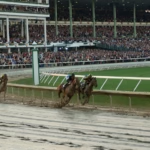
The Last Two Days at the Big A
NYRA didn't write a racing obituary; they put a closing line in the overnight. Aqueduct's final chapter will be run over two ticketed days, June 27 and June 28, 2026, with Sunday the 28th the official last card in track history. At five bucks a head, every ticket buys you two things the PPs can't show—entry to the building and a commemorative program that will be a graded-stakes level keepsake in a couple of years.
The farewell weekend looks like a stakes-quality sendoff dressed as a regular meet. There will be giveaways, photo exhibits, the usual food and drink, simulcast rooms humming, and a live crowd capped by capacity instead of apathy for once. The first thousand through the doors on Sunday get small containers of Aqueduct dirt—the same surface that carried champions and cheap claimers alike—which is probably the most literal “piece of the track” any of us will ever own.
An art gallery by Henry Kornaros will be open both days, featuring photographs of horses, people, and scenes that anyone who has ever chased a late double at the Big A will recognize immediately. Kornaros and Public Opinion already shot a documentary inside Aqueduct, capturing the track in its final sprint to the wire, and that visual record may age into the definitive replay of what this place really felt like.
Logistically, NYRA is treating closing weekend more like a Breeders' Cup host day than a random winter card. Longshots, Silks Bar, and the Triple Crown Café will all operate, with Jamaican food stands and hot dog vendors serving the usual range from beef patties to beer, while free on-site parking and strict occupancy limits aim to keep the whole thing from turning into an uncontrolled stampede. In a small but telling twist, kids eighteen and under don't even need a ticket, a nod to the idea that if the sport wants new fans, they at least ought to see what a real racetrack looks like before this one turns off the lights.
A Track That Always Found a Way
Handicappers like to talk about “form cycles,” and Aqueduct has been in and out of form for more than a century. The track first opened on September 27, 1894, a plain, utilitarian oval named not for romance or royalty, but for the Brooklyn Water Works conduit that ran across the property. In a New York landscape crowded with other venues—Gravesend, Sheepshead Bay, Morris Park, Saratoga—the Big A could easily have ended up a short-lived cheap track where dreams went to flame out, but early on it found patrons, horses, and an identity.
The Carter Handicap, endowed by tugboat captain William Carter in 1895, turned the still-modest facility into something more serious, bringing better stock and creating a race that still carries weight in a serious handicapper's March and April calendars. Aqueduct's real “new start,” though, came on September 14, 1959, after a three-year, $34.5 million remodel that turned the place into what the Associated Press called “the world's most modern and luxurious horse plant,” complete with 18 escalators, an elevator, 20,000 seats, and 14,000 more in air‑conditioned lounges and restaurants.
From 1963 through 1968, the Big A played understudy to Belmont Park, actually hosting the Belmont Stakes while its more glamorous sister was under reconstruction. Secretariat's career came full circle there when he was retired at Aqueduct on November 6, 1973, parading before 30,000 fans in a “Secretariat Day” sendoff that linked the track permanently with the sport's greatest modern champion.
Aqueduct never stopped reinventing itself to stay on the card. In 1975 it installed a winterized inner dirt track to carry the New York circuit through bad weather, and in 1981 it opened the multi-tiered Equestris restaurant, one of the largest in the city, trying to blend racing with a night-out experience. The biggest structural change came in 2011 with Resorts World Casino New York City, a 415,000‑square‑foot operation built into the former grandstand that signaled clearly where the real handle was coming from—and what was keeping the lights on in the grandstand.
A Handicapper’s Track, Not a Postcard
Aqueduct was never Saratoga-pretty, and that's part of why serious players loved it. The Big A in January is a different game than Belmont in June: raw wind, chalky breath, and a grandstand half full of people chasing small edges in big pools. The inner track turned into its own ecosystem, with horses that were monsters at Aqueduct and ordinary just about anywhere else, and handicappers learned to respect that local form the same way you respect a horse with back class or a trainer with a sneaky good second-off-the-claim angle.
The Wood Memorial Stakes became New York's premier Triple Crown prep, and the record shows how live that race was. Eleven Wood winners went on to win the Kentucky Derby, including Triple Crown winners Seattle Slew, Assault, Count Fleet, and Gallant Fox, while others like Secretariat used it as a stepping stone—finishing third in the Wood before detonating the Triple Crown series a month later. If you've ever handicapped the Derby trail seriously, Wood Memorial replays from Aqueduct are baked into your mental database, because the race has been a key pace-figure and trip-analysis puzzle for generations.
Beyond classic preps, Aqueduct created its own signature moments that handicappers still reference as benchmarks. Cigar used the 1994 NYRA Mile at Aqueduct—later renamed in his honor—as the second win in a 16-race streak that turned him from a useful horse into a world-class champion, and the 1985 Breeders' Cup Sprint at the Big A showed how deep and fast the sprint division could be over that surface. For those of us who grind replays, those races aren't just trivia; they're calibration points when we judge how good a performance really is.
The track's personality extended beyond the horses to the voices that framed the action. New York's great race callers—Tom Durkin, Marshall Cassidy, Dave Johnson, Larry Collmus, John Imbriale, and others—spent plenty of afternoons painting Aqueduct's winter scene, their phrasing becoming as much a part of the experience as the shuffle to the windows after a photo finish. For bettors, those calls are the soundtrack of past scores and brutal beats, the kind of sensory memory that comes back whenever you hear “And down the stretch they come!” or Durkin ramping up into a panicked stretch drive.
The Big A’s Place in New York Racing
To understand Aqueduct's closing, you have to see the New York circuit as one long meet with three very different hosts—Saratoga, Belmont, and the Big A. For decades, Aqueduct has filled the fall and winter gap, offering some of the best cold‑weather racing in the country while the other two tracks either rested or rebuilt. The winter meet was where barns tested their 2‑year‑olds turning three, where horsemen tried to steal purse money in lighter spots, and where veteran claimers carved out resumes that didn't travel but absolutely mattered five days a week in Queens.
Aqueduct also anchored racing within New York City itself. At one point, the city had seven thoroughbred tracks inside the limits; now, Aqueduct is the last one, a stubborn holdout of live racing amidst casinos, professional sports, and every other entertainment option fighting for a dollar. That matters more than the dirt strip itself: it's about accessibility. City fans can get to Aqueduct on the subway, walk in for an afternoon, and see live horses from the apron, something that will vanish when racing consolidates completely at Belmont Park on Long Island.
Even for horseplayers who never set foot in Queens, the Big A has long been a key signal on the simulcast grid. Handle from Aqueduct feeds not just NYRA but the wider ecosystem of the sport, and winter racing there has always been a proving ground for jockeys, trainers, and horses who then cycle to Belmont and Saratoga. When that meet disappears, the form-cycle map we all keep in our heads—who ships where, what barns heat up when the calendar turns, which riders own the inner track—will have to be rewritten.
NYRA's long-term plan is straightforward in business terms, if not sentimental ones: close Aqueduct, rebuild Belmont into a modern, year‑round facility, and consolidate racing there and at Saratoga. Once the new Belmont is ready, NYRA will surrender its lease on Aqueduct, shutting down the track and leaving the land to whatever development plan wins out. On paper, that's an efficiency move; on the ground, it's a shift in the sport's geography that pushes everyday live racing away from the city center and further into the suburbs.
What We Lose When Aqueduct Goes Dark
As handicappers, we're trained to think in terms of value, opportunity, and adaptability. Tracks close; circuits change; you adjust. Meadowlands lost its flat racing, Hollywood Park is a football stadium, and plenty of once-important venues are now malls or dust. By that measure, Aqueduct's closure is one more example of a long trend where the land under the track becomes more valuable than the handle over it.
But the numbers don't capture what's being taken off the board. Aqueduct is where generations of New York bettors learned the game, usually in the winter, when Saratoga was a rumor and the Derby trail was just far-off chatter. It's the place where you could watch a horse make a grinding, three‑wide move on the far turn into a headwind and know instantly that you wanted him back next time at a price. It's where track bias notebooks filled up with scribbles like “gold rail,” “outside lanes good late,” or “speed dead today,” notes that transformed into real edges at the windows.
There's also a cultural cost that doesn't show up in purse structures. Aqueduct has been a gathering point for local communities, from the backstretch workers who made a life there to the families who showed up on big days, to the regulars who sat in the same seats in Longshots day after day, chasing pick‑4s and arguing about jockey decisions. Events like Pope John Paul II's 1995 mass in front of 75,000 people remind you how once, just for a moment, this racing plant doubled as a civic cathedral.
For the broader sport, New York City losing its last racetrack severs a symbolic tie between the game and one of the world's great cities. You can still bet horses from anywhere with a phone, and Belmont will be a short train ride away, but there's something different about knowing that inside city limits, thoroughbreds are actually breaking from a gate and running past an actual wire. When that stops, horse racing becomes one more export, pushed out to the fringes while the city that once embraced it turns the page.
Playing the Final Card
Closing weekend at Aqueduct will be emotional, but handicappers will show up with the same tools we always bring—past performances, trip notes, and a willingness to be wrong in public. There will be overlay prices and bad favorites, just like any other day, and the tote board won't care that this is the last time it ever lights up for a live race at the Big A.
For the serious player, these final days are also a rare chance to say goodbye to a track that has shaped our habits more than we usually admit. This is the oval that taught a lot of us how to read a winter meet, how to treat inner-track specialists, and how to upgrade a horse who shows a sneaky good effort in the slop on a Wednesday afternoon. Picking winners on the closing card will matter, but being there—physically or figuratively—to see the last field turn for home in Queens might matter more.
And in a way, the game will go on as it always has. Horses will ship; trainers will adjust; the new Belmont will write its own chapter, and Saratoga will stay Saratoga for as long as we're lucky. But for those of us who have ever punched a ticket with AQU as the track code, the closing of Aqueduct is going to feel like losing a favorite angle that's finally been bet out of existence: you understand why it happened, you can explain it, but you still wish you had one more chance to play it on a cold weekday afternoon.
Image Credits
Featured Image Credit
Looking north at Aqueduct Racetrack via Wikimedia Commons by Ajfidelity with usage type - Public Domain