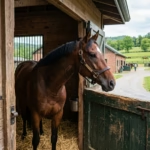
A Texas-bred yearling colt by Gunite turned the Texas Thoroughbred Association's Summer Yearling Sale into a statement about the strength of the regional market, topping the Lone Star Park session at $140,000 and heading into the hands of owner Ken Reimer and Hall of Famer Steve Asmussen.
The sale topper, cataloged as Hip 41, is a bay colt described in the catalog as the second foal out of the winning American Pharoah mare Wild America, from the immediate family of grade 3 winner Wild About Hilary. He was bred in Texas by Eric Schmitz and offered by Scott Mallory, acting as agent for Greenhill at Dunvegan, continuing Mallory's recent run of presenting high-end stock at regional venues. According to figures circulated by the Texas Thoroughbred Association, 108 yearlings changed hands for just under $1.93 million, with a mid-five-figure average and a five-figure median that held reasonably firm despite a lighter catalog than in prior years, suggesting a market that is trading depth for quality rather than simply shrinking on price.
Gunite's emergence as a commercial force is central to the story. The colt's sire is a two-time grade 1 winner and first-crop stallion, and the fact that buyers were willing to reach six figures for one of his very first yearlings in Texas underscores the confidence that professionals have in the profile of a tough, multi-surface sprinter-miler who danced a lot of big dances. At the top end of the marketplace, Gunite's yearlings have already announced themselves: a separate Gunite colt sold for $310,000 during the Fasig-Tipton Saratoga Sale earlier this month, giving the young stallion a six-figure presence both at boutique blueblood auctions and in a regional ring. That kind of spread—elite sales and a strong regional top—is exactly what signals a stallion whose appeal goes beyond a small set of pedigreed buyers.
For Reimer and his agent Susan Montanye, the Lone Star purchase reads as a continuation of a specific playbook: use the Texas sale to buy into pedigrees that look fast and precocious, then send them to a trainer with a long track record of maximizing that profile. Montanye has told industry outlets that she routinely shops this sale and has already found value in previous TTA graduates, while Reimer's decision to have Asmussen inspect the colt himself before the hammer fell suggests connections that are leaning into the sire's familiarity factor. Asmussen trained Gunite and knows exactly what kind of physical and mental traits the stallion carried to the races, so his willingness to endorse this colt is the kind of subtle market signal horseplayers and breeders pay attention to when they evaluate how a stallion's stock might be managed.
The overall sale, held at the Mary Ruyle Thoroughbred Sales Pavilion adjacent to Lone Star Park in Grand Prairie, continues to evolve in both composition and ambitions. Catalog updates in the weeks leading up to the auction added yearlings and horses of racing age by the likes of Arabian Lion, Greatest Honour, Oxbow and Take Charge Indy, broadening the sire roster and showing that the TTA has been actively courting more diverse bloodlines into the region's pipeline. Separate notices highlighted additions including a Cyberknife yearling and multiple horses of racing age to the catalog, underscoring that the sale is no longer just a yearling event but a mixed opportunity for buyers who want horses closer to the races. Those supplemental moves are typical of mid-tier regional sales trying to keep competitive with national outfits: they inject fresh pedigrees and potential quick-return stock without diluting the Texas-bred identity that anchors the event.
Context from recent seasons suggests that buyers have reason to take the Texas sale seriously as a source of live runners. Industry coverage has tracked a “Texas-sized” list of sale graduates who have delivered outsized racetrack returns relative to their purchase prices, with multiple TTA sale alumni developing into stakes performers and high-level allowance horses for regional barns. When an emerging stallion like Gunite is represented by a well-bred colt at the top of the sheet, it not only boosts the confidence of buyers chasing future speed; it also validates consignors who are willing to place their better stock in a Texas ring instead of shipping everything to Kentucky or New York. That, in turn, feeds back into the quality of future catalogs, because breeders who see real competition for top lots are more likely to send their better yearlings to the same sale.
From a handicapper's perspective, the implications will unfold over the next couple of seasons when this colt reaches the track. Gunite himself was a durable, high-level runner whose best efforts came around one turn, and the dam side here blends proven dirt speed with a family that has already thrown graded winners, so it is reasonable to expect a profile geared toward mid-range sprint and mile races on conventional dirt surfaces once the colt gets to Asmussen's barn. The fact that he commanded such a premium in Texas hints that he may debut on a circuit where Asmussen has depth—think major Midwest tracks and possibly the Kentucky circuit—rather than being limited strictly to Lone Star or Sam Houston, and horseplayers would be wise to keep an eye on maiden special weight entries from that barn in late 2027 and early 2028 for a well-backed Gunite colt emerging from work tabs. If he lives up to his billing, this sale-topper will be more than just a headline; he'll be a live example of how regional sales can be the launchpad for horses capable of playing on a national stage.