
AI Model History Guide
What it shows: How our AI models rated this horse in each of its recent races, compared with how they rate today’s field (the dashed lines).
What to look for: Lines that are rising and sit above the dashed field averages — the models have liked this horse and still do. Falling lines, or lines below the dashed ones, mean the models are cooling on it.
- Lines
- Each solid line shows this horse’s model score over its last 10 races: blue = Mod1, green = Mod2, amber = Mod3.
- Dashed Lines
- Dashed lines represent the current race’s field average for each model — a score below the dashed line indicates the horse ranked below average in this model’s assessment.
- Higher is Stronger
- All three model scores are 0–100: a higher number means the model rates this horse more favorably among the field.
Performance vs. Peers Guide
What it shows: Each horse’s career, last-3-race and last-race performance side by side, against the field average.
What to look for: Horses above the field average whose last race is green (better than their average) and whose trend line rises — improving form. Red last races and falling lines point to declining form.
- Bars (per post)
- Blue = avg career performance • Amber = avg last 3 races • Green = last race (improved vs. avg) • Red = last race (declined vs. avg)
- Trend Line
- Angled line above the bars: rising = improving form • falling = declining form.
- Horizontal Line
- Field average — the mean career performance of all horses in this race.
- Color Circles
- Standard post-position colors below each lane — same as the Total Pace chart.
- Border
- Thicker border = this horse’s post position.
Figure Comparison
What it shows: This horse’s ratings, speed figures and pace figures next to every other horse in the race.
What to look for: Where this horse (the darker column) leads the field or falls short. Strong ratings plus strong recent speed make a contender; recent speed well above career speed suggests improving form.
- Rating
- The three Pick Pony algorithm ratings (Algo 1, Algo 2, Algo 3) that make up the overall PP AI Rating — higher is a stronger contender rating.
- Speed
- Career average speed, recent 3-race average, and last-race speed figure — spot horses in improving or declining form.
- Pace
- Average Early (E1), Mid (E2), and Stretch (LP) pace figures — reveals pace-setters vs. closers vs. all-the-way types.
- This horse
- The horse whose stats card is open is highlighted with a darker column background.
Winning Profiles
What it shows: Each horse’s win rate and in-the-money rate over its last 10 starts, one dot per horse.
What to look for: Dots in the top-right are consistent winners. Top-left horses often finish in the money but rarely win — better for place and show bets or underneath in exotics. Bottom-left horses rarely finish well.
- Axes
- X: Win % from last 10 starts — Y: In-the-money % (top-3 finishes) from last 10 starts.
- Quadrants
- Consistent Winners (top-right): high win & ITM — reliable performers.
Place Threats (top-left): boards often but doesn’t win often — good exacta/trifecta angles.
Streaky (bottom-right): wins occasionally, misses the board often — all-or-nothing.
Developing (bottom-left): still finding form — longshot territory. - Reference Lines
- Dashed lines mark field averages. Dots to the right win more; dots higher board more.
- This horse
- Highlighted with a gold border and larger dot.
AI Model Comparison
What it shows: All AI model scores for every horse in the race, grouped by what each model is trained to find.
What to look for: The horse leading the green winner models is the models’ likely winner. A horse that stands out in the red longshot models but not the green ones is a longshot the models think is underrated.
- Winner Models (green)
- Mod1(W), Mod2(W), and Mod3(W) trained to predict race winners. Higher score = stronger contender.
- Longshot Models (red)
- Mod1-LS, Mod2-LS, and Mod3-LS trained to find high-value longshots. Higher score = stronger longshot candidate.
- Form Model (blue)
- Mod4 sequence model trained on recent form patterns. Higher score = stronger recent form profile.
- This horse
- Highlighted with a darker column background.
Race Pace Simulation Guide
What it shows: A simulated run of today’s race, based on each horse’s running style, post position and the expected pace.
What to look for: Who gets the lead, who gets boxed in, and who is gaining at the finish. Move the track-bias slider to see how the predicted order changes on a speed-favouring or closer-favouring track.
- Slider
- Drag left→right to advance from gate to finish. Drag all the way back to reset the race.
- Predicted Finish Order
- Factors in contested pace burn, each horse’s effort curve (peaked-early vs. peaked-late), and wide trip cost from outside posts. Updated live when Track Bias changes.
- Pace Scenario
- Lone Speed: single E horse likely rates and holds. Contested: two E horses burn each other — closers benefit. Hot Pace: speed meltdown, deep closers thrive. Soft: no early speed, moderate fractions throughout.
- Track Bias
- Slider below canvas. −2 = strong closer/wet bias; +2 = strong speed/rail bias. Recomputes the predicted finish order.
- Boxed Indicator
- Dashed orange ring = horse is surrounded (rival ahead, rival behind, wall outside). In a real race this horse must find a clear path to run.
- Running Styles
- E/EE = early speed (rushes to rail). P = presser (stalks the pace). S = stalker. SS = slow starter / closer.
| Stat | vs. Current Card | vs. All Horses |
|---|---|---|
| Averages
Career-average metrics across all AI race analysis. Performance and pace averages reflect estimated historical performance; trainer and jockey grades score in-the-money percentages. Grading scale: A = elite • B = above average • C = average • D = below average • F = poor • — = no data |
||
| Pick Pony AI Rating | F | D |
| Pace Trip Longshot | — | — |
| Connections Longshot | — | — |
| Situational Longshot | — | — |
| Speed | D | F |
| Early Pace | D | F |
| Mid Pace | D | F |
| Late Pace | D | F |
| Finish Pos | B | A |
| Dirt Speed | C | F |
| Turf Speed | D | D |
| Distance Speed | C | F |
| Trainer Effectiveness | C | C |
| Jockey Effectiveness | C | D |
| 3rd Party Ratings | D | F |
| Recent
Performance analysis from the horse's recent races, weighted to reflect current form. Sprint and Route FPS (Foot Per Second) measure pace efficiency over the horse's recent sprints and routes respectively. Grading scale: A = elite • B = above average • C = average • D = below average • F = poor • — = no data |
||
| Speed | D | F |
| Early Pace | D | F |
| Mid Pace | D | F |
| Late Pace | D | F |
| Sprint FPS | D | F |
| Route FPS | D | F |
| Trainer Effectiveness | C | C |
| Jockey Effectiveness | C | D |
| 3rd Party Ratings | D | F |
| Predictions
AI-generated projections for the upcoming race, derived from prior AI analysis for speed and pace trends, surface and distance suitability, and current conditions. Grading scale: A = elite • B = above average • C = average • D = below average • F = poor • — = no data |
||
| Speed | D | F |
| Early Pace | D | F |
| Mid Pace | D | F |
| Late Pace | C | C |
Chart Guide (2.0.40)
What it shows: This horse’s recent races, one bubble per race, plotted by its AI speed figure against the class par for today’s race (the dashed line).
What to look for: Recent bubbles at or above the dashed line, a trend line angled up, and a narrow shaded band (steady form). Check whether the good runs came on today’s surface and distance.
- Bubbles
- Color = surface: green (turf), brown (dirt), blue (synthetic)
- Top number = finishing position; bottom number in parentheses = starting post position
- Height above line = beaten lengths — closer means a smaller margin
- Border = track conditions: green (FST/GD/FM), yellow (WF/SL/YLD), red (SY/MY/FRZ/SFT/HVY)
- Connecting Line
- Solid = good conditions; dashed = bad conditions
- Line Symbol
- ▲ Triangle = sprint (7f or less); ● Circle = route (more than 7f)
- Days Between Races
- Small number above each bubble (e.g. 19d) = days since the previous race — helps spot freshness, layoffs, and tight scheduling.
- Shaded Band (Bollinger)
- Highlights volatility — a wider band means more variation in recent performance
- Performance Trend
- Straight line showing the overall performance direction — angled up = improving, angled down = declining
- Dashed Reference Line
- AI Opponent = AI analysis class-level par for the race
AI Model History Guide
What it shows: How our AI models rated this horse in each of its recent races, compared with how they rate today’s field (the dashed lines).
What to look for: Lines that are rising and sit above the dashed field averages — the models have liked this horse and still do. Falling lines, or lines below the dashed ones, mean the models are cooling on it.
- Lines
- Each solid line shows this horse’s model score over its last 10 races: blue = Mod1, green = Mod2, amber = Mod3.
- Dashed Lines
- Dashed lines represent the current race’s field average for each model — a score below the dashed line indicates the horse ranked below average in this model’s assessment.
- Higher is Stronger
- All three model scores are 0–100: a higher number means the model rates this horse more favorably among the field.
Mod1(W): 82 (1/8) Mod2(W): 75 (2/8) Mod3(W): 79 (3/8) Mod1-LS: 55 (6/8) Win Prob: 18.4% Value Score: 1.35 ★
Performance vs. Peers Guide
What it shows: Each horse’s career, last-3-race and last-race performance side by side, against the field average.
What to look for: Horses above the field average whose last race is green (better than their average) and whose trend line rises — improving form. Red last races and falling lines point to declining form.
- Bars (per post)
- Blue = avg career performance • Amber = avg last 3 races • Green = last race (improved vs. avg) • Red = last race (declined vs. avg)
- Trend Line
- Angled line above the bars: rising = improving form • falling = declining form.
- Horizontal Line
- Field average — the mean career performance of all horses in this race.
- Color Circles
- Standard post-position colors below each lane — same as the Total Pace chart.
- Border
- Thicker border = this horse’s post position.
Figure Comparison
What it shows: This horse’s ratings, speed figures and pace figures next to every other horse in the race.
What to look for: Where this horse (the darker column) leads the field or falls short. Strong ratings plus strong recent speed make a contender; recent speed well above career speed suggests improving form.
- Rating
- The three Pick Pony algorithm ratings (Algo 1, Algo 2, Algo 3) that make up the overall PP AI Rating — higher is a stronger contender rating.
- Speed
- Career average speed, recent 3-race average, and last-race speed figure — spot horses in improving or declining form.
- Pace
- Average Early (E1), Mid (E2), and Stretch (LP) pace figures — reveals pace-setters vs. closers vs. all-the-way types.
- This horse
- The horse whose stats card is open is highlighted with a darker column background.
Winning Profiles
What it shows: Each horse’s win rate and in-the-money rate over its last 10 starts, one dot per horse.
What to look for: Dots in the top-right are consistent winners. Top-left horses often finish in the money but rarely win — better for place and show bets or underneath in exotics. Bottom-left horses rarely finish well.
- Axes
- X: Win % from last 10 starts — Y: In-the-money % (top-3 finishes) from last 10 starts.
- Quadrants
- Consistent Winners (top-right): high win & ITM — reliable performers.
Place Threats (top-left): boards often but doesn’t win often — good exacta/trifecta angles.
Streaky (bottom-right): wins occasionally, misses the board often — all-or-nothing.
Developing (bottom-left): still finding form — longshot territory. - Reference Lines
- Dashed lines mark field averages. Dots to the right win more; dots higher board more.
- This horse
- Highlighted with a gold border and larger dot.
AI Model Comparison
What it shows: All AI model scores for every horse in the race, grouped by what each model is trained to find.
What to look for: The horse leading the green winner models is the models’ likely winner. A horse that stands out in the red longshot models but not the green ones is a longshot the models think is underrated.
- Winner Models (green)
- Mod1(W), Mod2(W), and Mod3(W) trained to predict race winners. Higher score = stronger contender.
- Longshot Models (red)
- Mod1-LS, Mod2-LS, and Mod3-LS trained to find high-value longshots. Higher score = stronger longshot candidate.
- Form Model (blue)
- Mod4 sequence model trained on recent form patterns. Higher score = stronger recent form profile.
- This horse
- Highlighted with a darker column background.
Race Pace Simulation Guide
What it shows: A simulated run of today’s race, based on each horse’s running style, post position and the expected pace.
What to look for: Who gets the lead, who gets boxed in, and who is gaining at the finish. Move the track-bias slider to see how the predicted order changes on a speed-favouring or closer-favouring track.
- Slider
- Drag left→right to advance from gate to finish. Drag all the way back to reset the race.
- Predicted Finish Order
- Factors in contested pace burn, each horse’s effort curve (peaked-early vs. peaked-late), and wide trip cost from outside posts. Updated live when Track Bias changes.
- Pace Scenario
- Lone Speed: single E horse likely rates and holds. Contested: two E horses burn each other — closers benefit. Hot Pace: speed meltdown, deep closers thrive. Soft: no early speed, moderate fractions throughout.
- Track Bias
- Slider below canvas. −2 = strong closer/wet bias; +2 = strong speed/rail bias. Recomputes the predicted finish order.
- Boxed Indicator
- Dashed orange ring = horse is surrounded (rival ahead, rival behind, wall outside). In a real race this horse must find a clear path to run.
- Running Styles
- E/EE = early speed (rushes to rail). P = presser (stalks the pace). S = stalker. SS = slow starter / closer.
| Stat | vs. Current Card | vs. All Horses |
|---|---|---|
| Averages
Career-average metrics across all AI race analysis. Performance and pace averages reflect estimated historical performance; trainer and jockey grades score in-the-money percentages. Grading scale: A = elite • B = above average • C = average • D = below average • F = poor • — = no data |
||
| Pick Pony AI Rating | A | C |
| Pace Trip Longshot | — | — |
| Connections Longshot | — | — |
| Situational Longshot | — | — |
| Speed | A | B |
| Early Pace | B | B |
| Mid Pace | C | F |
| Late Pace | A | A |
| Finish Pos | F | A |
| Dirt Speed | C | F |
| Turf Speed | C | D |
| Distance Speed | C | F |
| Trainer Effectiveness | C | C |
| Jockey Effectiveness | C | D |
| 3rd Party Ratings | A | A |
| Recent
Performance analysis from the horse's recent races, weighted to reflect current form. Sprint and Route FPS (Foot Per Second) measure pace efficiency over the horse's recent sprints and routes respectively. Grading scale: A = elite • B = above average • C = average • D = below average • F = poor • — = no data |
||
| Speed | A | B |
| Early Pace | B | B |
| Mid Pace | C | F |
| Late Pace | A | B |
| Sprint FPS | C | F |
| Route FPS | C | F |
| Trainer Effectiveness | C | C |
| Jockey Effectiveness | C | D |
| 3rd Party Ratings | A | A |
| Predictions
AI-generated projections for the upcoming race, derived from prior AI analysis for speed and pace trends, surface and distance suitability, and current conditions. Grading scale: A = elite • B = above average • C = average • D = below average • F = poor • — = no data |
||
| Speed | A | B |
| Early Pace | C | F |
| Mid Pace | C | F |
| Late Pace | C | C |
Saudi-based KAS Stable made the headline move of the Fasig-Tipton Midlantic May 2-Year-Olds in Training Sale, going to $2.1 million for a colt from the first crop of unbeaten champion Flightline. Bloodstock agent Pedro Lanz signed the ticket on the youngster, cataloged as hip 54 and consigned by Sequel as agent for breeder Chester Broman.
The Chestnut (33) colt is out of Bar of Gold, a hard-knocking New York-bred racemare who earned her defining victory in the GI Breeders' Cup Filly & Mare Sprint and retired with over $1.5 million in earnings. Bar of Gold has already proven she can pass on her class: she is also the dam of graded stakes winner Coinage, a Saratoga graded winner who showed versatility on both turf and dirt.
Lanz confirmed the big-ticket juvenile will stay stateside for his racing career.
“This horse is going to race here in the United States,” Lanz said after the hammer dropped. “I don't know who is going to train him yet. We were waiting to secure the horse first before we decided.”
The agent said the colt first grabbed his attention on video before backing it up in person.
“The first time I saw him was in a video of him breezing on dirt that Sequel posted on X,” Lanz explained. “He is a very nice mover. He is a beautiful, balanced horse with a good hip and shoulder and a nice walk. He is out of a Breeders' Cup champion mare. And then there is all the hype with Flightline. I think the hype is real.”
That “hype” has been building with every sale appearance by the Lane's End stallion's first juveniles. Flightline, an undefeated superstar and dominant Breeders' Cup Classic winner, has seen his initial 2-year-olds become the hottest commodity in the marketplace this spring. The frenzy peaked at the OBS Spring Sale in April, where a colt from his first crop brought a staggering $10.5 million from Amr Zedan, setting a record for a 2-year-old in training and later being named Zedan in honor of the owner's father.
“Everyone is excited about them,” Lanz said of the Flightline offspring. “The comments we are hearing from Japan are great and then you see the amazing Zedan in April. So I knew this horse was going to bring a lot of money.”
Unlike most 2-year-old sales, the under-tack works for this Midlantic session were not officially timed by the sales company, putting more emphasis on the trained eye than on the stopwatch. Lanz said the colt showed him everything he needed to see over the Timonium oval.
“He galloped into the turn on his left lead and then immediately changed leads perfectly,” Lanz recalled. “I don't care about the time, but I was clocking. The horse went in :35 4/5, which is a very nice three-furlong breeze for a 2-year-old.”
For all the fanfare that comes with signing a $2.1-million ticket, Lanz kept his focus on what really matters to any racing operation.
“I celebrate this, but the real celebration is when they can win races at the track,” he said.
The striking chestnut son of Flightline, offered as hip 54 from Sequel on behalf of Chester Broman, now heads into the KAS Stable pipeline as one of the most talked-about juveniles of the spring. With a world-class sire, a Breeders' Cup-winning dam in Bar of Gold, and a seven-figure price tag, he will be under the microscope from the moment he joins a top U.S. barn.
TL;DR
ToggleImage Credits
Featured Image Credit
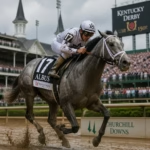
Thorpedo Anna before the Breeders Cup Distaff via Wikimedia Commons with usage type - Creative Commons License

Mod1(W): 82 (1/8) Mod2(W): 75 (2/8) Mod3(W): 79 (3/8) Mod1-LS: 55 (6/8) Win Prob: 18.4% Value Score: 1.35 ★