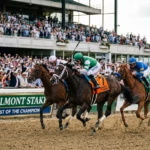
The Grade 1 Acorn at Saratoga on Friday is not about quantity – just five 3-year-old fillies signed on – but it has all the ingredients handicappers crave: an undefeated Kentucky Oaks winner, three Oaks rivals looking for revenge, and a lone-speed outsider who could scramble the script.
Run as Race 10 for a purse of $500,000, the Acorn brings Always a Runner back to the same 1 1/8-mile trip she conquered in the Kentucky Oaks and sets up as a tight rematch, with four of the five entrants exiting that Churchill Downs centerpiece. The race is scheduled for late in the card at 5:08 p.m. Eastern, a prime-time spot that will drop it into plenty of pick 4 and pick 5 sequences and magnify every opinion on the favorite.
Always a Runner is the obvious focal point. She shows a perfect 3-for-3 record capped by the Oaks, where she proved she could stretch her speed over nine furlongs and finish the job against a full field of the best fillies in the division. According to Daily Racing Form past performances, she owns the top last-out Beyer Speed Figure in this field, a profile that typically makes a filly odds-on in a short Grade 1 like this. Chad Brown's barn has long excelled with lightly raced route fillies, and his pattern here – patient early campaign, then a major step into Grade 1 company – is one he has used successfully throughout the Saratoga meets in recent years. With Jose Ortiz retaining the mount, she figures to get a similar trip to the Oaks: stalking just off the early pace with first run on the closers turning for home.
The question is not whether Always a Runner deserves favoritism; it's whether her price will remotely reflect her actual chances. In a five-horse field where four runners exit the same race and the favorite already showed her hand, the market often overcorrects. Handicappers willing to oppose a short price will see plenty to like in the trio of Oaks returnees who had something less than a clean shot at her in Louisville.
Counting Stars is the most obvious alternative for players hunting value. She exits the Oaks with a 92 Beyer Speed Figure and a trip that was solid on paper but arguably better visually: she sat closest to an honest pace tucked inside, had to wait for room, and then finished with a long, sustained stride that suggested more was under the hood than the running line alone shows. According to published figures in Daily Racing Form, her numbers have moved forward with each start, the classic pattern of a filly coming into her peak early in the summer. Mark Casse turns to Irad Ortiz Jr., whose aggressive, position-first riding style at Saratoga has produced countless ground-saving trips in two-turn races; if Counting Stars breaks sharply, she projects to sit right behind whatever early leader emerges, ready to pounce when Ortiz tips her out.
Prom Queen brings perhaps the most forgivable defeat from the Oaks. Drawn inside on the big stage, she broke a step slowly, was squeezed back, and never established the forward position that had been her calling card in a pair of Gulfstream wins to start the year. Those early races showed a filly with some tactical speed and the ability to quicken when asked, but she never had a chance to show it at Churchill. With the rail again and a compact field, a cleaner start changes everything. Brad Cox and Flavien Prat are a high-percentage team with 3-year-old fillies in route stakes, and their typical playbook from this draw is to establish position into the first turn and then ride the rail as long as possible before angling out in upper stretch. If Prom Queen leaves there in good order, she could find herself either on the lead or pocketed in behind, both vastly better scenarios than the chaos she faced in Louisville.
Meaning, the Oaks runner-up, is the known quantity in terms of effort. She was the one who took the race to the leaders at Churchill, forced the issue, and kept on gamely even when Always a Runner kicked away late. That kind of grinding, forward style often translates well to Saratoga's two-turn nine furlongs, especially in small fields where there is less chance of getting shuffled or trapped. The mild cloud is stamina at this trip in a race with potentially soft fractions; if the Acorn turns into a sprint home off a slow pace, Meaning's more methodical rhythm could leave her vulnerable to one of the stalkers with a sharper turn of foot.
The wild card is Maximum Offer, the lone entrant who did not dance in the Oaks. On paper she looks like a need-the-lead type, and her presence is the most important tactical wrinkle in the race. If she is quick enough to clear and slow things down, she could turn the Acorn into a rider's chess match, with Ortiz on Counting Stars and Prat on Prom Queen both facing a decision: press the longshot early and risk dulling their own kick, or concede the front and hope Maximum Offer comes back to them. In many short-field dirt routes at Saratoga, loose speed has proven dangerous, and even when the upset doesn't materialize, a sacrificial pacemaker can force the favorite to move earlier than ideal.
From a betting standpoint, this shapes up as a classic risk-reward puzzle. Always a Runner is the most likely winner and a logical single in multi-race wagers if you are leaning on price elsewhere, but she is also the definition of an underlay candidate if she hovers anywhere near 4-5 or lower in a race where three rivals have legitimate case-making trips from the Oaks. Players who take a stand against her will probably build tickets around Counting Stars as the primary upsetter, using Prom Queen and Meaning as backup win threats and leaning on the opinion that the Oaks form is tighter than the expected odds will suggest. However it breaks, the Acorn is doing what the best summer Grade 1s for 3-year-old fillies are supposed to do: sort out the pecking order at the top of the division while offering sharp-eyed bettors a chance to get paid for reading between the lines of the past performances.