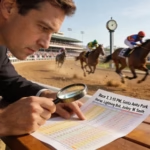
Baby Vino turned the 3-year-old division on its head with a 20-1 shocker in the $1 million NYRA Bets Haskell Stakes at Monmouth Park on July 18, running down Preakness winner Napoleon Solo and leaving heavily backed Further Ado spinning his wheels. The Grade 1, 1 1/8-mile centerpiece of the Monmouth meet has long been one of the most important summer barometers for Breeders' Cup Classic aspirations, and this year's result dramatically re-drew the map.
Official charts list Baby Vino first across the line under Jorge Vargas Jr., with Napoleon Solo settling for second and Iron Honor and The Puma rounding out the top four, while Star Sweeper, Further Ado, and Ocelli never landed a real blow. Racing data services pegged the winning time right around 1:50 for the nine furlongs on a fast track, a solid figure that becomes far more meaningful when you factor in the quality of the horses left behind. For trainer Lindsay Schultz, it was a signature breakout on the national stage, and for handicappers it was the classic case of a developing horse being underestimated in a field dominated by more celebrated names.
The upset feels even bigger when you rewind to the pre-race narrative. Further Ado arrived as the “now horse,” coming off a win in the Matt Winn Stakes and boasting four victories in Kentucky, which helped make him the 2-1 morning-line favorite in several advance analyses. Napoleon Solo, fresh from his Preakness triumph and a series of strong efforts at nine furlongs or longer, was widely touted as the most likely winner by national handicappers who saw his stamina and versatility as perfect fits for Monmouth's two-turn configuration. On paper, Iron Honor and The Puma were viewed as legitimate graded-stakes players and logical alternatives, while Ocelli and Star Sweeper were dismissed in many previews as capable locals but unlikely to deliver a breakthrough at this level.
Once the gates opened, though, the race became a reminder that reputation and spring classic credentials only go so far. Baby Vino had been slotted into the second tier of contenders by many public handicappers, but underlying metrics painted a picture of a colt with enough tactical speed and finishing punch to be dangerous if he continued to move forward. The fact that he was based at Monmouth and comfortable over the surface, a point raised in some video analyses leading up to the race, gave him a subtle home-court advantage that can be easy to overlook when the betting public is gravitating to Triple Crown winners and high-profile Kentucky shippers. When he delivered in the lane, it was a case of a horse catching his best day just as some bigger names flattened out.
Napoleon Solo's runner-up finish is unlikely to damage his overall résumé much, but it does reframe how bettors will view him through the rest of the year. Previews stressed that he already had wins at the Haskell distance and at multiple tracks, giving him a perceived foundation edge over much of the field. Finishing second to a rapidly improving rival while still clearly best of the more established stars suggests a colt who may have already done the heavy lifting in the Triple Crown and could be campaigned more selectively into the fall. A logical path would include another nine-furlong Grade 1 or 2—races like the Travers or Pennsylvania Derby loom as options—before connections decide whether the Breeders' Cup Classic or a slightly shorter target, such as the Dirt Mile, makes more sense; from a handicapper's angle, his consistency at a route distance remains a key asset.
For Further Ado, Haskell Day was a gut check. In the days before the race, America's Best Racing and other outlets highlighted his perfect Kentucky record and his smooth Matt Winn score as evidence that he might simply be better than this group at nine furlongs. Instead, he failed to fire and finished out of the frame, reinforcing a long-standing handicapping question: how reliably can Churchill Downs form transfer to Monmouth's tighter two-turn layout and different surface profile? Without a significant excuse on paper, bettors will probably demand a price the next time he steps into a Grade 1, and his connections may begin to think about whether races like the Breeders' Cup Dirt Mile or even intermediate-distance stakes might be more realistic fall goals than tackling the Classic's 1 1/4 miles.
The Haskell has historically been part of the Breeders' Cup Challenge “Win and You're In” series for the Classic, and Baby Vino's victory effectively thrusts him into that conversation whether or not an automatic berth was attached this season. Beyond the formalities, he now owns a Grade 1 win at a classic distance over a Preakness winner and several graded performers on a major summer stage, the exact profile that Classic voters and oddsmakers respect. The time may not scream superstar on its own, but context matters: late-developing three-year-olds often leap forward again between mid-July and early November, and the Haskell has been a launchpad for that kind of progression before with horses like Bayern and Big Brown.
Iron Honor and The Puma, meanwhile, emerge from the race as useful measuring sticks for the rest of the division. Both were given serious respect in the wagering, with single-digit odds reflecting their established graded form and the belief that they could either pressure or capitalize on any weaknesses in the favorites. Their inability to land a blow on the top two suggests that, for now, they occupy that second tier of the Classic picture—dangerous in the right spot, especially if they catch weaker Grade 1 or Grade 2 company, but needing another step forward or a pace meltdown to threaten the very top of the division.
Zooming out, Haskell weekend once again served as a pivot point for more than just one race. The undercard at Monmouth traditionally features important graded stakes for older dirt horses, turf routers, and fillies and mares, many of whom use those races as springboards to late-summer spots at Saratoga, Del Mar, or back on the Jersey Shore. Even without diving into specific results, the pattern is familiar: horses peaking now tend to reappear in the starting gates for races that feed directly into Breeders' Cup Sprint, Dirt Mile, Distaff, and Turf divisions. When handicappers review the replays this week, they will see more than one performance—on both dirt and turf—that looks like a logical stepping stone to a championship-stage try in November.
The larger lesson from this Haskell and the rest of the weekend is one seasoned players know well: mid-July is where narrative and reality start to diverge. Spring form, hype, and pedigree still matter, but current condition, surface preference, and tactical versatility increasingly separate contenders from pretenders. Baby Vino may not have been the headline act going in, yet he left Oceanport with the kind of profile every owner and trainer wants at this time of year: a Grade 1 win at a classic distance, a horse clearly still on the improve, and a ticket—formal or otherwise—pointing straight toward the Breeders' Cup Classic.