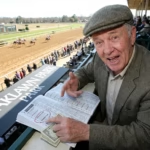
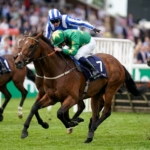
Hall of Fame jockey Mike Smith has been appointed to the Horseracing Integrity and Safety Authority's Racetrack Safety Standing Committee, giving the panel an active rider's voice at a time when safety standards are under intense scrutiny across the sport. The appointment was announced in early August and places one of the most experienced big-race jockeys in North America directly inside HISA's rulemaking framework for racetrack safety. Smith steps into a seat previously held by fellow Hall of Famer John Velazquez, continuing the committee's practice of including elite riders in its deliberations.
HISA's Racetrack Safety Standing Committee is tasked with reviewing data, industry input, and on‑track outcomes to refine the safety rules that govern covered racetracks nationwide, from pre‑race veterinary protocols to racing‑surface standards and in‑race regulations. Committee chair Dr. Susan Stover has emphasized that rider input is critical to shaping practical rules, noting that a jockey with Smith's depth of experience can help align written regulations with what actually happens at high speed on dirt and turf. With Smith's appointment, the group maintains a balance of veterinarians, track operators, and horsemen, but now benefits from a West Coast‑based rider who has spent decades navigating the nuances of American racing surfaces.
Smith's on‑track résumé explains why regulators value his perspective: he has won the Kentucky Derby, Preakness, Belmont Stakes, and multiple Breeders' Cup races, piloting champions such as Zenyatta and Justify while remaining a go‑to rider for top barns well into his 50s. That longevity has given him a firsthand view of how safety culture has evolved, from changes in whip rules to the rise of advanced veterinary screening and stricter medication oversight. He has ridden through eras of fast dirt, synthetic surfaces, and modern maintenance programs, and he understands how subtle shifts in track condition or race spacing can affect both performance and injury risk. For a committee charged with evaluating how horses and riders actually experience safety rules, that lived experience is as valuable as any spreadsheet.
Replacing Velazquez also preserves continuity in how riders interface with HISA's safety agenda, while subtly changing the lens through which the committee views the national circuit. Velazquez has long been associated with New York and major East Coast meets, whereas Smith's base has been Southern California, with frequent forays to major events in Kentucky, New York, and Dubai, among others. That shift broadens the geographic range of on‑the‑ground feedback, especially regarding how different climates, maintenance philosophies, and racing calendars interact with HISA's uniform safety standards. At a practical level, Smith is likely to bring detailed insights about how rule changes play out at Santa Anita and Del Mar, where recent years have seen intensive scrutiny of fatalities and an aggressive move toward enhanced safety protocols.
For horsemen and horseplayers alike, the presence of an active Hall of Fame jockey on a safety committee matters because it can influence how rules are calibrated between ideal safety outcomes and racing realities. Jockeys know where safety margins are thinnest: tight inside seams that riders try to avoid, downhill turf configurations, short run‑ups that sharpen early pace, or crowded chute starts where minor contact can cascade into major incidents. Smith's feedback on those issues can help regulators distinguish between theoretical risk and the hazards riders actually face, potentially shaping policies on field size, rail placement, spacing between races, and how stewards enforce interference and riding‑crop rules. That, in turn, affects how trainers prepare horses and how bettors evaluate race dynamics.
The appointment also reinforces HISA's broader strategy of pairing data‑driven regulation with stakeholder experience. As more years of injury and performance data accumulate under HISA's national framework, the Racetrack Safety Standing Committee will be asked to interpret what the numbers say and how far to push new rules without compromising the competitive essence of the sport. Smith's role positions him as a bridge between the analytics and the jockeys' room, someone who can translate statistical findings into practical recommendations and flag unintended consequences before they reach the starting gate. For a sport trying to reassure fans, bettors, and policymakers that it can police itself on safety, having a rider of Mike Smith's stature inside the room where those decisions are made is as significant as any stakes win.