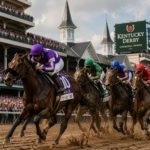
When the gate springs open on May 2 at Churchill Downs, the weather may be as decisive as any Hall of Fame rider in the room. A wet Derby is not simply “the same race on softer ground”; it is a fundamentally different handicapping puzzle in which footing, bias, and kickback can elevate one profile and bury another. In that environment, the horses who have already shown they relish moisture, or at least cope with it without losing efficiency, gain a tangible edge over those whose reputations were built exclusively on pristine, speed-favoring tracks.
The most intriguing of those wet-track movers is Luxor Café, the Japanese invader whose résumé is already marked by repeated success on moisture-affected dirt. In six career starts, he has competed on wet or “good” going in the majority of his races, and those efforts are anything but throwaways: his forward placement, stamina, and composure in kickback on deeper Japanese surfaces suggest that a sealed or rain-softened Churchill strip could actually play to his strengths rather than expose a flaw. That Japanese dirt, typically deeper and more demanding than many American tracks, has forced him to learn how to travel efficiently through testing footing, and he has done so while remaining tractable enough to stalk or press the pace as circumstances dictate. In a 20-horse Kentucky Derby, versatility is currency, and Luxor Café has already proven he does not require a manic early tempo or a billiard-table-fast surface to fire his race.
His pedigree only reinforces the visual evidence. By a sire line that has thrown multiple off-track performers and out of a female family with staying power, Luxor Café owns the kind of genetic profile one looks for when the forecast darkens. While many American sophomores arrive at Churchill with only a token wet-track line on their page—if that—Luxor Café stands out as a colt who has lived in that world since his debut. If the rain comes, he is not guessing. He is reliving conditions he has already handled with professionalism.
Across the barn area, Chad Brown's Derby pair, Sierra Leone and Domestic Product, present a very different kind of question for the handicapper. Sierra Leone, a deep closer with a devastating, sustained run, has at least shown that moisture does not blunt his ability to lengthen stride and finish. His style, however, introduces another layer of uncertainty that has nothing to do with talent. In a sloppy Kentucky Derby, especially on a sealed surface, midpack and late-running horses can find themselves engulfed in kickback from a 20-horse stampede. The mud that cakes their goggles and fills their nostrils is not an abstract concern; it is a physical impediment that can make a colt hesitate, climb, or lose his rhythm just when he needs to launch. Sierra Leone has the engine to overcome that if the track is playing fairly to off-the-pace types, but if the rail is golden and speed is carrying, his brilliance could be dulled simply by geometry and physics.
Domestic Product represents a subtler dilemma. On paper, Brown and many observers have been cautious about assuming he will move up on a wet track. His limited exposure to off-going has not produced the kind of eye-catching effort that screams “mud lover,” and in the absence of such an effort, the professional handicapper must weigh price, pattern, and connections. Brown is adept at getting a horse to improve with distance and experience, and Churchill is not Aqueduct or any other circuit where a single poor wet-track line may have been recorded. Still, when you are allocating real money on Derby Day, it is perfectly rational to demand a little evidence before you elevate an unproven runner into your primary tickets in adverse conditions.
The early pace scenario is where the weather can quietly overthrow the entire structure of the race. On fast dirt, speed horses like Further Ado and Commandment shape the narrative. They are the types who have posted big Beyer-style figures on firm, glib surfaces, breaking sharply, taking control, and daring the rest to chase them over a track that flatters high cruising speed. Their connections, and many bettors, are conditioned to believe that what worked in their prep races will translate naturally to the first Saturday in May. A wet Churchill Downs, however, is not obligated to honor that assumption. If the surface becomes more demanding, even subtly, early leaders may suddenly find that the comfortable fractions they set on fast dirt translate into genuine exertion in the slop. Some horses never truly “get hold” of the off-track; their action shortens, their heads bob, and what looked like effortless speed a month prior becomes labored after six furlongs.
That is the opening for the tactical stalkers, the Chief Wallabees and The Pumas of this field. These are horses who do not need the lead to run their race, yet possess enough natural speed to secure position in the first flight, avoid the worst of the kickback, and bide their time. On a wetter, slightly slower or more tiring surface, that sit-and-strike style can become optimal. Instead of having to run down a freewheeling front-runner on a highway-fast track, they are often attacking leaders who have already been softened by footing and pressure. If those stalkers draw reasonably well—inside to middle gates that allow them to claim the rail or the two-path into the first turn—they may find themselves perfectly placed, saving ground while others spin their wheels wider on a less efficient part of the track.
Behind them sit the likes of Renegade and Fulleffort, horses who, like many in the modern crop, arrive with a résumé rich in synthetic or fast-dirt form but thin on meaningful wet-track evidence. Their Jeff Ruby success stamps them as legitimate runners, but it does little to clarify what they will do when greeted by a sealed, sloppy Churchill surface. This is one of the defining problems of contemporary Derby handicapping: three-year-olds simply do not race often enough on off-tracks to give us the old-fashioned, multi-line mudder profile that past generations could lean on. In the absence of that data, professionals turn to pedigree, physical inspection, and price. A colt with a wet-track-friendly sire line, a smooth, efficient stride, and a calm demeanor in the paddock may be a plausible candidate to handle the slop—even if his past performances are silent on the matter. But plausibility is not proof, and unless the odds are generous, it is usually wise to keep that kind of runner in the supporting cast rather than the starring role when the weather turns.
All of this means that, as Derby week progresses, you are effectively handicapping two separate races and waiting for the sky to tell you which one you will actually get. In the dry version, the established fast-track metrics hold more weight. The pace figures and prep-race speed of horses like Further Ado and Commandment retain their authority, the speed-and-tactical brigade controls the terms, and the more speculative wet-track angles fade into the background. Luxor Café remains an interesting foreign challenger, but the edge lies with the American horses whose fast-dirt performances are already on the board.
In the wet version, the hierarchy reshuffles. Luxor Café moves from “interesting” to “galvanized threat,” his Japanese wet-track seasoning suddenly a core asset rather than a footnote. Sierra Leone stays in the conversation as a closer with the raw ability to overcome adverse conditions if the bias cooperates, but his trip risk and dependence on pace become more acute. The stalkers, Chief Wallabee and The Puma, become far more dangerous if the early burners struggle to translate fast-track brilliance into sloppy-track efficiency. Renegade, Fulleffort, and others with thin wet résumés become more about price and pedigree than about raw figure comparisons.
And of course, don't forget to check Pick Pony's AI Picks. Below the “normal” picks are alternate Off-track finish order as determined by our AI systems.