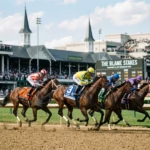
Five weeks after a gut-wrenching near-miss in the Kentucky Derby, Renegade heads to the Belmont Stakes at Saratoga as the horse everyone has to get by, and Todd Pletcher is doubling down by backing his divisional leader with an up-and-coming stablemate, Powershift, in a race that looks as much about tactics as talent.
The rematch angle is obvious. Golden Tempo, the 23-1 closer who stormed from the clouds to win the 152nd Derby and make Cherie DeVaux the first woman to train a Derby winner, is back to try and confirm that result over the same 1 1/4-mile trip. Renegade, who did the hard yards up close at Churchill Downs, had his race compromised almost as soon as the gates opened from the inside post, getting jostled and shuffled before re-emerging with a long, grinding run that fell just short. For many handicappers, that trip made him every bit as good as the winner, and his body of work leading into the Derby – capped by a dominant Arkansas Derby score – keeps him firmly atop a lot of 3-year-old rankings.
Pletcher's decision to press on to the Belmont with Renegade was never going to hinge on raw ability; it was about how the colt bounced out of that rough experience. Stable reports indicate the colt came out of Louisville physically sound but a touch light, which is no surprise for a horse that had to fight all the way from the first jump. The camp has focused on letting him pick back up his weight and energy before stringing together a straightforward Belmont prep: light exercise early in the five-week gap, then a pair of purposeful breezes over the Saratoga main track to remind him of his job while keeping plenty in the tank for another 10-furlong test. The home-court element matters here – Saratoga is his summer base, and horses that can walk out of their own stall to the race often carry themselves with a bit more confidence.
The twist this time is Powershift, the “other” Pletcher for owner Mike Repole who might be more than just company in the starting gate. The colt announced himself on the Derby undercard with a sharp maiden win around two turns, flashing enough tactical speed and finishing power to suggest he belongs with graded-caliber 3-year-olds. That performance reportedly earned a speed figure that stacks up with this crop's better stakes runners, and the connections are reading it as a sign he's catching up quickly after a slightly later start to his career. Rather than hunting for a softer spot, Pletcher and Repole are throwing him straight into the deep end, a move consistent with the trainer's past willingness to ask lightly raced but talented colts to jump straight into the Belmont when the numbers say they fit.
Given the projected field, Powershift's running style may prove just as important as Renegade's résumé. On paper, there is far less confirmed early speed signed on than there was in the Derby, which was loaded with pace and forced most riders to make decisions earlier than they wanted. Renegade showed at Oaklawn that he's comfortable stalking just off the lead before lengthening stride, whereas Powershift has already hinted he can be a forward factor from the break. That sets up the very real possibility that Luis Saez takes advantage of a clean break and natural speed to put Powershift on or near the lead, with Irad Ortiz Jr. settling Renegade in the first flight, and the Derby winner Golden Tempo once again biding his time several lengths back waiting to uncork that familiar late charge.
Layered into that chess match are several other Derby alumni trying to rewrite the narrative at a more traditional 1 1/4 miles on a different surface. Chief Wallabee, who arrived at Churchill as a lightly raced Tampa Bay maiden winner, ran credibly to finish fourth despite stepping way up in class. Commandment, whose Florida Derby victory stamped him as one of the winter's most reliable route colts, wound up seventh after never quite looking comfortable in traffic, while Emerging Market was tenth after failing to land a blow from midpack. All three get another chance in a race that is smaller, less chaotic and, crucially, does not ask them to adapt to Churchill's idiosyncratic configuration and 20-horse stampede.
The setting itself is a major part of the story. With Belmont Park's massive renovation forcing New York's signature classic north for one more year, the Belmont at Saratoga is a different kind of test. The race stays at 1 1/4 miles rather than the traditional 1 1/2, which should suit horses like Renegade who have already proven effective at that distance and may not be bred to truly excel at the old “Test of the Champion” trip. Saratoga's tighter turns and shorter stretch compared with downstate demand better positional speed and handier types; deep one-run closers often find themselves running out of real estate if they leave it too late. That could put some pressure on riders of horses like Golden Tempo to have them a touch closer than they were in the Derby, potentially sharpening the pace picture in ways that either empower or compromise Powershift on the front end.
Another undercurrent is that this Belmont unfolds in an era of heightened safety and medication oversight. The Horseracing Integrity and Safety Act, which took effect in 2022, brought federal regulation to areas like drug use, crop rules and track safety for the first time in American racing. Big-race outfits such as Pletcher's have had several seasons to adapt to the new landscape, and the style of preparation for a campaign like Renegade's – Arkansas Derby to Kentucky Derby to Belmont in 10 weeks – now has to be calibrated within a much more standardized testing and treatment environment than existed a decade ago. For bettors, that adds confidence that what they saw in the spring preps and the Derby is a reliable guide to what they'll see at Saratoga.
Historically, Pletcher has excelled when given a fit, classy 3-year-old and a defined target, and his Belmont record attests to that. His previous winners of the race downstate all tended to peak right on schedule, and the common thread was a deliberate spacing between major efforts and a willingness to run more than one horse when he felt their styles complemented each other. Renegade and Powershift fit that mold: one battle-hardened at the top level, the other still figuring out how good he might be. For Repole, who has made no secret of his desire to win the big New York classics in his own backyard, this is another swing at a race that would mean as much emotionally as it does on paper.
From a handicapping standpoint, the questions are straightforward but far from easy. Did the Derby take anything out of Renegade mentally, or did that rough trip simply harden a colt who already proved he can sustain a long run? Is Powershift ready to jump from maiden company to a Grade 1 and carry his speed all the way against seasoned rivals, or will his main job be to keep the pace honest for his stablemate? And can Golden Tempo, who benefitted from a scorching Derby tempo and a perfectly timed ride, reproduce that same punch on a different track with fewer horses and more tactical riders keying off him? However those answers break, the shape of this Belmont Stakes is being defined right now in Pletcher's Saratoga shedrow, where Renegade and Powershift are giving their trainer two very different – but potentially complementary – ways to take control of the 3-year-old division.