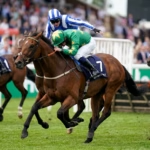
When the Maryland Racing Commission stewards announced that Paco Lopez committed no riding-crop violation in his Preakness-winning ride, the decision did more than close an inquiry. It put a spotlight on how modern whip rules are interpreted at the highest level of the sport – and on a rider whose aggressive style has always divided opinion among horseplayers and horsemen alike.
In the age of HISA, every big-race stretch drive is immediately run back on social media frame by frame. The Preakness was no exception. As soon as Lopez hit the wire first, replay clips began circulating and fans started counting crop motions on their phones. That online jury moved faster than any regulatory body, and a narrative formed: did he use the crop too many times?
After reviewing the video and applying Horseracing Integrity and Safety Authority guidelines, Maryland stewards said no. Their ruling confirmed that Lopez's ride stayed within the numerical and stylistic limits of the national crop rule, and the Preakness result stands as run.
For casual fans, that might sound like a footnote. For serious handicappers and industry insiders, it's a window into how today's riding, officiating, and betting are being reshaped by the crop rule era.
How stewards actually count crop use
One reason these controversies flare so quickly is that what looks obvious at full speed on TV isn't necessarily how the rulebook sees it.
HISA's crop regulations put a hard cap on how many times a jockey can strike a horse in a race and how those strikes can be delivered. Only underhanded use is allowed; over-the-shoulder “windsmilling” or using the crop in front of the saddle are prohibited. Between those boundaries, stewards are asked to distinguish between:
- True strikes (actual contact intended to encourage the horse)
- Showing, waving, or cocking the crop without contact
- Light taps on the shoulder or down the neck that may not count as full “strikes” under the rule
On big-race days, those judgments are made from multiple angles: pan shot, head-on, rear-view and, increasingly, higher-definition footage than what most TV viewers see. Stewards slow the action down and literally count. What looks like 10 or 12 “hits” in real time can shrink when you separate flourishes from contact.
The Preakness review followed that familiar pattern. Fans saw a hard-driven Classic winner. Stewards saw a ride that, in their judgment, stayed within the crop's permitted use. Under HISA, the standard penalty for going over the limit can include days, fines, and even purse changes in severe cases. That makes their conclusion – no violation – a significant one.
Why Paco Lopez is always going to be under the microscope
Lopez is not just any jockey. For more than a decade he's been one of the most productive and polarizing riders in American racing.
On the positive side of the ledger, he's the definition of a “money rider” at the Mid-Atlantic and East Coast circuits. Multiple riding titles at Monmouth Park, big days at Gulfstream and the Jersey Shore, and a steady stream of graded-stakes wins have made him a go-to choice for aggressive front-end tactics. When connections want a horse put into the race early, Lopez is high on the call list.
But his reputation has another side. Well before HISA, Lopez had drawn criticism – and suspensions – for race-riding that other jockeys considered overly aggressive. He's been involved in a series of spills and tight-quarters incidents that led to significant days on the sidelines, with fellow riders and regulators publicly questioning his judgment on occasion.
That history matters when a camera catches him riding hard in a Classic. Horseplayers bring those old memories with them, and it colors how any close call is perceived. A ride that might be given the benefit of the doubt from a quieter jockey is treated very differently when it belongs to a rider with Lopez's file.
The Preakness verdict doesn't rewrite that history, but it does clarify something important: under the current national crop rules, stewards were willing to say that a hard, visually aggressive ride can still be legal. That line between “hard” and “illegal” is exactly where the sport is now fighting its culture war.
Optics vs. outcomes in the HISA era
Racing's crop debate has always had two overlapping but distinct components: welfare and optics.
From a welfare standpoint, the modern popper-style crops used in U.S. racing are a far cry from the old leather sticks. They're padded and regulated in weight, length, and construction. Most horsemen and veterinarians will tell you that when used correctly, they create more noise and sensation than pain.
But optics are another matter. To the casual viewer – and to many fans watching only a few big races a year – any repeated striking in the stretch looks bad. Lawmakers and animal-welfare groups aren't studying slow-motion head-ons; they're reacting to the big-picture image of a horse being hit over and over to the wire.
HISA's crop rules tried to thread that needle: limit how often and how aggressively the crop can be used while still allowing jockeys to ride competitively. The downside is that the rule puts stewards in the middle of a subjective count every time the crop comes out. If they enforce too strictly, they're accused of deciding races from the stand. If they're too lenient, critics say the rule is toothless.
That tension was on full display in the Preakness. Some observers wanted the book thrown at any jockey whose arm moved “too many” times. Stewards, bound by language about strikes, style, and intent, concluded that Lopez had stayed on the legal side of the line.
What this means for future big races
For horseplayers and connections, there are a few practical takeaways from the Preakness ruling.
First, the enforcement bar at the Classic level appears to be: clear, countable, rulebook-level violations – not vibes. Stewards are unlikely to take down a major race winner unless they are convinced the number of true strikes exceeded the limit or the crop was used in a clearly prohibited manner. “Looked bad” doesn't seem to be enough.
Second, jockeys who have fully adapted to the rule are now at a premium. The best riders are learning how to do more with less: timing their crop use to a single decisive move, using hands and body to keep a horse focused, and saving that last allowed strike for the crucial final yards. For handicappers, any rider who has shown they can finish horses strongly without running afoul of the rule deserves extra credit, especially in deep stretch battles.
Third, trainers and owners are paying attention. Losing a big race is painful; losing one in the stewards' room over a crop violation would be a nightmare. The Preakness ruling gives some comfort that stewards won't be hyper-technical in megastakes, but no one wants to be the test case when they decide they do need to make an example.
Handicapping in the crop-rule era
The Lopez decision is also a reminder that horseplayers have to handicap differently in this environment. A few angles to keep in mind:
- Riders who rely on old-school “throw everything at them” stretch tactics can be liabilities if they're still adjusting to the limit. Horses that once responded to a furious drive may not get it anymore.
- Look for jockeys whose win photos show a lot of hands-and-heels riding and less crop. Those riders are already doing what the rule demands: getting a response without overuse.
- Horses who are naturally professional – focused, straight, and willing – gain a small edge. If you can't remind a lazy horse 12 times in the lane, you'd better be on one that wants to run through the wire on its own.
- In close finishes, be aware that stewards' crop reviews can delay official results. It's rare for placings to change, but on big days you may want to be cautious about firing new bets until the race is absolutely official.
Lopez himself is an interesting case study for bettors. His aggression out of the gate and into the turn is a known quantity. What everyone is watching now is how his late-race style evolves under the crop cap. The Preakness showed he can ride a Classic aggressively enough to win without triggering a penalty. Whether that becomes the new normal in his day-to-day mounts is something keen replay watchers will be tracking.
Where the debate goes from here
The Preakness inquiry won't be the last time a marquee race gets slowed down and dissected for crop use. As long as there's a firm numerical limit, there will be borderline cases. As long as social media can turn slow-motion clips into outrage fuel, there will be loud calls for disqualifications every time a jockey lifts their arm.
But the Maryland stewards' ruling does send a message: they're going to enforce the crop rule, not rewrite it. Lopez's ride might not have been pretty to everyone, but within the framework HISA has laid down, it passed muster.
For the sport, that leaves three parallel conversations running at once. Regulators will keep fine-tuning the rule language. Jockeys will continue to adjust their techniques and tactics. And horseplayers will keep parsing it all for an edge, deciding which riders they trust to walk that tightrope between riding hard and staying within the lines.
Paco Lopez's Preakness will go in the book as a clean win. The larger question – what a “clean” ride should look like in the modern era – is still very much in play.