
Chart Guide (2.0.38)
- Bubbles
- Color = surface: green (turf), brown (dirt), blue (synthetic)
- Top number = finishing position; bottom number in parentheses = starting post position
- Height above line = beaten lengths — closer means a smaller margin
- Border = track conditions: green (FST/GD/FM), yellow (WF/SL/YLD), red (SY/MY/FRZ/SFT/HVY)
- Connecting Line
- Solid = good conditions; dashed = bad conditions
- Line Symbol
- ▲ Triangle = sprint (7f or less); ● Circle = route (more than 7f)
- Days Between Races
- Small number above each bubble (e.g. 19d) = days since the previous race — helps spot freshness, layoffs, and tight scheduling.
- Shaded Band (Bollinger)
- Highlights volatility — a wider band means more variation in recent performance
- Performance Trend
- Straight line showing the overall performance direction — angled up = improving, angled down = declining
- Dashed Reference Line
- AI Opponent = AI analysis class-level par for the race
⚠ Concerns:(1) Consider there will be likely pace pressure in this race - multiple E types entered. (2) Poor record at this track (0 wins from 6 starts). (3) Trip note from last race: Duel;3p;chase on. (4) No workout in last 30 days despite 21 days since last race. (5) 0 wins from 10 starts on dirt in last 10 — repeated failure on today's surface.
Lane Bias Guide
- Bar Direction
- Bars above the line = more favorable lane • Bars below = less favorable, relative to the average at this track.
- Color
- Green = above-average advantage • Yellow = near-average • Red = below-average • Blue = this horse’s lane.
- Bias Score
- Derived from weighted average finishing positions across historical races at this track. Shown in the tooltip on hover. To use the bias score, calculate your handicap for the horse (e.g. finish position), then add (detrimental bias) or subtract (favorable bias) the bias score.
- Races
- Number of historical races used to compute each lane’s bias score.
Race Pace Bias Guide
- Bar Height & Direction
- Positive (green) = pace favors this horse • Negative (red) = pace works against this horse • Near-zero (amber) = neutral.
- Race Shape
- Projected race shape based on running styles of all horses (e.g. EE = two early horses, EP = one early presser).
- Pace Category
- FAST = contested early pace • LONE EARLY = one speed horse controlling pace • HONEST = moderate early pressure • SLOW = closers’ race.
- Flag (★)
- A star above the bar means this horse’s pace bias figure is ≥ 1.5 — a meaningful pace advantage or disadvantage.
Total Pace Guide
- Bar Segments
- Green = Early Pace (E1) • Amber = Mid Pace (E2) • Red = Late Pace (LP)
- Bar Height
- Total height = sum of E1 + E2 + LP average pace figures. Taller bars indicate a faster-paced horse overall.
- Grades & Rankings
- Hover to see each horse’s letter grade and ranking vs. other horses in this race (e.g. 2/9 = 2nd best of 9).
- Border
- Thicker border = this horse’s post position.
Performance vs. Peers Guide
- Bars (per post)
- Blue = avg career performance • Amber = avg last 3 races • Green = last race (improved vs. avg) • Red = last race (declined vs. avg)
- Trend Line
- Angled line above the bars: rising = improving form • falling = declining form.
- Horizontal Line
- Field average — the mean career performance of all horses in this race.
- Color Circles
- Standard post-position colors below each lane — same as the Total Pace chart.
- Border
- Thicker border = this horse’s post position.
Figure Comparison
- Rating
- The three Pick Pony algorithm ratings (Algo 1, Algo 2, Algo 3) that make up the overall PP AI Rating — higher is a stronger contender rating.
- Speed
- Career average speed, recent 3-race average, and last-race speed figure — spot horses in improving or declining form.
- Pace
- Average Early (E1), Mid (E2), and Stretch (LP) pace figures — reveals pace-setters vs. closers vs. all-the-way types.
- This horse
- The horse whose stats card is open is highlighted with a darker column background.
Winning Profiles
- Axes
- X: Win % from last 10 starts — Y: In-the-money % (top-3 finishes) from last 10 starts.
- Quadrants
- Consistent Winners (top-right): high win & ITM — reliable performers.
Place Threats (top-left): boards often but doesn’t win often — good exacta/trifecta angles.
Streaky (bottom-right): wins occasionally, misses the board often — all-or-nothing.
Developing (bottom-left): still finding form — longshot territory. - Reference Lines
- Dashed lines mark field averages. Dots to the right win more; dots higher board more.
- This horse
- Highlighted with a gold border and larger dot.
Race Pace Simulation Guide
- Slider
- Drag left→right to advance from gate to finish. Drag all the way back to reset the race.
- Predicted Finish Order
- Factors in contested pace burn, each horse’s effort curve (peaked-early vs. peaked-late), and wide trip cost from outside posts. Updated live when Track Bias changes.
- Pace Scenario
- Lone Speed: single E horse likely rates and holds. Contested: two E horses burn each other — closers benefit. Hot Pace: speed meltdown, deep closers thrive. Soft: no early speed, moderate fractions throughout.
- Track Bias
- Slider below canvas. −2 = strong closer/wet bias; +2 = strong speed/rail bias. Recomputes the predicted finish order.
- Boxed Indicator
- Dashed orange ring = horse is surrounded (rival ahead, rival behind, wall outside). In a real race this horse must find a clear path to run.
- Running Styles
- E/EE = early speed (rushes to rail). P = presser (stalks the pace). S = stalker. SS = slow starter / closer.
| Stat | vs. Current Card | vs. All Horses |
|---|---|---|
| Averages
Career-average metrics across all AI race analysis. Performance and pace averages reflect estimated historical performance; trainer and jockey grades score in-the-money percentages. Grading scale: A = elite • B = above average • C = average • D = below average • F = poor • — = no data |
||
| Pick Pony AI Rating | C | D |
| Pace Trip Longshot | — | — |
| Connections Longshot | — | — |
| Situational Longshot | — | — |
| Speed | F | D |
| Early Pace | B | C |
| Mid Pace | B | D |
| Late Pace | B | C |
| Finish Pos | D | D |
| Dirt Speed | A | B |
| Turf Speed | F | D |
| Distance Speed | B | C |
| Trainer Effectiveness | F | F |
| Jockey Effectiveness | F | F |
| 3rd Party Ratings | D | D |
| Recent
Performance analysis from the horse's recent races, weighted to reflect current form. Sprint and Route FPS (Foot Per Second) measure pace efficiency over the horse's recent sprints and routes respectively. Grading scale: A = elite • B = above average • C = average • D = below average • F = poor • — = no data |
||
| Speed | B | C |
| Early Pace | B | D |
| Mid Pace | C | D |
| Late Pace | B | C |
| Sprint FPS | D | C |
| Route FPS | F | D |
| Trainer Effectiveness | F | F |
| Jockey Effectiveness | F | F |
| 3rd Party Ratings | D | D |
| Predictions
AI-generated projections for the upcoming race, derived from prior AI analysis for speed and pace trends, surface and distance suitability, and current conditions. Grading scale: A = elite • B = above average • C = average • D = below average • F = poor • — = no data |
||
| Speed | F | D |
| Early Pace | A | C |
| Mid Pace | A | A |
| Late Pace | C | C |
Mod1(W): 82 (1/8) Mod2(W): 75 (2/8) Mod3(W): 79 (3/8) Mod1-LS: 55 (6/8) Win Prob: 18.4% Value Score: 1.35 ★
AI Model Comparison
- Winner Models (green)
- Mod1(W), Mod2(W), and Mod3(W) trained to predict race winners. Higher score = stronger contender.
- Longshot Models (red)
- Mod1-LS, Mod2-LS, and Mod3-LS trained to find high-value longshots. Higher score = stronger longshot candidate.
- Form Model (blue)
- Mod4 sequence model trained on recent form patterns. Higher score = stronger recent form profile.
- This horse
- Highlighted with a darker column background.
Chart Guide (2.0.38)
- Bubbles
- Color = surface: green (turf), brown (dirt), blue (synthetic)
- Top number = finishing position; bottom number in parentheses = starting post position
- Height above line = beaten lengths — closer means a smaller margin
- Border = track conditions: green (FST/GD/FM), yellow (WF/SL/YLD), red (SY/MY/FRZ/SFT/HVY)
- Connecting Line
- Solid = good conditions; dashed = bad conditions
- Line Symbol
- ▲ Triangle = sprint (7f or less); ● Circle = route (more than 7f)
- Days Between Races
- Small number above each bubble (e.g. 19d) = days since the previous race — helps spot freshness, layoffs, and tight scheduling.
- Shaded Band (Bollinger)
- Highlights volatility — a wider band means more variation in recent performance
- Performance Trend
- Straight line showing the overall performance direction — angled up = improving, angled down = declining
- Dashed Reference Line
- AI Opponent = AI analysis class-level par for the race
✓ Positives:(1) Dropping in class today ($17,500 → $8,000). (2) Hot trainer - high ITM rate (48%). (3) Strong trainer/jockey combo - 3 wins from 7 starts (43%). (4) Hot jockey — high ITM rate (56%). (5) Late pace significantly above field median (LP: 80 vs field 72). (6) Closer/presser in a race with pace pressure — ideal race setup for late runners. (7) Switching turf-to-dirt with a strong turf pedigree rating (105) — pedigree suggests main-track improvement is likely. (8) Pick Pony Daily Edge Radar pick — value score 8/10 — angles: Hot Trainer-Jockey Pairing, Class Drop, Hot Trainer, Hot Jockey, Late Kick Advantage, Closer in Pace Duel, Pedigree-Backed Switch.
⚠ Concerns:(1) Consider there will be likely pace pressure in this race - multiple E types entered. (2) Switching from turf to dirt today. (3) Poor record at this distance (0 wins from 10 recent starts). (4) Trip note from last race: Bmpd st&3/16;4w1T;2-3p. (5) 0 wins from 5 starts on dirt in last 10 — repeated failure on today's surface. (6) First start at TAM — never raced here before (last seen at: GP).
Lane Bias Guide
- Bar Direction
- Bars above the line = more favorable lane • Bars below = less favorable, relative to the average at this track.
- Color
- Green = above-average advantage • Yellow = near-average • Red = below-average • Blue = this horse’s lane.
- Bias Score
- Derived from weighted average finishing positions across historical races at this track. Shown in the tooltip on hover. To use the bias score, calculate your handicap for the horse (e.g. finish position), then add (detrimental bias) or subtract (favorable bias) the bias score.
- Races
- Number of historical races used to compute each lane’s bias score.
Race Pace Bias Guide
- Bar Height & Direction
- Positive (green) = pace favors this horse • Negative (red) = pace works against this horse • Near-zero (amber) = neutral.
- Race Shape
- Projected race shape based on running styles of all horses (e.g. EE = two early horses, EP = one early presser).
- Pace Category
- FAST = contested early pace • LONE EARLY = one speed horse controlling pace • HONEST = moderate early pressure • SLOW = closers’ race.
- Flag (★)
- A star above the bar means this horse’s pace bias figure is ≥ 1.5 — a meaningful pace advantage or disadvantage.
Total Pace Guide
- Bar Segments
- Green = Early Pace (E1) • Amber = Mid Pace (E2) • Red = Late Pace (LP)
- Bar Height
- Total height = sum of E1 + E2 + LP average pace figures. Taller bars indicate a faster-paced horse overall.
- Grades & Rankings
- Hover to see each horse’s letter grade and ranking vs. other horses in this race (e.g. 2/9 = 2nd best of 9).
- Border
- Thicker border = this horse’s post position.
Performance vs. Peers Guide
- Bars (per post)
- Blue = avg career performance • Amber = avg last 3 races • Green = last race (improved vs. avg) • Red = last race (declined vs. avg)
- Trend Line
- Angled line above the bars: rising = improving form • falling = declining form.
- Horizontal Line
- Field average — the mean career performance of all horses in this race.
- Color Circles
- Standard post-position colors below each lane — same as the Total Pace chart.
- Border
- Thicker border = this horse’s post position.
Figure Comparison
- Rating
- The three Pick Pony algorithm ratings (Algo 1, Algo 2, Algo 3) that make up the overall PP AI Rating — higher is a stronger contender rating.
- Speed
- Career average speed, recent 3-race average, and last-race speed figure — spot horses in improving or declining form.
- Pace
- Average Early (E1), Mid (E2), and Stretch (LP) pace figures — reveals pace-setters vs. closers vs. all-the-way types.
- This horse
- The horse whose stats card is open is highlighted with a darker column background.
Winning Profiles
- Axes
- X: Win % from last 10 starts — Y: In-the-money % (top-3 finishes) from last 10 starts.
- Quadrants
- Consistent Winners (top-right): high win & ITM — reliable performers.
Place Threats (top-left): boards often but doesn’t win often — good exacta/trifecta angles.
Streaky (bottom-right): wins occasionally, misses the board often — all-or-nothing.
Developing (bottom-left): still finding form — longshot territory. - Reference Lines
- Dashed lines mark field averages. Dots to the right win more; dots higher board more.
- This horse
- Highlighted with a gold border and larger dot.
Race Pace Simulation Guide
- Slider
- Drag left→right to advance from gate to finish. Drag all the way back to reset the race.
- Predicted Finish Order
- Factors in contested pace burn, each horse’s effort curve (peaked-early vs. peaked-late), and wide trip cost from outside posts. Updated live when Track Bias changes.
- Pace Scenario
- Lone Speed: single E horse likely rates and holds. Contested: two E horses burn each other — closers benefit. Hot Pace: speed meltdown, deep closers thrive. Soft: no early speed, moderate fractions throughout.
- Track Bias
- Slider below canvas. −2 = strong closer/wet bias; +2 = strong speed/rail bias. Recomputes the predicted finish order.
- Boxed Indicator
- Dashed orange ring = horse is surrounded (rival ahead, rival behind, wall outside). In a real race this horse must find a clear path to run.
- Running Styles
- E/EE = early speed (rushes to rail). P = presser (stalks the pace). S = stalker. SS = slow starter / closer.
| Stat | vs. Current Card | vs. All Horses |
|---|---|---|
| Averages
Career-average metrics across all AI race analysis. Performance and pace averages reflect estimated historical performance; trainer and jockey grades score in-the-money percentages. Grading scale: A = elite • B = above average • C = average • D = below average • F = poor • — = no data |
||
| Pick Pony AI Rating | A | A |
| Pace Trip Longshot | — | — |
| Connections Longshot | — | — |
| Situational Longshot | — | — |
| Speed | A | C |
| Early Pace | F | D |
| Mid Pace | D | D |
| Late Pace | A | A |
| Finish Pos | A | B |
| Dirt Speed | A | B |
| Turf Speed | A | A |
| Distance Speed | D | F |
| Trainer Effectiveness | A | B |
| Jockey Effectiveness | A | A |
| 3rd Party Ratings | A | B |
| Recent
Performance analysis from the horse's recent races, weighted to reflect current form. Sprint and Route FPS (Foot Per Second) measure pace efficiency over the horse's recent sprints and routes respectively. Grading scale: A = elite • B = above average • C = average • D = below average • F = poor • — = no data |
||
| Speed | A | B |
| Early Pace | F | D |
| Mid Pace | D | D |
| Late Pace | A | A |
| Sprint FPS | C | C |
| Route FPS | B | B |
| Trainer Effectiveness | A | B |
| Jockey Effectiveness | A | A |
| 3rd Party Ratings | A | B |
| Predictions
AI-generated projections for the upcoming race, derived from prior AI analysis for speed and pace trends, surface and distance suitability, and current conditions. Grading scale: A = elite • B = above average • C = average • D = below average • F = poor • — = no data |
||
| Speed | A | C |
| Early Pace | F | D |
| Mid Pace | D | D |
| Late Pace | C | C |
Mod1(W): 82 (1/8) Mod2(W): 75 (2/8) Mod3(W): 79 (3/8) Mod1-LS: 55 (6/8) Win Prob: 18.4% Value Score: 1.35 ★
AI Model Comparison
- Winner Models (green)
- Mod1(W), Mod2(W), and Mod3(W) trained to predict race winners. Higher score = stronger contender.
- Longshot Models (red)
- Mod1-LS, Mod2-LS, and Mod3-LS trained to find high-value longshots. Higher score = stronger longshot candidate.
- Form Model (blue)
- Mod4 sequence model trained on recent form patterns. Higher score = stronger recent form profile.
- This horse
- Highlighted with a darker column background.
Chart Guide (2.0.38)
- Bubbles
- Color = surface: green (turf), brown (dirt), blue (synthetic)
- Top number = finishing position; bottom number in parentheses = starting post position
- Height above line = beaten lengths — closer means a smaller margin
- Border = track conditions: green (FST/GD/FM), yellow (WF/SL/YLD), red (SY/MY/FRZ/SFT/HVY)
- Connecting Line
- Solid = good conditions; dashed = bad conditions
- Line Symbol
- ▲ Triangle = sprint (7f or less); ● Circle = route (more than 7f)
- Days Between Races
- Small number above each bubble (e.g. 19d) = days since the previous race — helps spot freshness, layoffs, and tight scheduling.
- Shaded Band (Bollinger)
- Highlights volatility — a wider band means more variation in recent performance
- Performance Trend
- Straight line showing the overall performance direction — angled up = improving, angled down = declining
- Dashed Reference Line
- AI Opponent = AI analysis class-level par for the race
✓ Positives:(1) Dropping in class today ($16,000 → $8,000). (2) Hot trainer - high ITM rate (30%). (3) Career-best speed figure (62) recorded in last 1-2 starts — peaking form. (4) Hot jockey — high ITM rate (42%). (5) Has a bullet work (fastest at track that day) — sharp conditioning signal. (6) Fourth race back from a 54-day layoff — often the peak fitness race. (7) Switching turf-to-dirt with a strong turf pedigree rating (96) — pedigree suggests main-track improvement is likely. (8) Career-best figure (77) buried in races 4–10 back — 10 pts above race median and 7 pts above recent form — market has forgotten the peak effort. (9) Pick Pony Daily Edge Radar pick — value score 8/10 — angles: Career-Best Recent Figure, Class Drop, Hot Jockey, Hidden Figure, Bullet Workout, Classic Fourth Race Pattern, Pedigree-Backed Switch.
⚠ Concerns:(1) Consider there will be likely pace pressure in this race - multiple E types entered. (2) Unproven on dirt surface (1 start). (3) Switching from turf to dirt today. (4) Poor record at this distance (0 wins from 9 recent starts). (5) Tends to fade in the stretch at similar distances (6 of 9 starts). (6) Trip note from last race: 2w;5w trn;3w upr;faded. (7) First start at TAM — never raced here before (last seen at: TAM).
Lane Bias Guide
- Bar Direction
- Bars above the line = more favorable lane • Bars below = less favorable, relative to the average at this track.
- Color
- Green = above-average advantage • Yellow = near-average • Red = below-average • Blue = this horse’s lane.
- Bias Score
- Derived from weighted average finishing positions across historical races at this track. Shown in the tooltip on hover. To use the bias score, calculate your handicap for the horse (e.g. finish position), then add (detrimental bias) or subtract (favorable bias) the bias score.
- Races
- Number of historical races used to compute each lane’s bias score.
Race Pace Bias Guide
- Bar Height & Direction
- Positive (green) = pace favors this horse • Negative (red) = pace works against this horse • Near-zero (amber) = neutral.
- Race Shape
- Projected race shape based on running styles of all horses (e.g. EE = two early horses, EP = one early presser).
- Pace Category
- FAST = contested early pace • LONE EARLY = one speed horse controlling pace • HONEST = moderate early pressure • SLOW = closers’ race.
- Flag (★)
- A star above the bar means this horse’s pace bias figure is ≥ 1.5 — a meaningful pace advantage or disadvantage.
Total Pace Guide
- Bar Segments
- Green = Early Pace (E1) • Amber = Mid Pace (E2) • Red = Late Pace (LP)
- Bar Height
- Total height = sum of E1 + E2 + LP average pace figures. Taller bars indicate a faster-paced horse overall.
- Grades & Rankings
- Hover to see each horse’s letter grade and ranking vs. other horses in this race (e.g. 2/9 = 2nd best of 9).
- Border
- Thicker border = this horse’s post position.
Performance vs. Peers Guide
- Bars (per post)
- Blue = avg career performance • Amber = avg last 3 races • Green = last race (improved vs. avg) • Red = last race (declined vs. avg)
- Trend Line
- Angled line above the bars: rising = improving form • falling = declining form.
- Horizontal Line
- Field average — the mean career performance of all horses in this race.
- Color Circles
- Standard post-position colors below each lane — same as the Total Pace chart.
- Border
- Thicker border = this horse’s post position.
Figure Comparison
- Rating
- The three Pick Pony algorithm ratings (Algo 1, Algo 2, Algo 3) that make up the overall PP AI Rating — higher is a stronger contender rating.
- Speed
- Career average speed, recent 3-race average, and last-race speed figure — spot horses in improving or declining form.
- Pace
- Average Early (E1), Mid (E2), and Stretch (LP) pace figures — reveals pace-setters vs. closers vs. all-the-way types.
- This horse
- The horse whose stats card is open is highlighted with a darker column background.
Winning Profiles
- Axes
- X: Win % from last 10 starts — Y: In-the-money % (top-3 finishes) from last 10 starts.
- Quadrants
- Consistent Winners (top-right): high win & ITM — reliable performers.
Place Threats (top-left): boards often but doesn’t win often — good exacta/trifecta angles.
Streaky (bottom-right): wins occasionally, misses the board often — all-or-nothing.
Developing (bottom-left): still finding form — longshot territory. - Reference Lines
- Dashed lines mark field averages. Dots to the right win more; dots higher board more.
- This horse
- Highlighted with a gold border and larger dot.
Race Pace Simulation Guide
- Slider
- Drag left→right to advance from gate to finish. Drag all the way back to reset the race.
- Predicted Finish Order
- Factors in contested pace burn, each horse’s effort curve (peaked-early vs. peaked-late), and wide trip cost from outside posts. Updated live when Track Bias changes.
- Pace Scenario
- Lone Speed: single E horse likely rates and holds. Contested: two E horses burn each other — closers benefit. Hot Pace: speed meltdown, deep closers thrive. Soft: no early speed, moderate fractions throughout.
- Track Bias
- Slider below canvas. −2 = strong closer/wet bias; +2 = strong speed/rail bias. Recomputes the predicted finish order.
- Boxed Indicator
- Dashed orange ring = horse is surrounded (rival ahead, rival behind, wall outside). In a real race this horse must find a clear path to run.
- Running Styles
- E/EE = early speed (rushes to rail). P = presser (stalks the pace). S = stalker. SS = slow starter / closer.
| Stat | vs. Current Card | vs. All Horses |
|---|---|---|
| Averages
Career-average metrics across all AI race analysis. Performance and pace averages reflect estimated historical performance; trainer and jockey grades score in-the-money percentages. Grading scale: A = elite • B = above average • C = average • D = below average • F = poor • — = no data |
||
| Pick Pony AI Rating | D | D |
| Pace Trip Longshot | — | — |
| Connections Longshot | — | — |
| Situational Longshot | — | — |
| Speed | B | C |
| Early Pace | A | C |
| Mid Pace | A | C |
| Late Pace | D | C |
| Finish Pos | F | F |
| Dirt Speed | D | D |
| Turf Speed | B | B |
| Distance Speed | C | C |
| Trainer Effectiveness | D | D |
| Jockey Effectiveness | A | C |
| 3rd Party Ratings | C | D |
| Recent
Performance analysis from the horse's recent races, weighted to reflect current form. Sprint and Route FPS (Foot Per Second) measure pace efficiency over the horse's recent sprints and routes respectively. Grading scale: A = elite • B = above average • C = average • D = below average • F = poor • — = no data |
||
| Speed | C | D |
| Early Pace | A | C |
| Mid Pace | A | C |
| Late Pace | D | C |
| Sprint FPS | A | A |
| Route FPS | A | B |
| Trainer Effectiveness | D | D |
| Jockey Effectiveness | A | C |
| 3rd Party Ratings | C | D |
| Predictions
AI-generated projections for the upcoming race, derived from prior AI analysis for speed and pace trends, surface and distance suitability, and current conditions. Grading scale: A = elite • B = above average • C = average • D = below average • F = poor • — = no data |
||
| Speed | A | C |
| Early Pace | A | C |
| Mid Pace | B | C |
| Late Pace | C | C |
Mod1(W): 82 (1/8) Mod2(W): 75 (2/8) Mod3(W): 79 (3/8) Mod1-LS: 55 (6/8) Win Prob: 18.4% Value Score: 1.35 ★
AI Model Comparison
- Winner Models (green)
- Mod1(W), Mod2(W), and Mod3(W) trained to predict race winners. Higher score = stronger contender.
- Longshot Models (red)
- Mod1-LS, Mod2-LS, and Mod3-LS trained to find high-value longshots. Higher score = stronger longshot candidate.
- Form Model (blue)
- Mod4 sequence model trained on recent form patterns. Higher score = stronger recent form profile.
- This horse
- Highlighted with a darker column background.
Chart Guide (2.0.38)
- Bubbles
- Color = surface: green (turf), brown (dirt), blue (synthetic)
- Top number = finishing position; bottom number in parentheses = starting post position
- Height above line = beaten lengths — closer means a smaller margin
- Border = track conditions: green (FST/GD/FM), yellow (WF/SL/YLD), red (SY/MY/FRZ/SFT/HVY)
- Connecting Line
- Solid = good conditions; dashed = bad conditions
- Line Symbol
- ▲ Triangle = sprint (7f or less); ● Circle = route (more than 7f)
- Days Between Races
- Small number above each bubble (e.g. 19d) = days since the previous race — helps spot freshness, layoffs, and tight scheduling.
- Shaded Band (Bollinger)
- Highlights volatility — a wider band means more variation in recent performance
- Performance Trend
- Straight line showing the overall performance direction — angled up = improving, angled down = declining
- Dashed Reference Line
- AI Opponent = AI analysis class-level par for the race
✓ Positives:(1) Returning from 65-day layoff with a recent workout. (2) Dropping in class today ($25,000 → $8,000). (3) Hot trainer - high ITM rate (51%). (4) Career-best speed figure (62) recorded in last 1-2 starts — peaking form. (5) Hot jockey — high ITM rate (35%). (6) Closer/presser in a race with pace pressure — ideal race setup for late runners. (7) Switching turf-to-dirt with a strong turf pedigree rating (106) — pedigree suggests main-track improvement is likely. (8) Has won at today's distance (1800 yds) within the last 10 starts — proven ability at this trip. (9) Dropping in class ($8,000 vs last $25,000) after a 65-day freshening — trainer setup-for-win angle. (10) Pick Pony Daily Edge Radar pick — value score 9/10 — angles: Career-Best Recent Figure, Class Drop After Rest, Class Drop, Hot Trainer, Closer in Pace Duel, Won at This Distance, Pedigree-Backed Switch.
⚠ Concerns:(1) Has not raced in 65 days. (2) Consider there will be likely pace pressure in this race - multiple E types entered. (3) Unproven on dirt surface (2 starts). (4) Switching from turf to dirt today. (5) Trip note from last race: Bump st; herded6p1st. (6) First start at TAM — never raced here before (last seen at: TAM, MED).
Lane Bias Guide
- Bar Direction
- Bars above the line = more favorable lane • Bars below = less favorable, relative to the average at this track.
- Color
- Green = above-average advantage • Yellow = near-average • Red = below-average • Blue = this horse’s lane.
- Bias Score
- Derived from weighted average finishing positions across historical races at this track. Shown in the tooltip on hover. To use the bias score, calculate your handicap for the horse (e.g. finish position), then add (detrimental bias) or subtract (favorable bias) the bias score.
- Races
- Number of historical races used to compute each lane’s bias score.
Race Pace Bias Guide
- Bar Height & Direction
- Positive (green) = pace favors this horse • Negative (red) = pace works against this horse • Near-zero (amber) = neutral.
- Race Shape
- Projected race shape based on running styles of all horses (e.g. EE = two early horses, EP = one early presser).
- Pace Category
- FAST = contested early pace • LONE EARLY = one speed horse controlling pace • HONEST = moderate early pressure • SLOW = closers’ race.
- Flag (★)
- A star above the bar means this horse’s pace bias figure is ≥ 1.5 — a meaningful pace advantage or disadvantage.
Total Pace Guide
- Bar Segments
- Green = Early Pace (E1) • Amber = Mid Pace (E2) • Red = Late Pace (LP)
- Bar Height
- Total height = sum of E1 + E2 + LP average pace figures. Taller bars indicate a faster-paced horse overall.
- Grades & Rankings
- Hover to see each horse’s letter grade and ranking vs. other horses in this race (e.g. 2/9 = 2nd best of 9).
- Border
- Thicker border = this horse’s post position.
Performance vs. Peers Guide
- Bars (per post)
- Blue = avg career performance • Amber = avg last 3 races • Green = last race (improved vs. avg) • Red = last race (declined vs. avg)
- Trend Line
- Angled line above the bars: rising = improving form • falling = declining form.
- Horizontal Line
- Field average — the mean career performance of all horses in this race.
- Color Circles
- Standard post-position colors below each lane — same as the Total Pace chart.
- Border
- Thicker border = this horse’s post position.
Figure Comparison
- Rating
- The three Pick Pony algorithm ratings (Algo 1, Algo 2, Algo 3) that make up the overall PP AI Rating — higher is a stronger contender rating.
- Speed
- Career average speed, recent 3-race average, and last-race speed figure — spot horses in improving or declining form.
- Pace
- Average Early (E1), Mid (E2), and Stretch (LP) pace figures — reveals pace-setters vs. closers vs. all-the-way types.
- This horse
- The horse whose stats card is open is highlighted with a darker column background.
Winning Profiles
- Axes
- X: Win % from last 10 starts — Y: In-the-money % (top-3 finishes) from last 10 starts.
- Quadrants
- Consistent Winners (top-right): high win & ITM — reliable performers.
Place Threats (top-left): boards often but doesn’t win often — good exacta/trifecta angles.
Streaky (bottom-right): wins occasionally, misses the board often — all-or-nothing.
Developing (bottom-left): still finding form — longshot territory. - Reference Lines
- Dashed lines mark field averages. Dots to the right win more; dots higher board more.
- This horse
- Highlighted with a gold border and larger dot.
Race Pace Simulation Guide
- Slider
- Drag left→right to advance from gate to finish. Drag all the way back to reset the race.
- Predicted Finish Order
- Factors in contested pace burn, each horse’s effort curve (peaked-early vs. peaked-late), and wide trip cost from outside posts. Updated live when Track Bias changes.
- Pace Scenario
- Lone Speed: single E horse likely rates and holds. Contested: two E horses burn each other — closers benefit. Hot Pace: speed meltdown, deep closers thrive. Soft: no early speed, moderate fractions throughout.
- Track Bias
- Slider below canvas. −2 = strong closer/wet bias; +2 = strong speed/rail bias. Recomputes the predicted finish order.
- Boxed Indicator
- Dashed orange ring = horse is surrounded (rival ahead, rival behind, wall outside). In a real race this horse must find a clear path to run.
- Running Styles
- E/EE = early speed (rushes to rail). P = presser (stalks the pace). S = stalker. SS = slow starter / closer.
| Stat | vs. Current Card | vs. All Horses |
|---|---|---|
| Averages
Career-average metrics across all AI race analysis. Performance and pace averages reflect estimated historical performance; trainer and jockey grades score in-the-money percentages. Grading scale: A = elite • B = above average • C = average • D = below average • F = poor • — = no data |
||
| Pick Pony AI Rating | B | B |
| Pace Trip Longshot | — | — |
| Connections Longshot | — | — |
| Situational Longshot | — | — |
| Speed | C | C |
| Early Pace | D | D |
| Mid Pace | C | D |
| Late Pace | C | C |
| Finish Pos | B | D |
| Dirt Speed | D | D |
| Turf Speed | C | B |
| Distance Speed | D | F |
| Trainer Effectiveness | A | A |
| Jockey Effectiveness | B | D |
| 3rd Party Ratings | B | C |
| Recent
Performance analysis from the horse's recent races, weighted to reflect current form. Sprint and Route FPS (Foot Per Second) measure pace efficiency over the horse's recent sprints and routes respectively. Grading scale: A = elite • B = above average • C = average • D = below average • F = poor • — = no data |
||
| Speed | A | C |
| Early Pace | D | D |
| Mid Pace | C | D |
| Late Pace | C | C |
| Sprint FPS | A | C |
| Route FPS | A | B |
| Trainer Effectiveness | A | A |
| Jockey Effectiveness | B | D |
| 3rd Party Ratings | B | C |
| Predictions
AI-generated projections for the upcoming race, derived from prior AI analysis for speed and pace trends, surface and distance suitability, and current conditions. Grading scale: A = elite • B = above average • C = average • D = below average • F = poor • — = no data |
||
| Speed | B | D |
| Early Pace | D | D |
| Mid Pace | C | D |
| Late Pace | C | C |
Mod1(W): 82 (1/8) Mod2(W): 75 (2/8) Mod3(W): 79 (3/8) Mod1-LS: 55 (6/8) Win Prob: 18.4% Value Score: 1.35 ★
AI Model Comparison
- Winner Models (green)
- Mod1(W), Mod2(W), and Mod3(W) trained to predict race winners. Higher score = stronger contender.
- Longshot Models (red)
- Mod1-LS, Mod2-LS, and Mod3-LS trained to find high-value longshots. Higher score = stronger longshot candidate.
- Form Model (blue)
- Mod4 sequence model trained on recent form patterns. Higher score = stronger recent form profile.
- This horse
- Highlighted with a darker column background.
Chart Guide (2.0.38)
- Bubbles
- Color = surface: green (turf), brown (dirt), blue (synthetic)
- Top number = finishing position; bottom number in parentheses = starting post position
- Height above line = beaten lengths — closer means a smaller margin
- Border = track conditions: green (FST/GD/FM), yellow (WF/SL/YLD), red (SY/MY/FRZ/SFT/HVY)
- Connecting Line
- Solid = good conditions; dashed = bad conditions
- Line Symbol
- ▲ Triangle = sprint (7f or less); ● Circle = route (more than 7f)
- Days Between Races
- Small number above each bubble (e.g. 19d) = days since the previous race — helps spot freshness, layoffs, and tight scheduling.
- Shaded Band (Bollinger)
- Highlights volatility — a wider band means more variation in recent performance
- Performance Trend
- Straight line showing the overall performance direction — angled up = improving, angled down = declining
- Dashed Reference Line
- AI Opponent = AI analysis class-level par for the race
✓ Positives:(1) Hot trainer - high ITM rate (34%). (2) Hot jockey — high ITM rate (27.43%). (3) Has won at today's distance (1800 yds) within the last 10 starts — proven ability at this trip. (4) Has won at TAM on dirt in the last 10 starts — proven at today's exact track/surface combo. (5) Carries 7 lbs less than field median (111 lbs vs median 118 lbs). (6) Career-best figure (77) buried in races 4–10 back — 10 pts above race median and 5 pts above recent form — market has forgotten the peak effort. (7) Pick Pony Daily Edge Radar pick — value score 5/10 — angles: Won Here Before, Won at This Distance, Hidden Figure, Weight Advantage.
⚠ Concerns:(1) Consider there will be likely pace pressure in this race - multiple E types entered. (2) Trip note from last race: Track;3p;tired.
Lane Bias Guide
- Bar Direction
- Bars above the line = more favorable lane • Bars below = less favorable, relative to the average at this track.
- Color
- Green = above-average advantage • Yellow = near-average • Red = below-average • Blue = this horse’s lane.
- Bias Score
- Derived from weighted average finishing positions across historical races at this track. Shown in the tooltip on hover. To use the bias score, calculate your handicap for the horse (e.g. finish position), then add (detrimental bias) or subtract (favorable bias) the bias score.
- Races
- Number of historical races used to compute each lane’s bias score.
Race Pace Bias Guide
- Bar Height & Direction
- Positive (green) = pace favors this horse • Negative (red) = pace works against this horse • Near-zero (amber) = neutral.
- Race Shape
- Projected race shape based on running styles of all horses (e.g. EE = two early horses, EP = one early presser).
- Pace Category
- FAST = contested early pace • LONE EARLY = one speed horse controlling pace • HONEST = moderate early pressure • SLOW = closers’ race.
- Flag (★)
- A star above the bar means this horse’s pace bias figure is ≥ 1.5 — a meaningful pace advantage or disadvantage.
Total Pace Guide
- Bar Segments
- Green = Early Pace (E1) • Amber = Mid Pace (E2) • Red = Late Pace (LP)
- Bar Height
- Total height = sum of E1 + E2 + LP average pace figures. Taller bars indicate a faster-paced horse overall.
- Grades & Rankings
- Hover to see each horse’s letter grade and ranking vs. other horses in this race (e.g. 2/9 = 2nd best of 9).
- Border
- Thicker border = this horse’s post position.
Performance vs. Peers Guide
- Bars (per post)
- Blue = avg career performance • Amber = avg last 3 races • Green = last race (improved vs. avg) • Red = last race (declined vs. avg)
- Trend Line
- Angled line above the bars: rising = improving form • falling = declining form.
- Horizontal Line
- Field average — the mean career performance of all horses in this race.
- Color Circles
- Standard post-position colors below each lane — same as the Total Pace chart.
- Border
- Thicker border = this horse’s post position.
Figure Comparison
- Rating
- The three Pick Pony algorithm ratings (Algo 1, Algo 2, Algo 3) that make up the overall PP AI Rating — higher is a stronger contender rating.
- Speed
- Career average speed, recent 3-race average, and last-race speed figure — spot horses in improving or declining form.
- Pace
- Average Early (E1), Mid (E2), and Stretch (LP) pace figures — reveals pace-setters vs. closers vs. all-the-way types.
- This horse
- The horse whose stats card is open is highlighted with a darker column background.
Winning Profiles
- Axes
- X: Win % from last 10 starts — Y: In-the-money % (top-3 finishes) from last 10 starts.
- Quadrants
- Consistent Winners (top-right): high win & ITM — reliable performers.
Place Threats (top-left): boards often but doesn’t win often — good exacta/trifecta angles.
Streaky (bottom-right): wins occasionally, misses the board often — all-or-nothing.
Developing (bottom-left): still finding form — longshot territory. - Reference Lines
- Dashed lines mark field averages. Dots to the right win more; dots higher board more.
- This horse
- Highlighted with a gold border and larger dot.
Race Pace Simulation Guide
- Slider
- Drag left→right to advance from gate to finish. Drag all the way back to reset the race.
- Predicted Finish Order
- Factors in contested pace burn, each horse’s effort curve (peaked-early vs. peaked-late), and wide trip cost from outside posts. Updated live when Track Bias changes.
- Pace Scenario
- Lone Speed: single E horse likely rates and holds. Contested: two E horses burn each other — closers benefit. Hot Pace: speed meltdown, deep closers thrive. Soft: no early speed, moderate fractions throughout.
- Track Bias
- Slider below canvas. −2 = strong closer/wet bias; +2 = strong speed/rail bias. Recomputes the predicted finish order.
- Boxed Indicator
- Dashed orange ring = horse is surrounded (rival ahead, rival behind, wall outside). In a real race this horse must find a clear path to run.
- Running Styles
- E/EE = early speed (rushes to rail). P = presser (stalks the pace). S = stalker. SS = slow starter / closer.
| Stat | vs. Current Card | vs. All Horses |
|---|---|---|
| Averages
Career-average metrics across all AI race analysis. Performance and pace averages reflect estimated historical performance; trainer and jockey grades score in-the-money percentages. Grading scale: A = elite • B = above average • C = average • D = below average • F = poor • — = no data |
||
| Pick Pony AI Rating | A | B |
| Pace Trip Longshot | — | — |
| Connections Longshot | — | — |
| Situational Longshot | — | — |
| Speed | B | C |
| Early Pace | A | C |
| Mid Pace | A | C |
| Late Pace | F | D |
| Finish Pos | B | D |
| Dirt Speed | C | C |
| Turf Speed | B | B |
| Distance Speed | A | C |
| Trainer Effectiveness | B | D |
| Jockey Effectiveness | C | F |
| 3rd Party Ratings | A | C |
| Recent
Performance analysis from the horse's recent races, weighted to reflect current form. Sprint and Route FPS (Foot Per Second) measure pace efficiency over the horse's recent sprints and routes respectively. Grading scale: A = elite • B = above average • C = average • D = below average • F = poor • — = no data |
||
| Speed | F | D |
| Early Pace | A | C |
| Mid Pace | A | C |
| Late Pace | F | D |
| Sprint FPS | F | D |
| Route FPS | C | C |
| Trainer Effectiveness | B | D |
| Jockey Effectiveness | C | F |
| 3rd Party Ratings | A | C |
| Predictions
AI-generated projections for the upcoming race, derived from prior AI analysis for speed and pace trends, surface and distance suitability, and current conditions. Grading scale: A = elite • B = above average • C = average • D = below average • F = poor • — = no data |
||
| Speed | D | D |
| Early Pace | B | C |
| Mid Pace | A | C |
| Late Pace | C | C |
Mod1(W): 82 (1/8) Mod2(W): 75 (2/8) Mod3(W): 79 (3/8) Mod1-LS: 55 (6/8) Win Prob: 18.4% Value Score: 1.35 ★
AI Model Comparison
- Winner Models (green)
- Mod1(W), Mod2(W), and Mod3(W) trained to predict race winners. Higher score = stronger contender.
- Longshot Models (red)
- Mod1-LS, Mod2-LS, and Mod3-LS trained to find high-value longshots. Higher score = stronger longshot candidate.
- Form Model (blue)
- Mod4 sequence model trained on recent form patterns. Higher score = stronger recent form profile.
- This horse
- Highlighted with a darker column background.
Chart Guide (2.0.38)
- Bubbles
- Color = surface: green (turf), brown (dirt), blue (synthetic)
- Top number = finishing position; bottom number in parentheses = starting post position
- Height above line = beaten lengths — closer means a smaller margin
- Border = track conditions: green (FST/GD/FM), yellow (WF/SL/YLD), red (SY/MY/FRZ/SFT/HVY)
- Connecting Line
- Solid = good conditions; dashed = bad conditions
- Line Symbol
- ▲ Triangle = sprint (7f or less); ● Circle = route (more than 7f)
- Days Between Races
- Small number above each bubble (e.g. 19d) = days since the previous race — helps spot freshness, layoffs, and tight scheduling.
- Shaded Band (Bollinger)
- Highlights volatility — a wider band means more variation in recent performance
- Performance Trend
- Straight line showing the overall performance direction — angled up = improving, angled down = declining
- Dashed Reference Line
- AI Opponent = AI analysis class-level par for the race
✓ Positives:(1) Returning from 38-day layoff with a recent workout. (2) Hot trainer - high ITM rate (32%). (3) Equipment change today (code: 2). (4) Hot jockey — high ITM rate (30.16%). (5) Closer/presser in a race with pace pressure — ideal race setup for late runners. (6) Has won at today's distance (1800 yds) within the last 10 starts — proven ability at this trip. (7) Outstanding wet-track record: 1W from 4 starts (25%) — thrives when the going is off. (8) Returning from 38-day layoff with a bullet workout — trainer signaling extra readiness for today's spot. (9) Carries 7 lbs less than field median (111 lbs vs median 118 lbs). (10) Averages 67.2 speed pts in today's distance/surface configuration vs 60.8 in other configs (6 qualifying starts) — returning to ideal setup. (11) Pick Pony Daily Edge Radar pick — value score 6/10 — angles: Return to Proven Setup, Off-Track Ace, Sharp Return Workout, Closer in Pace Duel, Won at This Distance, Weight Advantage, Equipment Change.
⚠ Concerns:(1) Has not raced in 38 days. (2) Consider there will be likely pace pressure in this race - multiple E types entered. (3) Moving from a sprint to a route today. (4) Trip note from last race: Outside;3p;no bid. (5) Speed figures are highly erratic over last 5 starts (σ = 8.6 pts: [51, 64, 75, 66, 65]) — unpredictable performer.
Lane Bias Guide
- Bar Direction
- Bars above the line = more favorable lane • Bars below = less favorable, relative to the average at this track.
- Color
- Green = above-average advantage • Yellow = near-average • Red = below-average • Blue = this horse’s lane.
- Bias Score
- Derived from weighted average finishing positions across historical races at this track. Shown in the tooltip on hover. To use the bias score, calculate your handicap for the horse (e.g. finish position), then add (detrimental bias) or subtract (favorable bias) the bias score.
- Races
- Number of historical races used to compute each lane’s bias score.
Race Pace Bias Guide
- Bar Height & Direction
- Positive (green) = pace favors this horse • Negative (red) = pace works against this horse • Near-zero (amber) = neutral.
- Race Shape
- Projected race shape based on running styles of all horses (e.g. EE = two early horses, EP = one early presser).
- Pace Category
- FAST = contested early pace • LONE EARLY = one speed horse controlling pace • HONEST = moderate early pressure • SLOW = closers’ race.
- Flag (★)
- A star above the bar means this horse’s pace bias figure is ≥ 1.5 — a meaningful pace advantage or disadvantage.
Total Pace Guide
- Bar Segments
- Green = Early Pace (E1) • Amber = Mid Pace (E2) • Red = Late Pace (LP)
- Bar Height
- Total height = sum of E1 + E2 + LP average pace figures. Taller bars indicate a faster-paced horse overall.
- Grades & Rankings
- Hover to see each horse’s letter grade and ranking vs. other horses in this race (e.g. 2/9 = 2nd best of 9).
- Border
- Thicker border = this horse’s post position.
Performance vs. Peers Guide
- Bars (per post)
- Blue = avg career performance • Amber = avg last 3 races • Green = last race (improved vs. avg) • Red = last race (declined vs. avg)
- Trend Line
- Angled line above the bars: rising = improving form • falling = declining form.
- Horizontal Line
- Field average — the mean career performance of all horses in this race.
- Color Circles
- Standard post-position colors below each lane — same as the Total Pace chart.
- Border
- Thicker border = this horse’s post position.
Figure Comparison
- Rating
- The three Pick Pony algorithm ratings (Algo 1, Algo 2, Algo 3) that make up the overall PP AI Rating — higher is a stronger contender rating.
- Speed
- Career average speed, recent 3-race average, and last-race speed figure — spot horses in improving or declining form.
- Pace
- Average Early (E1), Mid (E2), and Stretch (LP) pace figures — reveals pace-setters vs. closers vs. all-the-way types.
- This horse
- The horse whose stats card is open is highlighted with a darker column background.
Winning Profiles
- Axes
- X: Win % from last 10 starts — Y: In-the-money % (top-3 finishes) from last 10 starts.
- Quadrants
- Consistent Winners (top-right): high win & ITM — reliable performers.
Place Threats (top-left): boards often but doesn’t win often — good exacta/trifecta angles.
Streaky (bottom-right): wins occasionally, misses the board often — all-or-nothing.
Developing (bottom-left): still finding form — longshot territory. - Reference Lines
- Dashed lines mark field averages. Dots to the right win more; dots higher board more.
- This horse
- Highlighted with a gold border and larger dot.
Race Pace Simulation Guide
- Slider
- Drag left→right to advance from gate to finish. Drag all the way back to reset the race.
- Predicted Finish Order
- Factors in contested pace burn, each horse’s effort curve (peaked-early vs. peaked-late), and wide trip cost from outside posts. Updated live when Track Bias changes.
- Pace Scenario
- Lone Speed: single E horse likely rates and holds. Contested: two E horses burn each other — closers benefit. Hot Pace: speed meltdown, deep closers thrive. Soft: no early speed, moderate fractions throughout.
- Track Bias
- Slider below canvas. −2 = strong closer/wet bias; +2 = strong speed/rail bias. Recomputes the predicted finish order.
- Boxed Indicator
- Dashed orange ring = horse is surrounded (rival ahead, rival behind, wall outside). In a real race this horse must find a clear path to run.
- Running Styles
- E/EE = early speed (rushes to rail). P = presser (stalks the pace). S = stalker. SS = slow starter / closer.
| Stat | vs. Current Card | vs. All Horses |
|---|---|---|
| Averages
Career-average metrics across all AI race analysis. Performance and pace averages reflect estimated historical performance; trainer and jockey grades score in-the-money percentages. Grading scale: A = elite • B = above average • C = average • D = below average • F = poor • — = no data |
||
| Pick Pony AI Rating | F | F |
| Pace Trip Longshot | — | — |
| Connections Longshot | — | — |
| Situational Longshot | — | — |
| Speed | D | D |
| Early Pace | C | D |
| Mid Pace | F | D |
| Late Pace | A | C |
| Finish Pos | C | D |
| Dirt Speed | B | B |
| Turf Speed | D | B |
| Distance Speed | A | C |
| Trainer Effectiveness | C | D |
| Jockey Effectiveness | D | F |
| 3rd Party Ratings | F | D |
| Recent
Performance analysis from the horse's recent races, weighted to reflect current form. Sprint and Route FPS (Foot Per Second) measure pace efficiency over the horse's recent sprints and routes respectively. Grading scale: A = elite • B = above average • C = average • D = below average • F = poor • — = no data |
||
| Speed | D | D |
| Early Pace | C | D |
| Mid Pace | F | D |
| Late Pace | A | C |
| Sprint FPS | B | C |
| Route FPS | D | D |
| Trainer Effectiveness | C | D |
| Jockey Effectiveness | D | F |
| 3rd Party Ratings | F | D |
| Predictions
AI-generated projections for the upcoming race, derived from prior AI analysis for speed and pace trends, surface and distance suitability, and current conditions. Grading scale: A = elite • B = above average • C = average • D = below average • F = poor • — = no data |
||
| Speed | C | D |
| Early Pace | C | D |
| Mid Pace | F | D |
| Late Pace | C | C |
Mod1(W): 82 (1/8) Mod2(W): 75 (2/8) Mod3(W): 79 (3/8) Mod1-LS: 55 (6/8) Win Prob: 18.4% Value Score: 1.35 ★
AI Model Comparison
- Winner Models (green)
- Mod1(W), Mod2(W), and Mod3(W) trained to predict race winners. Higher score = stronger contender.
- Longshot Models (red)
- Mod1-LS, Mod2-LS, and Mod3-LS trained to find high-value longshots. Higher score = stronger longshot candidate.
- Form Model (blue)
- Mod4 sequence model trained on recent form patterns. Higher score = stronger recent form profile.
- This horse
- Highlighted with a darker column background.
Chart Guide (2.0.38)
- Bubbles
- Color = surface: green (turf), brown (dirt), blue (synthetic)
- Top number = finishing position; bottom number in parentheses = starting post position
- Height above line = beaten lengths — closer means a smaller margin
- Border = track conditions: green (FST/GD/FM), yellow (WF/SL/YLD), red (SY/MY/FRZ/SFT/HVY)
- Connecting Line
- Solid = good conditions; dashed = bad conditions
- Line Symbol
- ▲ Triangle = sprint (7f or less); ● Circle = route (more than 7f)
- Days Between Races
- Small number above each bubble (e.g. 19d) = days since the previous race — helps spot freshness, layoffs, and tight scheduling.
- Shaded Band (Bollinger)
- Highlights volatility — a wider band means more variation in recent performance
- Performance Trend
- Straight line showing the overall performance direction — angled up = improving, angled down = declining
- Dashed Reference Line
- AI Opponent = AI analysis class-level par for the race
✓ Positives:(1) Hot trainer - high ITM rate (33%). (2) Career-best speed figure (80) recorded in last 1-2 starts — peaking form. (3) Hot jockey — high ITM rate (27.43%). (4) Track specialist — 6 wins from 21 starts here (29%). (5) Late pace significantly above field median (LP: 86 vs field 78). (6) Closer/presser in a race with pace pressure — ideal race setup for late runners. (7) Strong speed 2 back (80), modest dip last out (74) — form reversal angle, ready to bounce back to top form. (8) Has won at today's distance (1800 yds) within the last 10 starts — proven ability at this trip. (9) Has won at TAM on dirt in the last 10 starts — proven at today's exact track/surface combo. (10) Carries 7 lbs less than field median (113 lbs vs median 120 lbs). (11) Pick Pony Daily Edge Radar pick — value score 8/10 — angles: Career-Best Recent Figure, Form Reversal, Won Here Before, Late Kick Advantage, Closer in Pace Duel, Track Specialist, Won at This Distance, Weight Advantage.
⚠ Concerns:(1) Repeatedly beaten at this class level (3 of last 5 starts). (2) Consider there will be likely pace pressure in this race - multiple E types entered. (3) Trip note from last race: Svd gnd;no threat. (4) Consistently breaks behind post position (3 of last 5 starts). (5) Consistently runs wide at the first call (4 of last 5 starts). (6) 0 wins from post 1 in 4 recent starts.
Lane Bias Guide
- Bar Direction
- Bars above the line = more favorable lane • Bars below = less favorable, relative to the average at this track.
- Color
- Green = above-average advantage • Yellow = near-average • Red = below-average • Blue = this horse’s lane.
- Bias Score
- Derived from weighted average finishing positions across historical races at this track. Shown in the tooltip on hover. To use the bias score, calculate your handicap for the horse (e.g. finish position), then add (detrimental bias) or subtract (favorable bias) the bias score.
- Races
- Number of historical races used to compute each lane’s bias score.
Race Pace Bias Guide
- Bar Height & Direction
- Positive (green) = pace favors this horse • Negative (red) = pace works against this horse • Near-zero (amber) = neutral.
- Race Shape
- Projected race shape based on running styles of all horses (e.g. EE = two early horses, EP = one early presser).
- Pace Category
- FAST = contested early pace • LONE EARLY = one speed horse controlling pace • HONEST = moderate early pressure • SLOW = closers’ race.
- Flag (★)
- A star above the bar means this horse’s pace bias figure is ≥ 1.5 — a meaningful pace advantage or disadvantage.
Total Pace Guide
- Bar Segments
- Green = Early Pace (E1) • Amber = Mid Pace (E2) • Red = Late Pace (LP)
- Bar Height
- Total height = sum of E1 + E2 + LP average pace figures. Taller bars indicate a faster-paced horse overall.
- Grades & Rankings
- Hover to see each horse’s letter grade and ranking vs. other horses in this race (e.g. 2/9 = 2nd best of 9).
- Border
- Thicker border = this horse’s post position.
Performance vs. Peers Guide
- Bars (per post)
- Blue = avg career performance • Amber = avg last 3 races • Green = last race (improved vs. avg) • Red = last race (declined vs. avg)
- Trend Line
- Angled line above the bars: rising = improving form • falling = declining form.
- Horizontal Line
- Field average — the mean career performance of all horses in this race.
- Color Circles
- Standard post-position colors below each lane — same as the Total Pace chart.
- Border
- Thicker border = this horse’s post position.
Figure Comparison
- Rating
- The three Pick Pony algorithm ratings (Algo 1, Algo 2, Algo 3) that make up the overall PP AI Rating — higher is a stronger contender rating.
- Speed
- Career average speed, recent 3-race average, and last-race speed figure — spot horses in improving or declining form.
- Pace
- Average Early (E1), Mid (E2), and Stretch (LP) pace figures — reveals pace-setters vs. closers vs. all-the-way types.
- This horse
- The horse whose stats card is open is highlighted with a darker column background.
Winning Profiles
- Axes
- X: Win % from last 10 starts — Y: In-the-money % (top-3 finishes) from last 10 starts.
- Quadrants
- Consistent Winners (top-right): high win & ITM — reliable performers.
Place Threats (top-left): boards often but doesn’t win often — good exacta/trifecta angles.
Streaky (bottom-right): wins occasionally, misses the board often — all-or-nothing.
Developing (bottom-left): still finding form — longshot territory. - Reference Lines
- Dashed lines mark field averages. Dots to the right win more; dots higher board more.
- This horse
- Highlighted with a gold border and larger dot.
Race Pace Simulation Guide
- Slider
- Drag left→right to advance from gate to finish. Drag all the way back to reset the race.
- Predicted Finish Order
- Factors in contested pace burn, each horse’s effort curve (peaked-early vs. peaked-late), and wide trip cost from outside posts. Updated live when Track Bias changes.
- Pace Scenario
- Lone Speed: single E horse likely rates and holds. Contested: two E horses burn each other — closers benefit. Hot Pace: speed meltdown, deep closers thrive. Soft: no early speed, moderate fractions throughout.
- Track Bias
- Slider below canvas. −2 = strong closer/wet bias; +2 = strong speed/rail bias. Recomputes the predicted finish order.
- Boxed Indicator
- Dashed orange ring = horse is surrounded (rival ahead, rival behind, wall outside). In a real race this horse must find a clear path to run.
- Running Styles
- E/EE = early speed (rushes to rail). P = presser (stalks the pace). S = stalker. SS = slow starter / closer.
| Stat | vs. Current Card | vs. All Horses |
|---|---|---|
| Averages
Career-average metrics across all AI race analysis. Performance and pace averages reflect estimated historical performance; trainer and jockey grades score in-the-money percentages. Grading scale: A = elite • B = above average • C = average • D = below average • F = poor • — = no data |
||
| Pick Pony AI Rating | C | C |
| Pace Trip Longshot | — | — |
| Connections Longshot | — | — |
| Situational Longshot | — | — |
| Speed | C | C |
| Early Pace | F | F |
| Mid Pace | F | D |
| Late Pace | A | A |
| Finish Pos | B | C |
| Dirt Speed | D | B |
| Turf Speed | D | C |
| Distance Speed | D | B |
| Trainer Effectiveness | D | D |
| Jockey Effectiveness | D | F |
| 3rd Party Ratings | C | C |
| Recent
Performance analysis from the horse's recent races, weighted to reflect current form. Sprint and Route FPS (Foot Per Second) measure pace efficiency over the horse's recent sprints and routes respectively. Grading scale: A = elite • B = above average • C = average • D = below average • F = poor • — = no data |
||
| Speed | B | B |
| Early Pace | F | F |
| Mid Pace | F | D |
| Late Pace | A | A |
| Sprint FPS | F | F |
| Route FPS | F | F |
| Trainer Effectiveness | D | D |
| Jockey Effectiveness | D | F |
| 3rd Party Ratings | C | C |
| Predictions
AI-generated projections for the upcoming race, derived from prior AI analysis for speed and pace trends, surface and distance suitability, and current conditions. Grading scale: A = elite • B = above average • C = average • D = below average • F = poor • — = no data |
||
| Speed | C | C |
| Early Pace | F | D |
| Mid Pace | F | D |
| Late Pace | C | C |
Mod1(W): 82 (1/8) Mod2(W): 75 (2/8) Mod3(W): 79 (3/8) Mod1-LS: 55 (6/8) Win Prob: 18.4% Value Score: 1.35 ★
AI Model Comparison
- Winner Models (green)
- Mod1(W), Mod2(W), and Mod3(W) trained to predict race winners. Higher score = stronger contender.
- Longshot Models (red)
- Mod1-LS, Mod2-LS, and Mod3-LS trained to find high-value longshots. Higher score = stronger longshot candidate.
- Form Model (blue)
- Mod4 sequence model trained on recent form patterns. Higher score = stronger recent form profile.
- This horse
- Highlighted with a darker column background.
Chart Guide (2.0.38)
- Bubbles
- Color = surface: green (turf), brown (dirt), blue (synthetic)
- Top number = finishing position; bottom number in parentheses = starting post position
- Height above line = beaten lengths — closer means a smaller margin
- Border = track conditions: green (FST/GD/FM), yellow (WF/SL/YLD), red (SY/MY/FRZ/SFT/HVY)
- Connecting Line
- Solid = good conditions; dashed = bad conditions
- Line Symbol
- ▲ Triangle = sprint (7f or less); ● Circle = route (more than 7f)
- Days Between Races
- Small number above each bubble (e.g. 19d) = days since the previous race — helps spot freshness, layoffs, and tight scheduling.
- Shaded Band (Bollinger)
- Highlights volatility — a wider band means more variation in recent performance
- Performance Trend
- Straight line showing the overall performance direction — angled up = improving, angled down = declining
- Dashed Reference Line
- AI Opponent = AI analysis class-level par for the race
✓ Positives:(1) Dropping in class today ($10,000 → $5,000). (2) Speed average (81) well above field median (71). (3) Hot trainer - high ITM rate (51%). (4) Hot jockey — high ITM rate (52%). (5) Late pace significantly above field median (LP: 82 vs field 78). (6) Has won at today's distance (1800 yds) within the last 10 starts — proven ability at this trip. (7) Career-best figure (90) buried in races 4–10 back — 19 pts above race median and 12 pts above recent form — market has forgotten the peak effort. (8) Had documented trouble last race (codes: ['D', 'L', 'T', 'V']) yet still finished 3rd — a clean trip today sets up a form reversal. (9) Pick Pony Daily Edge Radar pick — value score 10/10 — angles: Class Superiority, Class Drop, Hot Trainer, Hot Jockey, Troubled Trip Comeback, Late Kick Advantage, Hidden Figure, Won at This Distance.
⚠ Concerns:(1) Consider there will be likely pace pressure in this race - multiple E types entered. (2) Trip note from last race: Vied 3path; yielded. (3) 0 wins from post 2 in 3 recent starts. (4) No workout in last 30 days despite 23 days since last race. (5) First start at TAM — never raced here before (last seen at: GP).
Lane Bias Guide
- Bar Direction
- Bars above the line = more favorable lane • Bars below = less favorable, relative to the average at this track.
- Color
- Green = above-average advantage • Yellow = near-average • Red = below-average • Blue = this horse’s lane.
- Bias Score
- Derived from weighted average finishing positions across historical races at this track. Shown in the tooltip on hover. To use the bias score, calculate your handicap for the horse (e.g. finish position), then add (detrimental bias) or subtract (favorable bias) the bias score.
- Races
- Number of historical races used to compute each lane’s bias score.
Race Pace Bias Guide
- Bar Height & Direction
- Positive (green) = pace favors this horse • Negative (red) = pace works against this horse • Near-zero (amber) = neutral.
- Race Shape
- Projected race shape based on running styles of all horses (e.g. EE = two early horses, EP = one early presser).
- Pace Category
- FAST = contested early pace • LONE EARLY = one speed horse controlling pace • HONEST = moderate early pressure • SLOW = closers’ race.
- Flag (★)
- A star above the bar means this horse’s pace bias figure is ≥ 1.5 — a meaningful pace advantage or disadvantage.
Total Pace Guide
- Bar Segments
- Green = Early Pace (E1) • Amber = Mid Pace (E2) • Red = Late Pace (LP)
- Bar Height
- Total height = sum of E1 + E2 + LP average pace figures. Taller bars indicate a faster-paced horse overall.
- Grades & Rankings
- Hover to see each horse’s letter grade and ranking vs. other horses in this race (e.g. 2/9 = 2nd best of 9).
- Border
- Thicker border = this horse’s post position.
Performance vs. Peers Guide
- Bars (per post)
- Blue = avg career performance • Amber = avg last 3 races • Green = last race (improved vs. avg) • Red = last race (declined vs. avg)
- Trend Line
- Angled line above the bars: rising = improving form • falling = declining form.
- Horizontal Line
- Field average — the mean career performance of all horses in this race.
- Color Circles
- Standard post-position colors below each lane — same as the Total Pace chart.
- Border
- Thicker border = this horse’s post position.
Figure Comparison
- Rating
- The three Pick Pony algorithm ratings (Algo 1, Algo 2, Algo 3) that make up the overall PP AI Rating — higher is a stronger contender rating.
- Speed
- Career average speed, recent 3-race average, and last-race speed figure — spot horses in improving or declining form.
- Pace
- Average Early (E1), Mid (E2), and Stretch (LP) pace figures — reveals pace-setters vs. closers vs. all-the-way types.
- This horse
- The horse whose stats card is open is highlighted with a darker column background.
Winning Profiles
- Axes
- X: Win % from last 10 starts — Y: In-the-money % (top-3 finishes) from last 10 starts.
- Quadrants
- Consistent Winners (top-right): high win & ITM — reliable performers.
Place Threats (top-left): boards often but doesn’t win often — good exacta/trifecta angles.
Streaky (bottom-right): wins occasionally, misses the board often — all-or-nothing.
Developing (bottom-left): still finding form — longshot territory. - Reference Lines
- Dashed lines mark field averages. Dots to the right win more; dots higher board more.
- This horse
- Highlighted with a gold border and larger dot.
Race Pace Simulation Guide
- Slider
- Drag left→right to advance from gate to finish. Drag all the way back to reset the race.
- Predicted Finish Order
- Factors in contested pace burn, each horse’s effort curve (peaked-early vs. peaked-late), and wide trip cost from outside posts. Updated live when Track Bias changes.
- Pace Scenario
- Lone Speed: single E horse likely rates and holds. Contested: two E horses burn each other — closers benefit. Hot Pace: speed meltdown, deep closers thrive. Soft: no early speed, moderate fractions throughout.
- Track Bias
- Slider below canvas. −2 = strong closer/wet bias; +2 = strong speed/rail bias. Recomputes the predicted finish order.
- Boxed Indicator
- Dashed orange ring = horse is surrounded (rival ahead, rival behind, wall outside). In a real race this horse must find a clear path to run.
- Running Styles
- E/EE = early speed (rushes to rail). P = presser (stalks the pace). S = stalker. SS = slow starter / closer.
| Stat | vs. Current Card | vs. All Horses |
|---|---|---|
| Averages
Career-average metrics across all AI race analysis. Performance and pace averages reflect estimated historical performance; trainer and jockey grades score in-the-money percentages. Grading scale: A = elite • B = above average • C = average • D = below average • F = poor • — = no data |
||
| Pick Pony AI Rating | A | A |
| Pace Trip Longshot | — | — |
| Connections Longshot | — | — |
| Situational Longshot | — | — |
| Speed | A | A |
| Early Pace | C | D |
| Mid Pace | A | B |
| Late Pace | A | A |
| Finish Pos | A | C |
| Dirt Speed | A | A |
| Turf Speed | A | A |
| Distance Speed | A | A |
| Trainer Effectiveness | A | A |
| Jockey Effectiveness | A | A |
| 3rd Party Ratings | A | B |
| Recent
Performance analysis from the horse's recent races, weighted to reflect current form. Sprint and Route FPS (Foot Per Second) measure pace efficiency over the horse's recent sprints and routes respectively. Grading scale: A = elite • B = above average • C = average • D = below average • F = poor • — = no data |
||
| Speed | A | B |
| Early Pace | B | D |
| Mid Pace | B | C |
| Late Pace | B | A |
| Sprint FPS | D | D |
| Route FPS | A | C |
| Trainer Effectiveness | A | A |
| Jockey Effectiveness | A | A |
| 3rd Party Ratings | A | B |
| Predictions
AI-generated projections for the upcoming race, derived from prior AI analysis for speed and pace trends, surface and distance suitability, and current conditions. Grading scale: A = elite • B = above average • C = average • D = below average • F = poor • — = no data |
||
| Speed | A | B |
| Early Pace | C | C |
| Mid Pace | A | B |
| Late Pace | C | C |
Mod1(W): 82 (1/8) Mod2(W): 75 (2/8) Mod3(W): 79 (3/8) Mod1-LS: 55 (6/8) Win Prob: 18.4% Value Score: 1.35 ★
AI Model Comparison
- Winner Models (green)
- Mod1(W), Mod2(W), and Mod3(W) trained to predict race winners. Higher score = stronger contender.
- Longshot Models (red)
- Mod1-LS, Mod2-LS, and Mod3-LS trained to find high-value longshots. Higher score = stronger longshot candidate.
- Form Model (blue)
- Mod4 sequence model trained on recent form patterns. Higher score = stronger recent form profile.
- This horse
- Highlighted with a darker column background.
Chart Guide (2.0.38)
- Bubbles
- Color = surface: green (turf), brown (dirt), blue (synthetic)
- Top number = finishing position; bottom number in parentheses = starting post position
- Height above line = beaten lengths — closer means a smaller margin
- Border = track conditions: green (FST/GD/FM), yellow (WF/SL/YLD), red (SY/MY/FRZ/SFT/HVY)
- Connecting Line
- Solid = good conditions; dashed = bad conditions
- Line Symbol
- ▲ Triangle = sprint (7f or less); ● Circle = route (more than 7f)
- Days Between Races
- Small number above each bubble (e.g. 19d) = days since the previous race — helps spot freshness, layoffs, and tight scheduling.
- Shaded Band (Bollinger)
- Highlights volatility — a wider band means more variation in recent performance
- Performance Trend
- Straight line showing the overall performance direction — angled up = improving, angled down = declining
- Dashed Reference Line
- AI Opponent = AI analysis class-level par for the race
✓ Positives:(1) Hot trainer - high ITM rate (38%). (2) Big last-race effort (80) — 12 pts above recent average. (3) Hot jockey — high ITM rate (41%). (4) Closer/presser in a race with pace pressure — ideal race setup for late runners. (5) Has won at today's distance (1800 yds) within the last 10 starts — proven ability at this trip. (6) Has won at TAM on dirt in the last 10 starts — proven at today's exact track/surface combo. (7) Had documented trouble last race (codes: ['B', 'D', 'L', 'U']) yet still finished 1st — a clean trip today sets up a form reversal. (8) Pick Pony Daily Edge Radar pick — value score 7/10 — angles: Big Last Effort, Won Here Before, Troubled Trip Comeback, Closer in Pace Duel, Won at This Distance.
⚠ Concerns:(1) Repeatedly beaten at this class level (3 of last 5 starts). (2) Consider there will be likely pace pressure in this race - multiple E types entered. (3) Trip note from last race: 3-4p;bid1/4;duel;up. (4) Consistently breaks behind post position (3 of last 5 starts). (5) No workout in last 30 days despite 22 days since last race.
Lane Bias Guide
- Bar Direction
- Bars above the line = more favorable lane • Bars below = less favorable, relative to the average at this track.
- Color
- Green = above-average advantage • Yellow = near-average • Red = below-average • Blue = this horse’s lane.
- Bias Score
- Derived from weighted average finishing positions across historical races at this track. Shown in the tooltip on hover. To use the bias score, calculate your handicap for the horse (e.g. finish position), then add (detrimental bias) or subtract (favorable bias) the bias score.
- Races
- Number of historical races used to compute each lane’s bias score.
Race Pace Bias Guide
- Bar Height & Direction
- Positive (green) = pace favors this horse • Negative (red) = pace works against this horse • Near-zero (amber) = neutral.
- Race Shape
- Projected race shape based on running styles of all horses (e.g. EE = two early horses, EP = one early presser).
- Pace Category
- FAST = contested early pace • LONE EARLY = one speed horse controlling pace • HONEST = moderate early pressure • SLOW = closers’ race.
- Flag (★)
- A star above the bar means this horse’s pace bias figure is ≥ 1.5 — a meaningful pace advantage or disadvantage.
Total Pace Guide
- Bar Segments
- Green = Early Pace (E1) • Amber = Mid Pace (E2) • Red = Late Pace (LP)
- Bar Height
- Total height = sum of E1 + E2 + LP average pace figures. Taller bars indicate a faster-paced horse overall.
- Grades & Rankings
- Hover to see each horse’s letter grade and ranking vs. other horses in this race (e.g. 2/9 = 2nd best of 9).
- Border
- Thicker border = this horse’s post position.
Performance vs. Peers Guide
- Bars (per post)
- Blue = avg career performance • Amber = avg last 3 races • Green = last race (improved vs. avg) • Red = last race (declined vs. avg)
- Trend Line
- Angled line above the bars: rising = improving form • falling = declining form.
- Horizontal Line
- Field average — the mean career performance of all horses in this race.
- Color Circles
- Standard post-position colors below each lane — same as the Total Pace chart.
- Border
- Thicker border = this horse’s post position.
Figure Comparison
- Rating
- The three Pick Pony algorithm ratings (Algo 1, Algo 2, Algo 3) that make up the overall PP AI Rating — higher is a stronger contender rating.
- Speed
- Career average speed, recent 3-race average, and last-race speed figure — spot horses in improving or declining form.
- Pace
- Average Early (E1), Mid (E2), and Stretch (LP) pace figures — reveals pace-setters vs. closers vs. all-the-way types.
- This horse
- The horse whose stats card is open is highlighted with a darker column background.
Winning Profiles
- Axes
- X: Win % from last 10 starts — Y: In-the-money % (top-3 finishes) from last 10 starts.
- Quadrants
- Consistent Winners (top-right): high win & ITM — reliable performers.
Place Threats (top-left): boards often but doesn’t win often — good exacta/trifecta angles.
Streaky (bottom-right): wins occasionally, misses the board often — all-or-nothing.
Developing (bottom-left): still finding form — longshot territory. - Reference Lines
- Dashed lines mark field averages. Dots to the right win more; dots higher board more.
- This horse
- Highlighted with a gold border and larger dot.
Race Pace Simulation Guide
- Slider
- Drag left→right to advance from gate to finish. Drag all the way back to reset the race.
- Predicted Finish Order
- Factors in contested pace burn, each horse’s effort curve (peaked-early vs. peaked-late), and wide trip cost from outside posts. Updated live when Track Bias changes.
- Pace Scenario
- Lone Speed: single E horse likely rates and holds. Contested: two E horses burn each other — closers benefit. Hot Pace: speed meltdown, deep closers thrive. Soft: no early speed, moderate fractions throughout.
- Track Bias
- Slider below canvas. −2 = strong closer/wet bias; +2 = strong speed/rail bias. Recomputes the predicted finish order.
- Boxed Indicator
- Dashed orange ring = horse is surrounded (rival ahead, rival behind, wall outside). In a real race this horse must find a clear path to run.
- Running Styles
- E/EE = early speed (rushes to rail). P = presser (stalks the pace). S = stalker. SS = slow starter / closer.
| Stat | vs. Current Card | vs. All Horses |
|---|---|---|
| Averages
Career-average metrics across all AI race analysis. Performance and pace averages reflect estimated historical performance; trainer and jockey grades score in-the-money percentages. Grading scale: A = elite • B = above average • C = average • D = below average • F = poor • — = no data |
||
| Pick Pony AI Rating | D | D |
| Pace Trip Longshot | — | — |
| Connections Longshot | — | — |
| Situational Longshot | — | — |
| Speed | B | B |
| Early Pace | C | D |
| Mid Pace | C | D |
| Late Pace | B | B |
| Finish Pos | B | C |
| Dirt Speed | B | A |
| Turf Speed | C | B |
| Distance Speed | B | A |
| Trainer Effectiveness | C | C |
| Jockey Effectiveness | C | C |
| 3rd Party Ratings | C | C |
| Recent
Performance analysis from the horse's recent races, weighted to reflect current form. Sprint and Route FPS (Foot Per Second) measure pace efficiency over the horse's recent sprints and routes respectively. Grading scale: A = elite • B = above average • C = average • D = below average • F = poor • — = no data |
||
| Speed | C | C |
| Early Pace | D | D |
| Mid Pace | D | D |
| Late Pace | A | A |
| Sprint FPS | C | C |
| Route FPS | B | C |
| Trainer Effectiveness | C | C |
| Jockey Effectiveness | C | C |
| 3rd Party Ratings | C | C |
| Predictions
AI-generated projections for the upcoming race, derived from prior AI analysis for speed and pace trends, surface and distance suitability, and current conditions. Grading scale: A = elite • B = above average • C = average • D = below average • F = poor • — = no data |
||
| Speed | B | C |
| Early Pace | C | D |
| Mid Pace | C | C |
| Late Pace | C | C |
Mod1(W): 82 (1/8) Mod2(W): 75 (2/8) Mod3(W): 79 (3/8) Mod1-LS: 55 (6/8) Win Prob: 18.4% Value Score: 1.35 ★
AI Model Comparison
- Winner Models (green)
- Mod1(W), Mod2(W), and Mod3(W) trained to predict race winners. Higher score = stronger contender.
- Longshot Models (red)
- Mod1-LS, Mod2-LS, and Mod3-LS trained to find high-value longshots. Higher score = stronger longshot candidate.
- Form Model (blue)
- Mod4 sequence model trained on recent form patterns. Higher score = stronger recent form profile.
- This horse
- Highlighted with a darker column background.
Chart Guide (2.0.38)
- Bubbles
- Color = surface: green (turf), brown (dirt), blue (synthetic)
- Top number = finishing position; bottom number in parentheses = starting post position
- Height above line = beaten lengths — closer means a smaller margin
- Border = track conditions: green (FST/GD/FM), yellow (WF/SL/YLD), red (SY/MY/FRZ/SFT/HVY)
- Connecting Line
- Solid = good conditions; dashed = bad conditions
- Line Symbol
- ▲ Triangle = sprint (7f or less); ● Circle = route (more than 7f)
- Days Between Races
- Small number above each bubble (e.g. 19d) = days since the previous race — helps spot freshness, layoffs, and tight scheduling.
- Shaded Band (Bollinger)
- Highlights volatility — a wider band means more variation in recent performance
- Performance Trend
- Straight line showing the overall performance direction — angled up = improving, angled down = declining
- Dashed Reference Line
- AI Opponent = AI analysis class-level par for the race
✓ Positives:(1) Dropping in class today ($16,000 → $5,000). (2) Hot trainer - high ITM rate (41%). (3) Career-best speed figure (76) recorded in last 1-2 starts — peaking form. (4) Hot jockey — high ITM rate (56%). (5) Closer/presser in a race with pace pressure — ideal race setup for late runners. (6) Fourth race back from a 48-day layoff — often the peak fitness race. (7) Switching turf-to-dirt with a strong turf pedigree rating (105) — pedigree suggests main-track improvement is likely. (8) Has won at today's distance (1800 yds) within the last 10 starts — proven ability at this trip. (9) Dropping in class ($5,000 vs last $16,000) after a 36-day freshening — trainer setup-for-win angle. (10) Has won at TAM on dirt in the last 10 starts — proven at today's exact track/surface combo. (11) Career-best figure (81) buried in races 4–10 back — 10 pts above race median and 5 pts above recent form — market has forgotten the peak effort. (12) Pick Pony Daily Edge Radar pick — value score 10/10 — angles: Career-Best Recent Figure, Class Drop After Rest, Class Drop, Hot Trainer, Won Here Before, Hot Jockey, Hidden Figure, Closer in Pace Duel, Won at This Distance, Pedigree-Backed Switch, Classic Fourth Race Pattern.
⚠ Concerns:(1) Has not raced in 36 days. (2) Consider there will be likely pace pressure in this race - multiple E types entered. (3) Speed average (64) well below field median (71). (4) Unproven on dirt surface (2 starts). (5) Switching from turf to dirt today. (6) Trip note from last race: Inside;2-3p;empty. (7) Speed figures are highly erratic over last 5 starts (σ = 16.5 pts: [46, 76, 43, 66, 78]) — unpredictable performer.
Lane Bias Guide
- Bar Direction
- Bars above the line = more favorable lane • Bars below = less favorable, relative to the average at this track.
- Color
- Green = above-average advantage • Yellow = near-average • Red = below-average • Blue = this horse’s lane.
- Bias Score
- Derived from weighted average finishing positions across historical races at this track. Shown in the tooltip on hover. To use the bias score, calculate your handicap for the horse (e.g. finish position), then add (detrimental bias) or subtract (favorable bias) the bias score.
- Races
- Number of historical races used to compute each lane’s bias score.
Race Pace Bias Guide
- Bar Height & Direction
- Positive (green) = pace favors this horse • Negative (red) = pace works against this horse • Near-zero (amber) = neutral.
- Race Shape
- Projected race shape based on running styles of all horses (e.g. EE = two early horses, EP = one early presser).
- Pace Category
- FAST = contested early pace • LONE EARLY = one speed horse controlling pace • HONEST = moderate early pressure • SLOW = closers’ race.
- Flag (★)
- A star above the bar means this horse’s pace bias figure is ≥ 1.5 — a meaningful pace advantage or disadvantage.
Total Pace Guide
- Bar Segments
- Green = Early Pace (E1) • Amber = Mid Pace (E2) • Red = Late Pace (LP)
- Bar Height
- Total height = sum of E1 + E2 + LP average pace figures. Taller bars indicate a faster-paced horse overall.
- Grades & Rankings
- Hover to see each horse’s letter grade and ranking vs. other horses in this race (e.g. 2/9 = 2nd best of 9).
- Border
- Thicker border = this horse’s post position.
Performance vs. Peers Guide
- Bars (per post)
- Blue = avg career performance • Amber = avg last 3 races • Green = last race (improved vs. avg) • Red = last race (declined vs. avg)
- Trend Line
- Angled line above the bars: rising = improving form • falling = declining form.
- Horizontal Line
- Field average — the mean career performance of all horses in this race.
- Color Circles
- Standard post-position colors below each lane — same as the Total Pace chart.
- Border
- Thicker border = this horse’s post position.
Figure Comparison
- Rating
- The three Pick Pony algorithm ratings (Algo 1, Algo 2, Algo 3) that make up the overall PP AI Rating — higher is a stronger contender rating.
- Speed
- Career average speed, recent 3-race average, and last-race speed figure — spot horses in improving or declining form.
- Pace
- Average Early (E1), Mid (E2), and Stretch (LP) pace figures — reveals pace-setters vs. closers vs. all-the-way types.
- This horse
- The horse whose stats card is open is highlighted with a darker column background.
Winning Profiles
- Axes
- X: Win % from last 10 starts — Y: In-the-money % (top-3 finishes) from last 10 starts.
- Quadrants
- Consistent Winners (top-right): high win & ITM — reliable performers.
Place Threats (top-left): boards often but doesn’t win often — good exacta/trifecta angles.
Streaky (bottom-right): wins occasionally, misses the board often — all-or-nothing.
Developing (bottom-left): still finding form — longshot territory. - Reference Lines
- Dashed lines mark field averages. Dots to the right win more; dots higher board more.
- This horse
- Highlighted with a gold border and larger dot.
Race Pace Simulation Guide
- Slider
- Drag left→right to advance from gate to finish. Drag all the way back to reset the race.
- Predicted Finish Order
- Factors in contested pace burn, each horse’s effort curve (peaked-early vs. peaked-late), and wide trip cost from outside posts. Updated live when Track Bias changes.
- Pace Scenario
- Lone Speed: single E horse likely rates and holds. Contested: two E horses burn each other — closers benefit. Hot Pace: speed meltdown, deep closers thrive. Soft: no early speed, moderate fractions throughout.
- Track Bias
- Slider below canvas. −2 = strong closer/wet bias; +2 = strong speed/rail bias. Recomputes the predicted finish order.
- Boxed Indicator
- Dashed orange ring = horse is surrounded (rival ahead, rival behind, wall outside). In a real race this horse must find a clear path to run.
- Running Styles
- E/EE = early speed (rushes to rail). P = presser (stalks the pace). S = stalker. SS = slow starter / closer.
| Stat | vs. Current Card | vs. All Horses |
|---|---|---|
| Averages
Career-average metrics across all AI race analysis. Performance and pace averages reflect estimated historical performance; trainer and jockey grades score in-the-money percentages. Grading scale: A = elite • B = above average • C = average • D = below average • F = poor • — = no data |
||
| Pick Pony AI Rating | C | C |
| Pace Trip Longshot | — | — |
| Connections Longshot | — | — |
| Situational Longshot | — | — |
| Speed | F | D |
| Early Pace | A | C |
| Mid Pace | C | C |
| Late Pace | F | D |
| Finish Pos | F | F |
| Dirt Speed | F | B |
| Turf Speed | B | A |
| Distance Speed | F | B |
| Trainer Effectiveness | B | C |
| Jockey Effectiveness | A | A |
| 3rd Party Ratings | F | D |
| Recent
Performance analysis from the horse's recent races, weighted to reflect current form. Sprint and Route FPS (Foot Per Second) measure pace efficiency over the horse's recent sprints and routes respectively. Grading scale: A = elite • B = above average • C = average • D = below average • F = poor • — = no data |
||
| Speed | F | F |
| Early Pace | C | D |
| Mid Pace | C | D |
| Late Pace | F | D |
| Sprint FPS | B | B |
| Route FPS | D | D |
| Trainer Effectiveness | B | C |
| Jockey Effectiveness | A | A |
| 3rd Party Ratings | F | D |
| Predictions
AI-generated projections for the upcoming race, derived from prior AI analysis for speed and pace trends, surface and distance suitability, and current conditions. Grading scale: A = elite • B = above average • C = average • D = below average • F = poor • — = no data |
||
| Speed | D | D |
| Early Pace | A | C |
| Mid Pace | C | C |
| Late Pace | C | C |
Mod1(W): 82 (1/8) Mod2(W): 75 (2/8) Mod3(W): 79 (3/8) Mod1-LS: 55 (6/8) Win Prob: 18.4% Value Score: 1.35 ★
AI Model Comparison
- Winner Models (green)
- Mod1(W), Mod2(W), and Mod3(W) trained to predict race winners. Higher score = stronger contender.
- Longshot Models (red)
- Mod1-LS, Mod2-LS, and Mod3-LS trained to find high-value longshots. Higher score = stronger longshot candidate.
- Form Model (blue)
- Mod4 sequence model trained on recent form patterns. Higher score = stronger recent form profile.
- This horse
- Highlighted with a darker column background.
Chart Guide (2.0.38)
- Bubbles
- Color = surface: green (turf), brown (dirt), blue (synthetic)
- Top number = finishing position; bottom number in parentheses = starting post position
- Height above line = beaten lengths — closer means a smaller margin
- Border = track conditions: green (FST/GD/FM), yellow (WF/SL/YLD), red (SY/MY/FRZ/SFT/HVY)
- Connecting Line
- Solid = good conditions; dashed = bad conditions
- Line Symbol
- ▲ Triangle = sprint (7f or less); ● Circle = route (more than 7f)
- Days Between Races
- Small number above each bubble (e.g. 19d) = days since the previous race — helps spot freshness, layoffs, and tight scheduling.
- Shaded Band (Bollinger)
- Highlights volatility — a wider band means more variation in recent performance
- Performance Trend
- Straight line showing the overall performance direction — angled up = improving, angled down = declining
- Dashed Reference Line
- AI Opponent = AI analysis class-level par for the race
✓ Positives:(1) Significantly better on off tracks (off: 90 vs fast: 84). (2) Hot trainer - high ITM rate (34%). (3) Big last-race effort (76) — 12 pts above recent average. (4) Hot jockey — high ITM rate (34%). (5) Fourth race back from a 138-day layoff — often the peak fitness race. (6) Carries 7 lbs less than field median (113 lbs vs median 120 lbs). (7) Speed improved +11 pts then +9 pts in last 2 starts (56 → 67 → 76) — trainer is progressively building fitness. (8) Had documented trouble last race (codes: ['B', 'D', 'O', 'V']) yet still finished 2nd — a clean trip today sets up a form reversal. (9) Pick Pony Daily Edge Radar pick — value score 9/10 — angles: Form Surge, Big Last Effort, Troubled Trip Comeback, Off-Track Preference, Classic Fourth Race Pattern, Weight Advantage.
⚠ Concerns:(1) Consider there will be likely pace pressure in this race - multiple E types entered. (2) Moving from a sprint to a route today. (3) 0 wins from 5 career starts on off tracks. (4) Poor record at this distance (0 wins from 9 recent starts). (5) Poor record at this track (0 wins from 17 starts). (6) Trip note from last race: Bmp brk;3p;improved. (7) Has not won in last 10 starts despite career wins. (8) Speed figures are highly erratic over last 5 starts (σ = 9.1 pts: [76, 67, 56, 70, 55]) — unpredictable performer. (9) 0 wins from 9 starts on dirt in last 10 — repeated failure on today's surface. (10) Two consecutive 5+ pt speed jumps (56 → 67 → 76) and last race speed is well above career average (66) — high bounce risk after back-to-back peak efforts.
Lane Bias Guide
- Bar Direction
- Bars above the line = more favorable lane • Bars below = less favorable, relative to the average at this track.
- Color
- Green = above-average advantage • Yellow = near-average • Red = below-average • Blue = this horse’s lane.
- Bias Score
- Derived from weighted average finishing positions across historical races at this track. Shown in the tooltip on hover. To use the bias score, calculate your handicap for the horse (e.g. finish position), then add (detrimental bias) or subtract (favorable bias) the bias score.
- Races
- Number of historical races used to compute each lane’s bias score.
Race Pace Bias Guide
- Bar Height & Direction
- Positive (green) = pace favors this horse • Negative (red) = pace works against this horse • Near-zero (amber) = neutral.
- Race Shape
- Projected race shape based on running styles of all horses (e.g. EE = two early horses, EP = one early presser).
- Pace Category
- FAST = contested early pace • LONE EARLY = one speed horse controlling pace • HONEST = moderate early pressure • SLOW = closers’ race.
- Flag (★)
- A star above the bar means this horse’s pace bias figure is ≥ 1.5 — a meaningful pace advantage or disadvantage.
Total Pace Guide
- Bar Segments
- Green = Early Pace (E1) • Amber = Mid Pace (E2) • Red = Late Pace (LP)
- Bar Height
- Total height = sum of E1 + E2 + LP average pace figures. Taller bars indicate a faster-paced horse overall.
- Grades & Rankings
- Hover to see each horse’s letter grade and ranking vs. other horses in this race (e.g. 2/9 = 2nd best of 9).
- Border
- Thicker border = this horse’s post position.
Performance vs. Peers Guide
- Bars (per post)
- Blue = avg career performance • Amber = avg last 3 races • Green = last race (improved vs. avg) • Red = last race (declined vs. avg)
- Trend Line
- Angled line above the bars: rising = improving form • falling = declining form.
- Horizontal Line
- Field average — the mean career performance of all horses in this race.
- Color Circles
- Standard post-position colors below each lane — same as the Total Pace chart.
- Border
- Thicker border = this horse’s post position.
Figure Comparison
- Rating
- The three Pick Pony algorithm ratings (Algo 1, Algo 2, Algo 3) that make up the overall PP AI Rating — higher is a stronger contender rating.
- Speed
- Career average speed, recent 3-race average, and last-race speed figure — spot horses in improving or declining form.
- Pace
- Average Early (E1), Mid (E2), and Stretch (LP) pace figures — reveals pace-setters vs. closers vs. all-the-way types.
- This horse
- The horse whose stats card is open is highlighted with a darker column background.
Winning Profiles
- Axes
- X: Win % from last 10 starts — Y: In-the-money % (top-3 finishes) from last 10 starts.
- Quadrants
- Consistent Winners (top-right): high win & ITM — reliable performers.
Place Threats (top-left): boards often but doesn’t win often — good exacta/trifecta angles.
Streaky (bottom-right): wins occasionally, misses the board often — all-or-nothing.
Developing (bottom-left): still finding form — longshot territory. - Reference Lines
- Dashed lines mark field averages. Dots to the right win more; dots higher board more.
- This horse
- Highlighted with a gold border and larger dot.
Race Pace Simulation Guide
- Slider
- Drag left→right to advance from gate to finish. Drag all the way back to reset the race.
- Predicted Finish Order
- Factors in contested pace burn, each horse’s effort curve (peaked-early vs. peaked-late), and wide trip cost from outside posts. Updated live when Track Bias changes.
- Pace Scenario
- Lone Speed: single E horse likely rates and holds. Contested: two E horses burn each other — closers benefit. Hot Pace: speed meltdown, deep closers thrive. Soft: no early speed, moderate fractions throughout.
- Track Bias
- Slider below canvas. −2 = strong closer/wet bias; +2 = strong speed/rail bias. Recomputes the predicted finish order.
- Boxed Indicator
- Dashed orange ring = horse is surrounded (rival ahead, rival behind, wall outside). In a real race this horse must find a clear path to run.
- Running Styles
- E/EE = early speed (rushes to rail). P = presser (stalks the pace). S = stalker. SS = slow starter / closer.
| Stat | vs. Current Card | vs. All Horses |
|---|---|---|
| Averages
Career-average metrics across all AI race analysis. Performance and pace averages reflect estimated historical performance; trainer and jockey grades score in-the-money percentages. Grading scale: A = elite • B = above average • C = average • D = below average • F = poor • — = no data |
||
| Pick Pony AI Rating | F | F |
| Pace Trip Longshot | — | — |
| Connections Longshot | — | — |
| Situational Longshot | — | — |
| Speed | D | C |
| Early Pace | D | D |
| Mid Pace | D | D |
| Late Pace | D | B |
| Finish Pos | C | D |
| Dirt Speed | C | B |
| Turf Speed | A | A |
| Distance Speed | C | B |
| Trainer Effectiveness | C | D |
| Jockey Effectiveness | C | D |
| 3rd Party Ratings | D | C |
| Recent
Performance analysis from the horse's recent races, weighted to reflect current form. Sprint and Route FPS (Foot Per Second) measure pace efficiency over the horse's recent sprints and routes respectively. Grading scale: A = elite • B = above average • C = average • D = below average • F = poor • — = no data |
||
| Speed | D | C |
| Early Pace | C | D |
| Mid Pace | C | D |
| Late Pace | C | B |
| Sprint FPS | C | C |
| Route FPS | C | C |
| Trainer Effectiveness | C | D |
| Jockey Effectiveness | C | D |
| 3rd Party Ratings | D | C |
| Predictions
AI-generated projections for the upcoming race, derived from prior AI analysis for speed and pace trends, surface and distance suitability, and current conditions. Grading scale: A = elite • B = above average • C = average • D = below average • F = poor • — = no data |
||
| Speed | F | D |
| Early Pace | D | D |
| Mid Pace | D | D |
| Late Pace | C | C |
Mod1(W): 82 (1/8) Mod2(W): 75 (2/8) Mod3(W): 79 (3/8) Mod1-LS: 55 (6/8) Win Prob: 18.4% Value Score: 1.35 ★
AI Model Comparison
- Winner Models (green)
- Mod1(W), Mod2(W), and Mod3(W) trained to predict race winners. Higher score = stronger contender.
- Longshot Models (red)
- Mod1-LS, Mod2-LS, and Mod3-LS trained to find high-value longshots. Higher score = stronger longshot candidate.
- Form Model (blue)
- Mod4 sequence model trained on recent form patterns. Higher score = stronger recent form profile.
- This horse
- Highlighted with a darker column background.
Chart Guide (2.0.38)
- Bubbles
- Color = surface: green (turf), brown (dirt), blue (synthetic)
- Top number = finishing position; bottom number in parentheses = starting post position
- Height above line = beaten lengths — closer means a smaller margin
- Border = track conditions: green (FST/GD/FM), yellow (WF/SL/YLD), red (SY/MY/FRZ/SFT/HVY)
- Connecting Line
- Solid = good conditions; dashed = bad conditions
- Line Symbol
- ▲ Triangle = sprint (7f or less); ● Circle = route (more than 7f)
- Days Between Races
- Small number above each bubble (e.g. 19d) = days since the previous race — helps spot freshness, layoffs, and tight scheduling.
- Shaded Band (Bollinger)
- Highlights volatility — a wider band means more variation in recent performance
- Performance Trend
- Straight line showing the overall performance direction — angled up = improving, angled down = declining
- Dashed Reference Line
- AI Opponent = AI analysis class-level par for the race
✓ Positives:(1) Speed average (71) well above field median (65). (2) Hot trainer - high ITM rate (52%). (3) Career-best speed figure (76) recorded in last 1-2 starts — peaking form. (4) Hot jockey — high ITM rate (46%). (5) Late pace significantly above field median (LP: 81 vs field 66). (6) Has won at today's distance (1320 yds) within the last 10 starts — proven ability at this trip. (7) Had documented trouble last race (codes: ['L', 'S', 'T']) yet still finished 2nd — a clean trip today sets up a form reversal. (8) Pick Pony Daily Edge Radar pick — value score 10/10 — angles: Class Superiority, Career-Best Recent Figure, Late Kick Advantage, Won at This Distance, Troubled Trip Comeback, Hot Jockey, Hot Trainer.
⚠ Concerns:(1) Was claimed from its most recent race - new connections. (2) Trip note from last race: Chase;3p;late gain. (3) Consistently runs wide at the first call (3 of last 5 starts).
Lane Bias Guide
- Bar Direction
- Bars above the line = more favorable lane • Bars below = less favorable, relative to the average at this track.
- Color
- Green = above-average advantage • Yellow = near-average • Red = below-average • Blue = this horse’s lane.
- Bias Score
- Derived from weighted average finishing positions across historical races at this track. Shown in the tooltip on hover. To use the bias score, calculate your handicap for the horse (e.g. finish position), then add (detrimental bias) or subtract (favorable bias) the bias score.
- Races
- Number of historical races used to compute each lane’s bias score.
Race Pace Bias Guide
- Bar Height & Direction
- Positive (green) = pace favors this horse • Negative (red) = pace works against this horse • Near-zero (amber) = neutral.
- Race Shape
- Projected race shape based on running styles of all horses (e.g. EE = two early horses, EP = one early presser).
- Pace Category
- FAST = contested early pace • LONE EARLY = one speed horse controlling pace • HONEST = moderate early pressure • SLOW = closers’ race.
- Flag (★)
- A star above the bar means this horse’s pace bias figure is ≥ 1.5 — a meaningful pace advantage or disadvantage.
Total Pace Guide
- Bar Segments
- Green = Early Pace (E1) • Amber = Mid Pace (E2) • Red = Late Pace (LP)
- Bar Height
- Total height = sum of E1 + E2 + LP average pace figures. Taller bars indicate a faster-paced horse overall.
- Grades & Rankings
- Hover to see each horse’s letter grade and ranking vs. other horses in this race (e.g. 2/9 = 2nd best of 9).
- Border
- Thicker border = this horse’s post position.
Performance vs. Peers Guide
- Bars (per post)
- Blue = avg career performance • Amber = avg last 3 races • Green = last race (improved vs. avg) • Red = last race (declined vs. avg)
- Trend Line
- Angled line above the bars: rising = improving form • falling = declining form.
- Horizontal Line
- Field average — the mean career performance of all horses in this race.
- Color Circles
- Standard post-position colors below each lane — same as the Total Pace chart.
- Border
- Thicker border = this horse’s post position.
Figure Comparison
- Rating
- The three Pick Pony algorithm ratings (Algo 1, Algo 2, Algo 3) that make up the overall PP AI Rating — higher is a stronger contender rating.
- Speed
- Career average speed, recent 3-race average, and last-race speed figure — spot horses in improving or declining form.
- Pace
- Average Early (E1), Mid (E2), and Stretch (LP) pace figures — reveals pace-setters vs. closers vs. all-the-way types.
- This horse
- The horse whose stats card is open is highlighted with a darker column background.
Winning Profiles
- Axes
- X: Win % from last 10 starts — Y: In-the-money % (top-3 finishes) from last 10 starts.
- Quadrants
- Consistent Winners (top-right): high win & ITM — reliable performers.
Place Threats (top-left): boards often but doesn’t win often — good exacta/trifecta angles.
Streaky (bottom-right): wins occasionally, misses the board often — all-or-nothing.
Developing (bottom-left): still finding form — longshot territory. - Reference Lines
- Dashed lines mark field averages. Dots to the right win more; dots higher board more.
- This horse
- Highlighted with a gold border and larger dot.
Race Pace Simulation Guide
- Slider
- Drag left→right to advance from gate to finish. Drag all the way back to reset the race.
- Predicted Finish Order
- Factors in contested pace burn, each horse’s effort curve (peaked-early vs. peaked-late), and wide trip cost from outside posts. Updated live when Track Bias changes.
- Pace Scenario
- Lone Speed: single E horse likely rates and holds. Contested: two E horses burn each other — closers benefit. Hot Pace: speed meltdown, deep closers thrive. Soft: no early speed, moderate fractions throughout.
- Track Bias
- Slider below canvas. −2 = strong closer/wet bias; +2 = strong speed/rail bias. Recomputes the predicted finish order.
- Boxed Indicator
- Dashed orange ring = horse is surrounded (rival ahead, rival behind, wall outside). In a real race this horse must find a clear path to run.
- Running Styles
- E/EE = early speed (rushes to rail). P = presser (stalks the pace). S = stalker. SS = slow starter / closer.
| Stat | vs. Current Card | vs. All Horses |
|---|---|---|
| Averages
Career-average metrics across all AI race analysis. Performance and pace averages reflect estimated historical performance; trainer and jockey grades score in-the-money percentages. Grading scale: A = elite • B = above average • C = average • D = below average • F = poor • — = no data |
||
| Pick Pony AI Rating | A | A |
| Pace Trip Longshot | — | — |
| Connections Longshot | — | — |
| Situational Longshot | — | — |
| Speed | A | C |
| Early Pace | C | C |
| Mid Pace | C | B |
| Late Pace | A | A |
| Finish Pos | A | B |
| Dirt Speed | C | B |
| Turf Speed | D | D |
| Distance Speed | C | B |
| Trainer Effectiveness | A | A |
| Jockey Effectiveness | A | B |
| 3rd Party Ratings | B | B |
| Recent
Performance analysis from the horse's recent races, weighted to reflect current form. Sprint and Route FPS (Foot Per Second) measure pace efficiency over the horse's recent sprints and routes respectively. Grading scale: A = elite • B = above average • C = average • D = below average • F = poor • — = no data |
||
| Speed | A | B |
| Early Pace | C | B |
| Mid Pace | C | B |
| Late Pace | A | A |
| Sprint FPS | B | B |
| Route FPS | B | B |
| Trainer Effectiveness | A | A |
| Jockey Effectiveness | A | B |
| 3rd Party Ratings | B | B |
| Predictions
AI-generated projections for the upcoming race, derived from prior AI analysis for speed and pace trends, surface and distance suitability, and current conditions. Grading scale: A = elite • B = above average • C = average • D = below average • F = poor • — = no data |
||
| Speed | A | C |
| Early Pace | C | C |
| Mid Pace | C | B |
| Late Pace | C | C |
Mod1(W): 82 (1/8) Mod2(W): 75 (2/8) Mod3(W): 79 (3/8) Mod1-LS: 55 (6/8) Win Prob: 18.4% Value Score: 1.35 ★
AI Model Comparison
- Winner Models (green)
- Mod1(W), Mod2(W), and Mod3(W) trained to predict race winners. Higher score = stronger contender.
- Longshot Models (red)
- Mod1-LS, Mod2-LS, and Mod3-LS trained to find high-value longshots. Higher score = stronger longshot candidate.
- Form Model (blue)
- Mod4 sequence model trained on recent form patterns. Higher score = stronger recent form profile.
- This horse
- Highlighted with a darker column background.
Chart Guide (2.0.38)
- Bubbles
- Color = surface: green (turf), brown (dirt), blue (synthetic)
- Top number = finishing position; bottom number in parentheses = starting post position
- Height above line = beaten lengths — closer means a smaller margin
- Border = track conditions: green (FST/GD/FM), yellow (WF/SL/YLD), red (SY/MY/FRZ/SFT/HVY)
- Connecting Line
- Solid = good conditions; dashed = bad conditions
- Line Symbol
- ▲ Triangle = sprint (7f or less); ● Circle = route (more than 7f)
- Days Between Races
- Small number above each bubble (e.g. 19d) = days since the previous race — helps spot freshness, layoffs, and tight scheduling.
- Shaded Band (Bollinger)
- Highlights volatility — a wider band means more variation in recent performance
- Performance Trend
- Straight line showing the overall performance direction — angled up = improving, angled down = declining
- Dashed Reference Line
- AI Opponent = AI analysis class-level par for the race
✓ Positives:(1) Dropping in class today ($10,000 → $5,000). (2) Hot trainer - high ITM rate (62%). (3) Hot jockey — high ITM rate (47%). (4) Strong speed 2 back (82), modest dip last out (70) — form reversal angle, ready to bounce back to top form. (5) Has won at today's distance (1800 yds) within the last 10 starts — proven ability at this trip. (6) Outstanding wet-track record: 2W from 4 starts (50%) — thrives when the going is off. (7) Trainer 'ARRIAGADA JUAN' has 2 horses in today's card all showing last-race improvement — barn appears sharp right now. (8) Pick Pony Daily Edge Radar pick — value score 7/10 — angles: Class Drop, Hot Trainer, Form Reversal, Stable on Fire, Hot Jockey, Off-Track Ace, Won at This Distance.
⚠ Concerns:(1) Consider there will be likely pace pressure in this race - multiple E types entered. (2) Tends to fade in the stretch at similar distances (4 of 6 starts). (3) Trip note from last race: Chase;svd gnd;tired. (4) 0 wins from post 6 in 3 recent starts. (5) No workout in last 30 days despite 21 days since last race.
Lane Bias Guide
- Bar Direction
- Bars above the line = more favorable lane • Bars below = less favorable, relative to the average at this track.
- Color
- Green = above-average advantage • Yellow = near-average • Red = below-average • Blue = this horse’s lane.
- Bias Score
- Derived from weighted average finishing positions across historical races at this track. Shown in the tooltip on hover. To use the bias score, calculate your handicap for the horse (e.g. finish position), then add (detrimental bias) or subtract (favorable bias) the bias score.
- Races
- Number of historical races used to compute each lane’s bias score.
Race Pace Bias Guide
- Bar Height & Direction
- Positive (green) = pace favors this horse • Negative (red) = pace works against this horse • Near-zero (amber) = neutral.
- Race Shape
- Projected race shape based on running styles of all horses (e.g. EE = two early horses, EP = one early presser).
- Pace Category
- FAST = contested early pace • LONE EARLY = one speed horse controlling pace • HONEST = moderate early pressure • SLOW = closers’ race.
- Flag (★)
- A star above the bar means this horse’s pace bias figure is ≥ 1.5 — a meaningful pace advantage or disadvantage.
Total Pace Guide
- Bar Segments
- Green = Early Pace (E1) • Amber = Mid Pace (E2) • Red = Late Pace (LP)
- Bar Height
- Total height = sum of E1 + E2 + LP average pace figures. Taller bars indicate a faster-paced horse overall.
- Grades & Rankings
- Hover to see each horse’s letter grade and ranking vs. other horses in this race (e.g. 2/9 = 2nd best of 9).
- Border
- Thicker border = this horse’s post position.
Performance vs. Peers Guide
- Bars (per post)
- Blue = avg career performance • Amber = avg last 3 races • Green = last race (improved vs. avg) • Red = last race (declined vs. avg)
- Trend Line
- Angled line above the bars: rising = improving form • falling = declining form.
- Horizontal Line
- Field average — the mean career performance of all horses in this race.
- Color Circles
- Standard post-position colors below each lane — same as the Total Pace chart.
- Border
- Thicker border = this horse’s post position.
Figure Comparison
- Rating
- The three Pick Pony algorithm ratings (Algo 1, Algo 2, Algo 3) that make up the overall PP AI Rating — higher is a stronger contender rating.
- Speed
- Career average speed, recent 3-race average, and last-race speed figure — spot horses in improving or declining form.
- Pace
- Average Early (E1), Mid (E2), and Stretch (LP) pace figures — reveals pace-setters vs. closers vs. all-the-way types.
- This horse
- The horse whose stats card is open is highlighted with a darker column background.
Winning Profiles
- Axes
- X: Win % from last 10 starts — Y: In-the-money % (top-3 finishes) from last 10 starts.
- Quadrants
- Consistent Winners (top-right): high win & ITM — reliable performers.
Place Threats (top-left): boards often but doesn’t win often — good exacta/trifecta angles.
Streaky (bottom-right): wins occasionally, misses the board often — all-or-nothing.
Developing (bottom-left): still finding form — longshot territory. - Reference Lines
- Dashed lines mark field averages. Dots to the right win more; dots higher board more.
- This horse
- Highlighted with a gold border and larger dot.
Race Pace Simulation Guide
- Slider
- Drag left→right to advance from gate to finish. Drag all the way back to reset the race.
- Predicted Finish Order
- Factors in contested pace burn, each horse’s effort curve (peaked-early vs. peaked-late), and wide trip cost from outside posts. Updated live when Track Bias changes.
- Pace Scenario
- Lone Speed: single E horse likely rates and holds. Contested: two E horses burn each other — closers benefit. Hot Pace: speed meltdown, deep closers thrive. Soft: no early speed, moderate fractions throughout.
- Track Bias
- Slider below canvas. −2 = strong closer/wet bias; +2 = strong speed/rail bias. Recomputes the predicted finish order.
- Boxed Indicator
- Dashed orange ring = horse is surrounded (rival ahead, rival behind, wall outside). In a real race this horse must find a clear path to run.
- Running Styles
- E/EE = early speed (rushes to rail). P = presser (stalks the pace). S = stalker. SS = slow starter / closer.
| Stat | vs. Current Card | vs. All Horses |
|---|---|---|
| Averages
Career-average metrics across all AI race analysis. Performance and pace averages reflect estimated historical performance; trainer and jockey grades score in-the-money percentages. Grading scale: A = elite • B = above average • C = average • D = below average • F = poor • — = no data |
||
| Pick Pony AI Rating | A | A |
| Pace Trip Longshot | — | — |
| Connections Longshot | — | — |
| Situational Longshot | — | — |
| Speed | A | B |
| Early Pace | B | C |
| Mid Pace | B | C |
| Late Pace | C | B |
| Finish Pos | C | D |
| Dirt Speed | A | A |
| Turf Speed | F | D |
| Distance Speed | A | A |
| Trainer Effectiveness | A | A |
| Jockey Effectiveness | B | B |
| 3rd Party Ratings | A | B |
| Recent
Performance analysis from the horse's recent races, weighted to reflect current form. Sprint and Route FPS (Foot Per Second) measure pace efficiency over the horse's recent sprints and routes respectively. Grading scale: A = elite • B = above average • C = average • D = below average • F = poor • — = no data |
||
| Speed | A | B |
| Early Pace | A | D |
| Mid Pace | A | B |
| Late Pace | C | B |
| Sprint FPS | A | B |
| Route FPS | A | A |
| Trainer Effectiveness | A | A |
| Jockey Effectiveness | B | B |
| 3rd Party Ratings | A | B |
| Predictions
AI-generated projections for the upcoming race, derived from prior AI analysis for speed and pace trends, surface and distance suitability, and current conditions. Grading scale: A = elite • B = above average • C = average • D = below average • F = poor • — = no data |
||
| Speed | A | B |
| Early Pace | B | C |
| Mid Pace | B | C |
| Late Pace | C | C |
Mod1(W): 82 (1/8) Mod2(W): 75 (2/8) Mod3(W): 79 (3/8) Mod1-LS: 55 (6/8) Win Prob: 18.4% Value Score: 1.35 ★
AI Model Comparison
- Winner Models (green)
- Mod1(W), Mod2(W), and Mod3(W) trained to predict race winners. Higher score = stronger contender.
- Longshot Models (red)
- Mod1-LS, Mod2-LS, and Mod3-LS trained to find high-value longshots. Higher score = stronger longshot candidate.
- Form Model (blue)
- Mod4 sequence model trained on recent form patterns. Higher score = stronger recent form profile.
- This horse
- Highlighted with a darker column background.
Chart Guide (2.0.38)
- Bubbles
- Color = surface: green (turf), brown (dirt), blue (synthetic)
- Top number = finishing position; bottom number in parentheses = starting post position
- Height above line = beaten lengths — closer means a smaller margin
- Border = track conditions: green (FST/GD/FM), yellow (WF/SL/YLD), red (SY/MY/FRZ/SFT/HVY)
- Connecting Line
- Solid = good conditions; dashed = bad conditions
- Line Symbol
- ▲ Triangle = sprint (7f or less); ● Circle = route (more than 7f)
- Days Between Races
- Small number above each bubble (e.g. 19d) = days since the previous race — helps spot freshness, layoffs, and tight scheduling.
- Shaded Band (Bollinger)
- Highlights volatility — a wider band means more variation in recent performance
- Performance Trend
- Straight line showing the overall performance direction — angled up = improving, angled down = declining
- Dashed Reference Line
- AI Opponent = AI analysis class-level par for the race
✓ Positives:(1) Hot trainer - high ITM rate (26%). (2) Big last-race effort (80) — 9 pts above recent average. (3) Hot jockey — high ITM rate (17.68%). (4) Early pace significantly above field median (E1: 85 vs field 79). (5) Closer/presser in a race with pace pressure — ideal race setup for late runners. (6) Has won at today's distance (1800 yds) within the last 10 starts — proven ability at this trip. (7) Has won at TAM on dirt in the last 10 starts — proven at today's exact track/surface combo. (8) Had documented trouble last race (codes: ['D', 'L', 'S', 'U']) yet still finished 1st — a clean trip today sets up a form reversal. (9) Pick Pony Daily Edge Radar pick — value score 8/10 — angles: Big Last Effort, Won Here Before, Troubled Trip Comeback, Early Speed Edge, Closer in Pace Duel, Won at This Distance.
⚠ Concerns:(1) Consider there will be likely pace pressure in this race - multiple E types entered. (2) Limited experience at today's distance (1 start). (3) Trip note from last race: Chase;3p;duel;up.
Lane Bias Guide
- Bar Direction
- Bars above the line = more favorable lane • Bars below = less favorable, relative to the average at this track.
- Color
- Green = above-average advantage • Yellow = near-average • Red = below-average • Blue = this horse’s lane.
- Bias Score
- Derived from weighted average finishing positions across historical races at this track. Shown in the tooltip on hover. To use the bias score, calculate your handicap for the horse (e.g. finish position), then add (detrimental bias) or subtract (favorable bias) the bias score.
- Races
- Number of historical races used to compute each lane’s bias score.
Race Pace Bias Guide
- Bar Height & Direction
- Positive (green) = pace favors this horse • Negative (red) = pace works against this horse • Near-zero (amber) = neutral.
- Race Shape
- Projected race shape based on running styles of all horses (e.g. EE = two early horses, EP = one early presser).
- Pace Category
- FAST = contested early pace • LONE EARLY = one speed horse controlling pace • HONEST = moderate early pressure • SLOW = closers’ race.
- Flag (★)
- A star above the bar means this horse’s pace bias figure is ≥ 1.5 — a meaningful pace advantage or disadvantage.
Total Pace Guide
- Bar Segments
- Green = Early Pace (E1) • Amber = Mid Pace (E2) • Red = Late Pace (LP)
- Bar Height
- Total height = sum of E1 + E2 + LP average pace figures. Taller bars indicate a faster-paced horse overall.
- Grades & Rankings
- Hover to see each horse’s letter grade and ranking vs. other horses in this race (e.g. 2/9 = 2nd best of 9).
- Border
- Thicker border = this horse’s post position.
Performance vs. Peers Guide
- Bars (per post)
- Blue = avg career performance • Amber = avg last 3 races • Green = last race (improved vs. avg) • Red = last race (declined vs. avg)
- Trend Line
- Angled line above the bars: rising = improving form • falling = declining form.
- Horizontal Line
- Field average — the mean career performance of all horses in this race.
- Color Circles
- Standard post-position colors below each lane — same as the Total Pace chart.
- Border
- Thicker border = this horse’s post position.
Figure Comparison
- Rating
- The three Pick Pony algorithm ratings (Algo 1, Algo 2, Algo 3) that make up the overall PP AI Rating — higher is a stronger contender rating.
- Speed
- Career average speed, recent 3-race average, and last-race speed figure — spot horses in improving or declining form.
- Pace
- Average Early (E1), Mid (E2), and Stretch (LP) pace figures — reveals pace-setters vs. closers vs. all-the-way types.
- This horse
- The horse whose stats card is open is highlighted with a darker column background.
Winning Profiles
- Axes
- X: Win % from last 10 starts — Y: In-the-money % (top-3 finishes) from last 10 starts.
- Quadrants
- Consistent Winners (top-right): high win & ITM — reliable performers.
Place Threats (top-left): boards often but doesn’t win often — good exacta/trifecta angles.
Streaky (bottom-right): wins occasionally, misses the board often — all-or-nothing.
Developing (bottom-left): still finding form — longshot territory. - Reference Lines
- Dashed lines mark field averages. Dots to the right win more; dots higher board more.
- This horse
- Highlighted with a gold border and larger dot.
Race Pace Simulation Guide
- Slider
- Drag left→right to advance from gate to finish. Drag all the way back to reset the race.
- Predicted Finish Order
- Factors in contested pace burn, each horse’s effort curve (peaked-early vs. peaked-late), and wide trip cost from outside posts. Updated live when Track Bias changes.
- Pace Scenario
- Lone Speed: single E horse likely rates and holds. Contested: two E horses burn each other — closers benefit. Hot Pace: speed meltdown, deep closers thrive. Soft: no early speed, moderate fractions throughout.
- Track Bias
- Slider below canvas. −2 = strong closer/wet bias; +2 = strong speed/rail bias. Recomputes the predicted finish order.
- Boxed Indicator
- Dashed orange ring = horse is surrounded (rival ahead, rival behind, wall outside). In a real race this horse must find a clear path to run.
- Running Styles
- E/EE = early speed (rushes to rail). P = presser (stalks the pace). S = stalker. SS = slow starter / closer.
| Stat | vs. Current Card | vs. All Horses |
|---|---|---|
| Averages
Career-average metrics across all AI race analysis. Performance and pace averages reflect estimated historical performance; trainer and jockey grades score in-the-money percentages. Grading scale: A = elite • B = above average • C = average • D = below average • F = poor • — = no data |
||
| Pick Pony AI Rating | B | B |
| Pace Trip Longshot | — | — |
| Connections Longshot | — | — |
| Situational Longshot | — | — |
| Speed | C | C |
| Early Pace | A | B |
| Mid Pace | A | B |
| Late Pace | C | B |
| Finish Pos | D | D |
| Dirt Speed | C | A |
| Turf Speed | C | B |
| Distance Speed | D | B |
| Trainer Effectiveness | F | F |
| Jockey Effectiveness | F | F |
| 3rd Party Ratings | B | B |
| Recent
Performance analysis from the horse's recent races, weighted to reflect current form. Sprint and Route FPS (Foot Per Second) measure pace efficiency over the horse's recent sprints and routes respectively. Grading scale: A = elite • B = above average • C = average • D = below average • F = poor • — = no data |
||
| Speed | C | C |
| Early Pace | A | B |
| Mid Pace | A | B |
| Late Pace | D | C |
| Sprint FPS | A | B |
| Route FPS | C | C |
| Trainer Effectiveness | F | F |
| Jockey Effectiveness | F | F |
| 3rd Party Ratings | B | B |
| Predictions
AI-generated projections for the upcoming race, derived from prior AI analysis for speed and pace trends, surface and distance suitability, and current conditions. Grading scale: A = elite • B = above average • C = average • D = below average • F = poor • — = no data |
||
| Speed | C | C |
| Early Pace | A | B |
| Mid Pace | A | B |
| Late Pace | C | C |
Mod1(W): 82 (1/8) Mod2(W): 75 (2/8) Mod3(W): 79 (3/8) Mod1-LS: 55 (6/8) Win Prob: 18.4% Value Score: 1.35 ★
AI Model Comparison
- Winner Models (green)
- Mod1(W), Mod2(W), and Mod3(W) trained to predict race winners. Higher score = stronger contender.
- Longshot Models (red)
- Mod1-LS, Mod2-LS, and Mod3-LS trained to find high-value longshots. Higher score = stronger longshot candidate.
- Form Model (blue)
- Mod4 sequence model trained on recent form patterns. Higher score = stronger recent form profile.
- This horse
- Highlighted with a darker column background.
Chart Guide (2.0.38)
- Bubbles
- Color = surface: green (turf), brown (dirt), blue (synthetic)
- Top number = finishing position; bottom number in parentheses = starting post position
- Height above line = beaten lengths — closer means a smaller margin
- Border = track conditions: green (FST/GD/FM), yellow (WF/SL/YLD), red (SY/MY/FRZ/SFT/HVY)
- Connecting Line
- Solid = good conditions; dashed = bad conditions
- Line Symbol
- ▲ Triangle = sprint (7f or less); ● Circle = route (more than 7f)
- Days Between Races
- Small number above each bubble (e.g. 19d) = days since the previous race — helps spot freshness, layoffs, and tight scheduling.
- Shaded Band (Bollinger)
- Highlights volatility — a wider band means more variation in recent performance
- Performance Trend
- Straight line showing the overall performance direction — angled up = improving, angled down = declining
- Dashed Reference Line
- AI Opponent = AI analysis class-level par for the race
✓ Positives:(1) Hot trainer - high ITM rate (48%). (2) Hot jockey — high ITM rate (37%). (3) Closer/presser in a race with pace pressure — ideal race setup for late runners. (4) Had documented trouble last race (codes: ['D', 'S', 'T']) yet still finished 4th — a clean trip today sets up a form reversal. (5) First career start on turf with a strong turf pedigree rating of 107 — bred for the surface; first-timers with strong pedigree win at a price. (6) Pick Pony Daily Edge Radar pick — value score 5/10 — angles: Troubled Trip Comeback, Closer in Pace Duel, First-Time Turf with Pedigree.
⚠ Concerns:(1) Consider there will be likely pace pressure in this race - multiple E types entered. (2) Speed average (58) well below field median (64). (3) Limited experience at today's distance (2 starts). (4) Moving from a sprint to a route today. (5) Has never raced on turf surface. (6) Switching from dirt to turf today. (7) Trip note from last race: 4wd; passed tiring. (8) Consistently runs wide at the first call (3 of last 5 starts). (9) Last race was career-best speed (66) — bounce risk after peak effort. (10) Speed figures are highly erratic over last 5 starts (σ = 13.0 pts: [66, 68, 65, 53, 37]) — unpredictable performer. (11) First start at TAM — never raced here before (last seen at: GP).
Lane Bias Guide
- Bar Direction
- Bars above the line = more favorable lane • Bars below = less favorable, relative to the average at this track.
- Color
- Green = above-average advantage • Yellow = near-average • Red = below-average • Blue = this horse’s lane.
- Bias Score
- Derived from weighted average finishing positions across historical races at this track. Shown in the tooltip on hover. To use the bias score, calculate your handicap for the horse (e.g. finish position), then add (detrimental bias) or subtract (favorable bias) the bias score.
- Races
- Number of historical races used to compute each lane’s bias score.
Race Pace Bias Guide
- Bar Height & Direction
- Positive (green) = pace favors this horse • Negative (red) = pace works against this horse • Near-zero (amber) = neutral.
- Race Shape
- Projected race shape based on running styles of all horses (e.g. EE = two early horses, EP = one early presser).
- Pace Category
- FAST = contested early pace • LONE EARLY = one speed horse controlling pace • HONEST = moderate early pressure • SLOW = closers’ race.
- Flag (★)
- A star above the bar means this horse’s pace bias figure is ≥ 1.5 — a meaningful pace advantage or disadvantage.
Total Pace Guide
- Bar Segments
- Green = Early Pace (E1) • Amber = Mid Pace (E2) • Red = Late Pace (LP)
- Bar Height
- Total height = sum of E1 + E2 + LP average pace figures. Taller bars indicate a faster-paced horse overall.
- Grades & Rankings
- Hover to see each horse’s letter grade and ranking vs. other horses in this race (e.g. 2/9 = 2nd best of 9).
- Border
- Thicker border = this horse’s post position.
Performance vs. Peers Guide
- Bars (per post)
- Blue = avg career performance • Amber = avg last 3 races • Green = last race (improved vs. avg) • Red = last race (declined vs. avg)
- Trend Line
- Angled line above the bars: rising = improving form • falling = declining form.
- Horizontal Line
- Field average — the mean career performance of all horses in this race.
- Color Circles
- Standard post-position colors below each lane — same as the Total Pace chart.
- Border
- Thicker border = this horse’s post position.
Figure Comparison
- Rating
- The three Pick Pony algorithm ratings (Algo 1, Algo 2, Algo 3) that make up the overall PP AI Rating — higher is a stronger contender rating.
- Speed
- Career average speed, recent 3-race average, and last-race speed figure — spot horses in improving or declining form.
- Pace
- Average Early (E1), Mid (E2), and Stretch (LP) pace figures — reveals pace-setters vs. closers vs. all-the-way types.
- This horse
- The horse whose stats card is open is highlighted with a darker column background.
Winning Profiles
- Axes
- X: Win % from last 10 starts — Y: In-the-money % (top-3 finishes) from last 10 starts.
- Quadrants
- Consistent Winners (top-right): high win & ITM — reliable performers.
Place Threats (top-left): boards often but doesn’t win often — good exacta/trifecta angles.
Streaky (bottom-right): wins occasionally, misses the board often — all-or-nothing.
Developing (bottom-left): still finding form — longshot territory. - Reference Lines
- Dashed lines mark field averages. Dots to the right win more; dots higher board more.
- This horse
- Highlighted with a gold border and larger dot.
Race Pace Simulation Guide
- Slider
- Drag left→right to advance from gate to finish. Drag all the way back to reset the race.
- Predicted Finish Order
- Factors in contested pace burn, each horse’s effort curve (peaked-early vs. peaked-late), and wide trip cost from outside posts. Updated live when Track Bias changes.
- Pace Scenario
- Lone Speed: single E horse likely rates and holds. Contested: two E horses burn each other — closers benefit. Hot Pace: speed meltdown, deep closers thrive. Soft: no early speed, moderate fractions throughout.
- Track Bias
- Slider below canvas. −2 = strong closer/wet bias; +2 = strong speed/rail bias. Recomputes the predicted finish order.
- Boxed Indicator
- Dashed orange ring = horse is surrounded (rival ahead, rival behind, wall outside). In a real race this horse must find a clear path to run.
- Running Styles
- E/EE = early speed (rushes to rail). P = presser (stalks the pace). S = stalker. SS = slow starter / closer.
| Stat | vs. Current Card | vs. All Horses |
|---|---|---|
| Averages
Career-average metrics across all AI race analysis. Performance and pace averages reflect estimated historical performance; trainer and jockey grades score in-the-money percentages. Grading scale: A = elite • B = above average • C = average • D = below average • F = poor • — = no data |
||
| Pick Pony AI Rating | D | F |
| Pace Trip Longshot | — | — |
| Connections Longshot | — | — |
| Situational Longshot | — | — |
| Speed | F | D |
| Early Pace | D | D |
| Mid Pace | D | D |
| Late Pace | C | C |
| Finish Pos | D | D |
| Dirt Speed | D | D |
| Turf Speed | D | D |
| Distance Speed | D | F |
| Trainer Effectiveness | B | B |
| Jockey Effectiveness | D | D |
| 3rd Party Ratings | D | C |
| Recent
Performance analysis from the horse's recent races, weighted to reflect current form. Sprint and Route FPS (Foot Per Second) measure pace efficiency over the horse's recent sprints and routes respectively. Grading scale: A = elite • B = above average • C = average • D = below average • F = poor • — = no data |
||
| Speed | B | C |
| Early Pace | C | C |
| Mid Pace | C | C |
| Late Pace | A | B |
| Sprint FPS | D | D |
| Route FPS | D | C |
| Trainer Effectiveness | B | B |
| Jockey Effectiveness | D | D |
| 3rd Party Ratings | D | C |
| Predictions
AI-generated projections for the upcoming race, derived from prior AI analysis for speed and pace trends, surface and distance suitability, and current conditions. Grading scale: A = elite • B = above average • C = average • D = below average • F = poor • — = no data |
||
| Speed | D | D |
| Early Pace | D | D |
| Mid Pace | D | C |
| Late Pace | C | C |
Mod1(W): 82 (1/8) Mod2(W): 75 (2/8) Mod3(W): 79 (3/8) Mod1-LS: 55 (6/8) Win Prob: 18.4% Value Score: 1.35 ★
AI Model Comparison
- Winner Models (green)
- Mod1(W), Mod2(W), and Mod3(W) trained to predict race winners. Higher score = stronger contender.
- Longshot Models (red)
- Mod1-LS, Mod2-LS, and Mod3-LS trained to find high-value longshots. Higher score = stronger longshot candidate.
- Form Model (blue)
- Mod4 sequence model trained on recent form patterns. Higher score = stronger recent form profile.
- This horse
- Highlighted with a darker column background.
Chart Guide (2.0.38)
- Bubbles
- Color = surface: green (turf), brown (dirt), blue (synthetic)
- Top number = finishing position; bottom number in parentheses = starting post position
- Height above line = beaten lengths — closer means a smaller margin
- Border = track conditions: green (FST/GD/FM), yellow (WF/SL/YLD), red (SY/MY/FRZ/SFT/HVY)
- Connecting Line
- Solid = good conditions; dashed = bad conditions
- Line Symbol
- ▲ Triangle = sprint (7f or less); ● Circle = route (more than 7f)
- Days Between Races
- Small number above each bubble (e.g. 19d) = days since the previous race — helps spot freshness, layoffs, and tight scheduling.
- Shaded Band (Bollinger)
- Highlights volatility — a wider band means more variation in recent performance
- Performance Trend
- Straight line showing the overall performance direction — angled up = improving, angled down = declining
- Dashed Reference Line
- AI Opponent = AI analysis class-level par for the race
✓ Positives:(1) Hot trainer - high ITM rate (35%). (2) Hot jockey — high ITM rate (35%). (3) Early pace significantly above field median (E1: 90 vs field 82). (4) Has won at today's distance (1760 yds) within the last 10 starts — proven ability at this trip. (5) Has won at TAM on turf in the last 10 starts — proven at today's exact track/surface combo. (6) Pick Pony Daily Edge Radar pick — value score 6/10 — angles: Won Here Before, Early Speed Edge, Won at This Distance.
⚠ Concerns:(1) Consider there will be likely pace pressure in this race - multiple E types entered. (2) Trip note from last race: Prsd pc;2p;faded. (3) No workout in last 30 days despite 25 days since last race. (4) Speed figures are highly erratic over last 5 starts (σ = 8.1 pts: [60, 56, 72, 61, 50]) — unpredictable performer.
Lane Bias Guide
- Bar Direction
- Bars above the line = more favorable lane • Bars below = less favorable, relative to the average at this track.
- Color
- Green = above-average advantage • Yellow = near-average • Red = below-average • Blue = this horse’s lane.
- Bias Score
- Derived from weighted average finishing positions across historical races at this track. Shown in the tooltip on hover. To use the bias score, calculate your handicap for the horse (e.g. finish position), then add (detrimental bias) or subtract (favorable bias) the bias score.
- Races
- Number of historical races used to compute each lane’s bias score.
Race Pace Bias Guide
- Bar Height & Direction
- Positive (green) = pace favors this horse • Negative (red) = pace works against this horse • Near-zero (amber) = neutral.
- Race Shape
- Projected race shape based on running styles of all horses (e.g. EE = two early horses, EP = one early presser).
- Pace Category
- FAST = contested early pace • LONE EARLY = one speed horse controlling pace • HONEST = moderate early pressure • SLOW = closers’ race.
- Flag (★)
- A star above the bar means this horse’s pace bias figure is ≥ 1.5 — a meaningful pace advantage or disadvantage.
Total Pace Guide
- Bar Segments
- Green = Early Pace (E1) • Amber = Mid Pace (E2) • Red = Late Pace (LP)
- Bar Height
- Total height = sum of E1 + E2 + LP average pace figures. Taller bars indicate a faster-paced horse overall.
- Grades & Rankings
- Hover to see each horse’s letter grade and ranking vs. other horses in this race (e.g. 2/9 = 2nd best of 9).
- Border
- Thicker border = this horse’s post position.
Performance vs. Peers Guide
- Bars (per post)
- Blue = avg career performance • Amber = avg last 3 races • Green = last race (improved vs. avg) • Red = last race (declined vs. avg)
- Trend Line
- Angled line above the bars: rising = improving form • falling = declining form.
- Horizontal Line
- Field average — the mean career performance of all horses in this race.
- Color Circles
- Standard post-position colors below each lane — same as the Total Pace chart.
- Border
- Thicker border = this horse’s post position.
Figure Comparison
- Rating
- The three Pick Pony algorithm ratings (Algo 1, Algo 2, Algo 3) that make up the overall PP AI Rating — higher is a stronger contender rating.
- Speed
- Career average speed, recent 3-race average, and last-race speed figure — spot horses in improving or declining form.
- Pace
- Average Early (E1), Mid (E2), and Stretch (LP) pace figures — reveals pace-setters vs. closers vs. all-the-way types.
- This horse
- The horse whose stats card is open is highlighted with a darker column background.
Winning Profiles
- Axes
- X: Win % from last 10 starts — Y: In-the-money % (top-3 finishes) from last 10 starts.
- Quadrants
- Consistent Winners (top-right): high win & ITM — reliable performers.
Place Threats (top-left): boards often but doesn’t win often — good exacta/trifecta angles.
Streaky (bottom-right): wins occasionally, misses the board often — all-or-nothing.
Developing (bottom-left): still finding form — longshot territory. - Reference Lines
- Dashed lines mark field averages. Dots to the right win more; dots higher board more.
- This horse
- Highlighted with a gold border and larger dot.
Race Pace Simulation Guide
- Slider
- Drag left→right to advance from gate to finish. Drag all the way back to reset the race.
- Predicted Finish Order
- Factors in contested pace burn, each horse’s effort curve (peaked-early vs. peaked-late), and wide trip cost from outside posts. Updated live when Track Bias changes.
- Pace Scenario
- Lone Speed: single E horse likely rates and holds. Contested: two E horses burn each other — closers benefit. Hot Pace: speed meltdown, deep closers thrive. Soft: no early speed, moderate fractions throughout.
- Track Bias
- Slider below canvas. −2 = strong closer/wet bias; +2 = strong speed/rail bias. Recomputes the predicted finish order.
- Boxed Indicator
- Dashed orange ring = horse is surrounded (rival ahead, rival behind, wall outside). In a real race this horse must find a clear path to run.
- Running Styles
- E/EE = early speed (rushes to rail). P = presser (stalks the pace). S = stalker. SS = slow starter / closer.
| Stat | vs. Current Card | vs. All Horses |
|---|---|---|
| Averages
Career-average metrics across all AI race analysis. Performance and pace averages reflect estimated historical performance; trainer and jockey grades score in-the-money percentages. Grading scale: A = elite • B = above average • C = average • D = below average • F = poor • — = no data |
||
| Pick Pony AI Rating | C | F |
| Pace Trip Longshot | — | — |
| Connections Longshot | — | — |
| Situational Longshot | — | — |
| Speed | D | D |
| Early Pace | A | A |
| Mid Pace | A | B |
| Late Pace | F | D |
| Finish Pos | B | C |
| Dirt Speed | C | C |
| Turf Speed | A | B |
| Distance Speed | A | C |
| Trainer Effectiveness | D | D |
| Jockey Effectiveness | D | D |
| 3rd Party Ratings | D | D |
| Recent
Performance analysis from the horse's recent races, weighted to reflect current form. Sprint and Route FPS (Foot Per Second) measure pace efficiency over the horse's recent sprints and routes respectively. Grading scale: A = elite • B = above average • C = average • D = below average • F = poor • — = no data |
||
| Speed | D | D |
| Early Pace | A | A |
| Mid Pace | A | B |
| Late Pace | F | D |
| Sprint FPS | A | B |
| Route FPS | B | B |
| Trainer Effectiveness | D | D |
| Jockey Effectiveness | D | D |
| 3rd Party Ratings | D | D |
| Predictions
AI-generated projections for the upcoming race, derived from prior AI analysis for speed and pace trends, surface and distance suitability, and current conditions. Grading scale: A = elite • B = above average • C = average • D = below average • F = poor • — = no data |
||
| Speed | D | D |
| Early Pace | A | A |
| Mid Pace | A | B |
| Late Pace | C | C |
Mod1(W): 82 (1/8) Mod2(W): 75 (2/8) Mod3(W): 79 (3/8) Mod1-LS: 55 (6/8) Win Prob: 18.4% Value Score: 1.35 ★
AI Model Comparison
- Winner Models (green)
- Mod1(W), Mod2(W), and Mod3(W) trained to predict race winners. Higher score = stronger contender.
- Longshot Models (red)
- Mod1-LS, Mod2-LS, and Mod3-LS trained to find high-value longshots. Higher score = stronger longshot candidate.
- Form Model (blue)
- Mod4 sequence model trained on recent form patterns. Higher score = stronger recent form profile.
- This horse
- Highlighted with a darker column background.
Chart Guide (2.0.38)
- Bubbles
- Color = surface: green (turf), brown (dirt), blue (synthetic)
- Top number = finishing position; bottom number in parentheses = starting post position
- Height above line = beaten lengths — closer means a smaller margin
- Border = track conditions: green (FST/GD/FM), yellow (WF/SL/YLD), red (SY/MY/FRZ/SFT/HVY)
- Connecting Line
- Solid = good conditions; dashed = bad conditions
- Line Symbol
- ▲ Triangle = sprint (7f or less); ● Circle = route (more than 7f)
- Days Between Races
- Small number above each bubble (e.g. 19d) = days since the previous race — helps spot freshness, layoffs, and tight scheduling.
- Shaded Band (Bollinger)
- Highlights volatility — a wider band means more variation in recent performance
- Performance Trend
- Straight line showing the overall performance direction — angled up = improving, angled down = declining
- Dashed Reference Line
- AI Opponent = AI analysis class-level par for the race
✓ Positives:(1) Returning from 39-day layoff with a recent workout. (2) Hot trainer - high ITM rate (37%). (3) Strong trainer/jockey combo - 2 wins from 7 starts (29%). (4) Career-best speed figure (74) recorded in last 1-2 starts — peaking form. (5) Hot jockey — high ITM rate (41%). (6) 3 workouts in last 30 days — horse appears sharp and fit. (7) Strong speed 2 back (74), modest dip last out (65) — form reversal angle, ready to bounce back to top form. (8) Consistent workout spacing (9, 7 days) — disciplined training regimen. (9) Early pace significantly above field median (E1: 92 vs field 82). (10) First career start on turf with a strong turf pedigree rating of 99 — bred for the surface; first-timers with strong pedigree win at a price. (11) Pick Pony Daily Edge Radar pick — value score 9/10 — angles: Career-Best Recent Figure, Hot Trainer-Jockey Pairing, Form Reversal, Early Speed Edge, Sharp Workout Pattern, First-Time Turf with Pedigree.
⚠ Concerns:(1) Has not raced in 39 days. (2) Was claimed from its most recent race - new connections. (3) Consider there will be likely pace pressure in this race - multiple E types entered. (4) First time at today's distance. (5) Moving from a sprint to a route today. (6) Today's distance is longer than any previous start. (7) Has never raced on turf surface. (8) Switching from dirt to turf today. (9) Trip note from last race: Stalk 3w;btwn trn;fade. (10) First start at TAM — never raced here before (last seen at: TAM).
Lane Bias Guide
- Bar Direction
- Bars above the line = more favorable lane • Bars below = less favorable, relative to the average at this track.
- Color
- Green = above-average advantage • Yellow = near-average • Red = below-average • Blue = this horse’s lane.
- Bias Score
- Derived from weighted average finishing positions across historical races at this track. Shown in the tooltip on hover. To use the bias score, calculate your handicap for the horse (e.g. finish position), then add (detrimental bias) or subtract (favorable bias) the bias score.
- Races
- Number of historical races used to compute each lane’s bias score.
Race Pace Bias Guide
- Bar Height & Direction
- Positive (green) = pace favors this horse • Negative (red) = pace works against this horse • Near-zero (amber) = neutral.
- Race Shape
- Projected race shape based on running styles of all horses (e.g. EE = two early horses, EP = one early presser).
- Pace Category
- FAST = contested early pace • LONE EARLY = one speed horse controlling pace • HONEST = moderate early pressure • SLOW = closers’ race.
- Flag (★)
- A star above the bar means this horse’s pace bias figure is ≥ 1.5 — a meaningful pace advantage or disadvantage.
Total Pace Guide
- Bar Segments
- Green = Early Pace (E1) • Amber = Mid Pace (E2) • Red = Late Pace (LP)
- Bar Height
- Total height = sum of E1 + E2 + LP average pace figures. Taller bars indicate a faster-paced horse overall.
- Grades & Rankings
- Hover to see each horse’s letter grade and ranking vs. other horses in this race (e.g. 2/9 = 2nd best of 9).
- Border
- Thicker border = this horse’s post position.
Performance vs. Peers Guide
- Bars (per post)
- Blue = avg career performance • Amber = avg last 3 races • Green = last race (improved vs. avg) • Red = last race (declined vs. avg)
- Trend Line
- Angled line above the bars: rising = improving form • falling = declining form.
- Horizontal Line
- Field average — the mean career performance of all horses in this race.
- Color Circles
- Standard post-position colors below each lane — same as the Total Pace chart.
- Border
- Thicker border = this horse’s post position.
Figure Comparison
- Rating
- The three Pick Pony algorithm ratings (Algo 1, Algo 2, Algo 3) that make up the overall PP AI Rating — higher is a stronger contender rating.
- Speed
- Career average speed, recent 3-race average, and last-race speed figure — spot horses in improving or declining form.
- Pace
- Average Early (E1), Mid (E2), and Stretch (LP) pace figures — reveals pace-setters vs. closers vs. all-the-way types.
- This horse
- The horse whose stats card is open is highlighted with a darker column background.
Winning Profiles
- Axes
- X: Win % from last 10 starts — Y: In-the-money % (top-3 finishes) from last 10 starts.
- Quadrants
- Consistent Winners (top-right): high win & ITM — reliable performers.
Place Threats (top-left): boards often but doesn’t win often — good exacta/trifecta angles.
Streaky (bottom-right): wins occasionally, misses the board often — all-or-nothing.
Developing (bottom-left): still finding form — longshot territory. - Reference Lines
- Dashed lines mark field averages. Dots to the right win more; dots higher board more.
- This horse
- Highlighted with a gold border and larger dot.
Race Pace Simulation Guide
- Slider
- Drag left→right to advance from gate to finish. Drag all the way back to reset the race.
- Predicted Finish Order
- Factors in contested pace burn, each horse’s effort curve (peaked-early vs. peaked-late), and wide trip cost from outside posts. Updated live when Track Bias changes.
- Pace Scenario
- Lone Speed: single E horse likely rates and holds. Contested: two E horses burn each other — closers benefit. Hot Pace: speed meltdown, deep closers thrive. Soft: no early speed, moderate fractions throughout.
- Track Bias
- Slider below canvas. −2 = strong closer/wet bias; +2 = strong speed/rail bias. Recomputes the predicted finish order.
- Boxed Indicator
- Dashed orange ring = horse is surrounded (rival ahead, rival behind, wall outside). In a real race this horse must find a clear path to run.
- Running Styles
- E/EE = early speed (rushes to rail). P = presser (stalks the pace). S = stalker. SS = slow starter / closer.
| Stat | vs. Current Card | vs. All Horses |
|---|---|---|
| Averages
Career-average metrics across all AI race analysis. Performance and pace averages reflect estimated historical performance; trainer and jockey grades score in-the-money percentages. Grading scale: A = elite • B = above average • C = average • D = below average • F = poor • — = no data |
||
| Pick Pony AI Rating | D | F |
| Pace Trip Longshot | — | — |
| Connections Longshot | — | — |
| Situational Longshot | — | — |
| Speed | B | D |
| Early Pace | A | A |
| Mid Pace | A | A |
| Late Pace | D | D |
| Finish Pos | F | F |
| Dirt Speed | B | C |
| Turf Speed | D | D |
| Distance Speed | D | F |
| Trainer Effectiveness | C | D |
| Jockey Effectiveness | C | C |
| 3rd Party Ratings | B | C |
| Recent
Performance analysis from the horse's recent races, weighted to reflect current form. Sprint and Route FPS (Foot Per Second) measure pace efficiency over the horse's recent sprints and routes respectively. Grading scale: A = elite • B = above average • C = average • D = below average • F = poor • — = no data |
||
| Speed | C | D |
| Early Pace | A | A |
| Mid Pace | A | A |
| Late Pace | D | D |
| Sprint FPS | A | A |
| Route FPS | A | A |
| Trainer Effectiveness | C | D |
| Jockey Effectiveness | C | C |
| 3rd Party Ratings | B | C |
| Predictions
AI-generated projections for the upcoming race, derived from prior AI analysis for speed and pace trends, surface and distance suitability, and current conditions. Grading scale: A = elite • B = above average • C = average • D = below average • F = poor • — = no data |
||
| Speed | B | D |
| Early Pace | A | A |
| Mid Pace | A | A |
| Late Pace | C | C |
Mod1(W): 82 (1/8) Mod2(W): 75 (2/8) Mod3(W): 79 (3/8) Mod1-LS: 55 (6/8) Win Prob: 18.4% Value Score: 1.35 ★
AI Model Comparison
- Winner Models (green)
- Mod1(W), Mod2(W), and Mod3(W) trained to predict race winners. Higher score = stronger contender.
- Longshot Models (red)
- Mod1-LS, Mod2-LS, and Mod3-LS trained to find high-value longshots. Higher score = stronger longshot candidate.
- Form Model (blue)
- Mod4 sequence model trained on recent form patterns. Higher score = stronger recent form profile.
- This horse
- Highlighted with a darker column background.
Chart Guide (2.0.38)
- Bubbles
- Color = surface: green (turf), brown (dirt), blue (synthetic)
- Top number = finishing position; bottom number in parentheses = starting post position
- Height above line = beaten lengths — closer means a smaller margin
- Border = track conditions: green (FST/GD/FM), yellow (WF/SL/YLD), red (SY/MY/FRZ/SFT/HVY)
- Connecting Line
- Solid = good conditions; dashed = bad conditions
- Line Symbol
- ▲ Triangle = sprint (7f or less); ● Circle = route (more than 7f)
- Days Between Races
- Small number above each bubble (e.g. 19d) = days since the previous race — helps spot freshness, layoffs, and tight scheduling.
- Shaded Band (Bollinger)
- Highlights volatility — a wider band means more variation in recent performance
- Performance Trend
- Straight line showing the overall performance direction — angled up = improving, angled down = declining
- Dashed Reference Line
- AI Opponent = AI analysis class-level par for the race
✓ Positives:(1) Significantly better on off tracks (off: 71 vs fast: 51). (2) Hot trainer - high ITM rate (42%). (3) Career-best speed figure (51) recorded in last 1-2 starts — peaking form. (4) Hot jockey — high ITM rate (56%). (5) Closer/presser in a race with pace pressure — ideal race setup for late runners. (6) Has won at today's distance (1760 yds) within the last 10 starts — proven ability at this trip. (7) Has won at TAM on turf in the last 10 starts — proven at today's exact track/surface combo. (8) Had documented trouble last race (codes: ['B', 'D', 'F', 'L', 'T']) yet still finished 4th — a clean trip today sets up a form reversal. (9) Averages 64.7 speed pts in today's distance/surface configuration vs 59.7 in other configs (3 qualifying starts) — returning to ideal setup. (10) Pick Pony Daily Edge Radar pick — value score 8/10 — angles: Career-Best Recent Figure, Return to Proven Setup, Won Here Before, Hot Jockey, Troubled Trip Comeback, Off-Track Preference, Closer in Pace Duel, Won at This Distance.
⚠ Concerns:(1) Consider there will be likely pace pressure in this race - multiple E types entered. (2) Trip note from last race: Bid3/8;2p2nd;flatten.
Lane Bias Guide
- Bar Direction
- Bars above the line = more favorable lane • Bars below = less favorable, relative to the average at this track.
- Color
- Green = above-average advantage • Yellow = near-average • Red = below-average • Blue = this horse’s lane.
- Bias Score
- Derived from weighted average finishing positions across historical races at this track. Shown in the tooltip on hover. To use the bias score, calculate your handicap for the horse (e.g. finish position), then add (detrimental bias) or subtract (favorable bias) the bias score.
- Races
- Number of historical races used to compute each lane’s bias score.
Race Pace Bias Guide
- Bar Height & Direction
- Positive (green) = pace favors this horse • Negative (red) = pace works against this horse • Near-zero (amber) = neutral.
- Race Shape
- Projected race shape based on running styles of all horses (e.g. EE = two early horses, EP = one early presser).
- Pace Category
- FAST = contested early pace • LONE EARLY = one speed horse controlling pace • HONEST = moderate early pressure • SLOW = closers’ race.
- Flag (★)
- A star above the bar means this horse’s pace bias figure is ≥ 1.5 — a meaningful pace advantage or disadvantage.
Total Pace Guide
- Bar Segments
- Green = Early Pace (E1) • Amber = Mid Pace (E2) • Red = Late Pace (LP)
- Bar Height
- Total height = sum of E1 + E2 + LP average pace figures. Taller bars indicate a faster-paced horse overall.
- Grades & Rankings
- Hover to see each horse’s letter grade and ranking vs. other horses in this race (e.g. 2/9 = 2nd best of 9).
- Border
- Thicker border = this horse’s post position.
Performance vs. Peers Guide
- Bars (per post)
- Blue = avg career performance • Amber = avg last 3 races • Green = last race (improved vs. avg) • Red = last race (declined vs. avg)
- Trend Line
- Angled line above the bars: rising = improving form • falling = declining form.
- Horizontal Line
- Field average — the mean career performance of all horses in this race.
- Color Circles
- Standard post-position colors below each lane — same as the Total Pace chart.
- Border
- Thicker border = this horse’s post position.
Figure Comparison
- Rating
- The three Pick Pony algorithm ratings (Algo 1, Algo 2, Algo 3) that make up the overall PP AI Rating — higher is a stronger contender rating.
- Speed
- Career average speed, recent 3-race average, and last-race speed figure — spot horses in improving or declining form.
- Pace
- Average Early (E1), Mid (E2), and Stretch (LP) pace figures — reveals pace-setters vs. closers vs. all-the-way types.
- This horse
- The horse whose stats card is open is highlighted with a darker column background.
Winning Profiles
- Axes
- X: Win % from last 10 starts — Y: In-the-money % (top-3 finishes) from last 10 starts.
- Quadrants
- Consistent Winners (top-right): high win & ITM — reliable performers.
Place Threats (top-left): boards often but doesn’t win often — good exacta/trifecta angles.
Streaky (bottom-right): wins occasionally, misses the board often — all-or-nothing.
Developing (bottom-left): still finding form — longshot territory. - Reference Lines
- Dashed lines mark field averages. Dots to the right win more; dots higher board more.
- This horse
- Highlighted with a gold border and larger dot.
Race Pace Simulation Guide
- Slider
- Drag left→right to advance from gate to finish. Drag all the way back to reset the race.
- Predicted Finish Order
- Factors in contested pace burn, each horse’s effort curve (peaked-early vs. peaked-late), and wide trip cost from outside posts. Updated live when Track Bias changes.
- Pace Scenario
- Lone Speed: single E horse likely rates and holds. Contested: two E horses burn each other — closers benefit. Hot Pace: speed meltdown, deep closers thrive. Soft: no early speed, moderate fractions throughout.
- Track Bias
- Slider below canvas. −2 = strong closer/wet bias; +2 = strong speed/rail bias. Recomputes the predicted finish order.
- Boxed Indicator
- Dashed orange ring = horse is surrounded (rival ahead, rival behind, wall outside). In a real race this horse must find a clear path to run.
- Running Styles
- E/EE = early speed (rushes to rail). P = presser (stalks the pace). S = stalker. SS = slow starter / closer.
| Stat | vs. Current Card | vs. All Horses |
|---|---|---|
| Averages
Career-average metrics across all AI race analysis. Performance and pace averages reflect estimated historical performance; trainer and jockey grades score in-the-money percentages. Grading scale: A = elite • B = above average • C = average • D = below average • F = poor • — = no data |
||
| Pick Pony AI Rating | B | D |
| Pace Trip Longshot | — | — |
| Connections Longshot | — | — |
| Situational Longshot | — | — |
| Speed | C | D |
| Early Pace | C | D |
| Mid Pace | D | D |
| Late Pace | B | C |
| Finish Pos | A | B |
| Dirt Speed | D | D |
| Turf Speed | B | B |
| Distance Speed | B | C |
| Trainer Effectiveness | C | C |
| Jockey Effectiveness | A | A |
| 3rd Party Ratings | C | C |
| Recent
Performance analysis from the horse's recent races, weighted to reflect current form. Sprint and Route FPS (Foot Per Second) measure pace efficiency over the horse's recent sprints and routes respectively. Grading scale: A = elite • B = above average • C = average • D = below average • F = poor • — = no data |
||
| Speed | C | D |
| Early Pace | D | D |
| Mid Pace | D | D |
| Late Pace | C | C |
| Sprint FPS | F | D |
| Route FPS | B | B |
| Trainer Effectiveness | C | C |
| Jockey Effectiveness | A | A |
| 3rd Party Ratings | C | C |
| Predictions
AI-generated projections for the upcoming race, derived from prior AI analysis for speed and pace trends, surface and distance suitability, and current conditions. Grading scale: A = elite • B = above average • C = average • D = below average • F = poor • — = no data |
||
| Speed | C | D |
| Early Pace | C | D |
| Mid Pace | D | D |
| Late Pace | C | C |
Mod1(W): 82 (1/8) Mod2(W): 75 (2/8) Mod3(W): 79 (3/8) Mod1-LS: 55 (6/8) Win Prob: 18.4% Value Score: 1.35 ★
AI Model Comparison
- Winner Models (green)
- Mod1(W), Mod2(W), and Mod3(W) trained to predict race winners. Higher score = stronger contender.
- Longshot Models (red)
- Mod1-LS, Mod2-LS, and Mod3-LS trained to find high-value longshots. Higher score = stronger longshot candidate.
- Form Model (blue)
- Mod4 sequence model trained on recent form patterns. Higher score = stronger recent form profile.
- This horse
- Highlighted with a darker column background.
Chart Guide (2.0.38)
- Bubbles
- Color = surface: green (turf), brown (dirt), blue (synthetic)
- Top number = finishing position; bottom number in parentheses = starting post position
- Height above line = beaten lengths — closer means a smaller margin
- Border = track conditions: green (FST/GD/FM), yellow (WF/SL/YLD), red (SY/MY/FRZ/SFT/HVY)
- Connecting Line
- Solid = good conditions; dashed = bad conditions
- Line Symbol
- ▲ Triangle = sprint (7f or less); ● Circle = route (more than 7f)
- Days Between Races
- Small number above each bubble (e.g. 19d) = days since the previous race — helps spot freshness, layoffs, and tight scheduling.
- Shaded Band (Bollinger)
- Highlights volatility — a wider band means more variation in recent performance
- Performance Trend
- Straight line showing the overall performance direction — angled up = improving, angled down = declining
- Dashed Reference Line
- AI Opponent = AI analysis class-level par for the race
✓ Positives:(1) Hot trainer - high ITM rate (31%). (2) Career-best speed figure (72) recorded in last 1-2 starts — peaking form. (3) Hot jockey — high ITM rate (47%). (4) Closer/presser in a race with pace pressure — ideal race setup for late runners. (5) Has won at today's distance (1760 yds) within the last 10 starts — proven ability at this trip. (6) Pick Pony Daily Edge Radar pick — value score 7/10 — angles: Career-Best Recent Figure, Hot Jockey, Closer in Pace Duel, Won at This Distance.
⚠ Concerns:(1) Repeatedly beaten at this class level (3 of last 5 starts). (2) Consider there will be likely pace pressure in this race - multiple E types entered. (3) Moving from a sprint to a route today. (4) Unproven on turf surface (1 start). (5) Switching from dirt to turf today. (6) Trip note from last race: Trailed;4p;no factor. (7) Consistently runs wide at the first call (3 of last 5 starts). (8) No workout in last 30 days despite 23 days since last race.
Lane Bias Guide
- Bar Direction
- Bars above the line = more favorable lane • Bars below = less favorable, relative to the average at this track.
- Color
- Green = above-average advantage • Yellow = near-average • Red = below-average • Blue = this horse’s lane.
- Bias Score
- Derived from weighted average finishing positions across historical races at this track. Shown in the tooltip on hover. To use the bias score, calculate your handicap for the horse (e.g. finish position), then add (detrimental bias) or subtract (favorable bias) the bias score.
- Races
- Number of historical races used to compute each lane’s bias score.
Race Pace Bias Guide
- Bar Height & Direction
- Positive (green) = pace favors this horse • Negative (red) = pace works against this horse • Near-zero (amber) = neutral.
- Race Shape
- Projected race shape based on running styles of all horses (e.g. EE = two early horses, EP = one early presser).
- Pace Category
- FAST = contested early pace • LONE EARLY = one speed horse controlling pace • HONEST = moderate early pressure • SLOW = closers’ race.
- Flag (★)
- A star above the bar means this horse’s pace bias figure is ≥ 1.5 — a meaningful pace advantage or disadvantage.
Total Pace Guide
- Bar Segments
- Green = Early Pace (E1) • Amber = Mid Pace (E2) • Red = Late Pace (LP)
- Bar Height
- Total height = sum of E1 + E2 + LP average pace figures. Taller bars indicate a faster-paced horse overall.
- Grades & Rankings
- Hover to see each horse’s letter grade and ranking vs. other horses in this race (e.g. 2/9 = 2nd best of 9).
- Border
- Thicker border = this horse’s post position.
Performance vs. Peers Guide
- Bars (per post)
- Blue = avg career performance • Amber = avg last 3 races • Green = last race (improved vs. avg) • Red = last race (declined vs. avg)
- Trend Line
- Angled line above the bars: rising = improving form • falling = declining form.
- Horizontal Line
- Field average — the mean career performance of all horses in this race.
- Color Circles
- Standard post-position colors below each lane — same as the Total Pace chart.
- Border
- Thicker border = this horse’s post position.
Figure Comparison
- Rating
- The three Pick Pony algorithm ratings (Algo 1, Algo 2, Algo 3) that make up the overall PP AI Rating — higher is a stronger contender rating.
- Speed
- Career average speed, recent 3-race average, and last-race speed figure — spot horses in improving or declining form.
- Pace
- Average Early (E1), Mid (E2), and Stretch (LP) pace figures — reveals pace-setters vs. closers vs. all-the-way types.
- This horse
- The horse whose stats card is open is highlighted with a darker column background.
Winning Profiles
- Axes
- X: Win % from last 10 starts — Y: In-the-money % (top-3 finishes) from last 10 starts.
- Quadrants
- Consistent Winners (top-right): high win & ITM — reliable performers.
Place Threats (top-left): boards often but doesn’t win often — good exacta/trifecta angles.
Streaky (bottom-right): wins occasionally, misses the board often — all-or-nothing.
Developing (bottom-left): still finding form — longshot territory. - Reference Lines
- Dashed lines mark field averages. Dots to the right win more; dots higher board more.
- This horse
- Highlighted with a gold border and larger dot.
Race Pace Simulation Guide
- Slider
- Drag left→right to advance from gate to finish. Drag all the way back to reset the race.
- Predicted Finish Order
- Factors in contested pace burn, each horse’s effort curve (peaked-early vs. peaked-late), and wide trip cost from outside posts. Updated live when Track Bias changes.
- Pace Scenario
- Lone Speed: single E horse likely rates and holds. Contested: two E horses burn each other — closers benefit. Hot Pace: speed meltdown, deep closers thrive. Soft: no early speed, moderate fractions throughout.
- Track Bias
- Slider below canvas. −2 = strong closer/wet bias; +2 = strong speed/rail bias. Recomputes the predicted finish order.
- Boxed Indicator
- Dashed orange ring = horse is surrounded (rival ahead, rival behind, wall outside). In a real race this horse must find a clear path to run.
- Running Styles
- E/EE = early speed (rushes to rail). P = presser (stalks the pace). S = stalker. SS = slow starter / closer.
| Stat | vs. Current Card | vs. All Horses |
|---|---|---|
| Averages
Career-average metrics across all AI race analysis. Performance and pace averages reflect estimated historical performance; trainer and jockey grades score in-the-money percentages. Grading scale: A = elite • B = above average • C = average • D = below average • F = poor • — = no data |
||
| Pick Pony AI Rating | F | F |
| Pace Trip Longshot | — | — |
| Connections Longshot | — | — |
| Situational Longshot | — | — |
| Speed | C | D |
| Early Pace | F | D |
| Mid Pace | F | D |
| Late Pace | B | C |
| Finish Pos | C | D |
| Dirt Speed | B | C |
| Turf Speed | C | C |
| Distance Speed | D | F |
| Trainer Effectiveness | D | D |
| Jockey Effectiveness | A | B |
| 3rd Party Ratings | F | D |
| Recent
Performance analysis from the horse's recent races, weighted to reflect current form. Sprint and Route FPS (Foot Per Second) measure pace efficiency over the horse's recent sprints and routes respectively. Grading scale: A = elite • B = above average • C = average • D = below average • F = poor • — = no data |
||
| Speed | D | D |
| Early Pace | F | F |
| Mid Pace | F | D |
| Late Pace | B | C |
| Sprint FPS | C | C |
| Route FPS | F | D |
| Trainer Effectiveness | D | D |
| Jockey Effectiveness | A | B |
| 3rd Party Ratings | F | D |
| Predictions
AI-generated projections for the upcoming race, derived from prior AI analysis for speed and pace trends, surface and distance suitability, and current conditions. Grading scale: A = elite • B = above average • C = average • D = below average • F = poor • — = no data |
||
| Speed | C | D |
| Early Pace | F | D |
| Mid Pace | F | D |
| Late Pace | C | C |
Mod1(W): 82 (1/8) Mod2(W): 75 (2/8) Mod3(W): 79 (3/8) Mod1-LS: 55 (6/8) Win Prob: 18.4% Value Score: 1.35 ★
AI Model Comparison
- Winner Models (green)
- Mod1(W), Mod2(W), and Mod3(W) trained to predict race winners. Higher score = stronger contender.
- Longshot Models (red)
- Mod1-LS, Mod2-LS, and Mod3-LS trained to find high-value longshots. Higher score = stronger longshot candidate.
- Form Model (blue)
- Mod4 sequence model trained on recent form patterns. Higher score = stronger recent form profile.
- This horse
- Highlighted with a darker column background.
Chart Guide (2.0.38)
- Bubbles
- Color = surface: green (turf), brown (dirt), blue (synthetic)
- Top number = finishing position; bottom number in parentheses = starting post position
- Height above line = beaten lengths — closer means a smaller margin
- Border = track conditions: green (FST/GD/FM), yellow (WF/SL/YLD), red (SY/MY/FRZ/SFT/HVY)
- Connecting Line
- Solid = good conditions; dashed = bad conditions
- Line Symbol
- ▲ Triangle = sprint (7f or less); ● Circle = route (more than 7f)
- Days Between Races
- Small number above each bubble (e.g. 19d) = days since the previous race — helps spot freshness, layoffs, and tight scheduling.
- Shaded Band (Bollinger)
- Highlights volatility — a wider band means more variation in recent performance
- Performance Trend
- Straight line showing the overall performance direction — angled up = improving, angled down = declining
- Dashed Reference Line
- AI Opponent = AI analysis class-level par for the race
✓ Positives:(1) Speed average (71) well above field median (64). (2) Hot trainer - high ITM rate (51%). (3) Career-best speed figure (76) recorded in last 1-2 starts — peaking form. (4) Hot jockey — high ITM rate (38%). (5) Late pace significantly above field median (LP: 81 vs field 71). (6) Closer/presser in a race with pace pressure — ideal race setup for late runners. (7) Had documented trouble last race (codes: ['L', 'S', 'T']) yet still finished 2nd — a clean trip today sets up a form reversal. (8) First career start on turf with a strong turf pedigree rating of 104 — bred for the surface; first-timers with strong pedigree win at a price. (9) Pick Pony Daily Edge Radar pick — value score 10/10 — angles: Class Superiority, Career-Best Recent Figure, Hot Trainer, Troubled Trip Comeback, Late Kick Advantage, Closer in Pace Duel, First-Time Turf with Pedigree.
⚠ Concerns:(1) Was claimed from its most recent race - new connections. (2) Consider there will be likely pace pressure in this race - multiple E types entered. (3) Limited experience at today's distance (1 start). (4) Moving from a sprint to a route today. (5) Has never raced on turf surface. (6) Switching from dirt to turf today. (7) Trip note from last race: Chase;3p;late gain. (8) Consistently runs wide at the first call (3 of last 5 starts). (9) First start at TAM — never raced here before (last seen at: TAM, GP).
Lane Bias Guide
- Bar Direction
- Bars above the line = more favorable lane • Bars below = less favorable, relative to the average at this track.
- Color
- Green = above-average advantage • Yellow = near-average • Red = below-average • Blue = this horse’s lane.
- Bias Score
- Derived from weighted average finishing positions across historical races at this track. Shown in the tooltip on hover. To use the bias score, calculate your handicap for the horse (e.g. finish position), then add (detrimental bias) or subtract (favorable bias) the bias score.
- Races
- Number of historical races used to compute each lane’s bias score.
Race Pace Bias Guide
- Bar Height & Direction
- Positive (green) = pace favors this horse • Negative (red) = pace works against this horse • Near-zero (amber) = neutral.
- Race Shape
- Projected race shape based on running styles of all horses (e.g. EE = two early horses, EP = one early presser).
- Pace Category
- FAST = contested early pace • LONE EARLY = one speed horse controlling pace • HONEST = moderate early pressure • SLOW = closers’ race.
- Flag (★)
- A star above the bar means this horse’s pace bias figure is ≥ 1.5 — a meaningful pace advantage or disadvantage.
Total Pace Guide
- Bar Segments
- Green = Early Pace (E1) • Amber = Mid Pace (E2) • Red = Late Pace (LP)
- Bar Height
- Total height = sum of E1 + E2 + LP average pace figures. Taller bars indicate a faster-paced horse overall.
- Grades & Rankings
- Hover to see each horse’s letter grade and ranking vs. other horses in this race (e.g. 2/9 = 2nd best of 9).
- Border
- Thicker border = this horse’s post position.
Performance vs. Peers Guide
- Bars (per post)
- Blue = avg career performance • Amber = avg last 3 races • Green = last race (improved vs. avg) • Red = last race (declined vs. avg)
- Trend Line
- Angled line above the bars: rising = improving form • falling = declining form.
- Horizontal Line
- Field average — the mean career performance of all horses in this race.
- Color Circles
- Standard post-position colors below each lane — same as the Total Pace chart.
- Border
- Thicker border = this horse’s post position.
Figure Comparison
- Rating
- The three Pick Pony algorithm ratings (Algo 1, Algo 2, Algo 3) that make up the overall PP AI Rating — higher is a stronger contender rating.
- Speed
- Career average speed, recent 3-race average, and last-race speed figure — spot horses in improving or declining form.
- Pace
- Average Early (E1), Mid (E2), and Stretch (LP) pace figures — reveals pace-setters vs. closers vs. all-the-way types.
- This horse
- The horse whose stats card is open is highlighted with a darker column background.
Winning Profiles
- Axes
- X: Win % from last 10 starts — Y: In-the-money % (top-3 finishes) from last 10 starts.
- Quadrants
- Consistent Winners (top-right): high win & ITM — reliable performers.
Place Threats (top-left): boards often but doesn’t win often — good exacta/trifecta angles.
Streaky (bottom-right): wins occasionally, misses the board often — all-or-nothing.
Developing (bottom-left): still finding form — longshot territory. - Reference Lines
- Dashed lines mark field averages. Dots to the right win more; dots higher board more.
- This horse
- Highlighted with a gold border and larger dot.
Race Pace Simulation Guide
- Slider
- Drag left→right to advance from gate to finish. Drag all the way back to reset the race.
- Predicted Finish Order
- Factors in contested pace burn, each horse’s effort curve (peaked-early vs. peaked-late), and wide trip cost from outside posts. Updated live when Track Bias changes.
- Pace Scenario
- Lone Speed: single E horse likely rates and holds. Contested: two E horses burn each other — closers benefit. Hot Pace: speed meltdown, deep closers thrive. Soft: no early speed, moderate fractions throughout.
- Track Bias
- Slider below canvas. −2 = strong closer/wet bias; +2 = strong speed/rail bias. Recomputes the predicted finish order.
- Boxed Indicator
- Dashed orange ring = horse is surrounded (rival ahead, rival behind, wall outside). In a real race this horse must find a clear path to run.
- Running Styles
- E/EE = early speed (rushes to rail). P = presser (stalks the pace). S = stalker. SS = slow starter / closer.
| Stat | vs. Current Card | vs. All Horses |
|---|---|---|
| Averages
Career-average metrics across all AI race analysis. Performance and pace averages reflect estimated historical performance; trainer and jockey grades score in-the-money percentages. Grading scale: A = elite • B = above average • C = average • D = below average • F = poor • — = no data |
||
| Pick Pony AI Rating | A | C |
| Pace Trip Longshot | — | — |
| Connections Longshot | — | — |
| Situational Longshot | — | — |
| Speed | A | C |
| Early Pace | B | C |
| Mid Pace | B | C |
| Late Pace | A | A |
| Finish Pos | A | B |
| Dirt Speed | A | B |
| Turf Speed | D | D |
| Distance Speed | D | F |
| Trainer Effectiveness | A | A |
| Jockey Effectiveness | C | C |
| 3rd Party Ratings | A | C |
| Recent
Performance analysis from the horse's recent races, weighted to reflect current form. Sprint and Route FPS (Foot Per Second) measure pace efficiency over the horse's recent sprints and routes respectively. Grading scale: A = elite • B = above average • C = average • D = below average • F = poor • — = no data |
||
| Speed | A | B |
| Early Pace | B | B |
| Mid Pace | B | B |
| Late Pace | A | A |
| Sprint FPS | B | B |
| Route FPS | C | B |
| Trainer Effectiveness | A | A |
| Jockey Effectiveness | C | C |
| 3rd Party Ratings | A | C |
| Predictions
AI-generated projections for the upcoming race, derived from prior AI analysis for speed and pace trends, surface and distance suitability, and current conditions. Grading scale: A = elite • B = above average • C = average • D = below average • F = poor • — = no data |
||
| Speed | A | C |
| Early Pace | B | C |
| Mid Pace | B | B |
| Late Pace | C | C |
Mod1(W): 82 (1/8) Mod2(W): 75 (2/8) Mod3(W): 79 (3/8) Mod1-LS: 55 (6/8) Win Prob: 18.4% Value Score: 1.35 ★
AI Model Comparison
- Winner Models (green)
- Mod1(W), Mod2(W), and Mod3(W) trained to predict race winners. Higher score = stronger contender.
- Longshot Models (red)
- Mod1-LS, Mod2-LS, and Mod3-LS trained to find high-value longshots. Higher score = stronger longshot candidate.
- Form Model (blue)
- Mod4 sequence model trained on recent form patterns. Higher score = stronger recent form profile.
- This horse
- Highlighted with a darker column background.
Chart Guide (2.0.38)
- Bubbles
- Color = surface: green (turf), brown (dirt), blue (synthetic)
- Top number = finishing position; bottom number in parentheses = starting post position
- Height above line = beaten lengths — closer means a smaller margin
- Border = track conditions: green (FST/GD/FM), yellow (WF/SL/YLD), red (SY/MY/FRZ/SFT/HVY)
- Connecting Line
- Solid = good conditions; dashed = bad conditions
- Line Symbol
- ▲ Triangle = sprint (7f or less); ● Circle = route (more than 7f)
- Days Between Races
- Small number above each bubble (e.g. 19d) = days since the previous race — helps spot freshness, layoffs, and tight scheduling.
- Shaded Band (Bollinger)
- Highlights volatility — a wider band means more variation in recent performance
- Performance Trend
- Straight line showing the overall performance direction — angled up = improving, angled down = declining
- Dashed Reference Line
- AI Opponent = AI analysis class-level par for the race
✓ Positives:(1) Hot trainer - high ITM rate (51%). (2) Strong trainer/jockey combo - 9 wins from 25 starts (36%). (3) Hot jockey — high ITM rate (42%). (4) Late pace significantly above field median (LP: 79 vs field 71). (5) Closer/presser in a race with pace pressure — ideal race setup for late runners. (6) Has won at today's distance (1760 yds) within the last 10 starts — proven ability at this trip. (7) First career start on turf with a strong turf pedigree rating of 102 — bred for the surface; first-timers with strong pedigree win at a price. (8) Pick Pony Daily Edge Radar pick — value score 7/10 — angles: Hot Trainer-Jockey Pairing, Hot Trainer, Late Kick Advantage, Closer in Pace Duel, Won at This Distance, First-Time Turf with Pedigree.
⚠ Concerns:(1) Consider there will be likely pace pressure in this race - multiple E types entered. (2) Moving from a sprint to a route today. (3) Has never raced on turf surface. (4) Switching from dirt to turf today. (5) Trip note from last race: Chase;3p;faded. (6) First start at TAM — never raced here before (last seen at: TAM).
Lane Bias Guide
- Bar Direction
- Bars above the line = more favorable lane • Bars below = less favorable, relative to the average at this track.
- Color
- Green = above-average advantage • Yellow = near-average • Red = below-average • Blue = this horse’s lane.
- Bias Score
- Derived from weighted average finishing positions across historical races at this track. Shown in the tooltip on hover. To use the bias score, calculate your handicap for the horse (e.g. finish position), then add (detrimental bias) or subtract (favorable bias) the bias score.
- Races
- Number of historical races used to compute each lane’s bias score.
Race Pace Bias Guide
- Bar Height & Direction
- Positive (green) = pace favors this horse • Negative (red) = pace works against this horse • Near-zero (amber) = neutral.
- Race Shape
- Projected race shape based on running styles of all horses (e.g. EE = two early horses, EP = one early presser).
- Pace Category
- FAST = contested early pace • LONE EARLY = one speed horse controlling pace • HONEST = moderate early pressure • SLOW = closers’ race.
- Flag (★)
- A star above the bar means this horse’s pace bias figure is ≥ 1.5 — a meaningful pace advantage or disadvantage.
Total Pace Guide
- Bar Segments
- Green = Early Pace (E1) • Amber = Mid Pace (E2) • Red = Late Pace (LP)
- Bar Height
- Total height = sum of E1 + E2 + LP average pace figures. Taller bars indicate a faster-paced horse overall.
- Grades & Rankings
- Hover to see each horse’s letter grade and ranking vs. other horses in this race (e.g. 2/9 = 2nd best of 9).
- Border
- Thicker border = this horse’s post position.
Performance vs. Peers Guide
- Bars (per post)
- Blue = avg career performance • Amber = avg last 3 races • Green = last race (improved vs. avg) • Red = last race (declined vs. avg)
- Trend Line
- Angled line above the bars: rising = improving form • falling = declining form.
- Horizontal Line
- Field average — the mean career performance of all horses in this race.
- Color Circles
- Standard post-position colors below each lane — same as the Total Pace chart.
- Border
- Thicker border = this horse’s post position.
Figure Comparison
- Rating
- The three Pick Pony algorithm ratings (Algo 1, Algo 2, Algo 3) that make up the overall PP AI Rating — higher is a stronger contender rating.
- Speed
- Career average speed, recent 3-race average, and last-race speed figure — spot horses in improving or declining form.
- Pace
- Average Early (E1), Mid (E2), and Stretch (LP) pace figures — reveals pace-setters vs. closers vs. all-the-way types.
- This horse
- The horse whose stats card is open is highlighted with a darker column background.
Winning Profiles
- Axes
- X: Win % from last 10 starts — Y: In-the-money % (top-3 finishes) from last 10 starts.
- Quadrants
- Consistent Winners (top-right): high win & ITM — reliable performers.
Place Threats (top-left): boards often but doesn’t win often — good exacta/trifecta angles.
Streaky (bottom-right): wins occasionally, misses the board often — all-or-nothing.
Developing (bottom-left): still finding form — longshot territory. - Reference Lines
- Dashed lines mark field averages. Dots to the right win more; dots higher board more.
- This horse
- Highlighted with a gold border and larger dot.
Race Pace Simulation Guide
- Slider
- Drag left→right to advance from gate to finish. Drag all the way back to reset the race.
- Predicted Finish Order
- Factors in contested pace burn, each horse’s effort curve (peaked-early vs. peaked-late), and wide trip cost from outside posts. Updated live when Track Bias changes.
- Pace Scenario
- Lone Speed: single E horse likely rates and holds. Contested: two E horses burn each other — closers benefit. Hot Pace: speed meltdown, deep closers thrive. Soft: no early speed, moderate fractions throughout.
- Track Bias
- Slider below canvas. −2 = strong closer/wet bias; +2 = strong speed/rail bias. Recomputes the predicted finish order.
- Boxed Indicator
- Dashed orange ring = horse is surrounded (rival ahead, rival behind, wall outside). In a real race this horse must find a clear path to run.
- Running Styles
- E/EE = early speed (rushes to rail). P = presser (stalks the pace). S = stalker. SS = slow starter / closer.
| Stat | vs. Current Card | vs. All Horses |
|---|---|---|
| Averages
Career-average metrics across all AI race analysis. Performance and pace averages reflect estimated historical performance; trainer and jockey grades score in-the-money percentages. Grading scale: A = elite • B = above average • C = average • D = below average • F = poor • — = no data |
||
| Pick Pony AI Rating | C | D |
| Pace Trip Longshot | — | — |
| Connections Longshot | — | — |
| Situational Longshot | — | — |
| Speed | A | C |
| Early Pace | D | D |
| Mid Pace | C | D |
| Late Pace | A | B |
| Finish Pos | B | C |
| Dirt Speed | A | B |
| Turf Speed | D | D |
| Distance Speed | D | F |
| Trainer Effectiveness | A | A |
| Jockey Effectiveness | B | C |
| 3rd Party Ratings | A | B |
| Recent
Performance analysis from the horse's recent races, weighted to reflect current form. Sprint and Route FPS (Foot Per Second) measure pace efficiency over the horse's recent sprints and routes respectively. Grading scale: A = elite • B = above average • C = average • D = below average • F = poor • — = no data |
||
| Speed | A | C |
| Early Pace | B | B |
| Mid Pace | B | B |
| Late Pace | B | C |
| Sprint FPS | B | B |
| Route FPS | A | A |
| Trainer Effectiveness | A | A |
| Jockey Effectiveness | B | C |
| 3rd Party Ratings | A | B |
| Predictions
AI-generated projections for the upcoming race, derived from prior AI analysis for speed and pace trends, surface and distance suitability, and current conditions. Grading scale: A = elite • B = above average • C = average • D = below average • F = poor • — = no data |
||
| Speed | A | C |
| Early Pace | B | C |
| Mid Pace | C | C |
| Late Pace | C | C |
Mod1(W): 82 (1/8) Mod2(W): 75 (2/8) Mod3(W): 79 (3/8) Mod1-LS: 55 (6/8) Win Prob: 18.4% Value Score: 1.35 ★
AI Model Comparison
- Winner Models (green)
- Mod1(W), Mod2(W), and Mod3(W) trained to predict race winners. Higher score = stronger contender.
- Longshot Models (red)
- Mod1-LS, Mod2-LS, and Mod3-LS trained to find high-value longshots. Higher score = stronger longshot candidate.
- Form Model (blue)
- Mod4 sequence model trained on recent form patterns. Higher score = stronger recent form profile.
- This horse
- Highlighted with a darker column background.
Chart Guide (2.0.38)
- Bubbles
- Color = surface: green (turf), brown (dirt), blue (synthetic)
- Top number = finishing position; bottom number in parentheses = starting post position
- Height above line = beaten lengths — closer means a smaller margin
- Border = track conditions: green (FST/GD/FM), yellow (WF/SL/YLD), red (SY/MY/FRZ/SFT/HVY)
- Connecting Line
- Solid = good conditions; dashed = bad conditions
- Line Symbol
- ▲ Triangle = sprint (7f or less); ● Circle = route (more than 7f)
- Days Between Races
- Small number above each bubble (e.g. 19d) = days since the previous race — helps spot freshness, layoffs, and tight scheduling.
- Shaded Band (Bollinger)
- Highlights volatility — a wider band means more variation in recent performance
- Performance Trend
- Straight line showing the overall performance direction — angled up = improving, angled down = declining
- Dashed Reference Line
- AI Opponent = AI analysis class-level par for the race
✓ Positives:(1) Hot trainer - high ITM rate (46%). (2) Career-best speed figure (78) recorded in last 1-2 starts — peaking form. (3) Hot jockey — high ITM rate (34%). (4) Early pace significantly above field median (E1: 65 vs field 50). (5) Closer/presser in a race with pace pressure — ideal race setup for late runners. (6) Strong speed 2 back (78), modest dip last out (73) — form reversal angle, ready to bounce back to top form. (7) Had documented trouble last race (codes: ['B', 'D', 'O', 'S', 'V']) yet still finished 3rd — a clean trip today sets up a form reversal. (8) Pick Pony Daily Edge Radar pick — value score 7/10 — angles: Career-Best Recent Figure, Form Reversal, Troubled Trip Comeback, Closer in Pace Duel.
⚠ Concerns:(1) Consider there will be likely pace pressure in this race - multiple E types entered. (2) Poor record at this distance (0 wins from 5 recent starts). (3) Tends to fade in the stretch at similar distances (3 of 5 starts). (4) Trip note from last race: Svd gnd;bid1/4;improve. (5) Outside post (8) in a large field of 10 horses. (6) Dropping in class in consecutive starts ($32,000 → $25,000 → $20,000). (7) Speed figures are highly erratic over last 5 starts (σ = 9.8 pts: [73, 78, 74, 56, 59]) — unpredictable performer.
Lane Bias Guide
- Bar Direction
- Bars above the line = more favorable lane • Bars below = less favorable, relative to the average at this track.
- Color
- Green = above-average advantage • Yellow = near-average • Red = below-average • Blue = this horse’s lane.
- Bias Score
- Derived from weighted average finishing positions across historical races at this track. Shown in the tooltip on hover. To use the bias score, calculate your handicap for the horse (e.g. finish position), then add (detrimental bias) or subtract (favorable bias) the bias score.
- Races
- Number of historical races used to compute each lane’s bias score.
Race Pace Bias Guide
- Bar Height & Direction
- Positive (green) = pace favors this horse • Negative (red) = pace works against this horse • Near-zero (amber) = neutral.
- Race Shape
- Projected race shape based on running styles of all horses (e.g. EE = two early horses, EP = one early presser).
- Pace Category
- FAST = contested early pace • LONE EARLY = one speed horse controlling pace • HONEST = moderate early pressure • SLOW = closers’ race.
- Flag (★)
- A star above the bar means this horse’s pace bias figure is ≥ 1.5 — a meaningful pace advantage or disadvantage.
Total Pace Guide
- Bar Segments
- Green = Early Pace (E1) • Amber = Mid Pace (E2) • Red = Late Pace (LP)
- Bar Height
- Total height = sum of E1 + E2 + LP average pace figures. Taller bars indicate a faster-paced horse overall.
- Grades & Rankings
- Hover to see each horse’s letter grade and ranking vs. other horses in this race (e.g. 2/9 = 2nd best of 9).
- Border
- Thicker border = this horse’s post position.
Performance vs. Peers Guide
- Bars (per post)
- Blue = avg career performance • Amber = avg last 3 races • Green = last race (improved vs. avg) • Red = last race (declined vs. avg)
- Trend Line
- Angled line above the bars: rising = improving form • falling = declining form.
- Horizontal Line
- Field average — the mean career performance of all horses in this race.
- Color Circles
- Standard post-position colors below each lane — same as the Total Pace chart.
- Border
- Thicker border = this horse’s post position.
Figure Comparison
- Rating
- The three Pick Pony algorithm ratings (Algo 1, Algo 2, Algo 3) that make up the overall PP AI Rating — higher is a stronger contender rating.
- Speed
- Career average speed, recent 3-race average, and last-race speed figure — spot horses in improving or declining form.
- Pace
- Average Early (E1), Mid (E2), and Stretch (LP) pace figures — reveals pace-setters vs. closers vs. all-the-way types.
- This horse
- The horse whose stats card is open is highlighted with a darker column background.
Winning Profiles
- Axes
- X: Win % from last 10 starts — Y: In-the-money % (top-3 finishes) from last 10 starts.
- Quadrants
- Consistent Winners (top-right): high win & ITM — reliable performers.
Place Threats (top-left): boards often but doesn’t win often — good exacta/trifecta angles.
Streaky (bottom-right): wins occasionally, misses the board often — all-or-nothing.
Developing (bottom-left): still finding form — longshot territory. - Reference Lines
- Dashed lines mark field averages. Dots to the right win more; dots higher board more.
- This horse
- Highlighted with a gold border and larger dot.
Race Pace Simulation Guide
- Slider
- Drag left→right to advance from gate to finish. Drag all the way back to reset the race.
- Predicted Finish Order
- Factors in contested pace burn, each horse’s effort curve (peaked-early vs. peaked-late), and wide trip cost from outside posts. Updated live when Track Bias changes.
- Pace Scenario
- Lone Speed: single E horse likely rates and holds. Contested: two E horses burn each other — closers benefit. Hot Pace: speed meltdown, deep closers thrive. Soft: no early speed, moderate fractions throughout.
- Track Bias
- Slider below canvas. −2 = strong closer/wet bias; +2 = strong speed/rail bias. Recomputes the predicted finish order.
- Boxed Indicator
- Dashed orange ring = horse is surrounded (rival ahead, rival behind, wall outside). In a real race this horse must find a clear path to run.
- Running Styles
- E/EE = early speed (rushes to rail). P = presser (stalks the pace). S = stalker. SS = slow starter / closer.
| Stat | vs. Current Card | vs. All Horses |
|---|---|---|
| Averages
Career-average metrics across all AI race analysis. Performance and pace averages reflect estimated historical performance; trainer and jockey grades score in-the-money percentages. Grading scale: A = elite • B = above average • C = average • D = below average • F = poor • — = no data |
||
| Pick Pony AI Rating | A | B |
| Pace Trip Longshot | — | — |
| Connections Longshot | — | — |
| Situational Longshot | — | — |
| Speed | B | C |
| Early Pace | B | C |
| Mid Pace | B | C |
| Late Pace | A | B |
| Finish Pos | D | D |
| Dirt Speed | A | B |
| Turf Speed | A | B |
| Distance Speed | A | B |
| Trainer Effectiveness | B | B |
| Jockey Effectiveness | F | D |
| 3rd Party Ratings | B | C |
| Recent
Performance analysis from the horse's recent races, weighted to reflect current form. Sprint and Route FPS (Foot Per Second) measure pace efficiency over the horse's recent sprints and routes respectively. Grading scale: A = elite • B = above average • C = average • D = below average • F = poor • — = no data |
||
| Speed | A | B |
| Early Pace | C | C |
| Mid Pace | C | C |
| Late Pace | A | B |
| Sprint FPS | D | D |
| Route FPS | C | C |
| Trainer Effectiveness | B | B |
| Jockey Effectiveness | F | D |
| 3rd Party Ratings | B | C |
| Predictions
AI-generated projections for the upcoming race, derived from prior AI analysis for speed and pace trends, surface and distance suitability, and current conditions. Grading scale: A = elite • B = above average • C = average • D = below average • F = poor • — = no data |
||
| Speed | B | C |
| Early Pace | D | D |
| Mid Pace | B | C |
| Late Pace | C | C |
Mod1(W): 82 (1/8) Mod2(W): 75 (2/8) Mod3(W): 79 (3/8) Mod1-LS: 55 (6/8) Win Prob: 18.4% Value Score: 1.35 ★
AI Model Comparison
- Winner Models (green)
- Mod1(W), Mod2(W), and Mod3(W) trained to predict race winners. Higher score = stronger contender.
- Longshot Models (red)
- Mod1-LS, Mod2-LS, and Mod3-LS trained to find high-value longshots. Higher score = stronger longshot candidate.
- Form Model (blue)
- Mod4 sequence model trained on recent form patterns. Higher score = stronger recent form profile.
- This horse
- Highlighted with a darker column background.
Chart Guide (2.0.38)
- Bubbles
- Color = surface: green (turf), brown (dirt), blue (synthetic)
- Top number = finishing position; bottom number in parentheses = starting post position
- Height above line = beaten lengths — closer means a smaller margin
- Border = track conditions: green (FST/GD/FM), yellow (WF/SL/YLD), red (SY/MY/FRZ/SFT/HVY)
- Connecting Line
- Solid = good conditions; dashed = bad conditions
- Line Symbol
- ▲ Triangle = sprint (7f or less); ● Circle = route (more than 7f)
- Days Between Races
- Small number above each bubble (e.g. 19d) = days since the previous race — helps spot freshness, layoffs, and tight scheduling.
- Shaded Band (Bollinger)
- Highlights volatility — a wider band means more variation in recent performance
- Performance Trend
- Straight line showing the overall performance direction — angled up = improving, angled down = declining
- Dashed Reference Line
- AI Opponent = AI analysis class-level par for the race
✓ Positives:(1) Returning from 31-day layoff with a recent workout. (2) Hot trainer - high ITM rate (29%). (3) Hot jockey — high ITM rate (43%). (4) Fourth race back from a 61-day layoff — often the peak fitness race. (5) Has won at today's distance (1760 yds) within the last 10 starts — proven ability at this trip. (6) Has won at TAM on turf in the last 10 starts — proven at today's exact track/surface combo. (7) Had documented trouble last race (codes: ['B', 'L', 'S', 'T']) yet still finished 1st — a clean trip today sets up a form reversal. (8) Averages 66.0 speed pts in today's distance/surface configuration vs 50.5 in other configs (3 qualifying starts) — returning to ideal setup. (9) Pick Pony Daily Edge Radar pick — value score 6/10 — angles: Return to Proven Setup, Won Here Before, Troubled Trip Comeback, Won at This Distance, Classic Fourth Race Pattern.
⚠ Concerns:(1) Has not raced in 31 days. (2) Consider there will be likely pace pressure in this race - multiple E types entered. (3) Trip note from last race: Bmp brk;3p1st;kick clr. (4) Outside post (9) in a large field of 10 horses. (5) Last race was career-best speed (67) — bounce risk after peak effort. (6) Speed figures are highly erratic over last 5 starts (σ = 8.7 pts: [67, 65, 48, 66, 53]) — unpredictable performer.
Lane Bias Guide
- Bar Direction
- Bars above the line = more favorable lane • Bars below = less favorable, relative to the average at this track.
- Color
- Green = above-average advantage • Yellow = near-average • Red = below-average • Blue = this horse’s lane.
- Bias Score
- Derived from weighted average finishing positions across historical races at this track. Shown in the tooltip on hover. To use the bias score, calculate your handicap for the horse (e.g. finish position), then add (detrimental bias) or subtract (favorable bias) the bias score.
- Races
- Number of historical races used to compute each lane’s bias score.
Race Pace Bias Guide
- Bar Height & Direction
- Positive (green) = pace favors this horse • Negative (red) = pace works against this horse • Near-zero (amber) = neutral.
- Race Shape
- Projected race shape based on running styles of all horses (e.g. EE = two early horses, EP = one early presser).
- Pace Category
- FAST = contested early pace • LONE EARLY = one speed horse controlling pace • HONEST = moderate early pressure • SLOW = closers’ race.
- Flag (★)
- A star above the bar means this horse’s pace bias figure is ≥ 1.5 — a meaningful pace advantage or disadvantage.
Total Pace Guide
- Bar Segments
- Green = Early Pace (E1) • Amber = Mid Pace (E2) • Red = Late Pace (LP)
- Bar Height
- Total height = sum of E1 + E2 + LP average pace figures. Taller bars indicate a faster-paced horse overall.
- Grades & Rankings
- Hover to see each horse’s letter grade and ranking vs. other horses in this race (e.g. 2/9 = 2nd best of 9).
- Border
- Thicker border = this horse’s post position.
Performance vs. Peers Guide
- Bars (per post)
- Blue = avg career performance • Amber = avg last 3 races • Green = last race (improved vs. avg) • Red = last race (declined vs. avg)
- Trend Line
- Angled line above the bars: rising = improving form • falling = declining form.
- Horizontal Line
- Field average — the mean career performance of all horses in this race.
- Color Circles
- Standard post-position colors below each lane — same as the Total Pace chart.
- Border
- Thicker border = this horse’s post position.
Figure Comparison
- Rating
- The three Pick Pony algorithm ratings (Algo 1, Algo 2, Algo 3) that make up the overall PP AI Rating — higher is a stronger contender rating.
- Speed
- Career average speed, recent 3-race average, and last-race speed figure — spot horses in improving or declining form.
- Pace
- Average Early (E1), Mid (E2), and Stretch (LP) pace figures — reveals pace-setters vs. closers vs. all-the-way types.
- This horse
- The horse whose stats card is open is highlighted with a darker column background.
Winning Profiles
- Axes
- X: Win % from last 10 starts — Y: In-the-money % (top-3 finishes) from last 10 starts.
- Quadrants
- Consistent Winners (top-right): high win & ITM — reliable performers.
Place Threats (top-left): boards often but doesn’t win often — good exacta/trifecta angles.
Streaky (bottom-right): wins occasionally, misses the board often — all-or-nothing.
Developing (bottom-left): still finding form — longshot territory. - Reference Lines
- Dashed lines mark field averages. Dots to the right win more; dots higher board more.
- This horse
- Highlighted with a gold border and larger dot.
Race Pace Simulation Guide
- Slider
- Drag left→right to advance from gate to finish. Drag all the way back to reset the race.
- Predicted Finish Order
- Factors in contested pace burn, each horse’s effort curve (peaked-early vs. peaked-late), and wide trip cost from outside posts. Updated live when Track Bias changes.
- Pace Scenario
- Lone Speed: single E horse likely rates and holds. Contested: two E horses burn each other — closers benefit. Hot Pace: speed meltdown, deep closers thrive. Soft: no early speed, moderate fractions throughout.
- Track Bias
- Slider below canvas. −2 = strong closer/wet bias; +2 = strong speed/rail bias. Recomputes the predicted finish order.
- Boxed Indicator
- Dashed orange ring = horse is surrounded (rival ahead, rival behind, wall outside). In a real race this horse must find a clear path to run.
- Running Styles
- E/EE = early speed (rushes to rail). P = presser (stalks the pace). S = stalker. SS = slow starter / closer.
| Stat | vs. Current Card | vs. All Horses |
|---|---|---|
| Averages
Career-average metrics across all AI race analysis. Performance and pace averages reflect estimated historical performance; trainer and jockey grades score in-the-money percentages. Grading scale: A = elite • B = above average • C = average • D = below average • F = poor • — = no data |
||
| Pick Pony AI Rating | B | D |
| Pace Trip Longshot | — | — |
| Connections Longshot | — | — |
| Situational Longshot | — | — |
| Speed | D | D |
| Early Pace | C | C |
| Mid Pace | C | C |
| Late Pace | D | D |
| Finish Pos | D | D |
| Dirt Speed | D | D |
| Turf Speed | B | B |
| Distance Speed | B | C |
| Trainer Effectiveness | F | D |
| Jockey Effectiveness | B | B |
| 3rd Party Ratings | C | C |
| Recent
Performance analysis from the horse's recent races, weighted to reflect current form. Sprint and Route FPS (Foot Per Second) measure pace efficiency over the horse's recent sprints and routes respectively. Grading scale: A = elite • B = above average • C = average • D = below average • F = poor • — = no data |
||
| Speed | F | D |
| Early Pace | D | D |
| Mid Pace | D | C |
| Late Pace | D | D |
| Sprint FPS | C | C |
| Route FPS | D | C |
| Trainer Effectiveness | F | D |
| Jockey Effectiveness | B | B |
| 3rd Party Ratings | C | C |
| Predictions
AI-generated projections for the upcoming race, derived from prior AI analysis for speed and pace trends, surface and distance suitability, and current conditions. Grading scale: A = elite • B = above average • C = average • D = below average • F = poor • — = no data |
||
| Speed | F | F |
| Early Pace | C | C |
| Mid Pace | C | C |
| Late Pace | C | C |
Mod1(W): 82 (1/8) Mod2(W): 75 (2/8) Mod3(W): 79 (3/8) Mod1-LS: 55 (6/8) Win Prob: 18.4% Value Score: 1.35 ★
AI Model Comparison
- Winner Models (green)
- Mod1(W), Mod2(W), and Mod3(W) trained to predict race winners. Higher score = stronger contender.
- Longshot Models (red)
- Mod1-LS, Mod2-LS, and Mod3-LS trained to find high-value longshots. Higher score = stronger longshot candidate.
- Form Model (blue)
- Mod4 sequence model trained on recent form patterns. Higher score = stronger recent form profile.
- This horse
- Highlighted with a darker column background.
Chart Guide (2.0.38)
- Bubbles
- Color = surface: green (turf), brown (dirt), blue (synthetic)
- Top number = finishing position; bottom number in parentheses = starting post position
- Height above line = beaten lengths — closer means a smaller margin
- Border = track conditions: green (FST/GD/FM), yellow (WF/SL/YLD), red (SY/MY/FRZ/SFT/HVY)
- Connecting Line
- Solid = good conditions; dashed = bad conditions
- Line Symbol
- ▲ Triangle = sprint (7f or less); ● Circle = route (more than 7f)
- Days Between Races
- Small number above each bubble (e.g. 19d) = days since the previous race — helps spot freshness, layoffs, and tight scheduling.
- Shaded Band (Bollinger)
- Highlights volatility — a wider band means more variation in recent performance
- Performance Trend
- Straight line showing the overall performance direction — angled up = improving, angled down = declining
- Dashed Reference Line
- AI Opponent = AI analysis class-level par for the race
✓ Positives:(1) Hot trainer - high ITM rate (62%). (2) Hot jockey — high ITM rate (52%). (3) Early pace significantly above field median (E1: 91 vs field 82). (4) Fourth race back from a 93-day layoff — often the peak fitness race. (5) Has won at today's distance (1760 yds) within the last 10 starts — proven ability at this trip. (6) Has won at TAM on turf in the last 10 starts — proven at today's exact track/surface combo. (7) Speed improved +7 pts then +6 pts in last 2 starts (64 → 71 → 77) — trainer is progressively building fitness. (8) Trainer 'ARRIAGADA JUAN' has 2 horses in today's card all showing last-race improvement — barn appears sharp right now. (9) Had documented trouble last race (codes: ['D', 'L', 'S', 'V']) yet still finished 1st — a clean trip today sets up a form reversal. (10) Pick Pony Daily Edge Radar pick — value score 9/10 — angles: Form Surge, Hot Trainer, Won Here Before, Stable on Fire, Hot Jockey, Troubled Trip Comeback, Early Speed Edge, Won at This Distance, Classic Fourth Race Pattern.
⚠ Concerns:(1) Consider there will be likely pace pressure in this race - multiple E types entered. (2) Limited experience at today's distance (2 starts). (3) Unproven on turf surface (2 starts). (4) Trip note from last race: Led;svd gnd;held clear. (5) Outside post (10) in a large field of 10 horses. (6) Dropping in class in consecutive starts ($62,500 → $32,000 → $20,000). (7) Two consecutive 5+ pt speed jumps (64 → 71 → 77) and last race speed is well above career average (69) — high bounce risk after back-to-back peak efforts.
Lane Bias Guide
- Bar Direction
- Bars above the line = more favorable lane • Bars below = less favorable, relative to the average at this track.
- Color
- Green = above-average advantage • Yellow = near-average • Red = below-average • Blue = this horse’s lane.
- Bias Score
- Derived from weighted average finishing positions across historical races at this track. Shown in the tooltip on hover. To use the bias score, calculate your handicap for the horse (e.g. finish position), then add (detrimental bias) or subtract (favorable bias) the bias score.
- Races
- Number of historical races used to compute each lane’s bias score.
Race Pace Bias Guide
- Bar Height & Direction
- Positive (green) = pace favors this horse • Negative (red) = pace works against this horse • Near-zero (amber) = neutral.
- Race Shape
- Projected race shape based on running styles of all horses (e.g. EE = two early horses, EP = one early presser).
- Pace Category
- FAST = contested early pace • LONE EARLY = one speed horse controlling pace • HONEST = moderate early pressure • SLOW = closers’ race.
- Flag (★)
- A star above the bar means this horse’s pace bias figure is ≥ 1.5 — a meaningful pace advantage or disadvantage.
Total Pace Guide
- Bar Segments
- Green = Early Pace (E1) • Amber = Mid Pace (E2) • Red = Late Pace (LP)
- Bar Height
- Total height = sum of E1 + E2 + LP average pace figures. Taller bars indicate a faster-paced horse overall.
- Grades & Rankings
- Hover to see each horse’s letter grade and ranking vs. other horses in this race (e.g. 2/9 = 2nd best of 9).
- Border
- Thicker border = this horse’s post position.
Performance vs. Peers Guide
- Bars (per post)
- Blue = avg career performance • Amber = avg last 3 races • Green = last race (improved vs. avg) • Red = last race (declined vs. avg)
- Trend Line
- Angled line above the bars: rising = improving form • falling = declining form.
- Horizontal Line
- Field average — the mean career performance of all horses in this race.
- Color Circles
- Standard post-position colors below each lane — same as the Total Pace chart.
- Border
- Thicker border = this horse’s post position.
Figure Comparison
- Rating
- The three Pick Pony algorithm ratings (Algo 1, Algo 2, Algo 3) that make up the overall PP AI Rating — higher is a stronger contender rating.
- Speed
- Career average speed, recent 3-race average, and last-race speed figure — spot horses in improving or declining form.
- Pace
- Average Early (E1), Mid (E2), and Stretch (LP) pace figures — reveals pace-setters vs. closers vs. all-the-way types.
- This horse
- The horse whose stats card is open is highlighted with a darker column background.
Winning Profiles
- Axes
- X: Win % from last 10 starts — Y: In-the-money % (top-3 finishes) from last 10 starts.
- Quadrants
- Consistent Winners (top-right): high win & ITM — reliable performers.
Place Threats (top-left): boards often but doesn’t win often — good exacta/trifecta angles.
Streaky (bottom-right): wins occasionally, misses the board often — all-or-nothing.
Developing (bottom-left): still finding form — longshot territory. - Reference Lines
- Dashed lines mark field averages. Dots to the right win more; dots higher board more.
- This horse
- Highlighted with a gold border and larger dot.
Race Pace Simulation Guide
- Slider
- Drag left→right to advance from gate to finish. Drag all the way back to reset the race.
- Predicted Finish Order
- Factors in contested pace burn, each horse’s effort curve (peaked-early vs. peaked-late), and wide trip cost from outside posts. Updated live when Track Bias changes.
- Pace Scenario
- Lone Speed: single E horse likely rates and holds. Contested: two E horses burn each other — closers benefit. Hot Pace: speed meltdown, deep closers thrive. Soft: no early speed, moderate fractions throughout.
- Track Bias
- Slider below canvas. −2 = strong closer/wet bias; +2 = strong speed/rail bias. Recomputes the predicted finish order.
- Boxed Indicator
- Dashed orange ring = horse is surrounded (rival ahead, rival behind, wall outside). In a real race this horse must find a clear path to run.
- Running Styles
- E/EE = early speed (rushes to rail). P = presser (stalks the pace). S = stalker. SS = slow starter / closer.
| Stat | vs. Current Card | vs. All Horses |
|---|---|---|
| Averages
Career-average metrics across all AI race analysis. Performance and pace averages reflect estimated historical performance; trainer and jockey grades score in-the-money percentages. Grading scale: A = elite • B = above average • C = average • D = below average • F = poor • — = no data |
||
| Pick Pony AI Rating | A | A |
| Pace Trip Longshot | — | — |
| Connections Longshot | — | — |
| Situational Longshot | — | — |
| Speed | A | C |
| Early Pace | A | A |
| Mid Pace | A | B |
| Late Pace | C | C |
| Finish Pos | A | B |
| Dirt Speed | F | F |
| Turf Speed | A | B |
| Distance Speed | A | B |
| Trainer Effectiveness | A | A |
| Jockey Effectiveness | A | A |
| 3rd Party Ratings | A | B |
| Recent
Performance analysis from the horse's recent races, weighted to reflect current form. Sprint and Route FPS (Foot Per Second) measure pace efficiency over the horse's recent sprints and routes respectively. Grading scale: A = elite • B = above average • C = average • D = below average • F = poor • — = no data |
||
| Speed | B | C |
| Early Pace | A | A |
| Mid Pace | A | A |
| Late Pace | C | D |
| Sprint FPS | A | B |
| Route FPS | A | A |
| Trainer Effectiveness | A | A |
| Jockey Effectiveness | A | A |
| 3rd Party Ratings | A | B |
| Predictions
AI-generated projections for the upcoming race, derived from prior AI analysis for speed and pace trends, surface and distance suitability, and current conditions. Grading scale: A = elite • B = above average • C = average • D = below average • F = poor • — = no data |
||
| Speed | A | C |
| Early Pace | A | A |
| Mid Pace | A | B |
| Late Pace | C | C |
Mod1(W): 82 (1/8) Mod2(W): 75 (2/8) Mod3(W): 79 (3/8) Mod1-LS: 55 (6/8) Win Prob: 18.4% Value Score: 1.35 ★
AI Model Comparison
- Winner Models (green)
- Mod1(W), Mod2(W), and Mod3(W) trained to predict race winners. Higher score = stronger contender.
- Longshot Models (red)
- Mod1-LS, Mod2-LS, and Mod3-LS trained to find high-value longshots. Higher score = stronger longshot candidate.
- Form Model (blue)
- Mod4 sequence model trained on recent form patterns. Higher score = stronger recent form profile.
- This horse
- Highlighted with a darker column background.
Chart Guide (2.0.38)
- Bubbles
- Color = surface: green (turf), brown (dirt), blue (synthetic)
- Top number = finishing position; bottom number in parentheses = starting post position
- Height above line = beaten lengths — closer means a smaller margin
- Border = track conditions: green (FST/GD/FM), yellow (WF/SL/YLD), red (SY/MY/FRZ/SFT/HVY)
- Connecting Line
- Solid = good conditions; dashed = bad conditions
- Line Symbol
- ▲ Triangle = sprint (7f or less); ● Circle = route (more than 7f)
- Days Between Races
- Small number above each bubble (e.g. 19d) = days since the previous race — helps spot freshness, layoffs, and tight scheduling.
- Shaded Band (Bollinger)
- Highlights volatility — a wider band means more variation in recent performance
- Performance Trend
- Straight line showing the overall performance direction — angled up = improving, angled down = declining
- Dashed Reference Line
- AI Opponent = AI analysis class-level par for the race
✓ Positives:(1) Significantly better on off tracks (off: 63 vs fast: 54). (2) Hot trainer - high ITM rate (43%). (3) Career-best speed figure (54) recorded in last 1-2 starts — peaking form. (4) Hot jockey — high ITM rate (20.00%). (5) Trainer 'ENGLEHART JEFFREY S' has 2 horses in today's card all showing last-race improvement — barn appears sharp right now. (6) Pick Pony Daily Edge Radar pick — value score 7/10 — angles: Career-Best Recent Figure, Stable on Fire, Off-Track Preference.
⚠ Concerns:(1) Limited experience at today's distance (1 start). (2) Unproven on dirt surface (2 starts). (3) Trip note from last race: 5p1st;chase;outkicked.
Lane Bias Guide
- Bar Direction
- Bars above the line = more favorable lane • Bars below = less favorable, relative to the average at this track.
- Color
- Green = above-average advantage • Yellow = near-average • Red = below-average • Blue = this horse’s lane.
- Bias Score
- Derived from weighted average finishing positions across historical races at this track. Shown in the tooltip on hover. To use the bias score, calculate your handicap for the horse (e.g. finish position), then add (detrimental bias) or subtract (favorable bias) the bias score.
- Races
- Number of historical races used to compute each lane’s bias score.
Race Pace Bias Guide
- Bar Height & Direction
- Positive (green) = pace favors this horse • Negative (red) = pace works against this horse • Near-zero (amber) = neutral.
- Race Shape
- Projected race shape based on running styles of all horses (e.g. EE = two early horses, EP = one early presser).
- Pace Category
- FAST = contested early pace • LONE EARLY = one speed horse controlling pace • HONEST = moderate early pressure • SLOW = closers’ race.
- Flag (★)
- A star above the bar means this horse’s pace bias figure is ≥ 1.5 — a meaningful pace advantage or disadvantage.
Total Pace Guide
- Bar Segments
- Green = Early Pace (E1) • Amber = Mid Pace (E2) • Red = Late Pace (LP)
- Bar Height
- Total height = sum of E1 + E2 + LP average pace figures. Taller bars indicate a faster-paced horse overall.
- Grades & Rankings
- Hover to see each horse’s letter grade and ranking vs. other horses in this race (e.g. 2/9 = 2nd best of 9).
- Border
- Thicker border = this horse’s post position.
Performance vs. Peers Guide
- Bars (per post)
- Blue = avg career performance • Amber = avg last 3 races • Green = last race (improved vs. avg) • Red = last race (declined vs. avg)
- Trend Line
- Angled line above the bars: rising = improving form • falling = declining form.
- Horizontal Line
- Field average — the mean career performance of all horses in this race.
- Color Circles
- Standard post-position colors below each lane — same as the Total Pace chart.
- Border
- Thicker border = this horse’s post position.
Figure Comparison
- Rating
- The three Pick Pony algorithm ratings (Algo 1, Algo 2, Algo 3) that make up the overall PP AI Rating — higher is a stronger contender rating.
- Speed
- Career average speed, recent 3-race average, and last-race speed figure — spot horses in improving or declining form.
- Pace
- Average Early (E1), Mid (E2), and Stretch (LP) pace figures — reveals pace-setters vs. closers vs. all-the-way types.
- This horse
- The horse whose stats card is open is highlighted with a darker column background.
Winning Profiles
- Axes
- X: Win % from last 10 starts — Y: In-the-money % (top-3 finishes) from last 10 starts.
- Quadrants
- Consistent Winners (top-right): high win & ITM — reliable performers.
Place Threats (top-left): boards often but doesn’t win often — good exacta/trifecta angles.
Streaky (bottom-right): wins occasionally, misses the board often — all-or-nothing.
Developing (bottom-left): still finding form — longshot territory. - Reference Lines
- Dashed lines mark field averages. Dots to the right win more; dots higher board more.
- This horse
- Highlighted with a gold border and larger dot.
Race Pace Simulation Guide
- Slider
- Drag left→right to advance from gate to finish. Drag all the way back to reset the race.
- Predicted Finish Order
- Factors in contested pace burn, each horse’s effort curve (peaked-early vs. peaked-late), and wide trip cost from outside posts. Updated live when Track Bias changes.
- Pace Scenario
- Lone Speed: single E horse likely rates and holds. Contested: two E horses burn each other — closers benefit. Hot Pace: speed meltdown, deep closers thrive. Soft: no early speed, moderate fractions throughout.
- Track Bias
- Slider below canvas. −2 = strong closer/wet bias; +2 = strong speed/rail bias. Recomputes the predicted finish order.
- Boxed Indicator
- Dashed orange ring = horse is surrounded (rival ahead, rival behind, wall outside). In a real race this horse must find a clear path to run.
- Running Styles
- E/EE = early speed (rushes to rail). P = presser (stalks the pace). S = stalker. SS = slow starter / closer.
| Stat | vs. Current Card | vs. All Horses |
|---|---|---|
| Averages
Career-average metrics across all AI race analysis. Performance and pace averages reflect estimated historical performance; trainer and jockey grades score in-the-money percentages. Grading scale: A = elite • B = above average • C = average • D = below average • F = poor • — = no data |
||
| Pick Pony AI Rating | D | D |
| Pace Trip Longshot | — | — |
| Connections Longshot | — | — |
| Situational Longshot | — | — |
| Speed | B | D |
| Early Pace | C | D |
| Mid Pace | C | D |
| Late Pace | B | C |
| Finish Pos | C | F |
| Dirt Speed | B | D |
| Turf Speed | D | D |
| Distance Speed | C | C |
| Trainer Effectiveness | C | C |
| Jockey Effectiveness | F | F |
| 3rd Party Ratings | C | D |
| Recent
Performance analysis from the horse's recent races, weighted to reflect current form. Sprint and Route FPS (Foot Per Second) measure pace efficiency over the horse's recent sprints and routes respectively. Grading scale: A = elite • B = above average • C = average • D = below average • F = poor • — = no data |
||
| Speed | C | D |
| Early Pace | C | D |
| Mid Pace | C | D |
| Late Pace | A | C |
| Sprint FPS | C | D |
| Route FPS | D | D |
| Trainer Effectiveness | C | C |
| Jockey Effectiveness | F | F |
| 3rd Party Ratings | C | D |
| Predictions
AI-generated projections for the upcoming race, derived from prior AI analysis for speed and pace trends, surface and distance suitability, and current conditions. Grading scale: A = elite • B = above average • C = average • D = below average • F = poor • — = no data |
||
| Speed | A | A |
| Early Pace | C | D |
| Mid Pace | A | D |
| Late Pace | C | C |
Mod1(W): 82 (1/8) Mod2(W): 75 (2/8) Mod3(W): 79 (3/8) Mod1-LS: 55 (6/8) Win Prob: 18.4% Value Score: 1.35 ★
AI Model Comparison
- Winner Models (green)
- Mod1(W), Mod2(W), and Mod3(W) trained to predict race winners. Higher score = stronger contender.
- Longshot Models (red)
- Mod1-LS, Mod2-LS, and Mod3-LS trained to find high-value longshots. Higher score = stronger longshot candidate.
- Form Model (blue)
- Mod4 sequence model trained on recent form patterns. Higher score = stronger recent form profile.
- This horse
- Highlighted with a darker column background.
Chart Guide (2.0.38)
- Bubbles
- Color = surface: green (turf), brown (dirt), blue (synthetic)
- Top number = finishing position; bottom number in parentheses = starting post position
- Height above line = beaten lengths — closer means a smaller margin
- Border = track conditions: green (FST/GD/FM), yellow (WF/SL/YLD), red (SY/MY/FRZ/SFT/HVY)
- Connecting Line
- Solid = good conditions; dashed = bad conditions
- Line Symbol
- ▲ Triangle = sprint (7f or less); ● Circle = route (more than 7f)
- Days Between Races
- Small number above each bubble (e.g. 19d) = days since the previous race — helps spot freshness, layoffs, and tight scheduling.
- Shaded Band (Bollinger)
- Highlights volatility — a wider band means more variation in recent performance
- Performance Trend
- Straight line showing the overall performance direction — angled up = improving, angled down = declining
- Dashed Reference Line
- AI Opponent = AI analysis class-level par for the race
✓ Positives:(1) Significantly better on off tracks (off: 65 vs fast: 16). (2) Hot trainer - high ITM rate (46%). (3) Hot jockey — high ITM rate (41%). (4) Fourth race back from a 67-day layoff — often the peak fitness race. (5) Had documented trouble last race (codes: ['B', 'D', 'L', 'T']) yet still finished 3rd — a clean trip today sets up a form reversal. (6) Averages 62.5 speed pts in today's distance/surface configuration vs 39.0 in other configs (4 qualifying starts) — returning to ideal setup. (7) Pick Pony Daily Edge Radar pick — value score 6/10 — angles: Hot Trainer, Return to Proven Setup, Troubled Trip Comeback, Off-Track Preference, Classic Fourth Race Pattern.
⚠ Concerns:(1) Poor record at this distance (0 wins from 5 recent starts). (2) Trip note from last race: Bid3/8;5p2nd;late gain. (3) Consistently runs wide at the first call (3 of last 5 starts). (4) Last race was career-best speed (65) — bounce risk after peak effort. (5) Speed figures are highly erratic over last 5 starts (σ = 8.7 pts: [65, 48, 71, 62, 66]) — unpredictable performer. (6) 0 wins from 5 starts on dirt in last 10 — repeated failure on today's surface.
Lane Bias Guide
- Bar Direction
- Bars above the line = more favorable lane • Bars below = less favorable, relative to the average at this track.
- Color
- Green = above-average advantage • Yellow = near-average • Red = below-average • Blue = this horse’s lane.
- Bias Score
- Derived from weighted average finishing positions across historical races at this track. Shown in the tooltip on hover. To use the bias score, calculate your handicap for the horse (e.g. finish position), then add (detrimental bias) or subtract (favorable bias) the bias score.
- Races
- Number of historical races used to compute each lane’s bias score.
Race Pace Bias Guide
- Bar Height & Direction
- Positive (green) = pace favors this horse • Negative (red) = pace works against this horse • Near-zero (amber) = neutral.
- Race Shape
- Projected race shape based on running styles of all horses (e.g. EE = two early horses, EP = one early presser).
- Pace Category
- FAST = contested early pace • LONE EARLY = one speed horse controlling pace • HONEST = moderate early pressure • SLOW = closers’ race.
- Flag (★)
- A star above the bar means this horse’s pace bias figure is ≥ 1.5 — a meaningful pace advantage or disadvantage.
Total Pace Guide
- Bar Segments
- Green = Early Pace (E1) • Amber = Mid Pace (E2) • Red = Late Pace (LP)
- Bar Height
- Total height = sum of E1 + E2 + LP average pace figures. Taller bars indicate a faster-paced horse overall.
- Grades & Rankings
- Hover to see each horse’s letter grade and ranking vs. other horses in this race (e.g. 2/9 = 2nd best of 9).
- Border
- Thicker border = this horse’s post position.
Performance vs. Peers Guide
- Bars (per post)
- Blue = avg career performance • Amber = avg last 3 races • Green = last race (improved vs. avg) • Red = last race (declined vs. avg)
- Trend Line
- Angled line above the bars: rising = improving form • falling = declining form.
- Horizontal Line
- Field average — the mean career performance of all horses in this race.
- Color Circles
- Standard post-position colors below each lane — same as the Total Pace chart.
- Border
- Thicker border = this horse’s post position.
Figure Comparison
- Rating
- The three Pick Pony algorithm ratings (Algo 1, Algo 2, Algo 3) that make up the overall PP AI Rating — higher is a stronger contender rating.
- Speed
- Career average speed, recent 3-race average, and last-race speed figure — spot horses in improving or declining form.
- Pace
- Average Early (E1), Mid (E2), and Stretch (LP) pace figures — reveals pace-setters vs. closers vs. all-the-way types.
- This horse
- The horse whose stats card is open is highlighted with a darker column background.
Winning Profiles
- Axes
- X: Win % from last 10 starts — Y: In-the-money % (top-3 finishes) from last 10 starts.
- Quadrants
- Consistent Winners (top-right): high win & ITM — reliable performers.
Place Threats (top-left): boards often but doesn’t win often — good exacta/trifecta angles.
Streaky (bottom-right): wins occasionally, misses the board often — all-or-nothing.
Developing (bottom-left): still finding form — longshot territory. - Reference Lines
- Dashed lines mark field averages. Dots to the right win more; dots higher board more.
- This horse
- Highlighted with a gold border and larger dot.
Race Pace Simulation Guide
- Slider
- Drag left→right to advance from gate to finish. Drag all the way back to reset the race.
- Predicted Finish Order
- Factors in contested pace burn, each horse’s effort curve (peaked-early vs. peaked-late), and wide trip cost from outside posts. Updated live when Track Bias changes.
- Pace Scenario
- Lone Speed: single E horse likely rates and holds. Contested: two E horses burn each other — closers benefit. Hot Pace: speed meltdown, deep closers thrive. Soft: no early speed, moderate fractions throughout.
- Track Bias
- Slider below canvas. −2 = strong closer/wet bias; +2 = strong speed/rail bias. Recomputes the predicted finish order.
- Boxed Indicator
- Dashed orange ring = horse is surrounded (rival ahead, rival behind, wall outside). In a real race this horse must find a clear path to run.
- Running Styles
- E/EE = early speed (rushes to rail). P = presser (stalks the pace). S = stalker. SS = slow starter / closer.
| Stat | vs. Current Card | vs. All Horses |
|---|---|---|
| Averages
Career-average metrics across all AI race analysis. Performance and pace averages reflect estimated historical performance; trainer and jockey grades score in-the-money percentages. Grading scale: A = elite • B = above average • C = average • D = below average • F = poor • — = no data |
||
| Pick Pony AI Rating | C | C |
| Pace Trip Longshot | — | — |
| Connections Longshot | — | — |
| Situational Longshot | — | — |
| Speed | D | F |
| Early Pace | D | F |
| Mid Pace | C | D |
| Late Pace | D | D |
| Finish Pos | C | F |
| Dirt Speed | C | D |
| Turf Speed | B | C |
| Distance Speed | B | C |
| Trainer Effectiveness | A | B |
| Jockey Effectiveness | C | C |
| 3rd Party Ratings | A | C |
| Recent
Performance analysis from the horse's recent races, weighted to reflect current form. Sprint and Route FPS (Foot Per Second) measure pace efficiency over the horse's recent sprints and routes respectively. Grading scale: A = elite • B = above average • C = average • D = below average • F = poor • — = no data |
||
| Speed | B | D |
| Early Pace | C | F |
| Mid Pace | C | D |
| Late Pace | C | C |
| Sprint FPS | D | D |
| Route FPS | F | D |
| Trainer Effectiveness | A | B |
| Jockey Effectiveness | C | C |
| 3rd Party Ratings | A | C |
| Predictions
AI-generated projections for the upcoming race, derived from prior AI analysis for speed and pace trends, surface and distance suitability, and current conditions. Grading scale: A = elite • B = above average • C = average • D = below average • F = poor • — = no data |
||
| Speed | D | F |
| Early Pace | C | D |
| Mid Pace | C | D |
| Late Pace | C | C |
Mod1(W): 82 (1/8) Mod2(W): 75 (2/8) Mod3(W): 79 (3/8) Mod1-LS: 55 (6/8) Win Prob: 18.4% Value Score: 1.35 ★
AI Model Comparison
- Winner Models (green)
- Mod1(W), Mod2(W), and Mod3(W) trained to predict race winners. Higher score = stronger contender.
- Longshot Models (red)
- Mod1-LS, Mod2-LS, and Mod3-LS trained to find high-value longshots. Higher score = stronger longshot candidate.
- Form Model (blue)
- Mod4 sequence model trained on recent form patterns. Higher score = stronger recent form profile.
- This horse
- Highlighted with a darker column background.
Chart Guide (2.0.38)
- Bubbles
- Color = surface: green (turf), brown (dirt), blue (synthetic)
- Top number = finishing position; bottom number in parentheses = starting post position
- Height above line = beaten lengths — closer means a smaller margin
- Border = track conditions: green (FST/GD/FM), yellow (WF/SL/YLD), red (SY/MY/FRZ/SFT/HVY)
- Connecting Line
- Solid = good conditions; dashed = bad conditions
- Line Symbol
- ▲ Triangle = sprint (7f or less); ● Circle = route (more than 7f)
- Days Between Races
- Small number above each bubble (e.g. 19d) = days since the previous race — helps spot freshness, layoffs, and tight scheduling.
- Shaded Band (Bollinger)
- Highlights volatility — a wider band means more variation in recent performance
- Performance Trend
- Straight line showing the overall performance direction — angled up = improving, angled down = declining
- Dashed Reference Line
- AI Opponent = AI analysis class-level par for the race
✓ Positives:(1) Dropping in class today ($25,000 → $16,000). (2) Speed average (68) well above field median (58). (3) Hot trainer - high ITM rate (45%). (4) Hot jockey — high ITM rate (52%). (5) Early pace significantly above field median (E1: 54 vs field 41). (6) Career-best figure (75) buried in races 4–10 back — 16 pts above race median and 6 pts above recent form — market has forgotten the peak effort. (7) Had documented trouble last race (codes: ['B', 'L', 'O', 'V']) yet still finished 4th — a clean trip today sets up a form reversal. (8) Pick Pony Daily Edge Radar pick — value score 9/10 — angles: Class Superiority, Class Drop, Hot Trainer, Hot Jockey, Troubled Trip Comeback, Hidden Figure.
⚠ Concerns:(1) Moving from a sprint to a route today. (2) Poor record at this distance (0 wins from 4 recent starts). (3) Trip note from last race: Hop brk;4p;evenly.
Lane Bias Guide
- Bar Direction
- Bars above the line = more favorable lane • Bars below = less favorable, relative to the average at this track.
- Color
- Green = above-average advantage • Yellow = near-average • Red = below-average • Blue = this horse’s lane.
- Bias Score
- Derived from weighted average finishing positions across historical races at this track. Shown in the tooltip on hover. To use the bias score, calculate your handicap for the horse (e.g. finish position), then add (detrimental bias) or subtract (favorable bias) the bias score.
- Races
- Number of historical races used to compute each lane’s bias score.
Race Pace Bias Guide
- Bar Height & Direction
- Positive (green) = pace favors this horse • Negative (red) = pace works against this horse • Near-zero (amber) = neutral.
- Race Shape
- Projected race shape based on running styles of all horses (e.g. EE = two early horses, EP = one early presser).
- Pace Category
- FAST = contested early pace • LONE EARLY = one speed horse controlling pace • HONEST = moderate early pressure • SLOW = closers’ race.
- Flag (★)
- A star above the bar means this horse’s pace bias figure is ≥ 1.5 — a meaningful pace advantage or disadvantage.
Total Pace Guide
- Bar Segments
- Green = Early Pace (E1) • Amber = Mid Pace (E2) • Red = Late Pace (LP)
- Bar Height
- Total height = sum of E1 + E2 + LP average pace figures. Taller bars indicate a faster-paced horse overall.
- Grades & Rankings
- Hover to see each horse’s letter grade and ranking vs. other horses in this race (e.g. 2/9 = 2nd best of 9).
- Border
- Thicker border = this horse’s post position.
Performance vs. Peers Guide
- Bars (per post)
- Blue = avg career performance • Amber = avg last 3 races • Green = last race (improved vs. avg) • Red = last race (declined vs. avg)
- Trend Line
- Angled line above the bars: rising = improving form • falling = declining form.
- Horizontal Line
- Field average — the mean career performance of all horses in this race.
- Color Circles
- Standard post-position colors below each lane — same as the Total Pace chart.
- Border
- Thicker border = this horse’s post position.
Figure Comparison
- Rating
- The three Pick Pony algorithm ratings (Algo 1, Algo 2, Algo 3) that make up the overall PP AI Rating — higher is a stronger contender rating.
- Speed
- Career average speed, recent 3-race average, and last-race speed figure — spot horses in improving or declining form.
- Pace
- Average Early (E1), Mid (E2), and Stretch (LP) pace figures — reveals pace-setters vs. closers vs. all-the-way types.
- This horse
- The horse whose stats card is open is highlighted with a darker column background.
Winning Profiles
- Axes
- X: Win % from last 10 starts — Y: In-the-money % (top-3 finishes) from last 10 starts.
- Quadrants
- Consistent Winners (top-right): high win & ITM — reliable performers.
Place Threats (top-left): boards often but doesn’t win often — good exacta/trifecta angles.
Streaky (bottom-right): wins occasionally, misses the board often — all-or-nothing.
Developing (bottom-left): still finding form — longshot territory. - Reference Lines
- Dashed lines mark field averages. Dots to the right win more; dots higher board more.
- This horse
- Highlighted with a gold border and larger dot.
Race Pace Simulation Guide
- Slider
- Drag left→right to advance from gate to finish. Drag all the way back to reset the race.
- Predicted Finish Order
- Factors in contested pace burn, each horse’s effort curve (peaked-early vs. peaked-late), and wide trip cost from outside posts. Updated live when Track Bias changes.
- Pace Scenario
- Lone Speed: single E horse likely rates and holds. Contested: two E horses burn each other — closers benefit. Hot Pace: speed meltdown, deep closers thrive. Soft: no early speed, moderate fractions throughout.
- Track Bias
- Slider below canvas. −2 = strong closer/wet bias; +2 = strong speed/rail bias. Recomputes the predicted finish order.
- Boxed Indicator
- Dashed orange ring = horse is surrounded (rival ahead, rival behind, wall outside). In a real race this horse must find a clear path to run.
- Running Styles
- E/EE = early speed (rushes to rail). P = presser (stalks the pace). S = stalker. SS = slow starter / closer.
| Stat | vs. Current Card | vs. All Horses |
|---|---|---|
| Averages
Career-average metrics across all AI race analysis. Performance and pace averages reflect estimated historical performance; trainer and jockey grades score in-the-money percentages. Grading scale: A = elite • B = above average • C = average • D = below average • F = poor • — = no data |
||
| Pick Pony AI Rating | A | A |
| Pace Trip Longshot | — | — |
| Connections Longshot | — | — |
| Situational Longshot | — | — |
| Speed | A | C |
| Early Pace | A | D |
| Mid Pace | A | C |
| Late Pace | A | C |
| Finish Pos | B | C |
| Dirt Speed | A | C |
| Turf Speed | A | B |
| Distance Speed | A | B |
| Trainer Effectiveness | A | B |
| Jockey Effectiveness | A | A |
| 3rd Party Ratings | A | B |
| Recent
Performance analysis from the horse's recent races, weighted to reflect current form. Sprint and Route FPS (Foot Per Second) measure pace efficiency over the horse's recent sprints and routes respectively. Grading scale: A = elite • B = above average • C = average • D = below average • F = poor • — = no data |
||
| Speed | A | C |
| Early Pace | A | D |
| Mid Pace | A | B |
| Late Pace | B | C |
| Sprint FPS | B | B |
| Route FPS | B | C |
| Trainer Effectiveness | A | B |
| Jockey Effectiveness | A | A |
| 3rd Party Ratings | A | B |
| Predictions
AI-generated projections for the upcoming race, derived from prior AI analysis for speed and pace trends, surface and distance suitability, and current conditions. Grading scale: A = elite • B = above average • C = average • D = below average • F = poor • — = no data |
||
| Speed | B | C |
| Early Pace | A | C |
| Mid Pace | B | D |
| Late Pace | C | C |
Mod1(W): 82 (1/8) Mod2(W): 75 (2/8) Mod3(W): 79 (3/8) Mod1-LS: 55 (6/8) Win Prob: 18.4% Value Score: 1.35 ★
AI Model Comparison
- Winner Models (green)
- Mod1(W), Mod2(W), and Mod3(W) trained to predict race winners. Higher score = stronger contender.
- Longshot Models (red)
- Mod1-LS, Mod2-LS, and Mod3-LS trained to find high-value longshots. Higher score = stronger longshot candidate.
- Form Model (blue)
- Mod4 sequence model trained on recent form patterns. Higher score = stronger recent form profile.
- This horse
- Highlighted with a darker column background.
Chart Guide (2.0.38)
- Bubbles
- Color = surface: green (turf), brown (dirt), blue (synthetic)
- Top number = finishing position; bottom number in parentheses = starting post position
- Height above line = beaten lengths — closer means a smaller margin
- Border = track conditions: green (FST/GD/FM), yellow (WF/SL/YLD), red (SY/MY/FRZ/SFT/HVY)
- Connecting Line
- Solid = good conditions; dashed = bad conditions
- Line Symbol
- ▲ Triangle = sprint (7f or less); ● Circle = route (more than 7f)
- Days Between Races
- Small number above each bubble (e.g. 19d) = days since the previous race — helps spot freshness, layoffs, and tight scheduling.
- Shaded Band (Bollinger)
- Highlights volatility — a wider band means more variation in recent performance
- Performance Trend
- Straight line showing the overall performance direction — angled up = improving, angled down = declining
- Dashed Reference Line
- AI Opponent = AI analysis class-level par for the race
✓ Positives:(1) Returning from 31-day layoff with a recent workout. (2) Hot trainer - high ITM rate (43%). (3) Hot jockey — high ITM rate (43%). (4) Switching turf-to-dirt with a strong turf pedigree rating (105) — pedigree suggests main-track improvement is likely. (5) Trainer 'ENGLEHART JEFFREY S' has 2 horses in today's card all showing last-race improvement — barn appears sharp right now. (6) Last race E1 pace (86.0) was 11.0 pts above personal avg (75.0) and horse still finished 4th — pace collapse victim; expect bounce if today's fractions are softer. (7) Had documented trouble last race (codes: ['D', 'L', 'T', 'V']) yet still finished 4th — a clean trip today sets up a form reversal. (8) Pick Pony Daily Edge Radar pick — value score 6/10 — angles: Stable on Fire, Hot Jockey, Troubled Trip Comeback, Pace Collapse Victim, Pedigree-Backed Switch.
⚠ Concerns:(1) Has not raced in 31 days. (2) Limited experience at today's distance (2 starts). (3) Has never raced on dirt surface. (4) Switching from turf to dirt today. (5) Trip note from last race: Led;2p2nd;gv way late.
Lane Bias Guide
- Bar Direction
- Bars above the line = more favorable lane • Bars below = less favorable, relative to the average at this track.
- Color
- Green = above-average advantage • Yellow = near-average • Red = below-average • Blue = this horse’s lane.
- Bias Score
- Derived from weighted average finishing positions across historical races at this track. Shown in the tooltip on hover. To use the bias score, calculate your handicap for the horse (e.g. finish position), then add (detrimental bias) or subtract (favorable bias) the bias score.
- Races
- Number of historical races used to compute each lane’s bias score.
Race Pace Bias Guide
- Bar Height & Direction
- Positive (green) = pace favors this horse • Negative (red) = pace works against this horse • Near-zero (amber) = neutral.
- Race Shape
- Projected race shape based on running styles of all horses (e.g. EE = two early horses, EP = one early presser).
- Pace Category
- FAST = contested early pace • LONE EARLY = one speed horse controlling pace • HONEST = moderate early pressure • SLOW = closers’ race.
- Flag (★)
- A star above the bar means this horse’s pace bias figure is ≥ 1.5 — a meaningful pace advantage or disadvantage.
Total Pace Guide
- Bar Segments
- Green = Early Pace (E1) • Amber = Mid Pace (E2) • Red = Late Pace (LP)
- Bar Height
- Total height = sum of E1 + E2 + LP average pace figures. Taller bars indicate a faster-paced horse overall.
- Grades & Rankings
- Hover to see each horse’s letter grade and ranking vs. other horses in this race (e.g. 2/9 = 2nd best of 9).
- Border
- Thicker border = this horse’s post position.
Performance vs. Peers Guide
- Bars (per post)
- Blue = avg career performance • Amber = avg last 3 races • Green = last race (improved vs. avg) • Red = last race (declined vs. avg)
- Trend Line
- Angled line above the bars: rising = improving form • falling = declining form.
- Horizontal Line
- Field average — the mean career performance of all horses in this race.
- Color Circles
- Standard post-position colors below each lane — same as the Total Pace chart.
- Border
- Thicker border = this horse’s post position.
Figure Comparison
- Rating
- The three Pick Pony algorithm ratings (Algo 1, Algo 2, Algo 3) that make up the overall PP AI Rating — higher is a stronger contender rating.
- Speed
- Career average speed, recent 3-race average, and last-race speed figure — spot horses in improving or declining form.
- Pace
- Average Early (E1), Mid (E2), and Stretch (LP) pace figures — reveals pace-setters vs. closers vs. all-the-way types.
- This horse
- The horse whose stats card is open is highlighted with a darker column background.
Winning Profiles
- Axes
- X: Win % from last 10 starts — Y: In-the-money % (top-3 finishes) from last 10 starts.
- Quadrants
- Consistent Winners (top-right): high win & ITM — reliable performers.
Place Threats (top-left): boards often but doesn’t win often — good exacta/trifecta angles.
Streaky (bottom-right): wins occasionally, misses the board often — all-or-nothing.
Developing (bottom-left): still finding form — longshot territory. - Reference Lines
- Dashed lines mark field averages. Dots to the right win more; dots higher board more.
- This horse
- Highlighted with a gold border and larger dot.
Race Pace Simulation Guide
- Slider
- Drag left→right to advance from gate to finish. Drag all the way back to reset the race.
- Predicted Finish Order
- Factors in contested pace burn, each horse’s effort curve (peaked-early vs. peaked-late), and wide trip cost from outside posts. Updated live when Track Bias changes.
- Pace Scenario
- Lone Speed: single E horse likely rates and holds. Contested: two E horses burn each other — closers benefit. Hot Pace: speed meltdown, deep closers thrive. Soft: no early speed, moderate fractions throughout.
- Track Bias
- Slider below canvas. −2 = strong closer/wet bias; +2 = strong speed/rail bias. Recomputes the predicted finish order.
- Boxed Indicator
- Dashed orange ring = horse is surrounded (rival ahead, rival behind, wall outside). In a real race this horse must find a clear path to run.
- Running Styles
- E/EE = early speed (rushes to rail). P = presser (stalks the pace). S = stalker. SS = slow starter / closer.
| Stat | vs. Current Card | vs. All Horses |
|---|---|---|
| Averages
Career-average metrics across all AI race analysis. Performance and pace averages reflect estimated historical performance; trainer and jockey grades score in-the-money percentages. Grading scale: A = elite • B = above average • C = average • D = below average • F = poor • — = no data |
||
| Pick Pony AI Rating | A | B |
| Pace Trip Longshot | — | — |
| Connections Longshot | — | — |
| Situational Longshot | — | — |
| Speed | A | D |
| Early Pace | B | D |
| Mid Pace | A | D |
| Late Pace | C | D |
| Finish Pos | F | F |
| Dirt Speed | D | F |
| Turf Speed | A | C |
| Distance Speed | D | F |
| Trainer Effectiveness | C | C |
| Jockey Effectiveness | B | B |
| 3rd Party Ratings | B | D |
| Recent
Performance analysis from the horse's recent races, weighted to reflect current form. Sprint and Route FPS (Foot Per Second) measure pace efficiency over the horse's recent sprints and routes respectively. Grading scale: A = elite • B = above average • C = average • D = below average • F = poor • — = no data |
||
| Speed | A | D |
| Early Pace | B | D |
| Mid Pace | A | D |
| Late Pace | D | D |
| Sprint FPS | A | A |
| Route FPS | A | A |
| Trainer Effectiveness | C | C |
| Jockey Effectiveness | B | B |
| 3rd Party Ratings | B | D |
| Predictions
AI-generated projections for the upcoming race, derived from prior AI analysis for speed and pace trends, surface and distance suitability, and current conditions. Grading scale: A = elite • B = above average • C = average • D = below average • F = poor • — = no data |
||
| Speed | A | A |
| Early Pace | A | B |
| Mid Pace | A | B |
| Late Pace | C | C |
Mod1(W): 82 (1/8) Mod2(W): 75 (2/8) Mod3(W): 79 (3/8) Mod1-LS: 55 (6/8) Win Prob: 18.4% Value Score: 1.35 ★
AI Model Comparison
- Winner Models (green)
- Mod1(W), Mod2(W), and Mod3(W) trained to predict race winners. Higher score = stronger contender.
- Longshot Models (red)
- Mod1-LS, Mod2-LS, and Mod3-LS trained to find high-value longshots. Higher score = stronger longshot candidate.
- Form Model (blue)
- Mod4 sequence model trained on recent form patterns. Higher score = stronger recent form profile.
- This horse
- Highlighted with a darker column background.
Chart Guide (2.0.38)
- Bubbles
- Color = surface: green (turf), brown (dirt), blue (synthetic)
- Top number = finishing position; bottom number in parentheses = starting post position
- Height above line = beaten lengths — closer means a smaller margin
- Border = track conditions: green (FST/GD/FM), yellow (WF/SL/YLD), red (SY/MY/FRZ/SFT/HVY)
- Connecting Line
- Solid = good conditions; dashed = bad conditions
- Line Symbol
- ▲ Triangle = sprint (7f or less); ● Circle = route (more than 7f)
- Days Between Races
- Small number above each bubble (e.g. 19d) = days since the previous race — helps spot freshness, layoffs, and tight scheduling.
- Shaded Band (Bollinger)
- Highlights volatility — a wider band means more variation in recent performance
- Performance Trend
- Straight line showing the overall performance direction — angled up = improving, angled down = declining
- Dashed Reference Line
- AI Opponent = AI analysis class-level par for the race
✓ Positives:(1) Hot trainer - high ITM rate (36%). (2) Big last-race effort (65) — 8 pts above recent average. (3) Hot jockey — high ITM rate (56%). (4) Consistent workout spacing (7, 7 days) — disciplined training regimen. (5) Speed improved +6 pts then +4 pts in last 2 starts (55 → 61 → 65) — trainer is progressively building fitness. (6) Had documented trouble last race (codes: ['B', 'D', 'L', 'S', 'T', 'V']) yet still finished 4th — a clean trip today sets up a form reversal. (7) Pick Pony Daily Edge Radar pick — value score 7/10 — angles: Form Surge, Big Last Effort, Hot Jockey, Troubled Trip Comeback.
⚠ Concerns:(1) Repeatedly beaten at this class level (5 of last 5 starts). (2) Poor record at this distance (0 wins from 4 recent starts). (3) Trip note from last race: Svd gnd;bid1/4;late gn. (4) Consistently breaks behind post position (4 of last 5 starts). (5) Last race was career-best speed (65) — bounce risk after peak effort.
Lane Bias Guide
- Bar Direction
- Bars above the line = more favorable lane • Bars below = less favorable, relative to the average at this track.
- Color
- Green = above-average advantage • Yellow = near-average • Red = below-average • Blue = this horse’s lane.
- Bias Score
- Derived from weighted average finishing positions across historical races at this track. Shown in the tooltip on hover. To use the bias score, calculate your handicap for the horse (e.g. finish position), then add (detrimental bias) or subtract (favorable bias) the bias score.
- Races
- Number of historical races used to compute each lane’s bias score.
Race Pace Bias Guide
- Bar Height & Direction
- Positive (green) = pace favors this horse • Negative (red) = pace works against this horse • Near-zero (amber) = neutral.
- Race Shape
- Projected race shape based on running styles of all horses (e.g. EE = two early horses, EP = one early presser).
- Pace Category
- FAST = contested early pace • LONE EARLY = one speed horse controlling pace • HONEST = moderate early pressure • SLOW = closers’ race.
- Flag (★)
- A star above the bar means this horse’s pace bias figure is ≥ 1.5 — a meaningful pace advantage or disadvantage.
Total Pace Guide
- Bar Segments
- Green = Early Pace (E1) • Amber = Mid Pace (E2) • Red = Late Pace (LP)
- Bar Height
- Total height = sum of E1 + E2 + LP average pace figures. Taller bars indicate a faster-paced horse overall.
- Grades & Rankings
- Hover to see each horse’s letter grade and ranking vs. other horses in this race (e.g. 2/9 = 2nd best of 9).
- Border
- Thicker border = this horse’s post position.
Performance vs. Peers Guide
- Bars (per post)
- Blue = avg career performance • Amber = avg last 3 races • Green = last race (improved vs. avg) • Red = last race (declined vs. avg)
- Trend Line
- Angled line above the bars: rising = improving form • falling = declining form.
- Horizontal Line
- Field average — the mean career performance of all horses in this race.
- Color Circles
- Standard post-position colors below each lane — same as the Total Pace chart.
- Border
- Thicker border = this horse’s post position.
Figure Comparison
- Rating
- The three Pick Pony algorithm ratings (Algo 1, Algo 2, Algo 3) that make up the overall PP AI Rating — higher is a stronger contender rating.
- Speed
- Career average speed, recent 3-race average, and last-race speed figure — spot horses in improving or declining form.
- Pace
- Average Early (E1), Mid (E2), and Stretch (LP) pace figures — reveals pace-setters vs. closers vs. all-the-way types.
- This horse
- The horse whose stats card is open is highlighted with a darker column background.
Winning Profiles
- Axes
- X: Win % from last 10 starts — Y: In-the-money % (top-3 finishes) from last 10 starts.
- Quadrants
- Consistent Winners (top-right): high win & ITM — reliable performers.
Place Threats (top-left): boards often but doesn’t win often — good exacta/trifecta angles.
Streaky (bottom-right): wins occasionally, misses the board often — all-or-nothing.
Developing (bottom-left): still finding form — longshot territory. - Reference Lines
- Dashed lines mark field averages. Dots to the right win more; dots higher board more.
- This horse
- Highlighted with a gold border and larger dot.
Race Pace Simulation Guide
- Slider
- Drag left→right to advance from gate to finish. Drag all the way back to reset the race.
- Predicted Finish Order
- Factors in contested pace burn, each horse’s effort curve (peaked-early vs. peaked-late), and wide trip cost from outside posts. Updated live when Track Bias changes.
- Pace Scenario
- Lone Speed: single E horse likely rates and holds. Contested: two E horses burn each other — closers benefit. Hot Pace: speed meltdown, deep closers thrive. Soft: no early speed, moderate fractions throughout.
- Track Bias
- Slider below canvas. −2 = strong closer/wet bias; +2 = strong speed/rail bias. Recomputes the predicted finish order.
- Boxed Indicator
- Dashed orange ring = horse is surrounded (rival ahead, rival behind, wall outside). In a real race this horse must find a clear path to run.
- Running Styles
- E/EE = early speed (rushes to rail). P = presser (stalks the pace). S = stalker. SS = slow starter / closer.
| Stat | vs. Current Card | vs. All Horses |
|---|---|---|
| Averages
Career-average metrics across all AI race analysis. Performance and pace averages reflect estimated historical performance; trainer and jockey grades score in-the-money percentages. Grading scale: A = elite • B = above average • C = average • D = below average • F = poor • — = no data |
||
| Pick Pony AI Rating | C | C |
| Pace Trip Longshot | — | — |
| Connections Longshot | — | — |
| Situational Longshot | — | — |
| Speed | C | D |
| Early Pace | C | D |
| Mid Pace | D | D |
| Late Pace | A | C |
| Finish Pos | D | F |
| Dirt Speed | A | D |
| Turf Speed | C | C |
| Distance Speed | B | C |
| Trainer Effectiveness | F | D |
| Jockey Effectiveness | A | A |
| 3rd Party Ratings | D | D |
| Recent
Performance analysis from the horse's recent races, weighted to reflect current form. Sprint and Route FPS (Foot Per Second) measure pace efficiency over the horse's recent sprints and routes respectively. Grading scale: A = elite • B = above average • C = average • D = below average • F = poor • — = no data |
||
| Speed | C | D |
| Early Pace | D | F |
| Mid Pace | D | F |
| Late Pace | A | B |
| Sprint FPS | C | D |
| Route FPS | C | D |
| Trainer Effectiveness | F | D |
| Jockey Effectiveness | A | A |
| 3rd Party Ratings | D | D |
| Predictions
AI-generated projections for the upcoming race, derived from prior AI analysis for speed and pace trends, surface and distance suitability, and current conditions. Grading scale: A = elite • B = above average • C = average • D = below average • F = poor • — = no data |
||
| Speed | C | D |
| Early Pace | B | D |
| Mid Pace | C | D |
| Late Pace | C | C |
Mod1(W): 82 (1/8) Mod2(W): 75 (2/8) Mod3(W): 79 (3/8) Mod1-LS: 55 (6/8) Win Prob: 18.4% Value Score: 1.35 ★
AI Model Comparison
- Winner Models (green)
- Mod1(W), Mod2(W), and Mod3(W) trained to predict race winners. Higher score = stronger contender.
- Longshot Models (red)
- Mod1-LS, Mod2-LS, and Mod3-LS trained to find high-value longshots. Higher score = stronger longshot candidate.
- Form Model (blue)
- Mod4 sequence model trained on recent form patterns. Higher score = stronger recent form profile.
- This horse
- Highlighted with a darker column background.
Chart Guide (2.0.38)
- Bubbles
- Color = surface: green (turf), brown (dirt), blue (synthetic)
- Top number = finishing position; bottom number in parentheses = starting post position
- Height above line = beaten lengths — closer means a smaller margin
- Border = track conditions: green (FST/GD/FM), yellow (WF/SL/YLD), red (SY/MY/FRZ/SFT/HVY)
- Connecting Line
- Solid = good conditions; dashed = bad conditions
- Line Symbol
- ▲ Triangle = sprint (7f or less); ● Circle = route (more than 7f)
- Days Between Races
- Small number above each bubble (e.g. 19d) = days since the previous race — helps spot freshness, layoffs, and tight scheduling.
- Shaded Band (Bollinger)
- Highlights volatility — a wider band means more variation in recent performance
- Performance Trend
- Straight line showing the overall performance direction — angled up = improving, angled down = declining
- Dashed Reference Line
- AI Opponent = AI analysis class-level par for the race
✓ Positives:(1) Dropping in class today ($32,000 → $16,000). (2) Hot trainer - high ITM rate (44%). (3) Equipment change today (code: 1). (4) Hot jockey — high ITM rate (31%). (5) Switching turf-to-dirt with a strong turf pedigree rating (102) — pedigree suggests main-track improvement is likely. (6) Pick Pony Daily Edge Radar pick — value score 6/10 — angles: Class Drop, Hot Trainer, Pedigree-Backed Switch, Equipment Change.
⚠ Concerns:(1) Limited experience at today's distance (1 start). (2) Has never raced on dirt surface. (3) Switching from turf to dirt today. (4) Trip note from last race: Inside;3p;no threat.
Lane Bias Guide
- Bar Direction
- Bars above the line = more favorable lane • Bars below = less favorable, relative to the average at this track.
- Color
- Green = above-average advantage • Yellow = near-average • Red = below-average • Blue = this horse’s lane.
- Bias Score
- Derived from weighted average finishing positions across historical races at this track. Shown in the tooltip on hover. To use the bias score, calculate your handicap for the horse (e.g. finish position), then add (detrimental bias) or subtract (favorable bias) the bias score.
- Races
- Number of historical races used to compute each lane’s bias score.
Race Pace Bias Guide
- Bar Height & Direction
- Positive (green) = pace favors this horse • Negative (red) = pace works against this horse • Near-zero (amber) = neutral.
- Race Shape
- Projected race shape based on running styles of all horses (e.g. EE = two early horses, EP = one early presser).
- Pace Category
- FAST = contested early pace • LONE EARLY = one speed horse controlling pace • HONEST = moderate early pressure • SLOW = closers’ race.
- Flag (★)
- A star above the bar means this horse’s pace bias figure is ≥ 1.5 — a meaningful pace advantage or disadvantage.
Total Pace Guide
- Bar Segments
- Green = Early Pace (E1) • Amber = Mid Pace (E2) • Red = Late Pace (LP)
- Bar Height
- Total height = sum of E1 + E2 + LP average pace figures. Taller bars indicate a faster-paced horse overall.
- Grades & Rankings
- Hover to see each horse’s letter grade and ranking vs. other horses in this race (e.g. 2/9 = 2nd best of 9).
- Border
- Thicker border = this horse’s post position.
Performance vs. Peers Guide
- Bars (per post)
- Blue = avg career performance • Amber = avg last 3 races • Green = last race (improved vs. avg) • Red = last race (declined vs. avg)
- Trend Line
- Angled line above the bars: rising = improving form • falling = declining form.
- Horizontal Line
- Field average — the mean career performance of all horses in this race.
- Color Circles
- Standard post-position colors below each lane — same as the Total Pace chart.
- Border
- Thicker border = this horse’s post position.
Figure Comparison
- Rating
- The three Pick Pony algorithm ratings (Algo 1, Algo 2, Algo 3) that make up the overall PP AI Rating — higher is a stronger contender rating.
- Speed
- Career average speed, recent 3-race average, and last-race speed figure — spot horses in improving or declining form.
- Pace
- Average Early (E1), Mid (E2), and Stretch (LP) pace figures — reveals pace-setters vs. closers vs. all-the-way types.
- This horse
- The horse whose stats card is open is highlighted with a darker column background.
Winning Profiles
- Axes
- X: Win % from last 10 starts — Y: In-the-money % (top-3 finishes) from last 10 starts.
- Quadrants
- Consistent Winners (top-right): high win & ITM — reliable performers.
Place Threats (top-left): boards often but doesn’t win often — good exacta/trifecta angles.
Streaky (bottom-right): wins occasionally, misses the board often — all-or-nothing.
Developing (bottom-left): still finding form — longshot territory. - Reference Lines
- Dashed lines mark field averages. Dots to the right win more; dots higher board more.
- This horse
- Highlighted with a gold border and larger dot.
Race Pace Simulation Guide
- Slider
- Drag left→right to advance from gate to finish. Drag all the way back to reset the race.
- Predicted Finish Order
- Factors in contested pace burn, each horse’s effort curve (peaked-early vs. peaked-late), and wide trip cost from outside posts. Updated live when Track Bias changes.
- Pace Scenario
- Lone Speed: single E horse likely rates and holds. Contested: two E horses burn each other — closers benefit. Hot Pace: speed meltdown, deep closers thrive. Soft: no early speed, moderate fractions throughout.
- Track Bias
- Slider below canvas. −2 = strong closer/wet bias; +2 = strong speed/rail bias. Recomputes the predicted finish order.
- Boxed Indicator
- Dashed orange ring = horse is surrounded (rival ahead, rival behind, wall outside). In a real race this horse must find a clear path to run.
- Running Styles
- E/EE = early speed (rushes to rail). P = presser (stalks the pace). S = stalker. SS = slow starter / closer.
| Stat | vs. Current Card | vs. All Horses |
|---|---|---|
| Averages
Career-average metrics across all AI race analysis. Performance and pace averages reflect estimated historical performance; trainer and jockey grades score in-the-money percentages. Grading scale: A = elite • B = above average • C = average • D = below average • F = poor • — = no data |
||
| Pick Pony AI Rating | F | D |
| Pace Trip Longshot | — | — |
| Connections Longshot | — | — |
| Situational Longshot | — | — |
| Speed | C | D |
| Early Pace | A | D |
| Mid Pace | B | D |
| Late Pace | C | D |
| Finish Pos | A | A |
| Dirt Speed | D | F |
| Turf Speed | C | C |
| Distance Speed | D | F |
| Trainer Effectiveness | B | B |
| Jockey Effectiveness | C | D |
| 3rd Party Ratings | C | D |
| Recent
Performance analysis from the horse's recent races, weighted to reflect current form. Sprint and Route FPS (Foot Per Second) measure pace efficiency over the horse's recent sprints and routes respectively. Grading scale: A = elite • B = above average • C = average • D = below average • F = poor • — = no data |
||
| Speed | D | D |
| Early Pace | A | D |
| Mid Pace | B | D |
| Late Pace | C | D |
| Sprint FPS | F | D |
| Route FPS | C | D |
| Trainer Effectiveness | B | B |
| Jockey Effectiveness | C | D |
| 3rd Party Ratings | C | D |
| Predictions
AI-generated projections for the upcoming race, derived from prior AI analysis for speed and pace trends, surface and distance suitability, and current conditions. Grading scale: A = elite • B = above average • C = average • D = below average • F = poor • — = no data |
||
| Speed | C | F |
| Early Pace | D | F |
| Mid Pace | D | F |
| Late Pace | C | C |
Mod1(W): 82 (1/8) Mod2(W): 75 (2/8) Mod3(W): 79 (3/8) Mod1-LS: 55 (6/8) Win Prob: 18.4% Value Score: 1.35 ★
AI Model Comparison
- Winner Models (green)
- Mod1(W), Mod2(W), and Mod3(W) trained to predict race winners. Higher score = stronger contender.
- Longshot Models (red)
- Mod1-LS, Mod2-LS, and Mod3-LS trained to find high-value longshots. Higher score = stronger longshot candidate.
- Form Model (blue)
- Mod4 sequence model trained on recent form patterns. Higher score = stronger recent form profile.
- This horse
- Highlighted with a darker column background.
✓ Positives:(1) Returning from 74-day layoff with a recent workout. (2) Hot trainer - high ITM rate (43%). (3) Hot jockey — high ITM rate (27.43%). (4) 3 workouts in last 30 days — horse appears sharp and fit. (5) Switching turf-to-dirt with a strong turf pedigree rating (106) — pedigree suggests main-track improvement is likely. (6) Carries 7 lbs less than field median (112 lbs vs median 119 lbs). (7) Pick Pony Daily Edge Radar pick — value score 2/10 — angles: Sharp Workout Pattern, Pedigree-Backed Switch, Weight Advantage.
⚠ Concerns:(1) Has not raced in 74 days. (2) Limited experience at today's distance (1 start). (3) Has never raced on dirt surface. (4) Switching from turf to dirt today. (5) Trip note from last race: Slow st; pull up; walk.
Lane Bias Guide
- Bar Direction
- Bars above the line = more favorable lane • Bars below = less favorable, relative to the average at this track.
- Color
- Green = above-average advantage • Yellow = near-average • Red = below-average • Blue = this horse’s lane.
- Bias Score
- Derived from weighted average finishing positions across historical races at this track. Shown in the tooltip on hover. To use the bias score, calculate your handicap for the horse (e.g. finish position), then add (detrimental bias) or subtract (favorable bias) the bias score.
- Races
- Number of historical races used to compute each lane’s bias score.
Race Pace Bias Guide
- Bar Height & Direction
- Positive (green) = pace favors this horse • Negative (red) = pace works against this horse • Near-zero (amber) = neutral.
- Race Shape
- Projected race shape based on running styles of all horses (e.g. EE = two early horses, EP = one early presser).
- Pace Category
- FAST = contested early pace • LONE EARLY = one speed horse controlling pace • HONEST = moderate early pressure • SLOW = closers’ race.
- Flag (★)
- A star above the bar means this horse’s pace bias figure is ≥ 1.5 — a meaningful pace advantage or disadvantage.
Total Pace Guide
- Bar Segments
- Green = Early Pace (E1) • Amber = Mid Pace (E2) • Red = Late Pace (LP)
- Bar Height
- Total height = sum of E1 + E2 + LP average pace figures. Taller bars indicate a faster-paced horse overall.
- Grades & Rankings
- Hover to see each horse’s letter grade and ranking vs. other horses in this race (e.g. 2/9 = 2nd best of 9).
- Border
- Thicker border = this horse’s post position.
Performance vs. Peers Guide
- Bars (per post)
- Blue = avg career performance • Amber = avg last 3 races • Green = last race (improved vs. avg) • Red = last race (declined vs. avg)
- Trend Line
- Angled line above the bars: rising = improving form • falling = declining form.
- Horizontal Line
- Field average — the mean career performance of all horses in this race.
- Color Circles
- Standard post-position colors below each lane — same as the Total Pace chart.
- Border
- Thicker border = this horse’s post position.
Figure Comparison
- Rating
- The three Pick Pony algorithm ratings (Algo 1, Algo 2, Algo 3) that make up the overall PP AI Rating — higher is a stronger contender rating.
- Speed
- Career average speed, recent 3-race average, and last-race speed figure — spot horses in improving or declining form.
- Pace
- Average Early (E1), Mid (E2), and Stretch (LP) pace figures — reveals pace-setters vs. closers vs. all-the-way types.
- This horse
- The horse whose stats card is open is highlighted with a darker column background.
Winning Profiles
- Axes
- X: Win % from last 10 starts — Y: In-the-money % (top-3 finishes) from last 10 starts.
- Quadrants
- Consistent Winners (top-right): high win & ITM — reliable performers.
Place Threats (top-left): boards often but doesn’t win often — good exacta/trifecta angles.
Streaky (bottom-right): wins occasionally, misses the board often — all-or-nothing.
Developing (bottom-left): still finding form — longshot territory. - Reference Lines
- Dashed lines mark field averages. Dots to the right win more; dots higher board more.
- This horse
- Highlighted with a gold border and larger dot.
Race Pace Simulation Guide
- Slider
- Drag left→right to advance from gate to finish. Drag all the way back to reset the race.
- Predicted Finish Order
- Factors in contested pace burn, each horse’s effort curve (peaked-early vs. peaked-late), and wide trip cost from outside posts. Updated live when Track Bias changes.
- Pace Scenario
- Lone Speed: single E horse likely rates and holds. Contested: two E horses burn each other — closers benefit. Hot Pace: speed meltdown, deep closers thrive. Soft: no early speed, moderate fractions throughout.
- Track Bias
- Slider below canvas. −2 = strong closer/wet bias; +2 = strong speed/rail bias. Recomputes the predicted finish order.
- Boxed Indicator
- Dashed orange ring = horse is surrounded (rival ahead, rival behind, wall outside). In a real race this horse must find a clear path to run.
- Running Styles
- E/EE = early speed (rushes to rail). P = presser (stalks the pace). S = stalker. SS = slow starter / closer.
| Stat | vs. Current Card | vs. All Horses |
|---|---|---|
| Averages
Career-average metrics across all AI race analysis. Performance and pace averages reflect estimated historical performance; trainer and jockey grades score in-the-money percentages. Grading scale: A = elite • B = above average • C = average • D = below average • F = poor • — = no data |
||
| Pick Pony AI Rating | B | C |
| Pace Trip Longshot | — | — |
| Connections Longshot | — | — |
| Situational Longshot | — | — |
| Speed | F | F |
| Early Pace | F | F |
| Mid Pace | F | F |
| Late Pace | F | F |
| Finish Pos | A | A |
| Dirt Speed | D | F |
| Turf Speed | D | D |
| Distance Speed | D | F |
| Trainer Effectiveness | D | C |
| Jockey Effectiveness | D | F |
| 3rd Party Ratings | F | F |
| Recent
Performance analysis from the horse's recent races, weighted to reflect current form. Sprint and Route FPS (Foot Per Second) measure pace efficiency over the horse's recent sprints and routes respectively. Grading scale: A = elite • B = above average • C = average • D = below average • F = poor • — = no data |
||
| Speed | F | F |
| Early Pace | F | F |
| Mid Pace | F | F |
| Late Pace | F | F |
| Sprint FPS | A | A |
| Route FPS | A | A |
| Trainer Effectiveness | D | C |
| Jockey Effectiveness | D | F |
| 3rd Party Ratings | F | F |
| Predictions
AI-generated projections for the upcoming race, derived from prior AI analysis for speed and pace trends, surface and distance suitability, and current conditions. Grading scale: A = elite • B = above average • C = average • D = below average • F = poor • — = no data |
||
| Speed | F | F |
| Early Pace | D | F |
| Mid Pace | D | F |
| Late Pace | C | C |
Mod1(W): 82 (1/8) Mod2(W): 75 (2/8) Mod3(W): 79 (3/8) Mod1-LS: 55 (6/8) Win Prob: 18.4% Value Score: 1.35 ★
AI Model Comparison
- Winner Models (green)
- Mod1(W), Mod2(W), and Mod3(W) trained to predict race winners. Higher score = stronger contender.
- Longshot Models (red)
- Mod1-LS, Mod2-LS, and Mod3-LS trained to find high-value longshots. Higher score = stronger longshot candidate.
- Form Model (blue)
- Mod4 sequence model trained on recent form patterns. Higher score = stronger recent form profile.
- This horse
- Highlighted with a darker column background.
Chart Guide (2.0.38)
- Bubbles
- Color = surface: green (turf), brown (dirt), blue (synthetic)
- Top number = finishing position; bottom number in parentheses = starting post position
- Height above line = beaten lengths — closer means a smaller margin
- Border = track conditions: green (FST/GD/FM), yellow (WF/SL/YLD), red (SY/MY/FRZ/SFT/HVY)
- Connecting Line
- Solid = good conditions; dashed = bad conditions
- Line Symbol
- ▲ Triangle = sprint (7f or less); ● Circle = route (more than 7f)
- Days Between Races
- Small number above each bubble (e.g. 19d) = days since the previous race — helps spot freshness, layoffs, and tight scheduling.
- Shaded Band (Bollinger)
- Highlights volatility — a wider band means more variation in recent performance
- Performance Trend
- Straight line showing the overall performance direction — angled up = improving, angled down = declining
- Dashed Reference Line
- AI Opponent = AI analysis class-level par for the race
✓ Positives:(1) Hot trainer - high ITM rate (45%). (2) Hot jockey — high ITM rate (41%). (3) Early pace significantly above field median (E1: 40 vs field 31). (4) Closer/presser in a race with pace pressure — ideal race setup for late runners. (5) Fourth race back from a 140-day layoff — often the peak fitness race. (6) Has won at today's distance (1760 yds) within the last 10 starts — proven ability at this trip. (7) Returning from 30-day layoff with a bullet workout — trainer signaling extra readiness for today's spot. (8) Had documented trouble last race (codes: ['D', 'L', 'S', 'T']) yet still finished 3rd — a clean trip today sets up a form reversal. (9) Pick Pony Daily Edge Radar pick — value score 6/10 — angles: Hot Trainer, Troubled Trip Comeback, Sharp Return Workout, Closer in Pace Duel, Won at This Distance, Classic Fourth Race Pattern.
⚠ Concerns:(1) Consider there will be likely pace pressure in this race - multiple E types entered. (2) Trip note from last race: 2p1st;4p2nd;mild gain.
Lane Bias Guide
- Bar Direction
- Bars above the line = more favorable lane • Bars below = less favorable, relative to the average at this track.
- Color
- Green = above-average advantage • Yellow = near-average • Red = below-average • Blue = this horse’s lane.
- Bias Score
- Derived from weighted average finishing positions across historical races at this track. Shown in the tooltip on hover. To use the bias score, calculate your handicap for the horse (e.g. finish position), then add (detrimental bias) or subtract (favorable bias) the bias score.
- Races
- Number of historical races used to compute each lane’s bias score.
Race Pace Bias Guide
- Bar Height & Direction
- Positive (green) = pace favors this horse • Negative (red) = pace works against this horse • Near-zero (amber) = neutral.
- Race Shape
- Projected race shape based on running styles of all horses (e.g. EE = two early horses, EP = one early presser).
- Pace Category
- FAST = contested early pace • LONE EARLY = one speed horse controlling pace • HONEST = moderate early pressure • SLOW = closers’ race.
- Flag (★)
- A star above the bar means this horse’s pace bias figure is ≥ 1.5 — a meaningful pace advantage or disadvantage.
Total Pace Guide
- Bar Segments
- Green = Early Pace (E1) • Amber = Mid Pace (E2) • Red = Late Pace (LP)
- Bar Height
- Total height = sum of E1 + E2 + LP average pace figures. Taller bars indicate a faster-paced horse overall.
- Grades & Rankings
- Hover to see each horse’s letter grade and ranking vs. other horses in this race (e.g. 2/9 = 2nd best of 9).
- Border
- Thicker border = this horse’s post position.
Performance vs. Peers Guide
- Bars (per post)
- Blue = avg career performance • Amber = avg last 3 races • Green = last race (improved vs. avg) • Red = last race (declined vs. avg)
- Trend Line
- Angled line above the bars: rising = improving form • falling = declining form.
- Horizontal Line
- Field average — the mean career performance of all horses in this race.
- Color Circles
- Standard post-position colors below each lane — same as the Total Pace chart.
- Border
- Thicker border = this horse’s post position.
Figure Comparison
- Rating
- The three Pick Pony algorithm ratings (Algo 1, Algo 2, Algo 3) that make up the overall PP AI Rating — higher is a stronger contender rating.
- Speed
- Career average speed, recent 3-race average, and last-race speed figure — spot horses in improving or declining form.
- Pace
- Average Early (E1), Mid (E2), and Stretch (LP) pace figures — reveals pace-setters vs. closers vs. all-the-way types.
- This horse
- The horse whose stats card is open is highlighted with a darker column background.
Winning Profiles
- Axes
- X: Win % from last 10 starts — Y: In-the-money % (top-3 finishes) from last 10 starts.
- Quadrants
- Consistent Winners (top-right): high win & ITM — reliable performers.
Place Threats (top-left): boards often but doesn’t win often — good exacta/trifecta angles.
Streaky (bottom-right): wins occasionally, misses the board often — all-or-nothing.
Developing (bottom-left): still finding form — longshot territory. - Reference Lines
- Dashed lines mark field averages. Dots to the right win more; dots higher board more.
- This horse
- Highlighted with a gold border and larger dot.
Race Pace Simulation Guide
- Slider
- Drag left→right to advance from gate to finish. Drag all the way back to reset the race.
- Predicted Finish Order
- Factors in contested pace burn, each horse’s effort curve (peaked-early vs. peaked-late), and wide trip cost from outside posts. Updated live when Track Bias changes.
- Pace Scenario
- Lone Speed: single E horse likely rates and holds. Contested: two E horses burn each other — closers benefit. Hot Pace: speed meltdown, deep closers thrive. Soft: no early speed, moderate fractions throughout.
- Track Bias
- Slider below canvas. −2 = strong closer/wet bias; +2 = strong speed/rail bias. Recomputes the predicted finish order.
- Boxed Indicator
- Dashed orange ring = horse is surrounded (rival ahead, rival behind, wall outside). In a real race this horse must find a clear path to run.
- Running Styles
- E/EE = early speed (rushes to rail). P = presser (stalks the pace). S = stalker. SS = slow starter / closer.
| Stat | vs. Current Card | vs. All Horses |
|---|---|---|
| Averages
Career-average metrics across all AI race analysis. Performance and pace averages reflect estimated historical performance; trainer and jockey grades score in-the-money percentages. Grading scale: A = elite • B = above average • C = average • D = below average • F = poor • — = no data |
||
| Pick Pony AI Rating | C | B |
| Pace Trip Longshot | — | — |
| Connections Longshot | — | — |
| Situational Longshot | — | — |
| Speed | C | C |
| Early Pace | D | C |
| Mid Pace | C | C |
| Late Pace | D | B |
| Finish Pos | C | C |
| Dirt Speed | C | F |
| Turf Speed | B | B |
| Distance Speed | A | B |
| Trainer Effectiveness | B | B |
| Jockey Effectiveness | D | C |
| 3rd Party Ratings | B | A |
| Recent
Performance analysis from the horse's recent races, weighted to reflect current form. Sprint and Route FPS (Foot Per Second) measure pace efficiency over the horse's recent sprints and routes respectively. Grading scale: A = elite • B = above average • C = average • D = below average • F = poor • — = no data |
||
| Speed | B | B |
| Early Pace | D | D |
| Mid Pace | C | D |
| Late Pace | B | A |
| Sprint FPS | D | C |
| Route FPS | D | B |
| Trainer Effectiveness | B | B |
| Jockey Effectiveness | D | C |
| 3rd Party Ratings | B | A |
| Predictions
AI-generated projections for the upcoming race, derived from prior AI analysis for speed and pace trends, surface and distance suitability, and current conditions. Grading scale: A = elite • B = above average • C = average • D = below average • F = poor • — = no data |
||
| Speed | C | C |
| Early Pace | B | C |
| Mid Pace | B | C |
| Late Pace | C | C |
Mod1(W): 82 (1/8) Mod2(W): 75 (2/8) Mod3(W): 79 (3/8) Mod1-LS: 55 (6/8) Win Prob: 18.4% Value Score: 1.35 ★
AI Model Comparison
- Winner Models (green)
- Mod1(W), Mod2(W), and Mod3(W) trained to predict race winners. Higher score = stronger contender.
- Longshot Models (red)
- Mod1-LS, Mod2-LS, and Mod3-LS trained to find high-value longshots. Higher score = stronger longshot candidate.
- Form Model (blue)
- Mod4 sequence model trained on recent form patterns. Higher score = stronger recent form profile.
- This horse
- Highlighted with a darker column background.
Chart Guide (2.0.38)
- Bubbles
- Color = surface: green (turf), brown (dirt), blue (synthetic)
- Top number = finishing position; bottom number in parentheses = starting post position
- Height above line = beaten lengths — closer means a smaller margin
- Border = track conditions: green (FST/GD/FM), yellow (WF/SL/YLD), red (SY/MY/FRZ/SFT/HVY)
- Connecting Line
- Solid = good conditions; dashed = bad conditions
- Line Symbol
- ▲ Triangle = sprint (7f or less); ● Circle = route (more than 7f)
- Days Between Races
- Small number above each bubble (e.g. 19d) = days since the previous race — helps spot freshness, layoffs, and tight scheduling.
- Shaded Band (Bollinger)
- Highlights volatility — a wider band means more variation in recent performance
- Performance Trend
- Straight line showing the overall performance direction — angled up = improving, angled down = declining
- Dashed Reference Line
- AI Opponent = AI analysis class-level par for the race
✓ Positives:(1) Speed average (85) well above field median (72). (2) Hot trainer - high ITM rate (41%). (3) Strong trainer/jockey combo - 5 wins from 8 starts (62%). (4) Career-best speed figure (87) recorded in last 1-2 starts — peaking form. (5) Hot jockey — high ITM rate (56%). (6) Late pace significantly above field median (LP: 86 vs field 79). (7) Early pace significantly above field median (E1: 96 vs field 83). (8) Had documented trouble last race (codes: ['D', 'O', 'S']) yet still finished 1st — a clean trip today sets up a form reversal. (9) First career start on turf with a strong turf pedigree rating of 108 — bred for the surface; first-timers with strong pedigree win at a price. (10) Pick Pony Daily Edge Radar pick — value score 10/10 — angles: Class Superiority, Career-Best Recent Figure, Hot Trainer-Jockey Pairing, Hot Jockey, Troubled Trip Comeback, Early Speed Edge, Late Kick Advantage, First-Time Turf with Pedigree.
⚠ Concerns:(1) Consider there will be likely pace pressure in this race - multiple E types entered. (2) First time at today's distance. (3) Moving from a sprint to a route today. (4) Today's distance is longer than any previous start. (5) Has never raced on turf surface. (6) Switching from dirt to turf today. (7) Trip note from last race: Chase;4p;in command.
Lane Bias Guide
- Bar Direction
- Bars above the line = more favorable lane • Bars below = less favorable, relative to the average at this track.
- Color
- Green = above-average advantage • Yellow = near-average • Red = below-average • Blue = this horse’s lane.
- Bias Score
- Derived from weighted average finishing positions across historical races at this track. Shown in the tooltip on hover. To use the bias score, calculate your handicap for the horse (e.g. finish position), then add (detrimental bias) or subtract (favorable bias) the bias score.
- Races
- Number of historical races used to compute each lane’s bias score.
Race Pace Bias Guide
- Bar Height & Direction
- Positive (green) = pace favors this horse • Negative (red) = pace works against this horse • Near-zero (amber) = neutral.
- Race Shape
- Projected race shape based on running styles of all horses (e.g. EE = two early horses, EP = one early presser).
- Pace Category
- FAST = contested early pace • LONE EARLY = one speed horse controlling pace • HONEST = moderate early pressure • SLOW = closers’ race.
- Flag (★)
- A star above the bar means this horse’s pace bias figure is ≥ 1.5 — a meaningful pace advantage or disadvantage.
Total Pace Guide
- Bar Segments
- Green = Early Pace (E1) • Amber = Mid Pace (E2) • Red = Late Pace (LP)
- Bar Height
- Total height = sum of E1 + E2 + LP average pace figures. Taller bars indicate a faster-paced horse overall.
- Grades & Rankings
- Hover to see each horse’s letter grade and ranking vs. other horses in this race (e.g. 2/9 = 2nd best of 9).
- Border
- Thicker border = this horse’s post position.
Performance vs. Peers Guide
- Bars (per post)
- Blue = avg career performance • Amber = avg last 3 races • Green = last race (improved vs. avg) • Red = last race (declined vs. avg)
- Trend Line
- Angled line above the bars: rising = improving form • falling = declining form.
- Horizontal Line
- Field average — the mean career performance of all horses in this race.
- Color Circles
- Standard post-position colors below each lane — same as the Total Pace chart.
- Border
- Thicker border = this horse’s post position.
Figure Comparison
- Rating
- The three Pick Pony algorithm ratings (Algo 1, Algo 2, Algo 3) that make up the overall PP AI Rating — higher is a stronger contender rating.
- Speed
- Career average speed, recent 3-race average, and last-race speed figure — spot horses in improving or declining form.
- Pace
- Average Early (E1), Mid (E2), and Stretch (LP) pace figures — reveals pace-setters vs. closers vs. all-the-way types.
- This horse
- The horse whose stats card is open is highlighted with a darker column background.
Winning Profiles
- Axes
- X: Win % from last 10 starts — Y: In-the-money % (top-3 finishes) from last 10 starts.
- Quadrants
- Consistent Winners (top-right): high win & ITM — reliable performers.
Place Threats (top-left): boards often but doesn’t win often — good exacta/trifecta angles.
Streaky (bottom-right): wins occasionally, misses the board often — all-or-nothing.
Developing (bottom-left): still finding form — longshot territory. - Reference Lines
- Dashed lines mark field averages. Dots to the right win more; dots higher board more.
- This horse
- Highlighted with a gold border and larger dot.
Race Pace Simulation Guide
- Slider
- Drag left→right to advance from gate to finish. Drag all the way back to reset the race.
- Predicted Finish Order
- Factors in contested pace burn, each horse’s effort curve (peaked-early vs. peaked-late), and wide trip cost from outside posts. Updated live when Track Bias changes.
- Pace Scenario
- Lone Speed: single E horse likely rates and holds. Contested: two E horses burn each other — closers benefit. Hot Pace: speed meltdown, deep closers thrive. Soft: no early speed, moderate fractions throughout.
- Track Bias
- Slider below canvas. −2 = strong closer/wet bias; +2 = strong speed/rail bias. Recomputes the predicted finish order.
- Boxed Indicator
- Dashed orange ring = horse is surrounded (rival ahead, rival behind, wall outside). In a real race this horse must find a clear path to run.
- Running Styles
- E/EE = early speed (rushes to rail). P = presser (stalks the pace). S = stalker. SS = slow starter / closer.
| Stat | vs. Current Card | vs. All Horses |
|---|---|---|
| Averages
Career-average metrics across all AI race analysis. Performance and pace averages reflect estimated historical performance; trainer and jockey grades score in-the-money percentages. Grading scale: A = elite • B = above average • C = average • D = below average • F = poor • — = no data |
||
| Pick Pony AI Rating | A | A |
| Pace Trip Longshot | — | — |
| Connections Longshot | — | — |
| Situational Longshot | — | — |
| Speed | A | A |
| Early Pace | A | A |
| Mid Pace | A | A |
| Late Pace | A | A |
| Finish Pos | A | A |
| Dirt Speed | A | A |
| Turf Speed | F | D |
| Distance Speed | F | F |
| Trainer Effectiveness | C | C |
| Jockey Effectiveness | A | A |
| 3rd Party Ratings | A | A |
| Recent
Performance analysis from the horse's recent races, weighted to reflect current form. Sprint and Route FPS (Foot Per Second) measure pace efficiency over the horse's recent sprints and routes respectively. Grading scale: A = elite • B = above average • C = average • D = below average • F = poor • — = no data |
||
| Speed | A | A |
| Early Pace | A | A |
| Mid Pace | A | A |
| Late Pace | A | A |
| Sprint FPS | B | B |
| Route FPS | A | A |
| Trainer Effectiveness | C | C |
| Jockey Effectiveness | A | A |
| 3rd Party Ratings | A | A |
| Predictions
AI-generated projections for the upcoming race, derived from prior AI analysis for speed and pace trends, surface and distance suitability, and current conditions. Grading scale: A = elite • B = above average • C = average • D = below average • F = poor • — = no data |
||
| Speed | A | A |
| Early Pace | A | A |
| Mid Pace | A | A |
| Late Pace | C | C |
Mod1(W): 82 (1/8) Mod2(W): 75 (2/8) Mod3(W): 79 (3/8) Mod1-LS: 55 (6/8) Win Prob: 18.4% Value Score: 1.35 ★
AI Model Comparison
- Winner Models (green)
- Mod1(W), Mod2(W), and Mod3(W) trained to predict race winners. Higher score = stronger contender.
- Longshot Models (red)
- Mod1-LS, Mod2-LS, and Mod3-LS trained to find high-value longshots. Higher score = stronger longshot candidate.
- Form Model (blue)
- Mod4 sequence model trained on recent form patterns. Higher score = stronger recent form profile.
- This horse
- Highlighted with a darker column background.
Chart Guide (2.0.38)
- Bubbles
- Color = surface: green (turf), brown (dirt), blue (synthetic)
- Top number = finishing position; bottom number in parentheses = starting post position
- Height above line = beaten lengths — closer means a smaller margin
- Border = track conditions: green (FST/GD/FM), yellow (WF/SL/YLD), red (SY/MY/FRZ/SFT/HVY)
- Connecting Line
- Solid = good conditions; dashed = bad conditions
- Line Symbol
- ▲ Triangle = sprint (7f or less); ● Circle = route (more than 7f)
- Days Between Races
- Small number above each bubble (e.g. 19d) = days since the previous race — helps spot freshness, layoffs, and tight scheduling.
- Shaded Band (Bollinger)
- Highlights volatility — a wider band means more variation in recent performance
- Performance Trend
- Straight line showing the overall performance direction — angled up = improving, angled down = declining
- Dashed Reference Line
- AI Opponent = AI analysis class-level par for the race
✓ Positives:(1) Hot trainer - high ITM rate (30%). (2) Career-best speed figure (63) recorded in last 1-2 starts — peaking form. (3) Hot jockey — high ITM rate (42%). (4) Has a bullet work (fastest at track that day) — sharp conditioning signal. (5) Early pace significantly above field median (E1: 50 vs field 31). (6) Fourth race back from a 99-day layoff — often the peak fitness race. (7) Has won at today's distance (1760 yds) within the last 10 starts — proven ability at this trip. (8) Returning from 30-day layoff with a bullet workout — trainer signaling extra readiness for today's spot. (9) Career-best figure (81) buried in races 4–10 back — 9 pts above race median and 10 pts above recent form — market has forgotten the peak effort. (10) Had documented trouble last race (codes: ['D', 'O', 'T', 'U']) yet still finished 4th — a clean trip today sets up a form reversal. (11) Averages 73.7 speed pts in today's distance/surface configuration vs 61.7 in other configs (3 qualifying starts) — returning to ideal setup. (12) Pick Pony Daily Edge Radar pick — value score 8/10 — angles: Career-Best Recent Figure, Return to Proven Setup, Troubled Trip Comeback, Hidden Figure, Sharp Return Workout, Bullet Workout, Won at This Distance, Classic Fourth Race Pattern.
⚠ Concerns:(1) Consider there will be likely pace pressure in this race - multiple E types entered. (2) Tends to fade in the stretch at similar distances (3 of 5 starts). (3) Trip note from last race: Track;3p2nd;outkicked. (4) 0 wins from post 3 in 3 recent starts. (5) Speed figures are highly erratic over last 5 starts (σ = 8.1 pts: [71, 69, 60, 81, 63]) — unpredictable performer.
Lane Bias Guide
- Bar Direction
- Bars above the line = more favorable lane • Bars below = less favorable, relative to the average at this track.
- Color
- Green = above-average advantage • Yellow = near-average • Red = below-average • Blue = this horse’s lane.
- Bias Score
- Derived from weighted average finishing positions across historical races at this track. Shown in the tooltip on hover. To use the bias score, calculate your handicap for the horse (e.g. finish position), then add (detrimental bias) or subtract (favorable bias) the bias score.
- Races
- Number of historical races used to compute each lane’s bias score.
Race Pace Bias Guide
- Bar Height & Direction
- Positive (green) = pace favors this horse • Negative (red) = pace works against this horse • Near-zero (amber) = neutral.
- Race Shape
- Projected race shape based on running styles of all horses (e.g. EE = two early horses, EP = one early presser).
- Pace Category
- FAST = contested early pace • LONE EARLY = one speed horse controlling pace • HONEST = moderate early pressure • SLOW = closers’ race.
- Flag (★)
- A star above the bar means this horse’s pace bias figure is ≥ 1.5 — a meaningful pace advantage or disadvantage.
Total Pace Guide
- Bar Segments
- Green = Early Pace (E1) • Amber = Mid Pace (E2) • Red = Late Pace (LP)
- Bar Height
- Total height = sum of E1 + E2 + LP average pace figures. Taller bars indicate a faster-paced horse overall.
- Grades & Rankings
- Hover to see each horse’s letter grade and ranking vs. other horses in this race (e.g. 2/9 = 2nd best of 9).
- Border
- Thicker border = this horse’s post position.
Performance vs. Peers Guide
- Bars (per post)
- Blue = avg career performance • Amber = avg last 3 races • Green = last race (improved vs. avg) • Red = last race (declined vs. avg)
- Trend Line
- Angled line above the bars: rising = improving form • falling = declining form.
- Horizontal Line
- Field average — the mean career performance of all horses in this race.
- Color Circles
- Standard post-position colors below each lane — same as the Total Pace chart.
- Border
- Thicker border = this horse’s post position.
Figure Comparison
- Rating
- The three Pick Pony algorithm ratings (Algo 1, Algo 2, Algo 3) that make up the overall PP AI Rating — higher is a stronger contender rating.
- Speed
- Career average speed, recent 3-race average, and last-race speed figure — spot horses in improving or declining form.
- Pace
- Average Early (E1), Mid (E2), and Stretch (LP) pace figures — reveals pace-setters vs. closers vs. all-the-way types.
- This horse
- The horse whose stats card is open is highlighted with a darker column background.
Winning Profiles
- Axes
- X: Win % from last 10 starts — Y: In-the-money % (top-3 finishes) from last 10 starts.
- Quadrants
- Consistent Winners (top-right): high win & ITM — reliable performers.
Place Threats (top-left): boards often but doesn’t win often — good exacta/trifecta angles.
Streaky (bottom-right): wins occasionally, misses the board often — all-or-nothing.
Developing (bottom-left): still finding form — longshot territory. - Reference Lines
- Dashed lines mark field averages. Dots to the right win more; dots higher board more.
- This horse
- Highlighted with a gold border and larger dot.
Race Pace Simulation Guide
- Slider
- Drag left→right to advance from gate to finish. Drag all the way back to reset the race.
- Predicted Finish Order
- Factors in contested pace burn, each horse’s effort curve (peaked-early vs. peaked-late), and wide trip cost from outside posts. Updated live when Track Bias changes.
- Pace Scenario
- Lone Speed: single E horse likely rates and holds. Contested: two E horses burn each other — closers benefit. Hot Pace: speed meltdown, deep closers thrive. Soft: no early speed, moderate fractions throughout.
- Track Bias
- Slider below canvas. −2 = strong closer/wet bias; +2 = strong speed/rail bias. Recomputes the predicted finish order.
- Boxed Indicator
- Dashed orange ring = horse is surrounded (rival ahead, rival behind, wall outside). In a real race this horse must find a clear path to run.
- Running Styles
- E/EE = early speed (rushes to rail). P = presser (stalks the pace). S = stalker. SS = slow starter / closer.
| Stat | vs. Current Card | vs. All Horses |
|---|---|---|
| Averages
Career-average metrics across all AI race analysis. Performance and pace averages reflect estimated historical performance; trainer and jockey grades score in-the-money percentages. Grading scale: A = elite • B = above average • C = average • D = below average • F = poor • — = no data |
||
| Pick Pony AI Rating | D | C |
| Pace Trip Longshot | — | — |
| Connections Longshot | — | — |
| Situational Longshot | — | — |
| Speed | D | C |
| Early Pace | C | C |
| Mid Pace | D | C |
| Late Pace | F | C |
| Finish Pos | D | D |
| Dirt Speed | A | C |
| Turf Speed | A | A |
| Distance Speed | A | B |
| Trainer Effectiveness | F | D |
| Jockey Effectiveness | D | C |
| 3rd Party Ratings | D | B |
| Recent
Performance analysis from the horse's recent races, weighted to reflect current form. Sprint and Route FPS (Foot Per Second) measure pace efficiency over the horse's recent sprints and routes respectively. Grading scale: A = elite • B = above average • C = average • D = below average • F = poor • — = no data |
||
| Speed | F | C |
| Early Pace | C | D |
| Mid Pace | F | D |
| Late Pace | F | C |
| Sprint FPS | C | C |
| Route FPS | D | C |
| Trainer Effectiveness | F | D |
| Jockey Effectiveness | D | C |
| 3rd Party Ratings | D | B |
| Predictions
AI-generated projections for the upcoming race, derived from prior AI analysis for speed and pace trends, surface and distance suitability, and current conditions. Grading scale: A = elite • B = above average • C = average • D = below average • F = poor • — = no data |
||
| Speed | D | C |
| Early Pace | B | C |
| Mid Pace | A | B |
| Late Pace | C | C |
Mod1(W): 82 (1/8) Mod2(W): 75 (2/8) Mod3(W): 79 (3/8) Mod1-LS: 55 (6/8) Win Prob: 18.4% Value Score: 1.35 ★
AI Model Comparison
- Winner Models (green)
- Mod1(W), Mod2(W), and Mod3(W) trained to predict race winners. Higher score = stronger contender.
- Longshot Models (red)
- Mod1-LS, Mod2-LS, and Mod3-LS trained to find high-value longshots. Higher score = stronger longshot candidate.
- Form Model (blue)
- Mod4 sequence model trained on recent form patterns. Higher score = stronger recent form profile.
- This horse
- Highlighted with a darker column background.
Chart Guide (2.0.38)
- Bubbles
- Color = surface: green (turf), brown (dirt), blue (synthetic)
- Top number = finishing position; bottom number in parentheses = starting post position
- Height above line = beaten lengths — closer means a smaller margin
- Border = track conditions: green (FST/GD/FM), yellow (WF/SL/YLD), red (SY/MY/FRZ/SFT/HVY)
- Connecting Line
- Solid = good conditions; dashed = bad conditions
- Line Symbol
- ▲ Triangle = sprint (7f or less); ● Circle = route (more than 7f)
- Days Between Races
- Small number above each bubble (e.g. 19d) = days since the previous race — helps spot freshness, layoffs, and tight scheduling.
- Shaded Band (Bollinger)
- Highlights volatility — a wider band means more variation in recent performance
- Performance Trend
- Straight line showing the overall performance direction — angled up = improving, angled down = declining
- Dashed Reference Line
- AI Opponent = AI analysis class-level par for the race
✓ Positives:(1) Returning from 44-day layoff with a recent workout. (2) Speed average (77) well above field median (72). (3) Hot trainer - high ITM rate (51%). (4) Strong trainer/jockey combo - 2 wins from 7 starts (29%). (5) Hot jockey — high ITM rate (43%). (6) 4 workouts in last 30 days — horse appears sharp and fit. (7) Has a bullet work (fastest at track that day) — sharp conditioning signal. (8) Closer/presser in a race with pace pressure — ideal race setup for late runners. (9) Early pace significantly above field median (E1: 90 vs field 83). (10) Returning from 44-day layoff with a bullet workout — trainer signaling extra readiness for today's spot. (11) Had documented trouble last race (codes: ['F', 'L', 'O', 'S', 'U']) yet still finished 3rd — a clean trip today sets up a form reversal. (12) Pick Pony Daily Edge Radar pick — value score 10/10 — angles: Class Superiority, Hot Trainer-Jockey Pairing, Hot Trainer, Troubled Trip Comeback, Early Speed Edge, Sharp Return Workout, Bullet Workout, Closer in Pace Duel, Sharp Workout Pattern.
⚠ Concerns:(1) Has not raced in 44 days. (2) Consider there will be likely pace pressure in this race - multiple E types entered. (3) First time at today's distance. (4) Moving from a sprint to a route today. (5) Today's distance is longer than any previous start. (6) Unproven on turf surface (1 start). (7) Switching from dirt to turf today. (8) Trip note from last race: Rail; up for show.
Lane Bias Guide
- Bar Direction
- Bars above the line = more favorable lane • Bars below = less favorable, relative to the average at this track.
- Color
- Green = above-average advantage • Yellow = near-average • Red = below-average • Blue = this horse’s lane.
- Bias Score
- Derived from weighted average finishing positions across historical races at this track. Shown in the tooltip on hover. To use the bias score, calculate your handicap for the horse (e.g. finish position), then add (detrimental bias) or subtract (favorable bias) the bias score.
- Races
- Number of historical races used to compute each lane’s bias score.
Race Pace Bias Guide
- Bar Height & Direction
- Positive (green) = pace favors this horse • Negative (red) = pace works against this horse • Near-zero (amber) = neutral.
- Race Shape
- Projected race shape based on running styles of all horses (e.g. EE = two early horses, EP = one early presser).
- Pace Category
- FAST = contested early pace • LONE EARLY = one speed horse controlling pace • HONEST = moderate early pressure • SLOW = closers’ race.
- Flag (★)
- A star above the bar means this horse’s pace bias figure is ≥ 1.5 — a meaningful pace advantage or disadvantage.
Total Pace Guide
- Bar Segments
- Green = Early Pace (E1) • Amber = Mid Pace (E2) • Red = Late Pace (LP)
- Bar Height
- Total height = sum of E1 + E2 + LP average pace figures. Taller bars indicate a faster-paced horse overall.
- Grades & Rankings
- Hover to see each horse’s letter grade and ranking vs. other horses in this race (e.g. 2/9 = 2nd best of 9).
- Border
- Thicker border = this horse’s post position.
Performance vs. Peers Guide
- Bars (per post)
- Blue = avg career performance • Amber = avg last 3 races • Green = last race (improved vs. avg) • Red = last race (declined vs. avg)
- Trend Line
- Angled line above the bars: rising = improving form • falling = declining form.
- Horizontal Line
- Field average — the mean career performance of all horses in this race.
- Color Circles
- Standard post-position colors below each lane — same as the Total Pace chart.
- Border
- Thicker border = this horse’s post position.
Figure Comparison
- Rating
- The three Pick Pony algorithm ratings (Algo 1, Algo 2, Algo 3) that make up the overall PP AI Rating — higher is a stronger contender rating.
- Speed
- Career average speed, recent 3-race average, and last-race speed figure — spot horses in improving or declining form.
- Pace
- Average Early (E1), Mid (E2), and Stretch (LP) pace figures — reveals pace-setters vs. closers vs. all-the-way types.
- This horse
- The horse whose stats card is open is highlighted with a darker column background.
Winning Profiles
- Axes
- X: Win % from last 10 starts — Y: In-the-money % (top-3 finishes) from last 10 starts.
- Quadrants
- Consistent Winners (top-right): high win & ITM — reliable performers.
Place Threats (top-left): boards often but doesn’t win often — good exacta/trifecta angles.
Streaky (bottom-right): wins occasionally, misses the board often — all-or-nothing.
Developing (bottom-left): still finding form — longshot territory. - Reference Lines
- Dashed lines mark field averages. Dots to the right win more; dots higher board more.
- This horse
- Highlighted with a gold border and larger dot.
Race Pace Simulation Guide
- Slider
- Drag left→right to advance from gate to finish. Drag all the way back to reset the race.
- Predicted Finish Order
- Factors in contested pace burn, each horse’s effort curve (peaked-early vs. peaked-late), and wide trip cost from outside posts. Updated live when Track Bias changes.
- Pace Scenario
- Lone Speed: single E horse likely rates and holds. Contested: two E horses burn each other — closers benefit. Hot Pace: speed meltdown, deep closers thrive. Soft: no early speed, moderate fractions throughout.
- Track Bias
- Slider below canvas. −2 = strong closer/wet bias; +2 = strong speed/rail bias. Recomputes the predicted finish order.
- Boxed Indicator
- Dashed orange ring = horse is surrounded (rival ahead, rival behind, wall outside). In a real race this horse must find a clear path to run.
- Running Styles
- E/EE = early speed (rushes to rail). P = presser (stalks the pace). S = stalker. SS = slow starter / closer.
| Stat | vs. Current Card | vs. All Horses |
|---|---|---|
| Averages
Career-average metrics across all AI race analysis. Performance and pace averages reflect estimated historical performance; trainer and jockey grades score in-the-money percentages. Grading scale: A = elite • B = above average • C = average • D = below average • F = poor • — = no data |
||
| Pick Pony AI Rating | B | B |
| Pace Trip Longshot | — | — |
| Connections Longshot | — | — |
| Situational Longshot | — | — |
| Speed | A | B |
| Early Pace | A | A |
| Mid Pace | A | A |
| Late Pace | C | B |
| Finish Pos | B | A |
| Dirt Speed | C | F |
| Turf Speed | B | B |
| Distance Speed | F | F |
| Trainer Effectiveness | A | A |
| Jockey Effectiveness | B | B |
| 3rd Party Ratings | B | A |
| Recent
Performance analysis from the horse's recent races, weighted to reflect current form. Sprint and Route FPS (Foot Per Second) measure pace efficiency over the horse's recent sprints and routes respectively. Grading scale: A = elite • B = above average • C = average • D = below average • F = poor • — = no data |
||
| Speed | B | B |
| Early Pace | A | A |
| Mid Pace | A | A |
| Late Pace | C | B |
| Sprint FPS | A | A |
| Route FPS | B | A |
| Trainer Effectiveness | A | A |
| Jockey Effectiveness | B | B |
| 3rd Party Ratings | B | A |
| Predictions
AI-generated projections for the upcoming race, derived from prior AI analysis for speed and pace trends, surface and distance suitability, and current conditions. Grading scale: A = elite • B = above average • C = average • D = below average • F = poor • — = no data |
||
| Speed | A | A |
| Early Pace | A | A |
| Mid Pace | D | F |
| Late Pace | C | C |
Mod1(W): 82 (1/8) Mod2(W): 75 (2/8) Mod3(W): 79 (3/8) Mod1-LS: 55 (6/8) Win Prob: 18.4% Value Score: 1.35 ★
AI Model Comparison
- Winner Models (green)
- Mod1(W), Mod2(W), and Mod3(W) trained to predict race winners. Higher score = stronger contender.
- Longshot Models (red)
- Mod1-LS, Mod2-LS, and Mod3-LS trained to find high-value longshots. Higher score = stronger longshot candidate.
- Form Model (blue)
- Mod4 sequence model trained on recent form patterns. Higher score = stronger recent form profile.
- This horse
- Highlighted with a darker column background.
Chart Guide (2.0.38)
- Bubbles
- Color = surface: green (turf), brown (dirt), blue (synthetic)
- Top number = finishing position; bottom number in parentheses = starting post position
- Height above line = beaten lengths — closer means a smaller margin
- Border = track conditions: green (FST/GD/FM), yellow (WF/SL/YLD), red (SY/MY/FRZ/SFT/HVY)
- Connecting Line
- Solid = good conditions; dashed = bad conditions
- Line Symbol
- ▲ Triangle = sprint (7f or less); ● Circle = route (more than 7f)
- Days Between Races
- Small number above each bubble (e.g. 19d) = days since the previous race — helps spot freshness, layoffs, and tight scheduling.
- Shaded Band (Bollinger)
- Highlights volatility — a wider band means more variation in recent performance
- Performance Trend
- Straight line showing the overall performance direction — angled up = improving, angled down = declining
- Dashed Reference Line
- AI Opponent = AI analysis class-level par for the race
✓ Positives:(1) Returning from 56-day layoff with a recent workout. (2) Hot trainer - high ITM rate (43%). (3) Big last-race effort (72) — 9 pts above recent average. (4) Hot jockey — high ITM rate (34%). (5) 4 workouts in last 30 days — horse appears sharp and fit. (6) Closer/presser in a race with pace pressure — ideal race setup for late runners. (7) Consistent workout spacing (8, 7 days) — disciplined training regimen. (8) Has won at today's distance (1760 yds) within the last 10 starts — proven ability at this trip. (9) Returning from 56-day layoff with a bullet workout — trainer signaling extra readiness for today's spot. (10) Speed improved +4 pts then +5 pts in last 2 starts (63 → 67 → 72) — trainer is progressively building fitness. (11) Had documented trouble last race (codes: ['D', 'L', 'O', 'S', 'T', 'U']) yet still finished 4th — a clean trip today sets up a form reversal. (12) Pick Pony Daily Edge Radar pick — value score 10/10 — angles: Form Surge, Big Last Effort, Troubled Trip Comeback, Sharp Return Workout, Closer in Pace Duel, Won at This Distance, Sharp Workout Pattern.
⚠ Concerns:(1) Has not raced in 56 days. (2) Consider there will be likely pace pressure in this race - multiple E types entered. (3) Speed average (66) well below field median (72). (4) Unproven on turf surface (2 starts). (5) Trip note from last race: Press 3w;outkckd;yield.
Lane Bias Guide
- Bar Direction
- Bars above the line = more favorable lane • Bars below = less favorable, relative to the average at this track.
- Color
- Green = above-average advantage • Yellow = near-average • Red = below-average • Blue = this horse’s lane.
- Bias Score
- Derived from weighted average finishing positions across historical races at this track. Shown in the tooltip on hover. To use the bias score, calculate your handicap for the horse (e.g. finish position), then add (detrimental bias) or subtract (favorable bias) the bias score.
- Races
- Number of historical races used to compute each lane’s bias score.
Race Pace Bias Guide
- Bar Height & Direction
- Positive (green) = pace favors this horse • Negative (red) = pace works against this horse • Near-zero (amber) = neutral.
- Race Shape
- Projected race shape based on running styles of all horses (e.g. EE = two early horses, EP = one early presser).
- Pace Category
- FAST = contested early pace • LONE EARLY = one speed horse controlling pace • HONEST = moderate early pressure • SLOW = closers’ race.
- Flag (★)
- A star above the bar means this horse’s pace bias figure is ≥ 1.5 — a meaningful pace advantage or disadvantage.
Total Pace Guide
- Bar Segments
- Green = Early Pace (E1) • Amber = Mid Pace (E2) • Red = Late Pace (LP)
- Bar Height
- Total height = sum of E1 + E2 + LP average pace figures. Taller bars indicate a faster-paced horse overall.
- Grades & Rankings
- Hover to see each horse’s letter grade and ranking vs. other horses in this race (e.g. 2/9 = 2nd best of 9).
- Border
- Thicker border = this horse’s post position.
Performance vs. Peers Guide
- Bars (per post)
- Blue = avg career performance • Amber = avg last 3 races • Green = last race (improved vs. avg) • Red = last race (declined vs. avg)
- Trend Line
- Angled line above the bars: rising = improving form • falling = declining form.
- Horizontal Line
- Field average — the mean career performance of all horses in this race.
- Color Circles
- Standard post-position colors below each lane — same as the Total Pace chart.
- Border
- Thicker border = this horse’s post position.
Figure Comparison
- Rating
- The three Pick Pony algorithm ratings (Algo 1, Algo 2, Algo 3) that make up the overall PP AI Rating — higher is a stronger contender rating.
- Speed
- Career average speed, recent 3-race average, and last-race speed figure — spot horses in improving or declining form.
- Pace
- Average Early (E1), Mid (E2), and Stretch (LP) pace figures — reveals pace-setters vs. closers vs. all-the-way types.
- This horse
- The horse whose stats card is open is highlighted with a darker column background.
Winning Profiles
- Axes
- X: Win % from last 10 starts — Y: In-the-money % (top-3 finishes) from last 10 starts.
- Quadrants
- Consistent Winners (top-right): high win & ITM — reliable performers.
Place Threats (top-left): boards often but doesn’t win often — good exacta/trifecta angles.
Streaky (bottom-right): wins occasionally, misses the board often — all-or-nothing.
Developing (bottom-left): still finding form — longshot territory. - Reference Lines
- Dashed lines mark field averages. Dots to the right win more; dots higher board more.
- This horse
- Highlighted with a gold border and larger dot.
Race Pace Simulation Guide
- Slider
- Drag left→right to advance from gate to finish. Drag all the way back to reset the race.
- Predicted Finish Order
- Factors in contested pace burn, each horse’s effort curve (peaked-early vs. peaked-late), and wide trip cost from outside posts. Updated live when Track Bias changes.
- Pace Scenario
- Lone Speed: single E horse likely rates and holds. Contested: two E horses burn each other — closers benefit. Hot Pace: speed meltdown, deep closers thrive. Soft: no early speed, moderate fractions throughout.
- Track Bias
- Slider below canvas. −2 = strong closer/wet bias; +2 = strong speed/rail bias. Recomputes the predicted finish order.
- Boxed Indicator
- Dashed orange ring = horse is surrounded (rival ahead, rival behind, wall outside). In a real race this horse must find a clear path to run.
- Running Styles
- E/EE = early speed (rushes to rail). P = presser (stalks the pace). S = stalker. SS = slow starter / closer.
| Stat | vs. Current Card | vs. All Horses |
|---|---|---|
| Averages
Career-average metrics across all AI race analysis. Performance and pace averages reflect estimated historical performance; trainer and jockey grades score in-the-money percentages. Grading scale: A = elite • B = above average • C = average • D = below average • F = poor • — = no data |
||
| Pick Pony AI Rating | F | D |
| Pace Trip Longshot | — | — |
| Connections Longshot | — | — |
| Situational Longshot | — | — |
| Speed | F | D |
| Early Pace | D | D |
| Mid Pace | D | D |
| Late Pace | D | C |
| Finish Pos | F | D |
| Dirt Speed | C | F |
| Turf Speed | C | B |
| Distance Speed | B | C |
| Trainer Effectiveness | B | C |
| Jockey Effectiveness | F | D |
| 3rd Party Ratings | D | C |
| Recent
Performance analysis from the horse's recent races, weighted to reflect current form. Sprint and Route FPS (Foot Per Second) measure pace efficiency over the horse's recent sprints and routes respectively. Grading scale: A = elite • B = above average • C = average • D = below average • F = poor • — = no data |
||
| Speed | D | C |
| Early Pace | C | D |
| Mid Pace | D | D |
| Late Pace | D | B |
| Sprint FPS | D | C |
| Route FPS | B | B |
| Trainer Effectiveness | B | C |
| Jockey Effectiveness | F | D |
| 3rd Party Ratings | D | C |
| Predictions
AI-generated projections for the upcoming race, derived from prior AI analysis for speed and pace trends, surface and distance suitability, and current conditions. Grading scale: A = elite • B = above average • C = average • D = below average • F = poor • — = no data |
||
| Speed | F | D |
| Early Pace | C | D |
| Mid Pace | B | C |
| Late Pace | C | C |
Mod1(W): 82 (1/8) Mod2(W): 75 (2/8) Mod3(W): 79 (3/8) Mod1-LS: 55 (6/8) Win Prob: 18.4% Value Score: 1.35 ★
AI Model Comparison
- Winner Models (green)
- Mod1(W), Mod2(W), and Mod3(W) trained to predict race winners. Higher score = stronger contender.
- Longshot Models (red)
- Mod1-LS, Mod2-LS, and Mod3-LS trained to find high-value longshots. Higher score = stronger longshot candidate.
- Form Model (blue)
- Mod4 sequence model trained on recent form patterns. Higher score = stronger recent form profile.
- This horse
- Highlighted with a darker column background.
Chart Guide (2.0.38)
- Bubbles
- Color = surface: green (turf), brown (dirt), blue (synthetic)
- Top number = finishing position; bottom number in parentheses = starting post position
- Height above line = beaten lengths — closer means a smaller margin
- Border = track conditions: green (FST/GD/FM), yellow (WF/SL/YLD), red (SY/MY/FRZ/SFT/HVY)
- Connecting Line
- Solid = good conditions; dashed = bad conditions
- Line Symbol
- ▲ Triangle = sprint (7f or less); ● Circle = route (more than 7f)
- Days Between Races
- Small number above each bubble (e.g. 19d) = days since the previous race — helps spot freshness, layoffs, and tight scheduling.
- Shaded Band (Bollinger)
- Highlights volatility — a wider band means more variation in recent performance
- Performance Trend
- Straight line showing the overall performance direction — angled up = improving, angled down = declining
- Dashed Reference Line
- AI Opponent = AI analysis class-level par for the race
✓ Positives:(1) Returning from 53-day layoff with a recent workout. (2) Hot trainer - high ITM rate (41%). (3) Strong trainer/jockey combo - 5 wins from 8 starts (62%). (4) Hot jockey — high ITM rate (56%). (5) 3 workouts in last 30 days — horse appears sharp and fit. (6) Has a bullet work (fastest at track that day) — sharp conditioning signal. (7) Consistent workout spacing (7, 8 days) — disciplined training regimen. (8) Has won at today's distance (1760 yds) within the last 10 starts — proven ability at this trip. (9) Returning from 53-day layoff with a bullet workout — trainer signaling extra readiness for today's spot. (10) Has won at TAM on turf in the last 10 starts — proven at today's exact track/surface combo. (11) Had documented trouble last race (codes: ['B', 'D', 'S', 'T', 'U']) yet still finished 1st — a clean trip today sets up a form reversal. (12) Pick Pony Daily Edge Radar pick — value score 8/10 — angles: Hot Trainer-Jockey Pairing, Won Here Before, Hot Jockey, Troubled Trip Comeback, Sharp Return Workout, Bullet Workout, Won at This Distance, Sharp Workout Pattern.
⚠ Concerns:(1) Has not raced in 53 days. (2) Consider there will be likely pace pressure in this race - multiple E types entered. (3) Limited experience at today's distance (1 start). (4) Unproven on turf surface (1 start). (5) Trip note from last race: Bump st; 2-3p; dug in.
Lane Bias Guide
- Bar Direction
- Bars above the line = more favorable lane • Bars below = less favorable, relative to the average at this track.
- Color
- Green = above-average advantage • Yellow = near-average • Red = below-average • Blue = this horse’s lane.
- Bias Score
- Derived from weighted average finishing positions across historical races at this track. Shown in the tooltip on hover. To use the bias score, calculate your handicap for the horse (e.g. finish position), then add (detrimental bias) or subtract (favorable bias) the bias score.
- Races
- Number of historical races used to compute each lane’s bias score.
Race Pace Bias Guide
- Bar Height & Direction
- Positive (green) = pace favors this horse • Negative (red) = pace works against this horse • Near-zero (amber) = neutral.
- Race Shape
- Projected race shape based on running styles of all horses (e.g. EE = two early horses, EP = one early presser).
- Pace Category
- FAST = contested early pace • LONE EARLY = one speed horse controlling pace • HONEST = moderate early pressure • SLOW = closers’ race.
- Flag (★)
- A star above the bar means this horse’s pace bias figure is ≥ 1.5 — a meaningful pace advantage or disadvantage.
Total Pace Guide
- Bar Segments
- Green = Early Pace (E1) • Amber = Mid Pace (E2) • Red = Late Pace (LP)
- Bar Height
- Total height = sum of E1 + E2 + LP average pace figures. Taller bars indicate a faster-paced horse overall.
- Grades & Rankings
- Hover to see each horse’s letter grade and ranking vs. other horses in this race (e.g. 2/9 = 2nd best of 9).
- Border
- Thicker border = this horse’s post position.
Performance vs. Peers Guide
- Bars (per post)
- Blue = avg career performance • Amber = avg last 3 races • Green = last race (improved vs. avg) • Red = last race (declined vs. avg)
- Trend Line
- Angled line above the bars: rising = improving form • falling = declining form.
- Horizontal Line
- Field average — the mean career performance of all horses in this race.
- Color Circles
- Standard post-position colors below each lane — same as the Total Pace chart.
- Border
- Thicker border = this horse’s post position.
Figure Comparison
- Rating
- The three Pick Pony algorithm ratings (Algo 1, Algo 2, Algo 3) that make up the overall PP AI Rating — higher is a stronger contender rating.
- Speed
- Career average speed, recent 3-race average, and last-race speed figure — spot horses in improving or declining form.
- Pace
- Average Early (E1), Mid (E2), and Stretch (LP) pace figures — reveals pace-setters vs. closers vs. all-the-way types.
- This horse
- The horse whose stats card is open is highlighted with a darker column background.
Winning Profiles
- Axes
- X: Win % from last 10 starts — Y: In-the-money % (top-3 finishes) from last 10 starts.
- Quadrants
- Consistent Winners (top-right): high win & ITM — reliable performers.
Place Threats (top-left): boards often but doesn’t win often — good exacta/trifecta angles.
Streaky (bottom-right): wins occasionally, misses the board often — all-or-nothing.
Developing (bottom-left): still finding form — longshot territory. - Reference Lines
- Dashed lines mark field averages. Dots to the right win more; dots higher board more.
- This horse
- Highlighted with a gold border and larger dot.
Race Pace Simulation Guide
- Slider
- Drag left→right to advance from gate to finish. Drag all the way back to reset the race.
- Predicted Finish Order
- Factors in contested pace burn, each horse’s effort curve (peaked-early vs. peaked-late), and wide trip cost from outside posts. Updated live when Track Bias changes.
- Pace Scenario
- Lone Speed: single E horse likely rates and holds. Contested: two E horses burn each other — closers benefit. Hot Pace: speed meltdown, deep closers thrive. Soft: no early speed, moderate fractions throughout.
- Track Bias
- Slider below canvas. −2 = strong closer/wet bias; +2 = strong speed/rail bias. Recomputes the predicted finish order.
- Boxed Indicator
- Dashed orange ring = horse is surrounded (rival ahead, rival behind, wall outside). In a real race this horse must find a clear path to run.
- Running Styles
- E/EE = early speed (rushes to rail). P = presser (stalks the pace). S = stalker. SS = slow starter / closer.
| Stat | vs. Current Card | vs. All Horses |
|---|---|---|
| Averages
Career-average metrics across all AI race analysis. Performance and pace averages reflect estimated historical performance; trainer and jockey grades score in-the-money percentages. Grading scale: A = elite • B = above average • C = average • D = below average • F = poor • — = no data |
||
| Pick Pony AI Rating | B | A |
| Pace Trip Longshot | — | — |
| Connections Longshot | — | — |
| Situational Longshot | — | — |
| Speed | B | C |
| Early Pace | B | B |
| Mid Pace | B | C |
| Late Pace | B | A |
| Finish Pos | A | A |
| Dirt Speed | C | F |
| Turf Speed | C | B |
| Distance Speed | B | C |
| Trainer Effectiveness | C | C |
| Jockey Effectiveness | A | A |
| 3rd Party Ratings | C | B |
| Recent
Performance analysis from the horse's recent races, weighted to reflect current form. Sprint and Route FPS (Foot Per Second) measure pace efficiency over the horse's recent sprints and routes respectively. Grading scale: A = elite • B = above average • C = average • D = below average • F = poor • — = no data |
||
| Speed | C | C |
| Early Pace | B | B |
| Mid Pace | B | C |
| Late Pace | B | A |
| Sprint FPS | A | A |
| Route FPS | A | A |
| Trainer Effectiveness | C | C |
| Jockey Effectiveness | A | A |
| 3rd Party Ratings | C | B |
| Predictions
AI-generated projections for the upcoming race, derived from prior AI analysis for speed and pace trends, surface and distance suitability, and current conditions. Grading scale: A = elite • B = above average • C = average • D = below average • F = poor • — = no data |
||
| Speed | B | C |
| Early Pace | F | F |
| Mid Pace | D | F |
| Late Pace | C | C |
Mod1(W): 82 (1/8) Mod2(W): 75 (2/8) Mod3(W): 79 (3/8) Mod1-LS: 55 (6/8) Win Prob: 18.4% Value Score: 1.35 ★
AI Model Comparison
- Winner Models (green)
- Mod1(W), Mod2(W), and Mod3(W) trained to predict race winners. Higher score = stronger contender.
- Longshot Models (red)
- Mod1-LS, Mod2-LS, and Mod3-LS trained to find high-value longshots. Higher score = stronger longshot candidate.
- Form Model (blue)
- Mod4 sequence model trained on recent form patterns. Higher score = stronger recent form profile.
- This horse
- Highlighted with a darker column background.
Chart Guide (2.0.38)
- Bubbles
- Color = surface: green (turf), brown (dirt), blue (synthetic)
- Top number = finishing position; bottom number in parentheses = starting post position
- Height above line = beaten lengths — closer means a smaller margin
- Border = track conditions: green (FST/GD/FM), yellow (WF/SL/YLD), red (SY/MY/FRZ/SFT/HVY)
- Connecting Line
- Solid = good conditions; dashed = bad conditions
- Line Symbol
- ▲ Triangle = sprint (7f or less); ● Circle = route (more than 7f)
- Days Between Races
- Small number above each bubble (e.g. 19d) = days since the previous race — helps spot freshness, layoffs, and tight scheduling.
- Shaded Band (Bollinger)
- Highlights volatility — a wider band means more variation in recent performance
- Performance Trend
- Straight line showing the overall performance direction — angled up = improving, angled down = declining
- Dashed Reference Line
- AI Opponent = AI analysis class-level par for the race
✓ Positives:(1) Returning from 176-day layoff with a recent workout. (2) Hot trainer - high ITM rate (36%). (3) Hot jockey — high ITM rate (42%). (4) 3 workouts in last 30 days — horse appears sharp and fit. (5) Closer/presser in a race with pace pressure — ideal race setup for late runners. (6) Consistent workout spacing (7, 8 days) — disciplined training regimen. (7) Returning from 176-day layoff with a bullet workout — trainer signaling extra readiness for today's spot. (8) Had documented trouble last race (codes: ['B', 'D', 'S']) yet still finished 2nd — a clean trip today sets up a form reversal. (9) Pick Pony Daily Edge Radar pick — value score 6/10 — angles: Troubled Trip Comeback, Sharp Return Workout, Closer in Pace Duel, Sharp Workout Pattern.
⚠ Concerns:(1) Has not raced in 176 days. (2) Consider there will be likely pace pressure in this race - multiple E types entered. (3) Limited experience at today's distance (1 start). (4) Unproven on turf surface (1 start). (5) Trip note from last race: Ins;bmpd 1/8;1/16;game.
Lane Bias Guide
- Bar Direction
- Bars above the line = more favorable lane • Bars below = less favorable, relative to the average at this track.
- Color
- Green = above-average advantage • Yellow = near-average • Red = below-average • Blue = this horse’s lane.
- Bias Score
- Derived from weighted average finishing positions across historical races at this track. Shown in the tooltip on hover. To use the bias score, calculate your handicap for the horse (e.g. finish position), then add (detrimental bias) or subtract (favorable bias) the bias score.
- Races
- Number of historical races used to compute each lane’s bias score.
Race Pace Bias Guide
- Bar Height & Direction
- Positive (green) = pace favors this horse • Negative (red) = pace works against this horse • Near-zero (amber) = neutral.
- Race Shape
- Projected race shape based on running styles of all horses (e.g. EE = two early horses, EP = one early presser).
- Pace Category
- FAST = contested early pace • LONE EARLY = one speed horse controlling pace • HONEST = moderate early pressure • SLOW = closers’ race.
- Flag (★)
- A star above the bar means this horse’s pace bias figure is ≥ 1.5 — a meaningful pace advantage or disadvantage.
Total Pace Guide
- Bar Segments
- Green = Early Pace (E1) • Amber = Mid Pace (E2) • Red = Late Pace (LP)
- Bar Height
- Total height = sum of E1 + E2 + LP average pace figures. Taller bars indicate a faster-paced horse overall.
- Grades & Rankings
- Hover to see each horse’s letter grade and ranking vs. other horses in this race (e.g. 2/9 = 2nd best of 9).
- Border
- Thicker border = this horse’s post position.
Performance vs. Peers Guide
- Bars (per post)
- Blue = avg career performance • Amber = avg last 3 races • Green = last race (improved vs. avg) • Red = last race (declined vs. avg)
- Trend Line
- Angled line above the bars: rising = improving form • falling = declining form.
- Horizontal Line
- Field average — the mean career performance of all horses in this race.
- Color Circles
- Standard post-position colors below each lane — same as the Total Pace chart.
- Border
- Thicker border = this horse’s post position.
Figure Comparison
- Rating
- The three Pick Pony algorithm ratings (Algo 1, Algo 2, Algo 3) that make up the overall PP AI Rating — higher is a stronger contender rating.
- Speed
- Career average speed, recent 3-race average, and last-race speed figure — spot horses in improving or declining form.
- Pace
- Average Early (E1), Mid (E2), and Stretch (LP) pace figures — reveals pace-setters vs. closers vs. all-the-way types.
- This horse
- The horse whose stats card is open is highlighted with a darker column background.
Winning Profiles
- Axes
- X: Win % from last 10 starts — Y: In-the-money % (top-3 finishes) from last 10 starts.
- Quadrants
- Consistent Winners (top-right): high win & ITM — reliable performers.
Place Threats (top-left): boards often but doesn’t win often — good exacta/trifecta angles.
Streaky (bottom-right): wins occasionally, misses the board often — all-or-nothing.
Developing (bottom-left): still finding form — longshot territory. - Reference Lines
- Dashed lines mark field averages. Dots to the right win more; dots higher board more.
- This horse
- Highlighted with a gold border and larger dot.
Race Pace Simulation Guide
- Slider
- Drag left→right to advance from gate to finish. Drag all the way back to reset the race.
- Predicted Finish Order
- Factors in contested pace burn, each horse’s effort curve (peaked-early vs. peaked-late), and wide trip cost from outside posts. Updated live when Track Bias changes.
- Pace Scenario
- Lone Speed: single E horse likely rates and holds. Contested: two E horses burn each other — closers benefit. Hot Pace: speed meltdown, deep closers thrive. Soft: no early speed, moderate fractions throughout.
- Track Bias
- Slider below canvas. −2 = strong closer/wet bias; +2 = strong speed/rail bias. Recomputes the predicted finish order.
- Boxed Indicator
- Dashed orange ring = horse is surrounded (rival ahead, rival behind, wall outside). In a real race this horse must find a clear path to run.
- Running Styles
- E/EE = early speed (rushes to rail). P = presser (stalks the pace). S = stalker. SS = slow starter / closer.
| Stat | vs. Current Card | vs. All Horses |
|---|---|---|
| Averages
Career-average metrics across all AI race analysis. Performance and pace averages reflect estimated historical performance; trainer and jockey grades score in-the-money percentages. Grading scale: A = elite • B = above average • C = average • D = below average • F = poor • — = no data |
||
| Pick Pony AI Rating | D | D |
| Pace Trip Longshot | — | — |
| Connections Longshot | — | — |
| Situational Longshot | — | — |
| Speed | D | C |
| Early Pace | C | C |
| Mid Pace | B | C |
| Late Pace | C | B |
| Finish Pos | B | A |
| Dirt Speed | C | F |
| Turf Speed | D | B |
| Distance Speed | D | C |
| Trainer Effectiveness | D | D |
| Jockey Effectiveness | C | B |
| 3rd Party Ratings | F | D |
| Recent
Performance analysis from the horse's recent races, weighted to reflect current form. Sprint and Route FPS (Foot Per Second) measure pace efficiency over the horse's recent sprints and routes respectively. Grading scale: A = elite • B = above average • C = average • D = below average • F = poor • — = no data |
||
| Speed | D | C |
| Early Pace | B | C |
| Mid Pace | B | C |
| Late Pace | C | B |
| Sprint FPS | B | B |
| Route FPS | C | B |
| Trainer Effectiveness | D | D |
| Jockey Effectiveness | C | B |
| 3rd Party Ratings | F | D |
| Predictions
AI-generated projections for the upcoming race, derived from prior AI analysis for speed and pace trends, surface and distance suitability, and current conditions. Grading scale: A = elite • B = above average • C = average • D = below average • F = poor • — = no data |
||
| Speed | D | C |
| Early Pace | F | F |
| Mid Pace | D | F |
| Late Pace | C | C |
Mod1(W): 82 (1/8) Mod2(W): 75 (2/8) Mod3(W): 79 (3/8) Mod1-LS: 55 (6/8) Win Prob: 18.4% Value Score: 1.35 ★
AI Model Comparison
- Winner Models (green)
- Mod1(W), Mod2(W), and Mod3(W) trained to predict race winners. Higher score = stronger contender.
- Longshot Models (red)
- Mod1-LS, Mod2-LS, and Mod3-LS trained to find high-value longshots. Higher score = stronger longshot candidate.
- Form Model (blue)
- Mod4 sequence model trained on recent form patterns. Higher score = stronger recent form profile.
- This horse
- Highlighted with a darker column background.
Chart Guide (2.0.38)
- Bubbles
- Color = surface: green (turf), brown (dirt), blue (synthetic)
- Top number = finishing position; bottom number in parentheses = starting post position
- Height above line = beaten lengths — closer means a smaller margin
- Border = track conditions: green (FST/GD/FM), yellow (WF/SL/YLD), red (SY/MY/FRZ/SFT/HVY)
- Connecting Line
- Solid = good conditions; dashed = bad conditions
- Line Symbol
- ▲ Triangle = sprint (7f or less); ● Circle = route (more than 7f)
- Days Between Races
- Small number above each bubble (e.g. 19d) = days since the previous race — helps spot freshness, layoffs, and tight scheduling.
- Shaded Band (Bollinger)
- Highlights volatility — a wider band means more variation in recent performance
- Performance Trend
- Straight line showing the overall performance direction — angled up = improving, angled down = declining
- Dashed Reference Line
- AI Opponent = AI analysis class-level par for the race
✓ Positives:(1) Returning from 43-day layoff with a recent workout. (2) Hot trainer - high ITM rate (48%). (3) Hot jockey — high ITM rate (52%). (4) Early pace significantly above field median (E1: 34 vs field 31). (5) Late pace significantly above field median (LP: 86 vs field 79). (6) Closer/presser in a race with pace pressure — ideal race setup for late runners. (7) Fourth race back from a 47-day layoff — often the peak fitness race. (8) Has won at today's distance (1760 yds) within the last 10 starts — proven ability at this trip. (9) Returning from 43-day layoff with a bullet workout — trainer signaling extra readiness for today's spot. (10) Averages 77.7 speed pts in today's distance/surface configuration vs 63.0 in other configs (3 qualifying starts) — returning to ideal setup. (11) Pick Pony Daily Edge Radar pick — value score 7/10 — angles: Hot Trainer, Return to Proven Setup, Hot Jockey, Late Kick Advantage, Sharp Return Workout, Closer in Pace Duel, Won at This Distance, Classic Fourth Race Pattern.
⚠ Concerns:(1) Has not raced in 43 days. (2) Consider there will be likely pace pressure in this race - multiple E types entered. (3) Trip note from last race: Stumbled start;. (4) Consistently breaks behind post position (3 of last 5 starts). (5) Consistently runs wide at the first call (4 of last 5 starts). (6) Stepping up to $75,000 — highest class level in last 10 starts (previous high: $35,000). (7) Speed figures are highly erratic over last 5 starts (σ = 16.7 pts: [79, 82, 83, 72, 43]) — unpredictable performer. (8) First start at TAM — never raced here before (last seen at: GP).
Lane Bias Guide
- Bar Direction
- Bars above the line = more favorable lane • Bars below = less favorable, relative to the average at this track.
- Color
- Green = above-average advantage • Yellow = near-average • Red = below-average • Blue = this horse’s lane.
- Bias Score
- Derived from weighted average finishing positions across historical races at this track. Shown in the tooltip on hover. To use the bias score, calculate your handicap for the horse (e.g. finish position), then add (detrimental bias) or subtract (favorable bias) the bias score.
- Races
- Number of historical races used to compute each lane’s bias score.
Race Pace Bias Guide
- Bar Height & Direction
- Positive (green) = pace favors this horse • Negative (red) = pace works against this horse • Near-zero (amber) = neutral.
- Race Shape
- Projected race shape based on running styles of all horses (e.g. EE = two early horses, EP = one early presser).
- Pace Category
- FAST = contested early pace • LONE EARLY = one speed horse controlling pace • HONEST = moderate early pressure • SLOW = closers’ race.
- Flag (★)
- A star above the bar means this horse’s pace bias figure is ≥ 1.5 — a meaningful pace advantage or disadvantage.
Total Pace Guide
- Bar Segments
- Green = Early Pace (E1) • Amber = Mid Pace (E2) • Red = Late Pace (LP)
- Bar Height
- Total height = sum of E1 + E2 + LP average pace figures. Taller bars indicate a faster-paced horse overall.
- Grades & Rankings
- Hover to see each horse’s letter grade and ranking vs. other horses in this race (e.g. 2/9 = 2nd best of 9).
- Border
- Thicker border = this horse’s post position.
Performance vs. Peers Guide
- Bars (per post)
- Blue = avg career performance • Amber = avg last 3 races • Green = last race (improved vs. avg) • Red = last race (declined vs. avg)
- Trend Line
- Angled line above the bars: rising = improving form • falling = declining form.
- Horizontal Line
- Field average — the mean career performance of all horses in this race.
- Color Circles
- Standard post-position colors below each lane — same as the Total Pace chart.
- Border
- Thicker border = this horse’s post position.
Figure Comparison
- Rating
- The three Pick Pony algorithm ratings (Algo 1, Algo 2, Algo 3) that make up the overall PP AI Rating — higher is a stronger contender rating.
- Speed
- Career average speed, recent 3-race average, and last-race speed figure — spot horses in improving or declining form.
- Pace
- Average Early (E1), Mid (E2), and Stretch (LP) pace figures — reveals pace-setters vs. closers vs. all-the-way types.
- This horse
- The horse whose stats card is open is highlighted with a darker column background.
Winning Profiles
- Axes
- X: Win % from last 10 starts — Y: In-the-money % (top-3 finishes) from last 10 starts.
- Quadrants
- Consistent Winners (top-right): high win & ITM — reliable performers.
Place Threats (top-left): boards often but doesn’t win often — good exacta/trifecta angles.
Streaky (bottom-right): wins occasionally, misses the board often — all-or-nothing.
Developing (bottom-left): still finding form — longshot territory. - Reference Lines
- Dashed lines mark field averages. Dots to the right win more; dots higher board more.
- This horse
- Highlighted with a gold border and larger dot.
Race Pace Simulation Guide
- Slider
- Drag left→right to advance from gate to finish. Drag all the way back to reset the race.
- Predicted Finish Order
- Factors in contested pace burn, each horse’s effort curve (peaked-early vs. peaked-late), and wide trip cost from outside posts. Updated live when Track Bias changes.
- Pace Scenario
- Lone Speed: single E horse likely rates and holds. Contested: two E horses burn each other — closers benefit. Hot Pace: speed meltdown, deep closers thrive. Soft: no early speed, moderate fractions throughout.
- Track Bias
- Slider below canvas. −2 = strong closer/wet bias; +2 = strong speed/rail bias. Recomputes the predicted finish order.
- Boxed Indicator
- Dashed orange ring = horse is surrounded (rival ahead, rival behind, wall outside). In a real race this horse must find a clear path to run.
- Running Styles
- E/EE = early speed (rushes to rail). P = presser (stalks the pace). S = stalker. SS = slow starter / closer.
| Stat | vs. Current Card | vs. All Horses |
|---|---|---|
| Averages
Career-average metrics across all AI race analysis. Performance and pace averages reflect estimated historical performance; trainer and jockey grades score in-the-money percentages. Grading scale: A = elite • B = above average • C = average • D = below average • F = poor • — = no data |
||
| Pick Pony AI Rating | A | A |
| Pace Trip Longshot | — | — |
| Connections Longshot | — | — |
| Situational Longshot | — | — |
| Speed | B | C |
| Early Pace | F | F |
| Mid Pace | F | D |
| Late Pace | A | A |
| Finish Pos | D | C |
| Dirt Speed | C | F |
| Turf Speed | A | A |
| Distance Speed | B | C |
| Trainer Effectiveness | A | B |
| Jockey Effectiveness | B | A |
| 3rd Party Ratings | A | A |
| Recent
Performance analysis from the horse's recent races, weighted to reflect current form. Sprint and Route FPS (Foot Per Second) measure pace efficiency over the horse's recent sprints and routes respectively. Grading scale: A = elite • B = above average • C = average • D = below average • F = poor • — = no data |
||
| Speed | A | A |
| Early Pace | F | D |
| Mid Pace | D | D |
| Late Pace | A | A |
| Sprint FPS | F | D |
| Route FPS | F | D |
| Trainer Effectiveness | A | B |
| Jockey Effectiveness | B | A |
| 3rd Party Ratings | A | A |
| Predictions
AI-generated projections for the upcoming race, derived from prior AI analysis for speed and pace trends, surface and distance suitability, and current conditions. Grading scale: A = elite • B = above average • C = average • D = below average • F = poor • — = no data |
||
| Speed | B | C |
| Early Pace | D | D |
| Mid Pace | C | D |
| Late Pace | C | C |
Mod1(W): 82 (1/8) Mod2(W): 75 (2/8) Mod3(W): 79 (3/8) Mod1-LS: 55 (6/8) Win Prob: 18.4% Value Score: 1.35 ★
AI Model Comparison
- Winner Models (green)
- Mod1(W), Mod2(W), and Mod3(W) trained to predict race winners. Higher score = stronger contender.
- Longshot Models (red)
- Mod1-LS, Mod2-LS, and Mod3-LS trained to find high-value longshots. Higher score = stronger longshot candidate.
- Form Model (blue)
- Mod4 sequence model trained on recent form patterns. Higher score = stronger recent form profile.
- This horse
- Highlighted with a darker column background.
Chart Guide (2.0.38)
- Bubbles
- Color = surface: green (turf), brown (dirt), blue (synthetic)
- Top number = finishing position; bottom number in parentheses = starting post position
- Height above line = beaten lengths — closer means a smaller margin
- Border = track conditions: green (FST/GD/FM), yellow (WF/SL/YLD), red (SY/MY/FRZ/SFT/HVY)
- Connecting Line
- Solid = good conditions; dashed = bad conditions
- Line Symbol
- ▲ Triangle = sprint (7f or less); ● Circle = route (more than 7f)
- Days Between Races
- Small number above each bubble (e.g. 19d) = days since the previous race — helps spot freshness, layoffs, and tight scheduling.
- Shaded Band (Bollinger)
- Highlights volatility — a wider band means more variation in recent performance
- Performance Trend
- Straight line showing the overall performance direction — angled up = improving, angled down = declining
- Dashed Reference Line
- AI Opponent = AI analysis class-level par for the race
✓ Positives:(1) Returning from 42-day layoff with a recent workout. (2) Speed average (70) well above field median (55). (3) Hot trainer - high ITM rate (45%). (4) Hot jockey — high ITM rate (56%). (5) Late pace significantly above field median (LP: 74 vs field 66). (6) Fourth race back from a 323-day layoff — often the peak fitness race. (7) Switching turf-to-dirt with a strong turf pedigree rating (97) — pedigree suggests main-track improvement is likely. (8) Pick Pony Daily Edge Radar pick — value score 8/10 — angles: Class Superiority, Hot Trainer, Hot Jockey, Late Kick Advantage, Pedigree-Backed Switch, Classic Fourth Race Pattern.
⚠ Concerns:(1) Has not raced in 42 days. (2) First time at today's distance. (3) Moving from a route to a sprint today. (4) Today's distance is shorter than any previous start. (5) Has never raced on dirt surface. (6) Switching from turf to dirt today. (7) Trip note from last race: Chsd 2-3w;6w upper. (8) First start at TAM — never raced here before (last seen at: TAM).
Lane Bias Guide
- Bar Direction
- Bars above the line = more favorable lane • Bars below = less favorable, relative to the average at this track.
- Color
- Green = above-average advantage • Yellow = near-average • Red = below-average • Blue = this horse’s lane.
- Bias Score
- Derived from weighted average finishing positions across historical races at this track. Shown in the tooltip on hover. To use the bias score, calculate your handicap for the horse (e.g. finish position), then add (detrimental bias) or subtract (favorable bias) the bias score.
- Races
- Number of historical races used to compute each lane’s bias score.
Race Pace Bias Guide
- Bar Height & Direction
- Positive (green) = pace favors this horse • Negative (red) = pace works against this horse • Near-zero (amber) = neutral.
- Race Shape
- Projected race shape based on running styles of all horses (e.g. EE = two early horses, EP = one early presser).
- Pace Category
- FAST = contested early pace • LONE EARLY = one speed horse controlling pace • HONEST = moderate early pressure • SLOW = closers’ race.
- Flag (★)
- A star above the bar means this horse’s pace bias figure is ≥ 1.5 — a meaningful pace advantage or disadvantage.
Total Pace Guide
- Bar Segments
- Green = Early Pace (E1) • Amber = Mid Pace (E2) • Red = Late Pace (LP)
- Bar Height
- Total height = sum of E1 + E2 + LP average pace figures. Taller bars indicate a faster-paced horse overall.
- Grades & Rankings
- Hover to see each horse’s letter grade and ranking vs. other horses in this race (e.g. 2/9 = 2nd best of 9).
- Border
- Thicker border = this horse’s post position.
Performance vs. Peers Guide
- Bars (per post)
- Blue = avg career performance • Amber = avg last 3 races • Green = last race (improved vs. avg) • Red = last race (declined vs. avg)
- Trend Line
- Angled line above the bars: rising = improving form • falling = declining form.
- Horizontal Line
- Field average — the mean career performance of all horses in this race.
- Color Circles
- Standard post-position colors below each lane — same as the Total Pace chart.
- Border
- Thicker border = this horse’s post position.
Figure Comparison
- Rating
- The three Pick Pony algorithm ratings (Algo 1, Algo 2, Algo 3) that make up the overall PP AI Rating — higher is a stronger contender rating.
- Speed
- Career average speed, recent 3-race average, and last-race speed figure — spot horses in improving or declining form.
- Pace
- Average Early (E1), Mid (E2), and Stretch (LP) pace figures — reveals pace-setters vs. closers vs. all-the-way types.
- This horse
- The horse whose stats card is open is highlighted with a darker column background.
Winning Profiles
- Axes
- X: Win % from last 10 starts — Y: In-the-money % (top-3 finishes) from last 10 starts.
- Quadrants
- Consistent Winners (top-right): high win & ITM — reliable performers.
Place Threats (top-left): boards often but doesn’t win often — good exacta/trifecta angles.
Streaky (bottom-right): wins occasionally, misses the board often — all-or-nothing.
Developing (bottom-left): still finding form — longshot territory. - Reference Lines
- Dashed lines mark field averages. Dots to the right win more; dots higher board more.
- This horse
- Highlighted with a gold border and larger dot.
Race Pace Simulation Guide
- Slider
- Drag left→right to advance from gate to finish. Drag all the way back to reset the race.
- Predicted Finish Order
- Factors in contested pace burn, each horse’s effort curve (peaked-early vs. peaked-late), and wide trip cost from outside posts. Updated live when Track Bias changes.
- Pace Scenario
- Lone Speed: single E horse likely rates and holds. Contested: two E horses burn each other — closers benefit. Hot Pace: speed meltdown, deep closers thrive. Soft: no early speed, moderate fractions throughout.
- Track Bias
- Slider below canvas. −2 = strong closer/wet bias; +2 = strong speed/rail bias. Recomputes the predicted finish order.
- Boxed Indicator
- Dashed orange ring = horse is surrounded (rival ahead, rival behind, wall outside). In a real race this horse must find a clear path to run.
- Running Styles
- E/EE = early speed (rushes to rail). P = presser (stalks the pace). S = stalker. SS = slow starter / closer.
| Stat | vs. Current Card | vs. All Horses |
|---|---|---|
| Averages
Career-average metrics across all AI race analysis. Performance and pace averages reflect estimated historical performance; trainer and jockey grades score in-the-money percentages. Grading scale: A = elite • B = above average • C = average • D = below average • F = poor • — = no data |
||
| Pick Pony AI Rating | A | B |
| Pace Trip Longshot | — | — |
| Connections Longshot | — | — |
| Situational Longshot | — | — |
| Speed | A | C |
| Early Pace | C | D |
| Mid Pace | A | C |
| Late Pace | B | B |
| Finish Pos | C | F |
| Dirt Speed | D | F |
| Turf Speed | A | A |
| Distance Speed | F | F |
| Trainer Effectiveness | B | B |
| Jockey Effectiveness | A | A |
| 3rd Party Ratings | A | B |
| Recent
Performance analysis from the horse's recent races, weighted to reflect current form. Sprint and Route FPS (Foot Per Second) measure pace efficiency over the horse's recent sprints and routes respectively. Grading scale: A = elite • B = above average • C = average • D = below average • F = poor • — = no data |
||
| Speed | A | C |
| Early Pace | C | D |
| Mid Pace | B | C |
| Late Pace | B | C |
| Sprint FPS | B | C |
| Route FPS | B | C |
| Trainer Effectiveness | B | B |
| Jockey Effectiveness | A | A |
| 3rd Party Ratings | A | B |
| Predictions
AI-generated projections for the upcoming race, derived from prior AI analysis for speed and pace trends, surface and distance suitability, and current conditions. Grading scale: A = elite • B = above average • C = average • D = below average • F = poor • — = no data |
||
| Speed | B | C |
| Early Pace | B | C |
| Mid Pace | A | C |
| Late Pace | C | C |
Mod1(W): 82 (1/8) Mod2(W): 75 (2/8) Mod3(W): 79 (3/8) Mod1-LS: 55 (6/8) Win Prob: 18.4% Value Score: 1.35 ★
AI Model Comparison
- Winner Models (green)
- Mod1(W), Mod2(W), and Mod3(W) trained to predict race winners. Higher score = stronger contender.
- Longshot Models (red)
- Mod1-LS, Mod2-LS, and Mod3-LS trained to find high-value longshots. Higher score = stronger longshot candidate.
- Form Model (blue)
- Mod4 sequence model trained on recent form patterns. Higher score = stronger recent form profile.
- This horse
- Highlighted with a darker column background.
Chart Guide (2.0.38)
- Bubbles
- Color = surface: green (turf), brown (dirt), blue (synthetic)
- Top number = finishing position; bottom number in parentheses = starting post position
- Height above line = beaten lengths — closer means a smaller margin
- Border = track conditions: green (FST/GD/FM), yellow (WF/SL/YLD), red (SY/MY/FRZ/SFT/HVY)
- Connecting Line
- Solid = good conditions; dashed = bad conditions
- Line Symbol
- ▲ Triangle = sprint (7f or less); ● Circle = route (more than 7f)
- Days Between Races
- Small number above each bubble (e.g. 19d) = days since the previous race — helps spot freshness, layoffs, and tight scheduling.
- Shaded Band (Bollinger)
- Highlights volatility — a wider band means more variation in recent performance
- Performance Trend
- Straight line showing the overall performance direction — angled up = improving, angled down = declining
- Dashed Reference Line
- AI Opponent = AI analysis class-level par for the race
✓ Positives:(1) Hot trainer - high ITM rate. (2) Career-best speed figure (56) recorded in last 1-2 starts — peaking form. (3) Hot jockey — high ITM rate (17.68%). (4) Fourth race back from a 100-day layoff — often the peak fitness race. (5) Pick Pony Daily Edge Radar pick — value score 5/10 — angles: Career-Best Recent Figure, Classic Fourth Race Pattern.
⚠ Concerns:(1) Unproven on dirt surface (2 starts). (2) Trip note from last race: Check early;no bid. (3) Cold trainer - low ITM rate (8%).
Lane Bias Guide
- Bar Direction
- Bars above the line = more favorable lane • Bars below = less favorable, relative to the average at this track.
- Color
- Green = above-average advantage • Yellow = near-average • Red = below-average • Blue = this horse’s lane.
- Bias Score
- Derived from weighted average finishing positions across historical races at this track. Shown in the tooltip on hover. To use the bias score, calculate your handicap for the horse (e.g. finish position), then add (detrimental bias) or subtract (favorable bias) the bias score.
- Races
- Number of historical races used to compute each lane’s bias score.
Race Pace Bias Guide
- Bar Height & Direction
- Positive (green) = pace favors this horse • Negative (red) = pace works against this horse • Near-zero (amber) = neutral.
- Race Shape
- Projected race shape based on running styles of all horses (e.g. EE = two early horses, EP = one early presser).
- Pace Category
- FAST = contested early pace • LONE EARLY = one speed horse controlling pace • HONEST = moderate early pressure • SLOW = closers’ race.
- Flag (★)
- A star above the bar means this horse’s pace bias figure is ≥ 1.5 — a meaningful pace advantage or disadvantage.
Total Pace Guide
- Bar Segments
- Green = Early Pace (E1) • Amber = Mid Pace (E2) • Red = Late Pace (LP)
- Bar Height
- Total height = sum of E1 + E2 + LP average pace figures. Taller bars indicate a faster-paced horse overall.
- Grades & Rankings
- Hover to see each horse’s letter grade and ranking vs. other horses in this race (e.g. 2/9 = 2nd best of 9).
- Border
- Thicker border = this horse’s post position.
Performance vs. Peers Guide
- Bars (per post)
- Blue = avg career performance • Amber = avg last 3 races • Green = last race (improved vs. avg) • Red = last race (declined vs. avg)
- Trend Line
- Angled line above the bars: rising = improving form • falling = declining form.
- Horizontal Line
- Field average — the mean career performance of all horses in this race.
- Color Circles
- Standard post-position colors below each lane — same as the Total Pace chart.
- Border
- Thicker border = this horse’s post position.
Figure Comparison
- Rating
- The three Pick Pony algorithm ratings (Algo 1, Algo 2, Algo 3) that make up the overall PP AI Rating — higher is a stronger contender rating.
- Speed
- Career average speed, recent 3-race average, and last-race speed figure — spot horses in improving or declining form.
- Pace
- Average Early (E1), Mid (E2), and Stretch (LP) pace figures — reveals pace-setters vs. closers vs. all-the-way types.
- This horse
- The horse whose stats card is open is highlighted with a darker column background.
Winning Profiles
- Axes
- X: Win % from last 10 starts — Y: In-the-money % (top-3 finishes) from last 10 starts.
- Quadrants
- Consistent Winners (top-right): high win & ITM — reliable performers.
Place Threats (top-left): boards often but doesn’t win often — good exacta/trifecta angles.
Streaky (bottom-right): wins occasionally, misses the board often — all-or-nothing.
Developing (bottom-left): still finding form — longshot territory. - Reference Lines
- Dashed lines mark field averages. Dots to the right win more; dots higher board more.
- This horse
- Highlighted with a gold border and larger dot.
Race Pace Simulation Guide
- Slider
- Drag left→right to advance from gate to finish. Drag all the way back to reset the race.
- Predicted Finish Order
- Factors in contested pace burn, each horse’s effort curve (peaked-early vs. peaked-late), and wide trip cost from outside posts. Updated live when Track Bias changes.
- Pace Scenario
- Lone Speed: single E horse likely rates and holds. Contested: two E horses burn each other — closers benefit. Hot Pace: speed meltdown, deep closers thrive. Soft: no early speed, moderate fractions throughout.
- Track Bias
- Slider below canvas. −2 = strong closer/wet bias; +2 = strong speed/rail bias. Recomputes the predicted finish order.
- Boxed Indicator
- Dashed orange ring = horse is surrounded (rival ahead, rival behind, wall outside). In a real race this horse must find a clear path to run.
- Running Styles
- E/EE = early speed (rushes to rail). P = presser (stalks the pace). S = stalker. SS = slow starter / closer.
| Stat | vs. Current Card | vs. All Horses |
|---|---|---|
| Averages
Career-average metrics across all AI race analysis. Performance and pace averages reflect estimated historical performance; trainer and jockey grades score in-the-money percentages. Grading scale: A = elite • B = above average • C = average • D = below average • F = poor • — = no data |
||
| Pick Pony AI Rating | D | F |
| Pace Trip Longshot | — | — |
| Connections Longshot | — | — |
| Situational Longshot | — | — |
| Speed | C | F |
| Early Pace | C | D |
| Mid Pace | C | D |
| Late Pace | C | D |
| Finish Pos | D | F |
| Dirt Speed | C | D |
| Turf Speed | A | C |
| Distance Speed | C | C |
| Trainer Effectiveness | F | F |
| Jockey Effectiveness | D | F |
| 3rd Party Ratings | C | D |
| Recent
Performance analysis from the horse's recent races, weighted to reflect current form. Sprint and Route FPS (Foot Per Second) measure pace efficiency over the horse's recent sprints and routes respectively. Grading scale: A = elite • B = above average • C = average • D = below average • F = poor • — = no data |
||
| Speed | C | F |
| Early Pace | C | D |
| Mid Pace | C | D |
| Late Pace | C | D |
| Sprint FPS | D | D |
| Route FPS | D | D |
| Trainer Effectiveness | F | F |
| Jockey Effectiveness | D | F |
| 3rd Party Ratings | C | D |
| Predictions
AI-generated projections for the upcoming race, derived from prior AI analysis for speed and pace trends, surface and distance suitability, and current conditions. Grading scale: A = elite • B = above average • C = average • D = below average • F = poor • — = no data |
||
| Speed | C | F |
| Early Pace | D | D |
| Mid Pace | C | D |
| Late Pace | C | C |
Mod1(W): 82 (1/8) Mod2(W): 75 (2/8) Mod3(W): 79 (3/8) Mod1-LS: 55 (6/8) Win Prob: 18.4% Value Score: 1.35 ★
AI Model Comparison
- Winner Models (green)
- Mod1(W), Mod2(W), and Mod3(W) trained to predict race winners. Higher score = stronger contender.
- Longshot Models (red)
- Mod1-LS, Mod2-LS, and Mod3-LS trained to find high-value longshots. Higher score = stronger longshot candidate.
- Form Model (blue)
- Mod4 sequence model trained on recent form patterns. Higher score = stronger recent form profile.
- This horse
- Highlighted with a darker column background.
Chart Guide (2.0.38)
- Bubbles
- Color = surface: green (turf), brown (dirt), blue (synthetic)
- Top number = finishing position; bottom number in parentheses = starting post position
- Height above line = beaten lengths — closer means a smaller margin
- Border = track conditions: green (FST/GD/FM), yellow (WF/SL/YLD), red (SY/MY/FRZ/SFT/HVY)
- Connecting Line
- Solid = good conditions; dashed = bad conditions
- Line Symbol
- ▲ Triangle = sprint (7f or less); ● Circle = route (more than 7f)
- Days Between Races
- Small number above each bubble (e.g. 19d) = days since the previous race — helps spot freshness, layoffs, and tight scheduling.
- Shaded Band (Bollinger)
- Highlights volatility — a wider band means more variation in recent performance
- Performance Trend
- Straight line showing the overall performance direction — angled up = improving, angled down = declining
- Dashed Reference Line
- AI Opponent = AI analysis class-level par for the race
✓ Positives:(1) Returning from 35-day layoff with a recent workout. (2) Hot trainer - high ITM rate. (3) Career-best speed figure (57) recorded in last 1-2 starts — peaking form. (4) Hot jockey — high ITM rate (23.88%). (5) Late pace significantly above field median (LP: 76 vs field 66). (6) One gate workout in recent training — sharpness signal from the gate. (7) Had documented trouble last race (codes: ['B', 'D', 'O', 'S', 'T', 'V']) yet still finished 4th — a clean trip today sets up a form reversal. (8) Pick Pony Daily Edge Radar pick — value score 7/10 — angles: Career-Best Recent Figure, Troubled Trip Comeback, Late Kick Advantage, Sharp Gate Work.
⚠ Concerns:(1) Has not raced in 35 days. (2) Limited experience at today's distance (1 start). (3) Unproven on dirt surface (1 start). (4) Trip note from last race: Bmp brk;svgnd;no thrt.
Lane Bias Guide
- Bar Direction
- Bars above the line = more favorable lane • Bars below = less favorable, relative to the average at this track.
- Color
- Green = above-average advantage • Yellow = near-average • Red = below-average • Blue = this horse’s lane.
- Bias Score
- Derived from weighted average finishing positions across historical races at this track. Shown in the tooltip on hover. To use the bias score, calculate your handicap for the horse (e.g. finish position), then add (detrimental bias) or subtract (favorable bias) the bias score.
- Races
- Number of historical races used to compute each lane’s bias score.
Race Pace Bias Guide
- Bar Height & Direction
- Positive (green) = pace favors this horse • Negative (red) = pace works against this horse • Near-zero (amber) = neutral.
- Race Shape
- Projected race shape based on running styles of all horses (e.g. EE = two early horses, EP = one early presser).
- Pace Category
- FAST = contested early pace • LONE EARLY = one speed horse controlling pace • HONEST = moderate early pressure • SLOW = closers’ race.
- Flag (★)
- A star above the bar means this horse’s pace bias figure is ≥ 1.5 — a meaningful pace advantage or disadvantage.
Total Pace Guide
- Bar Segments
- Green = Early Pace (E1) • Amber = Mid Pace (E2) • Red = Late Pace (LP)
- Bar Height
- Total height = sum of E1 + E2 + LP average pace figures. Taller bars indicate a faster-paced horse overall.
- Grades & Rankings
- Hover to see each horse’s letter grade and ranking vs. other horses in this race (e.g. 2/9 = 2nd best of 9).
- Border
- Thicker border = this horse’s post position.
Performance vs. Peers Guide
- Bars (per post)
- Blue = avg career performance • Amber = avg last 3 races • Green = last race (improved vs. avg) • Red = last race (declined vs. avg)
- Trend Line
- Angled line above the bars: rising = improving form • falling = declining form.
- Horizontal Line
- Field average — the mean career performance of all horses in this race.
- Color Circles
- Standard post-position colors below each lane — same as the Total Pace chart.
- Border
- Thicker border = this horse’s post position.
Figure Comparison
- Rating
- The three Pick Pony algorithm ratings (Algo 1, Algo 2, Algo 3) that make up the overall PP AI Rating — higher is a stronger contender rating.
- Speed
- Career average speed, recent 3-race average, and last-race speed figure — spot horses in improving or declining form.
- Pace
- Average Early (E1), Mid (E2), and Stretch (LP) pace figures — reveals pace-setters vs. closers vs. all-the-way types.
- This horse
- The horse whose stats card is open is highlighted with a darker column background.
Winning Profiles
- Axes
- X: Win % from last 10 starts — Y: In-the-money % (top-3 finishes) from last 10 starts.
- Quadrants
- Consistent Winners (top-right): high win & ITM — reliable performers.
Place Threats (top-left): boards often but doesn’t win often — good exacta/trifecta angles.
Streaky (bottom-right): wins occasionally, misses the board often — all-or-nothing.
Developing (bottom-left): still finding form — longshot territory. - Reference Lines
- Dashed lines mark field averages. Dots to the right win more; dots higher board more.
- This horse
- Highlighted with a gold border and larger dot.
Race Pace Simulation Guide
- Slider
- Drag left→right to advance from gate to finish. Drag all the way back to reset the race.
- Predicted Finish Order
- Factors in contested pace burn, each horse’s effort curve (peaked-early vs. peaked-late), and wide trip cost from outside posts. Updated live when Track Bias changes.
- Pace Scenario
- Lone Speed: single E horse likely rates and holds. Contested: two E horses burn each other — closers benefit. Hot Pace: speed meltdown, deep closers thrive. Soft: no early speed, moderate fractions throughout.
- Track Bias
- Slider below canvas. −2 = strong closer/wet bias; +2 = strong speed/rail bias. Recomputes the predicted finish order.
- Boxed Indicator
- Dashed orange ring = horse is surrounded (rival ahead, rival behind, wall outside). In a real race this horse must find a clear path to run.
- Running Styles
- E/EE = early speed (rushes to rail). P = presser (stalks the pace). S = stalker. SS = slow starter / closer.
| Stat | vs. Current Card | vs. All Horses |
|---|---|---|
| Averages
Career-average metrics across all AI race analysis. Performance and pace averages reflect estimated historical performance; trainer and jockey grades score in-the-money percentages. Grading scale: A = elite • B = above average • C = average • D = below average • F = poor • — = no data |
||
| Pick Pony AI Rating | C | D |
| Pace Trip Longshot | — | — |
| Connections Longshot | — | — |
| Situational Longshot | — | — |
| Speed | B | D |
| Early Pace | F | F |
| Mid Pace | C | D |
| Late Pace | A | B |
| Finish Pos | A | C |
| Dirt Speed | B | D |
| Turf Speed | D | D |
| Distance Speed | B | C |
| Trainer Effectiveness | D | F |
| Jockey Effectiveness | F | F |
| 3rd Party Ratings | C | D |
| Recent
Performance analysis from the horse's recent races, weighted to reflect current form. Sprint and Route FPS (Foot Per Second) measure pace efficiency over the horse's recent sprints and routes respectively. Grading scale: A = elite • B = above average • C = average • D = below average • F = poor • — = no data |
||
| Speed | C | D |
| Early Pace | F | D |
| Mid Pace | C | D |
| Late Pace | A | B |
| Sprint FPS | F | D |
| Route FPS | F | D |
| Trainer Effectiveness | D | F |
| Jockey Effectiveness | F | F |
| 3rd Party Ratings | C | D |
| Predictions
AI-generated projections for the upcoming race, derived from prior AI analysis for speed and pace trends, surface and distance suitability, and current conditions. Grading scale: A = elite • B = above average • C = average • D = below average • F = poor • — = no data |
||
| Speed | C | D |
| Early Pace | F | F |
| Mid Pace | F | F |
| Late Pace | C | C |
Mod1(W): 82 (1/8) Mod2(W): 75 (2/8) Mod3(W): 79 (3/8) Mod1-LS: 55 (6/8) Win Prob: 18.4% Value Score: 1.35 ★
AI Model Comparison
- Winner Models (green)
- Mod1(W), Mod2(W), and Mod3(W) trained to predict race winners. Higher score = stronger contender.
- Longshot Models (red)
- Mod1-LS, Mod2-LS, and Mod3-LS trained to find high-value longshots. Higher score = stronger longshot candidate.
- Form Model (blue)
- Mod4 sequence model trained on recent form patterns. Higher score = stronger recent form profile.
- This horse
- Highlighted with a darker column background.
Chart Guide (2.0.38)
- Bubbles
- Color = surface: green (turf), brown (dirt), blue (synthetic)
- Top number = finishing position; bottom number in parentheses = starting post position
- Height above line = beaten lengths — closer means a smaller margin
- Border = track conditions: green (FST/GD/FM), yellow (WF/SL/YLD), red (SY/MY/FRZ/SFT/HVY)
- Connecting Line
- Solid = good conditions; dashed = bad conditions
- Line Symbol
- ▲ Triangle = sprint (7f or less); ● Circle = route (more than 7f)
- Days Between Races
- Small number above each bubble (e.g. 19d) = days since the previous race — helps spot freshness, layoffs, and tight scheduling.
- Shaded Band (Bollinger)
- Highlights volatility — a wider band means more variation in recent performance
- Performance Trend
- Straight line showing the overall performance direction — angled up = improving, angled down = declining
- Dashed Reference Line
- AI Opponent = AI analysis class-level par for the race
✓ Positives:(1) Hot trainer - high ITM rate (35%). (2) Career-best speed figure (47) recorded in last 1-2 starts — peaking form. (3) Hot jockey — high ITM rate (30.16%). (4) Early pace significantly above field median (E1: 30 vs field 23). (5) Fourth race back from a 105-day layoff — often the peak fitness race. (6) Switching turf-to-dirt with a strong turf pedigree rating (98) — pedigree suggests main-track improvement is likely. (7) Carries 9 lbs less than field median (113 lbs vs median 122 lbs). (8) Cutting back to sprint (1320 yds) from routes — sprint speed figures (37.4) are 6.2 pts better than route figures (31.2). (9) Pick Pony Daily Edge Radar pick — value score 7/10 — angles: Career-Best Recent Figure, Distance Cutback, Pedigree-Backed Switch, Classic Fourth Race Pattern, Weight Advantage.
⚠ Concerns:(1) Rising in class today ($16,000 → $25,000). (2) Speed average (43) well below field median (55). (3) Moving from a route to a sprint today. (4) Switching from turf to dirt today. (5) Trip note from last race: Bmp brk;svd gnd;no bid. (6) No workout in last 30 days despite 23 days since last race. (7) Rising in class ($16,000 → $25,000) after finishing 10 last out — double negative.
Lane Bias Guide
- Bar Direction
- Bars above the line = more favorable lane • Bars below = less favorable, relative to the average at this track.
- Color
- Green = above-average advantage • Yellow = near-average • Red = below-average • Blue = this horse’s lane.
- Bias Score
- Derived from weighted average finishing positions across historical races at this track. Shown in the tooltip on hover. To use the bias score, calculate your handicap for the horse (e.g. finish position), then add (detrimental bias) or subtract (favorable bias) the bias score.
- Races
- Number of historical races used to compute each lane’s bias score.
Race Pace Bias Guide
- Bar Height & Direction
- Positive (green) = pace favors this horse • Negative (red) = pace works against this horse • Near-zero (amber) = neutral.
- Race Shape
- Projected race shape based on running styles of all horses (e.g. EE = two early horses, EP = one early presser).
- Pace Category
- FAST = contested early pace • LONE EARLY = one speed horse controlling pace • HONEST = moderate early pressure • SLOW = closers’ race.
- Flag (★)
- A star above the bar means this horse’s pace bias figure is ≥ 1.5 — a meaningful pace advantage or disadvantage.
Total Pace Guide
- Bar Segments
- Green = Early Pace (E1) • Amber = Mid Pace (E2) • Red = Late Pace (LP)
- Bar Height
- Total height = sum of E1 + E2 + LP average pace figures. Taller bars indicate a faster-paced horse overall.
- Grades & Rankings
- Hover to see each horse’s letter grade and ranking vs. other horses in this race (e.g. 2/9 = 2nd best of 9).
- Border
- Thicker border = this horse’s post position.
Performance vs. Peers Guide
- Bars (per post)
- Blue = avg career performance • Amber = avg last 3 races • Green = last race (improved vs. avg) • Red = last race (declined vs. avg)
- Trend Line
- Angled line above the bars: rising = improving form • falling = declining form.
- Horizontal Line
- Field average — the mean career performance of all horses in this race.
- Color Circles
- Standard post-position colors below each lane — same as the Total Pace chart.
- Border
- Thicker border = this horse’s post position.
Figure Comparison
- Rating
- The three Pick Pony algorithm ratings (Algo 1, Algo 2, Algo 3) that make up the overall PP AI Rating — higher is a stronger contender rating.
- Speed
- Career average speed, recent 3-race average, and last-race speed figure — spot horses in improving or declining form.
- Pace
- Average Early (E1), Mid (E2), and Stretch (LP) pace figures — reveals pace-setters vs. closers vs. all-the-way types.
- This horse
- The horse whose stats card is open is highlighted with a darker column background.
Winning Profiles
- Axes
- X: Win % from last 10 starts — Y: In-the-money % (top-3 finishes) from last 10 starts.
- Quadrants
- Consistent Winners (top-right): high win & ITM — reliable performers.
Place Threats (top-left): boards often but doesn’t win often — good exacta/trifecta angles.
Streaky (bottom-right): wins occasionally, misses the board often — all-or-nothing.
Developing (bottom-left): still finding form — longshot territory. - Reference Lines
- Dashed lines mark field averages. Dots to the right win more; dots higher board more.
- This horse
- Highlighted with a gold border and larger dot.
Race Pace Simulation Guide
- Slider
- Drag left→right to advance from gate to finish. Drag all the way back to reset the race.
- Predicted Finish Order
- Factors in contested pace burn, each horse’s effort curve (peaked-early vs. peaked-late), and wide trip cost from outside posts. Updated live when Track Bias changes.
- Pace Scenario
- Lone Speed: single E horse likely rates and holds. Contested: two E horses burn each other — closers benefit. Hot Pace: speed meltdown, deep closers thrive. Soft: no early speed, moderate fractions throughout.
- Track Bias
- Slider below canvas. −2 = strong closer/wet bias; +2 = strong speed/rail bias. Recomputes the predicted finish order.
- Boxed Indicator
- Dashed orange ring = horse is surrounded (rival ahead, rival behind, wall outside). In a real race this horse must find a clear path to run.
- Running Styles
- E/EE = early speed (rushes to rail). P = presser (stalks the pace). S = stalker. SS = slow starter / closer.
| Stat | vs. Current Card | vs. All Horses |
|---|---|---|
| Averages
Career-average metrics across all AI race analysis. Performance and pace averages reflect estimated historical performance; trainer and jockey grades score in-the-money percentages. Grading scale: A = elite • B = above average • C = average • D = below average • F = poor • — = no data |
||
| Pick Pony AI Rating | F | F |
| Pace Trip Longshot | — | — |
| Connections Longshot | — | — |
| Situational Longshot | — | — |
| Speed | D | F |
| Early Pace | D | D |
| Mid Pace | F | D |
| Late Pace | F | D |
| Finish Pos | F | F |
| Dirt Speed | C | D |
| Turf Speed | B | C |
| Distance Speed | C | D |
| Trainer Effectiveness | C | D |
| Jockey Effectiveness | C | F |
| 3rd Party Ratings | F | D |
| Recent
Performance analysis from the horse's recent races, weighted to reflect current form. Sprint and Route FPS (Foot Per Second) measure pace efficiency over the horse's recent sprints and routes respectively. Grading scale: A = elite • B = above average • C = average • D = below average • F = poor • — = no data |
||
| Speed | D | F |
| Early Pace | D | D |
| Mid Pace | F | D |
| Late Pace | F | D |
| Sprint FPS | C | D |
| Route FPS | C | D |
| Trainer Effectiveness | C | D |
| Jockey Effectiveness | C | F |
| 3rd Party Ratings | F | D |
| Predictions
AI-generated projections for the upcoming race, derived from prior AI analysis for speed and pace trends, surface and distance suitability, and current conditions. Grading scale: A = elite • B = above average • C = average • D = below average • F = poor • — = no data |
||
| Speed | D | F |
| Early Pace | C | D |
| Mid Pace | C | D |
| Late Pace | C | C |
Mod1(W): 82 (1/8) Mod2(W): 75 (2/8) Mod3(W): 79 (3/8) Mod1-LS: 55 (6/8) Win Prob: 18.4% Value Score: 1.35 ★
AI Model Comparison
- Winner Models (green)
- Mod1(W), Mod2(W), and Mod3(W) trained to predict race winners. Higher score = stronger contender.
- Longshot Models (red)
- Mod1-LS, Mod2-LS, and Mod3-LS trained to find high-value longshots. Higher score = stronger longshot candidate.
- Form Model (blue)
- Mod4 sequence model trained on recent form patterns. Higher score = stronger recent form profile.
- This horse
- Highlighted with a darker column background.
Chart Guide (2.0.38)
- Bubbles
- Color = surface: green (turf), brown (dirt), blue (synthetic)
- Top number = finishing position; bottom number in parentheses = starting post position
- Height above line = beaten lengths — closer means a smaller margin
- Border = track conditions: green (FST/GD/FM), yellow (WF/SL/YLD), red (SY/MY/FRZ/SFT/HVY)
- Connecting Line
- Solid = good conditions; dashed = bad conditions
- Line Symbol
- ▲ Triangle = sprint (7f or less); ● Circle = route (more than 7f)
- Days Between Races
- Small number above each bubble (e.g. 19d) = days since the previous race — helps spot freshness, layoffs, and tight scheduling.
- Shaded Band (Bollinger)
- Highlights volatility — a wider band means more variation in recent performance
- Performance Trend
- Straight line showing the overall performance direction — angled up = improving, angled down = declining
- Dashed Reference Line
- AI Opponent = AI analysis class-level par for the race
✓ Positives:(1) Returning from 212-day layoff with a recent workout. (2) Hot trainer - high ITM rate (45%). (3) Hot jockey — high ITM rate (52%). (4) One gate workout in recent training — sharpness signal from the gate. (5) Early pace significantly above field median (E1: 82 vs field 78). (6) Returning from 212-day layoff with a bullet workout — trainer signaling extra readiness for today's spot. (7) Pick Pony Daily Edge Radar pick — value score 6/10 — angles: Hot Trainer, Hot Jockey, Early Speed Edge, Sharp Return Workout, Sharp Gate Work.
⚠ Concerns:(1) Has not raced in 212 days. (2) Speed average (38) well below field median (55). (3) Limited experience at today's distance (2 starts). (4) Unproven on dirt surface (2 starts). (5) Trip note from last race: No factor; outrun.
Lane Bias Guide
- Bar Direction
- Bars above the line = more favorable lane • Bars below = less favorable, relative to the average at this track.
- Color
- Green = above-average advantage • Yellow = near-average • Red = below-average • Blue = this horse’s lane.
- Bias Score
- Derived from weighted average finishing positions across historical races at this track. Shown in the tooltip on hover. To use the bias score, calculate your handicap for the horse (e.g. finish position), then add (detrimental bias) or subtract (favorable bias) the bias score.
- Races
- Number of historical races used to compute each lane’s bias score.
Race Pace Bias Guide
- Bar Height & Direction
- Positive (green) = pace favors this horse • Negative (red) = pace works against this horse • Near-zero (amber) = neutral.
- Race Shape
- Projected race shape based on running styles of all horses (e.g. EE = two early horses, EP = one early presser).
- Pace Category
- FAST = contested early pace • LONE EARLY = one speed horse controlling pace • HONEST = moderate early pressure • SLOW = closers’ race.
- Flag (★)
- A star above the bar means this horse’s pace bias figure is ≥ 1.5 — a meaningful pace advantage or disadvantage.
Total Pace Guide
- Bar Segments
- Green = Early Pace (E1) • Amber = Mid Pace (E2) • Red = Late Pace (LP)
- Bar Height
- Total height = sum of E1 + E2 + LP average pace figures. Taller bars indicate a faster-paced horse overall.
- Grades & Rankings
- Hover to see each horse’s letter grade and ranking vs. other horses in this race (e.g. 2/9 = 2nd best of 9).
- Border
- Thicker border = this horse’s post position.
Performance vs. Peers Guide
- Bars (per post)
- Blue = avg career performance • Amber = avg last 3 races • Green = last race (improved vs. avg) • Red = last race (declined vs. avg)
- Trend Line
- Angled line above the bars: rising = improving form • falling = declining form.
- Horizontal Line
- Field average — the mean career performance of all horses in this race.
- Color Circles
- Standard post-position colors below each lane — same as the Total Pace chart.
- Border
- Thicker border = this horse’s post position.
Figure Comparison
- Rating
- The three Pick Pony algorithm ratings (Algo 1, Algo 2, Algo 3) that make up the overall PP AI Rating — higher is a stronger contender rating.
- Speed
- Career average speed, recent 3-race average, and last-race speed figure — spot horses in improving or declining form.
- Pace
- Average Early (E1), Mid (E2), and Stretch (LP) pace figures — reveals pace-setters vs. closers vs. all-the-way types.
- This horse
- The horse whose stats card is open is highlighted with a darker column background.
Winning Profiles
- Axes
- X: Win % from last 10 starts — Y: In-the-money % (top-3 finishes) from last 10 starts.
- Quadrants
- Consistent Winners (top-right): high win & ITM — reliable performers.
Place Threats (top-left): boards often but doesn’t win often — good exacta/trifecta angles.
Streaky (bottom-right): wins occasionally, misses the board often — all-or-nothing.
Developing (bottom-left): still finding form — longshot territory. - Reference Lines
- Dashed lines mark field averages. Dots to the right win more; dots higher board more.
- This horse
- Highlighted with a gold border and larger dot.
Race Pace Simulation Guide
- Slider
- Drag left→right to advance from gate to finish. Drag all the way back to reset the race.
- Predicted Finish Order
- Factors in contested pace burn, each horse’s effort curve (peaked-early vs. peaked-late), and wide trip cost from outside posts. Updated live when Track Bias changes.
- Pace Scenario
- Lone Speed: single E horse likely rates and holds. Contested: two E horses burn each other — closers benefit. Hot Pace: speed meltdown, deep closers thrive. Soft: no early speed, moderate fractions throughout.
- Track Bias
- Slider below canvas. −2 = strong closer/wet bias; +2 = strong speed/rail bias. Recomputes the predicted finish order.
- Boxed Indicator
- Dashed orange ring = horse is surrounded (rival ahead, rival behind, wall outside). In a real race this horse must find a clear path to run.
- Running Styles
- E/EE = early speed (rushes to rail). P = presser (stalks the pace). S = stalker. SS = slow starter / closer.
| Stat | vs. Current Card | vs. All Horses |
|---|---|---|
| Averages
Career-average metrics across all AI race analysis. Performance and pace averages reflect estimated historical performance; trainer and jockey grades score in-the-money percentages. Grading scale: A = elite • B = above average • C = average • D = below average • F = poor • — = no data |
||
| Pick Pony AI Rating | C | C |
| Pace Trip Longshot | — | — |
| Connections Longshot | — | — |
| Situational Longshot | — | — |
| Speed | F | F |
| Early Pace | B | C |
| Mid Pace | D | D |
| Late Pace | D | D |
| Finish Pos | C | F |
| Dirt Speed | D | F |
| Turf Speed | D | D |
| Distance Speed | D | D |
| Trainer Effectiveness | B | B |
| Jockey Effectiveness | A | A |
| 3rd Party Ratings | D | D |
| Recent
Performance analysis from the horse's recent races, weighted to reflect current form. Sprint and Route FPS (Foot Per Second) measure pace efficiency over the horse's recent sprints and routes respectively. Grading scale: A = elite • B = above average • C = average • D = below average • F = poor • — = no data |
||
| Speed | F | F |
| Early Pace | B | C |
| Mid Pace | D | D |
| Late Pace | D | D |
| Sprint FPS | A | C |
| Route FPS | C | D |
| Trainer Effectiveness | B | B |
| Jockey Effectiveness | A | A |
| 3rd Party Ratings | D | D |
| Predictions
AI-generated projections for the upcoming race, derived from prior AI analysis for speed and pace trends, surface and distance suitability, and current conditions. Grading scale: A = elite • B = above average • C = average • D = below average • F = poor • — = no data |
||
| Speed | A | B |
| Early Pace | C | D |
| Mid Pace | D | D |
| Late Pace | C | C |
Mod1(W): 82 (1/8) Mod2(W): 75 (2/8) Mod3(W): 79 (3/8) Mod1-LS: 55 (6/8) Win Prob: 18.4% Value Score: 1.35 ★
AI Model Comparison
- Winner Models (green)
- Mod1(W), Mod2(W), and Mod3(W) trained to predict race winners. Higher score = stronger contender.
- Longshot Models (red)
- Mod1-LS, Mod2-LS, and Mod3-LS trained to find high-value longshots. Higher score = stronger longshot candidate.
- Form Model (blue)
- Mod4 sequence model trained on recent form patterns. Higher score = stronger recent form profile.
- This horse
- Highlighted with a darker column background.
Chart Guide (2.0.38)
- Bubbles
- Color = surface: green (turf), brown (dirt), blue (synthetic)
- Top number = finishing position; bottom number in parentheses = starting post position
- Height above line = beaten lengths — closer means a smaller margin
- Border = track conditions: green (FST/GD/FM), yellow (WF/SL/YLD), red (SY/MY/FRZ/SFT/HVY)
- Connecting Line
- Solid = good conditions; dashed = bad conditions
- Line Symbol
- ▲ Triangle = sprint (7f or less); ● Circle = route (more than 7f)
- Days Between Races
- Small number above each bubble (e.g. 19d) = days since the previous race — helps spot freshness, layoffs, and tight scheduling.
- Shaded Band (Bollinger)
- Highlights volatility — a wider band means more variation in recent performance
- Performance Trend
- Straight line showing the overall performance direction — angled up = improving, angled down = declining
- Dashed Reference Line
- AI Opponent = AI analysis class-level par for the race
✓ Positives:(1) Only early-speed horse in the race - uncontested lead possible. (2) Significantly better on off tracks (off: 70 vs fast: 63). (3) Hot trainer - high ITM rate (47%). (4) Big last-race effort (70) — 21 pts above recent average. (5) Hot jockey — high ITM rate (34%). (6) Early pace significantly above field median (E1: 83 vs field 78). (7) Had documented trouble last race (codes: ['D', 'L', 'O', 'S']) yet still finished 2nd — a clean trip today sets up a form reversal. (8) Pick Pony Daily Edge Radar pick — value score 9/10 — angles: Lone Speed Advantage, Big Last Effort, Hot Trainer, Troubled Trip Comeback, Early Speed Edge, Off-Track Preference.
⚠ Concerns:(1) Poor record at this distance (0 wins from 7 recent starts). (2) Trip note from last race: Led;2p;chase on. (3) Last race was career-best speed (70) — bounce risk after peak effort. (4) Speed figures are highly erratic over last 5 starts (σ = 12.5 pts: [70, 44, 63, 41, 59]) — unpredictable performer. (5) 0 wins from 6 starts on dirt in last 10 — repeated failure on today's surface.
Lane Bias Guide
- Bar Direction
- Bars above the line = more favorable lane • Bars below = less favorable, relative to the average at this track.
- Color
- Green = above-average advantage • Yellow = near-average • Red = below-average • Blue = this horse’s lane.
- Bias Score
- Derived from weighted average finishing positions across historical races at this track. Shown in the tooltip on hover. To use the bias score, calculate your handicap for the horse (e.g. finish position), then add (detrimental bias) or subtract (favorable bias) the bias score.
- Races
- Number of historical races used to compute each lane’s bias score.
Race Pace Bias Guide
- Bar Height & Direction
- Positive (green) = pace favors this horse • Negative (red) = pace works against this horse • Near-zero (amber) = neutral.
- Race Shape
- Projected race shape based on running styles of all horses (e.g. EE = two early horses, EP = one early presser).
- Pace Category
- FAST = contested early pace • LONE EARLY = one speed horse controlling pace • HONEST = moderate early pressure • SLOW = closers’ race.
- Flag (★)
- A star above the bar means this horse’s pace bias figure is ≥ 1.5 — a meaningful pace advantage or disadvantage.
Total Pace Guide
- Bar Segments
- Green = Early Pace (E1) • Amber = Mid Pace (E2) • Red = Late Pace (LP)
- Bar Height
- Total height = sum of E1 + E2 + LP average pace figures. Taller bars indicate a faster-paced horse overall.
- Grades & Rankings
- Hover to see each horse’s letter grade and ranking vs. other horses in this race (e.g. 2/9 = 2nd best of 9).
- Border
- Thicker border = this horse’s post position.
Performance vs. Peers Guide
- Bars (per post)
- Blue = avg career performance • Amber = avg last 3 races • Green = last race (improved vs. avg) • Red = last race (declined vs. avg)
- Trend Line
- Angled line above the bars: rising = improving form • falling = declining form.
- Horizontal Line
- Field average — the mean career performance of all horses in this race.
- Color Circles
- Standard post-position colors below each lane — same as the Total Pace chart.
- Border
- Thicker border = this horse’s post position.
Figure Comparison
- Rating
- The three Pick Pony algorithm ratings (Algo 1, Algo 2, Algo 3) that make up the overall PP AI Rating — higher is a stronger contender rating.
- Speed
- Career average speed, recent 3-race average, and last-race speed figure — spot horses in improving or declining form.
- Pace
- Average Early (E1), Mid (E2), and Stretch (LP) pace figures — reveals pace-setters vs. closers vs. all-the-way types.
- This horse
- The horse whose stats card is open is highlighted with a darker column background.
Winning Profiles
- Axes
- X: Win % from last 10 starts — Y: In-the-money % (top-3 finishes) from last 10 starts.
- Quadrants
- Consistent Winners (top-right): high win & ITM — reliable performers.
Place Threats (top-left): boards often but doesn’t win often — good exacta/trifecta angles.
Streaky (bottom-right): wins occasionally, misses the board often — all-or-nothing.
Developing (bottom-left): still finding form — longshot territory. - Reference Lines
- Dashed lines mark field averages. Dots to the right win more; dots higher board more.
- This horse
- Highlighted with a gold border and larger dot.
Race Pace Simulation Guide
- Slider
- Drag left→right to advance from gate to finish. Drag all the way back to reset the race.
- Predicted Finish Order
- Factors in contested pace burn, each horse’s effort curve (peaked-early vs. peaked-late), and wide trip cost from outside posts. Updated live when Track Bias changes.
- Pace Scenario
- Lone Speed: single E horse likely rates and holds. Contested: two E horses burn each other — closers benefit. Hot Pace: speed meltdown, deep closers thrive. Soft: no early speed, moderate fractions throughout.
- Track Bias
- Slider below canvas. −2 = strong closer/wet bias; +2 = strong speed/rail bias. Recomputes the predicted finish order.
- Boxed Indicator
- Dashed orange ring = horse is surrounded (rival ahead, rival behind, wall outside). In a real race this horse must find a clear path to run.
- Running Styles
- E/EE = early speed (rushes to rail). P = presser (stalks the pace). S = stalker. SS = slow starter / closer.
| Stat | vs. Current Card | vs. All Horses |
|---|---|---|
| Averages
Career-average metrics across all AI race analysis. Performance and pace averages reflect estimated historical performance; trainer and jockey grades score in-the-money percentages. Grading scale: A = elite • B = above average • C = average • D = below average • F = poor • — = no data |
||
| Pick Pony AI Rating | B | C |
| Pace Trip Longshot | — | — |
| Connections Longshot | — | — |
| Situational Longshot | — | — |
| Speed | C | F |
| Early Pace | A | C |
| Mid Pace | B | C |
| Late Pace | C | D |
| Finish Pos | B | D |
| Dirt Speed | A | C |
| Turf Speed | C | C |
| Distance Speed | A | C |
| Trainer Effectiveness | A | B |
| Jockey Effectiveness | C | D |
| 3rd Party Ratings | B | C |
| Recent
Performance analysis from the horse's recent races, weighted to reflect current form. Sprint and Route FPS (Foot Per Second) measure pace efficiency over the horse's recent sprints and routes respectively. Grading scale: A = elite • B = above average • C = average • D = below average • F = poor • — = no data |
||
| Speed | B | D |
| Early Pace | A | A |
| Mid Pace | A | B |
| Late Pace | C | D |
| Sprint FPS | A | B |
| Route FPS | A | B |
| Trainer Effectiveness | A | B |
| Jockey Effectiveness | C | D |
| 3rd Party Ratings | B | C |
| Predictions
AI-generated projections for the upcoming race, derived from prior AI analysis for speed and pace trends, surface and distance suitability, and current conditions. Grading scale: A = elite • B = above average • C = average • D = below average • F = poor • — = no data |
||
| Speed | F | F |
| Early Pace | A | C |
| Mid Pace | B | C |
| Late Pace | C | C |
Mod1(W): 82 (1/8) Mod2(W): 75 (2/8) Mod3(W): 79 (3/8) Mod1-LS: 55 (6/8) Win Prob: 18.4% Value Score: 1.35 ★
AI Model Comparison
- Winner Models (green)
- Mod1(W), Mod2(W), and Mod3(W) trained to predict race winners. Higher score = stronger contender.
- Longshot Models (red)
- Mod1-LS, Mod2-LS, and Mod3-LS trained to find high-value longshots. Higher score = stronger longshot candidate.
- Form Model (blue)
- Mod4 sequence model trained on recent form patterns. Higher score = stronger recent form profile.
- This horse
- Highlighted with a darker column background.
Chart Guide (2.0.38)
- Bubbles
- Color = surface: green (turf), brown (dirt), blue (synthetic)
- Top number = finishing position; bottom number in parentheses = starting post position
- Height above line = beaten lengths — closer means a smaller margin
- Border = track conditions: green (FST/GD/FM), yellow (WF/SL/YLD), red (SY/MY/FRZ/SFT/HVY)
- Connecting Line
- Solid = good conditions; dashed = bad conditions
- Line Symbol
- ▲ Triangle = sprint (7f or less); ● Circle = route (more than 7f)
- Days Between Races
- Small number above each bubble (e.g. 19d) = days since the previous race — helps spot freshness, layoffs, and tight scheduling.
- Shaded Band (Bollinger)
- Highlights volatility — a wider band means more variation in recent performance
- Performance Trend
- Straight line showing the overall performance direction — angled up = improving, angled down = declining
- Dashed Reference Line
- AI Opponent = AI analysis class-level par for the race
✓ Positives:(1) Speed average (74) well above field median (55). (2) Hot trainer - high ITM rate (44%). (3) Big last-race effort (89) — 19 pts above recent average. (4) Hot jockey — high ITM rate (41%). (5) In the money in last 3 consecutive starts. (6) Has a bullet work (fastest at track that day) — sharp conditioning signal. (7) Early pace significantly above field median (E1: 83 vs field 78). (8) Late pace significantly above field median (LP: 81 vs field 66). (9) Returning from 35-day layoff with a bullet workout — trainer signaling extra readiness for today's spot. (10) Speed improved +5 pts then +11 pts in last 2 starts (73 → 78 → 89) — trainer is progressively building fitness. (11) Had documented trouble last race (codes: ['B', 'D', 'O', 'V']) yet still finished 2nd — a clean trip today sets up a form reversal. (12) Pick Pony Daily Edge Radar pick — value score 10/10 — angles: Class Superiority, Form Surge, Consistent In-The-Money, Big Last Effort, Hot Jockey, Troubled Trip Comeback, Early Speed Edge, Late Kick Advantage, Sharp Return Workout, Bullet Workout.
⚠ Concerns:(1) Has not raced in 35 days. (2) Poor record at this distance (0 wins from 5 recent starts). (3) Trip note from last race: 3p;bid1/4;improved. (4) Last race was career-best speed (89) — bounce risk after peak effort. (5) Speed figures are highly erratic over last 5 starts (σ = 10.6 pts: [89, 78, 73, 60, 71]) — unpredictable performer. (6) 0 wins from 5 starts on dirt in last 10 — repeated failure on today's surface. (7) Two consecutive 5+ pt speed jumps (73 → 78 → 89) and last race speed is well above career average (74) — high bounce risk after back-to-back peak efforts.
Lane Bias Guide
- Bar Direction
- Bars above the line = more favorable lane • Bars below = less favorable, relative to the average at this track.
- Color
- Green = above-average advantage • Yellow = near-average • Red = below-average • Blue = this horse’s lane.
- Bias Score
- Derived from weighted average finishing positions across historical races at this track. Shown in the tooltip on hover. To use the bias score, calculate your handicap for the horse (e.g. finish position), then add (detrimental bias) or subtract (favorable bias) the bias score.
- Races
- Number of historical races used to compute each lane’s bias score.
Race Pace Bias Guide
- Bar Height & Direction
- Positive (green) = pace favors this horse • Negative (red) = pace works against this horse • Near-zero (amber) = neutral.
- Race Shape
- Projected race shape based on running styles of all horses (e.g. EE = two early horses, EP = one early presser).
- Pace Category
- FAST = contested early pace • LONE EARLY = one speed horse controlling pace • HONEST = moderate early pressure • SLOW = closers’ race.
- Flag (★)
- A star above the bar means this horse’s pace bias figure is ≥ 1.5 — a meaningful pace advantage or disadvantage.
Total Pace Guide
- Bar Segments
- Green = Early Pace (E1) • Amber = Mid Pace (E2) • Red = Late Pace (LP)
- Bar Height
- Total height = sum of E1 + E2 + LP average pace figures. Taller bars indicate a faster-paced horse overall.
- Grades & Rankings
- Hover to see each horse’s letter grade and ranking vs. other horses in this race (e.g. 2/9 = 2nd best of 9).
- Border
- Thicker border = this horse’s post position.
Performance vs. Peers Guide
- Bars (per post)
- Blue = avg career performance • Amber = avg last 3 races • Green = last race (improved vs. avg) • Red = last race (declined vs. avg)
- Trend Line
- Angled line above the bars: rising = improving form • falling = declining form.
- Horizontal Line
- Field average — the mean career performance of all horses in this race.
- Color Circles
- Standard post-position colors below each lane — same as the Total Pace chart.
- Border
- Thicker border = this horse’s post position.
Figure Comparison
- Rating
- The three Pick Pony algorithm ratings (Algo 1, Algo 2, Algo 3) that make up the overall PP AI Rating — higher is a stronger contender rating.
- Speed
- Career average speed, recent 3-race average, and last-race speed figure — spot horses in improving or declining form.
- Pace
- Average Early (E1), Mid (E2), and Stretch (LP) pace figures — reveals pace-setters vs. closers vs. all-the-way types.
- This horse
- The horse whose stats card is open is highlighted with a darker column background.
Winning Profiles
- Axes
- X: Win % from last 10 starts — Y: In-the-money % (top-3 finishes) from last 10 starts.
- Quadrants
- Consistent Winners (top-right): high win & ITM — reliable performers.
Place Threats (top-left): boards often but doesn’t win often — good exacta/trifecta angles.
Streaky (bottom-right): wins occasionally, misses the board often — all-or-nothing.
Developing (bottom-left): still finding form — longshot territory. - Reference Lines
- Dashed lines mark field averages. Dots to the right win more; dots higher board more.
- This horse
- Highlighted with a gold border and larger dot.
Race Pace Simulation Guide
- Slider
- Drag left→right to advance from gate to finish. Drag all the way back to reset the race.
- Predicted Finish Order
- Factors in contested pace burn, each horse’s effort curve (peaked-early vs. peaked-late), and wide trip cost from outside posts. Updated live when Track Bias changes.
- Pace Scenario
- Lone Speed: single E horse likely rates and holds. Contested: two E horses burn each other — closers benefit. Hot Pace: speed meltdown, deep closers thrive. Soft: no early speed, moderate fractions throughout.
- Track Bias
- Slider below canvas. −2 = strong closer/wet bias; +2 = strong speed/rail bias. Recomputes the predicted finish order.
- Boxed Indicator
- Dashed orange ring = horse is surrounded (rival ahead, rival behind, wall outside). In a real race this horse must find a clear path to run.
- Running Styles
- E/EE = early speed (rushes to rail). P = presser (stalks the pace). S = stalker. SS = slow starter / closer.
| Stat | vs. Current Card | vs. All Horses |
|---|---|---|
| Averages
Career-average metrics across all AI race analysis. Performance and pace averages reflect estimated historical performance; trainer and jockey grades score in-the-money percentages. Grading scale: A = elite • B = above average • C = average • D = below average • F = poor • — = no data |
||
| Pick Pony AI Rating | A | A |
| Pace Trip Longshot | — | — |
| Connections Longshot | — | — |
| Situational Longshot | — | — |
| Speed | A | B |
| Early Pace | A | C |
| Mid Pace | A | B |
| Late Pace | A | A |
| Finish Pos | A | B |
| Dirt Speed | A | A |
| Turf Speed | D | D |
| Distance Speed | A | A |
| Trainer Effectiveness | C | B |
| Jockey Effectiveness | B | C |
| 3rd Party Ratings | A | B |
| Recent
Performance analysis from the horse's recent races, weighted to reflect current form. Sprint and Route FPS (Foot Per Second) measure pace efficiency over the horse's recent sprints and routes respectively. Grading scale: A = elite • B = above average • C = average • D = below average • F = poor • — = no data |
||
| Speed | A | A |
| Early Pace | A | C |
| Mid Pace | A | B |
| Late Pace | A | A |
| Sprint FPS | C | C |
| Route FPS | A | C |
| Trainer Effectiveness | C | B |
| Jockey Effectiveness | B | C |
| 3rd Party Ratings | A | B |
| Predictions
AI-generated projections for the upcoming race, derived from prior AI analysis for speed and pace trends, surface and distance suitability, and current conditions. Grading scale: A = elite • B = above average • C = average • D = below average • F = poor • — = no data |
||
| Speed | A | B |
| Early Pace | A | B |
| Mid Pace | A | B |
| Late Pace | C | C |
Mod1(W): 82 (1/8) Mod2(W): 75 (2/8) Mod3(W): 79 (3/8) Mod1-LS: 55 (6/8) Win Prob: 18.4% Value Score: 1.35 ★
AI Model Comparison
- Winner Models (green)
- Mod1(W), Mod2(W), and Mod3(W) trained to predict race winners. Higher score = stronger contender.
- Longshot Models (red)
- Mod1-LS, Mod2-LS, and Mod3-LS trained to find high-value longshots. Higher score = stronger longshot candidate.
- Form Model (blue)
- Mod4 sequence model trained on recent form patterns. Higher score = stronger recent form profile.
- This horse
- Highlighted with a darker column background.
Chart Guide (2.0.38)
- Bubbles
- Color = surface: green (turf), brown (dirt), blue (synthetic)
- Top number = finishing position; bottom number in parentheses = starting post position
- Height above line = beaten lengths — closer means a smaller margin
- Border = track conditions: green (FST/GD/FM), yellow (WF/SL/YLD), red (SY/MY/FRZ/SFT/HVY)
- Connecting Line
- Solid = good conditions; dashed = bad conditions
- Line Symbol
- ▲ Triangle = sprint (7f or less); ● Circle = route (more than 7f)
- Days Between Races
- Small number above each bubble (e.g. 19d) = days since the previous race — helps spot freshness, layoffs, and tight scheduling.
- Shaded Band (Bollinger)
- Highlights volatility — a wider band means more variation in recent performance
- Performance Trend
- Straight line showing the overall performance direction — angled up = improving, angled down = declining
- Dashed Reference Line
- AI Opponent = AI analysis class-level par for the race
✓ Positives:(1) Dropping in class today ($32,000 → $16,000). (2) Speed average (57) well above field median (52). (3) Hot trainer - high ITM rate (62%). (4) Strong trainer/jockey combo - 8 wins from 22 starts (36%). (5) Career-best speed figure (58) recorded in last 1-2 starts — peaking form. (6) Hot jockey — high ITM rate (52%). (7) Early pace significantly above field median (E1: 82 vs field 78). (8) Trainer 'ARRIAGADA JUAN' has 2 horses in today's card all showing last-race improvement — barn appears sharp right now. (9) Pick Pony Daily Edge Radar pick — value score 10/10 — angles: Class Superiority, Career-Best Recent Figure, Hot Trainer-Jockey Pairing, Class Drop, Hot Trainer, Stable on Fire, Hot Jockey, Early Speed Edge.
⚠ Concerns:(1) Consider there will be likely pace pressure in this race - multiple E types entered. (2) Unproven on turf surface (2 starts). (3) Switching from dirt to turf today. (4) Trip note from last race: 4p1st;svd gnd;faded.
Lane Bias Guide
- Bar Direction
- Bars above the line = more favorable lane • Bars below = less favorable, relative to the average at this track.
- Color
- Green = above-average advantage • Yellow = near-average • Red = below-average • Blue = this horse’s lane.
- Bias Score
- Derived from weighted average finishing positions across historical races at this track. Shown in the tooltip on hover. To use the bias score, calculate your handicap for the horse (e.g. finish position), then add (detrimental bias) or subtract (favorable bias) the bias score.
- Races
- Number of historical races used to compute each lane’s bias score.
Race Pace Bias Guide
- Bar Height & Direction
- Positive (green) = pace favors this horse • Negative (red) = pace works against this horse • Near-zero (amber) = neutral.
- Race Shape
- Projected race shape based on running styles of all horses (e.g. EE = two early horses, EP = one early presser).
- Pace Category
- FAST = contested early pace • LONE EARLY = one speed horse controlling pace • HONEST = moderate early pressure • SLOW = closers’ race.
- Flag (★)
- A star above the bar means this horse’s pace bias figure is ≥ 1.5 — a meaningful pace advantage or disadvantage.
Total Pace Guide
- Bar Segments
- Green = Early Pace (E1) • Amber = Mid Pace (E2) • Red = Late Pace (LP)
- Bar Height
- Total height = sum of E1 + E2 + LP average pace figures. Taller bars indicate a faster-paced horse overall.
- Grades & Rankings
- Hover to see each horse’s letter grade and ranking vs. other horses in this race (e.g. 2/9 = 2nd best of 9).
- Border
- Thicker border = this horse’s post position.
Performance vs. Peers Guide
- Bars (per post)
- Blue = avg career performance • Amber = avg last 3 races • Green = last race (improved vs. avg) • Red = last race (declined vs. avg)
- Trend Line
- Angled line above the bars: rising = improving form • falling = declining form.
- Horizontal Line
- Field average — the mean career performance of all horses in this race.
- Color Circles
- Standard post-position colors below each lane — same as the Total Pace chart.
- Border
- Thicker border = this horse’s post position.
Figure Comparison
- Rating
- The three Pick Pony algorithm ratings (Algo 1, Algo 2, Algo 3) that make up the overall PP AI Rating — higher is a stronger contender rating.
- Speed
- Career average speed, recent 3-race average, and last-race speed figure — spot horses in improving or declining form.
- Pace
- Average Early (E1), Mid (E2), and Stretch (LP) pace figures — reveals pace-setters vs. closers vs. all-the-way types.
- This horse
- The horse whose stats card is open is highlighted with a darker column background.
Winning Profiles
- Axes
- X: Win % from last 10 starts — Y: In-the-money % (top-3 finishes) from last 10 starts.
- Quadrants
- Consistent Winners (top-right): high win & ITM — reliable performers.
Place Threats (top-left): boards often but doesn’t win often — good exacta/trifecta angles.
Streaky (bottom-right): wins occasionally, misses the board often — all-or-nothing.
Developing (bottom-left): still finding form — longshot territory. - Reference Lines
- Dashed lines mark field averages. Dots to the right win more; dots higher board more.
- This horse
- Highlighted with a gold border and larger dot.
Race Pace Simulation Guide
- Slider
- Drag left→right to advance from gate to finish. Drag all the way back to reset the race.
- Predicted Finish Order
- Factors in contested pace burn, each horse’s effort curve (peaked-early vs. peaked-late), and wide trip cost from outside posts. Updated live when Track Bias changes.
- Pace Scenario
- Lone Speed: single E horse likely rates and holds. Contested: two E horses burn each other — closers benefit. Hot Pace: speed meltdown, deep closers thrive. Soft: no early speed, moderate fractions throughout.
- Track Bias
- Slider below canvas. −2 = strong closer/wet bias; +2 = strong speed/rail bias. Recomputes the predicted finish order.
- Boxed Indicator
- Dashed orange ring = horse is surrounded (rival ahead, rival behind, wall outside). In a real race this horse must find a clear path to run.
- Running Styles
- E/EE = early speed (rushes to rail). P = presser (stalks the pace). S = stalker. SS = slow starter / closer.
| Stat | vs. Current Card | vs. All Horses |
|---|---|---|
| Averages
Career-average metrics across all AI race analysis. Performance and pace averages reflect estimated historical performance; trainer and jockey grades score in-the-money percentages. Grading scale: A = elite • B = above average • C = average • D = below average • F = poor • — = no data |
||
| Pick Pony AI Rating | A | B |
| Pace Trip Longshot | — | — |
| Connections Longshot | — | — |
| Situational Longshot | — | — |
| Speed | B | D |
| Early Pace | B | C |
| Mid Pace | A | D |
| Late Pace | C | D |
| Finish Pos | C | D |
| Dirt Speed | B | D |
| Turf Speed | A | C |
| Distance Speed | A | C |
| Trainer Effectiveness | A | A |
| Jockey Effectiveness | A | A |
| 3rd Party Ratings | A | D |
| Recent
Performance analysis from the horse's recent races, weighted to reflect current form. Sprint and Route FPS (Foot Per Second) measure pace efficiency over the horse's recent sprints and routes respectively. Grading scale: A = elite • B = above average • C = average • D = below average • F = poor • — = no data |
||
| Speed | A | D |
| Early Pace | B | C |
| Mid Pace | A | C |
| Late Pace | C | D |
| Sprint FPS | C | C |
| Route FPS | B | C |
| Trainer Effectiveness | A | A |
| Jockey Effectiveness | A | A |
| 3rd Party Ratings | A | D |
| Predictions
AI-generated projections for the upcoming race, derived from prior AI analysis for speed and pace trends, surface and distance suitability, and current conditions. Grading scale: A = elite • B = above average • C = average • D = below average • F = poor • — = no data |
||
| Speed | B | D |
| Early Pace | B | C |
| Mid Pace | B | C |
| Late Pace | C | C |
Mod1(W): 82 (1/8) Mod2(W): 75 (2/8) Mod3(W): 79 (3/8) Mod1-LS: 55 (6/8) Win Prob: 18.4% Value Score: 1.35 ★
AI Model Comparison
- Winner Models (green)
- Mod1(W), Mod2(W), and Mod3(W) trained to predict race winners. Higher score = stronger contender.
- Longshot Models (red)
- Mod1-LS, Mod2-LS, and Mod3-LS trained to find high-value longshots. Higher score = stronger longshot candidate.
- Form Model (blue)
- Mod4 sequence model trained on recent form patterns. Higher score = stronger recent form profile.
- This horse
- Highlighted with a darker column background.
Chart Guide (2.0.38)
- Bubbles
- Color = surface: green (turf), brown (dirt), blue (synthetic)
- Top number = finishing position; bottom number in parentheses = starting post position
- Height above line = beaten lengths — closer means a smaller margin
- Border = track conditions: green (FST/GD/FM), yellow (WF/SL/YLD), red (SY/MY/FRZ/SFT/HVY)
- Connecting Line
- Solid = good conditions; dashed = bad conditions
- Line Symbol
- ▲ Triangle = sprint (7f or less); ● Circle = route (more than 7f)
- Days Between Races
- Small number above each bubble (e.g. 19d) = days since the previous race — helps spot freshness, layoffs, and tight scheduling.
- Shaded Band (Bollinger)
- Highlights volatility — a wider band means more variation in recent performance
- Performance Trend
- Straight line showing the overall performance direction — angled up = improving, angled down = declining
- Dashed Reference Line
- AI Opponent = AI analysis class-level par for the race
✓ Positives:(1) Speed average (62) well above field median (52). (2) Hot trainer - high ITM rate (62%). (3) Hot jockey — high ITM rate (47%). (4) In the money in last 3 consecutive starts. (5) Late pace significantly above field median (LP: 71 vs field 65). (6) Closer/presser in a race with pace pressure — ideal race setup for late runners. (7) Strong speed 2 back (63), modest dip last out (57) — form reversal angle, ready to bounce back to top form. (8) One gate workout in recent training — sharpness signal from the gate. (9) Trainer 'ARRIAGADA JUAN' has 2 horses in today's card all showing last-race improvement — barn appears sharp right now. (10) Had documented trouble last race (codes: ['B', 'D', 'O', 'V']) yet still finished 3rd — a clean trip today sets up a form reversal. (11) Pick Pony Daily Edge Radar pick — value score 10/10 — angles: Class Superiority, Consistent In-The-Money, Hot Trainer, Form Reversal, Stable on Fire, Hot Jockey, Troubled Trip Comeback, Late Kick Advantage, Closer in Pace Duel, Sharp Gate Work.
⚠ Concerns:(1) Consider there will be likely pace pressure in this race - multiple E types entered. (2) Unproven on turf surface (2 starts). (3) Switching from dirt to turf today. (4) Trip note from last race: 3p2nd;bid1/4;improved.
Lane Bias Guide
- Bar Direction
- Bars above the line = more favorable lane • Bars below = less favorable, relative to the average at this track.
- Color
- Green = above-average advantage • Yellow = near-average • Red = below-average • Blue = this horse’s lane.
- Bias Score
- Derived from weighted average finishing positions across historical races at this track. Shown in the tooltip on hover. To use the bias score, calculate your handicap for the horse (e.g. finish position), then add (detrimental bias) or subtract (favorable bias) the bias score.
- Races
- Number of historical races used to compute each lane’s bias score.
Race Pace Bias Guide
- Bar Height & Direction
- Positive (green) = pace favors this horse • Negative (red) = pace works against this horse • Near-zero (amber) = neutral.
- Race Shape
- Projected race shape based on running styles of all horses (e.g. EE = two early horses, EP = one early presser).
- Pace Category
- FAST = contested early pace • LONE EARLY = one speed horse controlling pace • HONEST = moderate early pressure • SLOW = closers’ race.
- Flag (★)
- A star above the bar means this horse’s pace bias figure is ≥ 1.5 — a meaningful pace advantage or disadvantage.
Total Pace Guide
- Bar Segments
- Green = Early Pace (E1) • Amber = Mid Pace (E2) • Red = Late Pace (LP)
- Bar Height
- Total height = sum of E1 + E2 + LP average pace figures. Taller bars indicate a faster-paced horse overall.
- Grades & Rankings
- Hover to see each horse’s letter grade and ranking vs. other horses in this race (e.g. 2/9 = 2nd best of 9).
- Border
- Thicker border = this horse’s post position.
Performance vs. Peers Guide
- Bars (per post)
- Blue = avg career performance • Amber = avg last 3 races • Green = last race (improved vs. avg) • Red = last race (declined vs. avg)
- Trend Line
- Angled line above the bars: rising = improving form • falling = declining form.
- Horizontal Line
- Field average — the mean career performance of all horses in this race.
- Color Circles
- Standard post-position colors below each lane — same as the Total Pace chart.
- Border
- Thicker border = this horse’s post position.
Figure Comparison
- Rating
- The three Pick Pony algorithm ratings (Algo 1, Algo 2, Algo 3) that make up the overall PP AI Rating — higher is a stronger contender rating.
- Speed
- Career average speed, recent 3-race average, and last-race speed figure — spot horses in improving or declining form.
- Pace
- Average Early (E1), Mid (E2), and Stretch (LP) pace figures — reveals pace-setters vs. closers vs. all-the-way types.
- This horse
- The horse whose stats card is open is highlighted with a darker column background.
Winning Profiles
- Axes
- X: Win % from last 10 starts — Y: In-the-money % (top-3 finishes) from last 10 starts.
- Quadrants
- Consistent Winners (top-right): high win & ITM — reliable performers.
Place Threats (top-left): boards often but doesn’t win often — good exacta/trifecta angles.
Streaky (bottom-right): wins occasionally, misses the board often — all-or-nothing.
Developing (bottom-left): still finding form — longshot territory. - Reference Lines
- Dashed lines mark field averages. Dots to the right win more; dots higher board more.
- This horse
- Highlighted with a gold border and larger dot.
Race Pace Simulation Guide
- Slider
- Drag left→right to advance from gate to finish. Drag all the way back to reset the race.
- Predicted Finish Order
- Factors in contested pace burn, each horse’s effort curve (peaked-early vs. peaked-late), and wide trip cost from outside posts. Updated live when Track Bias changes.
- Pace Scenario
- Lone Speed: single E horse likely rates and holds. Contested: two E horses burn each other — closers benefit. Hot Pace: speed meltdown, deep closers thrive. Soft: no early speed, moderate fractions throughout.
- Track Bias
- Slider below canvas. −2 = strong closer/wet bias; +2 = strong speed/rail bias. Recomputes the predicted finish order.
- Boxed Indicator
- Dashed orange ring = horse is surrounded (rival ahead, rival behind, wall outside). In a real race this horse must find a clear path to run.
- Running Styles
- E/EE = early speed (rushes to rail). P = presser (stalks the pace). S = stalker. SS = slow starter / closer.
| Stat | vs. Current Card | vs. All Horses |
|---|---|---|
| Averages
Career-average metrics across all AI race analysis. Performance and pace averages reflect estimated historical performance; trainer and jockey grades score in-the-money percentages. Grading scale: A = elite • B = above average • C = average • D = below average • F = poor • — = no data |
||
| Pick Pony AI Rating | A | A |
| Pace Trip Longshot | — | — |
| Connections Longshot | — | — |
| Situational Longshot | — | — |
| Speed | A | D |
| Early Pace | D | D |
| Mid Pace | D | D |
| Late Pace | A | C |
| Finish Pos | B | B |
| Dirt Speed | F | F |
| Turf Speed | A | C |
| Distance Speed | A | C |
| Trainer Effectiveness | A | A |
| Jockey Effectiveness | B | B |
| 3rd Party Ratings | A | D |
| Recent
Performance analysis from the horse's recent races, weighted to reflect current form. Sprint and Route FPS (Foot Per Second) measure pace efficiency over the horse's recent sprints and routes respectively. Grading scale: A = elite • B = above average • C = average • D = below average • F = poor • — = no data |
||
| Speed | A | D |
| Early Pace | D | D |
| Mid Pace | D | D |
| Late Pace | A | C |
| Sprint FPS | D | D |
| Route FPS | B | C |
| Trainer Effectiveness | A | A |
| Jockey Effectiveness | B | B |
| 3rd Party Ratings | A | D |
| Predictions
AI-generated projections for the upcoming race, derived from prior AI analysis for speed and pace trends, surface and distance suitability, and current conditions. Grading scale: A = elite • B = above average • C = average • D = below average • F = poor • — = no data |
||
| Speed | A | D |
| Early Pace | D | D |
| Mid Pace | D | D |
| Late Pace | C | C |
Mod1(W): 82 (1/8) Mod2(W): 75 (2/8) Mod3(W): 79 (3/8) Mod1-LS: 55 (6/8) Win Prob: 18.4% Value Score: 1.35 ★
AI Model Comparison
- Winner Models (green)
- Mod1(W), Mod2(W), and Mod3(W) trained to predict race winners. Higher score = stronger contender.
- Longshot Models (red)
- Mod1-LS, Mod2-LS, and Mod3-LS trained to find high-value longshots. Higher score = stronger longshot candidate.
- Form Model (blue)
- Mod4 sequence model trained on recent form patterns. Higher score = stronger recent form profile.
- This horse
- Highlighted with a darker column background.
Chart Guide (2.0.38)
- Bubbles
- Color = surface: green (turf), brown (dirt), blue (synthetic)
- Top number = finishing position; bottom number in parentheses = starting post position
- Height above line = beaten lengths — closer means a smaller margin
- Border = track conditions: green (FST/GD/FM), yellow (WF/SL/YLD), red (SY/MY/FRZ/SFT/HVY)
- Connecting Line
- Solid = good conditions; dashed = bad conditions
- Line Symbol
- ▲ Triangle = sprint (7f or less); ● Circle = route (more than 7f)
- Days Between Races
- Small number above each bubble (e.g. 19d) = days since the previous race — helps spot freshness, layoffs, and tight scheduling.
- Shaded Band (Bollinger)
- Highlights volatility — a wider band means more variation in recent performance
- Performance Trend
- Straight line showing the overall performance direction — angled up = improving, angled down = declining
- Dashed Reference Line
- AI Opponent = AI analysis class-level par for the race
✓ Positives:(1) Dropping in class today ($25,000 → $16,000). (2) Hot trainer - high ITM rate (41%). (3) Career-best speed figure (58) recorded in last 1-2 starts — peaking form. (4) Hot jockey — high ITM rate (41%). (5) Early pace significantly above field median (E1: 83 vs field 78). (6) Strong speed 2 back (62), modest dip last out (54) — form reversal angle, ready to bounce back to top form. (7) Pick Pony Daily Edge Radar pick — value score 7/10 — angles: Career-Best Recent Figure, Class Drop, Form Reversal, Hot Jockey, Early Speed Edge.
⚠ Concerns:(1) Consider there will be likely pace pressure in this race - multiple E types entered. (2) Limited experience at today's distance (2 starts). (3) Moving from a sprint to a route today. (4) Unproven on turf surface (2 starts). (5) Switching from dirt to turf today. (6) Trip note from last race: Inside trip;no rally. (7) First start at TAM — never raced here before (last seen at: TAM, GP).
Lane Bias Guide
- Bar Direction
- Bars above the line = more favorable lane • Bars below = less favorable, relative to the average at this track.
- Color
- Green = above-average advantage • Yellow = near-average • Red = below-average • Blue = this horse’s lane.
- Bias Score
- Derived from weighted average finishing positions across historical races at this track. Shown in the tooltip on hover. To use the bias score, calculate your handicap for the horse (e.g. finish position), then add (detrimental bias) or subtract (favorable bias) the bias score.
- Races
- Number of historical races used to compute each lane’s bias score.
Race Pace Bias Guide
- Bar Height & Direction
- Positive (green) = pace favors this horse • Negative (red) = pace works against this horse • Near-zero (amber) = neutral.
- Race Shape
- Projected race shape based on running styles of all horses (e.g. EE = two early horses, EP = one early presser).
- Pace Category
- FAST = contested early pace • LONE EARLY = one speed horse controlling pace • HONEST = moderate early pressure • SLOW = closers’ race.
- Flag (★)
- A star above the bar means this horse’s pace bias figure is ≥ 1.5 — a meaningful pace advantage or disadvantage.
Total Pace Guide
- Bar Segments
- Green = Early Pace (E1) • Amber = Mid Pace (E2) • Red = Late Pace (LP)
- Bar Height
- Total height = sum of E1 + E2 + LP average pace figures. Taller bars indicate a faster-paced horse overall.
- Grades & Rankings
- Hover to see each horse’s letter grade and ranking vs. other horses in this race (e.g. 2/9 = 2nd best of 9).
- Border
- Thicker border = this horse’s post position.
Performance vs. Peers Guide
- Bars (per post)
- Blue = avg career performance • Amber = avg last 3 races • Green = last race (improved vs. avg) • Red = last race (declined vs. avg)
- Trend Line
- Angled line above the bars: rising = improving form • falling = declining form.
- Horizontal Line
- Field average — the mean career performance of all horses in this race.
- Color Circles
- Standard post-position colors below each lane — same as the Total Pace chart.
- Border
- Thicker border = this horse’s post position.
Figure Comparison
- Rating
- The three Pick Pony algorithm ratings (Algo 1, Algo 2, Algo 3) that make up the overall PP AI Rating — higher is a stronger contender rating.
- Speed
- Career average speed, recent 3-race average, and last-race speed figure — spot horses in improving or declining form.
- Pace
- Average Early (E1), Mid (E2), and Stretch (LP) pace figures — reveals pace-setters vs. closers vs. all-the-way types.
- This horse
- The horse whose stats card is open is highlighted with a darker column background.
Winning Profiles
- Axes
- X: Win % from last 10 starts — Y: In-the-money % (top-3 finishes) from last 10 starts.
- Quadrants
- Consistent Winners (top-right): high win & ITM — reliable performers.
Place Threats (top-left): boards often but doesn’t win often — good exacta/trifecta angles.
Streaky (bottom-right): wins occasionally, misses the board often — all-or-nothing.
Developing (bottom-left): still finding form — longshot territory. - Reference Lines
- Dashed lines mark field averages. Dots to the right win more; dots higher board more.
- This horse
- Highlighted with a gold border and larger dot.
Race Pace Simulation Guide
- Slider
- Drag left→right to advance from gate to finish. Drag all the way back to reset the race.
- Predicted Finish Order
- Factors in contested pace burn, each horse’s effort curve (peaked-early vs. peaked-late), and wide trip cost from outside posts. Updated live when Track Bias changes.
- Pace Scenario
- Lone Speed: single E horse likely rates and holds. Contested: two E horses burn each other — closers benefit. Hot Pace: speed meltdown, deep closers thrive. Soft: no early speed, moderate fractions throughout.
- Track Bias
- Slider below canvas. −2 = strong closer/wet bias; +2 = strong speed/rail bias. Recomputes the predicted finish order.
- Boxed Indicator
- Dashed orange ring = horse is surrounded (rival ahead, rival behind, wall outside). In a real race this horse must find a clear path to run.
- Running Styles
- E/EE = early speed (rushes to rail). P = presser (stalks the pace). S = stalker. SS = slow starter / closer.
| Stat | vs. Current Card | vs. All Horses |
|---|---|---|
| Averages
Career-average metrics across all AI race analysis. Performance and pace averages reflect estimated historical performance; trainer and jockey grades score in-the-money percentages. Grading scale: A = elite • B = above average • C = average • D = below average • F = poor • — = no data |
||
| Pick Pony AI Rating | B | C |
| Pace Trip Longshot | — | — |
| Connections Longshot | — | — |
| Situational Longshot | — | — |
| Speed | B | D |
| Early Pace | A | C |
| Mid Pace | A | C |
| Late Pace | D | D |
| Finish Pos | D | F |
| Dirt Speed | B | D |
| Turf Speed | A | C |
| Distance Speed | A | C |
| Trainer Effectiveness | B | C |
| Jockey Effectiveness | B | C |
| 3rd Party Ratings | B | D |
| Recent
Performance analysis from the horse's recent races, weighted to reflect current form. Sprint and Route FPS (Foot Per Second) measure pace efficiency over the horse's recent sprints and routes respectively. Grading scale: A = elite • B = above average • C = average • D = below average • F = poor • — = no data |
||
| Speed | B | D |
| Early Pace | A | B |
| Mid Pace | A | B |
| Late Pace | D | D |
| Sprint FPS | A | B |
| Route FPS | A | C |
| Trainer Effectiveness | B | C |
| Jockey Effectiveness | B | C |
| 3rd Party Ratings | B | D |
| Predictions
AI-generated projections for the upcoming race, derived from prior AI analysis for speed and pace trends, surface and distance suitability, and current conditions. Grading scale: A = elite • B = above average • C = average • D = below average • F = poor • — = no data |
||
| Speed | A | D |
| Early Pace | B | C |
| Mid Pace | A | C |
| Late Pace | C | C |
Mod1(W): 82 (1/8) Mod2(W): 75 (2/8) Mod3(W): 79 (3/8) Mod1-LS: 55 (6/8) Win Prob: 18.4% Value Score: 1.35 ★
AI Model Comparison
- Winner Models (green)
- Mod1(W), Mod2(W), and Mod3(W) trained to predict race winners. Higher score = stronger contender.
- Longshot Models (red)
- Mod1-LS, Mod2-LS, and Mod3-LS trained to find high-value longshots. Higher score = stronger longshot candidate.
- Form Model (blue)
- Mod4 sequence model trained on recent form patterns. Higher score = stronger recent form profile.
- This horse
- Highlighted with a darker column background.
Chart Guide (2.0.38)
- Bubbles
- Color = surface: green (turf), brown (dirt), blue (synthetic)
- Top number = finishing position; bottom number in parentheses = starting post position
- Height above line = beaten lengths — closer means a smaller margin
- Border = track conditions: green (FST/GD/FM), yellow (WF/SL/YLD), red (SY/MY/FRZ/SFT/HVY)
- Connecting Line
- Solid = good conditions; dashed = bad conditions
- Line Symbol
- ▲ Triangle = sprint (7f or less); ● Circle = route (more than 7f)
- Days Between Races
- Small number above each bubble (e.g. 19d) = days since the previous race — helps spot freshness, layoffs, and tight scheduling.
- Shaded Band (Bollinger)
- Highlights volatility — a wider band means more variation in recent performance
- Performance Trend
- Straight line showing the overall performance direction — angled up = improving, angled down = declining
- Dashed Reference Line
- AI Opponent = AI analysis class-level par for the race
✓ Positives:(1) Dropping in class today ($25,000 → $16,000). (2) Hot trainer - high ITM rate. (3) Big last-race effort (51) — 16 pts above recent average. (4) Hot jockey — high ITM rate (34%). (5) Closer/presser in a race with pace pressure — ideal race setup for late runners. (6) Carries 7 lbs less than field median (112 lbs vs median 119 lbs). (7) First career start on turf with a strong turf pedigree rating of 100 — bred for the surface; first-timers with strong pedigree win at a price. (8) Pick Pony Daily Edge Radar pick — value score 8/10 — angles: Big Last Effort, Class Drop, Closer in Pace Duel, First-Time Turf with Pedigree, Weight Advantage.
⚠ Concerns:(1) Consider there will be likely pace pressure in this race - multiple E types entered. (2) Speed average (39) well below field median (52). (3) Limited experience at today's distance (1 start). (4) Moving from a sprint to a route today. (5) Has never raced on turf surface. (6) Switching from dirt to turf today. (7) Trip note from last race: 4w;no bid. (8) Last race was career-best speed (51) — bounce risk after peak effort. (9) First start at TAM — never raced here before (last seen at: TAM).
Lane Bias Guide
- Bar Direction
- Bars above the line = more favorable lane • Bars below = less favorable, relative to the average at this track.
- Color
- Green = above-average advantage • Yellow = near-average • Red = below-average • Blue = this horse’s lane.
- Bias Score
- Derived from weighted average finishing positions across historical races at this track. Shown in the tooltip on hover. To use the bias score, calculate your handicap for the horse (e.g. finish position), then add (detrimental bias) or subtract (favorable bias) the bias score.
- Races
- Number of historical races used to compute each lane’s bias score.
Race Pace Bias Guide
- Bar Height & Direction
- Positive (green) = pace favors this horse • Negative (red) = pace works against this horse • Near-zero (amber) = neutral.
- Race Shape
- Projected race shape based on running styles of all horses (e.g. EE = two early horses, EP = one early presser).
- Pace Category
- FAST = contested early pace • LONE EARLY = one speed horse controlling pace • HONEST = moderate early pressure • SLOW = closers’ race.
- Flag (★)
- A star above the bar means this horse’s pace bias figure is ≥ 1.5 — a meaningful pace advantage or disadvantage.
Total Pace Guide
- Bar Segments
- Green = Early Pace (E1) • Amber = Mid Pace (E2) • Red = Late Pace (LP)
- Bar Height
- Total height = sum of E1 + E2 + LP average pace figures. Taller bars indicate a faster-paced horse overall.
- Grades & Rankings
- Hover to see each horse’s letter grade and ranking vs. other horses in this race (e.g. 2/9 = 2nd best of 9).
- Border
- Thicker border = this horse’s post position.
Performance vs. Peers Guide
- Bars (per post)
- Blue = avg career performance • Amber = avg last 3 races • Green = last race (improved vs. avg) • Red = last race (declined vs. avg)
- Trend Line
- Angled line above the bars: rising = improving form • falling = declining form.
- Horizontal Line
- Field average — the mean career performance of all horses in this race.
- Color Circles
- Standard post-position colors below each lane — same as the Total Pace chart.
- Border
- Thicker border = this horse’s post position.
Figure Comparison
- Rating
- The three Pick Pony algorithm ratings (Algo 1, Algo 2, Algo 3) that make up the overall PP AI Rating — higher is a stronger contender rating.
- Speed
- Career average speed, recent 3-race average, and last-race speed figure — spot horses in improving or declining form.
- Pace
- Average Early (E1), Mid (E2), and Stretch (LP) pace figures — reveals pace-setters vs. closers vs. all-the-way types.
- This horse
- The horse whose stats card is open is highlighted with a darker column background.
Winning Profiles
- Axes
- X: Win % from last 10 starts — Y: In-the-money % (top-3 finishes) from last 10 starts.
- Quadrants
- Consistent Winners (top-right): high win & ITM — reliable performers.
Place Threats (top-left): boards often but doesn’t win often — good exacta/trifecta angles.
Streaky (bottom-right): wins occasionally, misses the board often — all-or-nothing.
Developing (bottom-left): still finding form — longshot territory. - Reference Lines
- Dashed lines mark field averages. Dots to the right win more; dots higher board more.
- This horse
- Highlighted with a gold border and larger dot.
Race Pace Simulation Guide
- Slider
- Drag left→right to advance from gate to finish. Drag all the way back to reset the race.
- Predicted Finish Order
- Factors in contested pace burn, each horse’s effort curve (peaked-early vs. peaked-late), and wide trip cost from outside posts. Updated live when Track Bias changes.
- Pace Scenario
- Lone Speed: single E horse likely rates and holds. Contested: two E horses burn each other — closers benefit. Hot Pace: speed meltdown, deep closers thrive. Soft: no early speed, moderate fractions throughout.
- Track Bias
- Slider below canvas. −2 = strong closer/wet bias; +2 = strong speed/rail bias. Recomputes the predicted finish order.
- Boxed Indicator
- Dashed orange ring = horse is surrounded (rival ahead, rival behind, wall outside). In a real race this horse must find a clear path to run.
- Running Styles
- E/EE = early speed (rushes to rail). P = presser (stalks the pace). S = stalker. SS = slow starter / closer.
| Stat | vs. Current Card | vs. All Horses |
|---|---|---|
| Averages
Career-average metrics across all AI race analysis. Performance and pace averages reflect estimated historical performance; trainer and jockey grades score in-the-money percentages. Grading scale: A = elite • B = above average • C = average • D = below average • F = poor • — = no data |
||
| Pick Pony AI Rating | D | F |
| Pace Trip Longshot | — | — |
| Connections Longshot | — | — |
| Situational Longshot | — | — |
| Speed | D | F |
| Early Pace | F | F |
| Mid Pace | F | F |
| Late Pace | C | D |
| Finish Pos | F | F |
| Dirt Speed | C | D |
| Turf Speed | D | D |
| Distance Speed | D | F |
| Trainer Effectiveness | F | F |
| Jockey Effectiveness | C | D |
| 3rd Party Ratings | D | F |
| Recent
Performance analysis from the horse's recent races, weighted to reflect current form. Sprint and Route FPS (Foot Per Second) measure pace efficiency over the horse's recent sprints and routes respectively. Grading scale: A = elite • B = above average • C = average • D = below average • F = poor • — = no data |
||
| Speed | D | F |
| Early Pace | F | F |
| Mid Pace | F | F |
| Late Pace | B | C |
| Sprint FPS | F | D |
| Route FPS | F | D |
| Trainer Effectiveness | F | F |
| Jockey Effectiveness | C | D |
| 3rd Party Ratings | D | F |
| Predictions
AI-generated projections for the upcoming race, derived from prior AI analysis for speed and pace trends, surface and distance suitability, and current conditions. Grading scale: A = elite • B = above average • C = average • D = below average • F = poor • — = no data |
||
| Speed | D | F |
| Early Pace | D | D |
| Mid Pace | D | D |
| Late Pace | C | C |
Mod1(W): 82 (1/8) Mod2(W): 75 (2/8) Mod3(W): 79 (3/8) Mod1-LS: 55 (6/8) Win Prob: 18.4% Value Score: 1.35 ★
AI Model Comparison
- Winner Models (green)
- Mod1(W), Mod2(W), and Mod3(W) trained to predict race winners. Higher score = stronger contender.
- Longshot Models (red)
- Mod1-LS, Mod2-LS, and Mod3-LS trained to find high-value longshots. Higher score = stronger longshot candidate.
- Form Model (blue)
- Mod4 sequence model trained on recent form patterns. Higher score = stronger recent form profile.
- This horse
- Highlighted with a darker column background.
Chart Guide (2.0.38)
- Bubbles
- Color = surface: green (turf), brown (dirt), blue (synthetic)
- Top number = finishing position; bottom number in parentheses = starting post position
- Height above line = beaten lengths — closer means a smaller margin
- Border = track conditions: green (FST/GD/FM), yellow (WF/SL/YLD), red (SY/MY/FRZ/SFT/HVY)
- Connecting Line
- Solid = good conditions; dashed = bad conditions
- Line Symbol
- ▲ Triangle = sprint (7f or less); ● Circle = route (more than 7f)
- Days Between Races
- Small number above each bubble (e.g. 19d) = days since the previous race — helps spot freshness, layoffs, and tight scheduling.
- Shaded Band (Bollinger)
- Highlights volatility — a wider band means more variation in recent performance
- Performance Trend
- Straight line showing the overall performance direction — angled up = improving, angled down = declining
- Dashed Reference Line
- AI Opponent = AI analysis class-level par for the race
✓ Positives:(1) Hot trainer - high ITM rate (36%). (2) Career-best speed figure (51) recorded in last 1-2 starts — peaking form. (3) Hot jockey — high ITM rate (23.88%). (4) Early pace significantly above field median (E1: 37 vs field 34). (5) Closer/presser in a race with pace pressure — ideal race setup for late runners. (6) Strong speed 2 back (59), modest dip last out (52) — form reversal angle, ready to bounce back to top form. (7) Had documented trouble last race (codes: ['B', 'D', 'L', 'T']) yet still finished 4th — a clean trip today sets up a form reversal. (8) Pick Pony Daily Edge Radar pick — value score 8/10 — angles: Career-Best Recent Figure, Form Reversal, Troubled Trip Comeback, Closer in Pace Duel.
⚠ Concerns:(1) Repeatedly beaten at this class level (4 of last 5 starts). (2) Consider there will be likely pace pressure in this race - multiple E types entered. (3) Switching from dirt to turf today. (4) Poor record at this distance (0 wins from 4 recent starts). (5) Trip note from last race: Btwn;3-4p;mild gain. (6) Speed figures are highly erratic over last 5 starts (σ = 8.6 pts: [52, 59, 38, 59, 51]) — unpredictable performer.
Lane Bias Guide
- Bar Direction
- Bars above the line = more favorable lane • Bars below = less favorable, relative to the average at this track.
- Color
- Green = above-average advantage • Yellow = near-average • Red = below-average • Blue = this horse’s lane.
- Bias Score
- Derived from weighted average finishing positions across historical races at this track. Shown in the tooltip on hover. To use the bias score, calculate your handicap for the horse (e.g. finish position), then add (detrimental bias) or subtract (favorable bias) the bias score.
- Races
- Number of historical races used to compute each lane’s bias score.
Race Pace Bias Guide
- Bar Height & Direction
- Positive (green) = pace favors this horse • Negative (red) = pace works against this horse • Near-zero (amber) = neutral.
- Race Shape
- Projected race shape based on running styles of all horses (e.g. EE = two early horses, EP = one early presser).
- Pace Category
- FAST = contested early pace • LONE EARLY = one speed horse controlling pace • HONEST = moderate early pressure • SLOW = closers’ race.
- Flag (★)
- A star above the bar means this horse’s pace bias figure is ≥ 1.5 — a meaningful pace advantage or disadvantage.
Total Pace Guide
- Bar Segments
- Green = Early Pace (E1) • Amber = Mid Pace (E2) • Red = Late Pace (LP)
- Bar Height
- Total height = sum of E1 + E2 + LP average pace figures. Taller bars indicate a faster-paced horse overall.
- Grades & Rankings
- Hover to see each horse’s letter grade and ranking vs. other horses in this race (e.g. 2/9 = 2nd best of 9).
- Border
- Thicker border = this horse’s post position.
Performance vs. Peers Guide
- Bars (per post)
- Blue = avg career performance • Amber = avg last 3 races • Green = last race (improved vs. avg) • Red = last race (declined vs. avg)
- Trend Line
- Angled line above the bars: rising = improving form • falling = declining form.
- Horizontal Line
- Field average — the mean career performance of all horses in this race.
- Color Circles
- Standard post-position colors below each lane — same as the Total Pace chart.
- Border
- Thicker border = this horse’s post position.
Figure Comparison
- Rating
- The three Pick Pony algorithm ratings (Algo 1, Algo 2, Algo 3) that make up the overall PP AI Rating — higher is a stronger contender rating.
- Speed
- Career average speed, recent 3-race average, and last-race speed figure — spot horses in improving or declining form.
- Pace
- Average Early (E1), Mid (E2), and Stretch (LP) pace figures — reveals pace-setters vs. closers vs. all-the-way types.
- This horse
- The horse whose stats card is open is highlighted with a darker column background.
Winning Profiles
- Axes
- X: Win % from last 10 starts — Y: In-the-money % (top-3 finishes) from last 10 starts.
- Quadrants
- Consistent Winners (top-right): high win & ITM — reliable performers.
Place Threats (top-left): boards often but doesn’t win often — good exacta/trifecta angles.
Streaky (bottom-right): wins occasionally, misses the board often — all-or-nothing.
Developing (bottom-left): still finding form — longshot territory. - Reference Lines
- Dashed lines mark field averages. Dots to the right win more; dots higher board more.
- This horse
- Highlighted with a gold border and larger dot.
Race Pace Simulation Guide
- Slider
- Drag left→right to advance from gate to finish. Drag all the way back to reset the race.
- Predicted Finish Order
- Factors in contested pace burn, each horse’s effort curve (peaked-early vs. peaked-late), and wide trip cost from outside posts. Updated live when Track Bias changes.
- Pace Scenario
- Lone Speed: single E horse likely rates and holds. Contested: two E horses burn each other — closers benefit. Hot Pace: speed meltdown, deep closers thrive. Soft: no early speed, moderate fractions throughout.
- Track Bias
- Slider below canvas. −2 = strong closer/wet bias; +2 = strong speed/rail bias. Recomputes the predicted finish order.
- Boxed Indicator
- Dashed orange ring = horse is surrounded (rival ahead, rival behind, wall outside). In a real race this horse must find a clear path to run.
- Running Styles
- E/EE = early speed (rushes to rail). P = presser (stalks the pace). S = stalker. SS = slow starter / closer.
| Stat | vs. Current Card | vs. All Horses |
|---|---|---|
| Averages
Career-average metrics across all AI race analysis. Performance and pace averages reflect estimated historical performance; trainer and jockey grades score in-the-money percentages. Grading scale: A = elite • B = above average • C = average • D = below average • F = poor • — = no data |
||
| Pick Pony AI Rating | C | D |
| Pace Trip Longshot | — | — |
| Connections Longshot | — | — |
| Situational Longshot | — | — |
| Speed | C | F |
| Early Pace | C | D |
| Mid Pace | D | D |
| Late Pace | D | D |
| Finish Pos | D | F |
| Dirt Speed | C | D |
| Turf Speed | B | C |
| Distance Speed | B | C |
| Trainer Effectiveness | C | D |
| Jockey Effectiveness | F | F |
| 3rd Party Ratings | C | F |
| Recent
Performance analysis from the horse's recent races, weighted to reflect current form. Sprint and Route FPS (Foot Per Second) measure pace efficiency over the horse's recent sprints and routes respectively. Grading scale: A = elite • B = above average • C = average • D = below average • F = poor • — = no data |
||
| Speed | C | F |
| Early Pace | D | D |
| Mid Pace | D | D |
| Late Pace | D | D |
| Sprint FPS | D | D |
| Route FPS | D | D |
| Trainer Effectiveness | C | D |
| Jockey Effectiveness | F | F |
| 3rd Party Ratings | C | F |
| Predictions
AI-generated projections for the upcoming race, derived from prior AI analysis for speed and pace trends, surface and distance suitability, and current conditions. Grading scale: A = elite • B = above average • C = average • D = below average • F = poor • — = no data |
||
| Speed | C | F |
| Early Pace | C | D |
| Mid Pace | D | D |
| Late Pace | C | C |
Mod1(W): 82 (1/8) Mod2(W): 75 (2/8) Mod3(W): 79 (3/8) Mod1-LS: 55 (6/8) Win Prob: 18.4% Value Score: 1.35 ★
AI Model Comparison
- Winner Models (green)
- Mod1(W), Mod2(W), and Mod3(W) trained to predict race winners. Higher score = stronger contender.
- Longshot Models (red)
- Mod1-LS, Mod2-LS, and Mod3-LS trained to find high-value longshots. Higher score = stronger longshot candidate.
- Form Model (blue)
- Mod4 sequence model trained on recent form patterns. Higher score = stronger recent form profile.
- This horse
- Highlighted with a darker column background.
Chart Guide (2.0.38)
- Bubbles
- Color = surface: green (turf), brown (dirt), blue (synthetic)
- Top number = finishing position; bottom number in parentheses = starting post position
- Height above line = beaten lengths — closer means a smaller margin
- Border = track conditions: green (FST/GD/FM), yellow (WF/SL/YLD), red (SY/MY/FRZ/SFT/HVY)
- Connecting Line
- Solid = good conditions; dashed = bad conditions
- Line Symbol
- ▲ Triangle = sprint (7f or less); ● Circle = route (more than 7f)
- Days Between Races
- Small number above each bubble (e.g. 19d) = days since the previous race — helps spot freshness, layoffs, and tight scheduling.
- Shaded Band (Bollinger)
- Highlights volatility — a wider band means more variation in recent performance
- Performance Trend
- Straight line showing the overall performance direction — angled up = improving, angled down = declining
- Dashed Reference Line
- AI Opponent = AI analysis class-level par for the race
✓ Positives:(1) Returning from 44-day layoff with a recent workout. (2) Career-best speed figure (37) recorded in last 1-2 starts — peaking form. (3) Hot jockey — high ITM rate (12.50%). (4) Closer/presser in a race with pace pressure — ideal race setup for late runners. (5) One gate workout in recent training — sharpness signal from the gate. (6) First career start on turf with a strong turf pedigree rating of 104 — bred for the surface; first-timers with strong pedigree win at a price. (7) Pick Pony Daily Edge Radar pick — value score 7/10 — angles: Career-Best Recent Figure, Closer in Pace Duel, First-Time Turf with Pedigree, Sharp Gate Work.
⚠ Concerns:(1) Has not raced in 44 days. (2) Consider there will be likely pace pressure in this race - multiple E types entered. (3) Speed average (37) well below field median (52). (4) First time at today's distance. (5) Moving from a sprint to a route today. (6) Today's distance is longer than any previous start. (7) Has never raced on turf surface. (8) Switching from dirt to turf today. (9) Trip note from last race: Off pace;2p;no bid.
Lane Bias Guide
- Bar Direction
- Bars above the line = more favorable lane • Bars below = less favorable, relative to the average at this track.
- Color
- Green = above-average advantage • Yellow = near-average • Red = below-average • Blue = this horse’s lane.
- Bias Score
- Derived from weighted average finishing positions across historical races at this track. Shown in the tooltip on hover. To use the bias score, calculate your handicap for the horse (e.g. finish position), then add (detrimental bias) or subtract (favorable bias) the bias score.
- Races
- Number of historical races used to compute each lane’s bias score.
Race Pace Bias Guide
- Bar Height & Direction
- Positive (green) = pace favors this horse • Negative (red) = pace works against this horse • Near-zero (amber) = neutral.
- Race Shape
- Projected race shape based on running styles of all horses (e.g. EE = two early horses, EP = one early presser).
- Pace Category
- FAST = contested early pace • LONE EARLY = one speed horse controlling pace • HONEST = moderate early pressure • SLOW = closers’ race.
- Flag (★)
- A star above the bar means this horse’s pace bias figure is ≥ 1.5 — a meaningful pace advantage or disadvantage.
Total Pace Guide
- Bar Segments
- Green = Early Pace (E1) • Amber = Mid Pace (E2) • Red = Late Pace (LP)
- Bar Height
- Total height = sum of E1 + E2 + LP average pace figures. Taller bars indicate a faster-paced horse overall.
- Grades & Rankings
- Hover to see each horse’s letter grade and ranking vs. other horses in this race (e.g. 2/9 = 2nd best of 9).
- Border
- Thicker border = this horse’s post position.
Performance vs. Peers Guide
- Bars (per post)
- Blue = avg career performance • Amber = avg last 3 races • Green = last race (improved vs. avg) • Red = last race (declined vs. avg)
- Trend Line
- Angled line above the bars: rising = improving form • falling = declining form.
- Horizontal Line
- Field average — the mean career performance of all horses in this race.
- Color Circles
- Standard post-position colors below each lane — same as the Total Pace chart.
- Border
- Thicker border = this horse’s post position.
Figure Comparison
- Rating
- The three Pick Pony algorithm ratings (Algo 1, Algo 2, Algo 3) that make up the overall PP AI Rating — higher is a stronger contender rating.
- Speed
- Career average speed, recent 3-race average, and last-race speed figure — spot horses in improving or declining form.
- Pace
- Average Early (E1), Mid (E2), and Stretch (LP) pace figures — reveals pace-setters vs. closers vs. all-the-way types.
- This horse
- The horse whose stats card is open is highlighted with a darker column background.
Winning Profiles
- Axes
- X: Win % from last 10 starts — Y: In-the-money % (top-3 finishes) from last 10 starts.
- Quadrants
- Consistent Winners (top-right): high win & ITM — reliable performers.
Place Threats (top-left): boards often but doesn’t win often — good exacta/trifecta angles.
Streaky (bottom-right): wins occasionally, misses the board often — all-or-nothing.
Developing (bottom-left): still finding form — longshot territory. - Reference Lines
- Dashed lines mark field averages. Dots to the right win more; dots higher board more.
- This horse
- Highlighted with a gold border and larger dot.
Race Pace Simulation Guide
- Slider
- Drag left→right to advance from gate to finish. Drag all the way back to reset the race.
- Predicted Finish Order
- Factors in contested pace burn, each horse’s effort curve (peaked-early vs. peaked-late), and wide trip cost from outside posts. Updated live when Track Bias changes.
- Pace Scenario
- Lone Speed: single E horse likely rates and holds. Contested: two E horses burn each other — closers benefit. Hot Pace: speed meltdown, deep closers thrive. Soft: no early speed, moderate fractions throughout.
- Track Bias
- Slider below canvas. −2 = strong closer/wet bias; +2 = strong speed/rail bias. Recomputes the predicted finish order.
- Boxed Indicator
- Dashed orange ring = horse is surrounded (rival ahead, rival behind, wall outside). In a real race this horse must find a clear path to run.
- Running Styles
- E/EE = early speed (rushes to rail). P = presser (stalks the pace). S = stalker. SS = slow starter / closer.
| Stat | vs. Current Card | vs. All Horses |
|---|---|---|
| Averages
Career-average metrics across all AI race analysis. Performance and pace averages reflect estimated historical performance; trainer and jockey grades score in-the-money percentages. Grading scale: A = elite • B = above average • C = average • D = below average • F = poor • — = no data |
||
| Pick Pony AI Rating | F | F |
| Pace Trip Longshot | — | — |
| Connections Longshot | — | — |
| Situational Longshot | — | — |
| Speed | F | F |
| Early Pace | F | F |
| Mid Pace | D | D |
| Late Pace | B | D |
| Finish Pos | D | F |
| Dirt Speed | D | D |
| Turf Speed | D | D |
| Distance Speed | D | F |
| Trainer Effectiveness | F | F |
| Jockey Effectiveness | F | F |
| 3rd Party Ratings | F | F |
| Recent
Performance analysis from the horse's recent races, weighted to reflect current form. Sprint and Route FPS (Foot Per Second) measure pace efficiency over the horse's recent sprints and routes respectively. Grading scale: A = elite • B = above average • C = average • D = below average • F = poor • — = no data |
||
| Speed | D | F |
| Early Pace | D | D |
| Mid Pace | D | D |
| Late Pace | B | D |
| Sprint FPS | D | D |
| Route FPS | D | D |
| Trainer Effectiveness | F | F |
| Jockey Effectiveness | F | F |
| 3rd Party Ratings | F | F |
| Predictions
AI-generated projections for the upcoming race, derived from prior AI analysis for speed and pace trends, surface and distance suitability, and current conditions. Grading scale: A = elite • B = above average • C = average • D = below average • F = poor • — = no data |
||
| Speed | D | F |
| Early Pace | F | F |
| Mid Pace | F | F |
| Late Pace | C | C |
Mod1(W): 82 (1/8) Mod2(W): 75 (2/8) Mod3(W): 79 (3/8) Mod1-LS: 55 (6/8) Win Prob: 18.4% Value Score: 1.35 ★
AI Model Comparison
- Winner Models (green)
- Mod1(W), Mod2(W), and Mod3(W) trained to predict race winners. Higher score = stronger contender.
- Longshot Models (red)
- Mod1-LS, Mod2-LS, and Mod3-LS trained to find high-value longshots. Higher score = stronger longshot candidate.
- Form Model (blue)
- Mod4 sequence model trained on recent form patterns. Higher score = stronger recent form profile.
- This horse
- Highlighted with a darker column background.
Chart Guide (2.0.38)
- Bubbles
- Color = surface: green (turf), brown (dirt), blue (synthetic)
- Top number = finishing position; bottom number in parentheses = starting post position
- Height above line = beaten lengths — closer means a smaller margin
- Border = track conditions: green (FST/GD/FM), yellow (WF/SL/YLD), red (SY/MY/FRZ/SFT/HVY)
- Connecting Line
- Solid = good conditions; dashed = bad conditions
- Line Symbol
- ▲ Triangle = sprint (7f or less); ● Circle = route (more than 7f)
- Days Between Races
- Small number above each bubble (e.g. 19d) = days since the previous race — helps spot freshness, layoffs, and tight scheduling.
- Shaded Band (Bollinger)
- Highlights volatility — a wider band means more variation in recent performance
- Performance Trend
- Straight line showing the overall performance direction — angled up = improving, angled down = declining
- Dashed Reference Line
- AI Opponent = AI analysis class-level par for the race
✓ Positives:(1) Hot trainer - high ITM rate (22%). (2) Career-best speed figure (58) recorded in last 1-2 starts — peaking form. (3) Hot jockey — high ITM rate (38%). (4) Early pace significantly above field median (E1: 84 vs field 78). (5) First career start on turf with a strong turf pedigree rating of 109 — bred for the surface; first-timers with strong pedigree win at a price. (6) Pick Pony Daily Edge Radar pick — value score 6/10 — angles: Career-Best Recent Figure, Early Speed Edge, First-Time Turf with Pedigree.
⚠ Concerns:(1) Consider there will be likely pace pressure in this race - multiple E types entered. (2) Speed average (46) well below field median (52). (3) First time at today's distance. (4) Moving from a sprint to a route today. (5) Today's distance is longer than any previous start. (6) Has never raced on turf surface. (7) Switching from dirt to turf today. (8) Trip note from last race: Svd gnd;no bid. (9) No workout in last 30 days despite 16 days since last race. (10) First start at TAM — never raced here before (last seen at: TAM).
Lane Bias Guide
- Bar Direction
- Bars above the line = more favorable lane • Bars below = less favorable, relative to the average at this track.
- Color
- Green = above-average advantage • Yellow = near-average • Red = below-average • Blue = this horse’s lane.
- Bias Score
- Derived from weighted average finishing positions across historical races at this track. Shown in the tooltip on hover. To use the bias score, calculate your handicap for the horse (e.g. finish position), then add (detrimental bias) or subtract (favorable bias) the bias score.
- Races
- Number of historical races used to compute each lane’s bias score.
Race Pace Bias Guide
- Bar Height & Direction
- Positive (green) = pace favors this horse • Negative (red) = pace works against this horse • Near-zero (amber) = neutral.
- Race Shape
- Projected race shape based on running styles of all horses (e.g. EE = two early horses, EP = one early presser).
- Pace Category
- FAST = contested early pace • LONE EARLY = one speed horse controlling pace • HONEST = moderate early pressure • SLOW = closers’ race.
- Flag (★)
- A star above the bar means this horse’s pace bias figure is ≥ 1.5 — a meaningful pace advantage or disadvantage.
Total Pace Guide
- Bar Segments
- Green = Early Pace (E1) • Amber = Mid Pace (E2) • Red = Late Pace (LP)
- Bar Height
- Total height = sum of E1 + E2 + LP average pace figures. Taller bars indicate a faster-paced horse overall.
- Grades & Rankings
- Hover to see each horse’s letter grade and ranking vs. other horses in this race (e.g. 2/9 = 2nd best of 9).
- Border
- Thicker border = this horse’s post position.
Performance vs. Peers Guide
- Bars (per post)
- Blue = avg career performance • Amber = avg last 3 races • Green = last race (improved vs. avg) • Red = last race (declined vs. avg)
- Trend Line
- Angled line above the bars: rising = improving form • falling = declining form.
- Horizontal Line
- Field average — the mean career performance of all horses in this race.
- Color Circles
- Standard post-position colors below each lane — same as the Total Pace chart.
- Border
- Thicker border = this horse’s post position.
Figure Comparison
- Rating
- The three Pick Pony algorithm ratings (Algo 1, Algo 2, Algo 3) that make up the overall PP AI Rating — higher is a stronger contender rating.
- Speed
- Career average speed, recent 3-race average, and last-race speed figure — spot horses in improving or declining form.
- Pace
- Average Early (E1), Mid (E2), and Stretch (LP) pace figures — reveals pace-setters vs. closers vs. all-the-way types.
- This horse
- The horse whose stats card is open is highlighted with a darker column background.
Winning Profiles
- Axes
- X: Win % from last 10 starts — Y: In-the-money % (top-3 finishes) from last 10 starts.
- Quadrants
- Consistent Winners (top-right): high win & ITM — reliable performers.
Place Threats (top-left): boards often but doesn’t win often — good exacta/trifecta angles.
Streaky (bottom-right): wins occasionally, misses the board often — all-or-nothing.
Developing (bottom-left): still finding form — longshot territory. - Reference Lines
- Dashed lines mark field averages. Dots to the right win more; dots higher board more.
- This horse
- Highlighted with a gold border and larger dot.
Race Pace Simulation Guide
- Slider
- Drag left→right to advance from gate to finish. Drag all the way back to reset the race.
- Predicted Finish Order
- Factors in contested pace burn, each horse’s effort curve (peaked-early vs. peaked-late), and wide trip cost from outside posts. Updated live when Track Bias changes.
- Pace Scenario
- Lone Speed: single E horse likely rates and holds. Contested: two E horses burn each other — closers benefit. Hot Pace: speed meltdown, deep closers thrive. Soft: no early speed, moderate fractions throughout.
- Track Bias
- Slider below canvas. −2 = strong closer/wet bias; +2 = strong speed/rail bias. Recomputes the predicted finish order.
- Boxed Indicator
- Dashed orange ring = horse is surrounded (rival ahead, rival behind, wall outside). In a real race this horse must find a clear path to run.
- Running Styles
- E/EE = early speed (rushes to rail). P = presser (stalks the pace). S = stalker. SS = slow starter / closer.
| Stat | vs. Current Card | vs. All Horses |
|---|---|---|
| Averages
Career-average metrics across all AI race analysis. Performance and pace averages reflect estimated historical performance; trainer and jockey grades score in-the-money percentages. Grading scale: A = elite • B = above average • C = average • D = below average • F = poor • — = no data |
||
| Pick Pony AI Rating | F | F |
| Pace Trip Longshot | — | — |
| Connections Longshot | — | — |
| Situational Longshot | — | — |
| Speed | C | F |
| Early Pace | A | B |
| Mid Pace | B | D |
| Late Pace | C | D |
| Finish Pos | F | F |
| Dirt Speed | B | D |
| Turf Speed | D | D |
| Distance Speed | D | F |
| Trainer Effectiveness | D | F |
| Jockey Effectiveness | C | C |
| 3rd Party Ratings | D | F |
| Recent
Performance analysis from the horse's recent races, weighted to reflect current form. Sprint and Route FPS (Foot Per Second) measure pace efficiency over the horse's recent sprints and routes respectively. Grading scale: A = elite • B = above average • C = average • D = below average • F = poor • — = no data |
||
| Speed | C | F |
| Early Pace | B | C |
| Mid Pace | B | D |
| Late Pace | C | D |
| Sprint FPS | B | C |
| Route FPS | C | D |
| Trainer Effectiveness | D | F |
| Jockey Effectiveness | C | C |
| 3rd Party Ratings | D | F |
| Predictions
AI-generated projections for the upcoming race, derived from prior AI analysis for speed and pace trends, surface and distance suitability, and current conditions. Grading scale: A = elite • B = above average • C = average • D = below average • F = poor • — = no data |
||
| Speed | C | F |
| Early Pace | A | B |
| Mid Pace | B | D |
| Late Pace | C | C |
Mod1(W): 82 (1/8) Mod2(W): 75 (2/8) Mod3(W): 79 (3/8) Mod1-LS: 55 (6/8) Win Prob: 18.4% Value Score: 1.35 ★
AI Model Comparison
- Winner Models (green)
- Mod1(W), Mod2(W), and Mod3(W) trained to predict race winners. Higher score = stronger contender.
- Longshot Models (red)
- Mod1-LS, Mod2-LS, and Mod3-LS trained to find high-value longshots. Higher score = stronger longshot candidate.
- Form Model (blue)
- Mod4 sequence model trained on recent form patterns. Higher score = stronger recent form profile.
- This horse
- Highlighted with a darker column background.
Chart Guide (2.0.38)
- Bubbles
- Color = surface: green (turf), brown (dirt), blue (synthetic)
- Top number = finishing position; bottom number in parentheses = starting post position
- Height above line = beaten lengths — closer means a smaller margin
- Border = track conditions: green (FST/GD/FM), yellow (WF/SL/YLD), red (SY/MY/FRZ/SFT/HVY)
- Connecting Line
- Solid = good conditions; dashed = bad conditions
- Line Symbol
- ▲ Triangle = sprint (7f or less); ● Circle = route (more than 7f)
- Days Between Races
- Small number above each bubble (e.g. 19d) = days since the previous race — helps spot freshness, layoffs, and tight scheduling.
- Shaded Band (Bollinger)
- Highlights volatility — a wider band means more variation in recent performance
- Performance Trend
- Straight line showing the overall performance direction — angled up = improving, angled down = declining
- Dashed Reference Line
- AI Opponent = AI analysis class-level par for the race
✓ Positives:(1) Dropping in class today ($32,000 → $16,000). (2) Speed average (57) well above field median (52). (3) Hot trainer - high ITM rate (28%). (4) Career-best speed figure (60) recorded in last 1-2 starts — peaking form. (5) Hot jockey — high ITM rate (41%). (6) Late pace significantly above field median (LP: 74 vs field 65). (7) Closer/presser in a race with pace pressure — ideal race setup for late runners. (8) Strong speed 2 back (60), modest dip last out (54) — form reversal angle, ready to bounce back to top form. (9) Had documented trouble last race (codes: ['B', 'D', 'O']) yet still finished 4th — a clean trip today sets up a form reversal. (10) First career start on turf with a strong turf pedigree rating of 101 — bred for the surface; first-timers with strong pedigree win at a price. (11) Pick Pony Daily Edge Radar pick — value score 10/10 — angles: Class Superiority, Career-Best Recent Figure, Class Drop, Form Reversal, Troubled Trip Comeback, Late Kick Advantage, Closer in Pace Duel, First-Time Turf with Pedigree.
⚠ Concerns:(1) Consider there will be likely pace pressure in this race - multiple E types entered. (2) Limited experience at today's distance (1 start). (3) Moving from a sprint to a route today. (4) Has never raced on turf surface. (5) Switching from dirt to turf today. (6) Trip note from last race: Bmp brk;2p;no bid. (7) Outside post (8) in a large field of 14 horses. (8) First start at TAM — never raced here before (last seen at: TAM).
Lane Bias Guide
- Bar Direction
- Bars above the line = more favorable lane • Bars below = less favorable, relative to the average at this track.
- Color
- Green = above-average advantage • Yellow = near-average • Red = below-average • Blue = this horse’s lane.
- Bias Score
- Derived from weighted average finishing positions across historical races at this track. Shown in the tooltip on hover. To use the bias score, calculate your handicap for the horse (e.g. finish position), then add (detrimental bias) or subtract (favorable bias) the bias score.
- Races
- Number of historical races used to compute each lane’s bias score.
Race Pace Bias Guide
- Bar Height & Direction
- Positive (green) = pace favors this horse • Negative (red) = pace works against this horse • Near-zero (amber) = neutral.
- Race Shape
- Projected race shape based on running styles of all horses (e.g. EE = two early horses, EP = one early presser).
- Pace Category
- FAST = contested early pace • LONE EARLY = one speed horse controlling pace • HONEST = moderate early pressure • SLOW = closers’ race.
- Flag (★)
- A star above the bar means this horse’s pace bias figure is ≥ 1.5 — a meaningful pace advantage or disadvantage.
Total Pace Guide
- Bar Segments
- Green = Early Pace (E1) • Amber = Mid Pace (E2) • Red = Late Pace (LP)
- Bar Height
- Total height = sum of E1 + E2 + LP average pace figures. Taller bars indicate a faster-paced horse overall.
- Grades & Rankings
- Hover to see each horse’s letter grade and ranking vs. other horses in this race (e.g. 2/9 = 2nd best of 9).
- Border
- Thicker border = this horse’s post position.
Performance vs. Peers Guide
- Bars (per post)
- Blue = avg career performance • Amber = avg last 3 races • Green = last race (improved vs. avg) • Red = last race (declined vs. avg)
- Trend Line
- Angled line above the bars: rising = improving form • falling = declining form.
- Horizontal Line
- Field average — the mean career performance of all horses in this race.
- Color Circles
- Standard post-position colors below each lane — same as the Total Pace chart.
- Border
- Thicker border = this horse’s post position.
Figure Comparison
- Rating
- The three Pick Pony algorithm ratings (Algo 1, Algo 2, Algo 3) that make up the overall PP AI Rating — higher is a stronger contender rating.
- Speed
- Career average speed, recent 3-race average, and last-race speed figure — spot horses in improving or declining form.
- Pace
- Average Early (E1), Mid (E2), and Stretch (LP) pace figures — reveals pace-setters vs. closers vs. all-the-way types.
- This horse
- The horse whose stats card is open is highlighted with a darker column background.
Winning Profiles
- Axes
- X: Win % from last 10 starts — Y: In-the-money % (top-3 finishes) from last 10 starts.
- Quadrants
- Consistent Winners (top-right): high win & ITM — reliable performers.
Place Threats (top-left): boards often but doesn’t win often — good exacta/trifecta angles.
Streaky (bottom-right): wins occasionally, misses the board often — all-or-nothing.
Developing (bottom-left): still finding form — longshot territory. - Reference Lines
- Dashed lines mark field averages. Dots to the right win more; dots higher board more.
- This horse
- Highlighted with a gold border and larger dot.
Race Pace Simulation Guide
- Slider
- Drag left→right to advance from gate to finish. Drag all the way back to reset the race.
- Predicted Finish Order
- Factors in contested pace burn, each horse’s effort curve (peaked-early vs. peaked-late), and wide trip cost from outside posts. Updated live when Track Bias changes.
- Pace Scenario
- Lone Speed: single E horse likely rates and holds. Contested: two E horses burn each other — closers benefit. Hot Pace: speed meltdown, deep closers thrive. Soft: no early speed, moderate fractions throughout.
- Track Bias
- Slider below canvas. −2 = strong closer/wet bias; +2 = strong speed/rail bias. Recomputes the predicted finish order.
- Boxed Indicator
- Dashed orange ring = horse is surrounded (rival ahead, rival behind, wall outside). In a real race this horse must find a clear path to run.
- Running Styles
- E/EE = early speed (rushes to rail). P = presser (stalks the pace). S = stalker. SS = slow starter / closer.
| Stat | vs. Current Card | vs. All Horses |
|---|---|---|
| Averages
Career-average metrics across all AI race analysis. Performance and pace averages reflect estimated historical performance; trainer and jockey grades score in-the-money percentages. Grading scale: A = elite • B = above average • C = average • D = below average • F = poor • — = no data |
||
| Pick Pony AI Rating | B | C |
| Pace Trip Longshot | — | — |
| Connections Longshot | — | — |
| Situational Longshot | — | — |
| Speed | A | D |
| Early Pace | C | D |
| Mid Pace | C | D |
| Late Pace | A | B |
| Finish Pos | C | D |
| Dirt Speed | A | D |
| Turf Speed | D | D |
| Distance Speed | D | F |
| Trainer Effectiveness | D | D |
| Jockey Effectiveness | B | C |
| 3rd Party Ratings | C | D |
| Recent
Performance analysis from the horse's recent races, weighted to reflect current form. Sprint and Route FPS (Foot Per Second) measure pace efficiency over the horse's recent sprints and routes respectively. Grading scale: A = elite • B = above average • C = average • D = below average • F = poor • — = no data |
||
| Speed | B | D |
| Early Pace | C | D |
| Mid Pace | C | D |
| Late Pace | A | C |
| Sprint FPS | C | D |
| Route FPS | D | D |
| Trainer Effectiveness | D | D |
| Jockey Effectiveness | B | C |
| 3rd Party Ratings | C | D |
| Predictions
AI-generated projections for the upcoming race, derived from prior AI analysis for speed and pace trends, surface and distance suitability, and current conditions. Grading scale: A = elite • B = above average • C = average • D = below average • F = poor • — = no data |
||
| Speed | B | D |
| Early Pace | C | D |
| Mid Pace | C | D |
| Late Pace | C | C |
Mod1(W): 82 (1/8) Mod2(W): 75 (2/8) Mod3(W): 79 (3/8) Mod1-LS: 55 (6/8) Win Prob: 18.4% Value Score: 1.35 ★
AI Model Comparison
- Winner Models (green)
- Mod1(W), Mod2(W), and Mod3(W) trained to predict race winners. Higher score = stronger contender.
- Longshot Models (red)
- Mod1-LS, Mod2-LS, and Mod3-LS trained to find high-value longshots. Higher score = stronger longshot candidate.
- Form Model (blue)
- Mod4 sequence model trained on recent form patterns. Higher score = stronger recent form profile.
- This horse
- Highlighted with a darker column background.
Chart Guide (2.0.38)
- Bubbles
- Color = surface: green (turf), brown (dirt), blue (synthetic)
- Top number = finishing position; bottom number in parentheses = starting post position
- Height above line = beaten lengths — closer means a smaller margin
- Border = track conditions: green (FST/GD/FM), yellow (WF/SL/YLD), red (SY/MY/FRZ/SFT/HVY)
- Connecting Line
- Solid = good conditions; dashed = bad conditions
- Line Symbol
- ▲ Triangle = sprint (7f or less); ● Circle = route (more than 7f)
- Days Between Races
- Small number above each bubble (e.g. 19d) = days since the previous race — helps spot freshness, layoffs, and tight scheduling.
- Shaded Band (Bollinger)
- Highlights volatility — a wider band means more variation in recent performance
- Performance Trend
- Straight line showing the overall performance direction — angled up = improving, angled down = declining
- Dashed Reference Line
- AI Opponent = AI analysis class-level par for the race
✓ Positives:(1) Hot trainer - high ITM rate (40%). (2) Big last-race effort (50) — 9 pts above recent average. (3) Hot jockey — high ITM rate (17.68%). (4) Early pace significantly above field median (E1: 47 vs field 34). (5) First career start on turf with a strong turf pedigree rating of 98 — bred for the surface; first-timers with strong pedigree win at a price. (6) Pick Pony Daily Edge Radar pick — value score 5/10 — angles: Big Last Effort, First-Time Turf with Pedigree.
⚠ Concerns:(1) Consider there will be likely pace pressure in this race - multiple E types entered. (2) Speed average (42) well below field median (52). (3) Limited experience at today's distance (1 start). (4) Has never raced on turf surface. (5) Switching from dirt to turf today. (6) Trip note from last race: Svd gnd;no kick. (7) Outside post (9) in a large field of 14 horses. (8) Last race was career-best speed (50) — bounce risk after peak effort. (9) First start at TAM — never raced here before (last seen at: TAM).
Lane Bias Guide
- Bar Direction
- Bars above the line = more favorable lane • Bars below = less favorable, relative to the average at this track.
- Color
- Green = above-average advantage • Yellow = near-average • Red = below-average • Blue = this horse’s lane.
- Bias Score
- Derived from weighted average finishing positions across historical races at this track. Shown in the tooltip on hover. To use the bias score, calculate your handicap for the horse (e.g. finish position), then add (detrimental bias) or subtract (favorable bias) the bias score.
- Races
- Number of historical races used to compute each lane’s bias score.
Race Pace Bias Guide
- Bar Height & Direction
- Positive (green) = pace favors this horse • Negative (red) = pace works against this horse • Near-zero (amber) = neutral.
- Race Shape
- Projected race shape based on running styles of all horses (e.g. EE = two early horses, EP = one early presser).
- Pace Category
- FAST = contested early pace • LONE EARLY = one speed horse controlling pace • HONEST = moderate early pressure • SLOW = closers’ race.
- Flag (★)
- A star above the bar means this horse’s pace bias figure is ≥ 1.5 — a meaningful pace advantage or disadvantage.
Total Pace Guide
- Bar Segments
- Green = Early Pace (E1) • Amber = Mid Pace (E2) • Red = Late Pace (LP)
- Bar Height
- Total height = sum of E1 + E2 + LP average pace figures. Taller bars indicate a faster-paced horse overall.
- Grades & Rankings
- Hover to see each horse’s letter grade and ranking vs. other horses in this race (e.g. 2/9 = 2nd best of 9).
- Border
- Thicker border = this horse’s post position.
Performance vs. Peers Guide
- Bars (per post)
- Blue = avg career performance • Amber = avg last 3 races • Green = last race (improved vs. avg) • Red = last race (declined vs. avg)
- Trend Line
- Angled line above the bars: rising = improving form • falling = declining form.
- Horizontal Line
- Field average — the mean career performance of all horses in this race.
- Color Circles
- Standard post-position colors below each lane — same as the Total Pace chart.
- Border
- Thicker border = this horse’s post position.
Figure Comparison
- Rating
- The three Pick Pony algorithm ratings (Algo 1, Algo 2, Algo 3) that make up the overall PP AI Rating — higher is a stronger contender rating.
- Speed
- Career average speed, recent 3-race average, and last-race speed figure — spot horses in improving or declining form.
- Pace
- Average Early (E1), Mid (E2), and Stretch (LP) pace figures — reveals pace-setters vs. closers vs. all-the-way types.
- This horse
- The horse whose stats card is open is highlighted with a darker column background.
Winning Profiles
- Axes
- X: Win % from last 10 starts — Y: In-the-money % (top-3 finishes) from last 10 starts.
- Quadrants
- Consistent Winners (top-right): high win & ITM — reliable performers.
Place Threats (top-left): boards often but doesn’t win often — good exacta/trifecta angles.
Streaky (bottom-right): wins occasionally, misses the board often — all-or-nothing.
Developing (bottom-left): still finding form — longshot territory. - Reference Lines
- Dashed lines mark field averages. Dots to the right win more; dots higher board more.
- This horse
- Highlighted with a gold border and larger dot.
Race Pace Simulation Guide
- Slider
- Drag left→right to advance from gate to finish. Drag all the way back to reset the race.
- Predicted Finish Order
- Factors in contested pace burn, each horse’s effort curve (peaked-early vs. peaked-late), and wide trip cost from outside posts. Updated live when Track Bias changes.
- Pace Scenario
- Lone Speed: single E horse likely rates and holds. Contested: two E horses burn each other — closers benefit. Hot Pace: speed meltdown, deep closers thrive. Soft: no early speed, moderate fractions throughout.
- Track Bias
- Slider below canvas. −2 = strong closer/wet bias; +2 = strong speed/rail bias. Recomputes the predicted finish order.
- Boxed Indicator
- Dashed orange ring = horse is surrounded (rival ahead, rival behind, wall outside). In a real race this horse must find a clear path to run.
- Running Styles
- E/EE = early speed (rushes to rail). P = presser (stalks the pace). S = stalker. SS = slow starter / closer.
| Stat | vs. Current Card | vs. All Horses |
|---|---|---|
| Averages
Career-average metrics across all AI race analysis. Performance and pace averages reflect estimated historical performance; trainer and jockey grades score in-the-money percentages. Grading scale: A = elite • B = above average • C = average • D = below average • F = poor • — = no data |
||
| Pick Pony AI Rating | D | F |
| Pace Trip Longshot | — | — |
| Connections Longshot | — | — |
| Situational Longshot | — | — |
| Speed | D | F |
| Early Pace | B | D |
| Mid Pace | C | D |
| Late Pace | F | D |
| Finish Pos | C | F |
| Dirt Speed | D | D |
| Turf Speed | D | D |
| Distance Speed | D | F |
| Trainer Effectiveness | C | C |
| Jockey Effectiveness | D | F |
| 3rd Party Ratings | D | F |
| Recent
Performance analysis from the horse's recent races, weighted to reflect current form. Sprint and Route FPS (Foot Per Second) measure pace efficiency over the horse's recent sprints and routes respectively. Grading scale: A = elite • B = above average • C = average • D = below average • F = poor • — = no data |
||
| Speed | D | F |
| Early Pace | B | C |
| Mid Pace | C | D |
| Late Pace | F | D |
| Sprint FPS | B | C |
| Route FPS | B | D |
| Trainer Effectiveness | C | C |
| Jockey Effectiveness | D | F |
| 3rd Party Ratings | D | F |
| Predictions
AI-generated projections for the upcoming race, derived from prior AI analysis for speed and pace trends, surface and distance suitability, and current conditions. Grading scale: A = elite • B = above average • C = average • D = below average • F = poor • — = no data |
||
| Speed | D | F |
| Early Pace | B | C |
| Mid Pace | C | D |
| Late Pace | C | C |
Mod1(W): 82 (1/8) Mod2(W): 75 (2/8) Mod3(W): 79 (3/8) Mod1-LS: 55 (6/8) Win Prob: 18.4% Value Score: 1.35 ★
AI Model Comparison
- Winner Models (green)
- Mod1(W), Mod2(W), and Mod3(W) trained to predict race winners. Higher score = stronger contender.
- Longshot Models (red)
- Mod1-LS, Mod2-LS, and Mod3-LS trained to find high-value longshots. Higher score = stronger longshot candidate.
- Form Model (blue)
- Mod4 sequence model trained on recent form patterns. Higher score = stronger recent form profile.
- This horse
- Highlighted with a darker column background.
✓ Positives:(1) Hot trainer - high ITM rate. (2) Hot jockey — high ITM rate (18.87%). (3) 3 workouts in last 30 days — horse appears sharp and fit. (4) Has a bullet work (fastest at track that day) — sharp conditioning signal. (5) Closer/presser in a race with pace pressure — ideal race setup for late runners. (6) One gate workout in recent training — sharpness signal from the gate. (7) First career start on turf with a strong turf pedigree rating of 102 — bred for the surface; first-timers with strong pedigree win at a price. (8) Pick Pony Daily Edge Radar pick — value score 6/10 — angles: Bullet Workout, Closer in Pace Duel, Sharp Workout Pattern, First-Time Turf with Pedigree, Sharp Gate Work.
⚠ Concerns:(1) First-time starter - no previous race record. (2) Consider there will be likely pace pressure in this race - multiple E types entered. (3) First time at today's distance. (4) Has never raced on turf surface. (5) Outside post (10) in a large field of 14 horses.
Lane Bias Guide
- Bar Direction
- Bars above the line = more favorable lane • Bars below = less favorable, relative to the average at this track.
- Color
- Green = above-average advantage • Yellow = near-average • Red = below-average • Blue = this horse’s lane.
- Bias Score
- Derived from weighted average finishing positions across historical races at this track. Shown in the tooltip on hover. To use the bias score, calculate your handicap for the horse (e.g. finish position), then add (detrimental bias) or subtract (favorable bias) the bias score.
- Races
- Number of historical races used to compute each lane’s bias score.
Race Pace Bias Guide
- Bar Height & Direction
- Positive (green) = pace favors this horse • Negative (red) = pace works against this horse • Near-zero (amber) = neutral.
- Race Shape
- Projected race shape based on running styles of all horses (e.g. EE = two early horses, EP = one early presser).
- Pace Category
- FAST = contested early pace • LONE EARLY = one speed horse controlling pace • HONEST = moderate early pressure • SLOW = closers’ race.
- Flag (★)
- A star above the bar means this horse’s pace bias figure is ≥ 1.5 — a meaningful pace advantage or disadvantage.
Total Pace Guide
- Bar Segments
- Green = Early Pace (E1) • Amber = Mid Pace (E2) • Red = Late Pace (LP)
- Bar Height
- Total height = sum of E1 + E2 + LP average pace figures. Taller bars indicate a faster-paced horse overall.
- Grades & Rankings
- Hover to see each horse’s letter grade and ranking vs. other horses in this race (e.g. 2/9 = 2nd best of 9).
- Border
- Thicker border = this horse’s post position.
Performance vs. Peers Guide
- Bars (per post)
- Blue = avg career performance • Amber = avg last 3 races • Green = last race (improved vs. avg) • Red = last race (declined vs. avg)
- Trend Line
- Angled line above the bars: rising = improving form • falling = declining form.
- Horizontal Line
- Field average — the mean career performance of all horses in this race.
- Color Circles
- Standard post-position colors below each lane — same as the Total Pace chart.
- Border
- Thicker border = this horse’s post position.
Figure Comparison
- Rating
- The three Pick Pony algorithm ratings (Algo 1, Algo 2, Algo 3) that make up the overall PP AI Rating — higher is a stronger contender rating.
- Speed
- Career average speed, recent 3-race average, and last-race speed figure — spot horses in improving or declining form.
- Pace
- Average Early (E1), Mid (E2), and Stretch (LP) pace figures — reveals pace-setters vs. closers vs. all-the-way types.
- This horse
- The horse whose stats card is open is highlighted with a darker column background.
Winning Profiles
- Axes
- X: Win % from last 10 starts — Y: In-the-money % (top-3 finishes) from last 10 starts.
- Quadrants
- Consistent Winners (top-right): high win & ITM — reliable performers.
Place Threats (top-left): boards often but doesn’t win often — good exacta/trifecta angles.
Streaky (bottom-right): wins occasionally, misses the board often — all-or-nothing.
Developing (bottom-left): still finding form — longshot territory. - Reference Lines
- Dashed lines mark field averages. Dots to the right win more; dots higher board more.
- This horse
- Highlighted with a gold border and larger dot.
Race Pace Simulation Guide
- Slider
- Drag left→right to advance from gate to finish. Drag all the way back to reset the race.
- Predicted Finish Order
- Factors in contested pace burn, each horse’s effort curve (peaked-early vs. peaked-late), and wide trip cost from outside posts. Updated live when Track Bias changes.
- Pace Scenario
- Lone Speed: single E horse likely rates and holds. Contested: two E horses burn each other — closers benefit. Hot Pace: speed meltdown, deep closers thrive. Soft: no early speed, moderate fractions throughout.
- Track Bias
- Slider below canvas. −2 = strong closer/wet bias; +2 = strong speed/rail bias. Recomputes the predicted finish order.
- Boxed Indicator
- Dashed orange ring = horse is surrounded (rival ahead, rival behind, wall outside). In a real race this horse must find a clear path to run.
- Running Styles
- E/EE = early speed (rushes to rail). P = presser (stalks the pace). S = stalker. SS = slow starter / closer.
| Stat | vs. Current Card | vs. All Horses |
|---|---|---|
| Averages
Career-average metrics across all AI race analysis. Performance and pace averages reflect estimated historical performance; trainer and jockey grades score in-the-money percentages. Grading scale: A = elite • B = above average • C = average • D = below average • F = poor • — = no data |
||
| Pick Pony AI Rating | C | D |
| Pace Trip Longshot | — | — |
| Connections Longshot | — | — |
| Situational Longshot | — | — |
| Speed | F | F |
| Early Pace | F | F |
| Mid Pace | F | F |
| Late Pace | F | F |
| Finish Pos | A | A |
| Dirt Speed | F | F |
| Turf Speed | D | D |
| Distance Speed | D | F |
| Trainer Effectiveness | D | F |
| Jockey Effectiveness | D | F |
| 3rd Party Ratings | F | F |
| Recent
Performance analysis from the horse's recent races, weighted to reflect current form. Sprint and Route FPS (Foot Per Second) measure pace efficiency over the horse's recent sprints and routes respectively. Grading scale: A = elite • B = above average • C = average • D = below average • F = poor • — = no data |
||
| Speed | F | F |
| Early Pace | F | F |
| Mid Pace | F | F |
| Late Pace | F | F |
| Sprint FPS | F | F |
| Route FPS | F | F |
| Trainer Effectiveness | D | F |
| Jockey Effectiveness | D | F |
| 3rd Party Ratings | F | F |
| Predictions
AI-generated projections for the upcoming race, derived from prior AI analysis for speed and pace trends, surface and distance suitability, and current conditions. Grading scale: A = elite • B = above average • C = average • D = below average • F = poor • — = no data |
||
| Speed | F | F |
| Early Pace | F | F |
| Mid Pace | F | F |
| Late Pace | C | C |
Mod1(W): 82 (1/8) Mod2(W): 75 (2/8) Mod3(W): 79 (3/8) Mod1-LS: 55 (6/8) Win Prob: 18.4% Value Score: 1.35 ★
AI Model Comparison
- Winner Models (green)
- Mod1(W), Mod2(W), and Mod3(W) trained to predict race winners. Higher score = stronger contender.
- Longshot Models (red)
- Mod1-LS, Mod2-LS, and Mod3-LS trained to find high-value longshots. Higher score = stronger longshot candidate.
- Form Model (blue)
- Mod4 sequence model trained on recent form patterns. Higher score = stronger recent form profile.
- This horse
- Highlighted with a darker column background.
Chart Guide (2.0.38)
- Bubbles
- Color = surface: green (turf), brown (dirt), blue (synthetic)
- Top number = finishing position; bottom number in parentheses = starting post position
- Height above line = beaten lengths — closer means a smaller margin
- Border = track conditions: green (FST/GD/FM), yellow (WF/SL/YLD), red (SY/MY/FRZ/SFT/HVY)
- Connecting Line
- Solid = good conditions; dashed = bad conditions
- Line Symbol
- ▲ Triangle = sprint (7f or less); ● Circle = route (more than 7f)
- Days Between Races
- Small number above each bubble (e.g. 19d) = days since the previous race — helps spot freshness, layoffs, and tight scheduling.
- Shaded Band (Bollinger)
- Highlights volatility — a wider band means more variation in recent performance
- Performance Trend
- Straight line showing the overall performance direction — angled up = improving, angled down = declining
- Dashed Reference Line
- AI Opponent = AI analysis class-level par for the race
✓ Positives:(1) Hot trainer - high ITM rate (45%). (2) Career-best speed figure (56) recorded in last 1-2 starts — peaking form. (3) Hot jockey — high ITM rate (52%). (4) Late pace significantly above field median (LP: 68 vs field 65). (5) Fourth race back from a 55-day layoff — often the peak fitness race. (6) Strong speed 2 back (56), modest dip last out (45) — form reversal angle, ready to bounce back to top form. (7) Early pace significantly above field median (E1: 85 vs field 78). (8) Pick Pony Daily Edge Radar pick — value score 8/10 — angles: Career-Best Recent Figure, Hot Trainer, Form Reversal, Hot Jockey, Early Speed Edge, Late Kick Advantage, Classic Fourth Race Pattern.
⚠ Concerns:(1) Repeatedly beaten at this class level (4 of last 5 starts). (2) Consider there will be likely pace pressure in this race - multiple E types entered. (3) Speed average (42) well below field median (52). (4) Limited experience at today's distance (1 start). (5) Moving from a sprint to a route today. (6) Unproven on turf surface (1 start). (7) Switching from dirt to turf today. (8) Trip note from last race: Chase;3p;wkn. (9) Outside post (11) in a large field of 14 horses.
Lane Bias Guide
- Bar Direction
- Bars above the line = more favorable lane • Bars below = less favorable, relative to the average at this track.
- Color
- Green = above-average advantage • Yellow = near-average • Red = below-average • Blue = this horse’s lane.
- Bias Score
- Derived from weighted average finishing positions across historical races at this track. Shown in the tooltip on hover. To use the bias score, calculate your handicap for the horse (e.g. finish position), then add (detrimental bias) or subtract (favorable bias) the bias score.
- Races
- Number of historical races used to compute each lane’s bias score.
Race Pace Bias Guide
- Bar Height & Direction
- Positive (green) = pace favors this horse • Negative (red) = pace works against this horse • Near-zero (amber) = neutral.
- Race Shape
- Projected race shape based on running styles of all horses (e.g. EE = two early horses, EP = one early presser).
- Pace Category
- FAST = contested early pace • LONE EARLY = one speed horse controlling pace • HONEST = moderate early pressure • SLOW = closers’ race.
- Flag (★)
- A star above the bar means this horse’s pace bias figure is ≥ 1.5 — a meaningful pace advantage or disadvantage.
Total Pace Guide
- Bar Segments
- Green = Early Pace (E1) • Amber = Mid Pace (E2) • Red = Late Pace (LP)
- Bar Height
- Total height = sum of E1 + E2 + LP average pace figures. Taller bars indicate a faster-paced horse overall.
- Grades & Rankings
- Hover to see each horse’s letter grade and ranking vs. other horses in this race (e.g. 2/9 = 2nd best of 9).
- Border
- Thicker border = this horse’s post position.
Performance vs. Peers Guide
- Bars (per post)
- Blue = avg career performance • Amber = avg last 3 races • Green = last race (improved vs. avg) • Red = last race (declined vs. avg)
- Trend Line
- Angled line above the bars: rising = improving form • falling = declining form.
- Horizontal Line
- Field average — the mean career performance of all horses in this race.
- Color Circles
- Standard post-position colors below each lane — same as the Total Pace chart.
- Border
- Thicker border = this horse’s post position.
Figure Comparison
- Rating
- The three Pick Pony algorithm ratings (Algo 1, Algo 2, Algo 3) that make up the overall PP AI Rating — higher is a stronger contender rating.
- Speed
- Career average speed, recent 3-race average, and last-race speed figure — spot horses in improving or declining form.
- Pace
- Average Early (E1), Mid (E2), and Stretch (LP) pace figures — reveals pace-setters vs. closers vs. all-the-way types.
- This horse
- The horse whose stats card is open is highlighted with a darker column background.
Winning Profiles
- Axes
- X: Win % from last 10 starts — Y: In-the-money % (top-3 finishes) from last 10 starts.
- Quadrants
- Consistent Winners (top-right): high win & ITM — reliable performers.
Place Threats (top-left): boards often but doesn’t win often — good exacta/trifecta angles.
Streaky (bottom-right): wins occasionally, misses the board often — all-or-nothing.
Developing (bottom-left): still finding form — longshot territory. - Reference Lines
- Dashed lines mark field averages. Dots to the right win more; dots higher board more.
- This horse
- Highlighted with a gold border and larger dot.
Race Pace Simulation Guide
- Slider
- Drag left→right to advance from gate to finish. Drag all the way back to reset the race.
- Predicted Finish Order
- Factors in contested pace burn, each horse’s effort curve (peaked-early vs. peaked-late), and wide trip cost from outside posts. Updated live when Track Bias changes.
- Pace Scenario
- Lone Speed: single E horse likely rates and holds. Contested: two E horses burn each other — closers benefit. Hot Pace: speed meltdown, deep closers thrive. Soft: no early speed, moderate fractions throughout.
- Track Bias
- Slider below canvas. −2 = strong closer/wet bias; +2 = strong speed/rail bias. Recomputes the predicted finish order.
- Boxed Indicator
- Dashed orange ring = horse is surrounded (rival ahead, rival behind, wall outside). In a real race this horse must find a clear path to run.
- Running Styles
- E/EE = early speed (rushes to rail). P = presser (stalks the pace). S = stalker. SS = slow starter / closer.
| Stat | vs. Current Card | vs. All Horses |
|---|---|---|
| Averages
Career-average metrics across all AI race analysis. Performance and pace averages reflect estimated historical performance; trainer and jockey grades score in-the-money percentages. Grading scale: A = elite • B = above average • C = average • D = below average • F = poor • — = no data |
||
| Pick Pony AI Rating | C | D |
| Pace Trip Longshot | — | — |
| Connections Longshot | — | — |
| Situational Longshot | — | — |
| Speed | D | F |
| Early Pace | A | B |
| Mid Pace | B | D |
| Late Pace | B | C |
| Finish Pos | A | A |
| Dirt Speed | C | D |
| Turf Speed | B | C |
| Distance Speed | B | D |
| Trainer Effectiveness | B | B |
| Jockey Effectiveness | A | A |
| 3rd Party Ratings | B | D |
| Recent
Performance analysis from the horse's recent races, weighted to reflect current form. Sprint and Route FPS (Foot Per Second) measure pace efficiency over the horse's recent sprints and routes respectively. Grading scale: A = elite • B = above average • C = average • D = below average • F = poor • — = no data |
||
| Speed | F | F |
| Early Pace | A | B |
| Mid Pace | B | D |
| Late Pace | B | C |
| Sprint FPS | B | C |
| Route FPS | C | D |
| Trainer Effectiveness | B | B |
| Jockey Effectiveness | A | A |
| 3rd Party Ratings | B | D |
| Predictions
AI-generated projections for the upcoming race, derived from prior AI analysis for speed and pace trends, surface and distance suitability, and current conditions. Grading scale: A = elite • B = above average • C = average • D = below average • F = poor • — = no data |
||
| Speed | F | F |
| Early Pace | A | B |
| Mid Pace | A | C |
| Late Pace | C | C |
Mod1(W): 82 (1/8) Mod2(W): 75 (2/8) Mod3(W): 79 (3/8) Mod1-LS: 55 (6/8) Win Prob: 18.4% Value Score: 1.35 ★
AI Model Comparison
- Winner Models (green)
- Mod1(W), Mod2(W), and Mod3(W) trained to predict race winners. Higher score = stronger contender.
- Longshot Models (red)
- Mod1-LS, Mod2-LS, and Mod3-LS trained to find high-value longshots. Higher score = stronger longshot candidate.
- Form Model (blue)
- Mod4 sequence model trained on recent form patterns. Higher score = stronger recent form profile.
- This horse
- Highlighted with a darker column background.
Chart Guide (2.0.38)
- Bubbles
- Color = surface: green (turf), brown (dirt), blue (synthetic)
- Top number = finishing position; bottom number in parentheses = starting post position
- Height above line = beaten lengths — closer means a smaller margin
- Border = track conditions: green (FST/GD/FM), yellow (WF/SL/YLD), red (SY/MY/FRZ/SFT/HVY)
- Connecting Line
- Solid = good conditions; dashed = bad conditions
- Line Symbol
- ▲ Triangle = sprint (7f or less); ● Circle = route (more than 7f)
- Days Between Races
- Small number above each bubble (e.g. 19d) = days since the previous race — helps spot freshness, layoffs, and tight scheduling.
- Shaded Band (Bollinger)
- Highlights volatility — a wider band means more variation in recent performance
- Performance Trend
- Straight line showing the overall performance direction — angled up = improving, angled down = declining
- Dashed Reference Line
- AI Opponent = AI analysis class-level par for the race
✓ Positives:(1) Hot trainer - high ITM rate (46%). (2) Strong trainer/jockey combo - 4 wins from 14 starts (29%). (3) Hot jockey — high ITM rate (56%). (4) Early pace significantly above field median (E1: 73 vs field 34). (5) Had documented trouble last race (codes: ['D', 'L', 'U', 'V']) yet still finished 3rd — a clean trip today sets up a form reversal. (6) Pick Pony Daily Edge Radar pick — value score 7/10 — angles: Hot Trainer-Jockey Pairing, Hot Trainer, Hot Jockey, Troubled Trip Comeback.
⚠ Concerns:(1) Consider there will be likely pace pressure in this race - multiple E types entered. (2) Moving from a sprint to a route today. (3) Unproven on turf surface (1 start). (4) Switching from dirt to turf today. (5) Poor record at this distance (0 wins from 7 recent starts). (6) Trip note from last race: Duel;2p;gave way. (7) Outside post (12) in a large field of 14 horses. (8) First start at TAM — never raced here before (last seen at: TAM).
Lane Bias Guide
- Bar Direction
- Bars above the line = more favorable lane • Bars below = less favorable, relative to the average at this track.
- Color
- Green = above-average advantage • Yellow = near-average • Red = below-average • Blue = this horse’s lane.
- Bias Score
- Derived from weighted average finishing positions across historical races at this track. Shown in the tooltip on hover. To use the bias score, calculate your handicap for the horse (e.g. finish position), then add (detrimental bias) or subtract (favorable bias) the bias score.
- Races
- Number of historical races used to compute each lane’s bias score.
Race Pace Bias Guide
- Bar Height & Direction
- Positive (green) = pace favors this horse • Negative (red) = pace works against this horse • Near-zero (amber) = neutral.
- Race Shape
- Projected race shape based on running styles of all horses (e.g. EE = two early horses, EP = one early presser).
- Pace Category
- FAST = contested early pace • LONE EARLY = one speed horse controlling pace • HONEST = moderate early pressure • SLOW = closers’ race.
- Flag (★)
- A star above the bar means this horse’s pace bias figure is ≥ 1.5 — a meaningful pace advantage or disadvantage.
Total Pace Guide
- Bar Segments
- Green = Early Pace (E1) • Amber = Mid Pace (E2) • Red = Late Pace (LP)
- Bar Height
- Total height = sum of E1 + E2 + LP average pace figures. Taller bars indicate a faster-paced horse overall.
- Grades & Rankings
- Hover to see each horse’s letter grade and ranking vs. other horses in this race (e.g. 2/9 = 2nd best of 9).
- Border
- Thicker border = this horse’s post position.
Performance vs. Peers Guide
- Bars (per post)
- Blue = avg career performance • Amber = avg last 3 races • Green = last race (improved vs. avg) • Red = last race (declined vs. avg)
- Trend Line
- Angled line above the bars: rising = improving form • falling = declining form.
- Horizontal Line
- Field average — the mean career performance of all horses in this race.
- Color Circles
- Standard post-position colors below each lane — same as the Total Pace chart.
- Border
- Thicker border = this horse’s post position.
Figure Comparison
- Rating
- The three Pick Pony algorithm ratings (Algo 1, Algo 2, Algo 3) that make up the overall PP AI Rating — higher is a stronger contender rating.
- Speed
- Career average speed, recent 3-race average, and last-race speed figure — spot horses in improving or declining form.
- Pace
- Average Early (E1), Mid (E2), and Stretch (LP) pace figures — reveals pace-setters vs. closers vs. all-the-way types.
- This horse
- The horse whose stats card is open is highlighted with a darker column background.
Winning Profiles
- Axes
- X: Win % from last 10 starts — Y: In-the-money % (top-3 finishes) from last 10 starts.
- Quadrants
- Consistent Winners (top-right): high win & ITM — reliable performers.
Place Threats (top-left): boards often but doesn’t win often — good exacta/trifecta angles.
Streaky (bottom-right): wins occasionally, misses the board often — all-or-nothing.
Developing (bottom-left): still finding form — longshot territory. - Reference Lines
- Dashed lines mark field averages. Dots to the right win more; dots higher board more.
- This horse
- Highlighted with a gold border and larger dot.
Race Pace Simulation Guide
- Slider
- Drag left→right to advance from gate to finish. Drag all the way back to reset the race.
- Predicted Finish Order
- Factors in contested pace burn, each horse’s effort curve (peaked-early vs. peaked-late), and wide trip cost from outside posts. Updated live when Track Bias changes.
- Pace Scenario
- Lone Speed: single E horse likely rates and holds. Contested: two E horses burn each other — closers benefit. Hot Pace: speed meltdown, deep closers thrive. Soft: no early speed, moderate fractions throughout.
- Track Bias
- Slider below canvas. −2 = strong closer/wet bias; +2 = strong speed/rail bias. Recomputes the predicted finish order.
- Boxed Indicator
- Dashed orange ring = horse is surrounded (rival ahead, rival behind, wall outside). In a real race this horse must find a clear path to run.
- Running Styles
- E/EE = early speed (rushes to rail). P = presser (stalks the pace). S = stalker. SS = slow starter / closer.
| Stat | vs. Current Card | vs. All Horses |
|---|---|---|
| Averages
Career-average metrics across all AI race analysis. Performance and pace averages reflect estimated historical performance; trainer and jockey grades score in-the-money percentages. Grading scale: A = elite • B = above average • C = average • D = below average • F = poor • — = no data |
||
| Pick Pony AI Rating | B | C |
| Pace Trip Longshot | — | — |
| Connections Longshot | — | — |
| Situational Longshot | — | — |
| Speed | B | D |
| Early Pace | D | D |
| Mid Pace | C | D |
| Late Pace | B | D |
| Finish Pos | A | A |
| Dirt Speed | A | D |
| Turf Speed | B | C |
| Distance Speed | D | F |
| Trainer Effectiveness | A | B |
| Jockey Effectiveness | A | A |
| 3rd Party Ratings | A | D |
| Recent
Performance analysis from the horse's recent races, weighted to reflect current form. Sprint and Route FPS (Foot Per Second) measure pace efficiency over the horse's recent sprints and routes respectively. Grading scale: A = elite • B = above average • C = average • D = below average • F = poor • — = no data |
||
| Speed | B | D |
| Early Pace | C | C |
| Mid Pace | B | D |
| Late Pace | D | D |
| Sprint FPS | A | B |
| Route FPS | A | C |
| Trainer Effectiveness | A | B |
| Jockey Effectiveness | A | A |
| 3rd Party Ratings | A | D |
| Predictions
AI-generated projections for the upcoming race, derived from prior AI analysis for speed and pace trends, surface and distance suitability, and current conditions. Grading scale: A = elite • B = above average • C = average • D = below average • F = poor • — = no data |
||
| Speed | B | F |
| Early Pace | D | D |
| Mid Pace | C | D |
| Late Pace | C | C |
Mod1(W): 82 (1/8) Mod2(W): 75 (2/8) Mod3(W): 79 (3/8) Mod1-LS: 55 (6/8) Win Prob: 18.4% Value Score: 1.35 ★
AI Model Comparison
- Winner Models (green)
- Mod1(W), Mod2(W), and Mod3(W) trained to predict race winners. Higher score = stronger contender.
- Longshot Models (red)
- Mod1-LS, Mod2-LS, and Mod3-LS trained to find high-value longshots. Higher score = stronger longshot candidate.
- Form Model (blue)
- Mod4 sequence model trained on recent form patterns. Higher score = stronger recent form profile.
- This horse
- Highlighted with a darker column background.
Chart Guide (2.0.38)
- Bubbles
- Color = surface: green (turf), brown (dirt), blue (synthetic)
- Top number = finishing position; bottom number in parentheses = starting post position
- Height above line = beaten lengths — closer means a smaller margin
- Border = track conditions: green (FST/GD/FM), yellow (WF/SL/YLD), red (SY/MY/FRZ/SFT/HVY)
- Connecting Line
- Solid = good conditions; dashed = bad conditions
- Line Symbol
- ▲ Triangle = sprint (7f or less); ● Circle = route (more than 7f)
- Days Between Races
- Small number above each bubble (e.g. 19d) = days since the previous race — helps spot freshness, layoffs, and tight scheduling.
- Shaded Band (Bollinger)
- Highlights volatility — a wider band means more variation in recent performance
- Performance Trend
- Straight line showing the overall performance direction — angled up = improving, angled down = declining
- Dashed Reference Line
- AI Opponent = AI analysis class-level par for the race
✓ Positives:(1) Returning from 32-day layoff with a recent workout. (2) Speed average (60) well above field median (52). (3) Hot trainer - high ITM rate (45%). (4) Career-best speed figure (64) recorded in last 1-2 starts — peaking form. (5) Equipment change today (code: 1). (6) Hot jockey — high ITM rate (27.43%). (7) Late pace significantly above field median (LP: 68 vs field 65). (8) One gate workout in recent training — sharpness signal from the gate. (9) Carries 7 lbs less than field median (112 lbs vs median 119 lbs). (10) Had documented trouble last race (codes: ['D', 'O', 'S', 'T', 'U']) yet still finished 3rd — a clean trip today sets up a form reversal. (11) First career start on turf with a strong turf pedigree rating of 100 — bred for the surface; first-timers with strong pedigree win at a price. (12) Pick Pony Daily Edge Radar pick — value score 10/10 — angles: Class Superiority, Career-Best Recent Figure, Hot Trainer, Troubled Trip Comeback, Late Kick Advantage, Sharp Gate Work, First-Time Turf with Pedigree, Equipment Change, Weight Advantage.
⚠ Concerns:(1) Has not raced in 32 days. (2) Consider there will be likely pace pressure in this race - multiple E types entered. (3) Limited experience at today's distance (2 starts). (4) Has never raced on turf surface. (5) Switching from dirt to turf today. (6) Trip note from last race: Prsd pc;2-3p;outkicked. (7) Outside post (13) in a large field of 14 horses. (8) First start at TAM — never raced here before (last seen at: TAM).
Lane Bias Guide
- Bar Direction
- Bars above the line = more favorable lane • Bars below = less favorable, relative to the average at this track.
- Color
- Green = above-average advantage • Yellow = near-average • Red = below-average • Blue = this horse’s lane.
- Bias Score
- Derived from weighted average finishing positions across historical races at this track. Shown in the tooltip on hover. To use the bias score, calculate your handicap for the horse (e.g. finish position), then add (detrimental bias) or subtract (favorable bias) the bias score.
- Races
- Number of historical races used to compute each lane’s bias score.
Race Pace Bias Guide
- Bar Height & Direction
- Positive (green) = pace favors this horse • Negative (red) = pace works against this horse • Near-zero (amber) = neutral.
- Race Shape
- Projected race shape based on running styles of all horses (e.g. EE = two early horses, EP = one early presser).
- Pace Category
- FAST = contested early pace • LONE EARLY = one speed horse controlling pace • HONEST = moderate early pressure • SLOW = closers’ race.
- Flag (★)
- A star above the bar means this horse’s pace bias figure is ≥ 1.5 — a meaningful pace advantage or disadvantage.
Total Pace Guide
- Bar Segments
- Green = Early Pace (E1) • Amber = Mid Pace (E2) • Red = Late Pace (LP)
- Bar Height
- Total height = sum of E1 + E2 + LP average pace figures. Taller bars indicate a faster-paced horse overall.
- Grades & Rankings
- Hover to see each horse’s letter grade and ranking vs. other horses in this race (e.g. 2/9 = 2nd best of 9).
- Border
- Thicker border = this horse’s post position.
Performance vs. Peers Guide
- Bars (per post)
- Blue = avg career performance • Amber = avg last 3 races • Green = last race (improved vs. avg) • Red = last race (declined vs. avg)
- Trend Line
- Angled line above the bars: rising = improving form • falling = declining form.
- Horizontal Line
- Field average — the mean career performance of all horses in this race.
- Color Circles
- Standard post-position colors below each lane — same as the Total Pace chart.
- Border
- Thicker border = this horse’s post position.
Figure Comparison
- Rating
- The three Pick Pony algorithm ratings (Algo 1, Algo 2, Algo 3) that make up the overall PP AI Rating — higher is a stronger contender rating.
- Speed
- Career average speed, recent 3-race average, and last-race speed figure — spot horses in improving or declining form.
- Pace
- Average Early (E1), Mid (E2), and Stretch (LP) pace figures — reveals pace-setters vs. closers vs. all-the-way types.
- This horse
- The horse whose stats card is open is highlighted with a darker column background.
Winning Profiles
- Axes
- X: Win % from last 10 starts — Y: In-the-money % (top-3 finishes) from last 10 starts.
- Quadrants
- Consistent Winners (top-right): high win & ITM — reliable performers.
Place Threats (top-left): boards often but doesn’t win often — good exacta/trifecta angles.
Streaky (bottom-right): wins occasionally, misses the board often — all-or-nothing.
Developing (bottom-left): still finding form — longshot territory. - Reference Lines
- Dashed lines mark field averages. Dots to the right win more; dots higher board more.
- This horse
- Highlighted with a gold border and larger dot.
Race Pace Simulation Guide
- Slider
- Drag left→right to advance from gate to finish. Drag all the way back to reset the race.
- Predicted Finish Order
- Factors in contested pace burn, each horse’s effort curve (peaked-early vs. peaked-late), and wide trip cost from outside posts. Updated live when Track Bias changes.
- Pace Scenario
- Lone Speed: single E horse likely rates and holds. Contested: two E horses burn each other — closers benefit. Hot Pace: speed meltdown, deep closers thrive. Soft: no early speed, moderate fractions throughout.
- Track Bias
- Slider below canvas. −2 = strong closer/wet bias; +2 = strong speed/rail bias. Recomputes the predicted finish order.
- Boxed Indicator
- Dashed orange ring = horse is surrounded (rival ahead, rival behind, wall outside). In a real race this horse must find a clear path to run.
- Running Styles
- E/EE = early speed (rushes to rail). P = presser (stalks the pace). S = stalker. SS = slow starter / closer.
| Stat | vs. Current Card | vs. All Horses |
|---|---|---|
| Averages
Career-average metrics across all AI race analysis. Performance and pace averages reflect estimated historical performance; trainer and jockey grades score in-the-money percentages. Grading scale: A = elite • B = above average • C = average • D = below average • F = poor • — = no data |
||
| Pick Pony AI Rating | A | A |
| Pace Trip Longshot | — | — |
| Connections Longshot | — | — |
| Situational Longshot | — | — |
| Speed | A | D |
| Early Pace | C | D |
| Mid Pace | B | D |
| Late Pace | A | C |
| Finish Pos | A | A |
| Dirt Speed | A | C |
| Turf Speed | D | D |
| Distance Speed | D | F |
| Trainer Effectiveness | B | B |
| Jockey Effectiveness | D | F |
| 3rd Party Ratings | B | D |
| Recent
Performance analysis from the horse's recent races, weighted to reflect current form. Sprint and Route FPS (Foot Per Second) measure pace efficiency over the horse's recent sprints and routes respectively. Grading scale: A = elite • B = above average • C = average • D = below average • F = poor • — = no data |
||
| Speed | A | D |
| Early Pace | C | D |
| Mid Pace | C | D |
| Late Pace | A | C |
| Sprint FPS | C | C |
| Route FPS | A | C |
| Trainer Effectiveness | B | B |
| Jockey Effectiveness | D | F |
| 3rd Party Ratings | B | D |
| Predictions
AI-generated projections for the upcoming race, derived from prior AI analysis for speed and pace trends, surface and distance suitability, and current conditions. Grading scale: A = elite • B = above average • C = average • D = below average • F = poor • — = no data |
||
| Speed | A | D |
| Early Pace | C | D |
| Mid Pace | B | D |
| Late Pace | C | C |
Mod1(W): 82 (1/8) Mod2(W): 75 (2/8) Mod3(W): 79 (3/8) Mod1-LS: 55 (6/8) Win Prob: 18.4% Value Score: 1.35 ★
AI Model Comparison
- Winner Models (green)
- Mod1(W), Mod2(W), and Mod3(W) trained to predict race winners. Higher score = stronger contender.
- Longshot Models (red)
- Mod1-LS, Mod2-LS, and Mod3-LS trained to find high-value longshots. Higher score = stronger longshot candidate.
- Form Model (blue)
- Mod4 sequence model trained on recent form patterns. Higher score = stronger recent form profile.
- This horse
- Highlighted with a darker column background.
Chart Guide (2.0.38)
- Bubbles
- Color = surface: green (turf), brown (dirt), blue (synthetic)
- Top number = finishing position; bottom number in parentheses = starting post position
- Height above line = beaten lengths — closer means a smaller margin
- Border = track conditions: green (FST/GD/FM), yellow (WF/SL/YLD), red (SY/MY/FRZ/SFT/HVY)
- Connecting Line
- Solid = good conditions; dashed = bad conditions
- Line Symbol
- ▲ Triangle = sprint (7f or less); ● Circle = route (more than 7f)
- Days Between Races
- Small number above each bubble (e.g. 19d) = days since the previous race — helps spot freshness, layoffs, and tight scheduling.
- Shaded Band (Bollinger)
- Highlights volatility — a wider band means more variation in recent performance
- Performance Trend
- Straight line showing the overall performance direction — angled up = improving, angled down = declining
- Dashed Reference Line
- AI Opponent = AI analysis class-level par for the race
✓ Positives:(1) Dropping in class today ($32,000 → $16,000). (2) Significantly better on off tracks (off: 51 vs fast: 45). (3) Hot trainer - high ITM rate (38%). (4) Career-best speed figure (45) recorded in last 1-2 starts — peaking form. (5) Hot jockey — high ITM rate (38%). (6) Early pace significantly above field median (E1: 83 vs field 78). (7) First career start on turf with a strong turf pedigree rating of 102 — bred for the surface; first-timers with strong pedigree win at a price. (8) Pick Pony Daily Edge Radar pick — value score 8/10 — angles: Career-Best Recent Figure, Class Drop, Early Speed Edge, Off-Track Preference, First-Time Turf with Pedigree.
⚠ Concerns:(1) Consider there will be likely pace pressure in this race - multiple E types entered. (2) Limited experience at today's distance (2 starts). (3) Moving from a sprint to a route today. (4) Has never raced on turf surface. (5) Switching from dirt to turf today. (6) Trip note from last race: Stalk;3p;faded. (7) Outside post (14) in a large field of 14 horses. (8) First start at TAM — never raced here before (last seen at: TAM, TP).
Lane Bias Guide
- Bar Direction
- Bars above the line = more favorable lane • Bars below = less favorable, relative to the average at this track.
- Color
- Green = above-average advantage • Yellow = near-average • Red = below-average • Blue = this horse’s lane.
- Bias Score
- Derived from weighted average finishing positions across historical races at this track. Shown in the tooltip on hover. To use the bias score, calculate your handicap for the horse (e.g. finish position), then add (detrimental bias) or subtract (favorable bias) the bias score.
- Races
- Number of historical races used to compute each lane’s bias score.
Race Pace Bias Guide
- Bar Height & Direction
- Positive (green) = pace favors this horse • Negative (red) = pace works against this horse • Near-zero (amber) = neutral.
- Race Shape
- Projected race shape based on running styles of all horses (e.g. EE = two early horses, EP = one early presser).
- Pace Category
- FAST = contested early pace • LONE EARLY = one speed horse controlling pace • HONEST = moderate early pressure • SLOW = closers’ race.
- Flag (★)
- A star above the bar means this horse’s pace bias figure is ≥ 1.5 — a meaningful pace advantage or disadvantage.
Total Pace Guide
- Bar Segments
- Green = Early Pace (E1) • Amber = Mid Pace (E2) • Red = Late Pace (LP)
- Bar Height
- Total height = sum of E1 + E2 + LP average pace figures. Taller bars indicate a faster-paced horse overall.
- Grades & Rankings
- Hover to see each horse’s letter grade and ranking vs. other horses in this race (e.g. 2/9 = 2nd best of 9).
- Border
- Thicker border = this horse’s post position.
Performance vs. Peers Guide
- Bars (per post)
- Blue = avg career performance • Amber = avg last 3 races • Green = last race (improved vs. avg) • Red = last race (declined vs. avg)
- Trend Line
- Angled line above the bars: rising = improving form • falling = declining form.
- Horizontal Line
- Field average — the mean career performance of all horses in this race.
- Color Circles
- Standard post-position colors below each lane — same as the Total Pace chart.
- Border
- Thicker border = this horse’s post position.
Figure Comparison
- Rating
- The three Pick Pony algorithm ratings (Algo 1, Algo 2, Algo 3) that make up the overall PP AI Rating — higher is a stronger contender rating.
- Speed
- Career average speed, recent 3-race average, and last-race speed figure — spot horses in improving or declining form.
- Pace
- Average Early (E1), Mid (E2), and Stretch (LP) pace figures — reveals pace-setters vs. closers vs. all-the-way types.
- This horse
- The horse whose stats card is open is highlighted with a darker column background.
Winning Profiles
- Axes
- X: Win % from last 10 starts — Y: In-the-money % (top-3 finishes) from last 10 starts.
- Quadrants
- Consistent Winners (top-right): high win & ITM — reliable performers.
Place Threats (top-left): boards often but doesn’t win often — good exacta/trifecta angles.
Streaky (bottom-right): wins occasionally, misses the board often — all-or-nothing.
Developing (bottom-left): still finding form — longshot territory. - Reference Lines
- Dashed lines mark field averages. Dots to the right win more; dots higher board more.
- This horse
- Highlighted with a gold border and larger dot.
Race Pace Simulation Guide
- Slider
- Drag left→right to advance from gate to finish. Drag all the way back to reset the race.
- Predicted Finish Order
- Factors in contested pace burn, each horse’s effort curve (peaked-early vs. peaked-late), and wide trip cost from outside posts. Updated live when Track Bias changes.
- Pace Scenario
- Lone Speed: single E horse likely rates and holds. Contested: two E horses burn each other — closers benefit. Hot Pace: speed meltdown, deep closers thrive. Soft: no early speed, moderate fractions throughout.
- Track Bias
- Slider below canvas. −2 = strong closer/wet bias; +2 = strong speed/rail bias. Recomputes the predicted finish order.
- Boxed Indicator
- Dashed orange ring = horse is surrounded (rival ahead, rival behind, wall outside). In a real race this horse must find a clear path to run.
- Running Styles
- E/EE = early speed (rushes to rail). P = presser (stalks the pace). S = stalker. SS = slow starter / closer.
| Stat | vs. Current Card | vs. All Horses |
|---|---|---|
| Averages
Career-average metrics across all AI race analysis. Performance and pace averages reflect estimated historical performance; trainer and jockey grades score in-the-money percentages. Grading scale: A = elite • B = above average • C = average • D = below average • F = poor • — = no data |
||
| Pick Pony AI Rating | D | F |
| Pace Trip Longshot | — | — |
| Connections Longshot | — | — |
| Situational Longshot | — | — |
| Speed | C | F |
| Early Pace | B | C |
| Mid Pace | A | D |
| Late Pace | D | D |
| Finish Pos | A | A |
| Dirt Speed | D | D |
| Turf Speed | D | D |
| Distance Speed | D | F |
| Trainer Effectiveness | C | C |
| Jockey Effectiveness | C | C |
| 3rd Party Ratings | C | D |
| Recent
Performance analysis from the horse's recent races, weighted to reflect current form. Sprint and Route FPS (Foot Per Second) measure pace efficiency over the horse's recent sprints and routes respectively. Grading scale: A = elite • B = above average • C = average • D = below average • F = poor • — = no data |
||
| Speed | C | F |
| Early Pace | A | B |
| Mid Pace | A | C |
| Late Pace | D | D |
| Sprint FPS | A | B |
| Route FPS | C | D |
| Trainer Effectiveness | C | C |
| Jockey Effectiveness | C | C |
| 3rd Party Ratings | C | D |
| Predictions
AI-generated projections for the upcoming race, derived from prior AI analysis for speed and pace trends, surface and distance suitability, and current conditions. Grading scale: A = elite • B = above average • C = average • D = below average • F = poor • — = no data |
||
| Speed | C | F |
| Early Pace | A | B |
| Mid Pace | A | C |
| Late Pace | C | C |
Mod1(W): 82 (1/8) Mod2(W): 75 (2/8) Mod3(W): 79 (3/8) Mod1-LS: 55 (6/8) Win Prob: 18.4% Value Score: 1.35 ★
AI Model Comparison
- Winner Models (green)
- Mod1(W), Mod2(W), and Mod3(W) trained to predict race winners. Higher score = stronger contender.
- Longshot Models (red)
- Mod1-LS, Mod2-LS, and Mod3-LS trained to find high-value longshots. Higher score = stronger longshot candidate.
- Form Model (blue)
- Mod4 sequence model trained on recent form patterns. Higher score = stronger recent form profile.
- This horse
- Highlighted with a darker column background.
Chart Guide (2.0.38)
- Bubbles
- Color = surface: green (turf), brown (dirt), blue (synthetic)
- Top number = finishing position; bottom number in parentheses = starting post position
- Height above line = beaten lengths — closer means a smaller margin
- Border = track conditions: green (FST/GD/FM), yellow (WF/SL/YLD), red (SY/MY/FRZ/SFT/HVY)
- Connecting Line
- Solid = good conditions; dashed = bad conditions
- Line Symbol
- ▲ Triangle = sprint (7f or less); ● Circle = route (more than 7f)
- Days Between Races
- Small number above each bubble (e.g. 19d) = days since the previous race — helps spot freshness, layoffs, and tight scheduling.
- Shaded Band (Bollinger)
- Highlights volatility — a wider band means more variation in recent performance
- Performance Trend
- Straight line showing the overall performance direction — angled up = improving, angled down = declining
- Dashed Reference Line
- AI Opponent = AI analysis class-level par for the race
✓ Positives:(1) Returning from 60-day layoff with a recent workout. (2) Dropping in class today ($16,000 → $8,000). (3) Hot trainer - high ITM rate (43%). (4) Hot jockey — high ITM rate (52%). (5) Early pace significantly above field median (E1: 86 vs field 82). (6) Strong speed 2 back (75), modest dip last out (68) — form reversal angle, ready to bounce back to top form. (7) Dropping in class ($8,000 vs last $16,000) after a 60-day freshening — trainer setup-for-win angle. (8) Career-best figure (80) buried in races 4–10 back — 11 pts above race median and 5 pts above recent form — market has forgotten the peak effort. (9) Pick Pony Daily Edge Radar pick — value score 8/10 — angles: Class Drop After Rest, Class Drop, Hot Trainer, Form Reversal, Hot Jockey, Hidden Figure.
⚠ Concerns:(1) Has not raced in 60 days. (2) Finish positions worsening over last 4 starts. (3) Consider there will be likely pace pressure in this race - multiple E types entered. (4) Poor record at this distance (0 wins from 9 recent starts). (5) Trip note from last race: Prompted 2p; weakened. (6) 0 wins from 10 starts on dirt in last 10 — repeated failure on today's surface.
Lane Bias Guide
- Bar Direction
- Bars above the line = more favorable lane • Bars below = less favorable, relative to the average at this track.
- Color
- Green = above-average advantage • Yellow = near-average • Red = below-average • Blue = this horse’s lane.
- Bias Score
- Derived from weighted average finishing positions across historical races at this track. Shown in the tooltip on hover. To use the bias score, calculate your handicap for the horse (e.g. finish position), then add (detrimental bias) or subtract (favorable bias) the bias score.
- Races
- Number of historical races used to compute each lane’s bias score.
Race Pace Bias Guide
- Bar Height & Direction
- Positive (green) = pace favors this horse • Negative (red) = pace works against this horse • Near-zero (amber) = neutral.
- Race Shape
- Projected race shape based on running styles of all horses (e.g. EE = two early horses, EP = one early presser).
- Pace Category
- FAST = contested early pace • LONE EARLY = one speed horse controlling pace • HONEST = moderate early pressure • SLOW = closers’ race.
- Flag (★)
- A star above the bar means this horse’s pace bias figure is ≥ 1.5 — a meaningful pace advantage or disadvantage.
Total Pace Guide
- Bar Segments
- Green = Early Pace (E1) • Amber = Mid Pace (E2) • Red = Late Pace (LP)
- Bar Height
- Total height = sum of E1 + E2 + LP average pace figures. Taller bars indicate a faster-paced horse overall.
- Grades & Rankings
- Hover to see each horse’s letter grade and ranking vs. other horses in this race (e.g. 2/9 = 2nd best of 9).
- Border
- Thicker border = this horse’s post position.
Performance vs. Peers Guide
- Bars (per post)
- Blue = avg career performance • Amber = avg last 3 races • Green = last race (improved vs. avg) • Red = last race (declined vs. avg)
- Trend Line
- Angled line above the bars: rising = improving form • falling = declining form.
- Horizontal Line
- Field average — the mean career performance of all horses in this race.
- Color Circles
- Standard post-position colors below each lane — same as the Total Pace chart.
- Border
- Thicker border = this horse’s post position.
Figure Comparison
- Rating
- The three Pick Pony algorithm ratings (Algo 1, Algo 2, Algo 3) that make up the overall PP AI Rating — higher is a stronger contender rating.
- Speed
- Career average speed, recent 3-race average, and last-race speed figure — spot horses in improving or declining form.
- Pace
- Average Early (E1), Mid (E2), and Stretch (LP) pace figures — reveals pace-setters vs. closers vs. all-the-way types.
- This horse
- The horse whose stats card is open is highlighted with a darker column background.
Winning Profiles
- Axes
- X: Win % from last 10 starts — Y: In-the-money % (top-3 finishes) from last 10 starts.
- Quadrants
- Consistent Winners (top-right): high win & ITM — reliable performers.
Place Threats (top-left): boards often but doesn’t win often — good exacta/trifecta angles.
Streaky (bottom-right): wins occasionally, misses the board often — all-or-nothing.
Developing (bottom-left): still finding form — longshot territory. - Reference Lines
- Dashed lines mark field averages. Dots to the right win more; dots higher board more.
- This horse
- Highlighted with a gold border and larger dot.
Race Pace Simulation Guide
- Slider
- Drag left→right to advance from gate to finish. Drag all the way back to reset the race.
- Predicted Finish Order
- Factors in contested pace burn, each horse’s effort curve (peaked-early vs. peaked-late), and wide trip cost from outside posts. Updated live when Track Bias changes.
- Pace Scenario
- Lone Speed: single E horse likely rates and holds. Contested: two E horses burn each other — closers benefit. Hot Pace: speed meltdown, deep closers thrive. Soft: no early speed, moderate fractions throughout.
- Track Bias
- Slider below canvas. −2 = strong closer/wet bias; +2 = strong speed/rail bias. Recomputes the predicted finish order.
- Boxed Indicator
- Dashed orange ring = horse is surrounded (rival ahead, rival behind, wall outside). In a real race this horse must find a clear path to run.
- Running Styles
- E/EE = early speed (rushes to rail). P = presser (stalks the pace). S = stalker. SS = slow starter / closer.
| Stat | vs. Current Card | vs. All Horses |
|---|---|---|
| Averages
Career-average metrics across all AI race analysis. Performance and pace averages reflect estimated historical performance; trainer and jockey grades score in-the-money percentages. Grading scale: A = elite • B = above average • C = average • D = below average • F = poor • — = no data |
||
| Pick Pony AI Rating | A | A |
| Pace Trip Longshot | — | — |
| Connections Longshot | — | — |
| Situational Longshot | — | — |
| Speed | C | C |
| Early Pace | A | B |
| Mid Pace | A | B |
| Late Pace | C | C |
| Finish Pos | B | C |
| Dirt Speed | B | B |
| Turf Speed | D | D |
| Distance Speed | F | F |
| Trainer Effectiveness | B | B |
| Jockey Effectiveness | A | A |
| 3rd Party Ratings | B | C |
| Recent
Performance analysis from the horse's recent races, weighted to reflect current form. Sprint and Route FPS (Foot Per Second) measure pace efficiency over the horse's recent sprints and routes respectively. Grading scale: A = elite • B = above average • C = average • D = below average • F = poor • — = no data |
||
| Speed | C | C |
| Early Pace | A | B |
| Mid Pace | A | A |
| Late Pace | D | C |
| Sprint FPS | A | A |
| Route FPS | B | B |
| Trainer Effectiveness | B | B |
| Jockey Effectiveness | A | A |
| 3rd Party Ratings | B | C |
| Predictions
AI-generated projections for the upcoming race, derived from prior AI analysis for speed and pace trends, surface and distance suitability, and current conditions. Grading scale: A = elite • B = above average • C = average • D = below average • F = poor • — = no data |
||
| Speed | C | C |
| Early Pace | A | B |
| Mid Pace | A | B |
| Late Pace | C | C |
Mod1(W): 82 (1/8) Mod2(W): 75 (2/8) Mod3(W): 79 (3/8) Mod1-LS: 55 (6/8) Win Prob: 18.4% Value Score: 1.35 ★
AI Model Comparison
- Winner Models (green)
- Mod1(W), Mod2(W), and Mod3(W) trained to predict race winners. Higher score = stronger contender.
- Longshot Models (red)
- Mod1-LS, Mod2-LS, and Mod3-LS trained to find high-value longshots. Higher score = stronger longshot candidate.
- Form Model (blue)
- Mod4 sequence model trained on recent form patterns. Higher score = stronger recent form profile.
- This horse
- Highlighted with a darker column background.
Chart Guide (2.0.38)
- Bubbles
- Color = surface: green (turf), brown (dirt), blue (synthetic)
- Top number = finishing position; bottom number in parentheses = starting post position
- Height above line = beaten lengths — closer means a smaller margin
- Border = track conditions: green (FST/GD/FM), yellow (WF/SL/YLD), red (SY/MY/FRZ/SFT/HVY)
- Connecting Line
- Solid = good conditions; dashed = bad conditions
- Line Symbol
- ▲ Triangle = sprint (7f or less); ● Circle = route (more than 7f)
- Days Between Races
- Small number above each bubble (e.g. 19d) = days since the previous race — helps spot freshness, layoffs, and tight scheduling.
- Shaded Band (Bollinger)
- Highlights volatility — a wider band means more variation in recent performance
- Performance Trend
- Straight line showing the overall performance direction — angled up = improving, angled down = declining
- Dashed Reference Line
- AI Opponent = AI analysis class-level par for the race
✓ Positives:(1) Hot trainer - high ITM rate (21%). (2) Hot jockey — high ITM rate (42%). (3) Early pace significantly above field median (E1: 87 vs field 84). (4) Fourth race back from a 49-day layoff — often the peak fitness race. (5) Has won at today's distance (1430 yds) within the last 10 starts — proven ability at this trip. (6) Has won at TAM on dirt in the last 10 starts — proven at today's exact track/surface combo. (7) Last race E1 pace (92.0) was 4.9 pts above personal avg (87.1) and horse still finished 8th — pace collapse victim; expect bounce if today's fractions are softer. (8) Pick Pony Daily Edge Radar pick — value score 7/10 — angles: Won Here Before, Early Speed Edge, Pace Collapse Victim, Won at This Distance, Classic Fourth Race Pattern.
⚠ Concerns:(1) Repeatedly beaten at this class level (3 of last 5 starts). (2) Consider there will be likely pace pressure in this race - multiple E types entered. (3) Speed average (58) well below field median (69). (4) Trip note from last race: Chase;svd gnd;faded. (5) Speed figures are highly erratic over last 5 starts (σ = 23.8 pts: [48, 13, 63, 69, 70]) — unpredictable performer.
Lane Bias Guide
- Bar Direction
- Bars above the line = more favorable lane • Bars below = less favorable, relative to the average at this track.
- Color
- Green = above-average advantage • Yellow = near-average • Red = below-average • Blue = this horse’s lane.
- Bias Score
- Derived from weighted average finishing positions across historical races at this track. Shown in the tooltip on hover. To use the bias score, calculate your handicap for the horse (e.g. finish position), then add (detrimental bias) or subtract (favorable bias) the bias score.
- Races
- Number of historical races used to compute each lane’s bias score.
Race Pace Bias Guide
- Bar Height & Direction
- Positive (green) = pace favors this horse • Negative (red) = pace works against this horse • Near-zero (amber) = neutral.
- Race Shape
- Projected race shape based on running styles of all horses (e.g. EE = two early horses, EP = one early presser).
- Pace Category
- FAST = contested early pace • LONE EARLY = one speed horse controlling pace • HONEST = moderate early pressure • SLOW = closers’ race.
- Flag (★)
- A star above the bar means this horse’s pace bias figure is ≥ 1.5 — a meaningful pace advantage or disadvantage.
Total Pace Guide
- Bar Segments
- Green = Early Pace (E1) • Amber = Mid Pace (E2) • Red = Late Pace (LP)
- Bar Height
- Total height = sum of E1 + E2 + LP average pace figures. Taller bars indicate a faster-paced horse overall.
- Grades & Rankings
- Hover to see each horse’s letter grade and ranking vs. other horses in this race (e.g. 2/9 = 2nd best of 9).
- Border
- Thicker border = this horse’s post position.
Performance vs. Peers Guide
- Bars (per post)
- Blue = avg career performance • Amber = avg last 3 races • Green = last race (improved vs. avg) • Red = last race (declined vs. avg)
- Trend Line
- Angled line above the bars: rising = improving form • falling = declining form.
- Horizontal Line
- Field average — the mean career performance of all horses in this race.
- Color Circles
- Standard post-position colors below each lane — same as the Total Pace chart.
- Border
- Thicker border = this horse’s post position.
Figure Comparison
- Rating
- The three Pick Pony algorithm ratings (Algo 1, Algo 2, Algo 3) that make up the overall PP AI Rating — higher is a stronger contender rating.
- Speed
- Career average speed, recent 3-race average, and last-race speed figure — spot horses in improving or declining form.
- Pace
- Average Early (E1), Mid (E2), and Stretch (LP) pace figures — reveals pace-setters vs. closers vs. all-the-way types.
- This horse
- The horse whose stats card is open is highlighted with a darker column background.
Winning Profiles
- Axes
- X: Win % from last 10 starts — Y: In-the-money % (top-3 finishes) from last 10 starts.
- Quadrants
- Consistent Winners (top-right): high win & ITM — reliable performers.
Place Threats (top-left): boards often but doesn’t win often — good exacta/trifecta angles.
Streaky (bottom-right): wins occasionally, misses the board often — all-or-nothing.
Developing (bottom-left): still finding form — longshot territory. - Reference Lines
- Dashed lines mark field averages. Dots to the right win more; dots higher board more.
- This horse
- Highlighted with a gold border and larger dot.
Race Pace Simulation Guide
- Slider
- Drag left→right to advance from gate to finish. Drag all the way back to reset the race.
- Predicted Finish Order
- Factors in contested pace burn, each horse’s effort curve (peaked-early vs. peaked-late), and wide trip cost from outside posts. Updated live when Track Bias changes.
- Pace Scenario
- Lone Speed: single E horse likely rates and holds. Contested: two E horses burn each other — closers benefit. Hot Pace: speed meltdown, deep closers thrive. Soft: no early speed, moderate fractions throughout.
- Track Bias
- Slider below canvas. −2 = strong closer/wet bias; +2 = strong speed/rail bias. Recomputes the predicted finish order.
- Boxed Indicator
- Dashed orange ring = horse is surrounded (rival ahead, rival behind, wall outside). In a real race this horse must find a clear path to run.
- Running Styles
- E/EE = early speed (rushes to rail). P = presser (stalks the pace). S = stalker. SS = slow starter / closer.
| Stat | vs. Current Card | vs. All Horses |
|---|---|---|
| Averages
Career-average metrics across all AI race analysis. Performance and pace averages reflect estimated historical performance; trainer and jockey grades score in-the-money percentages. Grading scale: A = elite • B = above average • C = average • D = below average • F = poor • — = no data |
||
| Pick Pony AI Rating | F | F |
| Pace Trip Longshot | — | — |
| Connections Longshot | — | — |
| Situational Longshot | — | — |
| Speed | D | D |
| Early Pace | A | B |
| Mid Pace | A | B |
| Late Pace | F | D |
| Finish Pos | C | D |
| Dirt Speed | D | C |
| Turf Speed | D | D |
| Distance Speed | D | D |
| Trainer Effectiveness | F | F |
| Jockey Effectiveness | B | B |
| 3rd Party Ratings | F | D |
| Recent
Performance analysis from the horse's recent races, weighted to reflect current form. Sprint and Route FPS (Foot Per Second) measure pace efficiency over the horse's recent sprints and routes respectively. Grading scale: A = elite • B = above average • C = average • D = below average • F = poor • — = no data |
||
| Speed | F | F |
| Early Pace | B | B |
| Mid Pace | C | B |
| Late Pace | F | F |
| Sprint FPS | C | C |
| Route FPS | C | C |
| Trainer Effectiveness | F | F |
| Jockey Effectiveness | B | B |
| 3rd Party Ratings | F | D |
| Predictions
AI-generated projections for the upcoming race, derived from prior AI analysis for speed and pace trends, surface and distance suitability, and current conditions. Grading scale: A = elite • B = above average • C = average • D = below average • F = poor • — = no data |
||
| Speed | D | D |
| Early Pace | A | B |
| Mid Pace | B | B |
| Late Pace | C | C |
Mod1(W): 82 (1/8) Mod2(W): 75 (2/8) Mod3(W): 79 (3/8) Mod1-LS: 55 (6/8) Win Prob: 18.4% Value Score: 1.35 ★
AI Model Comparison
- Winner Models (green)
- Mod1(W), Mod2(W), and Mod3(W) trained to predict race winners. Higher score = stronger contender.
- Longshot Models (red)
- Mod1-LS, Mod2-LS, and Mod3-LS trained to find high-value longshots. Higher score = stronger longshot candidate.
- Form Model (blue)
- Mod4 sequence model trained on recent form patterns. Higher score = stronger recent form profile.
- This horse
- Highlighted with a darker column background.
Chart Guide (2.0.38)
- Bubbles
- Color = surface: green (turf), brown (dirt), blue (synthetic)
- Top number = finishing position; bottom number in parentheses = starting post position
- Height above line = beaten lengths — closer means a smaller margin
- Border = track conditions: green (FST/GD/FM), yellow (WF/SL/YLD), red (SY/MY/FRZ/SFT/HVY)
- Connecting Line
- Solid = good conditions; dashed = bad conditions
- Line Symbol
- ▲ Triangle = sprint (7f or less); ● Circle = route (more than 7f)
- Days Between Races
- Small number above each bubble (e.g. 19d) = days since the previous race — helps spot freshness, layoffs, and tight scheduling.
- Shaded Band (Bollinger)
- Highlights volatility — a wider band means more variation in recent performance
- Performance Trend
- Straight line showing the overall performance direction — angled up = improving, angled down = declining
- Dashed Reference Line
- AI Opponent = AI analysis class-level par for the race
✓ Positives:(1) Hot trainer - high ITM rate (38%). (2) Hot jockey — high ITM rate (44%). (3) Closer/presser in a race with pace pressure — ideal race setup for late runners. (4) Had documented trouble last race (codes: ['O', 'S', 'T']) yet still finished 2nd — a clean trip today sets up a form reversal. (5) Pick Pony Daily Edge Radar pick — value score 5/10 — angles: Hot Jockey, Troubled Trip Comeback, Closer in Pace Duel.
⚠ Concerns:(1) Has not raced in 32 days. (2) Consider there will be likely pace pressure in this race - multiple E types entered. (3) Limited experience at today's distance (2 starts). (4) Trip note from last race: Chase;3p;kept on. (5) No workout in last 30 days despite 32 days since last race. (6) 0 wins from 10 starts on dirt in last 10 — repeated failure on today's surface.
Lane Bias Guide
- Bar Direction
- Bars above the line = more favorable lane • Bars below = less favorable, relative to the average at this track.
- Color
- Green = above-average advantage • Yellow = near-average • Red = below-average • Blue = this horse’s lane.
- Bias Score
- Derived from weighted average finishing positions across historical races at this track. Shown in the tooltip on hover. To use the bias score, calculate your handicap for the horse (e.g. finish position), then add (detrimental bias) or subtract (favorable bias) the bias score.
- Races
- Number of historical races used to compute each lane’s bias score.
Race Pace Bias Guide
- Bar Height & Direction
- Positive (green) = pace favors this horse • Negative (red) = pace works against this horse • Near-zero (amber) = neutral.
- Race Shape
- Projected race shape based on running styles of all horses (e.g. EE = two early horses, EP = one early presser).
- Pace Category
- FAST = contested early pace • LONE EARLY = one speed horse controlling pace • HONEST = moderate early pressure • SLOW = closers’ race.
- Flag (★)
- A star above the bar means this horse’s pace bias figure is ≥ 1.5 — a meaningful pace advantage or disadvantage.
Total Pace Guide
- Bar Segments
- Green = Early Pace (E1) • Amber = Mid Pace (E2) • Red = Late Pace (LP)
- Bar Height
- Total height = sum of E1 + E2 + LP average pace figures. Taller bars indicate a faster-paced horse overall.
- Grades & Rankings
- Hover to see each horse’s letter grade and ranking vs. other horses in this race (e.g. 2/9 = 2nd best of 9).
- Border
- Thicker border = this horse’s post position.
Performance vs. Peers Guide
- Bars (per post)
- Blue = avg career performance • Amber = avg last 3 races • Green = last race (improved vs. avg) • Red = last race (declined vs. avg)
- Trend Line
- Angled line above the bars: rising = improving form • falling = declining form.
- Horizontal Line
- Field average — the mean career performance of all horses in this race.
- Color Circles
- Standard post-position colors below each lane — same as the Total Pace chart.
- Border
- Thicker border = this horse’s post position.
Figure Comparison
- Rating
- The three Pick Pony algorithm ratings (Algo 1, Algo 2, Algo 3) that make up the overall PP AI Rating — higher is a stronger contender rating.
- Speed
- Career average speed, recent 3-race average, and last-race speed figure — spot horses in improving or declining form.
- Pace
- Average Early (E1), Mid (E2), and Stretch (LP) pace figures — reveals pace-setters vs. closers vs. all-the-way types.
- This horse
- The horse whose stats card is open is highlighted with a darker column background.
Winning Profiles
- Axes
- X: Win % from last 10 starts — Y: In-the-money % (top-3 finishes) from last 10 starts.
- Quadrants
- Consistent Winners (top-right): high win & ITM — reliable performers.
Place Threats (top-left): boards often but doesn’t win often — good exacta/trifecta angles.
Streaky (bottom-right): wins occasionally, misses the board often — all-or-nothing.
Developing (bottom-left): still finding form — longshot territory. - Reference Lines
- Dashed lines mark field averages. Dots to the right win more; dots higher board more.
- This horse
- Highlighted with a gold border and larger dot.
Race Pace Simulation Guide
- Slider
- Drag left→right to advance from gate to finish. Drag all the way back to reset the race.
- Predicted Finish Order
- Factors in contested pace burn, each horse’s effort curve (peaked-early vs. peaked-late), and wide trip cost from outside posts. Updated live when Track Bias changes.
- Pace Scenario
- Lone Speed: single E horse likely rates and holds. Contested: two E horses burn each other — closers benefit. Hot Pace: speed meltdown, deep closers thrive. Soft: no early speed, moderate fractions throughout.
- Track Bias
- Slider below canvas. −2 = strong closer/wet bias; +2 = strong speed/rail bias. Recomputes the predicted finish order.
- Boxed Indicator
- Dashed orange ring = horse is surrounded (rival ahead, rival behind, wall outside). In a real race this horse must find a clear path to run.
- Running Styles
- E/EE = early speed (rushes to rail). P = presser (stalks the pace). S = stalker. SS = slow starter / closer.
| Stat | vs. Current Card | vs. All Horses |
|---|---|---|
| Averages
Career-average metrics across all AI race analysis. Performance and pace averages reflect estimated historical performance; trainer and jockey grades score in-the-money percentages. Grading scale: A = elite • B = above average • C = average • D = below average • F = poor • — = no data |
||
| Pick Pony AI Rating | B | B |
| Pace Trip Longshot | — | — |
| Connections Longshot | — | — |
| Situational Longshot | — | — |
| Speed | B | C |
| Early Pace | F | C |
| Mid Pace | F | C |
| Late Pace | D | C |
| Finish Pos | A | C |
| Dirt Speed | B | B |
| Turf Speed | D | D |
| Distance Speed | C | C |
| Trainer Effectiveness | C | C |
| Jockey Effectiveness | B | B |
| 3rd Party Ratings | B | C |
| Recent
Performance analysis from the horse's recent races, weighted to reflect current form. Sprint and Route FPS (Foot Per Second) measure pace efficiency over the horse's recent sprints and routes respectively. Grading scale: A = elite • B = above average • C = average • D = below average • F = poor • — = no data |
||
| Speed | A | B |
| Early Pace | D | C |
| Mid Pace | C | B |
| Late Pace | C | C |
| Sprint FPS | B | B |
| Route FPS | A | A |
| Trainer Effectiveness | C | C |
| Jockey Effectiveness | B | B |
| 3rd Party Ratings | B | C |
| Predictions
AI-generated projections for the upcoming race, derived from prior AI analysis for speed and pace trends, surface and distance suitability, and current conditions. Grading scale: A = elite • B = above average • C = average • D = below average • F = poor • — = no data |
||
| Speed | B | C |
| Early Pace | F | D |
| Mid Pace | D | C |
| Late Pace | C | C |
Mod1(W): 82 (1/8) Mod2(W): 75 (2/8) Mod3(W): 79 (3/8) Mod1-LS: 55 (6/8) Win Prob: 18.4% Value Score: 1.35 ★
AI Model Comparison
- Winner Models (green)
- Mod1(W), Mod2(W), and Mod3(W) trained to predict race winners. Higher score = stronger contender.
- Longshot Models (red)
- Mod1-LS, Mod2-LS, and Mod3-LS trained to find high-value longshots. Higher score = stronger longshot candidate.
- Form Model (blue)
- Mod4 sequence model trained on recent form patterns. Higher score = stronger recent form profile.
- This horse
- Highlighted with a darker column background.
Chart Guide (2.0.38)
- Bubbles
- Color = surface: green (turf), brown (dirt), blue (synthetic)
- Top number = finishing position; bottom number in parentheses = starting post position
- Height above line = beaten lengths — closer means a smaller margin
- Border = track conditions: green (FST/GD/FM), yellow (WF/SL/YLD), red (SY/MY/FRZ/SFT/HVY)
- Connecting Line
- Solid = good conditions; dashed = bad conditions
- Line Symbol
- ▲ Triangle = sprint (7f or less); ● Circle = route (more than 7f)
- Days Between Races
- Small number above each bubble (e.g. 19d) = days since the previous race — helps spot freshness, layoffs, and tight scheduling.
- Shaded Band (Bollinger)
- Highlights volatility — a wider band means more variation in recent performance
- Performance Trend
- Straight line showing the overall performance direction — angled up = improving, angled down = declining
- Dashed Reference Line
- AI Opponent = AI analysis class-level par for the race
✓ Positives:(1) Hot trainer - high ITM rate (31%). (2) Hot jockey — high ITM rate (41%). (3) Has a bullet work (fastest at track that day) — sharp conditioning signal. (4) Closer/presser in a race with pace pressure — ideal race setup for late runners. (5) Has won at today's distance (1430 yds) within the last 10 starts — proven ability at this trip. (6) Had documented trouble last race (codes: ['B', 'D', 'L', 'T']) yet still finished 3rd — a clean trip today sets up a form reversal. (7) Averages 68.6 speed pts in today's distance/surface configuration vs 58.5 in other configs (7 qualifying starts) — returning to ideal setup. (8) Pick Pony Daily Edge Radar pick — value score 7/10 — angles: Return to Proven Setup, Troubled Trip Comeback, Bullet Workout, Closer in Pace Duel, Won at This Distance.
⚠ Concerns:(1) Repeatedly beaten at this class level (3 of last 5 starts). (2) Consider there will be likely pace pressure in this race - multiple E types entered. (3) Speed average (56) well below field median (69). (4) Poor record at this track (0 wins from 5 starts). (5) Trip note from last race: 2p;bid1/4;late gain. (6) Consistently breaks behind post position (3 of last 5 starts). (7) Consistently runs wide at the first call (4 of last 5 starts). (8) 0 wins from post 4 in 3 recent starts.
Lane Bias Guide
- Bar Direction
- Bars above the line = more favorable lane • Bars below = less favorable, relative to the average at this track.
- Color
- Green = above-average advantage • Yellow = near-average • Red = below-average • Blue = this horse’s lane.
- Bias Score
- Derived from weighted average finishing positions across historical races at this track. Shown in the tooltip on hover. To use the bias score, calculate your handicap for the horse (e.g. finish position), then add (detrimental bias) or subtract (favorable bias) the bias score.
- Races
- Number of historical races used to compute each lane’s bias score.
Race Pace Bias Guide
- Bar Height & Direction
- Positive (green) = pace favors this horse • Negative (red) = pace works against this horse • Near-zero (amber) = neutral.
- Race Shape
- Projected race shape based on running styles of all horses (e.g. EE = two early horses, EP = one early presser).
- Pace Category
- FAST = contested early pace • LONE EARLY = one speed horse controlling pace • HONEST = moderate early pressure • SLOW = closers’ race.
- Flag (★)
- A star above the bar means this horse’s pace bias figure is ≥ 1.5 — a meaningful pace advantage or disadvantage.
Total Pace Guide
- Bar Segments
- Green = Early Pace (E1) • Amber = Mid Pace (E2) • Red = Late Pace (LP)
- Bar Height
- Total height = sum of E1 + E2 + LP average pace figures. Taller bars indicate a faster-paced horse overall.
- Grades & Rankings
- Hover to see each horse’s letter grade and ranking vs. other horses in this race (e.g. 2/9 = 2nd best of 9).
- Border
- Thicker border = this horse’s post position.
Performance vs. Peers Guide
- Bars (per post)
- Blue = avg career performance • Amber = avg last 3 races • Green = last race (improved vs. avg) • Red = last race (declined vs. avg)
- Trend Line
- Angled line above the bars: rising = improving form • falling = declining form.
- Horizontal Line
- Field average — the mean career performance of all horses in this race.
- Color Circles
- Standard post-position colors below each lane — same as the Total Pace chart.
- Border
- Thicker border = this horse’s post position.
Figure Comparison
- Rating
- The three Pick Pony algorithm ratings (Algo 1, Algo 2, Algo 3) that make up the overall PP AI Rating — higher is a stronger contender rating.
- Speed
- Career average speed, recent 3-race average, and last-race speed figure — spot horses in improving or declining form.
- Pace
- Average Early (E1), Mid (E2), and Stretch (LP) pace figures — reveals pace-setters vs. closers vs. all-the-way types.
- This horse
- The horse whose stats card is open is highlighted with a darker column background.
Winning Profiles
- Axes
- X: Win % from last 10 starts — Y: In-the-money % (top-3 finishes) from last 10 starts.
- Quadrants
- Consistent Winners (top-right): high win & ITM — reliable performers.
Place Threats (top-left): boards often but doesn’t win often — good exacta/trifecta angles.
Streaky (bottom-right): wins occasionally, misses the board often — all-or-nothing.
Developing (bottom-left): still finding form — longshot territory. - Reference Lines
- Dashed lines mark field averages. Dots to the right win more; dots higher board more.
- This horse
- Highlighted with a gold border and larger dot.
Race Pace Simulation Guide
- Slider
- Drag left→right to advance from gate to finish. Drag all the way back to reset the race.
- Predicted Finish Order
- Factors in contested pace burn, each horse’s effort curve (peaked-early vs. peaked-late), and wide trip cost from outside posts. Updated live when Track Bias changes.
- Pace Scenario
- Lone Speed: single E horse likely rates and holds. Contested: two E horses burn each other — closers benefit. Hot Pace: speed meltdown, deep closers thrive. Soft: no early speed, moderate fractions throughout.
- Track Bias
- Slider below canvas. −2 = strong closer/wet bias; +2 = strong speed/rail bias. Recomputes the predicted finish order.
- Boxed Indicator
- Dashed orange ring = horse is surrounded (rival ahead, rival behind, wall outside). In a real race this horse must find a clear path to run.
- Running Styles
- E/EE = early speed (rushes to rail). P = presser (stalks the pace). S = stalker. SS = slow starter / closer.
| Stat | vs. Current Card | vs. All Horses |
|---|---|---|
| Averages
Career-average metrics across all AI race analysis. Performance and pace averages reflect estimated historical performance; trainer and jockey grades score in-the-money percentages. Grading scale: A = elite • B = above average • C = average • D = below average • F = poor • — = no data |
||
| Pick Pony AI Rating | D | D |
| Pace Trip Longshot | — | — |
| Connections Longshot | — | — |
| Situational Longshot | — | — |
| Speed | F | D |
| Early Pace | F | C |
| Mid Pace | D | C |
| Late Pace | B | C |
| Finish Pos | F | F |
| Dirt Speed | D | C |
| Turf Speed | B | B |
| Distance Speed | B | C |
| Trainer Effectiveness | D | D |
| Jockey Effectiveness | C | C |
| 3rd Party Ratings | D | C |
| Recent
Performance analysis from the horse's recent races, weighted to reflect current form. Sprint and Route FPS (Foot Per Second) measure pace efficiency over the horse's recent sprints and routes respectively. Grading scale: A = elite • B = above average • C = average • D = below average • F = poor • — = no data |
||
| Speed | D | C |
| Early Pace | F | D |
| Mid Pace | D | C |
| Late Pace | B | B |
| Sprint FPS | F | D |
| Route FPS | D | D |
| Trainer Effectiveness | D | D |
| Jockey Effectiveness | C | C |
| 3rd Party Ratings | D | C |
| Predictions
AI-generated projections for the upcoming race, derived from prior AI analysis for speed and pace trends, surface and distance suitability, and current conditions. Grading scale: A = elite • B = above average • C = average • D = below average • F = poor • — = no data |
||
| Speed | F | F |
| Early Pace | D | C |
| Mid Pace | F | C |
| Late Pace | C | C |
Mod1(W): 82 (1/8) Mod2(W): 75 (2/8) Mod3(W): 79 (3/8) Mod1-LS: 55 (6/8) Win Prob: 18.4% Value Score: 1.35 ★
AI Model Comparison
- Winner Models (green)
- Mod1(W), Mod2(W), and Mod3(W) trained to predict race winners. Higher score = stronger contender.
- Longshot Models (red)
- Mod1-LS, Mod2-LS, and Mod3-LS trained to find high-value longshots. Higher score = stronger longshot candidate.
- Form Model (blue)
- Mod4 sequence model trained on recent form patterns. Higher score = stronger recent form profile.
- This horse
- Highlighted with a darker column background.
Chart Guide (2.0.38)
- Bubbles
- Color = surface: green (turf), brown (dirt), blue (synthetic)
- Top number = finishing position; bottom number in parentheses = starting post position
- Height above line = beaten lengths — closer means a smaller margin
- Border = track conditions: green (FST/GD/FM), yellow (WF/SL/YLD), red (SY/MY/FRZ/SFT/HVY)
- Connecting Line
- Solid = good conditions; dashed = bad conditions
- Line Symbol
- ▲ Triangle = sprint (7f or less); ● Circle = route (more than 7f)
- Days Between Races
- Small number above each bubble (e.g. 19d) = days since the previous race — helps spot freshness, layoffs, and tight scheduling.
- Shaded Band (Bollinger)
- Highlights volatility — a wider band means more variation in recent performance
- Performance Trend
- Straight line showing the overall performance direction — angled up = improving, angled down = declining
- Dashed Reference Line
- AI Opponent = AI analysis class-level par for the race
✓ Positives:(1) Hot trainer - high ITM rate (27%). (2) Hot jockey — high ITM rate (42%). (3) Late pace significantly above field median (LP: 79 vs field 71). (4) Closer/presser in a race with pace pressure — ideal race setup for late runners. (5) Had documented trouble last race (codes: ['D', 'O', 'S', 'V']) yet still finished 4th — a clean trip today sets up a form reversal. (6) Pick Pony Daily Edge Radar pick — value score 5/10 — angles: Troubled Trip Comeback, Late Kick Advantage, Closer in Pace Duel.
⚠ Concerns:(1) Repeatedly beaten at this class level (3 of last 5 starts). (2) Consider there will be likely pace pressure in this race - multiple E types entered. (3) Poor record at this distance (0 wins from 6 recent starts). (4) Trip note from last race: Inside;4p;improved. (5) Last race was career-best speed (75) — bounce risk after peak effort. (6) 0 wins from 6 starts on dirt in last 10 — repeated failure on today's surface.
Lane Bias Guide
- Bar Direction
- Bars above the line = more favorable lane • Bars below = less favorable, relative to the average at this track.
- Color
- Green = above-average advantage • Yellow = near-average • Red = below-average • Blue = this horse’s lane.
- Bias Score
- Derived from weighted average finishing positions across historical races at this track. Shown in the tooltip on hover. To use the bias score, calculate your handicap for the horse (e.g. finish position), then add (detrimental bias) or subtract (favorable bias) the bias score.
- Races
- Number of historical races used to compute each lane’s bias score.
Race Pace Bias Guide
- Bar Height & Direction
- Positive (green) = pace favors this horse • Negative (red) = pace works against this horse • Near-zero (amber) = neutral.
- Race Shape
- Projected race shape based on running styles of all horses (e.g. EE = two early horses, EP = one early presser).
- Pace Category
- FAST = contested early pace • LONE EARLY = one speed horse controlling pace • HONEST = moderate early pressure • SLOW = closers’ race.
- Flag (★)
- A star above the bar means this horse’s pace bias figure is ≥ 1.5 — a meaningful pace advantage or disadvantage.
Total Pace Guide
- Bar Segments
- Green = Early Pace (E1) • Amber = Mid Pace (E2) • Red = Late Pace (LP)
- Bar Height
- Total height = sum of E1 + E2 + LP average pace figures. Taller bars indicate a faster-paced horse overall.
- Grades & Rankings
- Hover to see each horse’s letter grade and ranking vs. other horses in this race (e.g. 2/9 = 2nd best of 9).
- Border
- Thicker border = this horse’s post position.
Performance vs. Peers Guide
- Bars (per post)
- Blue = avg career performance • Amber = avg last 3 races • Green = last race (improved vs. avg) • Red = last race (declined vs. avg)
- Trend Line
- Angled line above the bars: rising = improving form • falling = declining form.
- Horizontal Line
- Field average — the mean career performance of all horses in this race.
- Color Circles
- Standard post-position colors below each lane — same as the Total Pace chart.
- Border
- Thicker border = this horse’s post position.
Figure Comparison
- Rating
- The three Pick Pony algorithm ratings (Algo 1, Algo 2, Algo 3) that make up the overall PP AI Rating — higher is a stronger contender rating.
- Speed
- Career average speed, recent 3-race average, and last-race speed figure — spot horses in improving or declining form.
- Pace
- Average Early (E1), Mid (E2), and Stretch (LP) pace figures — reveals pace-setters vs. closers vs. all-the-way types.
- This horse
- The horse whose stats card is open is highlighted with a darker column background.
Winning Profiles
- Axes
- X: Win % from last 10 starts — Y: In-the-money % (top-3 finishes) from last 10 starts.
- Quadrants
- Consistent Winners (top-right): high win & ITM — reliable performers.
Place Threats (top-left): boards often but doesn’t win often — good exacta/trifecta angles.
Streaky (bottom-right): wins occasionally, misses the board often — all-or-nothing.
Developing (bottom-left): still finding form — longshot territory. - Reference Lines
- Dashed lines mark field averages. Dots to the right win more; dots higher board more.
- This horse
- Highlighted with a gold border and larger dot.
Race Pace Simulation Guide
- Slider
- Drag left→right to advance from gate to finish. Drag all the way back to reset the race.
- Predicted Finish Order
- Factors in contested pace burn, each horse’s effort curve (peaked-early vs. peaked-late), and wide trip cost from outside posts. Updated live when Track Bias changes.
- Pace Scenario
- Lone Speed: single E horse likely rates and holds. Contested: two E horses burn each other — closers benefit. Hot Pace: speed meltdown, deep closers thrive. Soft: no early speed, moderate fractions throughout.
- Track Bias
- Slider below canvas. −2 = strong closer/wet bias; +2 = strong speed/rail bias. Recomputes the predicted finish order.
- Boxed Indicator
- Dashed orange ring = horse is surrounded (rival ahead, rival behind, wall outside). In a real race this horse must find a clear path to run.
- Running Styles
- E/EE = early speed (rushes to rail). P = presser (stalks the pace). S = stalker. SS = slow starter / closer.
| Stat | vs. Current Card | vs. All Horses |
|---|---|---|
| Averages
Career-average metrics across all AI race analysis. Performance and pace averages reflect estimated historical performance; trainer and jockey grades score in-the-money percentages. Grading scale: A = elite • B = above average • C = average • D = below average • F = poor • — = no data |
||
| Pick Pony AI Rating | C | C |
| Pace Trip Longshot | — | — |
| Connections Longshot | — | — |
| Situational Longshot | — | — |
| Speed | B | C |
| Early Pace | D | C |
| Mid Pace | D | C |
| Late Pace | A | B |
| Finish Pos | D | F |
| Dirt Speed | D | C |
| Turf Speed | A | B |
| Distance Speed | B | C |
| Trainer Effectiveness | D | F |
| Jockey Effectiveness | C | C |
| 3rd Party Ratings | C | C |
| Recent
Performance analysis from the horse's recent races, weighted to reflect current form. Sprint and Route FPS (Foot Per Second) measure pace efficiency over the horse's recent sprints and routes respectively. Grading scale: A = elite • B = above average • C = average • D = below average • F = poor • — = no data |
||
| Speed | B | C |
| Early Pace | D | C |
| Mid Pace | D | C |
| Late Pace | A | A |
| Sprint FPS | D | D |
| Route FPS | D | D |
| Trainer Effectiveness | D | F |
| Jockey Effectiveness | C | C |
| 3rd Party Ratings | C | C |
| Predictions
AI-generated projections for the upcoming race, derived from prior AI analysis for speed and pace trends, surface and distance suitability, and current conditions. Grading scale: A = elite • B = above average • C = average • D = below average • F = poor • — = no data |
||
| Speed | C | C |
| Early Pace | D | C |
| Mid Pace | D | B |
| Late Pace | C | C |
Mod1(W): 82 (1/8) Mod2(W): 75 (2/8) Mod3(W): 79 (3/8) Mod1-LS: 55 (6/8) Win Prob: 18.4% Value Score: 1.35 ★
AI Model Comparison
- Winner Models (green)
- Mod1(W), Mod2(W), and Mod3(W) trained to predict race winners. Higher score = stronger contender.
- Longshot Models (red)
- Mod1-LS, Mod2-LS, and Mod3-LS trained to find high-value longshots. Higher score = stronger longshot candidate.
- Form Model (blue)
- Mod4 sequence model trained on recent form patterns. Higher score = stronger recent form profile.
- This horse
- Highlighted with a darker column background.
Chart Guide (2.0.38)
- Bubbles
- Color = surface: green (turf), brown (dirt), blue (synthetic)
- Top number = finishing position; bottom number in parentheses = starting post position
- Height above line = beaten lengths — closer means a smaller margin
- Border = track conditions: green (FST/GD/FM), yellow (WF/SL/YLD), red (SY/MY/FRZ/SFT/HVY)
- Connecting Line
- Solid = good conditions; dashed = bad conditions
- Line Symbol
- ▲ Triangle = sprint (7f or less); ● Circle = route (more than 7f)
- Days Between Races
- Small number above each bubble (e.g. 19d) = days since the previous race — helps spot freshness, layoffs, and tight scheduling.
- Shaded Band (Bollinger)
- Highlights volatility — a wider band means more variation in recent performance
- Performance Trend
- Straight line showing the overall performance direction — angled up = improving, angled down = declining
- Dashed Reference Line
- AI Opponent = AI analysis class-level par for the race
✓ Positives:(1) Hot trainer - high ITM rate (46%). (2) Hot jockey — high ITM rate (34%). (3) Late pace significantly above field median (LP: 76 vs field 71). (4) Had documented trouble last race (codes: ['D', 'F', 'O', 'V']) yet still finished 4th — a clean trip today sets up a form reversal. (5) Pick Pony Daily Edge Radar pick — value score 6/10 — angles: Hot Trainer, Troubled Trip Comeback, Late Kick Advantage.
⚠ Concerns:(1) Repeatedly beaten at this class level (4 of last 5 starts). (2) Consider there will be likely pace pressure in this race - multiple E types entered. (3) 0 wins from 7 career starts on off tracks. (4) Poor record at this distance (0 wins from 10 recent starts). (5) Poor record at this track (0 wins from 5 starts). (6) Trip note from last race: Off pace;5p;improved. (7) 0 wins from 10 starts on dirt in last 10 — repeated failure on today's surface.
Lane Bias Guide
- Bar Direction
- Bars above the line = more favorable lane • Bars below = less favorable, relative to the average at this track.
- Color
- Green = above-average advantage • Yellow = near-average • Red = below-average • Blue = this horse’s lane.
- Bias Score
- Derived from weighted average finishing positions across historical races at this track. Shown in the tooltip on hover. To use the bias score, calculate your handicap for the horse (e.g. finish position), then add (detrimental bias) or subtract (favorable bias) the bias score.
- Races
- Number of historical races used to compute each lane’s bias score.
Race Pace Bias Guide
- Bar Height & Direction
- Positive (green) = pace favors this horse • Negative (red) = pace works against this horse • Near-zero (amber) = neutral.
- Race Shape
- Projected race shape based on running styles of all horses (e.g. EE = two early horses, EP = one early presser).
- Pace Category
- FAST = contested early pace • LONE EARLY = one speed horse controlling pace • HONEST = moderate early pressure • SLOW = closers’ race.
- Flag (★)
- A star above the bar means this horse’s pace bias figure is ≥ 1.5 — a meaningful pace advantage or disadvantage.
Total Pace Guide
- Bar Segments
- Green = Early Pace (E1) • Amber = Mid Pace (E2) • Red = Late Pace (LP)
- Bar Height
- Total height = sum of E1 + E2 + LP average pace figures. Taller bars indicate a faster-paced horse overall.
- Grades & Rankings
- Hover to see each horse’s letter grade and ranking vs. other horses in this race (e.g. 2/9 = 2nd best of 9).
- Border
- Thicker border = this horse’s post position.
Performance vs. Peers Guide
- Bars (per post)
- Blue = avg career performance • Amber = avg last 3 races • Green = last race (improved vs. avg) • Red = last race (declined vs. avg)
- Trend Line
- Angled line above the bars: rising = improving form • falling = declining form.
- Horizontal Line
- Field average — the mean career performance of all horses in this race.
- Color Circles
- Standard post-position colors below each lane — same as the Total Pace chart.
- Border
- Thicker border = this horse’s post position.
Figure Comparison
- Rating
- The three Pick Pony algorithm ratings (Algo 1, Algo 2, Algo 3) that make up the overall PP AI Rating — higher is a stronger contender rating.
- Speed
- Career average speed, recent 3-race average, and last-race speed figure — spot horses in improving or declining form.
- Pace
- Average Early (E1), Mid (E2), and Stretch (LP) pace figures — reveals pace-setters vs. closers vs. all-the-way types.
- This horse
- The horse whose stats card is open is highlighted with a darker column background.
Winning Profiles
- Axes
- X: Win % from last 10 starts — Y: In-the-money % (top-3 finishes) from last 10 starts.
- Quadrants
- Consistent Winners (top-right): high win & ITM — reliable performers.
Place Threats (top-left): boards often but doesn’t win often — good exacta/trifecta angles.
Streaky (bottom-right): wins occasionally, misses the board often — all-or-nothing.
Developing (bottom-left): still finding form — longshot territory. - Reference Lines
- Dashed lines mark field averages. Dots to the right win more; dots higher board more.
- This horse
- Highlighted with a gold border and larger dot.
Race Pace Simulation Guide
- Slider
- Drag left→right to advance from gate to finish. Drag all the way back to reset the race.
- Predicted Finish Order
- Factors in contested pace burn, each horse’s effort curve (peaked-early vs. peaked-late), and wide trip cost from outside posts. Updated live when Track Bias changes.
- Pace Scenario
- Lone Speed: single E horse likely rates and holds. Contested: two E horses burn each other — closers benefit. Hot Pace: speed meltdown, deep closers thrive. Soft: no early speed, moderate fractions throughout.
- Track Bias
- Slider below canvas. −2 = strong closer/wet bias; +2 = strong speed/rail bias. Recomputes the predicted finish order.
- Boxed Indicator
- Dashed orange ring = horse is surrounded (rival ahead, rival behind, wall outside). In a real race this horse must find a clear path to run.
- Running Styles
- E/EE = early speed (rushes to rail). P = presser (stalks the pace). S = stalker. SS = slow starter / closer.
| Stat | vs. Current Card | vs. All Horses |
|---|---|---|
| Averages
Career-average metrics across all AI race analysis. Performance and pace averages reflect estimated historical performance; trainer and jockey grades score in-the-money percentages. Grading scale: A = elite • B = above average • C = average • D = below average • F = poor • — = no data |
||
| Pick Pony AI Rating | C | D |
| Pace Trip Longshot | — | — |
| Connections Longshot | — | — |
| Situational Longshot | — | — |
| Speed | A | C |
| Early Pace | C | B |
| Mid Pace | B | B |
| Late Pace | A | B |
| Finish Pos | A | C |
| Dirt Speed | C | B |
| Turf Speed | D | D |
| Distance Speed | A | B |
| Trainer Effectiveness | A | B |
| Jockey Effectiveness | D | D |
| 3rd Party Ratings | C | C |
| Recent
Performance analysis from the horse's recent races, weighted to reflect current form. Sprint and Route FPS (Foot Per Second) measure pace efficiency over the horse's recent sprints and routes respectively. Grading scale: A = elite • B = above average • C = average • D = below average • F = poor • — = no data |
||
| Speed | C | C |
| Early Pace | A | B |
| Mid Pace | A | B |
| Late Pace | D | C |
| Sprint FPS | A | A |
| Route FPS | A | A |
| Trainer Effectiveness | A | B |
| Jockey Effectiveness | D | D |
| 3rd Party Ratings | C | C |
| Predictions
AI-generated projections for the upcoming race, derived from prior AI analysis for speed and pace trends, surface and distance suitability, and current conditions. Grading scale: A = elite • B = above average • C = average • D = below average • F = poor • — = no data |
||
| Speed | B | C |
| Early Pace | C | B |
| Mid Pace | B | B |
| Late Pace | C | C |
Mod1(W): 82 (1/8) Mod2(W): 75 (2/8) Mod3(W): 79 (3/8) Mod1-LS: 55 (6/8) Win Prob: 18.4% Value Score: 1.35 ★
AI Model Comparison
- Winner Models (green)
- Mod1(W), Mod2(W), and Mod3(W) trained to predict race winners. Higher score = stronger contender.
- Longshot Models (red)
- Mod1-LS, Mod2-LS, and Mod3-LS trained to find high-value longshots. Higher score = stronger longshot candidate.
- Form Model (blue)
- Mod4 sequence model trained on recent form patterns. Higher score = stronger recent form profile.
- This horse
- Highlighted with a darker column background.
Chart Guide (2.0.38)
- Bubbles
- Color = surface: green (turf), brown (dirt), blue (synthetic)
- Top number = finishing position; bottom number in parentheses = starting post position
- Height above line = beaten lengths — closer means a smaller margin
- Border = track conditions: green (FST/GD/FM), yellow (WF/SL/YLD), red (SY/MY/FRZ/SFT/HVY)
- Connecting Line
- Solid = good conditions; dashed = bad conditions
- Line Symbol
- ▲ Triangle = sprint (7f or less); ● Circle = route (more than 7f)
- Days Between Races
- Small number above each bubble (e.g. 19d) = days since the previous race — helps spot freshness, layoffs, and tight scheduling.
- Shaded Band (Bollinger)
- Highlights volatility — a wider band means more variation in recent performance
- Performance Trend
- Straight line showing the overall performance direction — angled up = improving, angled down = declining
- Dashed Reference Line
- AI Opponent = AI analysis class-level par for the race
✓ Positives:(1) Returning from 46-day layoff with a recent workout. (2) Hot trainer - high ITM rate (41%). (3) Hot jockey — high ITM rate (56%). (4) Has won at today's distance (1430 yds) within the last 10 starts — proven ability at this trip. (5) Has won at TAM on dirt in the last 10 starts — proven at today's exact track/surface combo. (6) Had documented trouble last race (codes: ['D', 'O', 'S', 'T', 'U', 'V']) yet still finished 3rd — a clean trip today sets up a form reversal. (7) Pick Pony Daily Edge Radar pick — value score 6/10 — angles: Won Here Before, Hot Jockey, Troubled Trip Comeback, Won at This Distance.
⚠ Concerns:(1) Has not raced in 46 days. (2) Consider there will be likely pace pressure in this race - multiple E types entered. (3) Trip note from last race: Outside;3p;improved. (4) Post 7 in a 9-horse dirt sprint — wide draw forces extra ground and a difficult first-turn path.
Lane Bias Guide
- Bar Direction
- Bars above the line = more favorable lane • Bars below = less favorable, relative to the average at this track.
- Color
- Green = above-average advantage • Yellow = near-average • Red = below-average • Blue = this horse’s lane.
- Bias Score
- Derived from weighted average finishing positions across historical races at this track. Shown in the tooltip on hover. To use the bias score, calculate your handicap for the horse (e.g. finish position), then add (detrimental bias) or subtract (favorable bias) the bias score.
- Races
- Number of historical races used to compute each lane’s bias score.
Race Pace Bias Guide
- Bar Height & Direction
- Positive (green) = pace favors this horse • Negative (red) = pace works against this horse • Near-zero (amber) = neutral.
- Race Shape
- Projected race shape based on running styles of all horses (e.g. EE = two early horses, EP = one early presser).
- Pace Category
- FAST = contested early pace • LONE EARLY = one speed horse controlling pace • HONEST = moderate early pressure • SLOW = closers’ race.
- Flag (★)
- A star above the bar means this horse’s pace bias figure is ≥ 1.5 — a meaningful pace advantage or disadvantage.
Total Pace Guide
- Bar Segments
- Green = Early Pace (E1) • Amber = Mid Pace (E2) • Red = Late Pace (LP)
- Bar Height
- Total height = sum of E1 + E2 + LP average pace figures. Taller bars indicate a faster-paced horse overall.
- Grades & Rankings
- Hover to see each horse’s letter grade and ranking vs. other horses in this race (e.g. 2/9 = 2nd best of 9).
- Border
- Thicker border = this horse’s post position.
Performance vs. Peers Guide
- Bars (per post)
- Blue = avg career performance • Amber = avg last 3 races • Green = last race (improved vs. avg) • Red = last race (declined vs. avg)
- Trend Line
- Angled line above the bars: rising = improving form • falling = declining form.
- Horizontal Line
- Field average — the mean career performance of all horses in this race.
- Color Circles
- Standard post-position colors below each lane — same as the Total Pace chart.
- Border
- Thicker border = this horse’s post position.
Figure Comparison
- Rating
- The three Pick Pony algorithm ratings (Algo 1, Algo 2, Algo 3) that make up the overall PP AI Rating — higher is a stronger contender rating.
- Speed
- Career average speed, recent 3-race average, and last-race speed figure — spot horses in improving or declining form.
- Pace
- Average Early (E1), Mid (E2), and Stretch (LP) pace figures — reveals pace-setters vs. closers vs. all-the-way types.
- This horse
- The horse whose stats card is open is highlighted with a darker column background.
Winning Profiles
- Axes
- X: Win % from last 10 starts — Y: In-the-money % (top-3 finishes) from last 10 starts.
- Quadrants
- Consistent Winners (top-right): high win & ITM — reliable performers.
Place Threats (top-left): boards often but doesn’t win often — good exacta/trifecta angles.
Streaky (bottom-right): wins occasionally, misses the board often — all-or-nothing.
Developing (bottom-left): still finding form — longshot territory. - Reference Lines
- Dashed lines mark field averages. Dots to the right win more; dots higher board more.
- This horse
- Highlighted with a gold border and larger dot.
Race Pace Simulation Guide
- Slider
- Drag left→right to advance from gate to finish. Drag all the way back to reset the race.
- Predicted Finish Order
- Factors in contested pace burn, each horse’s effort curve (peaked-early vs. peaked-late), and wide trip cost from outside posts. Updated live when Track Bias changes.
- Pace Scenario
- Lone Speed: single E horse likely rates and holds. Contested: two E horses burn each other — closers benefit. Hot Pace: speed meltdown, deep closers thrive. Soft: no early speed, moderate fractions throughout.
- Track Bias
- Slider below canvas. −2 = strong closer/wet bias; +2 = strong speed/rail bias. Recomputes the predicted finish order.
- Boxed Indicator
- Dashed orange ring = horse is surrounded (rival ahead, rival behind, wall outside). In a real race this horse must find a clear path to run.
- Running Styles
- E/EE = early speed (rushes to rail). P = presser (stalks the pace). S = stalker. SS = slow starter / closer.
| Stat | vs. Current Card | vs. All Horses |
|---|---|---|
| Averages
Career-average metrics across all AI race analysis. Performance and pace averages reflect estimated historical performance; trainer and jockey grades score in-the-money percentages. Grading scale: A = elite • B = above average • C = average • D = below average • F = poor • — = no data |
||
| Pick Pony AI Rating | A | A |
| Pace Trip Longshot | — | — |
| Connections Longshot | — | — |
| Situational Longshot | — | — |
| Speed | C | C |
| Early Pace | B | B |
| Mid Pace | C | B |
| Late Pace | C | C |
| Finish Pos | B | D |
| Dirt Speed | A | B |
| Turf Speed | D | D |
| Distance Speed | A | B |
| Trainer Effectiveness | B | C |
| Jockey Effectiveness | A | A |
| 3rd Party Ratings | A | B |
| Recent
Performance analysis from the horse's recent races, weighted to reflect current form. Sprint and Route FPS (Foot Per Second) measure pace efficiency over the horse's recent sprints and routes respectively. Grading scale: A = elite • B = above average • C = average • D = below average • F = poor • — = no data |
||
| Speed | A | B |
| Early Pace | B | B |
| Mid Pace | B | B |
| Late Pace | A | B |
| Sprint FPS | B | B |
| Route FPS | B | B |
| Trainer Effectiveness | B | C |
| Jockey Effectiveness | A | A |
| 3rd Party Ratings | A | B |
| Predictions
AI-generated projections for the upcoming race, derived from prior AI analysis for speed and pace trends, surface and distance suitability, and current conditions. Grading scale: A = elite • B = above average • C = average • D = below average • F = poor • — = no data |
||
| Speed | A | B |
| Early Pace | C | B |
| Mid Pace | C | B |
| Late Pace | C | C |
Mod1(W): 82 (1/8) Mod2(W): 75 (2/8) Mod3(W): 79 (3/8) Mod1-LS: 55 (6/8) Win Prob: 18.4% Value Score: 1.35 ★
AI Model Comparison
- Winner Models (green)
- Mod1(W), Mod2(W), and Mod3(W) trained to predict race winners. Higher score = stronger contender.
- Longshot Models (red)
- Mod1-LS, Mod2-LS, and Mod3-LS trained to find high-value longshots. Higher score = stronger longshot candidate.
- Form Model (blue)
- Mod4 sequence model trained on recent form patterns. Higher score = stronger recent form profile.
- This horse
- Highlighted with a darker column background.
Chart Guide (2.0.38)
- Bubbles
- Color = surface: green (turf), brown (dirt), blue (synthetic)
- Top number = finishing position; bottom number in parentheses = starting post position
- Height above line = beaten lengths — closer means a smaller margin
- Border = track conditions: green (FST/GD/FM), yellow (WF/SL/YLD), red (SY/MY/FRZ/SFT/HVY)
- Connecting Line
- Solid = good conditions; dashed = bad conditions
- Line Symbol
- ▲ Triangle = sprint (7f or less); ● Circle = route (more than 7f)
- Days Between Races
- Small number above each bubble (e.g. 19d) = days since the previous race — helps spot freshness, layoffs, and tight scheduling.
- Shaded Band (Bollinger)
- Highlights volatility — a wider band means more variation in recent performance
- Performance Trend
- Straight line showing the overall performance direction — angled up = improving, angled down = declining
- Dashed Reference Line
- AI Opponent = AI analysis class-level par for the race
✓ Positives:(1) Hot trainer - high ITM rate (62%). (2) Big last-race effort (81) — 10 pts above recent average. (3) Hot jockey — high ITM rate (27.43%). (4) Fourth race back from a 46-day layoff — often the peak fitness race. (5) Has won at today's distance (1430 yds) within the last 10 starts — proven ability at this trip. (6) Has won at TAM on dirt in the last 10 starts — proven at today's exact track/surface combo. (7) Carries 7 lbs less than field median (111 lbs vs median 118 lbs). (8) Speed improved +11 pts then +7 pts in last 2 starts (63 → 74 → 81) — trainer is progressively building fitness. (9) Trainer 'ARRIAGADA JUAN' has 2 horses in today's card all showing last-race improvement — barn appears sharp right now. (10) Had documented trouble last race (codes: ['D', 'F', 'L', 'T']) yet still finished 1st — a clean trip today sets up a form reversal. (11) Pick Pony Daily Edge Radar pick — value score 9/10 — angles: Form Surge, Big Last Effort, Hot Trainer, Won Here Before, Stable on Fire, Troubled Trip Comeback, Won at This Distance, Weight Advantage, Classic Fourth Race Pattern.
⚠ Concerns:(1) Consider there will be likely pace pressure in this race - multiple E types entered. (2) Trip note from last race: Led;2p;drift;held;DQ3. (3) 0 wins from post 8 in 3 recent starts. (4) Last race was career-best speed (81) — bounce risk after peak effort. (5) Post 8 in a 9-horse dirt sprint — wide draw forces extra ground and a difficult first-turn path. (6) Two consecutive 5+ pt speed jumps (63 → 74 → 81) and last race speed is well above career average (70) — high bounce risk after back-to-back peak efforts.
Lane Bias Guide
- Bar Direction
- Bars above the line = more favorable lane • Bars below = less favorable, relative to the average at this track.
- Color
- Green = above-average advantage • Yellow = near-average • Red = below-average • Blue = this horse’s lane.
- Bias Score
- Derived from weighted average finishing positions across historical races at this track. Shown in the tooltip on hover. To use the bias score, calculate your handicap for the horse (e.g. finish position), then add (detrimental bias) or subtract (favorable bias) the bias score.
- Races
- Number of historical races used to compute each lane’s bias score.
Race Pace Bias Guide
- Bar Height & Direction
- Positive (green) = pace favors this horse • Negative (red) = pace works against this horse • Near-zero (amber) = neutral.
- Race Shape
- Projected race shape based on running styles of all horses (e.g. EE = two early horses, EP = one early presser).
- Pace Category
- FAST = contested early pace • LONE EARLY = one speed horse controlling pace • HONEST = moderate early pressure • SLOW = closers’ race.
- Flag (★)
- A star above the bar means this horse’s pace bias figure is ≥ 1.5 — a meaningful pace advantage or disadvantage.
Total Pace Guide
- Bar Segments
- Green = Early Pace (E1) • Amber = Mid Pace (E2) • Red = Late Pace (LP)
- Bar Height
- Total height = sum of E1 + E2 + LP average pace figures. Taller bars indicate a faster-paced horse overall.
- Grades & Rankings
- Hover to see each horse’s letter grade and ranking vs. other horses in this race (e.g. 2/9 = 2nd best of 9).
- Border
- Thicker border = this horse’s post position.
Performance vs. Peers Guide
- Bars (per post)
- Blue = avg career performance • Amber = avg last 3 races • Green = last race (improved vs. avg) • Red = last race (declined vs. avg)
- Trend Line
- Angled line above the bars: rising = improving form • falling = declining form.
- Horizontal Line
- Field average — the mean career performance of all horses in this race.
- Color Circles
- Standard post-position colors below each lane — same as the Total Pace chart.
- Border
- Thicker border = this horse’s post position.
Figure Comparison
- Rating
- The three Pick Pony algorithm ratings (Algo 1, Algo 2, Algo 3) that make up the overall PP AI Rating — higher is a stronger contender rating.
- Speed
- Career average speed, recent 3-race average, and last-race speed figure — spot horses in improving or declining form.
- Pace
- Average Early (E1), Mid (E2), and Stretch (LP) pace figures — reveals pace-setters vs. closers vs. all-the-way types.
- This horse
- The horse whose stats card is open is highlighted with a darker column background.
Winning Profiles
- Axes
- X: Win % from last 10 starts — Y: In-the-money % (top-3 finishes) from last 10 starts.
- Quadrants
- Consistent Winners (top-right): high win & ITM — reliable performers.
Place Threats (top-left): boards often but doesn’t win often — good exacta/trifecta angles.
Streaky (bottom-right): wins occasionally, misses the board often — all-or-nothing.
Developing (bottom-left): still finding form — longshot territory. - Reference Lines
- Dashed lines mark field averages. Dots to the right win more; dots higher board more.
- This horse
- Highlighted with a gold border and larger dot.
Race Pace Simulation Guide
- Slider
- Drag left→right to advance from gate to finish. Drag all the way back to reset the race.
- Predicted Finish Order
- Factors in contested pace burn, each horse’s effort curve (peaked-early vs. peaked-late), and wide trip cost from outside posts. Updated live when Track Bias changes.
- Pace Scenario
- Lone Speed: single E horse likely rates and holds. Contested: two E horses burn each other — closers benefit. Hot Pace: speed meltdown, deep closers thrive. Soft: no early speed, moderate fractions throughout.
- Track Bias
- Slider below canvas. −2 = strong closer/wet bias; +2 = strong speed/rail bias. Recomputes the predicted finish order.
- Boxed Indicator
- Dashed orange ring = horse is surrounded (rival ahead, rival behind, wall outside). In a real race this horse must find a clear path to run.
- Running Styles
- E/EE = early speed (rushes to rail). P = presser (stalks the pace). S = stalker. SS = slow starter / closer.
| Stat | vs. Current Card | vs. All Horses |
|---|---|---|
| Averages
Career-average metrics across all AI race analysis. Performance and pace averages reflect estimated historical performance; trainer and jockey grades score in-the-money percentages. Grading scale: A = elite • B = above average • C = average • D = below average • F = poor • — = no data |
||
| Pick Pony AI Rating | B | A |
| Pace Trip Longshot | — | — |
| Connections Longshot | — | — |
| Situational Longshot | — | — |
| Speed | A | C |
| Early Pace | C | C |
| Mid Pace | B | B |
| Late Pace | B | B |
| Finish Pos | C | D |
| Dirt Speed | A | B |
| Turf Speed | B | C |
| Distance Speed | F | F |
| Trainer Effectiveness | A | A |
| Jockey Effectiveness | D | F |
| 3rd Party Ratings | A | B |
| Recent
Performance analysis from the horse's recent races, weighted to reflect current form. Sprint and Route FPS (Foot Per Second) measure pace efficiency over the horse's recent sprints and routes respectively. Grading scale: A = elite • B = above average • C = average • D = below average • F = poor • — = no data |
||
| Speed | B | C |
| Early Pace | C | C |
| Mid Pace | A | B |
| Late Pace | C | C |
| Sprint FPS | C | C |
| Route FPS | C | C |
| Trainer Effectiveness | A | A |
| Jockey Effectiveness | D | F |
| 3rd Party Ratings | A | B |
| Predictions
AI-generated projections for the upcoming race, derived from prior AI analysis for speed and pace trends, surface and distance suitability, and current conditions. Grading scale: A = elite • B = above average • C = average • D = below average • F = poor • — = no data |
||
| Speed | A | B |
| Early Pace | B | B |
| Mid Pace | A | B |
| Late Pace | C | C |
Mod1(W): 82 (1/8) Mod2(W): 75 (2/8) Mod3(W): 79 (3/8) Mod1-LS: 55 (6/8) Win Prob: 18.4% Value Score: 1.35 ★
AI Model Comparison
- Winner Models (green)
- Mod1(W), Mod2(W), and Mod3(W) trained to predict race winners. Higher score = stronger contender.
- Longshot Models (red)
- Mod1-LS, Mod2-LS, and Mod3-LS trained to find high-value longshots. Higher score = stronger longshot candidate.
- Form Model (blue)
- Mod4 sequence model trained on recent form patterns. Higher score = stronger recent form profile.
- This horse
- Highlighted with a darker column background.
Chart Guide (2.0.38)
- Bubbles
- Color = surface: green (turf), brown (dirt), blue (synthetic)
- Top number = finishing position; bottom number in parentheses = starting post position
- Height above line = beaten lengths — closer means a smaller margin
- Border = track conditions: green (FST/GD/FM), yellow (WF/SL/YLD), red (SY/MY/FRZ/SFT/HVY)
- Connecting Line
- Solid = good conditions; dashed = bad conditions
- Line Symbol
- ▲ Triangle = sprint (7f or less); ● Circle = route (more than 7f)
- Days Between Races
- Small number above each bubble (e.g. 19d) = days since the previous race — helps spot freshness, layoffs, and tight scheduling.
- Shaded Band (Bollinger)
- Highlights volatility — a wider band means more variation in recent performance
- Performance Trend
- Straight line showing the overall performance direction — angled up = improving, angled down = declining
- Dashed Reference Line
- AI Opponent = AI analysis class-level par for the race
✓ Positives:(1) Hot trainer - high ITM rate (32%). (2) Career-best speed figure (67) recorded in last 1-2 starts — peaking form. (3) Hot jockey — high ITM rate (30.16%). (4) Closer/presser in a race with pace pressure — ideal race setup for late runners. (5) Has won at today's distance (1430 yds) within the last 10 starts — proven ability at this trip. (6) Has won at TAM on dirt in the last 10 starts — proven at today's exact track/surface combo. (7) Carries 7 lbs less than field median (111 lbs vs median 118 lbs). (8) Pick Pony Daily Edge Radar pick — value score 8/10 — angles: Career-Best Recent Figure, Won Here Before, Closer in Pace Duel, Won at This Distance, Weight Advantage.
⚠ Concerns:(1) Consider there will be likely pace pressure in this race - multiple E types entered. (2) Trip note from last race: Off pace;4p;no bid. (3) Consistently breaks behind post position (3 of last 5 starts). (4) Consistently runs wide at the first call (3 of last 5 starts). (5) Post 9 in a 9-horse dirt sprint — wide draw forces extra ground and a difficult first-turn path.
Lane Bias Guide
- Bar Direction
- Bars above the line = more favorable lane • Bars below = less favorable, relative to the average at this track.
- Color
- Green = above-average advantage • Yellow = near-average • Red = below-average • Blue = this horse’s lane.
- Bias Score
- Derived from weighted average finishing positions across historical races at this track. Shown in the tooltip on hover. To use the bias score, calculate your handicap for the horse (e.g. finish position), then add (detrimental bias) or subtract (favorable bias) the bias score.
- Races
- Number of historical races used to compute each lane’s bias score.
Race Pace Bias Guide
- Bar Height & Direction
- Positive (green) = pace favors this horse • Negative (red) = pace works against this horse • Near-zero (amber) = neutral.
- Race Shape
- Projected race shape based on running styles of all horses (e.g. EE = two early horses, EP = one early presser).
- Pace Category
- FAST = contested early pace • LONE EARLY = one speed horse controlling pace • HONEST = moderate early pressure • SLOW = closers’ race.
- Flag (★)
- A star above the bar means this horse’s pace bias figure is ≥ 1.5 — a meaningful pace advantage or disadvantage.
Total Pace Guide
- Bar Segments
- Green = Early Pace (E1) • Amber = Mid Pace (E2) • Red = Late Pace (LP)
- Bar Height
- Total height = sum of E1 + E2 + LP average pace figures. Taller bars indicate a faster-paced horse overall.
- Grades & Rankings
- Hover to see each horse’s letter grade and ranking vs. other horses in this race (e.g. 2/9 = 2nd best of 9).
- Border
- Thicker border = this horse’s post position.
Performance vs. Peers Guide
- Bars (per post)
- Blue = avg career performance • Amber = avg last 3 races • Green = last race (improved vs. avg) • Red = last race (declined vs. avg)
- Trend Line
- Angled line above the bars: rising = improving form • falling = declining form.
- Horizontal Line
- Field average — the mean career performance of all horses in this race.
- Color Circles
- Standard post-position colors below each lane — same as the Total Pace chart.
- Border
- Thicker border = this horse’s post position.
Figure Comparison
- Rating
- The three Pick Pony algorithm ratings (Algo 1, Algo 2, Algo 3) that make up the overall PP AI Rating — higher is a stronger contender rating.
- Speed
- Career average speed, recent 3-race average, and last-race speed figure — spot horses in improving or declining form.
- Pace
- Average Early (E1), Mid (E2), and Stretch (LP) pace figures — reveals pace-setters vs. closers vs. all-the-way types.
- This horse
- The horse whose stats card is open is highlighted with a darker column background.
Winning Profiles
- Axes
- X: Win % from last 10 starts — Y: In-the-money % (top-3 finishes) from last 10 starts.
- Quadrants
- Consistent Winners (top-right): high win & ITM — reliable performers.
Place Threats (top-left): boards often but doesn’t win often — good exacta/trifecta angles.
Streaky (bottom-right): wins occasionally, misses the board often — all-or-nothing.
Developing (bottom-left): still finding form — longshot territory. - Reference Lines
- Dashed lines mark field averages. Dots to the right win more; dots higher board more.
- This horse
- Highlighted with a gold border and larger dot.
Race Pace Simulation Guide
- Slider
- Drag left→right to advance from gate to finish. Drag all the way back to reset the race.
- Predicted Finish Order
- Factors in contested pace burn, each horse’s effort curve (peaked-early vs. peaked-late), and wide trip cost from outside posts. Updated live when Track Bias changes.
- Pace Scenario
- Lone Speed: single E horse likely rates and holds. Contested: two E horses burn each other — closers benefit. Hot Pace: speed meltdown, deep closers thrive. Soft: no early speed, moderate fractions throughout.
- Track Bias
- Slider below canvas. −2 = strong closer/wet bias; +2 = strong speed/rail bias. Recomputes the predicted finish order.
- Boxed Indicator
- Dashed orange ring = horse is surrounded (rival ahead, rival behind, wall outside). In a real race this horse must find a clear path to run.
- Running Styles
- E/EE = early speed (rushes to rail). P = presser (stalks the pace). S = stalker. SS = slow starter / closer.
| Stat | vs. Current Card | vs. All Horses |
|---|---|---|
| Averages
Career-average metrics across all AI race analysis. Performance and pace averages reflect estimated historical performance; trainer and jockey grades score in-the-money percentages. Grading scale: A = elite • B = above average • C = average • D = below average • F = poor • — = no data |
||
| Pick Pony AI Rating | D | D |
| Pace Trip Longshot | — | — |
| Connections Longshot | — | — |
| Situational Longshot | — | — |
| Speed | D | C |
| Early Pace | B | B |
| Mid Pace | C | B |
| Late Pace | D | C |
| Finish Pos | D | F |
| Dirt Speed | F | C |
| Turf Speed | A | B |
| Distance Speed | C | C |
| Trainer Effectiveness | C | D |
| Jockey Effectiveness | F | F |
| 3rd Party Ratings | D | D |
| Recent
Performance analysis from the horse's recent races, weighted to reflect current form. Sprint and Route FPS (Foot Per Second) measure pace efficiency over the horse's recent sprints and routes respectively. Grading scale: A = elite • B = above average • C = average • D = below average • F = poor • — = no data |
||
| Speed | D | C |
| Early Pace | C | C |
| Mid Pace | F | C |
| Late Pace | B | B |
| Sprint FPS | D | D |
| Route FPS | F | D |
| Trainer Effectiveness | C | D |
| Jockey Effectiveness | F | F |
| 3rd Party Ratings | D | D |
| Predictions
AI-generated projections for the upcoming race, derived from prior AI analysis for speed and pace trends, surface and distance suitability, and current conditions. Grading scale: A = elite • B = above average • C = average • D = below average • F = poor • — = no data |
||
| Speed | D | D |
| Early Pace | B | B |
| Mid Pace | C | B |
| Late Pace | C | C |
Mod1(W): 82 (1/8) Mod2(W): 75 (2/8) Mod3(W): 79 (3/8) Mod1-LS: 55 (6/8) Win Prob: 18.4% Value Score: 1.35 ★
AI Model Comparison
- Winner Models (green)
- Mod1(W), Mod2(W), and Mod3(W) trained to predict race winners. Higher score = stronger contender.
- Longshot Models (red)
- Mod1-LS, Mod2-LS, and Mod3-LS trained to find high-value longshots. Higher score = stronger longshot candidate.
- Form Model (blue)
- Mod4 sequence model trained on recent form patterns. Higher score = stronger recent form profile.
- This horse
- Highlighted with a darker column background.
Chart Guide (2.0.38)
- Bubbles
- Color = surface: green (turf), brown (dirt), blue (synthetic)
- Top number = finishing position; bottom number in parentheses = starting post position
- Height above line = beaten lengths — closer means a smaller margin
- Border = track conditions: green (FST/GD/FM), yellow (WF/SL/YLD), red (SY/MY/FRZ/SFT/HVY)
- Connecting Line
- Solid = good conditions; dashed = bad conditions
- Line Symbol
- ▲ Triangle = sprint (7f or less); ● Circle = route (more than 7f)
- Days Between Races
- Small number above each bubble (e.g. 19d) = days since the previous race — helps spot freshness, layoffs, and tight scheduling.
- Shaded Band (Bollinger)
- Highlights volatility — a wider band means more variation in recent performance
- Performance Trend
- Straight line showing the overall performance direction — angled up = improving, angled down = declining
- Dashed Reference Line
- AI Opponent = AI analysis class-level par for the race
✓ Positives:(1) Finish positions improving over last 4 starts. (2) Hot trainer - high ITM rate (43%). (3) Strong trainer/jockey combo - 5 wins from 8 starts (62%). (4) Hot jockey — high ITM rate (52%). (5) Late pace significantly above field median (LP: 81 vs field 77). (6) Closer/presser in a race with pace pressure — ideal race setup for late runners. (7) Has won at today's distance (1800 yds) within the last 10 starts — proven ability at this trip. (8) Career-best figure (84) buried in races 4–10 back — 9 pts above race median and 5 pts above recent form — market has forgotten the peak effort. (9) Had documented trouble last race (codes: ['B', 'D', 'L', 'T']) yet still finished 2nd — a clean trip today sets up a form reversal. (10) Averages 76.6 speed pts in today's distance/surface configuration vs 68.0 in other configs (8 qualifying starts) — returning to ideal setup. (11) Pick Pony Daily Edge Radar pick — value score 9/10 — angles: Hot Trainer-Jockey Pairing, Hot Trainer, Return to Proven Setup, Improving Finisher, Hot Jockey, Troubled Trip Comeback, Late Kick Advantage, Hidden Figure, Closer in Pace Duel, Won at This Distance.
⚠ Concerns:(1) Consider there will be likely pace pressure in this race - multiple E types entered. (2) Poor record at this track (0 wins from 6 starts). (3) Trip note from last race: 4p;bid1/4;late gain.
Lane Bias Guide
- Bar Direction
- Bars above the line = more favorable lane • Bars below = less favorable, relative to the average at this track.
- Color
- Green = above-average advantage • Yellow = near-average • Red = below-average • Blue = this horse’s lane.
- Bias Score
- Derived from weighted average finishing positions across historical races at this track. Shown in the tooltip on hover. To use the bias score, calculate your handicap for the horse (e.g. finish position), then add (detrimental bias) or subtract (favorable bias) the bias score.
- Races
- Number of historical races used to compute each lane’s bias score.
Race Pace Bias Guide
- Bar Height & Direction
- Positive (green) = pace favors this horse • Negative (red) = pace works against this horse • Near-zero (amber) = neutral.
- Race Shape
- Projected race shape based on running styles of all horses (e.g. EE = two early horses, EP = one early presser).
- Pace Category
- FAST = contested early pace • LONE EARLY = one speed horse controlling pace • HONEST = moderate early pressure • SLOW = closers’ race.
- Flag (★)
- A star above the bar means this horse’s pace bias figure is ≥ 1.5 — a meaningful pace advantage or disadvantage.
Total Pace Guide
- Bar Segments
- Green = Early Pace (E1) • Amber = Mid Pace (E2) • Red = Late Pace (LP)
- Bar Height
- Total height = sum of E1 + E2 + LP average pace figures. Taller bars indicate a faster-paced horse overall.
- Grades & Rankings
- Hover to see each horse’s letter grade and ranking vs. other horses in this race (e.g. 2/9 = 2nd best of 9).
- Border
- Thicker border = this horse’s post position.
Performance vs. Peers Guide
- Bars (per post)
- Blue = avg career performance • Amber = avg last 3 races • Green = last race (improved vs. avg) • Red = last race (declined vs. avg)
- Trend Line
- Angled line above the bars: rising = improving form • falling = declining form.
- Horizontal Line
- Field average — the mean career performance of all horses in this race.
- Color Circles
- Standard post-position colors below each lane — same as the Total Pace chart.
- Border
- Thicker border = this horse’s post position.
Figure Comparison
- Rating
- The three Pick Pony algorithm ratings (Algo 1, Algo 2, Algo 3) that make up the overall PP AI Rating — higher is a stronger contender rating.
- Speed
- Career average speed, recent 3-race average, and last-race speed figure — spot horses in improving or declining form.
- Pace
- Average Early (E1), Mid (E2), and Stretch (LP) pace figures — reveals pace-setters vs. closers vs. all-the-way types.
- This horse
- The horse whose stats card is open is highlighted with a darker column background.
Winning Profiles
- Axes
- X: Win % from last 10 starts — Y: In-the-money % (top-3 finishes) from last 10 starts.
- Quadrants
- Consistent Winners (top-right): high win & ITM — reliable performers.
Place Threats (top-left): boards often but doesn’t win often — good exacta/trifecta angles.
Streaky (bottom-right): wins occasionally, misses the board often — all-or-nothing.
Developing (bottom-left): still finding form — longshot territory. - Reference Lines
- Dashed lines mark field averages. Dots to the right win more; dots higher board more.
- This horse
- Highlighted with a gold border and larger dot.
Race Pace Simulation Guide
- Slider
- Drag left→right to advance from gate to finish. Drag all the way back to reset the race.
- Predicted Finish Order
- Factors in contested pace burn, each horse’s effort curve (peaked-early vs. peaked-late), and wide trip cost from outside posts. Updated live when Track Bias changes.
- Pace Scenario
- Lone Speed: single E horse likely rates and holds. Contested: two E horses burn each other — closers benefit. Hot Pace: speed meltdown, deep closers thrive. Soft: no early speed, moderate fractions throughout.
- Track Bias
- Slider below canvas. −2 = strong closer/wet bias; +2 = strong speed/rail bias. Recomputes the predicted finish order.
- Boxed Indicator
- Dashed orange ring = horse is surrounded (rival ahead, rival behind, wall outside). In a real race this horse must find a clear path to run.
- Running Styles
- E/EE = early speed (rushes to rail). P = presser (stalks the pace). S = stalker. SS = slow starter / closer.
| Stat | vs. Current Card | vs. All Horses |
|---|---|---|
| Averages
Career-average metrics across all AI race analysis. Performance and pace averages reflect estimated historical performance; trainer and jockey grades score in-the-money percentages. Grading scale: A = elite • B = above average • C = average • D = below average • F = poor • — = no data |
||
| Pick Pony AI Rating | A | A |
| Pace Trip Longshot | — | — |
| Connections Longshot | — | — |
| Situational Longshot | — | — |
| Speed | C | B |
| Early Pace | C | D |
| Mid Pace | C | C |
| Late Pace | B | A |
| Finish Pos | C | C |
| Dirt Speed | D | B |
| Turf Speed | B | B |
| Distance Speed | D | B |
| Trainer Effectiveness | B | C |
| Jockey Effectiveness | A | A |
| 3rd Party Ratings | B | B |
| Recent
Performance analysis from the horse's recent races, weighted to reflect current form. Sprint and Route FPS (Foot Per Second) measure pace efficiency over the horse's recent sprints and routes respectively. Grading scale: A = elite • B = above average • C = average • D = below average • F = poor • — = no data |
||
| Speed | B | B |
| Early Pace | C | D |
| Mid Pace | C | C |
| Late Pace | A | A |
| Sprint FPS | D | D |
| Route FPS | D | D |
| Trainer Effectiveness | B | C |
| Jockey Effectiveness | A | A |
| 3rd Party Ratings | B | B |
| Predictions
AI-generated projections for the upcoming race, derived from prior AI analysis for speed and pace trends, surface and distance suitability, and current conditions. Grading scale: A = elite • B = above average • C = average • D = below average • F = poor • — = no data |
||
| Speed | B | B |
| Early Pace | D | D |
| Mid Pace | C | C |
| Late Pace | C | C |
Mod1(W): 82 (1/8) Mod2(W): 75 (2/8) Mod3(W): 79 (3/8) Mod1-LS: 55 (6/8) Win Prob: 18.4% Value Score: 1.35 ★
AI Model Comparison
- Winner Models (green)
- Mod1(W), Mod2(W), and Mod3(W) trained to predict race winners. Higher score = stronger contender.
- Longshot Models (red)
- Mod1-LS, Mod2-LS, and Mod3-LS trained to find high-value longshots. Higher score = stronger longshot candidate.
- Form Model (blue)
- Mod4 sequence model trained on recent form patterns. Higher score = stronger recent form profile.
- This horse
- Highlighted with a darker column background.
Chart Guide (2.0.38)
- Bubbles
- Color = surface: green (turf), brown (dirt), blue (synthetic)
- Top number = finishing position; bottom number in parentheses = starting post position
- Height above line = beaten lengths — closer means a smaller margin
- Border = track conditions: green (FST/GD/FM), yellow (WF/SL/YLD), red (SY/MY/FRZ/SFT/HVY)
- Connecting Line
- Solid = good conditions; dashed = bad conditions
- Line Symbol
- ▲ Triangle = sprint (7f or less); ● Circle = route (more than 7f)
- Days Between Races
- Small number above each bubble (e.g. 19d) = days since the previous race — helps spot freshness, layoffs, and tight scheduling.
- Shaded Band (Bollinger)
- Highlights volatility — a wider band means more variation in recent performance
- Performance Trend
- Straight line showing the overall performance direction — angled up = improving, angled down = declining
- Dashed Reference Line
- AI Opponent = AI analysis class-level par for the race
✓ Positives:(1) Hot trainer - high ITM rate (51%). (2) Strong trainer/jockey combo - 3 wins from 7 starts (43%). (3) Hot jockey — high ITM rate (56%). (4) Early pace significantly above field median (E1: 84 vs field 77). (5) Has won at today's distance (1800 yds) within the last 10 starts — proven ability at this trip. (6) Has won at TAM on dirt in the last 10 starts — proven at today's exact track/surface combo. (7) Had documented trouble last race (codes: ['D', 'L', 'S', 'V']) yet still finished 1st — a clean trip today sets up a form reversal. (8) Averages 80.4 speed pts in today's distance/surface configuration vs 71.0 in other configs (7 qualifying starts) — returning to ideal setup. (9) Pick Pony Daily Edge Radar pick — value score 8/10 — angles: Hot Trainer-Jockey Pairing, Hot Trainer, Won Here Before, Return to Proven Setup, Hot Jockey, Troubled Trip Comeback, Early Speed Edge, Won at This Distance.
⚠ Concerns:(1) Consider there will be likely pace pressure in this race - multiple E types entered. (2) Trip note from last race: Led;svd gnd;held.
Lane Bias Guide
- Bar Direction
- Bars above the line = more favorable lane • Bars below = less favorable, relative to the average at this track.
- Color
- Green = above-average advantage • Yellow = near-average • Red = below-average • Blue = this horse’s lane.
- Bias Score
- Derived from weighted average finishing positions across historical races at this track. Shown in the tooltip on hover. To use the bias score, calculate your handicap for the horse (e.g. finish position), then add (detrimental bias) or subtract (favorable bias) the bias score.
- Races
- Number of historical races used to compute each lane’s bias score.
Race Pace Bias Guide
- Bar Height & Direction
- Positive (green) = pace favors this horse • Negative (red) = pace works against this horse • Near-zero (amber) = neutral.
- Race Shape
- Projected race shape based on running styles of all horses (e.g. EE = two early horses, EP = one early presser).
- Pace Category
- FAST = contested early pace • LONE EARLY = one speed horse controlling pace • HONEST = moderate early pressure • SLOW = closers’ race.
- Flag (★)
- A star above the bar means this horse’s pace bias figure is ≥ 1.5 — a meaningful pace advantage or disadvantage.
Total Pace Guide
- Bar Segments
- Green = Early Pace (E1) • Amber = Mid Pace (E2) • Red = Late Pace (LP)
- Bar Height
- Total height = sum of E1 + E2 + LP average pace figures. Taller bars indicate a faster-paced horse overall.
- Grades & Rankings
- Hover to see each horse’s letter grade and ranking vs. other horses in this race (e.g. 2/9 = 2nd best of 9).
- Border
- Thicker border = this horse’s post position.
Performance vs. Peers Guide
- Bars (per post)
- Blue = avg career performance • Amber = avg last 3 races • Green = last race (improved vs. avg) • Red = last race (declined vs. avg)
- Trend Line
- Angled line above the bars: rising = improving form • falling = declining form.
- Horizontal Line
- Field average — the mean career performance of all horses in this race.
- Color Circles
- Standard post-position colors below each lane — same as the Total Pace chart.
- Border
- Thicker border = this horse’s post position.
Figure Comparison
- Rating
- The three Pick Pony algorithm ratings (Algo 1, Algo 2, Algo 3) that make up the overall PP AI Rating — higher is a stronger contender rating.
- Speed
- Career average speed, recent 3-race average, and last-race speed figure — spot horses in improving or declining form.
- Pace
- Average Early (E1), Mid (E2), and Stretch (LP) pace figures — reveals pace-setters vs. closers vs. all-the-way types.
- This horse
- The horse whose stats card is open is highlighted with a darker column background.
Winning Profiles
- Axes
- X: Win % from last 10 starts — Y: In-the-money % (top-3 finishes) from last 10 starts.
- Quadrants
- Consistent Winners (top-right): high win & ITM — reliable performers.
Place Threats (top-left): boards often but doesn’t win often — good exacta/trifecta angles.
Streaky (bottom-right): wins occasionally, misses the board often — all-or-nothing.
Developing (bottom-left): still finding form — longshot territory. - Reference Lines
- Dashed lines mark field averages. Dots to the right win more; dots higher board more.
- This horse
- Highlighted with a gold border and larger dot.
Race Pace Simulation Guide
- Slider
- Drag left→right to advance from gate to finish. Drag all the way back to reset the race.
- Predicted Finish Order
- Factors in contested pace burn, each horse’s effort curve (peaked-early vs. peaked-late), and wide trip cost from outside posts. Updated live when Track Bias changes.
- Pace Scenario
- Lone Speed: single E horse likely rates and holds. Contested: two E horses burn each other — closers benefit. Hot Pace: speed meltdown, deep closers thrive. Soft: no early speed, moderate fractions throughout.
- Track Bias
- Slider below canvas. −2 = strong closer/wet bias; +2 = strong speed/rail bias. Recomputes the predicted finish order.
- Boxed Indicator
- Dashed orange ring = horse is surrounded (rival ahead, rival behind, wall outside). In a real race this horse must find a clear path to run.
- Running Styles
- E/EE = early speed (rushes to rail). P = presser (stalks the pace). S = stalker. SS = slow starter / closer.
| Stat | vs. Current Card | vs. All Horses |
|---|---|---|
| Averages
Career-average metrics across all AI race analysis. Performance and pace averages reflect estimated historical performance; trainer and jockey grades score in-the-money percentages. Grading scale: A = elite • B = above average • C = average • D = below average • F = poor • — = no data |
||
| Pick Pony AI Rating | A | A |
| Pace Trip Longshot | — | — |
| Connections Longshot | — | — |
| Situational Longshot | — | — |
| Speed | B | B |
| Early Pace | A | B |
| Mid Pace | A | B |
| Late Pace | C | B |
| Finish Pos | A | B |
| Dirt Speed | C | A |
| Turf Speed | C | B |
| Distance Speed | B | A |
| Trainer Effectiveness | A | A |
| Jockey Effectiveness | A | A |
| 3rd Party Ratings | A | A |
| Recent
Performance analysis from the horse's recent races, weighted to reflect current form. Sprint and Route FPS (Foot Per Second) measure pace efficiency over the horse's recent sprints and routes respectively. Grading scale: A = elite • B = above average • C = average • D = below average • F = poor • — = no data |
||
| Speed | B | B |
| Early Pace | A | B |
| Mid Pace | B | B |
| Late Pace | C | B |
| Sprint FPS | C | B |
| Route FPS | B | A |
| Trainer Effectiveness | A | A |
| Jockey Effectiveness | A | A |
| 3rd Party Ratings | A | A |
| Predictions
AI-generated projections for the upcoming race, derived from prior AI analysis for speed and pace trends, surface and distance suitability, and current conditions. Grading scale: A = elite • B = above average • C = average • D = below average • F = poor • — = no data |
||
| Speed | B | B |
| Early Pace | A | B |
| Mid Pace | A | B |
| Late Pace | C | C |
Mod1(W): 82 (1/8) Mod2(W): 75 (2/8) Mod3(W): 79 (3/8) Mod1-LS: 55 (6/8) Win Prob: 18.4% Value Score: 1.35 ★
AI Model Comparison
- Winner Models (green)
- Mod1(W), Mod2(W), and Mod3(W) trained to predict race winners. Higher score = stronger contender.
- Longshot Models (red)
- Mod1-LS, Mod2-LS, and Mod3-LS trained to find high-value longshots. Higher score = stronger longshot candidate.
- Form Model (blue)
- Mod4 sequence model trained on recent form patterns. Higher score = stronger recent form profile.
- This horse
- Highlighted with a darker column background.
Chart Guide (2.0.38)
- Bubbles
- Color = surface: green (turf), brown (dirt), blue (synthetic)
- Top number = finishing position; bottom number in parentheses = starting post position
- Height above line = beaten lengths — closer means a smaller margin
- Border = track conditions: green (FST/GD/FM), yellow (WF/SL/YLD), red (SY/MY/FRZ/SFT/HVY)
- Connecting Line
- Solid = good conditions; dashed = bad conditions
- Line Symbol
- ▲ Triangle = sprint (7f or less); ● Circle = route (more than 7f)
- Days Between Races
- Small number above each bubble (e.g. 19d) = days since the previous race — helps spot freshness, layoffs, and tight scheduling.
- Shaded Band (Bollinger)
- Highlights volatility — a wider band means more variation in recent performance
- Performance Trend
- Straight line showing the overall performance direction — angled up = improving, angled down = declining
- Dashed Reference Line
- AI Opponent = AI analysis class-level par for the race
✓ Positives:(1) Hot trainer - high ITM rate (37%). (2) Strong trainer/jockey combo - 2 wins from 7 starts (29%). (3) Hot jockey — high ITM rate (41%). (4) Late pace significantly above field median (LP: 83 vs field 77). (5) Fourth race back from a 115-day layoff — often the peak fitness race. (6) Strong speed 2 back (82), modest dip last out (77) — form reversal angle, ready to bounce back to top form. (7) Outstanding wet-track record: 1W from 4 starts (25%) — thrives when the going is off. (8) Averages 77.1 speed pts in today's distance/surface configuration vs 70.3 in other configs (7 qualifying starts) — returning to ideal setup. (9) Pick Pony Daily Edge Radar pick — value score 8/10 — angles: Hot Trainer-Jockey Pairing, Form Reversal, Return to Proven Setup, Hot Jockey, Off-Track Ace, Late Kick Advantage, Classic Fourth Race Pattern.
⚠ Concerns:(1) Consider there will be likely pace pressure in this race - multiple E types entered. (2) Poor record at this distance (0 wins from 10 recent starts). (3) Poor record at this track (0 wins from 5 starts). (4) Trip note from last race: Trailed;2p;no bid. (5) Has not won in last 10 starts despite career wins. (6) No workout in last 30 days despite 23 days since last race. (7) 0 wins from 7 starts on dirt in last 10 — repeated failure on today's surface.
Lane Bias Guide
- Bar Direction
- Bars above the line = more favorable lane • Bars below = less favorable, relative to the average at this track.
- Color
- Green = above-average advantage • Yellow = near-average • Red = below-average • Blue = this horse’s lane.
- Bias Score
- Derived from weighted average finishing positions across historical races at this track. Shown in the tooltip on hover. To use the bias score, calculate your handicap for the horse (e.g. finish position), then add (detrimental bias) or subtract (favorable bias) the bias score.
- Races
- Number of historical races used to compute each lane’s bias score.
Race Pace Bias Guide
- Bar Height & Direction
- Positive (green) = pace favors this horse • Negative (red) = pace works against this horse • Near-zero (amber) = neutral.
- Race Shape
- Projected race shape based on running styles of all horses (e.g. EE = two early horses, EP = one early presser).
- Pace Category
- FAST = contested early pace • LONE EARLY = one speed horse controlling pace • HONEST = moderate early pressure • SLOW = closers’ race.
- Flag (★)
- A star above the bar means this horse’s pace bias figure is ≥ 1.5 — a meaningful pace advantage or disadvantage.
Total Pace Guide
- Bar Segments
- Green = Early Pace (E1) • Amber = Mid Pace (E2) • Red = Late Pace (LP)
- Bar Height
- Total height = sum of E1 + E2 + LP average pace figures. Taller bars indicate a faster-paced horse overall.
- Grades & Rankings
- Hover to see each horse’s letter grade and ranking vs. other horses in this race (e.g. 2/9 = 2nd best of 9).
- Border
- Thicker border = this horse’s post position.
Performance vs. Peers Guide
- Bars (per post)
- Blue = avg career performance • Amber = avg last 3 races • Green = last race (improved vs. avg) • Red = last race (declined vs. avg)
- Trend Line
- Angled line above the bars: rising = improving form • falling = declining form.
- Horizontal Line
- Field average — the mean career performance of all horses in this race.
- Color Circles
- Standard post-position colors below each lane — same as the Total Pace chart.
- Border
- Thicker border = this horse’s post position.
Figure Comparison
- Rating
- The three Pick Pony algorithm ratings (Algo 1, Algo 2, Algo 3) that make up the overall PP AI Rating — higher is a stronger contender rating.
- Speed
- Career average speed, recent 3-race average, and last-race speed figure — spot horses in improving or declining form.
- Pace
- Average Early (E1), Mid (E2), and Stretch (LP) pace figures — reveals pace-setters vs. closers vs. all-the-way types.
- This horse
- The horse whose stats card is open is highlighted with a darker column background.
Winning Profiles
- Axes
- X: Win % from last 10 starts — Y: In-the-money % (top-3 finishes) from last 10 starts.
- Quadrants
- Consistent Winners (top-right): high win & ITM — reliable performers.
Place Threats (top-left): boards often but doesn’t win often — good exacta/trifecta angles.
Streaky (bottom-right): wins occasionally, misses the board often — all-or-nothing.
Developing (bottom-left): still finding form — longshot territory. - Reference Lines
- Dashed lines mark field averages. Dots to the right win more; dots higher board more.
- This horse
- Highlighted with a gold border and larger dot.
Race Pace Simulation Guide
- Slider
- Drag left→right to advance from gate to finish. Drag all the way back to reset the race.
- Predicted Finish Order
- Factors in contested pace burn, each horse’s effort curve (peaked-early vs. peaked-late), and wide trip cost from outside posts. Updated live when Track Bias changes.
- Pace Scenario
- Lone Speed: single E horse likely rates and holds. Contested: two E horses burn each other — closers benefit. Hot Pace: speed meltdown, deep closers thrive. Soft: no early speed, moderate fractions throughout.
- Track Bias
- Slider below canvas. −2 = strong closer/wet bias; +2 = strong speed/rail bias. Recomputes the predicted finish order.
- Boxed Indicator
- Dashed orange ring = horse is surrounded (rival ahead, rival behind, wall outside). In a real race this horse must find a clear path to run.
- Running Styles
- E/EE = early speed (rushes to rail). P = presser (stalks the pace). S = stalker. SS = slow starter / closer.
| Stat | vs. Current Card | vs. All Horses |
|---|---|---|
| Averages
Career-average metrics across all AI race analysis. Performance and pace averages reflect estimated historical performance; trainer and jockey grades score in-the-money percentages. Grading scale: A = elite • B = above average • C = average • D = below average • F = poor • — = no data |
||
| Pick Pony AI Rating | B | B |
| Pace Trip Longshot | — | — |
| Connections Longshot | — | — |
| Situational Longshot | — | — |
| Speed | B | B |
| Early Pace | F | F |
| Mid Pace | F | D |
| Late Pace | B | A |
| Finish Pos | D | F |
| Dirt Speed | A | A |
| Turf Speed | A | A |
| Distance Speed | B | A |
| Trainer Effectiveness | B | D |
| Jockey Effectiveness | B | C |
| 3rd Party Ratings | D | B |
| Recent
Performance analysis from the horse's recent races, weighted to reflect current form. Sprint and Route FPS (Foot Per Second) measure pace efficiency over the horse's recent sprints and routes respectively. Grading scale: A = elite • B = above average • C = average • D = below average • F = poor • — = no data |
||
| Speed | A | B |
| Early Pace | F | D |
| Mid Pace | C | C |
| Late Pace | A | A |
| Sprint FPS | C | B |
| Route FPS | B | B |
| Trainer Effectiveness | B | D |
| Jockey Effectiveness | B | C |
| 3rd Party Ratings | D | B |
| Predictions
AI-generated projections for the upcoming race, derived from prior AI analysis for speed and pace trends, surface and distance suitability, and current conditions. Grading scale: A = elite • B = above average • C = average • D = below average • F = poor • — = no data |
||
| Speed | C | B |
| Early Pace | F | D |
| Mid Pace | F | D |
| Late Pace | C | C |
Mod1(W): 82 (1/8) Mod2(W): 75 (2/8) Mod3(W): 79 (3/8) Mod1-LS: 55 (6/8) Win Prob: 18.4% Value Score: 1.35 ★
AI Model Comparison
- Winner Models (green)
- Mod1(W), Mod2(W), and Mod3(W) trained to predict race winners. Higher score = stronger contender.
- Longshot Models (red)
- Mod1-LS, Mod2-LS, and Mod3-LS trained to find high-value longshots. Higher score = stronger longshot candidate.
- Form Model (blue)
- Mod4 sequence model trained on recent form patterns. Higher score = stronger recent form profile.
- This horse
- Highlighted with a darker column background.
Chart Guide (2.0.38)
- Bubbles
- Color = surface: green (turf), brown (dirt), blue (synthetic)
- Top number = finishing position; bottom number in parentheses = starting post position
- Height above line = beaten lengths — closer means a smaller margin
- Border = track conditions: green (FST/GD/FM), yellow (WF/SL/YLD), red (SY/MY/FRZ/SFT/HVY)
- Connecting Line
- Solid = good conditions; dashed = bad conditions
- Line Symbol
- ▲ Triangle = sprint (7f or less); ● Circle = route (more than 7f)
- Days Between Races
- Small number above each bubble (e.g. 19d) = days since the previous race — helps spot freshness, layoffs, and tight scheduling.
- Shaded Band (Bollinger)
- Highlights volatility — a wider band means more variation in recent performance
- Performance Trend
- Straight line showing the overall performance direction — angled up = improving, angled down = declining
- Dashed Reference Line
- AI Opponent = AI analysis class-level par for the race
✓ Positives:(1) Hot trainer - high ITM rate. (2) Hot jockey — high ITM rate (34%). (3) Closer/presser in a race with pace pressure — ideal race setup for late runners. (4) Strong speed 2 back (80), modest dip last out (69) — form reversal angle, ready to bounce back to top form. (5) Pick Pony Daily Edge Radar pick — value score 5/10 — angles: Form Reversal, Closer in Pace Duel.
⚠ Concerns:(1) Rising in class today ($5,000 → $10,000). (2) Was claimed from its most recent race - new connections. (3) Consider there will be likely pace pressure in this race - multiple E types entered. (4) Speed average (70) well below field median (75). (5) 0 wins from 4 career starts on off tracks. (6) Poor record at this distance (0 wins from 9 recent starts). (7) Trip note from last race: 5-6p2nd;pass tiring. (8) 0 wins from post 4 in 3 recent starts. (9) Has not won in last 10 starts despite career wins. (10) Rising in class ($5,000 → $10,000) after finishing 5 last out — double negative. (11) Cold trainer - low ITM rate (8%). (12) 0 wins from 10 starts on dirt in last 10 — repeated failure on today's surface.
Lane Bias Guide
- Bar Direction
- Bars above the line = more favorable lane • Bars below = less favorable, relative to the average at this track.
- Color
- Green = above-average advantage • Yellow = near-average • Red = below-average • Blue = this horse’s lane.
- Bias Score
- Derived from weighted average finishing positions across historical races at this track. Shown in the tooltip on hover. To use the bias score, calculate your handicap for the horse (e.g. finish position), then add (detrimental bias) or subtract (favorable bias) the bias score.
- Races
- Number of historical races used to compute each lane’s bias score.
Race Pace Bias Guide
- Bar Height & Direction
- Positive (green) = pace favors this horse • Negative (red) = pace works against this horse • Near-zero (amber) = neutral.
- Race Shape
- Projected race shape based on running styles of all horses (e.g. EE = two early horses, EP = one early presser).
- Pace Category
- FAST = contested early pace • LONE EARLY = one speed horse controlling pace • HONEST = moderate early pressure • SLOW = closers’ race.
- Flag (★)
- A star above the bar means this horse’s pace bias figure is ≥ 1.5 — a meaningful pace advantage or disadvantage.
Total Pace Guide
- Bar Segments
- Green = Early Pace (E1) • Amber = Mid Pace (E2) • Red = Late Pace (LP)
- Bar Height
- Total height = sum of E1 + E2 + LP average pace figures. Taller bars indicate a faster-paced horse overall.
- Grades & Rankings
- Hover to see each horse’s letter grade and ranking vs. other horses in this race (e.g. 2/9 = 2nd best of 9).
- Border
- Thicker border = this horse’s post position.
Performance vs. Peers Guide
- Bars (per post)
- Blue = avg career performance • Amber = avg last 3 races • Green = last race (improved vs. avg) • Red = last race (declined vs. avg)
- Trend Line
- Angled line above the bars: rising = improving form • falling = declining form.
- Horizontal Line
- Field average — the mean career performance of all horses in this race.
- Color Circles
- Standard post-position colors below each lane — same as the Total Pace chart.
- Border
- Thicker border = this horse’s post position.
Figure Comparison
- Rating
- The three Pick Pony algorithm ratings (Algo 1, Algo 2, Algo 3) that make up the overall PP AI Rating — higher is a stronger contender rating.
- Speed
- Career average speed, recent 3-race average, and last-race speed figure — spot horses in improving or declining form.
- Pace
- Average Early (E1), Mid (E2), and Stretch (LP) pace figures — reveals pace-setters vs. closers vs. all-the-way types.
- This horse
- The horse whose stats card is open is highlighted with a darker column background.
Winning Profiles
- Axes
- X: Win % from last 10 starts — Y: In-the-money % (top-3 finishes) from last 10 starts.
- Quadrants
- Consistent Winners (top-right): high win & ITM — reliable performers.
Place Threats (top-left): boards often but doesn’t win often — good exacta/trifecta angles.
Streaky (bottom-right): wins occasionally, misses the board often — all-or-nothing.
Developing (bottom-left): still finding form — longshot territory. - Reference Lines
- Dashed lines mark field averages. Dots to the right win more; dots higher board more.
- This horse
- Highlighted with a gold border and larger dot.
Race Pace Simulation Guide
- Slider
- Drag left→right to advance from gate to finish. Drag all the way back to reset the race.
- Predicted Finish Order
- Factors in contested pace burn, each horse’s effort curve (peaked-early vs. peaked-late), and wide trip cost from outside posts. Updated live when Track Bias changes.
- Pace Scenario
- Lone Speed: single E horse likely rates and holds. Contested: two E horses burn each other — closers benefit. Hot Pace: speed meltdown, deep closers thrive. Soft: no early speed, moderate fractions throughout.
- Track Bias
- Slider below canvas. −2 = strong closer/wet bias; +2 = strong speed/rail bias. Recomputes the predicted finish order.
- Boxed Indicator
- Dashed orange ring = horse is surrounded (rival ahead, rival behind, wall outside). In a real race this horse must find a clear path to run.
- Running Styles
- E/EE = early speed (rushes to rail). P = presser (stalks the pace). S = stalker. SS = slow starter / closer.
| Stat | vs. Current Card | vs. All Horses |
|---|---|---|
| Averages
Career-average metrics across all AI race analysis. Performance and pace averages reflect estimated historical performance; trainer and jockey grades score in-the-money percentages. Grading scale: A = elite • B = above average • C = average • D = below average • F = poor • — = no data |
||
| Pick Pony AI Rating | F | F |
| Pace Trip Longshot | — | — |
| Connections Longshot | — | — |
| Situational Longshot | — | — |
| Speed | F | C |
| Early Pace | D | D |
| Mid Pace | D | D |
| Late Pace | D | B |
| Finish Pos | D | D |
| Dirt Speed | D | B |
| Turf Speed | F | D |
| Distance Speed | C | A |
| Trainer Effectiveness | F | F |
| Jockey Effectiveness | C | D |
| 3rd Party Ratings | D | C |
| Recent
Performance analysis from the horse's recent races, weighted to reflect current form. Sprint and Route FPS (Foot Per Second) measure pace efficiency over the horse's recent sprints and routes respectively. Grading scale: A = elite • B = above average • C = average • D = below average • F = poor • — = no data |
||
| Speed | D | B |
| Early Pace | D | D |
| Mid Pace | D | D |
| Late Pace | C | B |
| Sprint FPS | B | B |
| Route FPS | C | C |
| Trainer Effectiveness | F | F |
| Jockey Effectiveness | C | D |
| 3rd Party Ratings | D | C |
| Predictions
AI-generated projections for the upcoming race, derived from prior AI analysis for speed and pace trends, surface and distance suitability, and current conditions. Grading scale: A = elite • B = above average • C = average • D = below average • F = poor • — = no data |
||
| Speed | F | C |
| Early Pace | D | D |
| Mid Pace | D | D |
| Late Pace | C | C |
Mod1(W): 82 (1/8) Mod2(W): 75 (2/8) Mod3(W): 79 (3/8) Mod1-LS: 55 (6/8) Win Prob: 18.4% Value Score: 1.35 ★
AI Model Comparison
- Winner Models (green)
- Mod1(W), Mod2(W), and Mod3(W) trained to predict race winners. Higher score = stronger contender.
- Longshot Models (red)
- Mod1-LS, Mod2-LS, and Mod3-LS trained to find high-value longshots. Higher score = stronger longshot candidate.
- Form Model (blue)
- Mod4 sequence model trained on recent form patterns. Higher score = stronger recent form profile.
- This horse
- Highlighted with a darker column background.
Chart Guide (2.0.38)
- Bubbles
- Color = surface: green (turf), brown (dirt), blue (synthetic)
- Top number = finishing position; bottom number in parentheses = starting post position
- Height above line = beaten lengths — closer means a smaller margin
- Border = track conditions: green (FST/GD/FM), yellow (WF/SL/YLD), red (SY/MY/FRZ/SFT/HVY)
- Connecting Line
- Solid = good conditions; dashed = bad conditions
- Line Symbol
- ▲ Triangle = sprint (7f or less); ● Circle = route (more than 7f)
- Days Between Races
- Small number above each bubble (e.g. 19d) = days since the previous race — helps spot freshness, layoffs, and tight scheduling.
- Shaded Band (Bollinger)
- Highlights volatility — a wider band means more variation in recent performance
- Performance Trend
- Straight line showing the overall performance direction — angled up = improving, angled down = declining
- Dashed Reference Line
- AI Opponent = AI analysis class-level par for the race
✓ Positives:(1) Hot trainer - high ITM rate (46%). (2) Hot jockey — high ITM rate (33%). (3) In the money in last 5 consecutive starts. (4) Strong speed 2 back (78), modest dip last out (73) — form reversal angle, ready to bounce back to top form. (5) Has won at today's distance (1800 yds) within the last 10 starts — proven ability at this trip. (6) Has won at TAM on dirt in the last 10 starts — proven at today's exact track/surface combo. (7) Had documented trouble last race (codes: ['D', 'L', 'U']) yet still finished 1st — a clean trip today sets up a form reversal. (8) Pick Pony Daily Edge Radar pick — value score 8/10 — angles: Consistent In-The-Money, Hot Trainer, Form Reversal, Won Here Before, Troubled Trip Comeback, Won at This Distance.
⚠ Concerns:(1) Consider there will be likely pace pressure in this race - multiple E types entered. (2) Trip note from last race: Duel;2p;dug in;clr. (3) No workout in last 30 days despite 29 days since last race.
Lane Bias Guide
- Bar Direction
- Bars above the line = more favorable lane • Bars below = less favorable, relative to the average at this track.
- Color
- Green = above-average advantage • Yellow = near-average • Red = below-average • Blue = this horse’s lane.
- Bias Score
- Derived from weighted average finishing positions across historical races at this track. Shown in the tooltip on hover. To use the bias score, calculate your handicap for the horse (e.g. finish position), then add (detrimental bias) or subtract (favorable bias) the bias score.
- Races
- Number of historical races used to compute each lane’s bias score.
Race Pace Bias Guide
- Bar Height & Direction
- Positive (green) = pace favors this horse • Negative (red) = pace works against this horse • Near-zero (amber) = neutral.
- Race Shape
- Projected race shape based on running styles of all horses (e.g. EE = two early horses, EP = one early presser).
- Pace Category
- FAST = contested early pace • LONE EARLY = one speed horse controlling pace • HONEST = moderate early pressure • SLOW = closers’ race.
- Flag (★)
- A star above the bar means this horse’s pace bias figure is ≥ 1.5 — a meaningful pace advantage or disadvantage.
Total Pace Guide
- Bar Segments
- Green = Early Pace (E1) • Amber = Mid Pace (E2) • Red = Late Pace (LP)
- Bar Height
- Total height = sum of E1 + E2 + LP average pace figures. Taller bars indicate a faster-paced horse overall.
- Grades & Rankings
- Hover to see each horse’s letter grade and ranking vs. other horses in this race (e.g. 2/9 = 2nd best of 9).
- Border
- Thicker border = this horse’s post position.
Performance vs. Peers Guide
- Bars (per post)
- Blue = avg career performance • Amber = avg last 3 races • Green = last race (improved vs. avg) • Red = last race (declined vs. avg)
- Trend Line
- Angled line above the bars: rising = improving form • falling = declining form.
- Horizontal Line
- Field average — the mean career performance of all horses in this race.
- Color Circles
- Standard post-position colors below each lane — same as the Total Pace chart.
- Border
- Thicker border = this horse’s post position.
Figure Comparison
- Rating
- The three Pick Pony algorithm ratings (Algo 1, Algo 2, Algo 3) that make up the overall PP AI Rating — higher is a stronger contender rating.
- Speed
- Career average speed, recent 3-race average, and last-race speed figure — spot horses in improving or declining form.
- Pace
- Average Early (E1), Mid (E2), and Stretch (LP) pace figures — reveals pace-setters vs. closers vs. all-the-way types.
- This horse
- The horse whose stats card is open is highlighted with a darker column background.
Winning Profiles
- Axes
- X: Win % from last 10 starts — Y: In-the-money % (top-3 finishes) from last 10 starts.
- Quadrants
- Consistent Winners (top-right): high win & ITM — reliable performers.
Place Threats (top-left): boards often but doesn’t win often — good exacta/trifecta angles.
Streaky (bottom-right): wins occasionally, misses the board often — all-or-nothing.
Developing (bottom-left): still finding form — longshot territory. - Reference Lines
- Dashed lines mark field averages. Dots to the right win more; dots higher board more.
- This horse
- Highlighted with a gold border and larger dot.
Race Pace Simulation Guide
- Slider
- Drag left→right to advance from gate to finish. Drag all the way back to reset the race.
- Predicted Finish Order
- Factors in contested pace burn, each horse’s effort curve (peaked-early vs. peaked-late), and wide trip cost from outside posts. Updated live when Track Bias changes.
- Pace Scenario
- Lone Speed: single E horse likely rates and holds. Contested: two E horses burn each other — closers benefit. Hot Pace: speed meltdown, deep closers thrive. Soft: no early speed, moderate fractions throughout.
- Track Bias
- Slider below canvas. −2 = strong closer/wet bias; +2 = strong speed/rail bias. Recomputes the predicted finish order.
- Boxed Indicator
- Dashed orange ring = horse is surrounded (rival ahead, rival behind, wall outside). In a real race this horse must find a clear path to run.
- Running Styles
- E/EE = early speed (rushes to rail). P = presser (stalks the pace). S = stalker. SS = slow starter / closer.
| Stat | vs. Current Card | vs. All Horses |
|---|---|---|
| Averages
Career-average metrics across all AI race analysis. Performance and pace averages reflect estimated historical performance; trainer and jockey grades score in-the-money percentages. Grading scale: A = elite • B = above average • C = average • D = below average • F = poor • — = no data |
||
| Pick Pony AI Rating | C | D |
| Pace Trip Longshot | — | — |
| Connections Longshot | — | — |
| Situational Longshot | — | — |
| Speed | C | B |
| Early Pace | C | D |
| Mid Pace | D | D |
| Late Pace | C | B |
| Finish Pos | B | C |
| Dirt Speed | F | B |
| Turf Speed | C | B |
| Distance Speed | F | B |
| Trainer Effectiveness | A | B |
| Jockey Effectiveness | D | D |
| 3rd Party Ratings | B | B |
| Recent
Performance analysis from the horse's recent races, weighted to reflect current form. Sprint and Route FPS (Foot Per Second) measure pace efficiency over the horse's recent sprints and routes respectively. Grading scale: A = elite • B = above average • C = average • D = below average • F = poor • — = no data |
||
| Speed | D | B |
| Early Pace | C | D |
| Mid Pace | D | D |
| Late Pace | B | A |
| Sprint FPS | F | F |
| Route FPS | F | F |
| Trainer Effectiveness | A | B |
| Jockey Effectiveness | D | D |
| 3rd Party Ratings | B | B |
| Predictions
AI-generated projections for the upcoming race, derived from prior AI analysis for speed and pace trends, surface and distance suitability, and current conditions. Grading scale: A = elite • B = above average • C = average • D = below average • F = poor • — = no data |
||
| Speed | C | C |
| Early Pace | C | D |
| Mid Pace | D | C |
| Late Pace | C | C |
Mod1(W): 82 (1/8) Mod2(W): 75 (2/8) Mod3(W): 79 (3/8) Mod1-LS: 55 (6/8) Win Prob: 18.4% Value Score: 1.35 ★
AI Model Comparison
- Winner Models (green)
- Mod1(W), Mod2(W), and Mod3(W) trained to predict race winners. Higher score = stronger contender.
- Longshot Models (red)
- Mod1-LS, Mod2-LS, and Mod3-LS trained to find high-value longshots. Higher score = stronger longshot candidate.
- Form Model (blue)
- Mod4 sequence model trained on recent form patterns. Higher score = stronger recent form profile.
- This horse
- Highlighted with a darker column background.
Chart Guide (2.0.38)
- Bubbles
- Color = surface: green (turf), brown (dirt), blue (synthetic)
- Top number = finishing position; bottom number in parentheses = starting post position
- Height above line = beaten lengths — closer means a smaller margin
- Border = track conditions: green (FST/GD/FM), yellow (WF/SL/YLD), red (SY/MY/FRZ/SFT/HVY)
- Connecting Line
- Solid = good conditions; dashed = bad conditions
- Line Symbol
- ▲ Triangle = sprint (7f or less); ● Circle = route (more than 7f)
- Days Between Races
- Small number above each bubble (e.g. 19d) = days since the previous race — helps spot freshness, layoffs, and tight scheduling.
- Shaded Band (Bollinger)
- Highlights volatility — a wider band means more variation in recent performance
- Performance Trend
- Straight line showing the overall performance direction — angled up = improving, angled down = declining
- Dashed Reference Line
- AI Opponent = AI analysis class-level par for the race
✓ Positives:(1) Hot trainer - high ITM rate (34%). (2) Hot jockey — high ITM rate (37%). (3) Early pace significantly above field median (E1: 87 vs field 77). (4) Has won at today's distance (1800 yds) within the last 10 starts — proven ability at this trip. (5) Has won at TAM on dirt in the last 10 starts — proven at today's exact track/surface combo. (6) Last race E1 pace (91.0) was 4.3 pts above personal avg (86.7) and horse still finished 5th — pace collapse victim; expect bounce if today's fractions are softer. (7) Pick Pony Daily Edge Radar pick — value score 7/10 — angles: Won Here Before, Early Speed Edge, Pace Collapse Victim, Won at This Distance.
⚠ Concerns:(1) Consider there will be likely pace pressure in this race - multiple E types entered. (2) Moving from a sprint to a route today. (3) Trip note from last race: Chase;svd gnd;wkn.
Lane Bias Guide
- Bar Direction
- Bars above the line = more favorable lane • Bars below = less favorable, relative to the average at this track.
- Color
- Green = above-average advantage • Yellow = near-average • Red = below-average • Blue = this horse’s lane.
- Bias Score
- Derived from weighted average finishing positions across historical races at this track. Shown in the tooltip on hover. To use the bias score, calculate your handicap for the horse (e.g. finish position), then add (detrimental bias) or subtract (favorable bias) the bias score.
- Races
- Number of historical races used to compute each lane’s bias score.
Race Pace Bias Guide
- Bar Height & Direction
- Positive (green) = pace favors this horse • Negative (red) = pace works against this horse • Near-zero (amber) = neutral.
- Race Shape
- Projected race shape based on running styles of all horses (e.g. EE = two early horses, EP = one early presser).
- Pace Category
- FAST = contested early pace • LONE EARLY = one speed horse controlling pace • HONEST = moderate early pressure • SLOW = closers’ race.
- Flag (★)
- A star above the bar means this horse’s pace bias figure is ≥ 1.5 — a meaningful pace advantage or disadvantage.
Total Pace Guide
- Bar Segments
- Green = Early Pace (E1) • Amber = Mid Pace (E2) • Red = Late Pace (LP)
- Bar Height
- Total height = sum of E1 + E2 + LP average pace figures. Taller bars indicate a faster-paced horse overall.
- Grades & Rankings
- Hover to see each horse’s letter grade and ranking vs. other horses in this race (e.g. 2/9 = 2nd best of 9).
- Border
- Thicker border = this horse’s post position.
Performance vs. Peers Guide
- Bars (per post)
- Blue = avg career performance • Amber = avg last 3 races • Green = last race (improved vs. avg) • Red = last race (declined vs. avg)
- Trend Line
- Angled line above the bars: rising = improving form • falling = declining form.
- Horizontal Line
- Field average — the mean career performance of all horses in this race.
- Color Circles
- Standard post-position colors below each lane — same as the Total Pace chart.
- Border
- Thicker border = this horse’s post position.
Figure Comparison
- Rating
- The three Pick Pony algorithm ratings (Algo 1, Algo 2, Algo 3) that make up the overall PP AI Rating — higher is a stronger contender rating.
- Speed
- Career average speed, recent 3-race average, and last-race speed figure — spot horses in improving or declining form.
- Pace
- Average Early (E1), Mid (E2), and Stretch (LP) pace figures — reveals pace-setters vs. closers vs. all-the-way types.
- This horse
- The horse whose stats card is open is highlighted with a darker column background.
Winning Profiles
- Axes
- X: Win % from last 10 starts — Y: In-the-money % (top-3 finishes) from last 10 starts.
- Quadrants
- Consistent Winners (top-right): high win & ITM — reliable performers.
Place Threats (top-left): boards often but doesn’t win often — good exacta/trifecta angles.
Streaky (bottom-right): wins occasionally, misses the board often — all-or-nothing.
Developing (bottom-left): still finding form — longshot territory. - Reference Lines
- Dashed lines mark field averages. Dots to the right win more; dots higher board more.
- This horse
- Highlighted with a gold border and larger dot.
Race Pace Simulation Guide
- Slider
- Drag left→right to advance from gate to finish. Drag all the way back to reset the race.
- Predicted Finish Order
- Factors in contested pace burn, each horse’s effort curve (peaked-early vs. peaked-late), and wide trip cost from outside posts. Updated live when Track Bias changes.
- Pace Scenario
- Lone Speed: single E horse likely rates and holds. Contested: two E horses burn each other — closers benefit. Hot Pace: speed meltdown, deep closers thrive. Soft: no early speed, moderate fractions throughout.
- Track Bias
- Slider below canvas. −2 = strong closer/wet bias; +2 = strong speed/rail bias. Recomputes the predicted finish order.
- Boxed Indicator
- Dashed orange ring = horse is surrounded (rival ahead, rival behind, wall outside). In a real race this horse must find a clear path to run.
- Running Styles
- E/EE = early speed (rushes to rail). P = presser (stalks the pace). S = stalker. SS = slow starter / closer.
| Stat | vs. Current Card | vs. All Horses |
|---|---|---|
| Averages
Career-average metrics across all AI race analysis. Performance and pace averages reflect estimated historical performance; trainer and jockey grades score in-the-money percentages. Grading scale: A = elite • B = above average • C = average • D = below average • F = poor • — = no data |
||
| Pick Pony AI Rating | D | D |
| Pace Trip Longshot | — | — |
| Connections Longshot | — | — |
| Situational Longshot | — | — |
| Speed | D | B |
| Early Pace | A | B |
| Mid Pace | A | B |
| Late Pace | F | D |
| Finish Pos | B | C |
| Dirt Speed | D | B |
| Turf Speed | B | B |
| Distance Speed | D | B |
| Trainer Effectiveness | C | D |
| Jockey Effectiveness | C | D |
| 3rd Party Ratings | C | B |
| Recent
Performance analysis from the horse's recent races, weighted to reflect current form. Sprint and Route FPS (Foot Per Second) measure pace efficiency over the horse's recent sprints and routes respectively. Grading scale: A = elite • B = above average • C = average • D = below average • F = poor • — = no data |
||
| Speed | D | B |
| Early Pace | A | B |
| Mid Pace | A | A |
| Late Pace | F | C |
| Sprint FPS | B | B |
| Route FPS | C | B |
| Trainer Effectiveness | C | D |
| Jockey Effectiveness | C | D |
| 3rd Party Ratings | C | B |
| Predictions
AI-generated projections for the upcoming race, derived from prior AI analysis for speed and pace trends, surface and distance suitability, and current conditions. Grading scale: A = elite • B = above average • C = average • D = below average • F = poor • — = no data |
||
| Speed | D | C |
| Early Pace | A | A |
| Mid Pace | A | B |
| Late Pace | C | C |
Mod1(W): 82 (1/8) Mod2(W): 75 (2/8) Mod3(W): 79 (3/8) Mod1-LS: 55 (6/8) Win Prob: 18.4% Value Score: 1.35 ★
AI Model Comparison
- Winner Models (green)
- Mod1(W), Mod2(W), and Mod3(W) trained to predict race winners. Higher score = stronger contender.
- Longshot Models (red)
- Mod1-LS, Mod2-LS, and Mod3-LS trained to find high-value longshots. Higher score = stronger longshot candidate.
- Form Model (blue)
- Mod4 sequence model trained on recent form patterns. Higher score = stronger recent form profile.
- This horse
- Highlighted with a darker column background.
Chart Guide (2.0.38)
- Bubbles
- Color = surface: green (turf), brown (dirt), blue (synthetic)
- Top number = finishing position; bottom number in parentheses = starting post position
- Height above line = beaten lengths — closer means a smaller margin
- Border = track conditions: green (FST/GD/FM), yellow (WF/SL/YLD), red (SY/MY/FRZ/SFT/HVY)
- Connecting Line
- Solid = good conditions; dashed = bad conditions
- Line Symbol
- ▲ Triangle = sprint (7f or less); ● Circle = route (more than 7f)
- Days Between Races
- Small number above each bubble (e.g. 19d) = days since the previous race — helps spot freshness, layoffs, and tight scheduling.
- Shaded Band (Bollinger)
- Highlights volatility — a wider band means more variation in recent performance
- Performance Trend
- Straight line showing the overall performance direction — angled up = improving, angled down = declining
- Dashed Reference Line
- AI Opponent = AI analysis class-level par for the race
✓ Positives:(1) Returning from 42-day layoff with a recent workout. (2) Dropping in class today ($16,000 → $10,000). (3) Hot trainer - high ITM rate (29%). (4) Hot jockey — high ITM rate (17.68%). (5) Late pace significantly above field median (LP: 83 vs field 77). (6) Fourth race back from a 77-day layoff — often the peak fitness race. (7) Strong speed 2 back (83), modest dip last out (78) — form reversal angle, ready to bounce back to top form. (8) Has won at today's distance (1800 yds) within the last 10 starts — proven ability at this trip. (9) Dropping in class ($10,000 vs last $16,000) after a 42-day freshening — trainer setup-for-win angle. (10) Career-best figure (89) buried in races 4–10 back — 14 pts above race median and 6 pts above recent form — market has forgotten the peak effort. (11) Pick Pony Daily Edge Radar pick — value score 8/10 — angles: Class Drop After Rest, Class Drop, Form Reversal, Late Kick Advantage, Hidden Figure, Won at This Distance, Classic Fourth Race Pattern.
⚠ Concerns:(1) Has not raced in 42 days. (2) Consider there will be likely pace pressure in this race - multiple E types entered. (3) Trip note from last race: Block brk;2p;no bid.
Lane Bias Guide
- Bar Direction
- Bars above the line = more favorable lane • Bars below = less favorable, relative to the average at this track.
- Color
- Green = above-average advantage • Yellow = near-average • Red = below-average • Blue = this horse’s lane.
- Bias Score
- Derived from weighted average finishing positions across historical races at this track. Shown in the tooltip on hover. To use the bias score, calculate your handicap for the horse (e.g. finish position), then add (detrimental bias) or subtract (favorable bias) the bias score.
- Races
- Number of historical races used to compute each lane’s bias score.
Race Pace Bias Guide
- Bar Height & Direction
- Positive (green) = pace favors this horse • Negative (red) = pace works against this horse • Near-zero (amber) = neutral.
- Race Shape
- Projected race shape based on running styles of all horses (e.g. EE = two early horses, EP = one early presser).
- Pace Category
- FAST = contested early pace • LONE EARLY = one speed horse controlling pace • HONEST = moderate early pressure • SLOW = closers’ race.
- Flag (★)
- A star above the bar means this horse’s pace bias figure is ≥ 1.5 — a meaningful pace advantage or disadvantage.
Total Pace Guide
- Bar Segments
- Green = Early Pace (E1) • Amber = Mid Pace (E2) • Red = Late Pace (LP)
- Bar Height
- Total height = sum of E1 + E2 + LP average pace figures. Taller bars indicate a faster-paced horse overall.
- Grades & Rankings
- Hover to see each horse’s letter grade and ranking vs. other horses in this race (e.g. 2/9 = 2nd best of 9).
- Border
- Thicker border = this horse’s post position.
Performance vs. Peers Guide
- Bars (per post)
- Blue = avg career performance • Amber = avg last 3 races • Green = last race (improved vs. avg) • Red = last race (declined vs. avg)
- Trend Line
- Angled line above the bars: rising = improving form • falling = declining form.
- Horizontal Line
- Field average — the mean career performance of all horses in this race.
- Color Circles
- Standard post-position colors below each lane — same as the Total Pace chart.
- Border
- Thicker border = this horse’s post position.
Figure Comparison
- Rating
- The three Pick Pony algorithm ratings (Algo 1, Algo 2, Algo 3) that make up the overall PP AI Rating — higher is a stronger contender rating.
- Speed
- Career average speed, recent 3-race average, and last-race speed figure — spot horses in improving or declining form.
- Pace
- Average Early (E1), Mid (E2), and Stretch (LP) pace figures — reveals pace-setters vs. closers vs. all-the-way types.
- This horse
- The horse whose stats card is open is highlighted with a darker column background.
Winning Profiles
- Axes
- X: Win % from last 10 starts — Y: In-the-money % (top-3 finishes) from last 10 starts.
- Quadrants
- Consistent Winners (top-right): high win & ITM — reliable performers.
Place Threats (top-left): boards often but doesn’t win often — good exacta/trifecta angles.
Streaky (bottom-right): wins occasionally, misses the board often — all-or-nothing.
Developing (bottom-left): still finding form — longshot territory. - Reference Lines
- Dashed lines mark field averages. Dots to the right win more; dots higher board more.
- This horse
- Highlighted with a gold border and larger dot.
Race Pace Simulation Guide
- Slider
- Drag left→right to advance from gate to finish. Drag all the way back to reset the race.
- Predicted Finish Order
- Factors in contested pace burn, each horse’s effort curve (peaked-early vs. peaked-late), and wide trip cost from outside posts. Updated live when Track Bias changes.
- Pace Scenario
- Lone Speed: single E horse likely rates and holds. Contested: two E horses burn each other — closers benefit. Hot Pace: speed meltdown, deep closers thrive. Soft: no early speed, moderate fractions throughout.
- Track Bias
- Slider below canvas. −2 = strong closer/wet bias; +2 = strong speed/rail bias. Recomputes the predicted finish order.
- Boxed Indicator
- Dashed orange ring = horse is surrounded (rival ahead, rival behind, wall outside). In a real race this horse must find a clear path to run.
- Running Styles
- E/EE = early speed (rushes to rail). P = presser (stalks the pace). S = stalker. SS = slow starter / closer.
| Stat | vs. Current Card | vs. All Horses |
|---|---|---|
| Averages
Career-average metrics across all AI race analysis. Performance and pace averages reflect estimated historical performance; trainer and jockey grades score in-the-money percentages. Grading scale: A = elite • B = above average • C = average • D = below average • F = poor • — = no data |
||
| Pick Pony AI Rating | B | A |
| Pace Trip Longshot | — | — |
| Connections Longshot | — | — |
| Situational Longshot | — | — |
| Speed | A | A |
| Early Pace | B | C |
| Mid Pace | B | C |
| Late Pace | A | A |
| Finish Pos | C | C |
| Dirt Speed | A | A |
| Turf Speed | D | C |
| Distance Speed | A | A |
| Trainer Effectiveness | D | D |
| Jockey Effectiveness | D | F |
| 3rd Party Ratings | A | B |
| Recent
Performance analysis from the horse's recent races, weighted to reflect current form. Sprint and Route FPS (Foot Per Second) measure pace efficiency over the horse's recent sprints and routes respectively. Grading scale: A = elite • B = above average • C = average • D = below average • F = poor • — = no data |
||
| Speed | A | B |
| Early Pace | B | B |
| Mid Pace | B | C |
| Late Pace | B | A |
| Sprint FPS | A | A |
| Route FPS | A | A |
| Trainer Effectiveness | D | D |
| Jockey Effectiveness | D | F |
| 3rd Party Ratings | A | B |
| Predictions
AI-generated projections for the upcoming race, derived from prior AI analysis for speed and pace trends, surface and distance suitability, and current conditions. Grading scale: A = elite • B = above average • C = average • D = below average • F = poor • — = no data |
||
| Speed | A | B |
| Early Pace | B | C |
| Mid Pace | B | C |
| Late Pace | C | C |
Mod1(W): 82 (1/8) Mod2(W): 75 (2/8) Mod3(W): 79 (3/8) Mod1-LS: 55 (6/8) Win Prob: 18.4% Value Score: 1.35 ★
AI Model Comparison
- Winner Models (green)
- Mod1(W), Mod2(W), and Mod3(W) trained to predict race winners. Higher score = stronger contender.
- Longshot Models (red)
- Mod1-LS, Mod2-LS, and Mod3-LS trained to find high-value longshots. Higher score = stronger longshot candidate.
- Form Model (blue)
- Mod4 sequence model trained on recent form patterns. Higher score = stronger recent form profile.
- This horse
- Highlighted with a darker column background.
Chart Guide (2.0.38)
- Bubbles
- Color = surface: green (turf), brown (dirt), blue (synthetic)
- Top number = finishing position; bottom number in parentheses = starting post position
- Height above line = beaten lengths — closer means a smaller margin
- Border = track conditions: green (FST/GD/FM), yellow (WF/SL/YLD), red (SY/MY/FRZ/SFT/HVY)
- Connecting Line
- Solid = good conditions; dashed = bad conditions
- Line Symbol
- ▲ Triangle = sprint (7f or less); ● Circle = route (more than 7f)
- Days Between Races
- Small number above each bubble (e.g. 19d) = days since the previous race — helps spot freshness, layoffs, and tight scheduling.
- Shaded Band (Bollinger)
- Highlights volatility — a wider band means more variation in recent performance
- Performance Trend
- Straight line showing the overall performance direction — angled up = improving, angled down = declining
- Dashed Reference Line
- AI Opponent = AI analysis class-level par for the race
✓ Positives:(1) Dropping in class today ($16,000 → $10,000). (2) Hot trainer - high ITM rate. (3) Hot jockey — high ITM rate (9.09%). (4) Closer/presser in a race with pace pressure — ideal race setup for late runners. (5) Switching turf-to-dirt with a strong turf pedigree rating (104) — pedigree suggests main-track improvement is likely. (6) Carries 10 lbs less than field median (108 lbs vs median 118 lbs). (7) Pick Pony Daily Edge Radar pick — value score 6/10 — angles: Class Drop, Closer in Pace Duel, Pedigree-Backed Switch, Weight Advantage.
⚠ Concerns:(1) Consider there will be likely pace pressure in this race - multiple E types entered. (2) Switching from turf to dirt today. (3) 0 wins from 4 career starts on off tracks. (4) Poor record at this distance (0 wins from 8 recent starts). (5) Trip note from last race: Outside;3-4p;empty. (6) Has not won in last 10 starts despite career wins. (7) Cold trainer - low ITM rate (8%). (8) Cold jockey — low ITM rate (8%). (9) Speed figures are highly erratic over last 5 starts (σ = 8.3 pts: [56, 75, 77, 67, 66]) — unpredictable performer. (10) 0 wins from 8 starts on dirt in last 10 — repeated failure on today's surface.
Lane Bias Guide
- Bar Direction
- Bars above the line = more favorable lane • Bars below = less favorable, relative to the average at this track.
- Color
- Green = above-average advantage • Yellow = near-average • Red = below-average • Blue = this horse’s lane.
- Bias Score
- Derived from weighted average finishing positions across historical races at this track. Shown in the tooltip on hover. To use the bias score, calculate your handicap for the horse (e.g. finish position), then add (detrimental bias) or subtract (favorable bias) the bias score.
- Races
- Number of historical races used to compute each lane’s bias score.
Race Pace Bias Guide
- Bar Height & Direction
- Positive (green) = pace favors this horse • Negative (red) = pace works against this horse • Near-zero (amber) = neutral.
- Race Shape
- Projected race shape based on running styles of all horses (e.g. EE = two early horses, EP = one early presser).
- Pace Category
- FAST = contested early pace • LONE EARLY = one speed horse controlling pace • HONEST = moderate early pressure • SLOW = closers’ race.
- Flag (★)
- A star above the bar means this horse’s pace bias figure is ≥ 1.5 — a meaningful pace advantage or disadvantage.
Total Pace Guide
- Bar Segments
- Green = Early Pace (E1) • Amber = Mid Pace (E2) • Red = Late Pace (LP)
- Bar Height
- Total height = sum of E1 + E2 + LP average pace figures. Taller bars indicate a faster-paced horse overall.
- Grades & Rankings
- Hover to see each horse’s letter grade and ranking vs. other horses in this race (e.g. 2/9 = 2nd best of 9).
- Border
- Thicker border = this horse’s post position.
Performance vs. Peers Guide
- Bars (per post)
- Blue = avg career performance • Amber = avg last 3 races • Green = last race (improved vs. avg) • Red = last race (declined vs. avg)
- Trend Line
- Angled line above the bars: rising = improving form • falling = declining form.
- Horizontal Line
- Field average — the mean career performance of all horses in this race.
- Color Circles
- Standard post-position colors below each lane — same as the Total Pace chart.
- Border
- Thicker border = this horse’s post position.
Figure Comparison
- Rating
- The three Pick Pony algorithm ratings (Algo 1, Algo 2, Algo 3) that make up the overall PP AI Rating — higher is a stronger contender rating.
- Speed
- Career average speed, recent 3-race average, and last-race speed figure — spot horses in improving or declining form.
- Pace
- Average Early (E1), Mid (E2), and Stretch (LP) pace figures — reveals pace-setters vs. closers vs. all-the-way types.
- This horse
- The horse whose stats card is open is highlighted with a darker column background.
Winning Profiles
- Axes
- X: Win % from last 10 starts — Y: In-the-money % (top-3 finishes) from last 10 starts.
- Quadrants
- Consistent Winners (top-right): high win & ITM — reliable performers.
Place Threats (top-left): boards often but doesn’t win often — good exacta/trifecta angles.
Streaky (bottom-right): wins occasionally, misses the board often — all-or-nothing.
Developing (bottom-left): still finding form — longshot territory. - Reference Lines
- Dashed lines mark field averages. Dots to the right win more; dots higher board more.
- This horse
- Highlighted with a gold border and larger dot.
Race Pace Simulation Guide
- Slider
- Drag left→right to advance from gate to finish. Drag all the way back to reset the race.
- Predicted Finish Order
- Factors in contested pace burn, each horse’s effort curve (peaked-early vs. peaked-late), and wide trip cost from outside posts. Updated live when Track Bias changes.
- Pace Scenario
- Lone Speed: single E horse likely rates and holds. Contested: two E horses burn each other — closers benefit. Hot Pace: speed meltdown, deep closers thrive. Soft: no early speed, moderate fractions throughout.
- Track Bias
- Slider below canvas. −2 = strong closer/wet bias; +2 = strong speed/rail bias. Recomputes the predicted finish order.
- Boxed Indicator
- Dashed orange ring = horse is surrounded (rival ahead, rival behind, wall outside). In a real race this horse must find a clear path to run.
- Running Styles
- E/EE = early speed (rushes to rail). P = presser (stalks the pace). S = stalker. SS = slow starter / closer.
| Stat | vs. Current Card | vs. All Horses |
|---|---|---|
| Averages
Career-average metrics across all AI race analysis. Performance and pace averages reflect estimated historical performance; trainer and jockey grades score in-the-money percentages. Grading scale: A = elite • B = above average • C = average • D = below average • F = poor • — = no data |
||
| Pick Pony AI Rating | D | F |
| Pace Trip Longshot | — | — |
| Connections Longshot | — | — |
| Situational Longshot | — | — |
| Speed | D | C |
| Early Pace | D | D |
| Mid Pace | C | C |
| Late Pace | D | C |
| Finish Pos | F | F |
| Dirt Speed | B | A |
| Turf Speed | A | A |
| Distance Speed | A | A |
| Trainer Effectiveness | F | F |
| Jockey Effectiveness | F | F |
| 3rd Party Ratings | F | C |
| Recent
Performance analysis from the horse's recent races, weighted to reflect current form. Sprint and Route FPS (Foot Per Second) measure pace efficiency over the horse's recent sprints and routes respectively. Grading scale: A = elite • B = above average • C = average • D = below average • F = poor • — = no data |
||
| Speed | F | C |
| Early Pace | D | D |
| Mid Pace | F | D |
| Late Pace | D | C |
| Sprint FPS | D | C |
| Route FPS | D | C |
| Trainer Effectiveness | F | F |
| Jockey Effectiveness | F | F |
| 3rd Party Ratings | F | C |
| Predictions
AI-generated projections for the upcoming race, derived from prior AI analysis for speed and pace trends, surface and distance suitability, and current conditions. Grading scale: A = elite • B = above average • C = average • D = below average • F = poor • — = no data |
||
| Speed | D | C |
| Early Pace | C | D |
| Mid Pace | C | C |
| Late Pace | C | C |
Mod1(W): 82 (1/8) Mod2(W): 75 (2/8) Mod3(W): 79 (3/8) Mod1-LS: 55 (6/8) Win Prob: 18.4% Value Score: 1.35 ★
AI Model Comparison
- Winner Models (green)
- Mod1(W), Mod2(W), and Mod3(W) trained to predict race winners. Higher score = stronger contender.
- Longshot Models (red)
- Mod1-LS, Mod2-LS, and Mod3-LS trained to find high-value longshots. Higher score = stronger longshot candidate.
- Form Model (blue)
- Mod4 sequence model trained on recent form patterns. Higher score = stronger recent form profile.
- This horse
- Highlighted with a darker column background.
Chart Guide (2.0.38)
- Bubbles
- Color = surface: green (turf), brown (dirt), blue (synthetic)
- Top number = finishing position; bottom number in parentheses = starting post position
- Height above line = beaten lengths — closer means a smaller margin
- Border = track conditions: green (FST/GD/FM), yellow (WF/SL/YLD), red (SY/MY/FRZ/SFT/HVY)
- Connecting Line
- Solid = good conditions; dashed = bad conditions
- Line Symbol
- ▲ Triangle = sprint (7f or less); ● Circle = route (more than 7f)
- Days Between Races
- Small number above each bubble (e.g. 19d) = days since the previous race — helps spot freshness, layoffs, and tight scheduling.
- Shaded Band (Bollinger)
- Highlights volatility — a wider band means more variation in recent performance
- Performance Trend
- Straight line showing the overall performance direction — angled up = improving, angled down = declining
- Dashed Reference Line
- AI Opponent = AI analysis class-level par for the race
✓ Positives:(1) Returning from 57-day layoff with a recent workout. (2) Speed average (80) well above field median (75). (3) Hot trainer - high ITM rate (34%). (4) Hot jockey — high ITM rate (38%). (5) 3 workouts in last 30 days — horse appears sharp and fit. (6) Early pace significantly above field median (E1: 81 vs field 77). (7) Late pace significantly above field median (LP: 83 vs field 77). (8) Has won at today's distance (1800 yds) within the last 10 starts — proven ability at this trip. (9) Averages 82.6 speed pts in today's distance/surface configuration vs 71.0 in other configs (8 qualifying starts) — returning to ideal setup. (10) Pick Pony Daily Edge Radar pick — value score 8/10 — angles: Class Superiority, Return to Proven Setup, Early Speed Edge, Late Kick Advantage, Won at This Distance, Sharp Workout Pattern.
⚠ Concerns:(1) Has not raced in 57 days. (2) Consider there will be likely pace pressure in this race - multiple E types entered. (3) Moving from a sprint to a route today. (4) Tends to fade in the stretch at similar distances (5 of 8 starts). (5) Trip note from last race: Btwn3-5p;no final bid.
Lane Bias Guide
- Bar Direction
- Bars above the line = more favorable lane • Bars below = less favorable, relative to the average at this track.
- Color
- Green = above-average advantage • Yellow = near-average • Red = below-average • Blue = this horse’s lane.
- Bias Score
- Derived from weighted average finishing positions across historical races at this track. Shown in the tooltip on hover. To use the bias score, calculate your handicap for the horse (e.g. finish position), then add (detrimental bias) or subtract (favorable bias) the bias score.
- Races
- Number of historical races used to compute each lane’s bias score.
Race Pace Bias Guide
- Bar Height & Direction
- Positive (green) = pace favors this horse • Negative (red) = pace works against this horse • Near-zero (amber) = neutral.
- Race Shape
- Projected race shape based on running styles of all horses (e.g. EE = two early horses, EP = one early presser).
- Pace Category
- FAST = contested early pace • LONE EARLY = one speed horse controlling pace • HONEST = moderate early pressure • SLOW = closers’ race.
- Flag (★)
- A star above the bar means this horse’s pace bias figure is ≥ 1.5 — a meaningful pace advantage or disadvantage.
Total Pace Guide
- Bar Segments
- Green = Early Pace (E1) • Amber = Mid Pace (E2) • Red = Late Pace (LP)
- Bar Height
- Total height = sum of E1 + E2 + LP average pace figures. Taller bars indicate a faster-paced horse overall.
- Grades & Rankings
- Hover to see each horse’s letter grade and ranking vs. other horses in this race (e.g. 2/9 = 2nd best of 9).
- Border
- Thicker border = this horse’s post position.
Performance vs. Peers Guide
- Bars (per post)
- Blue = avg career performance • Amber = avg last 3 races • Green = last race (improved vs. avg) • Red = last race (declined vs. avg)
- Trend Line
- Angled line above the bars: rising = improving form • falling = declining form.
- Horizontal Line
- Field average — the mean career performance of all horses in this race.
- Color Circles
- Standard post-position colors below each lane — same as the Total Pace chart.
- Border
- Thicker border = this horse’s post position.
Figure Comparison
- Rating
- The three Pick Pony algorithm ratings (Algo 1, Algo 2, Algo 3) that make up the overall PP AI Rating — higher is a stronger contender rating.
- Speed
- Career average speed, recent 3-race average, and last-race speed figure — spot horses in improving or declining form.
- Pace
- Average Early (E1), Mid (E2), and Stretch (LP) pace figures — reveals pace-setters vs. closers vs. all-the-way types.
- This horse
- The horse whose stats card is open is highlighted with a darker column background.
Winning Profiles
- Axes
- X: Win % from last 10 starts — Y: In-the-money % (top-3 finishes) from last 10 starts.
- Quadrants
- Consistent Winners (top-right): high win & ITM — reliable performers.
Place Threats (top-left): boards often but doesn’t win often — good exacta/trifecta angles.
Streaky (bottom-right): wins occasionally, misses the board often — all-or-nothing.
Developing (bottom-left): still finding form — longshot territory. - Reference Lines
- Dashed lines mark field averages. Dots to the right win more; dots higher board more.
- This horse
- Highlighted with a gold border and larger dot.
Race Pace Simulation Guide
- Slider
- Drag left→right to advance from gate to finish. Drag all the way back to reset the race.
- Predicted Finish Order
- Factors in contested pace burn, each horse’s effort curve (peaked-early vs. peaked-late), and wide trip cost from outside posts. Updated live when Track Bias changes.
- Pace Scenario
- Lone Speed: single E horse likely rates and holds. Contested: two E horses burn each other — closers benefit. Hot Pace: speed meltdown, deep closers thrive. Soft: no early speed, moderate fractions throughout.
- Track Bias
- Slider below canvas. −2 = strong closer/wet bias; +2 = strong speed/rail bias. Recomputes the predicted finish order.
- Boxed Indicator
- Dashed orange ring = horse is surrounded (rival ahead, rival behind, wall outside). In a real race this horse must find a clear path to run.
- Running Styles
- E/EE = early speed (rushes to rail). P = presser (stalks the pace). S = stalker. SS = slow starter / closer.
| Stat | vs. Current Card | vs. All Horses |
|---|---|---|
| Averages
Career-average metrics across all AI race analysis. Performance and pace averages reflect estimated historical performance; trainer and jockey grades score in-the-money percentages. Grading scale: A = elite • B = above average • C = average • D = below average • F = poor • — = no data |
||
| Pick Pony AI Rating | C | C |
| Pace Trip Longshot | — | — |
| Connections Longshot | — | — |
| Situational Longshot | — | — |
| Speed | A | A |
| Early Pace | B | C |
| Mid Pace | B | C |
| Late Pace | A | A |
| Finish Pos | A | C |
| Dirt Speed | A | A |
| Turf Speed | F | D |
| Distance Speed | B | A |
| Trainer Effectiveness | C | D |
| Jockey Effectiveness | B | C |
| 3rd Party Ratings | C | B |
| Recent
Performance analysis from the horse's recent races, weighted to reflect current form. Sprint and Route FPS (Foot Per Second) measure pace efficiency over the horse's recent sprints and routes respectively. Grading scale: A = elite • B = above average • C = average • D = below average • F = poor • — = no data |
||
| Speed | C | B |
| Early Pace | A | B |
| Mid Pace | A | A |
| Late Pace | D | C |
| Sprint FPS | A | A |
| Route FPS | A | A |
| Trainer Effectiveness | C | D |
| Jockey Effectiveness | B | C |
| 3rd Party Ratings | C | B |
| Predictions
AI-generated projections for the upcoming race, derived from prior AI analysis for speed and pace trends, surface and distance suitability, and current conditions. Grading scale: A = elite • B = above average • C = average • D = below average • F = poor • — = no data |
||
| Speed | A | B |
| Early Pace | B | C |
| Mid Pace | B | B |
| Late Pace | C | C |
Mod1(W): 82 (1/8) Mod2(W): 75 (2/8) Mod3(W): 79 (3/8) Mod1-LS: 55 (6/8) Win Prob: 18.4% Value Score: 1.35 ★
AI Model Comparison
- Winner Models (green)
- Mod1(W), Mod2(W), and Mod3(W) trained to predict race winners. Higher score = stronger contender.
- Longshot Models (red)
- Mod1-LS, Mod2-LS, and Mod3-LS trained to find high-value longshots. Higher score = stronger longshot candidate.
- Form Model (blue)
- Mod4 sequence model trained on recent form patterns. Higher score = stronger recent form profile.
- This horse
- Highlighted with a darker column background.
Chart Guide (2.0.38)
- Bubbles
- Color = surface: green (turf), brown (dirt), blue (synthetic)
- Top number = finishing position; bottom number in parentheses = starting post position
- Height above line = beaten lengths — closer means a smaller margin
- Border = track conditions: green (FST/GD/FM), yellow (WF/SL/YLD), red (SY/MY/FRZ/SFT/HVY)
- Connecting Line
- Solid = good conditions; dashed = bad conditions
- Line Symbol
- ▲ Triangle = sprint (7f or less); ● Circle = route (more than 7f)
- Days Between Races
- Small number above each bubble (e.g. 19d) = days since the previous race — helps spot freshness, layoffs, and tight scheduling.
- Shaded Band (Bollinger)
- Highlights volatility — a wider band means more variation in recent performance
- Performance Trend
- Straight line showing the overall performance direction — angled up = improving, angled down = declining
- Dashed Reference Line
- AI Opponent = AI analysis class-level par for the race
✓ Positives:(1) Returning from 207-day layoff with a recent workout. (2) Speed average (90) well above field median (82). (3) Hot trainer - high ITM rate (53%). (4) Big last-race effort (98) — 10 pts above recent average. (5) Hot jockey — high ITM rate (43%). (6) In the money in last 4 consecutive starts. (7) 4 workouts in last 30 days — horse appears sharp and fit. (8) Late pace significantly above field median (LP: 90 vs field 83). (9) Consistent workout spacing (7, 7 days) — disciplined training regimen. (10) Early pace significantly above field median (E1: 89 vs field 86). (11) Has won at today's distance (1760 yds) within the last 10 starts — proven ability at this trip. (12) Had documented trouble last race (codes: ['D', 'F', 'O']) yet still finished 2nd — a clean trip today sets up a form reversal. (13) Pick Pony Daily Edge Radar pick — value score 10/10 — angles: Class Superiority, Consistent In-The-Money, Big Last Effort, Won at This Distance, Early Speed Edge, Hot Trainer, Troubled Trip Comeback, Late Kick Advantage, Sharp Workout Pattern.
⚠ Concerns:(1) Has not raced in 207 days. (2) Consider there will be likely pace pressure in this race - multiple E types entered. (3) Trip note from last race: Forced pace;came again. (4) Last race was career-best speed (98) — bounce risk after peak effort. (5) First start at GP — never raced here before (last seen at: PRX, ELP, CD).
Lane Bias Guide
- Bar Direction
- Bars above the line = more favorable lane • Bars below = less favorable, relative to the average at this track.
- Color
- Green = above-average advantage • Yellow = near-average • Red = below-average • Blue = this horse’s lane.
- Bias Score
- Derived from weighted average finishing positions across historical races at this track. Shown in the tooltip on hover. To use the bias score, calculate your handicap for the horse (e.g. finish position), then add (detrimental bias) or subtract (favorable bias) the bias score.
- Races
- Number of historical races used to compute each lane’s bias score.
Race Pace Bias Guide
- Bar Height & Direction
- Positive (green) = pace favors this horse • Negative (red) = pace works against this horse • Near-zero (amber) = neutral.
- Race Shape
- Projected race shape based on running styles of all horses (e.g. EE = two early horses, EP = one early presser).
- Pace Category
- FAST = contested early pace • LONE EARLY = one speed horse controlling pace • HONEST = moderate early pressure • SLOW = closers’ race.
- Flag (★)
- A star above the bar means this horse’s pace bias figure is ≥ 1.5 — a meaningful pace advantage or disadvantage.
Total Pace Guide
- Bar Segments
- Green = Early Pace (E1) • Amber = Mid Pace (E2) • Red = Late Pace (LP)
- Bar Height
- Total height = sum of E1 + E2 + LP average pace figures. Taller bars indicate a faster-paced horse overall.
- Grades & Rankings
- Hover to see each horse’s letter grade and ranking vs. other horses in this race (e.g. 2/9 = 2nd best of 9).
- Border
- Thicker border = this horse’s post position.
Performance vs. Peers Guide
- Bars (per post)
- Blue = avg career performance • Amber = avg last 3 races • Green = last race (improved vs. avg) • Red = last race (declined vs. avg)
- Trend Line
- Angled line above the bars: rising = improving form • falling = declining form.
- Horizontal Line
- Field average — the mean career performance of all horses in this race.
- Color Circles
- Standard post-position colors below each lane — same as the Total Pace chart.
- Border
- Thicker border = this horse’s post position.
Figure Comparison
- Rating
- The three Pick Pony algorithm ratings (Algo 1, Algo 2, Algo 3) that make up the overall PP AI Rating — higher is a stronger contender rating.
- Speed
- Career average speed, recent 3-race average, and last-race speed figure — spot horses in improving or declining form.
- Pace
- Average Early (E1), Mid (E2), and Stretch (LP) pace figures — reveals pace-setters vs. closers vs. all-the-way types.
- This horse
- The horse whose stats card is open is highlighted with a darker column background.
Winning Profiles
- Axes
- X: Win % from last 10 starts — Y: In-the-money % (top-3 finishes) from last 10 starts.
- Quadrants
- Consistent Winners (top-right): high win & ITM — reliable performers.
Place Threats (top-left): boards often but doesn’t win often — good exacta/trifecta angles.
Streaky (bottom-right): wins occasionally, misses the board often — all-or-nothing.
Developing (bottom-left): still finding form — longshot territory. - Reference Lines
- Dashed lines mark field averages. Dots to the right win more; dots higher board more.
- This horse
- Highlighted with a gold border and larger dot.
Race Pace Simulation Guide
- Slider
- Drag left→right to advance from gate to finish. Drag all the way back to reset the race.
- Predicted Finish Order
- Factors in contested pace burn, each horse’s effort curve (peaked-early vs. peaked-late), and wide trip cost from outside posts. Updated live when Track Bias changes.
- Pace Scenario
- Lone Speed: single E horse likely rates and holds. Contested: two E horses burn each other — closers benefit. Hot Pace: speed meltdown, deep closers thrive. Soft: no early speed, moderate fractions throughout.
- Track Bias
- Slider below canvas. −2 = strong closer/wet bias; +2 = strong speed/rail bias. Recomputes the predicted finish order.
- Boxed Indicator
- Dashed orange ring = horse is surrounded (rival ahead, rival behind, wall outside). In a real race this horse must find a clear path to run.
- Running Styles
- E/EE = early speed (rushes to rail). P = presser (stalks the pace). S = stalker. SS = slow starter / closer.
| Stat | vs. Current Card | vs. All Horses |
|---|---|---|
| Averages
Career-average metrics across all AI race analysis. Performance and pace averages reflect estimated historical performance; trainer and jockey grades score in-the-money percentages. Grading scale: A = elite • B = above average • C = average • D = below average • F = poor • — = no data |
||
| Pick Pony AI Rating | B | A |
| Pace Trip Longshot | — | — |
| Connections Longshot | — | — |
| Situational Longshot | — | — |
| Speed | A | A |
| Early Pace | A | A |
| Mid Pace | A | A |
| Late Pace | A | A |
| Finish Pos | A | A |
| Dirt Speed | A | A |
| Turf Speed | D | D |
| Distance Speed | A | A |
| Trainer Effectiveness | A | A |
| Jockey Effectiveness | C | B |
| 3rd Party Ratings | A | A |
| Recent
Performance analysis from the horse's recent races, weighted to reflect current form. Sprint and Route FPS (Foot Per Second) measure pace efficiency over the horse's recent sprints and routes respectively. Grading scale: A = elite • B = above average • C = average • D = below average • F = poor • — = no data |
||
| Speed | A | A |
| Early Pace | C | B |
| Mid Pace | B | A |
| Late Pace | B | A |
| Sprint FPS | D | B |
| Route FPS | C | B |
| Trainer Effectiveness | A | A |
| Jockey Effectiveness | C | B |
| 3rd Party Ratings | A | A |
| Predictions
AI-generated projections for the upcoming race, derived from prior AI analysis for speed and pace trends, surface and distance suitability, and current conditions. Grading scale: A = elite • B = above average • C = average • D = below average • F = poor • — = no data |
||
| Speed | C | A |
| Early Pace | A | A |
| Mid Pace | A | A |
| Late Pace | C | C |
Mod1(W): 82 (1/8) Mod2(W): 75 (2/8) Mod3(W): 79 (3/8) Mod1-LS: 55 (6/8) Win Prob: 18.4% Value Score: 1.35 ★
AI Model Comparison
- Winner Models (green)
- Mod1(W), Mod2(W), and Mod3(W) trained to predict race winners. Higher score = stronger contender.
- Longshot Models (red)
- Mod1-LS, Mod2-LS, and Mod3-LS trained to find high-value longshots. Higher score = stronger longshot candidate.
- Form Model (blue)
- Mod4 sequence model trained on recent form patterns. Higher score = stronger recent form profile.
- This horse
- Highlighted with a darker column background.
TL;DR
Toggle
Get more in-depth analysis, expert picks, handicapper reports, AI picks, handicapping tools, in-article data tooltips, NO ADVERTISEMENTS, and other membership perks with a Pick Pony subscription!
The Pick Pony Handicapper's Report is published daily and provides analysis of all races on the card. A Pick Pony analyst prepares the report, so selections may differ from the Pick Pony Expert Picks, which are based on the consensus of all Pick Pony analysts.
Don’t forget Pick Pony’s Expert Picks, AI Picks, and Past Performance Sheets/Racing Forms!
Tampa Bay Downs returns to live racing today, Sunday, March 15, 2026, with a nine-race card that leans heavily on lower- to mid-level claiming and maiden claiming events, plus a solid allowance optional claiming turf feature for three-year-old fillies in race 5. The program offers a mix of dirt routes, dirt sprints, and turf routes with temporary rail at 12 feet, giving handicappers a full suite of race shapes and betting opportunities.
Dirt routes today are framed mostly around claiming conditions in the 8000–10000 range and maiden claimers at 16000, so form cycles, barn intent, and subtle class moves are crucial. The key class race is race 5, an allowance optional claiming event for three-year-old fillies on turf at one mile, which projects as one of the most reliable form races on the card. The fields are reasonably sized, with several two-turn races drawing 7–10 runners and the maiden turf route in race 7 coming up particularly deep with 14 entries.
Given the recent meet statistics and last week's track profile, forward but not necessarily all-out speed has been holding well on the dirt, while turf routes continue to reward patient rides and late kicks. Inside posts are a modest plus in routes on both surfaces, especially at today's one-mile and one-mile-and-forty-yard configurations.
Weather and Track Conditions
Oldsmar, Florida, where Tampa Bay Downs is located, is forecast to be warm and mostly dry today, with afternoon temperatures around the low 80s Fahrenheit and light to moderate southerly to south-southwesterly winds. March climatology for Oldsmar typically features afternoon highs in the mid-to-upper 70s to near 80, with only scattered showers and a relatively firm, drying surface profile.
Nothing in the official track communications indicates off conditions; the track calendar and front page show standard operations with no weather-related alerts, and recent cards this week have been conducted on fast main track and firm turf. With no meaningful rain trends in the immediate historical data and typical March patterns, you can treat the main track as fast and the turf as firm, with the turf rail explicitly set at 12 feet for applicable races today.
The combination of warm temperatures, light breeze, and no significant moisture should favor a consistent, relatively fair surface, with any existing meet biases from earlier in March remaining more relevant than day-of weather shifts.
Track Bias and Post Position Bias
Meet-wide data through early March show Tampa's dirt sprints at six furlongs producing about 35–36 percent wire-to-wire winners, with best running styles classified as early and best posts trending toward the middle (posts 4–6). Dirt routes show a strong performance by stalking types, with about 44 percent of dirt routes won by stalkers over the first sixteen weeks of the meet, and recent weekly profiles emphasizing strong results for inside posts 1–3 in routes.
For turf routes, closers have been notably powerful this season; over the past month closers have won around half of turf routes, though stalkers were slightly better last week, and posts 4–6 have been winning roughly 41 percent of turf routes overall. Historical configuration analysis also shows that in Tampa's turf events, inside runners are at a modest advantage, with post 1 producing around 16 percent of winners and post 5 also solid, while post 6 has underperformed.
In dirt sprints, there is no overwhelming post bias, but inside and mid posts are mildly preferred, and recent weekly numbers show posts 4–6 winning over 40 percent of these races. In dirt routes, inside posts are more clearly advantageous, with approximately 15 percent of winners from the rail and weaker returns from the outermost posts in smaller fields. For today's card, that translates into a small but meaningful edge to inside-to-middle draws in races 1, 2, 4, 8, and 9 on dirt, and to inside-to-middle draws in the turf races 3, 5, and 7, especially given the 12-foot temporary rail.
Race 1 – Claiming 8000 N3L, 1m 40y Dirt, Fillies and Mares
Post Time
12:35 PM local.
Pace Analysis
This is a compact six-horse dirt route with several runners capable of attending the pace but no pure need-the-lead type, suggesting a controlled early tempo. Early Delivery (1) has shown tactical speed stretching out at Tampa and projects to be on or just off the lead from the rail. C C Girl (5) has sprint speed and could be used aggressively from her outside draw, while Shakrevenge (4) has been forward in prior routes at this level.
Given the meet profile where stalkers are winning a large share of dirt routes and inside posts did well last week, the most likely race shape is a moderate early pace with Early Delivery (1) and C C Girl (5) sharing or contesting the lead, Shakrevenge (4) tracking in the next flight, and Pemberley (2) sitting an ideal stalking trip in the pocket. Honorable Chill (3) and Mishka (6) project as midpack or deeper runners who will need some pace help and a clean lane turning for home.
Key Contenders
Pemberley (2) drops out of tougher company and owns consistently stronger figures against higher class fields, with recent form in better races making this class level a clear relief. Handicappers see her as the most likely winner, with probable odds in the 7/5 range, citing a prior record of competitive finishes in higher-level Tampa routes. From post 2, she maps perfectly to stalk in the clear behind the inside speed, and the meet's preference for inside posts in routes only enhances her position.
Early Delivery (1) exits a strong runner-up effort over this course and distance, showing that she handles both the configuration and today's class level, and her rail draw should allow her to secure the first run trip if she breaks alertly. Her tactical speed fits the current dirt-route profile that favors stalkers and tactical types rather than deep closers.
C C Girl (5) owns an impressive win two starts back and appears to be in good form, with enough early foot to press or sit just off Early Delivery (1) and Shakrevenge (4). She does give up the inside draw edge but could still be in a prime striking spot if the early fractions are honest.
Secondary Choices
Shakrevenge (4) has been holding her own in similar company and has the mid-gate draw to work out a pressing or stalking trip. She looks like the type who could capitalize if the top choices underperform but may lack the late punch of Pemberley (2) and Early Delivery (1) if the race comes down to a sprint home.
Honorable Chill (3) is a grinder type whose best races at Tampa place her slightly behind today's top pair on figures, but she benefits if the top three engage in a more contested pace than expected. Mishka (6), drawn outside, would need both a return to better form and a pace collapse to threaten the top spots, and she may find herself hung wider into the first turn.
Longshots
Mishka (6) is the longest price on most early lines, with handicappers noting her prior also-eligible status in a higher price race and inconsistent recent efforts. She has some route experience but has not recently shown the sustained finish required to upset a relatively solid favorite like Pemberley (2).
Selections
Selections
Win Pemberley (2)
Place Early Delivery (1)
Show C C Girl (5)
Betting Strategy and Angles
With a logical favorite in Pemberley (2), this race leans toward a more straightforward approach, possibly positioning her as a single in early horizontals like the early daily double or any early Pick 3. Exacta players can key Pemberley (2) over Early Delivery (1) and C C Girl (5) while using a saver with Early Delivery (1) on top, given the possibility that the rail speed simply never comes back.
Because the field is small and the top three are clearly separated from the rest, trifecta structures could be tightened to 2 over 1,5 over 1,3,4,5,6, with some small reverse coverage using 1 over 2,5 over the same set. Value-wise, the main angle is to lean on Pemberley (2) in multi-race wagers and look to find price differentiation later on the card rather than overprotecting with deeper spreads here.
Race 2 – Claiming 5000, 1m 40y Dirt
Post Time
1:06 PM.
Pace Analysis
Race 2 is a seven-horse older male claiming route where early positioning will matter, but meet stats suggest stalkers still hold the best overall edge. Holiday Fantasy (3) and Surprise Package (4) both have enough tactical speed to be near the front, while lower-weighted Cox Canyon (1) and Azure Sky (5) could also show early intent to avoid being shuffled back on the rail and inside.
American Farmer (2) tends to sit just off the pace, and Conspiracy Fact (6) and Mr. Squeaky Wheels (7) shape as midpack or second-flight stalkers with a bit less early punch. Expect a fair honest tempo between Holiday Fantasy (3) and Surprise Package (4), with inside posts 1 and 2 saving ground just behind them, setting the race up for a ground-saving stalker trip.
Key Contenders
Conspiracy Fact (6) is highlighted by handicappers as the class of the field with strong prior form and a potential rebound spot after a disappointing last run, and his overall body of work at this level is superior. He fits the meet's stalker-friendly dirt-route profile, and although drawn a bit wide, he should be able to drop in behind the first flight into the first turn.
American Farmer (2) is a nine-year-old but remains admirably consistent at this level, repeatedly running competitive races in Tampa routes and making him a reliable exotics player. His inside post and tactical style should allow him to sit just behind or between the early leaders, conserving ground and energy.
Holiday Fantasy (3) comes in off a last-out win, and while he will be tested to reproduce that effort off the step-up, recent winning form is always dangerous in claimers. His likely role as a pace factor gives him some control over race shape if he breaks sharply.
Secondary Choices
Surprise Package (4) is lightly raced compared with some of the veterans and brings upside as a four-year-old in this spot, but he needs to prove stamina at the demanding one-mile-and-forty-yard distance. With a good break he can sit close to Holiday Fantasy (3), yet he may face pressure from multiple sides into the first turn.
Cox Canyon (1) draws the rail with a light impost, which could help him get position, yet his previous efforts suggest he is slightly below the strongest figures in this group. Azure Sky (5) has been scratched multiple times in recent months for various reasons and has question marks around current form and soundness, making him a riskier proposition for win bets.
Mr. Squeaky Wheels (7) is lightly experienced and stretches out, and his wide gate could see him lose ground and be forced into a wide stalking trip, which is not ideal for this configuration. He may be best regarded as a fringe exotics chance if several others underperform.
Longshots
Azure Sky (5) has a history of scratches including steward and also-eligible notes, and combined with modest recent form, he projects as a longshot needing both improvement and racing luck. Mr. Squeaky Wheels (7) similarly appears a notch below the main group and may offer long odds that are more reflective of current ability than hidden upside.
Selections
Selections
Win Conspiracy Fact (6)
Place American Farmer (2)
Show Holiday Fantasy (3)
Betting Strategy and Angles
With Conspiracy Fact (6) and American Farmer (2) both solid, the most efficient approach is to key around them in exactas and trifectas, with Holiday Fantasy (3) and Surprise Package (4) providing coverage. Exacta 6–2 is the main play, with smaller saver tickets 2–6 and 6–3, while trifectas can be structured as 6,2 over 6,2,3,4 over 1,3,4,5,7.
Horizontally, Conspiracy Fact (6) is a strong candidate to be an A-level horse in Pick 3 and Pick 4 tickets, with American Farmer (2) as a backup on more conservative spreads. Given the class profile here, there may still be some price in exotics even with a logical favorite if longshots like Azure Sky (5) and Mr. Squeaky Wheels (7) underperform, tightening the finish around the top three.
Race 3 – Claiming 20000, 1m Turf, 3-year-olds
Post Time
1:36 PM.
Pace Analysis
Race 3 is a ten-horse three-year-old turf claiming route at one mile with the rail at 12 feet, a configuration that usually rewards patient rides and strong late kicks. Jes See Me (10) is singled out by handicappers as a strong recent winner over course and distance, indicating tactical speed and finishing power, and he may be forwardly placed again from the outside.
Magic Mikey (2), Chaos Comin (3), and Win Winnie Win (7) have shown some early to tactical speed in prior starts, and they could share the early lead or pressing roles, while several others, including Wise Words (4) and If I Can Dream (6), may sit midpack. Meet turf stats indicate a strong closing and stalking bias, so midpack and deeper runners will remain dangerous if the front group overdoes the pace.
Key Contenders
Jes See Me (10) enters off an impressive course-and-distance win, where he overcame the field with a strong stretch kick, and he is widely viewed as the one to beat in this spot. While drawn widest, he has already proven he can handle the Tampa turf at a mile, and his style as a tactical closer fits the current turf-route profile that favors late-running and stalking types.
Wise Words (4) is a logical main contender; his prior efforts suggest he has enough tactical speed to secure a midfield position and the stamina to finish strongly. He benefits from a good mid-gate draw and avoids the extremes of the rail and far outside, which can both create traffic or ground-loss issues in large three-year-old fields.
If I Can Dream (6) is another who has been consistently competitive and may enjoy the pace setup today, tracking behind the top flight and launching a run turning for home. His style aligns with the stalker bias that has been productive in recent weeks in Tampa turf routes.
Secondary Choices
Chimuelo (1) draws the rail, which is statistically beneficial on the Tampa turf, but he must avoid being bottled up behind tiring horses. A ground-saving midpack trip with a rail opening in the stretch is his ideal path to an upset or strong placing.
Magic Mikey (2) and Chaos Comin (3) are pace-involved types who could either steal the race if allowed to set moderate fractions or be vulnerable late if pressured by each other and Win Winnie Win (7). Moral Power (5) and High Yield Hunk (8) have shown flashes but appear a notch below the top tier on paper, needing improvement or optimal trips to get into the exacta.
Future Blues (9) has been entered on an also-eligible list previously and remains lightly exposed, offering some upside but also raising questions on reliability. Win Winnie Win (7) is somewhat pace dependent and may get caught up in the early tempo, leaving him susceptible to late closers.
Longshots
Moral Power (5) and High Yield Hunk (8) profile as longer-priced runners who might pick up pieces if the main contenders falter or if the pace melts down. Future Blues (9) remains more speculative, with prior also-eligible status and limited stakes on which to judge his turf ability at this level.
Selections
Selections
Win Jes See Me (10)
Place Wise Words (4)
Show If I Can Dream (6)
Betting Strategy and Angles
Given the strong endorsement of Jes See Me (10) by handicappers and his recent local win, he is a candidate to be a strong single in the middle legs of early horizontals. Exacta players can key Jes See Me (10) over Wise Words (4), If I Can Dream (6), and Chimuelo (1), with saver exactas backing the 4 and 6 over the 10 in case of trip trouble.
Because Tampa turf routes reward closers, trifecta structures focusing on logical midpack and deep-closer types could be attractive, such as 10 over 4,6,1 over 4,6,1,2,3,7,9. If prices allow, a small win bet on Wise Words (4) as an alternative value play is reasonable if Jes See Me (10) goes off heavily favored.
Race 4 – Maiden Claiming 16000, 1m 40y Dirt, 3-year-olds
Post Time
2:09 PM.
Pace Analysis
Race 4 features seven three-year-old maidens routing on dirt, a configuration where inexperience and surface familiarity often create unpredictable pace scenarios. Liv Has Rizz (1) has some early speed from the rail and could be sent to secure position, while Double Miles (2), Miki Jak (5), and Festivities (6) also show indications of being willing to attend the pace.
He's My Uncle (3) is the probable favorite and has enough tactical speed to sit just off the leaders, while Leonidas Stand (4) likely tracks in the second flight. Always Bourbon (7) has outside speed and could be involved early if asked aggressively, though his post may force him to work harder into the first turn.
Key Contenders
He's My Uncle (3) is strongly favored in overseas markets at around 7/5 and is regarded as the horse to beat, based on his previous Tampa maiden route efforts and overall figure profile. He has the benefit of being conditioned by a strong local barn and has already shown enough ability at this distance to suggest he can control the race from a stalking position.
Miki Jak (5) is the second main threat at around 9/2 on early lines, with handicappers noting his potential improvement stretching out or gaining experience. His mid-gate draw allows flexibility in race tactics, and he may sit a good pressing trip outside He's My Uncle (3).
Double Miles (2) is another who could show improvement with distance and experience, and early markets around 4/1 suggest respect from handicappers. With an inside post and a rider capable of securing good position, he could be right behind the early speed, saving ground.
Secondary Choices
Leonidas Stand (4) has been priced around 6/1 in early markets, meaning handicappers see him as a viable secondary player who could step forward with added distance. His prior efforts do not match the top ones on paper, but improvement is plausible given the age and development stage of the field.
Always Bourbon (7) is priced near 5/1, signaling respect despite the outside draw; he may benefit if the early fractions are moderate and if he can slot into a tracking position by the first turn. Festivities (6) and Liv Has Rizz (1) are considered more speculative types but could contribute to early pace, potentially softening things up for He's My Uncle (3).
Longshots
Liv Has Rizz (1) is a longer shot around 15/1, and while the rail is an advantage in routes, his prior efforts suggest he will need a big jump forward to contend for the win. Festivities (6) is similarly regarded as long odds and would need significant improvement or major underperformance from several rivals to crack the exacta.
Selections
Selections
Win He's My Uncle (3)
Place Miki Jak (5)
Show Double Miles (2)
Betting Strategy and Angles
He's My Uncle (3) profiles as a likely single in multi-race wagers due to his clear edge on paper and strong market support. Exacta structures can center on 3 over 2,5,4,7 with a small saver on 5 over 3 given the potential for progression from Miki Jak (5).
Because the field is small and the top three are well identified, exotic spreads should be kept tight; trifectas such as 3 over 2,5 over 1,2,4,5,6,7 can leverage the favorite's perceived superiority. The best wagering stance is likely to lean heavily on He's My Uncle (3) in horizontal sequences and seek value in other races rather than trying to beat him here.
Race 5 – Allowance Optional Claiming 75500, 1m Turf, 3-year-old Fillies
Post Time
2:40 PM.
Pace Analysis
This is the class feature of the card, an eight-horse allowance optional claiming turf mile for three-year-old fillies with the rail at 12 feet, where turf-route meet biases toward closers and stalkers are an important factor. I've Got The Honey (1), Go Mischievous (3), and Tululo (4) all project to have tactical speed and could contest the early lead, while Tamarack (7) and One Sweet Girl (8) may sit in the second flight.
May Gray (2), French Tip (6), and Wine Party (5) appear more likely to be midpack or late-running types, benefiting from any early tussle. Given the class, pace may be controlled rather than manic, but with several fillies willing to be forward, a fair and honest pace is the most probable outcome.
Key Contenders
I've Got The Honey (1) gets a favorable inside post for a turf mile and comes from a top barn that spots fillies conservatively, suggesting confidence. Her tactical style fits the profile of an inside-run stalking trip, saving ground and waiting for a seam turning for home, which has been an effective tactic on Tampa's turf.
May Gray (2) and French Tip (6), both associated with the same connections, are logical major players, with May Gray (2) likely to be a stalking type and French Tip (6) potentially a bit more tempo dependent but also highly capable. Their class and conditioning profile fits this allowance level well, and their running styles align with the meet's tilt toward stalkers and closers in turf routes.
One Sweet Girl (8) from the outside draws is another key contender, with a leading local rider and likely to be placed midpack early before unleashing a late run. While the outside post can cost ground, her connections and style hint that she may drop in around midpack and avoid the worst of the early traffic.
Secondary Choices
Go Mischievous (3) and Tululo (4) are both early-speed or pressers who could get first run on the deeper closers if the turf is playing less strongly to late kicks today. Tamarack (7) and Wine Party (5) have potential to pick up a piece with the right trip but seem a half-step behind the top quartet on raw ability and class exposure.
Longshots
Tamarack (7) and Wine Party (5) profile as longer-priced fillies with some upside but needing improvement or ideal setups to win; they may be more useful underneath in exotics than as win candidates. Their best route to impact is a collapse scenario if the front group pushes each other harder than expected and the more highly regarded closers encounter traffic.
Selections
Selections
Win I've Got The Honey (1)
Place May Gray (2)
Show One Sweet Girl (8)
Betting Strategy and Angles
This is a race where spreading more deeply in multi-race wagers can be justified, but I've Got The Honey (1) and May Gray (2) look like key A-level horses. Exactas can focus on 1,2 over 1,2,6,8, with small saver tickets reversing the 6 or 8 on top in case of trip luck or minor form reversal.
Given the competitive nature of the field, trifectas with a modest spread are sensible, for example 1,2 over 1,2,6,8 over 1,2,3,4,5,6,7,8, which lean on the top two but recognize the depth underneath. If horizontal sequences require a stronger stance, I've Got The Honey (1) is the filly most suited to being the primary single for players looking to limit ticket cost.
Race 6 – Maiden Claiming 25000, 6f Dirt, Fillies and Mares 4+
Post Time
3:11 PM.
Pace Analysis
Race 6 is a seven-horse older maiden claimer sprint at six furlongs, a distance where meet stats show a higher-than-average wire-to-wire rate and success for early speed and mid-post runners. Take Dat (1) from the rail and Ms. Aventina (5) appear to be the primary early-speed candidates, with Blazing Affair (7) and Lucky Lil Kiss (2) also capable of showing pace.
Nifty's Spirit (3), Gone A Lil West (4), and Maggies Brew (6) project as stalking or midpack types who will need the race to heat up early. Recent weekly track profiles have emphasized that early runners in dirt sprints at Tampa have been winning at solid rates, so the inside-speed types warrant extra respect.
Key Contenders
Ms. Aventina (5) is in a strong barn and has the tactical speed to be on or near the lead, while not being buried inside, a good combination for the current sprint bias. With a top local rider aboard and a competitive claiming tag, she projects as the mare most likely to take a significant step forward in this spot.
Take Dat (1) benefits from the rail in a six-furlong sprint and should be able to utilize that position to either send or sit just off the inside pace. If she breaks sharply, the combination of inside draw and early speed could prove decisive, especially if the track continues to favor aggressive tactics in sprints.
Blazing Affair (7) is a logical contender from the outside, offering a chance to sit a stalking trip outside the main speed and pounce turning for home. Her outside draw provides a clear run but may also cause slight ground loss, though that can be offset by a clean, uninterrupted lane.
Secondary Choices
Lucky Lil Kiss (2) is capable of showing pace and is a candidate to sit behind Take Dat (1), but her current ability relative to Ms. Aventina (5) and Blazing Affair (7) is uncertain and she may be a better use underneath. Nifty's Spirit (3) has had vet-related scratches in the past and arrives with question marks; she may benefit from experience but does not project as a primary win candidate.
Maggies Brew (6) and Gone A Lil West (4) will likely need either a pace collapse or significant improvement to get into the exacta, as both appear more like midpack grinders than horses with the sharp speed commonly rewarded in Tampa dirt sprints.
Longshots
Nifty's Spirit (3) and Gone A Lil West (4) both carry longshot profiles, given prior veterinarian or steward-related scratches and modest visible form. Maggies Brew (6) also shapes as a longer price who may be better counted on for minor awards should the race fall apart late.
Selections
Selections
Win Ms. Aventina (5)
Place Take Dat (1)
Show Blazing Affair (7)
Betting Strategy and Angles
Given the strong profile for early speed in Tampa dirt sprints, it makes sense to focus win and exacta plays around Ms. Aventina (5) and Take Dat (1), with Blazing Affair (7) as the main outside stalking threat. Exacta 5–1 is appealing, with saver exactas 1–5 and 5–7, and trifecta plays such as 5,1 over 5,1,7 over 2,3,4,6,7.
In horizontals, Ms. Aventina (5) and Take Dat (1) both deserve A-line treatment; more conservative players can use Blazing Affair (7) as a backup. Given the overall card, this race offers a chance to take a somewhat firmer stance and look for separation in multi-race bets by narrowing to two or three logical contenders here.
Race 7 – Maiden Claiming 16000, 1m Turf, 3-year-old Fillies
Post Time
3:41 PM.
Pace Analysis
Race 7 is a deep fourteen-horse maiden claiming turf mile for three-year-old fillies with the rail at 12 feet, a configuration that amplifies the importance of post position, trip, and the prevailing turf bias. Mistrial Wind (1), She's The Rage (2), Kathleen's Derby (3), and Knowledge Is Good (12) have shown enough speed or tactical ability to be relatively forward, while several others, including Daddy's Love (6) and Rich Lady (10), may attend the pace as well.
Given the large field and typical Tampa turf-route profile, an honest to quick early pace is likely, which should set things up for midpack and deeper closers who can work out clean trips. Inside posts and those in the 4–6 lane range statistically fare better on the Tampa turf, but with fourteen runners, traffic and luck will play major roles.
Key Contenders
Mistrial Wind (1) has an ideal rail draw, a top local rider, and is conditioned by a barn that places horses effectively in maiden claiming spots, marking her as a major player. From post 1 she should be able to save all the ground and either sit just behind the lead or in a pocket trip, waiting for room in the lane, which is often the winning formula in Tampa turf routes.
She's The Rage (2) from the adjacent inside post is another key contender, and the fact that connections run multiple entrants in the race indicates confidence in their fillies' suitability for this class and surface. Her running style should allow a ground-saving trip and, assuming she handles the conditions, she will have every chance at a breakthrough win.
R Skyline (11) carries strong barn and rider connections and, while not optimally drawn, possesses the type of tactical style and stamina that can overcome a mid-to-outside draw if the rider can tuck in by the first turn. Black Fly (7) and Precious Sight (8) have been involved in previous Tampa maiden claiming turf attempts and, with better trips, could also make significant noise late.
Secondary Choices
Kathleen's Derby (3) and Daddy's Love (6) appear to have enough pace to be prominent early without needing the lead, and either could trip out if the rail horses encounter traffic or pressure. Rich Lady (10) and G One Bound (14) sit in posts that are less favorable statistically, yet their performance will largely be trip dependent, especially if they are forced wide early.
D Dolly's Girl (5), Mor Miss Mojo (4), Givemeacookie (9), and Knowledge Is Good (12) all shape as mid-tier contenders who can improve with experience and distance, but they may be more likely to provide value underneath in exotics than to win outright. Lookin Lovely (13) and Precious Sight (8) both have prior scratch history but remain potential movers if they secure clean trips and appreciate the distance.
Longshots
Several fillies in this bulky field will be at long odds, including D Dolly's Girl (5), Mor Miss Mojo (4), and G One Bound (14), all of whom have either scratch histories or limited demonstrated ability at this level. The outside draw for G One Bound (14) is particularly challenging given Tampa's turf course statistics, and she would need a major pace breakdown plus an extraordinary trip to win.
Selections
Selections
Win Mistrial Wind (1)
Place She's The Rage (2)
Show R Skyline (11)
Betting Strategy and Angles
This is a race where value opportunities abound but so do trip risks; it is well suited to spreading in horizontals rather than trying to pinpoint a single. Key horses like Mistrial Wind (1), She's The Rage (2), R Skyline (11), Black Fly (7), and Precious Sight (8) should all be considered for coverage in multi-race sequences.
In intra-race bets, exactas can focus on 1,2 over 1,2,7,8,11, with some savers 7,8,11 over 1,2 for price potential. Trifectas could take advantage of likely chaos, such as 1,2,11 over 1,2,7,8,9,11 over 3,4,5,6,7,8,9,10,11,12,13,14, recognizing that this is the kind of race where deep closers and mid-price runners frequently crash the frame.
Race 8 – Claiming 8000 N2L, 6.5f Dirt
Post Time
4:12 PM.
Pace Analysis
Race 8 is a nine-horse non-winners of two lifetime claiming sprint at six and a half furlongs on dirt; this intermediate sprint distance often enhances the advantage for stalkers and outside or mid posts. Divo D'oro (1) from the rail, Loyal Clement (4), K Paz (5), Fit To Fire (7), and Redbird Nation (8) all show potential early or pressing early speed, while Breath Deeply (3) and Profitability (6) may stalk.
He's Side Eyed (9) and Gary's Flying Lion (2) appear likely to be off the pace early and will hope for a collapse. Given the meet's sprint bias, forward horses from mid gates (4–6) warrant significant respect, though the extra half-furlong gives closers slightly more time than in a pure six-furlong dash.
Key Contenders
Divo D'oro (1) benefits from a strong rider and rail draw, and he has the tactical speed to take advantage of the sprint bias if he breaks sharply and avoids pressure from his outside. With a solid class fit at this level, he projects as one of the main win candidates.
Fit To Fire (7) and K Paz (5) both have profiles that suit the 6.5-furlong distance, with enough speed to be in the thick of things early but also enough stamina to finish, particularly in a race where multiple speed elements may sort themselves out by midrace. Profitability (6) also merits respect from a mid-gate draw, with a profile leaning more toward a stalker who may get first run on deeper closers.
Secondary Choices
Breath Deeply (3) is a consistent type who often runs his race but has sometimes found one or two better, suggesting he is a strong exacta and trifecta piece rather than a clear win standout. Loyal Clement (4) has pace but may face pressure from multiple sides, and if he cannot clear, he could be softened up for stalking types behind him.
Redbird Nation (8) and He's Side Eyed (9) from the outer posts could find themselves wide early but may benefit if the pace is contested and they can tuck behind the main pack, launching from the outside late.
Longshots
Gary's Flying Lion (2) is an older gelding whose recent form suggests long odds and limited upside without a major return to earlier career bests. He's Side Eyed (9) has shown some ability but appears slightly below the more logical contenders; his far outside post and typical running style make him more of a candidate for minor awards.
Selections
Selections
Win Divo D'oro (1)
Place Fit To Fire (7)
Show Profitability (6)
Betting Strategy and Angles
Given the sprint bias and inside post advantage, Divo D'oro (1) is a logical key horse for win bets and as an A-level in horizontals. Exactas can surround 1 over 3,5,6,7,8, with saver tickets that include 7 and 6 on top over the 1 for protection in case Divo D'oro (1) encounters traffic or fails to finish.
Trifectas such as 1,7,6 over 1,3,5,6,7 over 1,2,3,4,5,6,7,8,9 can capture a range of outcomes while still leaning on the core set of logical runners. Because this race precedes the finale, decisions here will strongly influence late Pick 3 or Pick 4 structures, and solid opinions on sprint biases should be applied with conviction.
Race 9 – Claiming 10000, 1m 40y Dirt
Post Time
4:43 PM.
Pace Analysis
Race 9 closes the card with a nine-horse 10000 claiming dirt route, a configuration where stalkers and inside posts have done well all meet. Mission Mike (1), Passioned (2), Denying (3), and Everdoit (4) all possess some early or tactical speed, making for a leader group that could be moderately contested.
Stone Cold Flex (5) and Anchises (6) likely sit in the second flight, while Style Me Royal (7), Cool Rags (8), and Lace Up (9) project as midpack or deep closers. With inside runners having fared well in recent weeks, the pace scenario seems most favorable to a horse that can sit just off the lead in the two- to four-path into the first turn.
Key Contenders
Mission Mike (1) draws ideally in post 1 and has a leading Tampa rider; his tactical speed should allow him to either lead or sit just behind Passioned (2) and Everdoit (4). Given the inside bias in routes and the strength of stalking profiles, Mission Mike (1) is a major win candidate.
Passioned (2) from the Avila barn is another obvious contender; he has enough speed to be forwardly placed and is in a consistent barn that has had success with this type of claimer. His inside draw and likely spot near the rail through both turns enhance his chances significantly.
Denying (3) represents a solid mid-gate option, with a profile suggesting a stalking or pressing style just behind the leaders; his previous form with the same trainer shows he can handle Tampa's route layout. Everdoit (4) also comes from a capable barn and can be prominent early, though he may be more vulnerable late if the pace is contested strongly.
Secondary Choices
Anchises (6) and Stone Cold Flex (5) are respectable secondary choices, likely to get second-flight stalking trips; both can take advantage if Mission Mike (1) and Passioned (2) engage too early or if Denying (3) and Everdoit (4) push the tempo. Style Me Royal (7) and Cool Rags (8) are more reliant on a strong pace meltdown and may only hit the frame if the race collapses or the main contenders do not fire.
Lace Up (9) from the outside post will need to overcome a tricky draw into the first turn and is likely to lose some ground; his chance improves if he can drop in behind the leaders before the bend.
Longshots
Cool Rags (8) and Style Me Royal (7) carry longshot profiles given prior scratch notes and modest recent form, although their late-running styles would be more appealing if the race pace looked hotter on paper. Lace Up (9) as a wide-drawn runner will probably offer a price but faces a clear post disadvantage in this two-turn event.
Selections
Selections
Win Mission Mike (1)
Place Passioned (2)
Show Denying (3)
Betting Strategy and Angles
This finale looks like a race to lean on inside posts and tactical speed in exactas and in the closing legs of horizontal wagers. Exacta boxes of 1–2 and 1–3, along with straight exacta 1 over 2,3,4,6, and smaller saver exactas using 2 over 1,3, may capture the most probable outcomes.
Trifectas like 1,2 over 1,2,3,4,5,6 over 1,2,3,4,5,6,7,8,9 can leverage the strong positions of the main inside runners while keeping a broad net for minor awards. For horizontals, Mission Mike (1) and Passioned (2) are strong A-line horses, with Denying (3) and Everdoit (4) as B-level backups.
Jockey Notes and Insights
Tampa Bay Downs' meet stats and local expert commentary indicate that regulars at the track are adept at adjusting to subtle biases, particularly the need to secure early position without over-committing in two-turn events. Riders like Samy Camacho, Antonio Gallardo, Daniel Centeno, and leading local names frequently appear on live mounts and are known for their strong sense of pace and ability to work out ground-saving trips.
On today's card, Samy Camacho partners live contenders such as American Farmer (2) in race 2, He's My Uncle (3) in race 4, Ms. Aventina (5) in race 6, Mistrial Wind (1) in race 7, Divo D'oro (1) in race 8, and Mission Mike (1) in race 9, making his mounts key focal points for serious bettors. Antonio Gallardo's presence on Jes See Me (10) in race 3 is particularly notable given that horse's recent strong win, and his turf-riding skill should not be underestimated.
Daniel Centeno appears on Leonidas Stand (4) in race 4 and Tululo (4) in race 5, both of whom can benefit from his patient style and experience on Tampa's two-turn courses. Other capable local riders such as Sonny Leon, Samuel Marin, and Jesus Castanon are scattered across the card on secondary and longshot mounts, and their tactical decisions may shape race dynamics even when they are not aboard the favorites.
Trainer Notes and Insights
Trainer patterns at Tampa Bay Downs often revolve around smart placement in claiming conditions and consistent targeting of specific distances and surfaces where barns excel. The card showcases multiple runners from productive local outfits such as Gerald Bennett, Juan Carlos Avila, Jose Francisco D'Angelo, and others, each with recognized strengths in different divisions.
Gerald Bennett has key players like He's My Uncle (3) in race 4, Take Dat (1) and Ms. Aventina (5) in race 6, and R Skyline (11) and Lookin Lovely (13) in race 7, indicating a strong presence in both dirt and turf routes. Juan Carlos Avila has important claimers like Shakrevenge (4) in race 1, Win Winnie Win (7) in race 3, Passioned (2) in race 9, and others, pointing to his willingness to aggressively place horses where they can win at Tampa.
Mark Casse sends I've Got The Honey (1) in the race 5 feature, reflecting his continued use of Tampa as a development spot for promising turf and route horses early in the year. Other barns such as Proctor, Arriagada, and Wilson also appear repeatedly on today's card, suggesting stable-level strategies around claiming price bands and class drops that careful handicappers can track across multiple races.
Best Wagering Strategies and Value Plays
From a vertical wagering perspective, races 1, 2, 3, and 4 present relatively strong favorites with logical supporting contenders, making them good spots for keyed exactas and tight trifectas rather than wide spreads. In races 6 and 8, the sprint biases on dirt and the presence of clear early-speed or tactically advantaged horses like Ms. Aventina (5) in race 6 and Divo D'oro (1) in race 8 create opportunities for confident win wagers and leaner horizontal coverage.
Races 5 and 7, the turf allowance for fillies and the bulky maiden claiming turf race, are the most natural spots to look for value and to spread. In race 5, while I've Got The Honey (1) is a logical key, using May Gray (2), French Tip (6), and One Sweet Girl (8) aggressively in exactas and trifectas offers a chance to capitalize if one of them upsets or outruns their price. In race 7, the potential chaos of a fourteen-horse field lends itself to playing multiple mid-priced horses like Mistrial Wind (1), She's The Rage (2), R Skyline (11), Black Fly (7), and Precious Sight (8) in trifectas and superfectas, anticipating that the win and minor positions may not be dominated by short-priced favorites.
For exotics, the early Pick 5 (if offered) covering races 1–5 could be structured with singles or narrow use of Pemberley (2) in race 1, Conspiracy Fact (6) in race 2, Jes See Me (10) in race 3, and He's My Uncle (3) in race 4, while spreading more deeply in race 5. A late Pick 4 or Pick 5 sequence covering races 5–9 might employ I've Got The Honey (1) and May Gray (2) as A-level horses in race 5, Ms. Aventina (5) and Take Dat (1) as A-level in race 6, a spread approach in the chaotic race 7, and more focused coverage around Divo D'oro (1), Fit To Fire (7), and Profitability (6) in race 8, and Mission Mike (1), Passioned (2), and Denying (3) in race 9.
Value plays on the card include Wise Words (4) as a win or win-place alternative to Jes See Me (10) in race 3 if odds drift significantly, and Mistrial Wind (1) or She's The Rage (2) in race 7 if either is overlooked in a wide-open field where inside posts are a meaningful advantage. Overall, the card rewards a strategy of trusting the most solid favorites in smaller, more formful fields and taking bolder, price-seeking swings in the large turf route fields, while always paying attention to the ongoing dirt and turf biases that have defined Tampa's 2025–26 meet.
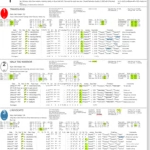

✓ Positives:(1) Hot trainer - high ITM rate. (2) Big last-race effort (69) — 8 pts above recent average. (3) Hot jockey — high ITM rate (19.35%). (4) Closer/presser in a race with pace pressure — ideal race setup for late runners. (5) Had documented trouble last race (codes: ['D', 'L', 'O', 'S', 'U']) yet still finished 2nd — a clean trip today sets up a form reversal. (6) Averages 66.7 speed pts in today's distance/surface configuration vs 61.3 in other configs (3 qualifying starts) — returning to ideal setup. (7) Pick Pony Daily Edge Radar pick — value score 7/10 — angles: Big Last Effort, Return to Proven Setup, Troubled Trip Comeback, Closer in Pace Duel.