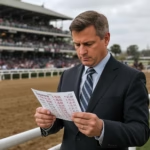
Turf Paradise's 2026-27 season is now a race against the calendar as a landlord lockout, competing financial claims and a mass management exodus threaten preparations for the Phoenix track's scheduled Nov. 27 opening. The 80-day meet remains on the books, but the operation that was supposed to stage it has been stripped of several key personnel and access to the facility. Paulick Report reported that horses were expected to begin arriving Oct. 17, leaving little margin for a management reset.
The immediate break came Oct. 10, when longtime owner Jerry Simms locked Gary Hartunian's Skyfall 7 team out of the property. According to a letter from Arizona Horsemen's Benevolent and Protective Association executive director Leroy Gessmann, Simms exercised rights under the lease and prohibited Skyfall employees from entering the track. The lockout shut down more than offices: simulcast patrons were removed, and the facility's day-to-day race-meet infrastructure was effectively placed in limbo. Daily Racing Form reported that Simms had retaken possession under the lease agreement.
The money dispute has two sharply different versions. Former general manager Tom Ludt told Thoroughbred Daily News that Skyfall 7 owed approximately $3.5 million, including obligations involving Simms, a communications company and a tractor lessor. Hartunian, through attorney Mitchell Nelson, countered that the landlord owed Skyfall more than $3.2 million for alleged pre-existing damage, repairs and municipal and state penalties. Neither side's accounting has been independently resolved in the public record, making the lease dispute more than a public-relations battle: it is now directly affecting whether a licensed operator can function on the premises. Thoroughbred Daily News detailed both the competing claims and Ludt's account of the breakdown.
The Arizona horsemen's side has raised an even more immediate concern. Gessmann told the Arizona Racing Commission that more than $500,000 had recently been missing from the purse account; he said Hartunian had returned $360,000, while $182,000 was still owed to horsemen. Hartunian told the commission that the bills and utilities were paid and characterized the remaining dispute as a matter between his company and Simms. For owners and trainers, however, purse-account uncertainty is not an abstract accounting issue. It can influence whether they ship horses to a track, commit staff and tack, or seek a more reliable winter circuit. Paulick Report reported the figures presented at the commission's Oct. 8 meeting.
The leadership losses have compounded the financial questions. Ludt resigned Oct. 1, and assistant general manager Dave Johnson and other senior employees subsequently departed. At the commission meeting, Hartunian said Johnson would replace Ludt, only for commission chairman James Padish to say the agency had received written confirmation that Johnson had also resigned. Earlier reporting indicated that Turf Paradise was also without a track superintendent and chief veterinarian while preparations for the meet continued. Paulick Report said applications had been received for roughly 1,700 horses, a sizable population to accommodate without a settled operational team.
Hartunian has described the lockout as a coordinated attempt to sabotage Skyfall 7 and prevent the season from proceeding. Ludt, meanwhile, told TDN that a group including Skyfall 7 minority owner Joey Platts had offered Sept. 20 to take over the racing license, but negotiations collapsed before Ludt resigned. Ludt said he could still return if Hartunian were bought out, although any replacement principals would need review by the Arizona Department of Gaming and Arizona Racing Commission. That process, combined with the need to restore access, staffing and horsemen's confidence, makes the Nov. 27 date increasingly conditional even if the permit itself remains in place. Thoroughbred Daily News reported Ludt's account of the alternative operating proposal.
The practical test comes next: whether Turf Paradise can reopen its stable area, complete required safety preparations and demonstrate that racing personnel and purse funding are in place. The track's calendar was already reduced from 104 days to 80 days by a 4-0 commission vote, a concession to the financial and scheduling realities facing the meet. Now the operator and property owner must resolve who controls the grounds before horses arrive. Until that happens, the most consequential question for Arizona racing is not which horse will win opening day, but whether there will be a functioning opening day at all. Horse Racing Nation reported the commission-approved reduction and the uncertainty surrounding the season.