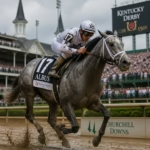
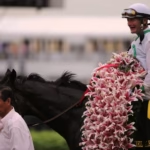
Forty-five seconds at the draw changed the entire shape of this Kentucky Derby. The moment those pills came out, every serious ticket in the country needed a rewrite. If you were building around Renegade as a rock-solid win key or leaning hard on Further Ado as a clean-speed top, the new gate assignments force you to re-price the race, not just tweak around the edges. The Derby isn't a paper exercise anymore; it's geometry, traffic, and probability wrapped into ten furlongs with 20 horses and one chance to get paid.
Renegade is the center of gravity in this discussion, and Post 1 is a brutal place to put a favorite. Historically, the rail at Churchill Downs has been a graveyard in the modern Derby: no winner from that gate since Ferdinand in 1986, and only a handful of in-the-money finishes from posts 1–3 in the nearly four decades since. That is not superstition; it's structure. The clubhouse turn comes up fast at a mile and a quarter, and the inside horse has exactly two options: break running and risk getting cooked on a pressured inside lead, or take back and pray for racing room later. In a 20-horse Derby, both options are fraught.
Renegade comes in with the kind of figures that justify favoritism, and Irad Ortiz Jr. is a major asset in a tactical nightmare like this. Ortiz knows you cannot just gun from the rail and hope for clear sailing all the way. The most likely play is to break alertly, let the pure burners cross over, and try to secure a stalking pocket two or three lengths off the pace, ideally no worse than midpack into the first turn. That means eating some kickback early, switching off, and then angling out at the three-eighths pole. It is a perfectly viable plan on paper, but it is far from low risk. One rival stopping in his lap, one outside horse hanging on the flank that he needs to clear, and Renegade can find himself trapped behind tiring speed with the rail his only escape route. Given the post, you cannot justify taking underlaid odds on top. If the board drifts him out to something in the 6–1 range because of rail panic, you can reopen the conversation, but at a short price from Post 1, he becomes an underneath piece in serious exotic structures rather than the anchor he was pre-draw.
Commandment, on the other hand, came out of the draw much better, landing in Post 6 at 6–1. That slot has produced its share of useful efforts, and more importantly, it gives a quality horse enough room to clear from the gate without being immediately pinched, while still retaining the option to drop in behind the main speed. From there, a rider like Luis Saez can decide in the first 100 yards whether the race needs him to press or to tuck. The downside is that the inside cluster from 1–8 can get congested quickly; you are not getting a free, unpressured lead from this draw. For a horse with Commandment's talent, it's not a toss situation at all—but he does move from being a potential “control-the-race” type to more of a tactical speed player who has to earn his trip. The fade here is not about ability; it's about ensuring his price reflects the reality that his draw is workable, not perfect.
Where the draw really opened doors is in the middle of the gate, and that's where The Puma becomes one of the most attractive propositions on the entire board. Post 9 with a 10–1 morning line is almost the textbook definition of a Derby sweet spot. Historically, the band from 8 through 14 has produced a heavy share of winners and in-the-money finishes, and posts like 8, 10, 12, and 15 show win rates that outstrip the rail and the far outside. The logic is simple: from this band, you're far enough out to avoid the worst of the crush into the first turn, but not so wide that you're giving away multiple paths of ground every step of the way. The Puma, as a natural stalker with some tactical foot, can break cleanly, choose the two- or three-path heading into the clubhouse turn, and let the chaos happen inside and outside of him. At a double-digit quote from a post that historically upgrades horses with his running style, he is exactly the type you want to lean on in win bets and as a primary “A” horse in exactas and trifectas.
Chief Wallabee might have done even better, drawing Post 12 at 8–1. If you study modern Derby data, you'll see a clear pattern: mid-to-outside posts, especially in the 10–15 zone, have been disproportionately successful since the era of oversized fields began. Posts like 5 and 10 have gaudy win totals, and the surrounding gates consistently outperform the extreme inside and the historically cursed 17. From 12, Chief Wallabee is in a position to let the entire inside scramble play out in front of him, slide into a comfortable stalking or second-flight trip, and stay out of the worst of the congestion. Bill Mott is not going to get cute here—this is a straightforward “break, secure, stalk, and pounce” assignment, and Junior Alvarado should have exactly the real estate he needs to execute it. At 8–1, with a running style that meshes with his draw and a gate in the heart of the productive band, Chief Wallabee shapes up as a live overlay, the kind of horse sharp money will gravitate toward as Renegade's rail story dominates the headlines.
Further Ado's Post 18 is where the handicapping work gets nuanced. You cannot simply say “outside is bad” and walk away, because in recent years posts 18–20 have actually produced some high-profile winners—Country House from 18 in 2019, I'll Have Another from 19 in 2012, Rich Strike from 20 in 2022—as Churchill's gate configuration and race dynamics evolved. The problem isn't that 18 is unwinnable; it's that it imposes a tax in ground loss and trip complexity. Further Ado already brings serious talent to the table—an 11-length Blue Grass blowout doesn't happen by accident—but asking that horse to break from 18, clear or tuck while crossing over a stampede, and still finish with authority at 10 furlongs is asking for an A-plus trip on top of A-plus ability. With John Velazquez aboard, you know he'll get a thinking ride, but the draw forces you to recalibrate. On paper, he looks like the kind you want prominently in your exactas and tris, especially if the pace melts down and wide moves are playing, but not the horse you key on top at a short price. If the public sours and lets him drift north of 10–1, then you can start arguing for a speculative win stab on sheer talent overcoming structural disadvantage.
The rest of the draw adds texture to the board rather than rewriting it. Post 11, where Incredibolt landed at 20–1, has historically produced modest hit rates—fine, but not especially friendly when you factor in the likelihood of being sandwiched between forward-moving rivals from 10 and 12. Getting bracketed by an international runner that may break erratically on one side and the well-positioned Chief Wallabee on the other raises the risk of a compromised first furlong. A mid-price horse in a historically neutral-to-weakish slot, surrounded by more credentialed or more aggressive types, is exactly the profile that struggles to work out the clean, energy-efficient trip necessary to upset this race. She's usable in the absolute depths of spread tickets if you love her form, but the draw didn't do her any favors.
Out wide, Fulleffort's Post 20 brings its own baggage and opportunity. Historically, 20 has done better than many would guess, with a couple of big upsets—including Rich Strike's sensational run from the outside gate—showing that a late-running or patient stalker can drop in behind the field, avoid early calamity, and circle late. The trade-off is simple: you give up ground to buy a cleaner trip. For most horses, that's a losing bargain; for one or two every decade, it's the perfect setup. If Fulleffort has been training forwardly on the Road to the Derby and shows a relaxed demeanor in the paddock and post parade, she becomes the kind of price horse you want in the third and fourth slots of supers, but rarely as a principal win play on the draw alone.
Then there's Wonder Dean, a name that may not have jumped off the page before the draw but suddenly looks very live from Post 10 at a long price. Historically, Post 10 is the single most productive gate in Derby history, with nine winners leaving from that slot, and the structural reasons are obvious: you are outside enough to avoid immediate inside crush, yet ideally positioned to tuck behind the first rank and save some ground into the first turn. For a stalking or pressing type like Wonder Dean, it is almost a custom fit. At 30–1 on the line, the combination of gate, running style, and historical trend turns him into exactly the kind of horse that punches tickets in the exotics and occasionally blows up the win pool when the public fixates on flashier names drawn in tougher posts. Any professional player is at least giving him a hard look as a key in the second and third spots, and some will take a flyer on the win pool purely on structural value.
Taken together, the draw has created clear tiers for smart money. Renegade remains a high-talent horse trapped in a low-percentage post, downgraded from win key to underneath engine. Commandment keeps his status as a major player but loses some “trip control” shine from a packed inside cluster. Further Ado is a talented colt whose 18-hole forces you to demand a better price before keying him on top. The Puma and Chief Wallabee, sitting in that 9–12 band, emerge as the most straightforward win and exacta keys: they have favorable posts, compatible running styles, and morning lines that still offer upside if the public overreacts to Renegade's rail misfortune. Wonder Dean becomes the sneaky mid-gate longshot whose post alone demands exotic attention, while horses like Incredibolt and some mid-priced mid-gate runners move into the “only if you're spreading deep” category.
From here until post time, the job is to watch how the tote adjusts to these realities. If the crowd panics off Renegade and overcompensates on Commandment or another name horse, you may find unexpected overlays on The Puma, Chief Wallabee, or Wonder Dean. If Further Ado drifts well past his morning line because players can't stomach Post 18, you may find yourself staring at a fair win bet on a serious talent at a now-fair price. The post draw didn't just give us a starting grid; it handed every serious handicapper a new probability distribution. The ones who get paid on May 2 will be the ones who had the discipline to throw out their pre-draw assumptions, respect the geometry of Churchill Downs, and build tickets that reflect how this race will actually be run from the stalls they drew—not the ones we wished they'd gotten.