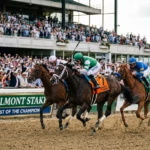
The 158th Belmont Stakes will once again ask 3-year-olds the toughest question in American racing: who can stay 1½ miles and still quicken when it counts. While full 2026 entries were not available through official public records at press time, the shape of a typical Belmont field and the way connections target this race give handicappers a clear idea of what to expect, even before the program is printed.
The Belmont sits as the third and longest leg of the U.S. Triple Crown, following the Kentucky Derby and Preakness Stakes. By the time the gate opens in New York, the classic crop is already battle-tested: some runners arrive with Triple Crown miles in their legs, others are fresher late developers stepping into Grade 1 company for the first time. Historically, the cast is a mix of familiar names from Louisville and Baltimore plus new shooters whose connections deliberately skipped the first two legs to build toward this demanding marathon.
From a connections standpoint, certain barns reliably have a presence in this race. Trainers like Todd Pletcher, Bill Mott and others with deep classic programs routinely point a stamina-minded colt or two at the Belmont, often mapping out a campaign months in advance with long-prep races and generous spacing. Pletcher in particular has turned the race into a specialty over the past two decades, focusing on horses who finish strongly at nine and ten furlongs and who train willingly over a big, sandy surface. That template is now widely copied by rival outfits looking to engineer a peak effort on the first Saturday in June.
Whatever names ultimately populate the 2026 program, their past performances will tell a familiar story to experienced players. Handicappers lean on Daily Racing Form past performances and similar data to parse running styles, class lines and speed figures for the Belmont Stakes. A typical field includes at least one pace-pressing type stretching out from shorter routes, a couple of midpack grinders who finish off their races reliably, and one or two deep closers whose effectiveness depends heavily on how honestly the early fractions are run. The most dangerous profile, year in and year out, is a colt tactical enough to secure position into the first turn yet relaxed enough to conserve energy for the long homestretch.
Preparation is as revealing as the paper form. Connections aiming for the Belmont traditionally give their horses a series of stamina-building works—often six or seven furlongs—rather than a string of sharp half-miles, looking for strong gallop-outs that suggest the extra distance is within reach. Equipment moves, such as adding or removing blinkers, are less common here than in shorter races; when they do occur, they are often intended to help a colt settle and switch off early rather than to sharpen speed. Observers who can track workout reports and on-track appearance in the days before the race will gain an edge that raw figures alone do not provide.
Context matters just as much as raw talent. The Belmont's surface has long been known for its depth and “Big Sandy” feel, and horses who have at least trained locally often hold an advantage over shippers seeing it for the first time. Inside posts can help a tactical runner secure position heading into the clubhouse turn, but extreme outside draws are less of a death sentence here than at tighter tracks because the long run into the first bend allows riders time to slot in. Weather and any emerging track bias on the undercard will further refine how players interpret post positions once they are drawn.
On the wagering side, Belmont day is consistently one of the highest-handle cards on the North American calendar, with the classic itself anchoring rich multi-race sequences that include major Grade 1 undercard events. That liquidity generally produces fair odds on most runners but can also lead to overbet narratives—such as Triple Crown storylines or eye-catching Derby trouble trips—that create value on more workmanlike, under-the-radar types whose form has simply been improving from start to start. Savvy bettors will wait for the official field, scrutinize spacing between races, patterns of incremental speed-figure gains, and how each colt is likely to trip out over 12 furlongs before deciding where to commit.
Until the 158th Belmont Stakes field is formally drawn and program numbers are assigned, the handicapping exercise is necessarily theoretical. But the core questions never change: who is bred to stay, who is coming into the race on an upward curve rather than a plateau, and which riders are most adept at judging pace over a distance very few American horses are ever asked to tackle. Once the names and post positions are set, those angles—grounded in form, preparation and profile—will separate the legitimate classic contenders from the crowd of hopefuls trying to see out a mile and a half on the sport's grandest spring stage.