
Chart Guide (2.0.38)
- Bubbles
- Color = surface: green (turf), brown (dirt), blue (synthetic)
- Top number = finishing position; bottom number in parentheses = starting post position
- Height above line = beaten lengths — closer means a smaller margin
- Border = track conditions: green (FST/GD/FM), yellow (WF/SL/YLD), red (SY/MY/FRZ/SFT/HVY)
- Connecting Line
- Solid = good conditions; dashed = bad conditions
- Line Symbol
- ▲ Triangle = sprint (7f or less); ● Circle = route (more than 7f)
- Days Between Races
- Small number above each bubble (e.g. 19d) = days since the previous race — helps spot freshness, layoffs, and tight scheduling.
- Shaded Band (Bollinger)
- Highlights volatility — a wider band means more variation in recent performance
- Performance Trend
- Straight line showing the overall performance direction — angled up = improving, angled down = declining
- Dashed Reference Line
- AI Opponent = AI analysis class-level par for the race
⚠ Concerns:(1) Consider there will be likely pace pressure in this race - multiple E types entered. (2) Switching from turf to dirt today. (3) Poor record at this distance (0 wins from 7 recent starts). (4) Trip note from last race: Outside;4-5p;faded.
Lane Bias Guide
- Bar Direction
- Bars above the line = more favorable lane • Bars below = less favorable, relative to the average at this track.
- Color
- Green = above-average advantage • Yellow = near-average • Red = below-average • Blue = this horse’s lane.
- Bias Score
- Derived from weighted average finishing positions across historical races at this track. Shown in the tooltip on hover. To use the bias score, calculate your handicap for the horse (e.g. finish position), then add (detrimental bias) or subtract (favorable bias) the bias score.
- Races
- Number of historical races used to compute each lane’s bias score.
Race Pace Bias Guide
- Bar Height & Direction
- Positive (green) = pace favors this horse • Negative (red) = pace works against this horse • Near-zero (amber) = neutral.
- Race Shape
- Projected race shape based on running styles of all horses (e.g. EE = two early horses, EP = one early presser).
- Pace Category
- FAST = contested early pace • LONE EARLY = one speed horse controlling pace • HONEST = moderate early pressure • SLOW = closers’ race.
- Flag (★)
- A star above the bar means this horse’s pace bias figure is ≥ 1.5 — a meaningful pace advantage or disadvantage.
Total Pace Guide
- Bar Segments
- Green = Early Pace (E1) • Amber = Mid Pace (E2) • Red = Late Pace (LP)
- Bar Height
- Total height = sum of E1 + E2 + LP average pace figures. Taller bars indicate a faster-paced horse overall.
- Grades & Rankings
- Hover to see each horse’s letter grade and ranking vs. other horses in this race (e.g. 2/9 = 2nd best of 9).
- Border
- Thicker border = this horse’s post position.
Performance vs. Peers Guide
- Bars (per post)
- Blue = avg career performance • Amber = avg last 3 races • Green = last race (improved vs. avg) • Red = last race (declined vs. avg)
- Trend Line
- Angled line above the bars: rising = improving form • falling = declining form.
- Horizontal Line
- Field average — the mean career performance of all horses in this race.
- Color Circles
- Standard post-position colors below each lane — same as the Total Pace chart.
- Border
- Thicker border = this horse’s post position.
Figure Comparison
- Rating
- The three Pick Pony algorithm ratings (Algo 1, Algo 2, Algo 3) that make up the overall PP AI Rating — higher is a stronger contender rating.
- Speed
- Career average speed, recent 3-race average, and last-race speed figure — spot horses in improving or declining form.
- Pace
- Average Early (E1), Mid (E2), and Stretch (LP) pace figures — reveals pace-setters vs. closers vs. all-the-way types.
- This horse
- The horse whose stats card is open is highlighted with a darker column background.
Winning Profiles
- Axes
- X: Win % from last 10 starts — Y: In-the-money % (top-3 finishes) from last 10 starts.
- Quadrants
- Consistent Winners (top-right): high win & ITM — reliable performers.
Place Threats (top-left): boards often but doesn’t win often — good exacta/trifecta angles.
Streaky (bottom-right): wins occasionally, misses the board often — all-or-nothing.
Developing (bottom-left): still finding form — longshot territory. - Reference Lines
- Dashed lines mark field averages. Dots to the right win more; dots higher board more.
- This horse
- Highlighted with a gold border and larger dot.
Race Pace Simulation Guide
- Slider
- Drag left→right to advance from gate to finish. Drag all the way back to reset the race.
- Predicted Finish Order
- Factors in contested pace burn, each horse’s effort curve (peaked-early vs. peaked-late), and wide trip cost from outside posts. Updated live when Track Bias changes.
- Pace Scenario
- Lone Speed: single E horse likely rates and holds. Contested: two E horses burn each other — closers benefit. Hot Pace: speed meltdown, deep closers thrive. Soft: no early speed, moderate fractions throughout.
- Track Bias
- Slider below canvas. −2 = strong closer/wet bias; +2 = strong speed/rail bias. Recomputes the predicted finish order.
- Boxed Indicator
- Dashed orange ring = horse is surrounded (rival ahead, rival behind, wall outside). In a real race this horse must find a clear path to run.
- Running Styles
- E/EE = early speed (rushes to rail). P = presser (stalks the pace). S = stalker. SS = slow starter / closer.
| Stat | vs. Current Card | vs. All Horses |
|---|---|---|
| Averages
Career-average metrics across all AI race analysis. Performance and pace averages reflect estimated historical performance; trainer and jockey grades score in-the-money percentages. Grading scale: A = elite • B = above average • C = average • D = below average • F = poor • — = no data |
||
| Pick Pony AI Rating | A | C |
| Pace Trip Longshot | — | — |
| Connections Longshot | — | — |
| Situational Longshot | — | — |
| Speed | B | F |
| Early Pace | D | D |
| Mid Pace | D | D |
| Late Pace | D | D |
| Finish Pos | B | F |
| Dirt Speed | B | C |
| Turf Speed | A | B |
| Distance Speed | B | C |
| Trainer Effectiveness | B | D |
| Jockey Effectiveness | B | D |
| 3rd Party Ratings | B | D |
| Recent
Performance analysis from the horse's recent races, weighted to reflect current form. Sprint and Route FPS (Foot Per Second) measure pace efficiency over the horse's recent sprints and routes respectively. Grading scale: A = elite • B = above average • C = average • D = below average • F = poor • — = no data |
||
| Speed | B | D |
| Early Pace | C | D |
| Mid Pace | D | D |
| Late Pace | B | D |
| Sprint FPS | F | F |
| Route FPS | F | F |
| Trainer Effectiveness | B | D |
| Jockey Effectiveness | B | D |
| 3rd Party Ratings | B | D |
| Predictions
AI-generated projections for the upcoming race, derived from prior AI analysis for speed and pace trends, surface and distance suitability, and current conditions. Grading scale: A = elite • B = above average • C = average • D = below average • F = poor • — = no data |
||
| Speed | B | F |
| Early Pace | D | D |
| Mid Pace | D | D |
| Late Pace | C | C |
Mod1(W): 82 (1/8) Mod2(W): 75 (2/8) Mod3(W): 79 (3/8) Mod1-LS: 55 (6/8) Win Prob: 18.4% Value Score: 1.35 ★
AI Model Comparison
- Winner Models (green)
- Mod1(W), Mod2(W), and Mod3(W) trained to predict race winners. Higher score = stronger contender.
- Longshot Models (red)
- Mod1-LS, Mod2-LS, and Mod3-LS trained to find high-value longshots. Higher score = stronger longshot candidate.
- Form Model (blue)
- Mod4 sequence model trained on recent form patterns. Higher score = stronger recent form profile.
- This horse
- Highlighted with a darker column background.
Chart Guide (2.0.38)
- Bubbles
- Color = surface: green (turf), brown (dirt), blue (synthetic)
- Top number = finishing position; bottom number in parentheses = starting post position
- Height above line = beaten lengths — closer means a smaller margin
- Border = track conditions: green (FST/GD/FM), yellow (WF/SL/YLD), red (SY/MY/FRZ/SFT/HVY)
- Connecting Line
- Solid = good conditions; dashed = bad conditions
- Line Symbol
- ▲ Triangle = sprint (7f or less); ● Circle = route (more than 7f)
- Days Between Races
- Small number above each bubble (e.g. 19d) = days since the previous race — helps spot freshness, layoffs, and tight scheduling.
- Shaded Band (Bollinger)
- Highlights volatility — a wider band means more variation in recent performance
- Performance Trend
- Straight line showing the overall performance direction — angled up = improving, angled down = declining
- Dashed Reference Line
- AI Opponent = AI analysis class-level par for the race
✓ Positives:(1) Returning from 58-day layoff with a recent workout. (2) Hot trainer - high ITM rate (28%). (3) Hot jockey — high ITM rate (38%). (4) 3 workouts in last 30 days — horse appears sharp and fit. (5) Late pace significantly above field median (LP: 71 vs field 61). (6) Closer/presser in a race with pace pressure — ideal race setup for late runners. (7) Career-best figure (65) buried in races 4–10 back — 12 pts above race median and 14 pts above recent form — market has forgotten the peak effort. (8) Pick Pony Daily Edge Radar pick — value score 7/10 — angles: Hot Jockey, Hidden Figure, Closer in Pace Duel, Late Kick Advantage, Sharp Workout Pattern.
⚠ Concerns:(1) Has not raced in 58 days. (2) Repeatedly beaten at this class level (3 of last 5 starts). (3) Consider there will be likely pace pressure in this race - multiple E types entered. (4) Poor record at this distance (0 wins from 6 recent starts). (5) Poor record at this track (0 wins from 5 starts). (6) Trip note from last race: Wellback 2p; no threat. (7) Speed figures are highly erratic over last 5 starts (σ = 9.5 pts: [40, 44, 51, 51, 65]) — unpredictable performer. (8) 0 wins from 9 starts on dirt in last 10 — repeated failure on today's surface.
Lane Bias Guide
- Bar Direction
- Bars above the line = more favorable lane • Bars below = less favorable, relative to the average at this track.
- Color
- Green = above-average advantage • Yellow = near-average • Red = below-average • Blue = this horse’s lane.
- Bias Score
- Derived from weighted average finishing positions across historical races at this track. Shown in the tooltip on hover. To use the bias score, calculate your handicap for the horse (e.g. finish position), then add (detrimental bias) or subtract (favorable bias) the bias score.
- Races
- Number of historical races used to compute each lane’s bias score.
Race Pace Bias Guide
- Bar Height & Direction
- Positive (green) = pace favors this horse • Negative (red) = pace works against this horse • Near-zero (amber) = neutral.
- Race Shape
- Projected race shape based on running styles of all horses (e.g. EE = two early horses, EP = one early presser).
- Pace Category
- FAST = contested early pace • LONE EARLY = one speed horse controlling pace • HONEST = moderate early pressure • SLOW = closers’ race.
- Flag (★)
- A star above the bar means this horse’s pace bias figure is ≥ 1.5 — a meaningful pace advantage or disadvantage.
Total Pace Guide
- Bar Segments
- Green = Early Pace (E1) • Amber = Mid Pace (E2) • Red = Late Pace (LP)
- Bar Height
- Total height = sum of E1 + E2 + LP average pace figures. Taller bars indicate a faster-paced horse overall.
- Grades & Rankings
- Hover to see each horse’s letter grade and ranking vs. other horses in this race (e.g. 2/9 = 2nd best of 9).
- Border
- Thicker border = this horse’s post position.
Performance vs. Peers Guide
- Bars (per post)
- Blue = avg career performance • Amber = avg last 3 races • Green = last race (improved vs. avg) • Red = last race (declined vs. avg)
- Trend Line
- Angled line above the bars: rising = improving form • falling = declining form.
- Horizontal Line
- Field average — the mean career performance of all horses in this race.
- Color Circles
- Standard post-position colors below each lane — same as the Total Pace chart.
- Border
- Thicker border = this horse’s post position.
Figure Comparison
- Rating
- The three Pick Pony algorithm ratings (Algo 1, Algo 2, Algo 3) that make up the overall PP AI Rating — higher is a stronger contender rating.
- Speed
- Career average speed, recent 3-race average, and last-race speed figure — spot horses in improving or declining form.
- Pace
- Average Early (E1), Mid (E2), and Stretch (LP) pace figures — reveals pace-setters vs. closers vs. all-the-way types.
- This horse
- The horse whose stats card is open is highlighted with a darker column background.
Winning Profiles
- Axes
- X: Win % from last 10 starts — Y: In-the-money % (top-3 finishes) from last 10 starts.
- Quadrants
- Consistent Winners (top-right): high win & ITM — reliable performers.
Place Threats (top-left): boards often but doesn’t win often — good exacta/trifecta angles.
Streaky (bottom-right): wins occasionally, misses the board often — all-or-nothing.
Developing (bottom-left): still finding form — longshot territory. - Reference Lines
- Dashed lines mark field averages. Dots to the right win more; dots higher board more.
- This horse
- Highlighted with a gold border and larger dot.
Race Pace Simulation Guide
- Slider
- Drag left→right to advance from gate to finish. Drag all the way back to reset the race.
- Predicted Finish Order
- Factors in contested pace burn, each horse’s effort curve (peaked-early vs. peaked-late), and wide trip cost from outside posts. Updated live when Track Bias changes.
- Pace Scenario
- Lone Speed: single E horse likely rates and holds. Contested: two E horses burn each other — closers benefit. Hot Pace: speed meltdown, deep closers thrive. Soft: no early speed, moderate fractions throughout.
- Track Bias
- Slider below canvas. −2 = strong closer/wet bias; +2 = strong speed/rail bias. Recomputes the predicted finish order.
- Boxed Indicator
- Dashed orange ring = horse is surrounded (rival ahead, rival behind, wall outside). In a real race this horse must find a clear path to run.
- Running Styles
- E/EE = early speed (rushes to rail). P = presser (stalks the pace). S = stalker. SS = slow starter / closer.
| Stat | vs. Current Card | vs. All Horses |
|---|---|---|
| Averages
Career-average metrics across all AI race analysis. Performance and pace averages reflect estimated historical performance; trainer and jockey grades score in-the-money percentages. Grading scale: A = elite • B = above average • C = average • D = below average • F = poor • — = no data |
||
| Pick Pony AI Rating | C | D |
| Pace Trip Longshot | — | — |
| Connections Longshot | — | — |
| Situational Longshot | — | — |
| Speed | B | F |
| Early Pace | D | D |
| Mid Pace | D | D |
| Late Pace | A | C |
| Finish Pos | B | F |
| Dirt Speed | B | C |
| Turf Speed | C | C |
| Distance Speed | A | C |
| Trainer Effectiveness | C | D |
| Jockey Effectiveness | A | C |
| 3rd Party Ratings | F | F |
| Recent
Performance analysis from the horse's recent races, weighted to reflect current form. Sprint and Route FPS (Foot Per Second) measure pace efficiency over the horse's recent sprints and routes respectively. Grading scale: A = elite • B = above average • C = average • D = below average • F = poor • — = no data |
||
| Speed | D | F |
| Early Pace | D | D |
| Mid Pace | D | D |
| Late Pace | D | D |
| Sprint FPS | C | D |
| Route FPS | C | D |
| Trainer Effectiveness | C | D |
| Jockey Effectiveness | A | C |
| 3rd Party Ratings | F | F |
| Predictions
AI-generated projections for the upcoming race, derived from prior AI analysis for speed and pace trends, surface and distance suitability, and current conditions. Grading scale: A = elite • B = above average • C = average • D = below average • F = poor • — = no data |
||
| Speed | D | F |
| Early Pace | D | D |
| Mid Pace | D | D |
| Late Pace | C | C |
Mod1(W): 82 (1/8) Mod2(W): 75 (2/8) Mod3(W): 79 (3/8) Mod1-LS: 55 (6/8) Win Prob: 18.4% Value Score: 1.35 ★
AI Model Comparison
- Winner Models (green)
- Mod1(W), Mod2(W), and Mod3(W) trained to predict race winners. Higher score = stronger contender.
- Longshot Models (red)
- Mod1-LS, Mod2-LS, and Mod3-LS trained to find high-value longshots. Higher score = stronger longshot candidate.
- Form Model (blue)
- Mod4 sequence model trained on recent form patterns. Higher score = stronger recent form profile.
- This horse
- Highlighted with a darker column background.
Chart Guide (2.0.38)
- Bubbles
- Color = surface: green (turf), brown (dirt), blue (synthetic)
- Top number = finishing position; bottom number in parentheses = starting post position
- Height above line = beaten lengths — closer means a smaller margin
- Border = track conditions: green (FST/GD/FM), yellow (WF/SL/YLD), red (SY/MY/FRZ/SFT/HVY)
- Connecting Line
- Solid = good conditions; dashed = bad conditions
- Line Symbol
- ▲ Triangle = sprint (7f or less); ● Circle = route (more than 7f)
- Days Between Races
- Small number above each bubble (e.g. 19d) = days since the previous race — helps spot freshness, layoffs, and tight scheduling.
- Shaded Band (Bollinger)
- Highlights volatility — a wider band means more variation in recent performance
- Performance Trend
- Straight line showing the overall performance direction — angled up = improving, angled down = declining
- Dashed Reference Line
- AI Opponent = AI analysis class-level par for the race
✓ Positives:(1) Returning from 65-day layoff with a recent workout. (2) Hot trainer - high ITM rate. (3) Hot jockey — high ITM rate (25.00%). (4) Has a bullet work (fastest at track that day) — sharp conditioning signal. (5) Returning from 65-day layoff with a bullet workout — trainer signaling extra readiness for today's spot. (6) Trainer 'CASCALLARES NESTOR' has 3 horses in today's card all showing last-race improvement — barn appears sharp right now. (7) Pick Pony Daily Edge Radar pick — value score 6/10 — angles: Bullet Workout, Stable on Fire, Sharp Return Workout.
⚠ Concerns:(1) Has not raced in 65 days. (2) Rising in class today ($5,000 → $10,000). (3) Repeatedly beaten at this class level (3 of last 5 starts). (4) Consider there will be likely pace pressure in this race - multiple E types entered. (5) Speed average (38) well below field median (53). (6) Moving from a sprint to a route today. (7) Trip note from last race: Off pace; gave way. (8) Rising in class ($5,000 → $10,000) after finishing 7 last out — double negative. (9) Speed figures are highly erratic over last 5 starts (σ = 18.6 pts: [43, 45, 35, 53, 5]) — unpredictable performer. (10) 0 wins from 8 starts on dirt in last 10 — repeated failure on today's surface. (11) First start at TAM — never raced here before (last seen at: DED).
Lane Bias Guide
- Bar Direction
- Bars above the line = more favorable lane • Bars below = less favorable, relative to the average at this track.
- Color
- Green = above-average advantage • Yellow = near-average • Red = below-average • Blue = this horse’s lane.
- Bias Score
- Derived from weighted average finishing positions across historical races at this track. Shown in the tooltip on hover. To use the bias score, calculate your handicap for the horse (e.g. finish position), then add (detrimental bias) or subtract (favorable bias) the bias score.
- Races
- Number of historical races used to compute each lane’s bias score.
Race Pace Bias Guide
- Bar Height & Direction
- Positive (green) = pace favors this horse • Negative (red) = pace works against this horse • Near-zero (amber) = neutral.
- Race Shape
- Projected race shape based on running styles of all horses (e.g. EE = two early horses, EP = one early presser).
- Pace Category
- FAST = contested early pace • LONE EARLY = one speed horse controlling pace • HONEST = moderate early pressure • SLOW = closers’ race.
- Flag (★)
- A star above the bar means this horse’s pace bias figure is ≥ 1.5 — a meaningful pace advantage or disadvantage.
Total Pace Guide
- Bar Segments
- Green = Early Pace (E1) • Amber = Mid Pace (E2) • Red = Late Pace (LP)
- Bar Height
- Total height = sum of E1 + E2 + LP average pace figures. Taller bars indicate a faster-paced horse overall.
- Grades & Rankings
- Hover to see each horse’s letter grade and ranking vs. other horses in this race (e.g. 2/9 = 2nd best of 9).
- Border
- Thicker border = this horse’s post position.
Performance vs. Peers Guide
- Bars (per post)
- Blue = avg career performance • Amber = avg last 3 races • Green = last race (improved vs. avg) • Red = last race (declined vs. avg)
- Trend Line
- Angled line above the bars: rising = improving form • falling = declining form.
- Horizontal Line
- Field average — the mean career performance of all horses in this race.
- Color Circles
- Standard post-position colors below each lane — same as the Total Pace chart.
- Border
- Thicker border = this horse’s post position.
Figure Comparison
- Rating
- The three Pick Pony algorithm ratings (Algo 1, Algo 2, Algo 3) that make up the overall PP AI Rating — higher is a stronger contender rating.
- Speed
- Career average speed, recent 3-race average, and last-race speed figure — spot horses in improving or declining form.
- Pace
- Average Early (E1), Mid (E2), and Stretch (LP) pace figures — reveals pace-setters vs. closers vs. all-the-way types.
- This horse
- The horse whose stats card is open is highlighted with a darker column background.
Winning Profiles
- Axes
- X: Win % from last 10 starts — Y: In-the-money % (top-3 finishes) from last 10 starts.
- Quadrants
- Consistent Winners (top-right): high win & ITM — reliable performers.
Place Threats (top-left): boards often but doesn’t win often — good exacta/trifecta angles.
Streaky (bottom-right): wins occasionally, misses the board often — all-or-nothing.
Developing (bottom-left): still finding form — longshot territory. - Reference Lines
- Dashed lines mark field averages. Dots to the right win more; dots higher board more.
- This horse
- Highlighted with a gold border and larger dot.
Race Pace Simulation Guide
- Slider
- Drag left→right to advance from gate to finish. Drag all the way back to reset the race.
- Predicted Finish Order
- Factors in contested pace burn, each horse’s effort curve (peaked-early vs. peaked-late), and wide trip cost from outside posts. Updated live when Track Bias changes.
- Pace Scenario
- Lone Speed: single E horse likely rates and holds. Contested: two E horses burn each other — closers benefit. Hot Pace: speed meltdown, deep closers thrive. Soft: no early speed, moderate fractions throughout.
- Track Bias
- Slider below canvas. −2 = strong closer/wet bias; +2 = strong speed/rail bias. Recomputes the predicted finish order.
- Boxed Indicator
- Dashed orange ring = horse is surrounded (rival ahead, rival behind, wall outside). In a real race this horse must find a clear path to run.
- Running Styles
- E/EE = early speed (rushes to rail). P = presser (stalks the pace). S = stalker. SS = slow starter / closer.
| Stat | vs. Current Card | vs. All Horses |
|---|---|---|
| Averages
Career-average metrics across all AI race analysis. Performance and pace averages reflect estimated historical performance; trainer and jockey grades score in-the-money percentages. Grading scale: A = elite • B = above average • C = average • D = below average • F = poor • — = no data |
||
| Pick Pony AI Rating | F | F |
| Pace Trip Longshot | — | — |
| Connections Longshot | — | — |
| Situational Longshot | — | — |
| Speed | F | F |
| Early Pace | B | C |
| Mid Pace | B | D |
| Late Pace | F | F |
| Finish Pos | D | F |
| Dirt Speed | F | D |
| Turf Speed | D | D |
| Distance Speed | C | D |
| Trainer Effectiveness | F | F |
| Jockey Effectiveness | C | F |
| 3rd Party Ratings | D | F |
| Recent
Performance analysis from the horse's recent races, weighted to reflect current form. Sprint and Route FPS (Foot Per Second) measure pace efficiency over the horse's recent sprints and routes respectively. Grading scale: A = elite • B = above average • C = average • D = below average • F = poor • — = no data |
||
| Speed | F | F |
| Early Pace | B | C |
| Mid Pace | A | D |
| Late Pace | F | D |
| Sprint FPS | B | D |
| Route FPS | B | D |
| Trainer Effectiveness | F | F |
| Jockey Effectiveness | C | F |
| 3rd Party Ratings | D | F |
| Predictions
AI-generated projections for the upcoming race, derived from prior AI analysis for speed and pace trends, surface and distance suitability, and current conditions. Grading scale: A = elite • B = above average • C = average • D = below average • F = poor • — = no data |
||
| Speed | F | F |
| Early Pace | B | C |
| Mid Pace | B | D |
| Late Pace | C | C |
Mod1(W): 82 (1/8) Mod2(W): 75 (2/8) Mod3(W): 79 (3/8) Mod1-LS: 55 (6/8) Win Prob: 18.4% Value Score: 1.35 ★
AI Model Comparison
- Winner Models (green)
- Mod1(W), Mod2(W), and Mod3(W) trained to predict race winners. Higher score = stronger contender.
- Longshot Models (red)
- Mod1-LS, Mod2-LS, and Mod3-LS trained to find high-value longshots. Higher score = stronger longshot candidate.
- Form Model (blue)
- Mod4 sequence model trained on recent form patterns. Higher score = stronger recent form profile.
- This horse
- Highlighted with a darker column background.
Chart Guide (2.0.38)
- Bubbles
- Color = surface: green (turf), brown (dirt), blue (synthetic)
- Top number = finishing position; bottom number in parentheses = starting post position
- Height above line = beaten lengths — closer means a smaller margin
- Border = track conditions: green (FST/GD/FM), yellow (WF/SL/YLD), red (SY/MY/FRZ/SFT/HVY)
- Connecting Line
- Solid = good conditions; dashed = bad conditions
- Line Symbol
- ▲ Triangle = sprint (7f or less); ● Circle = route (more than 7f)
- Days Between Races
- Small number above each bubble (e.g. 19d) = days since the previous race — helps spot freshness, layoffs, and tight scheduling.
- Shaded Band (Bollinger)
- Highlights volatility — a wider band means more variation in recent performance
- Performance Trend
- Straight line showing the overall performance direction — angled up = improving, angled down = declining
- Dashed Reference Line
- AI Opponent = AI analysis class-level par for the race
✓ Positives:(1) Dropping in class today ($16,000 → $10,000). (2) Speed average (63) well above field median (53). (3) Hot trainer - high ITM rate (75%). (4) Hot jockey — high ITM rate (56%). (5) Early pace significantly above field median (E1: 82 vs field 70). (6) Late pace significantly above field median (LP: 73 vs field 61). (7) Career-best figure (73) buried in races 4–10 back — 20 pts above race median and 6 pts above recent form — market has forgotten the peak effort. (8) Had documented trouble last race (codes: ['D', 'L', 'S', 'T', 'U', 'V']) yet still finished 3rd — a clean trip today sets up a form reversal. (9) Pick Pony Daily Edge Radar pick — value score 9/10 — angles: Class Superiority, Hot Jockey, Troubled Trip Comeback, Hidden Figure, Late Kick Advantage, Hot Trainer, Class Drop.
⚠ Concerns:(1) Consider there will be likely pace pressure in this race - multiple E types entered. (2) Limited experience at today's distance (1 start). (3) Trip note from last race: Duel;svd gnd;caught. (4) Speed figures are highly erratic over last 5 starts (σ = 11.6 pts: [64, 65, 67, 67, 40]) — unpredictable performer. (5) 0 wins from 10 starts on dirt in last 10 — repeated failure on today's surface.
Lane Bias Guide
- Bar Direction
- Bars above the line = more favorable lane • Bars below = less favorable, relative to the average at this track.
- Color
- Green = above-average advantage • Yellow = near-average • Red = below-average • Blue = this horse’s lane.
- Bias Score
- Derived from weighted average finishing positions across historical races at this track. Shown in the tooltip on hover. To use the bias score, calculate your handicap for the horse (e.g. finish position), then add (detrimental bias) or subtract (favorable bias) the bias score.
- Races
- Number of historical races used to compute each lane’s bias score.
Race Pace Bias Guide
- Bar Height & Direction
- Positive (green) = pace favors this horse • Negative (red) = pace works against this horse • Near-zero (amber) = neutral.
- Race Shape
- Projected race shape based on running styles of all horses (e.g. EE = two early horses, EP = one early presser).
- Pace Category
- FAST = contested early pace • LONE EARLY = one speed horse controlling pace • HONEST = moderate early pressure • SLOW = closers’ race.
- Flag (★)
- A star above the bar means this horse’s pace bias figure is ≥ 1.5 — a meaningful pace advantage or disadvantage.
Total Pace Guide
- Bar Segments
- Green = Early Pace (E1) • Amber = Mid Pace (E2) • Red = Late Pace (LP)
- Bar Height
- Total height = sum of E1 + E2 + LP average pace figures. Taller bars indicate a faster-paced horse overall.
- Grades & Rankings
- Hover to see each horse’s letter grade and ranking vs. other horses in this race (e.g. 2/9 = 2nd best of 9).
- Border
- Thicker border = this horse’s post position.
Performance vs. Peers Guide
- Bars (per post)
- Blue = avg career performance • Amber = avg last 3 races • Green = last race (improved vs. avg) • Red = last race (declined vs. avg)
- Trend Line
- Angled line above the bars: rising = improving form • falling = declining form.
- Horizontal Line
- Field average — the mean career performance of all horses in this race.
- Color Circles
- Standard post-position colors below each lane — same as the Total Pace chart.
- Border
- Thicker border = this horse’s post position.
Figure Comparison
- Rating
- The three Pick Pony algorithm ratings (Algo 1, Algo 2, Algo 3) that make up the overall PP AI Rating — higher is a stronger contender rating.
- Speed
- Career average speed, recent 3-race average, and last-race speed figure — spot horses in improving or declining form.
- Pace
- Average Early (E1), Mid (E2), and Stretch (LP) pace figures — reveals pace-setters vs. closers vs. all-the-way types.
- This horse
- The horse whose stats card is open is highlighted with a darker column background.
Winning Profiles
- Axes
- X: Win % from last 10 starts — Y: In-the-money % (top-3 finishes) from last 10 starts.
- Quadrants
- Consistent Winners (top-right): high win & ITM — reliable performers.
Place Threats (top-left): boards often but doesn’t win often — good exacta/trifecta angles.
Streaky (bottom-right): wins occasionally, misses the board often — all-or-nothing.
Developing (bottom-left): still finding form — longshot territory. - Reference Lines
- Dashed lines mark field averages. Dots to the right win more; dots higher board more.
- This horse
- Highlighted with a gold border and larger dot.
Race Pace Simulation Guide
- Slider
- Drag left→right to advance from gate to finish. Drag all the way back to reset the race.
- Predicted Finish Order
- Factors in contested pace burn, each horse’s effort curve (peaked-early vs. peaked-late), and wide trip cost from outside posts. Updated live when Track Bias changes.
- Pace Scenario
- Lone Speed: single E horse likely rates and holds. Contested: two E horses burn each other — closers benefit. Hot Pace: speed meltdown, deep closers thrive. Soft: no early speed, moderate fractions throughout.
- Track Bias
- Slider below canvas. −2 = strong closer/wet bias; +2 = strong speed/rail bias. Recomputes the predicted finish order.
- Boxed Indicator
- Dashed orange ring = horse is surrounded (rival ahead, rival behind, wall outside). In a real race this horse must find a clear path to run.
- Running Styles
- E/EE = early speed (rushes to rail). P = presser (stalks the pace). S = stalker. SS = slow starter / closer.
| Stat | vs. Current Card | vs. All Horses |
|---|---|---|
| Averages
Career-average metrics across all AI race analysis. Performance and pace averages reflect estimated historical performance; trainer and jockey grades score in-the-money percentages. Grading scale: A = elite • B = above average • C = average • D = below average • F = poor • — = no data |
||
| Pick Pony AI Rating | A | A |
| Pace Trip Longshot | — | — |
| Connections Longshot | — | — |
| Situational Longshot | — | — |
| Speed | A | D |
| Early Pace | A | C |
| Mid Pace | A | C |
| Late Pace | A | C |
| Finish Pos | A | B |
| Dirt Speed | A | B |
| Turf Speed | B | C |
| Distance Speed | A | C |
| Trainer Effectiveness | A | A |
| Jockey Effectiveness | A | A |
| 3rd Party Ratings | A | D |
| Recent
Performance analysis from the horse's recent races, weighted to reflect current form. Sprint and Route FPS (Foot Per Second) measure pace efficiency over the horse's recent sprints and routes respectively. Grading scale: A = elite • B = above average • C = average • D = below average • F = poor • — = no data |
||
| Speed | A | D |
| Early Pace | B | C |
| Mid Pace | B | D |
| Late Pace | A | B |
| Sprint FPS | A | B |
| Route FPS | A | C |
| Trainer Effectiveness | A | A |
| Jockey Effectiveness | A | A |
| 3rd Party Ratings | A | D |
| Predictions
AI-generated projections for the upcoming race, derived from prior AI analysis for speed and pace trends, surface and distance suitability, and current conditions. Grading scale: A = elite • B = above average • C = average • D = below average • F = poor • — = no data |
||
| Speed | A | D |
| Early Pace | C | C |
| Mid Pace | A | C |
| Late Pace | C | C |
Mod1(W): 82 (1/8) Mod2(W): 75 (2/8) Mod3(W): 79 (3/8) Mod1-LS: 55 (6/8) Win Prob: 18.4% Value Score: 1.35 ★
AI Model Comparison
- Winner Models (green)
- Mod1(W), Mod2(W), and Mod3(W) trained to predict race winners. Higher score = stronger contender.
- Longshot Models (red)
- Mod1-LS, Mod2-LS, and Mod3-LS trained to find high-value longshots. Higher score = stronger longshot candidate.
- Form Model (blue)
- Mod4 sequence model trained on recent form patterns. Higher score = stronger recent form profile.
- This horse
- Highlighted with a darker column background.
Chart Guide (2.0.38)
- Bubbles
- Color = surface: green (turf), brown (dirt), blue (synthetic)
- Top number = finishing position; bottom number in parentheses = starting post position
- Height above line = beaten lengths — closer means a smaller margin
- Border = track conditions: green (FST/GD/FM), yellow (WF/SL/YLD), red (SY/MY/FRZ/SFT/HVY)
- Connecting Line
- Solid = good conditions; dashed = bad conditions
- Line Symbol
- ▲ Triangle = sprint (7f or less); ● Circle = route (more than 7f)
- Days Between Races
- Small number above each bubble (e.g. 19d) = days since the previous race — helps spot freshness, layoffs, and tight scheduling.
- Shaded Band (Bollinger)
- Highlights volatility — a wider band means more variation in recent performance
- Performance Trend
- Straight line showing the overall performance direction — angled up = improving, angled down = declining
- Dashed Reference Line
- AI Opponent = AI analysis class-level par for the race
✓ Positives:(1) Hot trainer - high ITM rate (25%). (2) Hot jockey — high ITM rate (27.10%). (3) Early pace significantly above field median (E1: 85 vs field 80). (4) Carries 7 lbs less than field median (115 lbs vs median 122 lbs). (5) Pick Pony Daily Edge Radar pick — value score 3/10 — angles: Early Speed Edge, Weight Advantage.
⚠ Concerns:(1) Repeatedly beaten at this class level (3 of last 5 starts). (2) Consider there will be likely pace pressure in this race - multiple E types entered. (3) First time at today's distance. (4) Moving from a sprint to a route today. (5) Today's distance is longer than any previous start. (6) Poor record at this track (0 wins from 5 starts). (7) Trip note from last race: Track;3p;tired. (8) Speed figures are highly erratic over last 5 starts (σ = 18.5 pts: [55, 48, 75, 58, 24]) — unpredictable performer. (9) 0 wins from 10 starts on dirt in last 10 — repeated failure on today's surface.
Lane Bias Guide
- Bar Direction
- Bars above the line = more favorable lane • Bars below = less favorable, relative to the average at this track.
- Color
- Green = above-average advantage • Yellow = near-average • Red = below-average • Blue = this horse’s lane.
- Bias Score
- Derived from weighted average finishing positions across historical races at this track. Shown in the tooltip on hover. To use the bias score, calculate your handicap for the horse (e.g. finish position), then add (detrimental bias) or subtract (favorable bias) the bias score.
- Races
- Number of historical races used to compute each lane’s bias score.
Race Pace Bias Guide
- Bar Height & Direction
- Positive (green) = pace favors this horse • Negative (red) = pace works against this horse • Near-zero (amber) = neutral.
- Race Shape
- Projected race shape based on running styles of all horses (e.g. EE = two early horses, EP = one early presser).
- Pace Category
- FAST = contested early pace • LONE EARLY = one speed horse controlling pace • HONEST = moderate early pressure • SLOW = closers’ race.
- Flag (★)
- A star above the bar means this horse’s pace bias figure is ≥ 1.5 — a meaningful pace advantage or disadvantage.
Total Pace Guide
- Bar Segments
- Green = Early Pace (E1) • Amber = Mid Pace (E2) • Red = Late Pace (LP)
- Bar Height
- Total height = sum of E1 + E2 + LP average pace figures. Taller bars indicate a faster-paced horse overall.
- Grades & Rankings
- Hover to see each horse’s letter grade and ranking vs. other horses in this race (e.g. 2/9 = 2nd best of 9).
- Border
- Thicker border = this horse’s post position.
Performance vs. Peers Guide
- Bars (per post)
- Blue = avg career performance • Amber = avg last 3 races • Green = last race (improved vs. avg) • Red = last race (declined vs. avg)
- Trend Line
- Angled line above the bars: rising = improving form • falling = declining form.
- Horizontal Line
- Field average — the mean career performance of all horses in this race.
- Color Circles
- Standard post-position colors below each lane — same as the Total Pace chart.
- Border
- Thicker border = this horse’s post position.
Figure Comparison
- Rating
- The three Pick Pony algorithm ratings (Algo 1, Algo 2, Algo 3) that make up the overall PP AI Rating — higher is a stronger contender rating.
- Speed
- Career average speed, recent 3-race average, and last-race speed figure — spot horses in improving or declining form.
- Pace
- Average Early (E1), Mid (E2), and Stretch (LP) pace figures — reveals pace-setters vs. closers vs. all-the-way types.
- This horse
- The horse whose stats card is open is highlighted with a darker column background.
Winning Profiles
- Axes
- X: Win % from last 10 starts — Y: In-the-money % (top-3 finishes) from last 10 starts.
- Quadrants
- Consistent Winners (top-right): high win & ITM — reliable performers.
Place Threats (top-left): boards often but doesn’t win often — good exacta/trifecta angles.
Streaky (bottom-right): wins occasionally, misses the board often — all-or-nothing.
Developing (bottom-left): still finding form — longshot territory. - Reference Lines
- Dashed lines mark field averages. Dots to the right win more; dots higher board more.
- This horse
- Highlighted with a gold border and larger dot.
Race Pace Simulation Guide
- Slider
- Drag left→right to advance from gate to finish. Drag all the way back to reset the race.
- Predicted Finish Order
- Factors in contested pace burn, each horse’s effort curve (peaked-early vs. peaked-late), and wide trip cost from outside posts. Updated live when Track Bias changes.
- Pace Scenario
- Lone Speed: single E horse likely rates and holds. Contested: two E horses burn each other — closers benefit. Hot Pace: speed meltdown, deep closers thrive. Soft: no early speed, moderate fractions throughout.
- Track Bias
- Slider below canvas. −2 = strong closer/wet bias; +2 = strong speed/rail bias. Recomputes the predicted finish order.
- Boxed Indicator
- Dashed orange ring = horse is surrounded (rival ahead, rival behind, wall outside). In a real race this horse must find a clear path to run.
- Running Styles
- E/EE = early speed (rushes to rail). P = presser (stalks the pace). S = stalker. SS = slow starter / closer.
| Stat | vs. Current Card | vs. All Horses |
|---|---|---|
| Averages
Career-average metrics across all AI race analysis. Performance and pace averages reflect estimated historical performance; trainer and jockey grades score in-the-money percentages. Grading scale: A = elite • B = above average • C = average • D = below average • F = poor • — = no data |
||
| Pick Pony AI Rating | D | D |
| Pace Trip Longshot | — | — |
| Connections Longshot | — | — |
| Situational Longshot | — | — |
| Speed | C | F |
| Early Pace | A | B |
| Mid Pace | A | C |
| Late Pace | D | D |
| Finish Pos | A | F |
| Dirt Speed | A | C |
| Turf Speed | D | D |
| Distance Speed | F | F |
| Trainer Effectiveness | D | F |
| Jockey Effectiveness | B | F |
| 3rd Party Ratings | A | D |
| Recent
Performance analysis from the horse's recent races, weighted to reflect current form. Sprint and Route FPS (Foot Per Second) measure pace efficiency over the horse's recent sprints and routes respectively. Grading scale: A = elite • B = above average • C = average • D = below average • F = poor • — = no data |
||
| Speed | A | D |
| Early Pace | A | B |
| Mid Pace | A | B |
| Late Pace | C | D |
| Sprint FPS | A | A |
| Route FPS | A | B |
| Trainer Effectiveness | D | F |
| Jockey Effectiveness | B | F |
| 3rd Party Ratings | A | D |
| Predictions
AI-generated projections for the upcoming race, derived from prior AI analysis for speed and pace trends, surface and distance suitability, and current conditions. Grading scale: A = elite • B = above average • C = average • D = below average • F = poor • — = no data |
||
| Speed | D | F |
| Early Pace | A | B |
| Mid Pace | A | B |
| Late Pace | C | C |
Mod1(W): 82 (1/8) Mod2(W): 75 (2/8) Mod3(W): 79 (3/8) Mod1-LS: 55 (6/8) Win Prob: 18.4% Value Score: 1.35 ★
AI Model Comparison
- Winner Models (green)
- Mod1(W), Mod2(W), and Mod3(W) trained to predict race winners. Higher score = stronger contender.
- Longshot Models (red)
- Mod1-LS, Mod2-LS, and Mod3-LS trained to find high-value longshots. Higher score = stronger longshot candidate.
- Form Model (blue)
- Mod4 sequence model trained on recent form patterns. Higher score = stronger recent form profile.
- This horse
- Highlighted with a darker column background.
Chart Guide (2.0.38)
- Bubbles
- Color = surface: green (turf), brown (dirt), blue (synthetic)
- Top number = finishing position; bottom number in parentheses = starting post position
- Height above line = beaten lengths — closer means a smaller margin
- Border = track conditions: green (FST/GD/FM), yellow (WF/SL/YLD), red (SY/MY/FRZ/SFT/HVY)
- Connecting Line
- Solid = good conditions; dashed = bad conditions
- Line Symbol
- ▲ Triangle = sprint (7f or less); ● Circle = route (more than 7f)
- Days Between Races
- Small number above each bubble (e.g. 19d) = days since the previous race — helps spot freshness, layoffs, and tight scheduling.
- Shaded Band (Bollinger)
- Highlights volatility — a wider band means more variation in recent performance
- Performance Trend
- Straight line showing the overall performance direction — angled up = improving, angled down = declining
- Dashed Reference Line
- AI Opponent = AI analysis class-level par for the race
✓ Positives:(1) Hot trainer - high ITM rate (21%). (2) Career-best speed figure (61) recorded in last 1-2 starts — peaking form. (3) Hot jockey — high ITM rate (11.11%). (4) Early pace significantly above field median (E1: 77 vs field 70). (5) Fourth race back from a 91-day layoff — often the peak fitness race. (6) Strong speed 2 back (61), modest dip last out (50) — form reversal angle, ready to bounce back to top form. (7) Carries 10 lbs less than field median (112 lbs vs median 122 lbs). (8) Career-best figure (69) buried in races 4–10 back — 16 pts above race median and 8 pts above recent form — market has forgotten the peak effort. (9) Pick Pony Daily Edge Radar pick — value score 7/10 — angles: Career-Best Recent Figure, Form Reversal, Hidden Figure, Weight Advantage, Classic Fourth Race Pattern.
⚠ Concerns:(1) Consider there will be likely pace pressure in this race - multiple E types entered. (2) Moving from a sprint to a route today. (3) Poor record at this distance (0 wins from 8 recent starts). (4) Trip note from last race: Bmp brk;3p;no bid. (5) Speed figures are highly erratic over last 5 starts (σ = 9.3 pts: [50, 61, 59, 40, 62]) — unpredictable performer. (6) 0 wins from 8 starts on dirt in last 10 — repeated failure on today's surface.
Lane Bias Guide
- Bar Direction
- Bars above the line = more favorable lane • Bars below = less favorable, relative to the average at this track.
- Color
- Green = above-average advantage • Yellow = near-average • Red = below-average • Blue = this horse’s lane.
- Bias Score
- Derived from weighted average finishing positions across historical races at this track. Shown in the tooltip on hover. To use the bias score, calculate your handicap for the horse (e.g. finish position), then add (detrimental bias) or subtract (favorable bias) the bias score.
- Races
- Number of historical races used to compute each lane’s bias score.
Race Pace Bias Guide
- Bar Height & Direction
- Positive (green) = pace favors this horse • Negative (red) = pace works against this horse • Near-zero (amber) = neutral.
- Race Shape
- Projected race shape based on running styles of all horses (e.g. EE = two early horses, EP = one early presser).
- Pace Category
- FAST = contested early pace • LONE EARLY = one speed horse controlling pace • HONEST = moderate early pressure • SLOW = closers’ race.
- Flag (★)
- A star above the bar means this horse’s pace bias figure is ≥ 1.5 — a meaningful pace advantage or disadvantage.
Total Pace Guide
- Bar Segments
- Green = Early Pace (E1) • Amber = Mid Pace (E2) • Red = Late Pace (LP)
- Bar Height
- Total height = sum of E1 + E2 + LP average pace figures. Taller bars indicate a faster-paced horse overall.
- Grades & Rankings
- Hover to see each horse’s letter grade and ranking vs. other horses in this race (e.g. 2/9 = 2nd best of 9).
- Border
- Thicker border = this horse’s post position.
Performance vs. Peers Guide
- Bars (per post)
- Blue = avg career performance • Amber = avg last 3 races • Green = last race (improved vs. avg) • Red = last race (declined vs. avg)
- Trend Line
- Angled line above the bars: rising = improving form • falling = declining form.
- Horizontal Line
- Field average — the mean career performance of all horses in this race.
- Color Circles
- Standard post-position colors below each lane — same as the Total Pace chart.
- Border
- Thicker border = this horse’s post position.
Figure Comparison
- Rating
- The three Pick Pony algorithm ratings (Algo 1, Algo 2, Algo 3) that make up the overall PP AI Rating — higher is a stronger contender rating.
- Speed
- Career average speed, recent 3-race average, and last-race speed figure — spot horses in improving or declining form.
- Pace
- Average Early (E1), Mid (E2), and Stretch (LP) pace figures — reveals pace-setters vs. closers vs. all-the-way types.
- This horse
- The horse whose stats card is open is highlighted with a darker column background.
Winning Profiles
- Axes
- X: Win % from last 10 starts — Y: In-the-money % (top-3 finishes) from last 10 starts.
- Quadrants
- Consistent Winners (top-right): high win & ITM — reliable performers.
Place Threats (top-left): boards often but doesn’t win often — good exacta/trifecta angles.
Streaky (bottom-right): wins occasionally, misses the board often — all-or-nothing.
Developing (bottom-left): still finding form — longshot territory. - Reference Lines
- Dashed lines mark field averages. Dots to the right win more; dots higher board more.
- This horse
- Highlighted with a gold border and larger dot.
Race Pace Simulation Guide
- Slider
- Drag left→right to advance from gate to finish. Drag all the way back to reset the race.
- Predicted Finish Order
- Factors in contested pace burn, each horse’s effort curve (peaked-early vs. peaked-late), and wide trip cost from outside posts. Updated live when Track Bias changes.
- Pace Scenario
- Lone Speed: single E horse likely rates and holds. Contested: two E horses burn each other — closers benefit. Hot Pace: speed meltdown, deep closers thrive. Soft: no early speed, moderate fractions throughout.
- Track Bias
- Slider below canvas. −2 = strong closer/wet bias; +2 = strong speed/rail bias. Recomputes the predicted finish order.
- Boxed Indicator
- Dashed orange ring = horse is surrounded (rival ahead, rival behind, wall outside). In a real race this horse must find a clear path to run.
- Running Styles
- E/EE = early speed (rushes to rail). P = presser (stalks the pace). S = stalker. SS = slow starter / closer.
| Stat | vs. Current Card | vs. All Horses |
|---|---|---|
| Averages
Career-average metrics across all AI race analysis. Performance and pace averages reflect estimated historical performance; trainer and jockey grades score in-the-money percentages. Grading scale: A = elite • B = above average • C = average • D = below average • F = poor • — = no data |
||
| Pick Pony AI Rating | B | C |
| Pace Trip Longshot | — | — |
| Connections Longshot | — | — |
| Situational Longshot | — | — |
| Speed | A | D |
| Early Pace | C | D |
| Mid Pace | C | D |
| Late Pace | C | D |
| Finish Pos | C | F |
| Dirt Speed | C | D |
| Turf Speed | A | B |
| Distance Speed | B | C |
| Trainer Effectiveness | D | F |
| Jockey Effectiveness | F | F |
| 3rd Party Ratings | B | D |
| Recent
Performance analysis from the horse's recent races, weighted to reflect current form. Sprint and Route FPS (Foot Per Second) measure pace efficiency over the horse's recent sprints and routes respectively. Grading scale: A = elite • B = above average • C = average • D = below average • F = poor • — = no data |
||
| Speed | B | D |
| Early Pace | D | D |
| Mid Pace | C | D |
| Late Pace | A | C |
| Sprint FPS | B | C |
| Route FPS | B | D |
| Trainer Effectiveness | D | F |
| Jockey Effectiveness | F | F |
| 3rd Party Ratings | B | D |
| Predictions
AI-generated projections for the upcoming race, derived from prior AI analysis for speed and pace trends, surface and distance suitability, and current conditions. Grading scale: A = elite • B = above average • C = average • D = below average • F = poor • — = no data |
||
| Speed | B | F |
| Early Pace | A | C |
| Mid Pace | C | D |
| Late Pace | C | C |
Mod1(W): 82 (1/8) Mod2(W): 75 (2/8) Mod3(W): 79 (3/8) Mod1-LS: 55 (6/8) Win Prob: 18.4% Value Score: 1.35 ★
AI Model Comparison
- Winner Models (green)
- Mod1(W), Mod2(W), and Mod3(W) trained to predict race winners. Higher score = stronger contender.
- Longshot Models (red)
- Mod1-LS, Mod2-LS, and Mod3-LS trained to find high-value longshots. Higher score = stronger longshot candidate.
- Form Model (blue)
- Mod4 sequence model trained on recent form patterns. Higher score = stronger recent form profile.
- This horse
- Highlighted with a darker column background.
Chart Guide (2.0.38)
- Bubbles
- Color = surface: green (turf), brown (dirt), blue (synthetic)
- Top number = finishing position; bottom number in parentheses = starting post position
- Height above line = beaten lengths — closer means a smaller margin
- Border = track conditions: green (FST/GD/FM), yellow (WF/SL/YLD), red (SY/MY/FRZ/SFT/HVY)
- Connecting Line
- Solid = good conditions; dashed = bad conditions
- Line Symbol
- ▲ Triangle = sprint (7f or less); ● Circle = route (more than 7f)
- Days Between Races
- Small number above each bubble (e.g. 19d) = days since the previous race — helps spot freshness, layoffs, and tight scheduling.
- Shaded Band (Bollinger)
- Highlights volatility — a wider band means more variation in recent performance
- Performance Trend
- Straight line showing the overall performance direction — angled up = improving, angled down = declining
- Dashed Reference Line
- AI Opponent = AI analysis class-level par for the race
✓ Positives:(1) Dropping in class today ($10,000 → $6,250). (2) Hot trainer - high ITM rate (39%). (3) Career-best speed figure (84) recorded in last 1-2 starts — peaking form. (4) Hot jockey — high ITM rate (20.31%). (5) Track specialist — 3 wins from 6 starts here (50%). (6) Strong speed 2 back (84), modest dip last out (73) — form reversal angle, ready to bounce back to top form. (7) Has won at today's distance (1800 yds) within the last 10 starts — proven ability at this trip. (8) Has won at TAM on dirt in the last 10 starts — proven at today's exact track/surface combo. (9) Averages 76.9 speed pts in today's distance/surface configuration vs 71.3 in other configs (7 qualifying starts) — returning to ideal setup. (10) Pick Pony Daily Edge Radar pick — value score 8/10 — angles: Career-Best Recent Figure, Return to Proven Setup, Form Reversal, Track Specialist, Won at This Distance, Class Drop, Won Here Before.
⚠ Concerns:(1) Consider there will be likely pace pressure in this race - multiple E types entered. (2) Trip note from last race: Track;2-3p;faded.
Lane Bias Guide
- Bar Direction
- Bars above the line = more favorable lane • Bars below = less favorable, relative to the average at this track.
- Color
- Green = above-average advantage • Yellow = near-average • Red = below-average • Blue = this horse’s lane.
- Bias Score
- Derived from weighted average finishing positions across historical races at this track. Shown in the tooltip on hover. To use the bias score, calculate your handicap for the horse (e.g. finish position), then add (detrimental bias) or subtract (favorable bias) the bias score.
- Races
- Number of historical races used to compute each lane’s bias score.
Race Pace Bias Guide
- Bar Height & Direction
- Positive (green) = pace favors this horse • Negative (red) = pace works against this horse • Near-zero (amber) = neutral.
- Race Shape
- Projected race shape based on running styles of all horses (e.g. EE = two early horses, EP = one early presser).
- Pace Category
- FAST = contested early pace • LONE EARLY = one speed horse controlling pace • HONEST = moderate early pressure • SLOW = closers’ race.
- Flag (★)
- A star above the bar means this horse’s pace bias figure is ≥ 1.5 — a meaningful pace advantage or disadvantage.
Total Pace Guide
- Bar Segments
- Green = Early Pace (E1) • Amber = Mid Pace (E2) • Red = Late Pace (LP)
- Bar Height
- Total height = sum of E1 + E2 + LP average pace figures. Taller bars indicate a faster-paced horse overall.
- Grades & Rankings
- Hover to see each horse’s letter grade and ranking vs. other horses in this race (e.g. 2/9 = 2nd best of 9).
- Border
- Thicker border = this horse’s post position.
Performance vs. Peers Guide
- Bars (per post)
- Blue = avg career performance • Amber = avg last 3 races • Green = last race (improved vs. avg) • Red = last race (declined vs. avg)
- Trend Line
- Angled line above the bars: rising = improving form • falling = declining form.
- Horizontal Line
- Field average — the mean career performance of all horses in this race.
- Color Circles
- Standard post-position colors below each lane — same as the Total Pace chart.
- Border
- Thicker border = this horse’s post position.
Figure Comparison
- Rating
- The three Pick Pony algorithm ratings (Algo 1, Algo 2, Algo 3) that make up the overall PP AI Rating — higher is a stronger contender rating.
- Speed
- Career average speed, recent 3-race average, and last-race speed figure — spot horses in improving or declining form.
- Pace
- Average Early (E1), Mid (E2), and Stretch (LP) pace figures — reveals pace-setters vs. closers vs. all-the-way types.
- This horse
- The horse whose stats card is open is highlighted with a darker column background.
Winning Profiles
- Axes
- X: Win % from last 10 starts — Y: In-the-money % (top-3 finishes) from last 10 starts.
- Quadrants
- Consistent Winners (top-right): high win & ITM — reliable performers.
Place Threats (top-left): boards often but doesn’t win often — good exacta/trifecta angles.
Streaky (bottom-right): wins occasionally, misses the board often — all-or-nothing.
Developing (bottom-left): still finding form — longshot territory. - Reference Lines
- Dashed lines mark field averages. Dots to the right win more; dots higher board more.
- This horse
- Highlighted with a gold border and larger dot.
Race Pace Simulation Guide
- Slider
- Drag left→right to advance from gate to finish. Drag all the way back to reset the race.
- Predicted Finish Order
- Factors in contested pace burn, each horse’s effort curve (peaked-early vs. peaked-late), and wide trip cost from outside posts. Updated live when Track Bias changes.
- Pace Scenario
- Lone Speed: single E horse likely rates and holds. Contested: two E horses burn each other — closers benefit. Hot Pace: speed meltdown, deep closers thrive. Soft: no early speed, moderate fractions throughout.
- Track Bias
- Slider below canvas. −2 = strong closer/wet bias; +2 = strong speed/rail bias. Recomputes the predicted finish order.
- Boxed Indicator
- Dashed orange ring = horse is surrounded (rival ahead, rival behind, wall outside). In a real race this horse must find a clear path to run.
- Running Styles
- E/EE = early speed (rushes to rail). P = presser (stalks the pace). S = stalker. SS = slow starter / closer.
| Stat | vs. Current Card | vs. All Horses |
|---|---|---|
| Averages
Career-average metrics across all AI race analysis. Performance and pace averages reflect estimated historical performance; trainer and jockey grades score in-the-money percentages. Grading scale: A = elite • B = above average • C = average • D = below average • F = poor • — = no data |
||
| Pick Pony AI Rating | C | B |
| Pace Trip Longshot | — | — |
| Connections Longshot | — | — |
| Situational Longshot | — | — |
| Speed | A | B |
| Early Pace | C | C |
| Mid Pace | C | C |
| Late Pace | A | B |
| Finish Pos | B | B |
| Dirt Speed | A | B |
| Turf Speed | B | A |
| Distance Speed | A | A |
| Trainer Effectiveness | C | C |
| Jockey Effectiveness | F | F |
| 3rd Party Ratings | C | B |
| Recent
Performance analysis from the horse's recent races, weighted to reflect current form. Sprint and Route FPS (Foot Per Second) measure pace efficiency over the horse's recent sprints and routes respectively. Grading scale: A = elite • B = above average • C = average • D = below average • F = poor • — = no data |
||
| Speed | A | B |
| Early Pace | C | C |
| Mid Pace | C | C |
| Late Pace | A | A |
| Sprint FPS | B | B |
| Route FPS | D | C |
| Trainer Effectiveness | C | C |
| Jockey Effectiveness | F | F |
| 3rd Party Ratings | C | B |
| Predictions
AI-generated projections for the upcoming race, derived from prior AI analysis for speed and pace trends, surface and distance suitability, and current conditions. Grading scale: A = elite • B = above average • C = average • D = below average • F = poor • — = no data |
||
| Speed | A | B |
| Early Pace | C | C |
| Mid Pace | C | C |
| Late Pace | C | C |
Mod1(W): 82 (1/8) Mod2(W): 75 (2/8) Mod3(W): 79 (3/8) Mod1-LS: 55 (6/8) Win Prob: 18.4% Value Score: 1.35 ★
AI Model Comparison
- Winner Models (green)
- Mod1(W), Mod2(W), and Mod3(W) trained to predict race winners. Higher score = stronger contender.
- Longshot Models (red)
- Mod1-LS, Mod2-LS, and Mod3-LS trained to find high-value longshots. Higher score = stronger longshot candidate.
- Form Model (blue)
- Mod4 sequence model trained on recent form patterns. Higher score = stronger recent form profile.
- This horse
- Highlighted with a darker column background.
Chart Guide (2.0.38)
- Bubbles
- Color = surface: green (turf), brown (dirt), blue (synthetic)
- Top number = finishing position; bottom number in parentheses = starting post position
- Height above line = beaten lengths — closer means a smaller margin
- Border = track conditions: green (FST/GD/FM), yellow (WF/SL/YLD), red (SY/MY/FRZ/SFT/HVY)
- Connecting Line
- Solid = good conditions; dashed = bad conditions
- Line Symbol
- ▲ Triangle = sprint (7f or less); ● Circle = route (more than 7f)
- Days Between Races
- Small number above each bubble (e.g. 19d) = days since the previous race — helps spot freshness, layoffs, and tight scheduling.
- Shaded Band (Bollinger)
- Highlights volatility — a wider band means more variation in recent performance
- Performance Trend
- Straight line showing the overall performance direction — angled up = improving, angled down = declining
- Dashed Reference Line
- AI Opponent = AI analysis class-level par for the race
✓ Positives:(1) Hot trainer - high ITM rate (51%). (2) Strong trainer/jockey combo - 8 wins from 19 starts (42%). (3) Big last-race effort (82) — 9 pts above recent average. (4) Hot jockey — high ITM rate (42%). (5) Track specialist — 2 wins from 5 starts here (40%). (6) Has won at today's distance (1800 yds) within the last 10 starts — proven ability at this trip. (7) Outstanding wet-track record: 2W from 5 starts (40%) — thrives when the going is off. (8) Has won at TAM on dirt in the last 10 starts — proven at today's exact track/surface combo. (9) Had documented trouble last race (codes: ['D', 'L', 'S']) yet still finished 1st — a clean trip today sets up a form reversal. (10) Pick Pony Daily Edge Radar pick — value score 10/10 — angles: Big Last Effort, Hot Trainer-Jockey Pairing, Hot Jockey, Troubled Trip Comeback, Off-Track Ace, Won Here Before, Won at This Distance, Track Specialist, Hot Trainer.
⚠ Concerns:(1) Consider there will be likely pace pressure in this race - multiple E types entered. (2) Trip note from last race: Prsd pc;2-3p;kick clr. (3) Last race was career-best speed (82) — bounce risk after peak effort. (4) Dropping in class in consecutive starts ($8,000 → $6,250 → $5,000).
Lane Bias Guide
- Bar Direction
- Bars above the line = more favorable lane • Bars below = less favorable, relative to the average at this track.
- Color
- Green = above-average advantage • Yellow = near-average • Red = below-average • Blue = this horse’s lane.
- Bias Score
- Derived from weighted average finishing positions across historical races at this track. Shown in the tooltip on hover. To use the bias score, calculate your handicap for the horse (e.g. finish position), then add (detrimental bias) or subtract (favorable bias) the bias score.
- Races
- Number of historical races used to compute each lane’s bias score.
Race Pace Bias Guide
- Bar Height & Direction
- Positive (green) = pace favors this horse • Negative (red) = pace works against this horse • Near-zero (amber) = neutral.
- Race Shape
- Projected race shape based on running styles of all horses (e.g. EE = two early horses, EP = one early presser).
- Pace Category
- FAST = contested early pace • LONE EARLY = one speed horse controlling pace • HONEST = moderate early pressure • SLOW = closers’ race.
- Flag (★)
- A star above the bar means this horse’s pace bias figure is ≥ 1.5 — a meaningful pace advantage or disadvantage.
Total Pace Guide
- Bar Segments
- Green = Early Pace (E1) • Amber = Mid Pace (E2) • Red = Late Pace (LP)
- Bar Height
- Total height = sum of E1 + E2 + LP average pace figures. Taller bars indicate a faster-paced horse overall.
- Grades & Rankings
- Hover to see each horse’s letter grade and ranking vs. other horses in this race (e.g. 2/9 = 2nd best of 9).
- Border
- Thicker border = this horse’s post position.
Performance vs. Peers Guide
- Bars (per post)
- Blue = avg career performance • Amber = avg last 3 races • Green = last race (improved vs. avg) • Red = last race (declined vs. avg)
- Trend Line
- Angled line above the bars: rising = improving form • falling = declining form.
- Horizontal Line
- Field average — the mean career performance of all horses in this race.
- Color Circles
- Standard post-position colors below each lane — same as the Total Pace chart.
- Border
- Thicker border = this horse’s post position.
Figure Comparison
- Rating
- The three Pick Pony algorithm ratings (Algo 1, Algo 2, Algo 3) that make up the overall PP AI Rating — higher is a stronger contender rating.
- Speed
- Career average speed, recent 3-race average, and last-race speed figure — spot horses in improving or declining form.
- Pace
- Average Early (E1), Mid (E2), and Stretch (LP) pace figures — reveals pace-setters vs. closers vs. all-the-way types.
- This horse
- The horse whose stats card is open is highlighted with a darker column background.
Winning Profiles
- Axes
- X: Win % from last 10 starts — Y: In-the-money % (top-3 finishes) from last 10 starts.
- Quadrants
- Consistent Winners (top-right): high win & ITM — reliable performers.
Place Threats (top-left): boards often but doesn’t win often — good exacta/trifecta angles.
Streaky (bottom-right): wins occasionally, misses the board often — all-or-nothing.
Developing (bottom-left): still finding form — longshot territory. - Reference Lines
- Dashed lines mark field averages. Dots to the right win more; dots higher board more.
- This horse
- Highlighted with a gold border and larger dot.
Race Pace Simulation Guide
- Slider
- Drag left→right to advance from gate to finish. Drag all the way back to reset the race.
- Predicted Finish Order
- Factors in contested pace burn, each horse’s effort curve (peaked-early vs. peaked-late), and wide trip cost from outside posts. Updated live when Track Bias changes.
- Pace Scenario
- Lone Speed: single E horse likely rates and holds. Contested: two E horses burn each other — closers benefit. Hot Pace: speed meltdown, deep closers thrive. Soft: no early speed, moderate fractions throughout.
- Track Bias
- Slider below canvas. −2 = strong closer/wet bias; +2 = strong speed/rail bias. Recomputes the predicted finish order.
- Boxed Indicator
- Dashed orange ring = horse is surrounded (rival ahead, rival behind, wall outside). In a real race this horse must find a clear path to run.
- Running Styles
- E/EE = early speed (rushes to rail). P = presser (stalks the pace). S = stalker. SS = slow starter / closer.
| Stat | vs. Current Card | vs. All Horses |
|---|---|---|
| Averages
Career-average metrics across all AI race analysis. Performance and pace averages reflect estimated historical performance; trainer and jockey grades score in-the-money percentages. Grading scale: A = elite • B = above average • C = average • D = below average • F = poor • — = no data |
||
| Pick Pony AI Rating | A | A |
| Pace Trip Longshot | — | — |
| Connections Longshot | — | — |
| Situational Longshot | — | — |
| Speed | C | B |
| Early Pace | F | D |
| Mid Pace | F | C |
| Late Pace | A | B |
| Finish Pos | A | B |
| Dirt Speed | D | B |
| Turf Speed | C | A |
| Distance Speed | B | B |
| Trainer Effectiveness | A | A |
| Jockey Effectiveness | B | B |
| 3rd Party Ratings | C | B |
| Recent
Performance analysis from the horse's recent races, weighted to reflect current form. Sprint and Route FPS (Foot Per Second) measure pace efficiency over the horse's recent sprints and routes respectively. Grading scale: A = elite • B = above average • C = average • D = below average • F = poor • — = no data |
||
| Speed | C | B |
| Early Pace | C | D |
| Mid Pace | D | C |
| Late Pace | B | B |
| Sprint FPS | F | D |
| Route FPS | F | C |
| Trainer Effectiveness | A | A |
| Jockey Effectiveness | B | B |
| 3rd Party Ratings | C | B |
| Predictions
AI-generated projections for the upcoming race, derived from prior AI analysis for speed and pace trends, surface and distance suitability, and current conditions. Grading scale: A = elite • B = above average • C = average • D = below average • F = poor • — = no data |
||
| Speed | F | C |
| Early Pace | F | D |
| Mid Pace | F | C |
| Late Pace | C | C |
Mod1(W): 82 (1/8) Mod2(W): 75 (2/8) Mod3(W): 79 (3/8) Mod1-LS: 55 (6/8) Win Prob: 18.4% Value Score: 1.35 ★
AI Model Comparison
- Winner Models (green)
- Mod1(W), Mod2(W), and Mod3(W) trained to predict race winners. Higher score = stronger contender.
- Longshot Models (red)
- Mod1-LS, Mod2-LS, and Mod3-LS trained to find high-value longshots. Higher score = stronger longshot candidate.
- Form Model (blue)
- Mod4 sequence model trained on recent form patterns. Higher score = stronger recent form profile.
- This horse
- Highlighted with a darker column background.
Chart Guide (2.0.38)
- Bubbles
- Color = surface: green (turf), brown (dirt), blue (synthetic)
- Top number = finishing position; bottom number in parentheses = starting post position
- Height above line = beaten lengths — closer means a smaller margin
- Border = track conditions: green (FST/GD/FM), yellow (WF/SL/YLD), red (SY/MY/FRZ/SFT/HVY)
- Connecting Line
- Solid = good conditions; dashed = bad conditions
- Line Symbol
- ▲ Triangle = sprint (7f or less); ● Circle = route (more than 7f)
- Days Between Races
- Small number above each bubble (e.g. 19d) = days since the previous race — helps spot freshness, layoffs, and tight scheduling.
- Shaded Band (Bollinger)
- Highlights volatility — a wider band means more variation in recent performance
- Performance Trend
- Straight line showing the overall performance direction — angled up = improving, angled down = declining
- Dashed Reference Line
- AI Opponent = AI analysis class-level par for the race
✓ Positives:(1) Returning from 32-day layoff with a recent workout. (2) Hot trainer - high ITM rate (34%). (3) Hot jockey — high ITM rate (56%). (4) Early pace significantly above field median (E1: 88 vs field 82). (5) Has won at today's distance (1800 yds) within the last 10 starts — proven ability at this trip. (6) Dropping in class ($6,250 vs last $8,000) after a 32-day freshening — trainer setup-for-win angle. (7) Has won at TAM on dirt in the last 10 starts — proven at today's exact track/surface combo. (8) Had documented trouble last race (codes: ['D', 'L', 'S', 'T', 'V']) yet still finished 3rd — a clean trip today sets up a form reversal. (9) Averages 75.4 speed pts in today's distance/surface configuration vs 70.0 in other configs (5 qualifying starts) — returning to ideal setup. (10) Pick Pony Daily Edge Radar pick — value score 8/10 — angles: Class Drop After Rest, Hot Jockey, Troubled Trip Comeback, Return to Proven Setup, Early Speed Edge, Won at This Distance, Won Here Before.
⚠ Concerns:(1) Has not raced in 32 days. (2) Was claimed from its most recent race - new connections. (3) Consider there will be likely pace pressure in this race - multiple E types entered. (4) Trip note from last race: Prsd pc;3p;gv way lt.
Lane Bias Guide
- Bar Direction
- Bars above the line = more favorable lane • Bars below = less favorable, relative to the average at this track.
- Color
- Green = above-average advantage • Yellow = near-average • Red = below-average • Blue = this horse’s lane.
- Bias Score
- Derived from weighted average finishing positions across historical races at this track. Shown in the tooltip on hover. To use the bias score, calculate your handicap for the horse (e.g. finish position), then add (detrimental bias) or subtract (favorable bias) the bias score.
- Races
- Number of historical races used to compute each lane’s bias score.
Race Pace Bias Guide
- Bar Height & Direction
- Positive (green) = pace favors this horse • Negative (red) = pace works against this horse • Near-zero (amber) = neutral.
- Race Shape
- Projected race shape based on running styles of all horses (e.g. EE = two early horses, EP = one early presser).
- Pace Category
- FAST = contested early pace • LONE EARLY = one speed horse controlling pace • HONEST = moderate early pressure • SLOW = closers’ race.
- Flag (★)
- A star above the bar means this horse’s pace bias figure is ≥ 1.5 — a meaningful pace advantage or disadvantage.
Total Pace Guide
- Bar Segments
- Green = Early Pace (E1) • Amber = Mid Pace (E2) • Red = Late Pace (LP)
- Bar Height
- Total height = sum of E1 + E2 + LP average pace figures. Taller bars indicate a faster-paced horse overall.
- Grades & Rankings
- Hover to see each horse’s letter grade and ranking vs. other horses in this race (e.g. 2/9 = 2nd best of 9).
- Border
- Thicker border = this horse’s post position.
Performance vs. Peers Guide
- Bars (per post)
- Blue = avg career performance • Amber = avg last 3 races • Green = last race (improved vs. avg) • Red = last race (declined vs. avg)
- Trend Line
- Angled line above the bars: rising = improving form • falling = declining form.
- Horizontal Line
- Field average — the mean career performance of all horses in this race.
- Color Circles
- Standard post-position colors below each lane — same as the Total Pace chart.
- Border
- Thicker border = this horse’s post position.
Figure Comparison
- Rating
- The three Pick Pony algorithm ratings (Algo 1, Algo 2, Algo 3) that make up the overall PP AI Rating — higher is a stronger contender rating.
- Speed
- Career average speed, recent 3-race average, and last-race speed figure — spot horses in improving or declining form.
- Pace
- Average Early (E1), Mid (E2), and Stretch (LP) pace figures — reveals pace-setters vs. closers vs. all-the-way types.
- This horse
- The horse whose stats card is open is highlighted with a darker column background.
Winning Profiles
- Axes
- X: Win % from last 10 starts — Y: In-the-money % (top-3 finishes) from last 10 starts.
- Quadrants
- Consistent Winners (top-right): high win & ITM — reliable performers.
Place Threats (top-left): boards often but doesn’t win often — good exacta/trifecta angles.
Streaky (bottom-right): wins occasionally, misses the board often — all-or-nothing.
Developing (bottom-left): still finding form — longshot territory. - Reference Lines
- Dashed lines mark field averages. Dots to the right win more; dots higher board more.
- This horse
- Highlighted with a gold border and larger dot.
Race Pace Simulation Guide
- Slider
- Drag left→right to advance from gate to finish. Drag all the way back to reset the race.
- Predicted Finish Order
- Factors in contested pace burn, each horse’s effort curve (peaked-early vs. peaked-late), and wide trip cost from outside posts. Updated live when Track Bias changes.
- Pace Scenario
- Lone Speed: single E horse likely rates and holds. Contested: two E horses burn each other — closers benefit. Hot Pace: speed meltdown, deep closers thrive. Soft: no early speed, moderate fractions throughout.
- Track Bias
- Slider below canvas. −2 = strong closer/wet bias; +2 = strong speed/rail bias. Recomputes the predicted finish order.
- Boxed Indicator
- Dashed orange ring = horse is surrounded (rival ahead, rival behind, wall outside). In a real race this horse must find a clear path to run.
- Running Styles
- E/EE = early speed (rushes to rail). P = presser (stalks the pace). S = stalker. SS = slow starter / closer.
| Stat | vs. Current Card | vs. All Horses |
|---|---|---|
| Averages
Career-average metrics across all AI race analysis. Performance and pace averages reflect estimated historical performance; trainer and jockey grades score in-the-money percentages. Grading scale: A = elite • B = above average • C = average • D = below average • F = poor • — = no data |
||
| Pick Pony AI Rating | B | B |
| Pace Trip Longshot | — | — |
| Connections Longshot | — | — |
| Situational Longshot | — | — |
| Speed | C | B |
| Early Pace | A | A |
| Mid Pace | A | B |
| Late Pace | D | C |
| Finish Pos | C | C |
| Dirt Speed | B | B |
| Turf Speed | F | C |
| Distance Speed | D | B |
| Trainer Effectiveness | F | D |
| Jockey Effectiveness | A | A |
| 3rd Party Ratings | B | B |
| Recent
Performance analysis from the horse's recent races, weighted to reflect current form. Sprint and Route FPS (Foot Per Second) measure pace efficiency over the horse's recent sprints and routes respectively. Grading scale: A = elite • B = above average • C = average • D = below average • F = poor • — = no data |
||
| Speed | C | B |
| Early Pace | A | B |
| Mid Pace | A | A |
| Late Pace | D | D |
| Sprint FPS | D | C |
| Route FPS | C | C |
| Trainer Effectiveness | F | D |
| Jockey Effectiveness | A | A |
| 3rd Party Ratings | B | B |
| Predictions
AI-generated projections for the upcoming race, derived from prior AI analysis for speed and pace trends, surface and distance suitability, and current conditions. Grading scale: A = elite • B = above average • C = average • D = below average • F = poor • — = no data |
||
| Speed | C | C |
| Early Pace | A | A |
| Mid Pace | A | B |
| Late Pace | C | C |
Mod1(W): 82 (1/8) Mod2(W): 75 (2/8) Mod3(W): 79 (3/8) Mod1-LS: 55 (6/8) Win Prob: 18.4% Value Score: 1.35 ★
AI Model Comparison
- Winner Models (green)
- Mod1(W), Mod2(W), and Mod3(W) trained to predict race winners. Higher score = stronger contender.
- Longshot Models (red)
- Mod1-LS, Mod2-LS, and Mod3-LS trained to find high-value longshots. Higher score = stronger longshot candidate.
- Form Model (blue)
- Mod4 sequence model trained on recent form patterns. Higher score = stronger recent form profile.
- This horse
- Highlighted with a darker column background.
Chart Guide (2.0.38)
- Bubbles
- Color = surface: green (turf), brown (dirt), blue (synthetic)
- Top number = finishing position; bottom number in parentheses = starting post position
- Height above line = beaten lengths — closer means a smaller margin
- Border = track conditions: green (FST/GD/FM), yellow (WF/SL/YLD), red (SY/MY/FRZ/SFT/HVY)
- Connecting Line
- Solid = good conditions; dashed = bad conditions
- Line Symbol
- ▲ Triangle = sprint (7f or less); ● Circle = route (more than 7f)
- Days Between Races
- Small number above each bubble (e.g. 19d) = days since the previous race — helps spot freshness, layoffs, and tight scheduling.
- Shaded Band (Bollinger)
- Highlights volatility — a wider band means more variation in recent performance
- Performance Trend
- Straight line showing the overall performance direction — angled up = improving, angled down = declining
- Dashed Reference Line
- AI Opponent = AI analysis class-level par for the race
✓ Positives:(1) Hot trainer - high ITM rate (37%). (2) Hot jockey — high ITM rate (52%). (3) Has won at today's distance (1800 yds) within the last 10 starts — proven ability at this trip. (4) Outstanding wet-track record: 1W from 4 starts (25%) — thrives when the going is off. (5) Trainer 'CAMPBELL JOEL' has 3 horses in today's card all showing last-race improvement — barn appears sharp right now. (6) Had documented trouble last race (codes: ['B', 'O', 'S']) yet still finished 2nd — a clean trip today sets up a form reversal. (7) Pick Pony Daily Edge Radar pick — value score 6/10 — angles: Hot Jockey, Troubled Trip Comeback, Off-Track Ace, Won at This Distance, Stable on Fire.
⚠ Concerns:(1) Has not raced in 32 days. (2) Was claimed from its most recent race - new connections. (3) Consider there will be likely pace pressure in this race - multiple E types entered. (4) Poor record at this track (0 wins from 10 starts). (5) Trip note from last race: Bmp brk;2p;chase on. (6) Has not won in last 10 starts despite career wins.
Lane Bias Guide
- Bar Direction
- Bars above the line = more favorable lane • Bars below = less favorable, relative to the average at this track.
- Color
- Green = above-average advantage • Yellow = near-average • Red = below-average • Blue = this horse’s lane.
- Bias Score
- Derived from weighted average finishing positions across historical races at this track. Shown in the tooltip on hover. To use the bias score, calculate your handicap for the horse (e.g. finish position), then add (detrimental bias) or subtract (favorable bias) the bias score.
- Races
- Number of historical races used to compute each lane’s bias score.
Race Pace Bias Guide
- Bar Height & Direction
- Positive (green) = pace favors this horse • Negative (red) = pace works against this horse • Near-zero (amber) = neutral.
- Race Shape
- Projected race shape based on running styles of all horses (e.g. EE = two early horses, EP = one early presser).
- Pace Category
- FAST = contested early pace • LONE EARLY = one speed horse controlling pace • HONEST = moderate early pressure • SLOW = closers’ race.
- Flag (★)
- A star above the bar means this horse’s pace bias figure is ≥ 1.5 — a meaningful pace advantage or disadvantage.
Total Pace Guide
- Bar Segments
- Green = Early Pace (E1) • Amber = Mid Pace (E2) • Red = Late Pace (LP)
- Bar Height
- Total height = sum of E1 + E2 + LP average pace figures. Taller bars indicate a faster-paced horse overall.
- Grades & Rankings
- Hover to see each horse’s letter grade and ranking vs. other horses in this race (e.g. 2/9 = 2nd best of 9).
- Border
- Thicker border = this horse’s post position.
Performance vs. Peers Guide
- Bars (per post)
- Blue = avg career performance • Amber = avg last 3 races • Green = last race (improved vs. avg) • Red = last race (declined vs. avg)
- Trend Line
- Angled line above the bars: rising = improving form • falling = declining form.
- Horizontal Line
- Field average — the mean career performance of all horses in this race.
- Color Circles
- Standard post-position colors below each lane — same as the Total Pace chart.
- Border
- Thicker border = this horse’s post position.
Figure Comparison
- Rating
- The three Pick Pony algorithm ratings (Algo 1, Algo 2, Algo 3) that make up the overall PP AI Rating — higher is a stronger contender rating.
- Speed
- Career average speed, recent 3-race average, and last-race speed figure — spot horses in improving or declining form.
- Pace
- Average Early (E1), Mid (E2), and Stretch (LP) pace figures — reveals pace-setters vs. closers vs. all-the-way types.
- This horse
- The horse whose stats card is open is highlighted with a darker column background.
Winning Profiles
- Axes
- X: Win % from last 10 starts — Y: In-the-money % (top-3 finishes) from last 10 starts.
- Quadrants
- Consistent Winners (top-right): high win & ITM — reliable performers.
Place Threats (top-left): boards often but doesn’t win often — good exacta/trifecta angles.
Streaky (bottom-right): wins occasionally, misses the board often — all-or-nothing.
Developing (bottom-left): still finding form — longshot territory. - Reference Lines
- Dashed lines mark field averages. Dots to the right win more; dots higher board more.
- This horse
- Highlighted with a gold border and larger dot.
Race Pace Simulation Guide
- Slider
- Drag left→right to advance from gate to finish. Drag all the way back to reset the race.
- Predicted Finish Order
- Factors in contested pace burn, each horse’s effort curve (peaked-early vs. peaked-late), and wide trip cost from outside posts. Updated live when Track Bias changes.
- Pace Scenario
- Lone Speed: single E horse likely rates and holds. Contested: two E horses burn each other — closers benefit. Hot Pace: speed meltdown, deep closers thrive. Soft: no early speed, moderate fractions throughout.
- Track Bias
- Slider below canvas. −2 = strong closer/wet bias; +2 = strong speed/rail bias. Recomputes the predicted finish order.
- Boxed Indicator
- Dashed orange ring = horse is surrounded (rival ahead, rival behind, wall outside). In a real race this horse must find a clear path to run.
- Running Styles
- E/EE = early speed (rushes to rail). P = presser (stalks the pace). S = stalker. SS = slow starter / closer.
| Stat | vs. Current Card | vs. All Horses |
|---|---|---|
| Averages
Career-average metrics across all AI race analysis. Performance and pace averages reflect estimated historical performance; trainer and jockey grades score in-the-money percentages. Grading scale: A = elite • B = above average • C = average • D = below average • F = poor • — = no data |
||
| Pick Pony AI Rating | C | B |
| Pace Trip Longshot | — | — |
| Connections Longshot | — | — |
| Situational Longshot | — | — |
| Speed | A | B |
| Early Pace | B | C |
| Mid Pace | B | C |
| Late Pace | B | B |
| Finish Pos | B | B |
| Dirt Speed | B | B |
| Turf Speed | D | B |
| Distance Speed | B | B |
| Trainer Effectiveness | D | C |
| Jockey Effectiveness | A | A |
| 3rd Party Ratings | D | B |
| Recent
Performance analysis from the horse's recent races, weighted to reflect current form. Sprint and Route FPS (Foot Per Second) measure pace efficiency over the horse's recent sprints and routes respectively. Grading scale: A = elite • B = above average • C = average • D = below average • F = poor • — = no data |
||
| Speed | B | B |
| Early Pace | B | B |
| Mid Pace | B | B |
| Late Pace | C | B |
| Sprint FPS | A | B |
| Route FPS | A | A |
| Trainer Effectiveness | D | C |
| Jockey Effectiveness | A | A |
| 3rd Party Ratings | D | B |
| Predictions
AI-generated projections for the upcoming race, derived from prior AI analysis for speed and pace trends, surface and distance suitability, and current conditions. Grading scale: A = elite • B = above average • C = average • D = below average • F = poor • — = no data |
||
| Speed | A | B |
| Early Pace | B | C |
| Mid Pace | B | C |
| Late Pace | C | C |
Mod1(W): 82 (1/8) Mod2(W): 75 (2/8) Mod3(W): 79 (3/8) Mod1-LS: 55 (6/8) Win Prob: 18.4% Value Score: 1.35 ★
AI Model Comparison
- Winner Models (green)
- Mod1(W), Mod2(W), and Mod3(W) trained to predict race winners. Higher score = stronger contender.
- Longshot Models (red)
- Mod1-LS, Mod2-LS, and Mod3-LS trained to find high-value longshots. Higher score = stronger longshot candidate.
- Form Model (blue)
- Mod4 sequence model trained on recent form patterns. Higher score = stronger recent form profile.
- This horse
- Highlighted with a darker column background.
Chart Guide (2.0.38)
- Bubbles
- Color = surface: green (turf), brown (dirt), blue (synthetic)
- Top number = finishing position; bottom number in parentheses = starting post position
- Height above line = beaten lengths — closer means a smaller margin
- Border = track conditions: green (FST/GD/FM), yellow (WF/SL/YLD), red (SY/MY/FRZ/SFT/HVY)
- Connecting Line
- Solid = good conditions; dashed = bad conditions
- Line Symbol
- ▲ Triangle = sprint (7f or less); ● Circle = route (more than 7f)
- Days Between Races
- Small number above each bubble (e.g. 19d) = days since the previous race — helps spot freshness, layoffs, and tight scheduling.
- Shaded Band (Bollinger)
- Highlights volatility — a wider band means more variation in recent performance
- Performance Trend
- Straight line showing the overall performance direction — angled up = improving, angled down = declining
- Dashed Reference Line
- AI Opponent = AI analysis class-level par for the race
✓ Positives:(1) Hot trainer - high ITM rate (38%). (2) Career-best speed figure (82) recorded in last 1-2 starts — peaking form. (3) Hot jockey — high ITM rate (40%). (4) Track specialist — 4 wins from 15 starts here (27%). (5) Strong speed 2 back (82), modest dip last out (76) — form reversal angle, ready to bounce back to top form. (6) Has won at today's distance (1800 yds) within the last 10 starts — proven ability at this trip. (7) Returning from 32-day layoff with a bullet workout — trainer signaling extra readiness for today's spot. (8) Has won at TAM on dirt in the last 10 starts — proven at today's exact track/surface combo. (9) Pick Pony Daily Edge Radar pick — value score 8/10 — angles: Career-Best Recent Figure, Form Reversal, Track Specialist, Won at This Distance, Sharp Return Workout, Won Here Before.
⚠ Concerns:(1) Has not raced in 32 days. (2) Was claimed from its most recent race - new connections. (3) Consider there will be likely pace pressure in this race - multiple E types entered. (4) Tends to fade in the stretch at similar distances (6 of 10 starts). (5) Trip note from last race: Bmp brk;2-3p;wkn. (6) No workout in last 30 days despite 32 days since last race. (7) Speed figures are highly erratic over last 5 starts (σ = 8.8 pts: [76, 82, 81, 67, 62]) — unpredictable performer.
Lane Bias Guide
- Bar Direction
- Bars above the line = more favorable lane • Bars below = less favorable, relative to the average at this track.
- Color
- Green = above-average advantage • Yellow = near-average • Red = below-average • Blue = this horse’s lane.
- Bias Score
- Derived from weighted average finishing positions across historical races at this track. Shown in the tooltip on hover. To use the bias score, calculate your handicap for the horse (e.g. finish position), then add (detrimental bias) or subtract (favorable bias) the bias score.
- Races
- Number of historical races used to compute each lane’s bias score.
Race Pace Bias Guide
- Bar Height & Direction
- Positive (green) = pace favors this horse • Negative (red) = pace works against this horse • Near-zero (amber) = neutral.
- Race Shape
- Projected race shape based on running styles of all horses (e.g. EE = two early horses, EP = one early presser).
- Pace Category
- FAST = contested early pace • LONE EARLY = one speed horse controlling pace • HONEST = moderate early pressure • SLOW = closers’ race.
- Flag (★)
- A star above the bar means this horse’s pace bias figure is ≥ 1.5 — a meaningful pace advantage or disadvantage.
Total Pace Guide
- Bar Segments
- Green = Early Pace (E1) • Amber = Mid Pace (E2) • Red = Late Pace (LP)
- Bar Height
- Total height = sum of E1 + E2 + LP average pace figures. Taller bars indicate a faster-paced horse overall.
- Grades & Rankings
- Hover to see each horse’s letter grade and ranking vs. other horses in this race (e.g. 2/9 = 2nd best of 9).
- Border
- Thicker border = this horse’s post position.
Performance vs. Peers Guide
- Bars (per post)
- Blue = avg career performance • Amber = avg last 3 races • Green = last race (improved vs. avg) • Red = last race (declined vs. avg)
- Trend Line
- Angled line above the bars: rising = improving form • falling = declining form.
- Horizontal Line
- Field average — the mean career performance of all horses in this race.
- Color Circles
- Standard post-position colors below each lane — same as the Total Pace chart.
- Border
- Thicker border = this horse’s post position.
Figure Comparison
- Rating
- The three Pick Pony algorithm ratings (Algo 1, Algo 2, Algo 3) that make up the overall PP AI Rating — higher is a stronger contender rating.
- Speed
- Career average speed, recent 3-race average, and last-race speed figure — spot horses in improving or declining form.
- Pace
- Average Early (E1), Mid (E2), and Stretch (LP) pace figures — reveals pace-setters vs. closers vs. all-the-way types.
- This horse
- The horse whose stats card is open is highlighted with a darker column background.
Winning Profiles
- Axes
- X: Win % from last 10 starts — Y: In-the-money % (top-3 finishes) from last 10 starts.
- Quadrants
- Consistent Winners (top-right): high win & ITM — reliable performers.
Place Threats (top-left): boards often but doesn’t win often — good exacta/trifecta angles.
Streaky (bottom-right): wins occasionally, misses the board often — all-or-nothing.
Developing (bottom-left): still finding form — longshot territory. - Reference Lines
- Dashed lines mark field averages. Dots to the right win more; dots higher board more.
- This horse
- Highlighted with a gold border and larger dot.
Race Pace Simulation Guide
- Slider
- Drag left→right to advance from gate to finish. Drag all the way back to reset the race.
- Predicted Finish Order
- Factors in contested pace burn, each horse’s effort curve (peaked-early vs. peaked-late), and wide trip cost from outside posts. Updated live when Track Bias changes.
- Pace Scenario
- Lone Speed: single E horse likely rates and holds. Contested: two E horses burn each other — closers benefit. Hot Pace: speed meltdown, deep closers thrive. Soft: no early speed, moderate fractions throughout.
- Track Bias
- Slider below canvas. −2 = strong closer/wet bias; +2 = strong speed/rail bias. Recomputes the predicted finish order.
- Boxed Indicator
- Dashed orange ring = horse is surrounded (rival ahead, rival behind, wall outside). In a real race this horse must find a clear path to run.
- Running Styles
- E/EE = early speed (rushes to rail). P = presser (stalks the pace). S = stalker. SS = slow starter / closer.
| Stat | vs. Current Card | vs. All Horses |
|---|---|---|
| Averages
Career-average metrics across all AI race analysis. Performance and pace averages reflect estimated historical performance; trainer and jockey grades score in-the-money percentages. Grading scale: A = elite • B = above average • C = average • D = below average • F = poor • — = no data |
||
| Pick Pony AI Rating | D | D |
| Pace Trip Longshot | — | — |
| Connections Longshot | — | — |
| Situational Longshot | — | — |
| Speed | B | B |
| Early Pace | D | D |
| Mid Pace | C | C |
| Late Pace | C | B |
| Finish Pos | A | B |
| Dirt Speed | B | B |
| Turf Speed | C | A |
| Distance Speed | D | B |
| Trainer Effectiveness | C | C |
| Jockey Effectiveness | C | C |
| 3rd Party Ratings | A | B |
| Recent
Performance analysis from the horse's recent races, weighted to reflect current form. Sprint and Route FPS (Foot Per Second) measure pace efficiency over the horse's recent sprints and routes respectively. Grading scale: A = elite • B = above average • C = average • D = below average • F = poor • — = no data |
||
| Speed | A | B |
| Early Pace | F | D |
| Mid Pace | C | C |
| Late Pace | A | A |
| Sprint FPS | C | C |
| Route FPS | B | A |
| Trainer Effectiveness | C | C |
| Jockey Effectiveness | C | C |
| 3rd Party Ratings | A | B |
| Predictions
AI-generated projections for the upcoming race, derived from prior AI analysis for speed and pace trends, surface and distance suitability, and current conditions. Grading scale: A = elite • B = above average • C = average • D = below average • F = poor • — = no data |
||
| Speed | B | B |
| Early Pace | C | C |
| Mid Pace | C | C |
| Late Pace | C | C |
Mod1(W): 82 (1/8) Mod2(W): 75 (2/8) Mod3(W): 79 (3/8) Mod1-LS: 55 (6/8) Win Prob: 18.4% Value Score: 1.35 ★
AI Model Comparison
- Winner Models (green)
- Mod1(W), Mod2(W), and Mod3(W) trained to predict race winners. Higher score = stronger contender.
- Longshot Models (red)
- Mod1-LS, Mod2-LS, and Mod3-LS trained to find high-value longshots. Higher score = stronger longshot candidate.
- Form Model (blue)
- Mod4 sequence model trained on recent form patterns. Higher score = stronger recent form profile.
- This horse
- Highlighted with a darker column background.
Chart Guide (2.0.38)
- Bubbles
- Color = surface: green (turf), brown (dirt), blue (synthetic)
- Top number = finishing position; bottom number in parentheses = starting post position
- Height above line = beaten lengths — closer means a smaller margin
- Border = track conditions: green (FST/GD/FM), yellow (WF/SL/YLD), red (SY/MY/FRZ/SFT/HVY)
- Connecting Line
- Solid = good conditions; dashed = bad conditions
- Line Symbol
- ▲ Triangle = sprint (7f or less); ● Circle = route (more than 7f)
- Days Between Races
- Small number above each bubble (e.g. 19d) = days since the previous race — helps spot freshness, layoffs, and tight scheduling.
- Shaded Band (Bollinger)
- Highlights volatility — a wider band means more variation in recent performance
- Performance Trend
- Straight line showing the overall performance direction — angled up = improving, angled down = declining
- Dashed Reference Line
- AI Opponent = AI analysis class-level par for the race
✓ Positives:(1) Hot trainer - high ITM rate (44%). (2) Big last-race effort (80) — 11 pts above recent average. (3) Hot jockey — high ITM rate (31.48%). (4) Closer/presser in a race with pace pressure — ideal race setup for late runners. (5) Fourth race back from a 103-day layoff — often the peak fitness race. (6) Has won at today's distance (1800 yds) within the last 10 starts — proven ability at this trip. (7) Carries 7 lbs less than field median (112 lbs vs median 119 lbs). (8) Speed improved +4 pts then +16 pts in last 2 starts (60 → 64 → 80) — trainer is progressively building fitness. (9) Had documented trouble last race (codes: ['D', 'O', 'S', 'T']) yet still finished 2nd — a clean trip today sets up a form reversal. (10) Averages 75.6 speed pts in today's distance/surface configuration vs 59.5 in other configs (8 qualifying starts) — returning to ideal setup. (11) Pick Pony Daily Edge Radar pick — value score 9/10 — angles: Form Surge, Big Last Effort, Troubled Trip Comeback, Return to Proven Setup, Won at This Distance, Closer in Pace Duel, Hot Trainer, Weight Advantage, Classic Fourth Race Pattern.
⚠ Concerns:(1) Consider there will be likely pace pressure in this race - multiple E types entered. (2) 0 wins from 4 career starts on off tracks. (3) Trip note from last race: Chase;4p2nd;kept on. (4) Speed figures are highly erratic over last 5 starts (σ = 10.2 pts: [80, 64, 60, 82, 79]) — unpredictable performer.
Lane Bias Guide
- Bar Direction
- Bars above the line = more favorable lane • Bars below = less favorable, relative to the average at this track.
- Color
- Green = above-average advantage • Yellow = near-average • Red = below-average • Blue = this horse’s lane.
- Bias Score
- Derived from weighted average finishing positions across historical races at this track. Shown in the tooltip on hover. To use the bias score, calculate your handicap for the horse (e.g. finish position), then add (detrimental bias) or subtract (favorable bias) the bias score.
- Races
- Number of historical races used to compute each lane’s bias score.
Race Pace Bias Guide
- Bar Height & Direction
- Positive (green) = pace favors this horse • Negative (red) = pace works against this horse • Near-zero (amber) = neutral.
- Race Shape
- Projected race shape based on running styles of all horses (e.g. EE = two early horses, EP = one early presser).
- Pace Category
- FAST = contested early pace • LONE EARLY = one speed horse controlling pace • HONEST = moderate early pressure • SLOW = closers’ race.
- Flag (★)
- A star above the bar means this horse’s pace bias figure is ≥ 1.5 — a meaningful pace advantage or disadvantage.
Total Pace Guide
- Bar Segments
- Green = Early Pace (E1) • Amber = Mid Pace (E2) • Red = Late Pace (LP)
- Bar Height
- Total height = sum of E1 + E2 + LP average pace figures. Taller bars indicate a faster-paced horse overall.
- Grades & Rankings
- Hover to see each horse’s letter grade and ranking vs. other horses in this race (e.g. 2/9 = 2nd best of 9).
- Border
- Thicker border = this horse’s post position.
Performance vs. Peers Guide
- Bars (per post)
- Blue = avg career performance • Amber = avg last 3 races • Green = last race (improved vs. avg) • Red = last race (declined vs. avg)
- Trend Line
- Angled line above the bars: rising = improving form • falling = declining form.
- Horizontal Line
- Field average — the mean career performance of all horses in this race.
- Color Circles
- Standard post-position colors below each lane — same as the Total Pace chart.
- Border
- Thicker border = this horse’s post position.
Figure Comparison
- Rating
- The three Pick Pony algorithm ratings (Algo 1, Algo 2, Algo 3) that make up the overall PP AI Rating — higher is a stronger contender rating.
- Speed
- Career average speed, recent 3-race average, and last-race speed figure — spot horses in improving or declining form.
- Pace
- Average Early (E1), Mid (E2), and Stretch (LP) pace figures — reveals pace-setters vs. closers vs. all-the-way types.
- This horse
- The horse whose stats card is open is highlighted with a darker column background.
Winning Profiles
- Axes
- X: Win % from last 10 starts — Y: In-the-money % (top-3 finishes) from last 10 starts.
- Quadrants
- Consistent Winners (top-right): high win & ITM — reliable performers.
Place Threats (top-left): boards often but doesn’t win often — good exacta/trifecta angles.
Streaky (bottom-right): wins occasionally, misses the board often — all-or-nothing.
Developing (bottom-left): still finding form — longshot territory. - Reference Lines
- Dashed lines mark field averages. Dots to the right win more; dots higher board more.
- This horse
- Highlighted with a gold border and larger dot.
Race Pace Simulation Guide
- Slider
- Drag left→right to advance from gate to finish. Drag all the way back to reset the race.
- Predicted Finish Order
- Factors in contested pace burn, each horse’s effort curve (peaked-early vs. peaked-late), and wide trip cost from outside posts. Updated live when Track Bias changes.
- Pace Scenario
- Lone Speed: single E horse likely rates and holds. Contested: two E horses burn each other — closers benefit. Hot Pace: speed meltdown, deep closers thrive. Soft: no early speed, moderate fractions throughout.
- Track Bias
- Slider below canvas. −2 = strong closer/wet bias; +2 = strong speed/rail bias. Recomputes the predicted finish order.
- Boxed Indicator
- Dashed orange ring = horse is surrounded (rival ahead, rival behind, wall outside). In a real race this horse must find a clear path to run.
- Running Styles
- E/EE = early speed (rushes to rail). P = presser (stalks the pace). S = stalker. SS = slow starter / closer.
| Stat | vs. Current Card | vs. All Horses |
|---|---|---|
| Averages
Career-average metrics across all AI race analysis. Performance and pace averages reflect estimated historical performance; trainer and jockey grades score in-the-money percentages. Grading scale: A = elite • B = above average • C = average • D = below average • F = poor • — = no data |
||
| Pick Pony AI Rating | F | D |
| Pace Trip Longshot | — | — |
| Connections Longshot | — | — |
| Situational Longshot | — | — |
| Speed | D | B |
| Early Pace | C | C |
| Mid Pace | D | C |
| Late Pace | C | C |
| Finish Pos | D | C |
| Dirt Speed | D | B |
| Turf Speed | B | A |
| Distance Speed | B | B |
| Trainer Effectiveness | B | B |
| Jockey Effectiveness | C | D |
| 3rd Party Ratings | F | B |
| Recent
Performance analysis from the horse's recent races, weighted to reflect current form. Sprint and Route FPS (Foot Per Second) measure pace efficiency over the horse's recent sprints and routes respectively. Grading scale: A = elite • B = above average • C = average • D = below average • F = poor • — = no data |
||
| Speed | F | C |
| Early Pace | D | D |
| Mid Pace | F | D |
| Late Pace | C | C |
| Sprint FPS | C | C |
| Route FPS | C | B |
| Trainer Effectiveness | B | B |
| Jockey Effectiveness | C | D |
| 3rd Party Ratings | F | B |
| Predictions
AI-generated projections for the upcoming race, derived from prior AI analysis for speed and pace trends, surface and distance suitability, and current conditions. Grading scale: A = elite • B = above average • C = average • D = below average • F = poor • — = no data |
||
| Speed | C | C |
| Early Pace | D | D |
| Mid Pace | D | C |
| Late Pace | C | C |
Mod1(W): 82 (1/8) Mod2(W): 75 (2/8) Mod3(W): 79 (3/8) Mod1-LS: 55 (6/8) Win Prob: 18.4% Value Score: 1.35 ★
AI Model Comparison
- Winner Models (green)
- Mod1(W), Mod2(W), and Mod3(W) trained to predict race winners. Higher score = stronger contender.
- Longshot Models (red)
- Mod1-LS, Mod2-LS, and Mod3-LS trained to find high-value longshots. Higher score = stronger longshot candidate.
- Form Model (blue)
- Mod4 sequence model trained on recent form patterns. Higher score = stronger recent form profile.
- This horse
- Highlighted with a darker column background.
Chart Guide (2.0.38)
- Bubbles
- Color = surface: green (turf), brown (dirt), blue (synthetic)
- Top number = finishing position; bottom number in parentheses = starting post position
- Height above line = beaten lengths — closer means a smaller margin
- Border = track conditions: green (FST/GD/FM), yellow (WF/SL/YLD), red (SY/MY/FRZ/SFT/HVY)
- Connecting Line
- Solid = good conditions; dashed = bad conditions
- Line Symbol
- ▲ Triangle = sprint (7f or less); ● Circle = route (more than 7f)
- Days Between Races
- Small number above each bubble (e.g. 19d) = days since the previous race — helps spot freshness, layoffs, and tight scheduling.
- Shaded Band (Bollinger)
- Highlights volatility — a wider band means more variation in recent performance
- Performance Trend
- Straight line showing the overall performance direction — angled up = improving, angled down = declining
- Dashed Reference Line
- AI Opponent = AI analysis class-level par for the race
✓ Positives:(1) Returning from 43-day layoff with a recent workout. (2) Dropping in class today ($25,000 → $16,000). (3) Hot trainer - high ITM rate (35%). (4) Equipment change today (code: 2). (5) Hot jockey — high ITM rate (11.11%). (6) Early pace significantly above field median (E1: 40 vs field 31). (7) Dropping in class ($16,000 vs last $25,000) after a 43-day freshening — trainer setup-for-win angle. (8) Returning from 43-day layoff with a bullet workout — trainer signaling extra readiness for today's spot. (9) Carries 10 lbs less than field median (109 lbs vs median 119 lbs). (10) Pick Pony Daily Edge Radar pick — value score 8/10 — angles: Class Drop After Rest, Sharp Return Workout, Class Drop, Weight Advantage, Equipment Change.
⚠ Concerns:(1) Has not raced in 43 days. (2) Unproven on dirt surface (2 starts). (3) Poor record at this distance (0 wins from 4 recent starts). (4) Trip note from last race: Bmp st;4-2p;yield turn. (5) Speed figures are highly erratic over last 5 starts (σ = 11.3 pts: [52, 56, 32, 58, 60]) — unpredictable performer.
Lane Bias Guide
- Bar Direction
- Bars above the line = more favorable lane • Bars below = less favorable, relative to the average at this track.
- Color
- Green = above-average advantage • Yellow = near-average • Red = below-average • Blue = this horse’s lane.
- Bias Score
- Derived from weighted average finishing positions across historical races at this track. Shown in the tooltip on hover. To use the bias score, calculate your handicap for the horse (e.g. finish position), then add (detrimental bias) or subtract (favorable bias) the bias score.
- Races
- Number of historical races used to compute each lane’s bias score.
Race Pace Bias Guide
- Bar Height & Direction
- Positive (green) = pace favors this horse • Negative (red) = pace works against this horse • Near-zero (amber) = neutral.
- Race Shape
- Projected race shape based on running styles of all horses (e.g. EE = two early horses, EP = one early presser).
- Pace Category
- FAST = contested early pace • LONE EARLY = one speed horse controlling pace • HONEST = moderate early pressure • SLOW = closers’ race.
- Flag (★)
- A star above the bar means this horse’s pace bias figure is ≥ 1.5 — a meaningful pace advantage or disadvantage.
Total Pace Guide
- Bar Segments
- Green = Early Pace (E1) • Amber = Mid Pace (E2) • Red = Late Pace (LP)
- Bar Height
- Total height = sum of E1 + E2 + LP average pace figures. Taller bars indicate a faster-paced horse overall.
- Grades & Rankings
- Hover to see each horse’s letter grade and ranking vs. other horses in this race (e.g. 2/9 = 2nd best of 9).
- Border
- Thicker border = this horse’s post position.
Performance vs. Peers Guide
- Bars (per post)
- Blue = avg career performance • Amber = avg last 3 races • Green = last race (improved vs. avg) • Red = last race (declined vs. avg)
- Trend Line
- Angled line above the bars: rising = improving form • falling = declining form.
- Horizontal Line
- Field average — the mean career performance of all horses in this race.
- Color Circles
- Standard post-position colors below each lane — same as the Total Pace chart.
- Border
- Thicker border = this horse’s post position.
Figure Comparison
- Rating
- The three Pick Pony algorithm ratings (Algo 1, Algo 2, Algo 3) that make up the overall PP AI Rating — higher is a stronger contender rating.
- Speed
- Career average speed, recent 3-race average, and last-race speed figure — spot horses in improving or declining form.
- Pace
- Average Early (E1), Mid (E2), and Stretch (LP) pace figures — reveals pace-setters vs. closers vs. all-the-way types.
- This horse
- The horse whose stats card is open is highlighted with a darker column background.
Winning Profiles
- Axes
- X: Win % from last 10 starts — Y: In-the-money % (top-3 finishes) from last 10 starts.
- Quadrants
- Consistent Winners (top-right): high win & ITM — reliable performers.
Place Threats (top-left): boards often but doesn’t win often — good exacta/trifecta angles.
Streaky (bottom-right): wins occasionally, misses the board often — all-or-nothing.
Developing (bottom-left): still finding form — longshot territory. - Reference Lines
- Dashed lines mark field averages. Dots to the right win more; dots higher board more.
- This horse
- Highlighted with a gold border and larger dot.
Race Pace Simulation Guide
- Slider
- Drag left→right to advance from gate to finish. Drag all the way back to reset the race.
- Predicted Finish Order
- Factors in contested pace burn, each horse’s effort curve (peaked-early vs. peaked-late), and wide trip cost from outside posts. Updated live when Track Bias changes.
- Pace Scenario
- Lone Speed: single E horse likely rates and holds. Contested: two E horses burn each other — closers benefit. Hot Pace: speed meltdown, deep closers thrive. Soft: no early speed, moderate fractions throughout.
- Track Bias
- Slider below canvas. −2 = strong closer/wet bias; +2 = strong speed/rail bias. Recomputes the predicted finish order.
- Boxed Indicator
- Dashed orange ring = horse is surrounded (rival ahead, rival behind, wall outside). In a real race this horse must find a clear path to run.
- Running Styles
- E/EE = early speed (rushes to rail). P = presser (stalks the pace). S = stalker. SS = slow starter / closer.
| Stat | vs. Current Card | vs. All Horses |
|---|---|---|
| Averages
Career-average metrics across all AI race analysis. Performance and pace averages reflect estimated historical performance; trainer and jockey grades score in-the-money percentages. Grading scale: A = elite • B = above average • C = average • D = below average • F = poor • — = no data |
||
| Pick Pony AI Rating | B | C |
| Pace Trip Longshot | — | — |
| Connections Longshot | — | — |
| Situational Longshot | — | — |
| Speed | C | F |
| Early Pace | A | C |
| Mid Pace | B | D |
| Late Pace | C | D |
| Finish Pos | F | F |
| Dirt Speed | C | D |
| Turf Speed | B | C |
| Distance Speed | D | F |
| Trainer Effectiveness | D | D |
| Jockey Effectiveness | F | F |
| 3rd Party Ratings | C | D |
| Recent
Performance analysis from the horse's recent races, weighted to reflect current form. Sprint and Route FPS (Foot Per Second) measure pace efficiency over the horse's recent sprints and routes respectively. Grading scale: A = elite • B = above average • C = average • D = below average • F = poor • — = no data |
||
| Speed | C | F |
| Early Pace | A | C |
| Mid Pace | B | D |
| Late Pace | C | D |
| Sprint FPS | A | B |
| Route FPS | A | C |
| Trainer Effectiveness | D | D |
| Jockey Effectiveness | F | F |
| 3rd Party Ratings | C | D |
| Predictions
AI-generated projections for the upcoming race, derived from prior AI analysis for speed and pace trends, surface and distance suitability, and current conditions. Grading scale: A = elite • B = above average • C = average • D = below average • F = poor • — = no data |
||
| Speed | C | F |
| Early Pace | C | D |
| Mid Pace | B | C |
| Late Pace | C | C |
Mod1(W): 82 (1/8) Mod2(W): 75 (2/8) Mod3(W): 79 (3/8) Mod1-LS: 55 (6/8) Win Prob: 18.4% Value Score: 1.35 ★
AI Model Comparison
- Winner Models (green)
- Mod1(W), Mod2(W), and Mod3(W) trained to predict race winners. Higher score = stronger contender.
- Longshot Models (red)
- Mod1-LS, Mod2-LS, and Mod3-LS trained to find high-value longshots. Higher score = stronger longshot candidate.
- Form Model (blue)
- Mod4 sequence model trained on recent form patterns. Higher score = stronger recent form profile.
- This horse
- Highlighted with a darker column background.
Chart Guide (2.0.38)
- Bubbles
- Color = surface: green (turf), brown (dirt), blue (synthetic)
- Top number = finishing position; bottom number in parentheses = starting post position
- Height above line = beaten lengths — closer means a smaller margin
- Border = track conditions: green (FST/GD/FM), yellow (WF/SL/YLD), red (SY/MY/FRZ/SFT/HVY)
- Connecting Line
- Solid = good conditions; dashed = bad conditions
- Line Symbol
- ▲ Triangle = sprint (7f or less); ● Circle = route (more than 7f)
- Days Between Races
- Small number above each bubble (e.g. 19d) = days since the previous race — helps spot freshness, layoffs, and tight scheduling.
- Shaded Band (Bollinger)
- Highlights volatility — a wider band means more variation in recent performance
- Performance Trend
- Straight line showing the overall performance direction — angled up = improving, angled down = declining
- Dashed Reference Line
- AI Opponent = AI analysis class-level par for the race
✓ Positives:(1) Returning from 42-day layoff with a recent workout. (2) Speed average (63) well above field median (56). (3) Hot trainer - high ITM rate (51%). (4) Strong trainer/jockey combo - 3 wins from 6 starts (50%). (5) Career-best speed figure (66) recorded in last 1-2 starts — peaking form. (6) Equipment change today (code: 1). (7) Hot jockey — high ITM rate (56%). (8) 3 workouts in last 30 days — horse appears sharp and fit. (9) Late pace significantly above field median (LP: 72 vs field 67). (10) Strong speed 2 back (66), modest dip last out (57) — form reversal angle, ready to bounce back to top form. (11) Consistent workout spacing (7, 7 days) — disciplined training regimen. (12) One gate workout in recent training — sharpness signal from the gate. (13) Switching turf-to-dirt with a strong turf pedigree rating (105) — pedigree suggests main-track improvement is likely. (14) Returning from 42-day layoff with a bullet workout — trainer signaling extra readiness for today's spot. (15) Had documented trouble last race (codes: ['D', 'L', 'S', 'T']) yet still finished 3rd — a clean trip today sets up a form reversal. (16) Pick Pony Daily Edge Radar pick — value score 10/10 — angles: Class Superiority, Career-Best Recent Figure, Hot Trainer-Jockey Pairing, Form Reversal, Late Kick Advantage, Hot Jockey, Sharp Return Workout, Hot Trainer, Troubled Trip Comeback, Sharp Gate Work, Sharp Workout Pattern, Pedigree-Backed Switch, Equipment Change.
⚠ Concerns:(1) Has not raced in 42 days. (2) Was claimed from its most recent race - new connections. (3) Moving from a route to a sprint today. (4) Unproven on dirt surface (2 starts). (5) Switching from turf to dirt today. (6) Trip note from last race: Steady 1st;ins;wllngly.
Lane Bias Guide
- Bar Direction
- Bars above the line = more favorable lane • Bars below = less favorable, relative to the average at this track.
- Color
- Green = above-average advantage • Yellow = near-average • Red = below-average • Blue = this horse’s lane.
- Bias Score
- Derived from weighted average finishing positions across historical races at this track. Shown in the tooltip on hover. To use the bias score, calculate your handicap for the horse (e.g. finish position), then add (detrimental bias) or subtract (favorable bias) the bias score.
- Races
- Number of historical races used to compute each lane’s bias score.
Race Pace Bias Guide
- Bar Height & Direction
- Positive (green) = pace favors this horse • Negative (red) = pace works against this horse • Near-zero (amber) = neutral.
- Race Shape
- Projected race shape based on running styles of all horses (e.g. EE = two early horses, EP = one early presser).
- Pace Category
- FAST = contested early pace • LONE EARLY = one speed horse controlling pace • HONEST = moderate early pressure • SLOW = closers’ race.
- Flag (★)
- A star above the bar means this horse’s pace bias figure is ≥ 1.5 — a meaningful pace advantage or disadvantage.
Total Pace Guide
- Bar Segments
- Green = Early Pace (E1) • Amber = Mid Pace (E2) • Red = Late Pace (LP)
- Bar Height
- Total height = sum of E1 + E2 + LP average pace figures. Taller bars indicate a faster-paced horse overall.
- Grades & Rankings
- Hover to see each horse’s letter grade and ranking vs. other horses in this race (e.g. 2/9 = 2nd best of 9).
- Border
- Thicker border = this horse’s post position.
Performance vs. Peers Guide
- Bars (per post)
- Blue = avg career performance • Amber = avg last 3 races • Green = last race (improved vs. avg) • Red = last race (declined vs. avg)
- Trend Line
- Angled line above the bars: rising = improving form • falling = declining form.
- Horizontal Line
- Field average — the mean career performance of all horses in this race.
- Color Circles
- Standard post-position colors below each lane — same as the Total Pace chart.
- Border
- Thicker border = this horse’s post position.
Figure Comparison
- Rating
- The three Pick Pony algorithm ratings (Algo 1, Algo 2, Algo 3) that make up the overall PP AI Rating — higher is a stronger contender rating.
- Speed
- Career average speed, recent 3-race average, and last-race speed figure — spot horses in improving or declining form.
- Pace
- Average Early (E1), Mid (E2), and Stretch (LP) pace figures — reveals pace-setters vs. closers vs. all-the-way types.
- This horse
- The horse whose stats card is open is highlighted with a darker column background.
Winning Profiles
- Axes
- X: Win % from last 10 starts — Y: In-the-money % (top-3 finishes) from last 10 starts.
- Quadrants
- Consistent Winners (top-right): high win & ITM — reliable performers.
Place Threats (top-left): boards often but doesn’t win often — good exacta/trifecta angles.
Streaky (bottom-right): wins occasionally, misses the board often — all-or-nothing.
Developing (bottom-left): still finding form — longshot territory. - Reference Lines
- Dashed lines mark field averages. Dots to the right win more; dots higher board more.
- This horse
- Highlighted with a gold border and larger dot.
Race Pace Simulation Guide
- Slider
- Drag left→right to advance from gate to finish. Drag all the way back to reset the race.
- Predicted Finish Order
- Factors in contested pace burn, each horse’s effort curve (peaked-early vs. peaked-late), and wide trip cost from outside posts. Updated live when Track Bias changes.
- Pace Scenario
- Lone Speed: single E horse likely rates and holds. Contested: two E horses burn each other — closers benefit. Hot Pace: speed meltdown, deep closers thrive. Soft: no early speed, moderate fractions throughout.
- Track Bias
- Slider below canvas. −2 = strong closer/wet bias; +2 = strong speed/rail bias. Recomputes the predicted finish order.
- Boxed Indicator
- Dashed orange ring = horse is surrounded (rival ahead, rival behind, wall outside). In a real race this horse must find a clear path to run.
- Running Styles
- E/EE = early speed (rushes to rail). P = presser (stalks the pace). S = stalker. SS = slow starter / closer.
| Stat | vs. Current Card | vs. All Horses |
|---|---|---|
| Averages
Career-average metrics across all AI race analysis. Performance and pace averages reflect estimated historical performance; trainer and jockey grades score in-the-money percentages. Grading scale: A = elite • B = above average • C = average • D = below average • F = poor • — = no data |
||
| Pick Pony AI Rating | B | B |
| Pace Trip Longshot | — | — |
| Connections Longshot | — | — |
| Situational Longshot | — | — |
| Speed | A | D |
| Early Pace | B | D |
| Mid Pace | A | D |
| Late Pace | A | C |
| Finish Pos | D | B |
| Dirt Speed | A | C |
| Turf Speed | B | C |
| Distance Speed | A | C |
| Trainer Effectiveness | A | A |
| Jockey Effectiveness | A | A |
| 3rd Party Ratings | A | C |
| Recent
Performance analysis from the horse's recent races, weighted to reflect current form. Sprint and Route FPS (Foot Per Second) measure pace efficiency over the horse's recent sprints and routes respectively. Grading scale: A = elite • B = above average • C = average • D = below average • F = poor • — = no data |
||
| Speed | A | D |
| Early Pace | B | D |
| Mid Pace | A | C |
| Late Pace | B | C |
| Sprint FPS | B | C |
| Route FPS | B | C |
| Trainer Effectiveness | A | A |
| Jockey Effectiveness | A | A |
| 3rd Party Ratings | A | C |
| Predictions
AI-generated projections for the upcoming race, derived from prior AI analysis for speed and pace trends, surface and distance suitability, and current conditions. Grading scale: A = elite • B = above average • C = average • D = below average • F = poor • — = no data |
||
| Speed | A | D |
| Early Pace | A | C |
| Mid Pace | A | C |
| Late Pace | C | C |
Mod1(W): 82 (1/8) Mod2(W): 75 (2/8) Mod3(W): 79 (3/8) Mod1-LS: 55 (6/8) Win Prob: 18.4% Value Score: 1.35 ★
AI Model Comparison
- Winner Models (green)
- Mod1(W), Mod2(W), and Mod3(W) trained to predict race winners. Higher score = stronger contender.
- Longshot Models (red)
- Mod1-LS, Mod2-LS, and Mod3-LS trained to find high-value longshots. Higher score = stronger longshot candidate.
- Form Model (blue)
- Mod4 sequence model trained on recent form patterns. Higher score = stronger recent form profile.
- This horse
- Highlighted with a darker column background.
✓ Positives:(1) Hot trainer - high ITM rate (29%). (2) Hot jockey — high ITM rate (17.11%). (3) 3 workouts in last 30 days — horse appears sharp and fit. (4) Has a bullet work (fastest at track that day) — sharp conditioning signal. (5) Consistent workout spacing (6, 7 days) — disciplined training regimen. (6) One gate workout in recent training — sharpness signal from the gate. (7) Pick Pony Daily Edge Radar pick — value score 5/10 — angles: Bullet Workout, Sharp Workout Pattern, Sharp Gate Work.
⚠ Concerns:(1) First-time starter - no previous race record. (2) First time at today's distance. (3) Has never raced on dirt surface.
Lane Bias Guide
- Bar Direction
- Bars above the line = more favorable lane • Bars below = less favorable, relative to the average at this track.
- Color
- Green = above-average advantage • Yellow = near-average • Red = below-average • Blue = this horse’s lane.
- Bias Score
- Derived from weighted average finishing positions across historical races at this track. Shown in the tooltip on hover. To use the bias score, calculate your handicap for the horse (e.g. finish position), then add (detrimental bias) or subtract (favorable bias) the bias score.
- Races
- Number of historical races used to compute each lane’s bias score.
Race Pace Bias Guide
- Bar Height & Direction
- Positive (green) = pace favors this horse • Negative (red) = pace works against this horse • Near-zero (amber) = neutral.
- Race Shape
- Projected race shape based on running styles of all horses (e.g. EE = two early horses, EP = one early presser).
- Pace Category
- FAST = contested early pace • LONE EARLY = one speed horse controlling pace • HONEST = moderate early pressure • SLOW = closers’ race.
- Flag (★)
- A star above the bar means this horse’s pace bias figure is ≥ 1.5 — a meaningful pace advantage or disadvantage.
Total Pace Guide
- Bar Segments
- Green = Early Pace (E1) • Amber = Mid Pace (E2) • Red = Late Pace (LP)
- Bar Height
- Total height = sum of E1 + E2 + LP average pace figures. Taller bars indicate a faster-paced horse overall.
- Grades & Rankings
- Hover to see each horse’s letter grade and ranking vs. other horses in this race (e.g. 2/9 = 2nd best of 9).
- Border
- Thicker border = this horse’s post position.
Performance vs. Peers Guide
- Bars (per post)
- Blue = avg career performance • Amber = avg last 3 races • Green = last race (improved vs. avg) • Red = last race (declined vs. avg)
- Trend Line
- Angled line above the bars: rising = improving form • falling = declining form.
- Horizontal Line
- Field average — the mean career performance of all horses in this race.
- Color Circles
- Standard post-position colors below each lane — same as the Total Pace chart.
- Border
- Thicker border = this horse’s post position.
Figure Comparison
- Rating
- The three Pick Pony algorithm ratings (Algo 1, Algo 2, Algo 3) that make up the overall PP AI Rating — higher is a stronger contender rating.
- Speed
- Career average speed, recent 3-race average, and last-race speed figure — spot horses in improving or declining form.
- Pace
- Average Early (E1), Mid (E2), and Stretch (LP) pace figures — reveals pace-setters vs. closers vs. all-the-way types.
- This horse
- The horse whose stats card is open is highlighted with a darker column background.
Winning Profiles
- Axes
- X: Win % from last 10 starts — Y: In-the-money % (top-3 finishes) from last 10 starts.
- Quadrants
- Consistent Winners (top-right): high win & ITM — reliable performers.
Place Threats (top-left): boards often but doesn’t win often — good exacta/trifecta angles.
Streaky (bottom-right): wins occasionally, misses the board often — all-or-nothing.
Developing (bottom-left): still finding form — longshot territory. - Reference Lines
- Dashed lines mark field averages. Dots to the right win more; dots higher board more.
- This horse
- Highlighted with a gold border and larger dot.
Race Pace Simulation Guide
- Slider
- Drag left→right to advance from gate to finish. Drag all the way back to reset the race.
- Predicted Finish Order
- Factors in contested pace burn, each horse’s effort curve (peaked-early vs. peaked-late), and wide trip cost from outside posts. Updated live when Track Bias changes.
- Pace Scenario
- Lone Speed: single E horse likely rates and holds. Contested: two E horses burn each other — closers benefit. Hot Pace: speed meltdown, deep closers thrive. Soft: no early speed, moderate fractions throughout.
- Track Bias
- Slider below canvas. −2 = strong closer/wet bias; +2 = strong speed/rail bias. Recomputes the predicted finish order.
- Boxed Indicator
- Dashed orange ring = horse is surrounded (rival ahead, rival behind, wall outside). In a real race this horse must find a clear path to run.
- Running Styles
- E/EE = early speed (rushes to rail). P = presser (stalks the pace). S = stalker. SS = slow starter / closer.
| Stat | vs. Current Card | vs. All Horses |
|---|---|---|
| Averages
Career-average metrics across all AI race analysis. Performance and pace averages reflect estimated historical performance; trainer and jockey grades score in-the-money percentages. Grading scale: A = elite • B = above average • C = average • D = below average • F = poor • — = no data |
||
| Pick Pony AI Rating | D | D |
| Pace Trip Longshot | — | — |
| Connections Longshot | — | — |
| Situational Longshot | — | — |
| Speed | F | F |
| Early Pace | F | F |
| Mid Pace | F | F |
| Late Pace | F | F |
| Finish Pos | B | A |
| Dirt Speed | F | F |
| Turf Speed | D | D |
| Distance Speed | D | F |
| Trainer Effectiveness | D | D |
| Jockey Effectiveness | D | F |
| 3rd Party Ratings | F | F |
| Recent
Performance analysis from the horse's recent races, weighted to reflect current form. Sprint and Route FPS (Foot Per Second) measure pace efficiency over the horse's recent sprints and routes respectively. Grading scale: A = elite • B = above average • C = average • D = below average • F = poor • — = no data |
||
| Speed | F | F |
| Early Pace | F | F |
| Mid Pace | F | F |
| Late Pace | F | F |
| Sprint FPS | F | F |
| Route FPS | F | F |
| Trainer Effectiveness | D | D |
| Jockey Effectiveness | D | F |
| 3rd Party Ratings | F | F |
| Predictions
AI-generated projections for the upcoming race, derived from prior AI analysis for speed and pace trends, surface and distance suitability, and current conditions. Grading scale: A = elite • B = above average • C = average • D = below average • F = poor • — = no data |
||
| Speed | F | F |
| Early Pace | D | F |
| Mid Pace | D | F |
| Late Pace | C | C |
Mod1(W): 82 (1/8) Mod2(W): 75 (2/8) Mod3(W): 79 (3/8) Mod1-LS: 55 (6/8) Win Prob: 18.4% Value Score: 1.35 ★
AI Model Comparison
- Winner Models (green)
- Mod1(W), Mod2(W), and Mod3(W) trained to predict race winners. Higher score = stronger contender.
- Longshot Models (red)
- Mod1-LS, Mod2-LS, and Mod3-LS trained to find high-value longshots. Higher score = stronger longshot candidate.
- Form Model (blue)
- Mod4 sequence model trained on recent form patterns. Higher score = stronger recent form profile.
- This horse
- Highlighted with a darker column background.
✓ Positives:(1) Hot trainer - high ITM rate (38%). (2) Hot jockey — high ITM rate (52%). (3) One gate workout in recent training — sharpness signal from the gate. (4) Pick Pony Daily Edge Radar pick — value score 3/10 — angles: Hot Jockey, Sharp Gate Work.
⚠ Concerns:(1) First-time starter - no previous race record. (2) First time at today's distance. (3) Has never raced on dirt surface.
Lane Bias Guide
- Bar Direction
- Bars above the line = more favorable lane • Bars below = less favorable, relative to the average at this track.
- Color
- Green = above-average advantage • Yellow = near-average • Red = below-average • Blue = this horse’s lane.
- Bias Score
- Derived from weighted average finishing positions across historical races at this track. Shown in the tooltip on hover. To use the bias score, calculate your handicap for the horse (e.g. finish position), then add (detrimental bias) or subtract (favorable bias) the bias score.
- Races
- Number of historical races used to compute each lane’s bias score.
Race Pace Bias Guide
- Bar Height & Direction
- Positive (green) = pace favors this horse • Negative (red) = pace works against this horse • Near-zero (amber) = neutral.
- Race Shape
- Projected race shape based on running styles of all horses (e.g. EE = two early horses, EP = one early presser).
- Pace Category
- FAST = contested early pace • LONE EARLY = one speed horse controlling pace • HONEST = moderate early pressure • SLOW = closers’ race.
- Flag (★)
- A star above the bar means this horse’s pace bias figure is ≥ 1.5 — a meaningful pace advantage or disadvantage.
Total Pace Guide
- Bar Segments
- Green = Early Pace (E1) • Amber = Mid Pace (E2) • Red = Late Pace (LP)
- Bar Height
- Total height = sum of E1 + E2 + LP average pace figures. Taller bars indicate a faster-paced horse overall.
- Grades & Rankings
- Hover to see each horse’s letter grade and ranking vs. other horses in this race (e.g. 2/9 = 2nd best of 9).
- Border
- Thicker border = this horse’s post position.
Performance vs. Peers Guide
- Bars (per post)
- Blue = avg career performance • Amber = avg last 3 races • Green = last race (improved vs. avg) • Red = last race (declined vs. avg)
- Trend Line
- Angled line above the bars: rising = improving form • falling = declining form.
- Horizontal Line
- Field average — the mean career performance of all horses in this race.
- Color Circles
- Standard post-position colors below each lane — same as the Total Pace chart.
- Border
- Thicker border = this horse’s post position.
Figure Comparison
- Rating
- The three Pick Pony algorithm ratings (Algo 1, Algo 2, Algo 3) that make up the overall PP AI Rating — higher is a stronger contender rating.
- Speed
- Career average speed, recent 3-race average, and last-race speed figure — spot horses in improving or declining form.
- Pace
- Average Early (E1), Mid (E2), and Stretch (LP) pace figures — reveals pace-setters vs. closers vs. all-the-way types.
- This horse
- The horse whose stats card is open is highlighted with a darker column background.
Winning Profiles
- Axes
- X: Win % from last 10 starts — Y: In-the-money % (top-3 finishes) from last 10 starts.
- Quadrants
- Consistent Winners (top-right): high win & ITM — reliable performers.
Place Threats (top-left): boards often but doesn’t win often — good exacta/trifecta angles.
Streaky (bottom-right): wins occasionally, misses the board often — all-or-nothing.
Developing (bottom-left): still finding form — longshot territory. - Reference Lines
- Dashed lines mark field averages. Dots to the right win more; dots higher board more.
- This horse
- Highlighted with a gold border and larger dot.
Race Pace Simulation Guide
- Slider
- Drag left→right to advance from gate to finish. Drag all the way back to reset the race.
- Predicted Finish Order
- Factors in contested pace burn, each horse’s effort curve (peaked-early vs. peaked-late), and wide trip cost from outside posts. Updated live when Track Bias changes.
- Pace Scenario
- Lone Speed: single E horse likely rates and holds. Contested: two E horses burn each other — closers benefit. Hot Pace: speed meltdown, deep closers thrive. Soft: no early speed, moderate fractions throughout.
- Track Bias
- Slider below canvas. −2 = strong closer/wet bias; +2 = strong speed/rail bias. Recomputes the predicted finish order.
- Boxed Indicator
- Dashed orange ring = horse is surrounded (rival ahead, rival behind, wall outside). In a real race this horse must find a clear path to run.
- Running Styles
- E/EE = early speed (rushes to rail). P = presser (stalks the pace). S = stalker. SS = slow starter / closer.
| Stat | vs. Current Card | vs. All Horses |
|---|---|---|
| Averages
Career-average metrics across all AI race analysis. Performance and pace averages reflect estimated historical performance; trainer and jockey grades score in-the-money percentages. Grading scale: A = elite • B = above average • C = average • D = below average • F = poor • — = no data |
||
| Pick Pony AI Rating | C | C |
| Pace Trip Longshot | — | — |
| Connections Longshot | — | — |
| Situational Longshot | — | — |
| Speed | F | F |
| Early Pace | F | F |
| Mid Pace | F | F |
| Late Pace | F | F |
| Finish Pos | B | A |
| Dirt Speed | F | F |
| Turf Speed | D | D |
| Distance Speed | D | F |
| Trainer Effectiveness | C | C |
| Jockey Effectiveness | A | A |
| 3rd Party Ratings | F | F |
| Recent
Performance analysis from the horse's recent races, weighted to reflect current form. Sprint and Route FPS (Foot Per Second) measure pace efficiency over the horse's recent sprints and routes respectively. Grading scale: A = elite • B = above average • C = average • D = below average • F = poor • — = no data |
||
| Speed | F | F |
| Early Pace | F | F |
| Mid Pace | F | F |
| Late Pace | F | F |
| Sprint FPS | F | F |
| Route FPS | F | F |
| Trainer Effectiveness | C | C |
| Jockey Effectiveness | A | A |
| 3rd Party Ratings | F | F |
| Predictions
AI-generated projections for the upcoming race, derived from prior AI analysis for speed and pace trends, surface and distance suitability, and current conditions. Grading scale: A = elite • B = above average • C = average • D = below average • F = poor • — = no data |
||
| Speed | F | F |
| Early Pace | D | F |
| Mid Pace | D | F |
| Late Pace | C | C |
Mod1(W): 82 (1/8) Mod2(W): 75 (2/8) Mod3(W): 79 (3/8) Mod1-LS: 55 (6/8) Win Prob: 18.4% Value Score: 1.35 ★
AI Model Comparison
- Winner Models (green)
- Mod1(W), Mod2(W), and Mod3(W) trained to predict race winners. Higher score = stronger contender.
- Longshot Models (red)
- Mod1-LS, Mod2-LS, and Mod3-LS trained to find high-value longshots. Higher score = stronger longshot candidate.
- Form Model (blue)
- Mod4 sequence model trained on recent form patterns. Higher score = stronger recent form profile.
- This horse
- Highlighted with a darker column background.
Chart Guide (2.0.38)
- Bubbles
- Color = surface: green (turf), brown (dirt), blue (synthetic)
- Top number = finishing position; bottom number in parentheses = starting post position
- Height above line = beaten lengths — closer means a smaller margin
- Border = track conditions: green (FST/GD/FM), yellow (WF/SL/YLD), red (SY/MY/FRZ/SFT/HVY)
- Connecting Line
- Solid = good conditions; dashed = bad conditions
- Line Symbol
- ▲ Triangle = sprint (7f or less); ● Circle = route (more than 7f)
- Days Between Races
- Small number above each bubble (e.g. 19d) = days since the previous race — helps spot freshness, layoffs, and tight scheduling.
- Shaded Band (Bollinger)
- Highlights volatility — a wider band means more variation in recent performance
- Performance Trend
- Straight line showing the overall performance direction — angled up = improving, angled down = declining
- Dashed Reference Line
- AI Opponent = AI analysis class-level par for the race
✓ Positives:(1) Hot trainer - high ITM rate (45%). (2) Career-best speed figure (64) recorded in last 1-2 starts — peaking form. (3) Equipment change today (code: 1). (4) Hot jockey — high ITM rate (27.10%). (5) One gate workout in recent training — sharpness signal from the gate. (6) Carries 7 lbs less than field median (112 lbs vs median 119 lbs). (7) Had documented trouble last race (codes: ['D', 'O', 'S', 'T', 'U']) yet still finished 3rd — a clean trip today sets up a form reversal. (8) Pick Pony Daily Edge Radar pick — value score 6/10 — angles: Career-Best Recent Figure, Troubled Trip Comeback, Weight Advantage, Sharp Gate Work, Equipment Change.
⚠ Concerns:(1) Limited experience at today's distance (1 start). (2) Moving from a route to a sprint today. (3) Trip note from last race: Prsd pc;2-3p;outkicked. (4) Post 7 in a 9-horse dirt sprint — wide draw forces extra ground and a difficult first-turn path.
Lane Bias Guide
- Bar Direction
- Bars above the line = more favorable lane • Bars below = less favorable, relative to the average at this track.
- Color
- Green = above-average advantage • Yellow = near-average • Red = below-average • Blue = this horse’s lane.
- Bias Score
- Derived from weighted average finishing positions across historical races at this track. Shown in the tooltip on hover. To use the bias score, calculate your handicap for the horse (e.g. finish position), then add (detrimental bias) or subtract (favorable bias) the bias score.
- Races
- Number of historical races used to compute each lane’s bias score.
Race Pace Bias Guide
- Bar Height & Direction
- Positive (green) = pace favors this horse • Negative (red) = pace works against this horse • Near-zero (amber) = neutral.
- Race Shape
- Projected race shape based on running styles of all horses (e.g. EE = two early horses, EP = one early presser).
- Pace Category
- FAST = contested early pace • LONE EARLY = one speed horse controlling pace • HONEST = moderate early pressure • SLOW = closers’ race.
- Flag (★)
- A star above the bar means this horse’s pace bias figure is ≥ 1.5 — a meaningful pace advantage or disadvantage.
Total Pace Guide
- Bar Segments
- Green = Early Pace (E1) • Amber = Mid Pace (E2) • Red = Late Pace (LP)
- Bar Height
- Total height = sum of E1 + E2 + LP average pace figures. Taller bars indicate a faster-paced horse overall.
- Grades & Rankings
- Hover to see each horse’s letter grade and ranking vs. other horses in this race (e.g. 2/9 = 2nd best of 9).
- Border
- Thicker border = this horse’s post position.
Performance vs. Peers Guide
- Bars (per post)
- Blue = avg career performance • Amber = avg last 3 races • Green = last race (improved vs. avg) • Red = last race (declined vs. avg)
- Trend Line
- Angled line above the bars: rising = improving form • falling = declining form.
- Horizontal Line
- Field average — the mean career performance of all horses in this race.
- Color Circles
- Standard post-position colors below each lane — same as the Total Pace chart.
- Border
- Thicker border = this horse’s post position.
Figure Comparison
- Rating
- The three Pick Pony algorithm ratings (Algo 1, Algo 2, Algo 3) that make up the overall PP AI Rating — higher is a stronger contender rating.
- Speed
- Career average speed, recent 3-race average, and last-race speed figure — spot horses in improving or declining form.
- Pace
- Average Early (E1), Mid (E2), and Stretch (LP) pace figures — reveals pace-setters vs. closers vs. all-the-way types.
- This horse
- The horse whose stats card is open is highlighted with a darker column background.
Winning Profiles
- Axes
- X: Win % from last 10 starts — Y: In-the-money % (top-3 finishes) from last 10 starts.
- Quadrants
- Consistent Winners (top-right): high win & ITM — reliable performers.
Place Threats (top-left): boards often but doesn’t win often — good exacta/trifecta angles.
Streaky (bottom-right): wins occasionally, misses the board often — all-or-nothing.
Developing (bottom-left): still finding form — longshot territory. - Reference Lines
- Dashed lines mark field averages. Dots to the right win more; dots higher board more.
- This horse
- Highlighted with a gold border and larger dot.
Race Pace Simulation Guide
- Slider
- Drag left→right to advance from gate to finish. Drag all the way back to reset the race.
- Predicted Finish Order
- Factors in contested pace burn, each horse’s effort curve (peaked-early vs. peaked-late), and wide trip cost from outside posts. Updated live when Track Bias changes.
- Pace Scenario
- Lone Speed: single E horse likely rates and holds. Contested: two E horses burn each other — closers benefit. Hot Pace: speed meltdown, deep closers thrive. Soft: no early speed, moderate fractions throughout.
- Track Bias
- Slider below canvas. −2 = strong closer/wet bias; +2 = strong speed/rail bias. Recomputes the predicted finish order.
- Boxed Indicator
- Dashed orange ring = horse is surrounded (rival ahead, rival behind, wall outside). In a real race this horse must find a clear path to run.
- Running Styles
- E/EE = early speed (rushes to rail). P = presser (stalks the pace). S = stalker. SS = slow starter / closer.
| Stat | vs. Current Card | vs. All Horses |
|---|---|---|
| Averages
Career-average metrics across all AI race analysis. Performance and pace averages reflect estimated historical performance; trainer and jockey grades score in-the-money percentages. Grading scale: A = elite • B = above average • C = average • D = below average • F = poor • — = no data |
||
| Pick Pony AI Rating | A | B |
| Pace Trip Longshot | — | — |
| Connections Longshot | — | — |
| Situational Longshot | — | — |
| Speed | B | D |
| Early Pace | B | D |
| Mid Pace | B | D |
| Late Pace | B | C |
| Finish Pos | B | A |
| Dirt Speed | B | C |
| Turf Speed | D | D |
| Distance Speed | D | F |
| Trainer Effectiveness | B | B |
| Jockey Effectiveness | D | F |
| 3rd Party Ratings | B | C |
| Recent
Performance analysis from the horse's recent races, weighted to reflect current form. Sprint and Route FPS (Foot Per Second) measure pace efficiency over the horse's recent sprints and routes respectively. Grading scale: A = elite • B = above average • C = average • D = below average • F = poor • — = no data |
||
| Speed | B | D |
| Early Pace | B | D |
| Mid Pace | B | D |
| Late Pace | A | C |
| Sprint FPS | B | C |
| Route FPS | B | C |
| Trainer Effectiveness | B | B |
| Jockey Effectiveness | D | F |
| 3rd Party Ratings | B | C |
| Predictions
AI-generated projections for the upcoming race, derived from prior AI analysis for speed and pace trends, surface and distance suitability, and current conditions. Grading scale: A = elite • B = above average • C = average • D = below average • F = poor • — = no data |
||
| Speed | B | D |
| Early Pace | B | D |
| Mid Pace | B | D |
| Late Pace | C | C |
Mod1(W): 82 (1/8) Mod2(W): 75 (2/8) Mod3(W): 79 (3/8) Mod1-LS: 55 (6/8) Win Prob: 18.4% Value Score: 1.35 ★
AI Model Comparison
- Winner Models (green)
- Mod1(W), Mod2(W), and Mod3(W) trained to predict race winners. Higher score = stronger contender.
- Longshot Models (red)
- Mod1-LS, Mod2-LS, and Mod3-LS trained to find high-value longshots. Higher score = stronger longshot candidate.
- Form Model (blue)
- Mod4 sequence model trained on recent form patterns. Higher score = stronger recent form profile.
- This horse
- Highlighted with a darker column background.
Chart Guide (2.0.38)
- Bubbles
- Color = surface: green (turf), brown (dirt), blue (synthetic)
- Top number = finishing position; bottom number in parentheses = starting post position
- Height above line = beaten lengths — closer means a smaller margin
- Border = track conditions: green (FST/GD/FM), yellow (WF/SL/YLD), red (SY/MY/FRZ/SFT/HVY)
- Connecting Line
- Solid = good conditions; dashed = bad conditions
- Line Symbol
- ▲ Triangle = sprint (7f or less); ● Circle = route (more than 7f)
- Days Between Races
- Small number above each bubble (e.g. 19d) = days since the previous race — helps spot freshness, layoffs, and tight scheduling.
- Shaded Band (Bollinger)
- Highlights volatility — a wider band means more variation in recent performance
- Performance Trend
- Straight line showing the overall performance direction — angled up = improving, angled down = declining
- Dashed Reference Line
- AI Opponent = AI analysis class-level par for the race
✓ Positives:(1) Dropping in class today ($32,000 → $16,000). (2) Speed average (68) well above field median (56). (3) Hot trainer - high ITM rate (62%). (4) Big last-race effort (75) — 10 pts above recent average. (5) Hot jockey — high ITM rate (47%). (6) Late pace significantly above field median (LP: 77 vs field 67). (7) Early pace significantly above field median (E1: 88 vs field 78). (8) Had documented trouble last race (codes: ['B', 'O', 'T']) yet still finished 2nd — a clean trip today sets up a form reversal. (9) Pick Pony Daily Edge Radar pick — value score 10/10 — angles: Class Superiority, Big Last Effort, Hot Jockey, Troubled Trip Comeback, Early Speed Edge, Late Kick Advantage, Hot Trainer, Class Drop.
⚠ Concerns:(1) Unproven on dirt surface (2 starts). (2) Trip note from last race: Bmp bro;2p;kept on. (3) Last race was career-best speed (75) — bounce risk after peak effort. (4) Post 8 in a 9-horse dirt sprint — wide draw forces extra ground and a difficult first-turn path.
Lane Bias Guide
- Bar Direction
- Bars above the line = more favorable lane • Bars below = less favorable, relative to the average at this track.
- Color
- Green = above-average advantage • Yellow = near-average • Red = below-average • Blue = this horse’s lane.
- Bias Score
- Derived from weighted average finishing positions across historical races at this track. Shown in the tooltip on hover. To use the bias score, calculate your handicap for the horse (e.g. finish position), then add (detrimental bias) or subtract (favorable bias) the bias score.
- Races
- Number of historical races used to compute each lane’s bias score.
Race Pace Bias Guide
- Bar Height & Direction
- Positive (green) = pace favors this horse • Negative (red) = pace works against this horse • Near-zero (amber) = neutral.
- Race Shape
- Projected race shape based on running styles of all horses (e.g. EE = two early horses, EP = one early presser).
- Pace Category
- FAST = contested early pace • LONE EARLY = one speed horse controlling pace • HONEST = moderate early pressure • SLOW = closers’ race.
- Flag (★)
- A star above the bar means this horse’s pace bias figure is ≥ 1.5 — a meaningful pace advantage or disadvantage.
Total Pace Guide
- Bar Segments
- Green = Early Pace (E1) • Amber = Mid Pace (E2) • Red = Late Pace (LP)
- Bar Height
- Total height = sum of E1 + E2 + LP average pace figures. Taller bars indicate a faster-paced horse overall.
- Grades & Rankings
- Hover to see each horse’s letter grade and ranking vs. other horses in this race (e.g. 2/9 = 2nd best of 9).
- Border
- Thicker border = this horse’s post position.
Performance vs. Peers Guide
- Bars (per post)
- Blue = avg career performance • Amber = avg last 3 races • Green = last race (improved vs. avg) • Red = last race (declined vs. avg)
- Trend Line
- Angled line above the bars: rising = improving form • falling = declining form.
- Horizontal Line
- Field average — the mean career performance of all horses in this race.
- Color Circles
- Standard post-position colors below each lane — same as the Total Pace chart.
- Border
- Thicker border = this horse’s post position.
Figure Comparison
- Rating
- The three Pick Pony algorithm ratings (Algo 1, Algo 2, Algo 3) that make up the overall PP AI Rating — higher is a stronger contender rating.
- Speed
- Career average speed, recent 3-race average, and last-race speed figure — spot horses in improving or declining form.
- Pace
- Average Early (E1), Mid (E2), and Stretch (LP) pace figures — reveals pace-setters vs. closers vs. all-the-way types.
- This horse
- The horse whose stats card is open is highlighted with a darker column background.
Winning Profiles
- Axes
- X: Win % from last 10 starts — Y: In-the-money % (top-3 finishes) from last 10 starts.
- Quadrants
- Consistent Winners (top-right): high win & ITM — reliable performers.
Place Threats (top-left): boards often but doesn’t win often — good exacta/trifecta angles.
Streaky (bottom-right): wins occasionally, misses the board often — all-or-nothing.
Developing (bottom-left): still finding form — longshot territory. - Reference Lines
- Dashed lines mark field averages. Dots to the right win more; dots higher board more.
- This horse
- Highlighted with a gold border and larger dot.
Race Pace Simulation Guide
- Slider
- Drag left→right to advance from gate to finish. Drag all the way back to reset the race.
- Predicted Finish Order
- Factors in contested pace burn, each horse’s effort curve (peaked-early vs. peaked-late), and wide trip cost from outside posts. Updated live when Track Bias changes.
- Pace Scenario
- Lone Speed: single E horse likely rates and holds. Contested: two E horses burn each other — closers benefit. Hot Pace: speed meltdown, deep closers thrive. Soft: no early speed, moderate fractions throughout.
- Track Bias
- Slider below canvas. −2 = strong closer/wet bias; +2 = strong speed/rail bias. Recomputes the predicted finish order.
- Boxed Indicator
- Dashed orange ring = horse is surrounded (rival ahead, rival behind, wall outside). In a real race this horse must find a clear path to run.
- Running Styles
- E/EE = early speed (rushes to rail). P = presser (stalks the pace). S = stalker. SS = slow starter / closer.
| Stat | vs. Current Card | vs. All Horses |
|---|---|---|
| Averages
Career-average metrics across all AI race analysis. Performance and pace averages reflect estimated historical performance; trainer and jockey grades score in-the-money percentages. Grading scale: A = elite • B = above average • C = average • D = below average • F = poor • — = no data |
||
| Pick Pony AI Rating | A | A |
| Pace Trip Longshot | — | — |
| Connections Longshot | — | — |
| Situational Longshot | — | — |
| Speed | A | C |
| Early Pace | A | A |
| Mid Pace | A | C |
| Late Pace | A | B |
| Finish Pos | B | A |
| Dirt Speed | A | C |
| Turf Speed | A | C |
| Distance Speed | A | B |
| Trainer Effectiveness | A | A |
| Jockey Effectiveness | B | B |
| 3rd Party Ratings | A | B |
| Recent
Performance analysis from the horse's recent races, weighted to reflect current form. Sprint and Route FPS (Foot Per Second) measure pace efficiency over the horse's recent sprints and routes respectively. Grading scale: A = elite • B = above average • C = average • D = below average • F = poor • — = no data |
||
| Speed | A | C |
| Early Pace | A | B |
| Mid Pace | A | C |
| Late Pace | A | B |
| Sprint FPS | A | B |
| Route FPS | A | C |
| Trainer Effectiveness | A | A |
| Jockey Effectiveness | B | B |
| 3rd Party Ratings | A | B |
| Predictions
AI-generated projections for the upcoming race, derived from prior AI analysis for speed and pace trends, surface and distance suitability, and current conditions. Grading scale: A = elite • B = above average • C = average • D = below average • F = poor • — = no data |
||
| Speed | A | C |
| Early Pace | A | A |
| Mid Pace | A | C |
| Late Pace | C | C |
Mod1(W): 82 (1/8) Mod2(W): 75 (2/8) Mod3(W): 79 (3/8) Mod1-LS: 55 (6/8) Win Prob: 18.4% Value Score: 1.35 ★
AI Model Comparison
- Winner Models (green)
- Mod1(W), Mod2(W), and Mod3(W) trained to predict race winners. Higher score = stronger contender.
- Longshot Models (red)
- Mod1-LS, Mod2-LS, and Mod3-LS trained to find high-value longshots. Higher score = stronger longshot candidate.
- Form Model (blue)
- Mod4 sequence model trained on recent form patterns. Higher score = stronger recent form profile.
- This horse
- Highlighted with a darker column background.
Chart Guide (2.0.38)
- Bubbles
- Color = surface: green (turf), brown (dirt), blue (synthetic)
- Top number = finishing position; bottom number in parentheses = starting post position
- Height above line = beaten lengths — closer means a smaller margin
- Border = track conditions: green (FST/GD/FM), yellow (WF/SL/YLD), red (SY/MY/FRZ/SFT/HVY)
- Connecting Line
- Solid = good conditions; dashed = bad conditions
- Line Symbol
- ▲ Triangle = sprint (7f or less); ● Circle = route (more than 7f)
- Days Between Races
- Small number above each bubble (e.g. 19d) = days since the previous race — helps spot freshness, layoffs, and tight scheduling.
- Shaded Band (Bollinger)
- Highlights volatility — a wider band means more variation in recent performance
- Performance Trend
- Straight line showing the overall performance direction — angled up = improving, angled down = declining
- Dashed Reference Line
- AI Opponent = AI analysis class-level par for the race
✓ Positives:(1) Hot trainer - high ITM rate (37%). (2) Big last-race effort (61) — 17 pts above recent average. (3) Hot jockey — high ITM rate (39%). (4) Early pace significantly above field median (E1: 44 vs field 31). (5) Trainer 'CAMPBELL JOEL' has 3 horses in today's card all showing last-race improvement — barn appears sharp right now. (6) Had documented trouble last race (codes: ['D', 'L', 'O', 'S']) yet still finished 2nd — a clean trip today sets up a form reversal. (7) Cutting back to sprint (1540 yds) from routes — sprint speed figures (32.9) are 5.1 pts better than route figures (27.9). (8) Pick Pony Daily Edge Radar pick — value score 8/10 — angles: Big Last Effort, Troubled Trip Comeback, Stable on Fire, Distance Cutback.
⚠ Concerns:(1) Speed average (46) well below field median (56). (2) Limited experience at today's distance (1 start). (3) Moving from a route to a sprint today. (4) Trip note from last race: Led;2p2nd;chase on. (5) Last race was career-best speed (61) — bounce risk after peak effort. (6) No workout in last 30 days despite 25 days since last race. (7) Post 9 in a 9-horse dirt sprint — wide draw forces extra ground and a difficult first-turn path. (8) Speed figures are highly erratic over last 5 starts (σ = 14.2 pts: [61, 33, 56, 44, 28]) — unpredictable performer.
Lane Bias Guide
- Bar Direction
- Bars above the line = more favorable lane • Bars below = less favorable, relative to the average at this track.
- Color
- Green = above-average advantage • Yellow = near-average • Red = below-average • Blue = this horse’s lane.
- Bias Score
- Derived from weighted average finishing positions across historical races at this track. Shown in the tooltip on hover. To use the bias score, calculate your handicap for the horse (e.g. finish position), then add (detrimental bias) or subtract (favorable bias) the bias score.
- Races
- Number of historical races used to compute each lane’s bias score.
Race Pace Bias Guide
- Bar Height & Direction
- Positive (green) = pace favors this horse • Negative (red) = pace works against this horse • Near-zero (amber) = neutral.
- Race Shape
- Projected race shape based on running styles of all horses (e.g. EE = two early horses, EP = one early presser).
- Pace Category
- FAST = contested early pace • LONE EARLY = one speed horse controlling pace • HONEST = moderate early pressure • SLOW = closers’ race.
- Flag (★)
- A star above the bar means this horse’s pace bias figure is ≥ 1.5 — a meaningful pace advantage or disadvantage.
Total Pace Guide
- Bar Segments
- Green = Early Pace (E1) • Amber = Mid Pace (E2) • Red = Late Pace (LP)
- Bar Height
- Total height = sum of E1 + E2 + LP average pace figures. Taller bars indicate a faster-paced horse overall.
- Grades & Rankings
- Hover to see each horse’s letter grade and ranking vs. other horses in this race (e.g. 2/9 = 2nd best of 9).
- Border
- Thicker border = this horse’s post position.
Performance vs. Peers Guide
- Bars (per post)
- Blue = avg career performance • Amber = avg last 3 races • Green = last race (improved vs. avg) • Red = last race (declined vs. avg)
- Trend Line
- Angled line above the bars: rising = improving form • falling = declining form.
- Horizontal Line
- Field average — the mean career performance of all horses in this race.
- Color Circles
- Standard post-position colors below each lane — same as the Total Pace chart.
- Border
- Thicker border = this horse’s post position.
Figure Comparison
- Rating
- The three Pick Pony algorithm ratings (Algo 1, Algo 2, Algo 3) that make up the overall PP AI Rating — higher is a stronger contender rating.
- Speed
- Career average speed, recent 3-race average, and last-race speed figure — spot horses in improving or declining form.
- Pace
- Average Early (E1), Mid (E2), and Stretch (LP) pace figures — reveals pace-setters vs. closers vs. all-the-way types.
- This horse
- The horse whose stats card is open is highlighted with a darker column background.
Winning Profiles
- Axes
- X: Win % from last 10 starts — Y: In-the-money % (top-3 finishes) from last 10 starts.
- Quadrants
- Consistent Winners (top-right): high win & ITM — reliable performers.
Place Threats (top-left): boards often but doesn’t win often — good exacta/trifecta angles.
Streaky (bottom-right): wins occasionally, misses the board often — all-or-nothing.
Developing (bottom-left): still finding form — longshot territory. - Reference Lines
- Dashed lines mark field averages. Dots to the right win more; dots higher board more.
- This horse
- Highlighted with a gold border and larger dot.
Race Pace Simulation Guide
- Slider
- Drag left→right to advance from gate to finish. Drag all the way back to reset the race.
- Predicted Finish Order
- Factors in contested pace burn, each horse’s effort curve (peaked-early vs. peaked-late), and wide trip cost from outside posts. Updated live when Track Bias changes.
- Pace Scenario
- Lone Speed: single E horse likely rates and holds. Contested: two E horses burn each other — closers benefit. Hot Pace: speed meltdown, deep closers thrive. Soft: no early speed, moderate fractions throughout.
- Track Bias
- Slider below canvas. −2 = strong closer/wet bias; +2 = strong speed/rail bias. Recomputes the predicted finish order.
- Boxed Indicator
- Dashed orange ring = horse is surrounded (rival ahead, rival behind, wall outside). In a real race this horse must find a clear path to run.
- Running Styles
- E/EE = early speed (rushes to rail). P = presser (stalks the pace). S = stalker. SS = slow starter / closer.
| Stat | vs. Current Card | vs. All Horses |
|---|---|---|
| Averages
Career-average metrics across all AI race analysis. Performance and pace averages reflect estimated historical performance; trainer and jockey grades score in-the-money percentages. Grading scale: A = elite • B = above average • C = average • D = below average • F = poor • — = no data |
||
| Pick Pony AI Rating | D | F |
| Pace Trip Longshot | — | — |
| Connections Longshot | — | — |
| Situational Longshot | — | — |
| Speed | C | F |
| Early Pace | C | D |
| Mid Pace | C | D |
| Late Pace | C | D |
| Finish Pos | B | A |
| Dirt Speed | C | D |
| Turf Speed | C | C |
| Distance Speed | D | F |
| Trainer Effectiveness | C | C |
| Jockey Effectiveness | B | C |
| 3rd Party Ratings | C | D |
| Recent
Performance analysis from the horse's recent races, weighted to reflect current form. Sprint and Route FPS (Foot Per Second) measure pace efficiency over the horse's recent sprints and routes respectively. Grading scale: A = elite • B = above average • C = average • D = below average • F = poor • — = no data |
||
| Speed | C | F |
| Early Pace | C | D |
| Mid Pace | C | D |
| Late Pace | C | D |
| Sprint FPS | C | D |
| Route FPS | C | D |
| Trainer Effectiveness | C | C |
| Jockey Effectiveness | B | C |
| 3rd Party Ratings | C | D |
| Predictions
AI-generated projections for the upcoming race, derived from prior AI analysis for speed and pace trends, surface and distance suitability, and current conditions. Grading scale: A = elite • B = above average • C = average • D = below average • F = poor • — = no data |
||
| Speed | C | F |
| Early Pace | B | D |
| Mid Pace | C | D |
| Late Pace | C | C |
Mod1(W): 82 (1/8) Mod2(W): 75 (2/8) Mod3(W): 79 (3/8) Mod1-LS: 55 (6/8) Win Prob: 18.4% Value Score: 1.35 ★
AI Model Comparison
- Winner Models (green)
- Mod1(W), Mod2(W), and Mod3(W) trained to predict race winners. Higher score = stronger contender.
- Longshot Models (red)
- Mod1-LS, Mod2-LS, and Mod3-LS trained to find high-value longshots. Higher score = stronger longshot candidate.
- Form Model (blue)
- Mod4 sequence model trained on recent form patterns. Higher score = stronger recent form profile.
- This horse
- Highlighted with a darker column background.
Chart Guide (2.0.38)
- Bubbles
- Color = surface: green (turf), brown (dirt), blue (synthetic)
- Top number = finishing position; bottom number in parentheses = starting post position
- Height above line = beaten lengths — closer means a smaller margin
- Border = track conditions: green (FST/GD/FM), yellow (WF/SL/YLD), red (SY/MY/FRZ/SFT/HVY)
- Connecting Line
- Solid = good conditions; dashed = bad conditions
- Line Symbol
- ▲ Triangle = sprint (7f or less); ● Circle = route (more than 7f)
- Days Between Races
- Small number above each bubble (e.g. 19d) = days since the previous race — helps spot freshness, layoffs, and tight scheduling.
- Shaded Band (Bollinger)
- Highlights volatility — a wider band means more variation in recent performance
- Performance Trend
- Straight line showing the overall performance direction — angled up = improving, angled down = declining
- Dashed Reference Line
- AI Opponent = AI analysis class-level par for the race
✓ Positives:(1) Hot trainer - high ITM rate (37%). (2) Hot jockey — high ITM rate (47%). (3) Has won at today's distance (1320 yds) within the last 10 starts — proven ability at this trip. (4) Trainer 'CAMPBELL JOEL' has 3 horses in today's card all showing last-race improvement — barn appears sharp right now. (5) Averages 70.9 speed pts in today's distance/surface configuration vs 63.5 in other configs (8 qualifying starts) — returning to ideal setup. (6) Pick Pony Daily Edge Radar pick — value score 6/10 — angles: Hot Jockey, Return to Proven Setup, Won at This Distance, Stable on Fire.
⚠ Concerns:(1) Repeatedly beaten at this class level (3 of last 5 starts). (2) Trip note from last race: Led;svd gnd;faded. (3) No workout in last 30 days despite 21 days since last race.
Lane Bias Guide
- Bar Direction
- Bars above the line = more favorable lane • Bars below = less favorable, relative to the average at this track.
- Color
- Green = above-average advantage • Yellow = near-average • Red = below-average • Blue = this horse’s lane.
- Bias Score
- Derived from weighted average finishing positions across historical races at this track. Shown in the tooltip on hover. To use the bias score, calculate your handicap for the horse (e.g. finish position), then add (detrimental bias) or subtract (favorable bias) the bias score.
- Races
- Number of historical races used to compute each lane’s bias score.
Race Pace Bias Guide
- Bar Height & Direction
- Positive (green) = pace favors this horse • Negative (red) = pace works against this horse • Near-zero (amber) = neutral.
- Race Shape
- Projected race shape based on running styles of all horses (e.g. EE = two early horses, EP = one early presser).
- Pace Category
- FAST = contested early pace • LONE EARLY = one speed horse controlling pace • HONEST = moderate early pressure • SLOW = closers’ race.
- Flag (★)
- A star above the bar means this horse’s pace bias figure is ≥ 1.5 — a meaningful pace advantage or disadvantage.
Total Pace Guide
- Bar Segments
- Green = Early Pace (E1) • Amber = Mid Pace (E2) • Red = Late Pace (LP)
- Bar Height
- Total height = sum of E1 + E2 + LP average pace figures. Taller bars indicate a faster-paced horse overall.
- Grades & Rankings
- Hover to see each horse’s letter grade and ranking vs. other horses in this race (e.g. 2/9 = 2nd best of 9).
- Border
- Thicker border = this horse’s post position.
Performance vs. Peers Guide
- Bars (per post)
- Blue = avg career performance • Amber = avg last 3 races • Green = last race (improved vs. avg) • Red = last race (declined vs. avg)
- Trend Line
- Angled line above the bars: rising = improving form • falling = declining form.
- Horizontal Line
- Field average — the mean career performance of all horses in this race.
- Color Circles
- Standard post-position colors below each lane — same as the Total Pace chart.
- Border
- Thicker border = this horse’s post position.
Figure Comparison
- Rating
- The three Pick Pony algorithm ratings (Algo 1, Algo 2, Algo 3) that make up the overall PP AI Rating — higher is a stronger contender rating.
- Speed
- Career average speed, recent 3-race average, and last-race speed figure — spot horses in improving or declining form.
- Pace
- Average Early (E1), Mid (E2), and Stretch (LP) pace figures — reveals pace-setters vs. closers vs. all-the-way types.
- This horse
- The horse whose stats card is open is highlighted with a darker column background.
Winning Profiles
- Axes
- X: Win % from last 10 starts — Y: In-the-money % (top-3 finishes) from last 10 starts.
- Quadrants
- Consistent Winners (top-right): high win & ITM — reliable performers.
Place Threats (top-left): boards often but doesn’t win often — good exacta/trifecta angles.
Streaky (bottom-right): wins occasionally, misses the board often — all-or-nothing.
Developing (bottom-left): still finding form — longshot territory. - Reference Lines
- Dashed lines mark field averages. Dots to the right win more; dots higher board more.
- This horse
- Highlighted with a gold border and larger dot.
Race Pace Simulation Guide
- Slider
- Drag left→right to advance from gate to finish. Drag all the way back to reset the race.
- Predicted Finish Order
- Factors in contested pace burn, each horse’s effort curve (peaked-early vs. peaked-late), and wide trip cost from outside posts. Updated live when Track Bias changes.
- Pace Scenario
- Lone Speed: single E horse likely rates and holds. Contested: two E horses burn each other — closers benefit. Hot Pace: speed meltdown, deep closers thrive. Soft: no early speed, moderate fractions throughout.
- Track Bias
- Slider below canvas. −2 = strong closer/wet bias; +2 = strong speed/rail bias. Recomputes the predicted finish order.
- Boxed Indicator
- Dashed orange ring = horse is surrounded (rival ahead, rival behind, wall outside). In a real race this horse must find a clear path to run.
- Running Styles
- E/EE = early speed (rushes to rail). P = presser (stalks the pace). S = stalker. SS = slow starter / closer.
| Stat | vs. Current Card | vs. All Horses |
|---|---|---|
| Averages
Career-average metrics across all AI race analysis. Performance and pace averages reflect estimated historical performance; trainer and jockey grades score in-the-money percentages. Grading scale: A = elite • B = above average • C = average • D = below average • F = poor • — = no data |
||
| Pick Pony AI Rating | A | B |
| Pace Trip Longshot | — | — |
| Connections Longshot | — | — |
| Situational Longshot | — | — |
| Speed | A | C |
| Early Pace | D | C |
| Mid Pace | D | C |
| Late Pace | A | B |
| Finish Pos | A | C |
| Dirt Speed | D | B |
| Turf Speed | D | D |
| Distance Speed | F | B |
| Trainer Effectiveness | B | C |
| Jockey Effectiveness | A | B |
| 3rd Party Ratings | A | C |
| Recent
Performance analysis from the horse's recent races, weighted to reflect current form. Sprint and Route FPS (Foot Per Second) measure pace efficiency over the horse's recent sprints and routes respectively. Grading scale: A = elite • B = above average • C = average • D = below average • F = poor • — = no data |
||
| Speed | A | B |
| Early Pace | C | C |
| Mid Pace | B | B |
| Late Pace | C | C |
| Sprint FPS | B | B |
| Route FPS | B | B |
| Trainer Effectiveness | B | C |
| Jockey Effectiveness | A | B |
| 3rd Party Ratings | A | C |
| Predictions
AI-generated projections for the upcoming race, derived from prior AI analysis for speed and pace trends, surface and distance suitability, and current conditions. Grading scale: A = elite • B = above average • C = average • D = below average • F = poor • — = no data |
||
| Speed | B | C |
| Early Pace | D | C |
| Mid Pace | B | B |
| Late Pace | C | C |
Mod1(W): 82 (1/8) Mod2(W): 75 (2/8) Mod3(W): 79 (3/8) Mod1-LS: 55 (6/8) Win Prob: 18.4% Value Score: 1.35 ★
AI Model Comparison
- Winner Models (green)
- Mod1(W), Mod2(W), and Mod3(W) trained to predict race winners. Higher score = stronger contender.
- Longshot Models (red)
- Mod1-LS, Mod2-LS, and Mod3-LS trained to find high-value longshots. Higher score = stronger longshot candidate.
- Form Model (blue)
- Mod4 sequence model trained on recent form patterns. Higher score = stronger recent form profile.
- This horse
- Highlighted with a darker column background.
Chart Guide (2.0.38)
- Bubbles
- Color = surface: green (turf), brown (dirt), blue (synthetic)
- Top number = finishing position; bottom number in parentheses = starting post position
- Height above line = beaten lengths — closer means a smaller margin
- Border = track conditions: green (FST/GD/FM), yellow (WF/SL/YLD), red (SY/MY/FRZ/SFT/HVY)
- Connecting Line
- Solid = good conditions; dashed = bad conditions
- Line Symbol
- ▲ Triangle = sprint (7f or less); ● Circle = route (more than 7f)
- Days Between Races
- Small number above each bubble (e.g. 19d) = days since the previous race — helps spot freshness, layoffs, and tight scheduling.
- Shaded Band (Bollinger)
- Highlights volatility — a wider band means more variation in recent performance
- Performance Trend
- Straight line showing the overall performance direction — angled up = improving, angled down = declining
- Dashed Reference Line
- AI Opponent = AI analysis class-level par for the race
✓ Positives:(1) Hot trainer - high ITM rate (25%). (2) Big last-race effort (75) — 19 pts above recent average. (3) Hot jockey — high ITM rate (31.43%). (4) Has won at today's distance (1320 yds) within the last 10 starts — proven ability at this trip. (5) Has won at TAM on dirt in the last 10 starts — proven at today's exact track/surface combo. (6) Had documented trouble last race (codes: ['B', 'D', 'L']) yet still finished 1st — a clean trip today sets up a form reversal. (7) Pick Pony Daily Edge Radar pick — value score 7/10 — angles: Big Last Effort, Troubled Trip Comeback, Won at This Distance, Won Here Before.
⚠ Concerns:(1) Speed average (61) well below field median (68). (2) Trip note from last race: Rail bid 1/4;drw clear. (3) Speed figures are highly erratic over last 5 starts (σ = 18.3 pts: [75, 37, 80, 51, 72]) — unpredictable performer.
Lane Bias Guide
- Bar Direction
- Bars above the line = more favorable lane • Bars below = less favorable, relative to the average at this track.
- Color
- Green = above-average advantage • Yellow = near-average • Red = below-average • Blue = this horse’s lane.
- Bias Score
- Derived from weighted average finishing positions across historical races at this track. Shown in the tooltip on hover. To use the bias score, calculate your handicap for the horse (e.g. finish position), then add (detrimental bias) or subtract (favorable bias) the bias score.
- Races
- Number of historical races used to compute each lane’s bias score.
Race Pace Bias Guide
- Bar Height & Direction
- Positive (green) = pace favors this horse • Negative (red) = pace works against this horse • Near-zero (amber) = neutral.
- Race Shape
- Projected race shape based on running styles of all horses (e.g. EE = two early horses, EP = one early presser).
- Pace Category
- FAST = contested early pace • LONE EARLY = one speed horse controlling pace • HONEST = moderate early pressure • SLOW = closers’ race.
- Flag (★)
- A star above the bar means this horse’s pace bias figure is ≥ 1.5 — a meaningful pace advantage or disadvantage.
Total Pace Guide
- Bar Segments
- Green = Early Pace (E1) • Amber = Mid Pace (E2) • Red = Late Pace (LP)
- Bar Height
- Total height = sum of E1 + E2 + LP average pace figures. Taller bars indicate a faster-paced horse overall.
- Grades & Rankings
- Hover to see each horse’s letter grade and ranking vs. other horses in this race (e.g. 2/9 = 2nd best of 9).
- Border
- Thicker border = this horse’s post position.
Performance vs. Peers Guide
- Bars (per post)
- Blue = avg career performance • Amber = avg last 3 races • Green = last race (improved vs. avg) • Red = last race (declined vs. avg)
- Trend Line
- Angled line above the bars: rising = improving form • falling = declining form.
- Horizontal Line
- Field average — the mean career performance of all horses in this race.
- Color Circles
- Standard post-position colors below each lane — same as the Total Pace chart.
- Border
- Thicker border = this horse’s post position.
Figure Comparison
- Rating
- The three Pick Pony algorithm ratings (Algo 1, Algo 2, Algo 3) that make up the overall PP AI Rating — higher is a stronger contender rating.
- Speed
- Career average speed, recent 3-race average, and last-race speed figure — spot horses in improving or declining form.
- Pace
- Average Early (E1), Mid (E2), and Stretch (LP) pace figures — reveals pace-setters vs. closers vs. all-the-way types.
- This horse
- The horse whose stats card is open is highlighted with a darker column background.
Winning Profiles
- Axes
- X: Win % from last 10 starts — Y: In-the-money % (top-3 finishes) from last 10 starts.
- Quadrants
- Consistent Winners (top-right): high win & ITM — reliable performers.
Place Threats (top-left): boards often but doesn’t win often — good exacta/trifecta angles.
Streaky (bottom-right): wins occasionally, misses the board often — all-or-nothing.
Developing (bottom-left): still finding form — longshot territory. - Reference Lines
- Dashed lines mark field averages. Dots to the right win more; dots higher board more.
- This horse
- Highlighted with a gold border and larger dot.
Race Pace Simulation Guide
- Slider
- Drag left→right to advance from gate to finish. Drag all the way back to reset the race.
- Predicted Finish Order
- Factors in contested pace burn, each horse’s effort curve (peaked-early vs. peaked-late), and wide trip cost from outside posts. Updated live when Track Bias changes.
- Pace Scenario
- Lone Speed: single E horse likely rates and holds. Contested: two E horses burn each other — closers benefit. Hot Pace: speed meltdown, deep closers thrive. Soft: no early speed, moderate fractions throughout.
- Track Bias
- Slider below canvas. −2 = strong closer/wet bias; +2 = strong speed/rail bias. Recomputes the predicted finish order.
- Boxed Indicator
- Dashed orange ring = horse is surrounded (rival ahead, rival behind, wall outside). In a real race this horse must find a clear path to run.
- Running Styles
- E/EE = early speed (rushes to rail). P = presser (stalks the pace). S = stalker. SS = slow starter / closer.
| Stat | vs. Current Card | vs. All Horses |
|---|---|---|
| Averages
Career-average metrics across all AI race analysis. Performance and pace averages reflect estimated historical performance; trainer and jockey grades score in-the-money percentages. Grading scale: A = elite • B = above average • C = average • D = below average • F = poor • — = no data |
||
| Pick Pony AI Rating | D | D |
| Pace Trip Longshot | — | — |
| Connections Longshot | — | — |
| Situational Longshot | — | — |
| Speed | F | D |
| Early Pace | A | B |
| Mid Pace | B | B |
| Late Pace | F | D |
| Finish Pos | D | D |
| Dirt Speed | B | B |
| Turf Speed | D | D |
| Distance Speed | B | B |
| Trainer Effectiveness | D | F |
| Jockey Effectiveness | F | F |
| 3rd Party Ratings | B | C |
| Recent
Performance analysis from the horse's recent races, weighted to reflect current form. Sprint and Route FPS (Foot Per Second) measure pace efficiency over the horse's recent sprints and routes respectively. Grading scale: A = elite • B = above average • C = average • D = below average • F = poor • — = no data |
||
| Speed | D | D |
| Early Pace | A | A |
| Mid Pace | A | B |
| Late Pace | F | D |
| Sprint FPS | A | A |
| Route FPS | A | B |
| Trainer Effectiveness | D | F |
| Jockey Effectiveness | F | F |
| 3rd Party Ratings | B | C |
| Predictions
AI-generated projections for the upcoming race, derived from prior AI analysis for speed and pace trends, surface and distance suitability, and current conditions. Grading scale: A = elite • B = above average • C = average • D = below average • F = poor • — = no data |
||
| Speed | F | F |
| Early Pace | B | B |
| Mid Pace | D | C |
| Late Pace | C | C |
Mod1(W): 82 (1/8) Mod2(W): 75 (2/8) Mod3(W): 79 (3/8) Mod1-LS: 55 (6/8) Win Prob: 18.4% Value Score: 1.35 ★
AI Model Comparison
- Winner Models (green)
- Mod1(W), Mod2(W), and Mod3(W) trained to predict race winners. Higher score = stronger contender.
- Longshot Models (red)
- Mod1-LS, Mod2-LS, and Mod3-LS trained to find high-value longshots. Higher score = stronger longshot candidate.
- Form Model (blue)
- Mod4 sequence model trained on recent form patterns. Higher score = stronger recent form profile.
- This horse
- Highlighted with a darker column background.
Chart Guide (2.0.38)
- Bubbles
- Color = surface: green (turf), brown (dirt), blue (synthetic)
- Top number = finishing position; bottom number in parentheses = starting post position
- Height above line = beaten lengths — closer means a smaller margin
- Border = track conditions: green (FST/GD/FM), yellow (WF/SL/YLD), red (SY/MY/FRZ/SFT/HVY)
- Connecting Line
- Solid = good conditions; dashed = bad conditions
- Line Symbol
- ▲ Triangle = sprint (7f or less); ● Circle = route (more than 7f)
- Days Between Races
- Small number above each bubble (e.g. 19d) = days since the previous race — helps spot freshness, layoffs, and tight scheduling.
- Shaded Band (Bollinger)
- Highlights volatility — a wider band means more variation in recent performance
- Performance Trend
- Straight line showing the overall performance direction — angled up = improving, angled down = declining
- Dashed Reference Line
- AI Opponent = AI analysis class-level par for the race
✓ Positives:(1) Hot trainer - high ITM rate (39%). (2) Hot jockey — high ITM rate (27.10%). (3) Carries 7 lbs less than field median (111 lbs vs median 118 lbs). (4) Had documented trouble last race (codes: ['D', 'O', 'S', 'V']) yet still finished 3rd — a clean trip today sets up a form reversal. (5) Averages 67.7 speed pts in today's distance/surface configuration vs 57.3 in other configs (7 qualifying starts) — returning to ideal setup. (6) Pick Pony Daily Edge Radar pick — value score 5/10 — angles: Troubled Trip Comeback, Return to Proven Setup, Hot Trainer, Weight Advantage.
⚠ Concerns:(1) Repeatedly beaten at this class level (3 of last 5 starts). (2) 0 wins from 7 career starts on off tracks. (3) Poor record at this distance (0 wins from 9 recent starts). (4) Poor record at this track (0 wins from 13 starts). (5) Trip note from last race: Svd gnd;improved. (6) Has not won in last 10 starts despite career wins. (7) No workout in last 30 days despite 21 days since last race. (8) Speed figures are highly erratic over last 5 starts (σ = 16.1 pts: [76, 67, 70, 72, 36]) — unpredictable performer. (9) 0 wins from 8 starts on dirt in last 10 — repeated failure on today's surface.
Lane Bias Guide
- Bar Direction
- Bars above the line = more favorable lane • Bars below = less favorable, relative to the average at this track.
- Color
- Green = above-average advantage • Yellow = near-average • Red = below-average • Blue = this horse’s lane.
- Bias Score
- Derived from weighted average finishing positions across historical races at this track. Shown in the tooltip on hover. To use the bias score, calculate your handicap for the horse (e.g. finish position), then add (detrimental bias) or subtract (favorable bias) the bias score.
- Races
- Number of historical races used to compute each lane’s bias score.
Race Pace Bias Guide
- Bar Height & Direction
- Positive (green) = pace favors this horse • Negative (red) = pace works against this horse • Near-zero (amber) = neutral.
- Race Shape
- Projected race shape based on running styles of all horses (e.g. EE = two early horses, EP = one early presser).
- Pace Category
- FAST = contested early pace • LONE EARLY = one speed horse controlling pace • HONEST = moderate early pressure • SLOW = closers’ race.
- Flag (★)
- A star above the bar means this horse’s pace bias figure is ≥ 1.5 — a meaningful pace advantage or disadvantage.
Total Pace Guide
- Bar Segments
- Green = Early Pace (E1) • Amber = Mid Pace (E2) • Red = Late Pace (LP)
- Bar Height
- Total height = sum of E1 + E2 + LP average pace figures. Taller bars indicate a faster-paced horse overall.
- Grades & Rankings
- Hover to see each horse’s letter grade and ranking vs. other horses in this race (e.g. 2/9 = 2nd best of 9).
- Border
- Thicker border = this horse’s post position.
Performance vs. Peers Guide
- Bars (per post)
- Blue = avg career performance • Amber = avg last 3 races • Green = last race (improved vs. avg) • Red = last race (declined vs. avg)
- Trend Line
- Angled line above the bars: rising = improving form • falling = declining form.
- Horizontal Line
- Field average — the mean career performance of all horses in this race.
- Color Circles
- Standard post-position colors below each lane — same as the Total Pace chart.
- Border
- Thicker border = this horse’s post position.
Figure Comparison
- Rating
- The three Pick Pony algorithm ratings (Algo 1, Algo 2, Algo 3) that make up the overall PP AI Rating — higher is a stronger contender rating.
- Speed
- Career average speed, recent 3-race average, and last-race speed figure — spot horses in improving or declining form.
- Pace
- Average Early (E1), Mid (E2), and Stretch (LP) pace figures — reveals pace-setters vs. closers vs. all-the-way types.
- This horse
- The horse whose stats card is open is highlighted with a darker column background.
Winning Profiles
- Axes
- X: Win % from last 10 starts — Y: In-the-money % (top-3 finishes) from last 10 starts.
- Quadrants
- Consistent Winners (top-right): high win & ITM — reliable performers.
Place Threats (top-left): boards often but doesn’t win often — good exacta/trifecta angles.
Streaky (bottom-right): wins occasionally, misses the board often — all-or-nothing.
Developing (bottom-left): still finding form — longshot territory. - Reference Lines
- Dashed lines mark field averages. Dots to the right win more; dots higher board more.
- This horse
- Highlighted with a gold border and larger dot.
Race Pace Simulation Guide
- Slider
- Drag left→right to advance from gate to finish. Drag all the way back to reset the race.
- Predicted Finish Order
- Factors in contested pace burn, each horse’s effort curve (peaked-early vs. peaked-late), and wide trip cost from outside posts. Updated live when Track Bias changes.
- Pace Scenario
- Lone Speed: single E horse likely rates and holds. Contested: two E horses burn each other — closers benefit. Hot Pace: speed meltdown, deep closers thrive. Soft: no early speed, moderate fractions throughout.
- Track Bias
- Slider below canvas. −2 = strong closer/wet bias; +2 = strong speed/rail bias. Recomputes the predicted finish order.
- Boxed Indicator
- Dashed orange ring = horse is surrounded (rival ahead, rival behind, wall outside). In a real race this horse must find a clear path to run.
- Running Styles
- E/EE = early speed (rushes to rail). P = presser (stalks the pace). S = stalker. SS = slow starter / closer.
| Stat | vs. Current Card | vs. All Horses |
|---|---|---|
| Averages
Career-average metrics across all AI race analysis. Performance and pace averages reflect estimated historical performance; trainer and jockey grades score in-the-money percentages. Grading scale: A = elite • B = above average • C = average • D = below average • F = poor • — = no data |
||
| Pick Pony AI Rating | B | C |
| Pace Trip Longshot | — | — |
| Connections Longshot | — | — |
| Situational Longshot | — | — |
| Speed | D | D |
| Early Pace | C | C |
| Mid Pace | D | C |
| Late Pace | C | C |
| Finish Pos | F | F |
| Dirt Speed | A | A |
| Turf Speed | B | B |
| Distance Speed | B | B |
| Trainer Effectiveness | A | C |
| Jockey Effectiveness | D | F |
| 3rd Party Ratings | D | C |
| Recent
Performance analysis from the horse's recent races, weighted to reflect current form. Sprint and Route FPS (Foot Per Second) measure pace efficiency over the horse's recent sprints and routes respectively. Grading scale: A = elite • B = above average • C = average • D = below average • F = poor • — = no data |
||
| Speed | B | C |
| Early Pace | D | C |
| Mid Pace | C | C |
| Late Pace | B | B |
| Sprint FPS | C | C |
| Route FPS | C | C |
| Trainer Effectiveness | A | C |
| Jockey Effectiveness | D | F |
| 3rd Party Ratings | D | C |
| Predictions
AI-generated projections for the upcoming race, derived from prior AI analysis for speed and pace trends, surface and distance suitability, and current conditions. Grading scale: A = elite • B = above average • C = average • D = below average • F = poor • — = no data |
||
| Speed | D | D |
| Early Pace | C | C |
| Mid Pace | D | C |
| Late Pace | C | C |
Mod1(W): 82 (1/8) Mod2(W): 75 (2/8) Mod3(W): 79 (3/8) Mod1-LS: 55 (6/8) Win Prob: 18.4% Value Score: 1.35 ★
AI Model Comparison
- Winner Models (green)
- Mod1(W), Mod2(W), and Mod3(W) trained to predict race winners. Higher score = stronger contender.
- Longshot Models (red)
- Mod1-LS, Mod2-LS, and Mod3-LS trained to find high-value longshots. Higher score = stronger longshot candidate.
- Form Model (blue)
- Mod4 sequence model trained on recent form patterns. Higher score = stronger recent form profile.
- This horse
- Highlighted with a darker column background.
Chart Guide (2.0.38)
- Bubbles
- Color = surface: green (turf), brown (dirt), blue (synthetic)
- Top number = finishing position; bottom number in parentheses = starting post position
- Height above line = beaten lengths — closer means a smaller margin
- Border = track conditions: green (FST/GD/FM), yellow (WF/SL/YLD), red (SY/MY/FRZ/SFT/HVY)
- Connecting Line
- Solid = good conditions; dashed = bad conditions
- Line Symbol
- ▲ Triangle = sprint (7f or less); ● Circle = route (more than 7f)
- Days Between Races
- Small number above each bubble (e.g. 19d) = days since the previous race — helps spot freshness, layoffs, and tight scheduling.
- Shaded Band (Bollinger)
- Highlights volatility — a wider band means more variation in recent performance
- Performance Trend
- Straight line showing the overall performance direction — angled up = improving, angled down = declining
- Dashed Reference Line
- AI Opponent = AI analysis class-level par for the race
✓ Positives:(1) Returning from 116-day layoff with a recent workout. (2) Significantly better on off tracks (off: 81 vs fast: 74). (3) Hot jockey — high ITM rate (17.11%). (4) Has a bullet work (fastest at track that day) — sharp conditioning signal. (5) Early pace significantly above field median (E1: 88 vs field 83). (6) One gate workout in recent training — sharpness signal from the gate. (7) Has won at today's distance (1320 yds) within the last 10 starts — proven ability at this trip. (8) Returning from 116-day layoff with a bullet workout — trainer signaling extra readiness for today's spot. (9) Has won at TAM on dirt in the last 10 starts — proven at today's exact track/surface combo. (10) Career-best figure (81) buried in races 4–10 back — 12 pts above race median and 7 pts above recent form — market has forgotten the peak effort. (11) Had documented trouble last race (codes: ['D', 'F', 'L', 'O', 'T']) yet still finished 4th — a clean trip today sets up a form reversal. (12) Pick Pony Daily Edge Radar pick — value score 8/10 — angles: Troubled Trip Comeback, Bullet Workout, Hidden Figure, Won at This Distance, Sharp Return Workout, Off-Track Preference, Won Here Before, Sharp Gate Work.
⚠ Concerns:(1) Has not raced in 116 days. (2) Rising in class today ($4,500 → $8,000). (3) Tends to fade in the stretch at similar distances (4 of 6 starts). (4) Trip note from last race: 4w;left-ld; no kick. (5) Rising in class ($4,500 → $8,000) after finishing 4 last out — double negative. (6) Speed figures are highly erratic over last 5 starts (σ = 11.5 pts: [65, 64, 74, 44, 54]) — unpredictable performer.
Lane Bias Guide
- Bar Direction
- Bars above the line = more favorable lane • Bars below = less favorable, relative to the average at this track.
- Color
- Green = above-average advantage • Yellow = near-average • Red = below-average • Blue = this horse’s lane.
- Bias Score
- Derived from weighted average finishing positions across historical races at this track. Shown in the tooltip on hover. To use the bias score, calculate your handicap for the horse (e.g. finish position), then add (detrimental bias) or subtract (favorable bias) the bias score.
- Races
- Number of historical races used to compute each lane’s bias score.
Race Pace Bias Guide
- Bar Height & Direction
- Positive (green) = pace favors this horse • Negative (red) = pace works against this horse • Near-zero (amber) = neutral.
- Race Shape
- Projected race shape based on running styles of all horses (e.g. EE = two early horses, EP = one early presser).
- Pace Category
- FAST = contested early pace • LONE EARLY = one speed horse controlling pace • HONEST = moderate early pressure • SLOW = closers’ race.
- Flag (★)
- A star above the bar means this horse’s pace bias figure is ≥ 1.5 — a meaningful pace advantage or disadvantage.
Total Pace Guide
- Bar Segments
- Green = Early Pace (E1) • Amber = Mid Pace (E2) • Red = Late Pace (LP)
- Bar Height
- Total height = sum of E1 + E2 + LP average pace figures. Taller bars indicate a faster-paced horse overall.
- Grades & Rankings
- Hover to see each horse’s letter grade and ranking vs. other horses in this race (e.g. 2/9 = 2nd best of 9).
- Border
- Thicker border = this horse’s post position.
Performance vs. Peers Guide
- Bars (per post)
- Blue = avg career performance • Amber = avg last 3 races • Green = last race (improved vs. avg) • Red = last race (declined vs. avg)
- Trend Line
- Angled line above the bars: rising = improving form • falling = declining form.
- Horizontal Line
- Field average — the mean career performance of all horses in this race.
- Color Circles
- Standard post-position colors below each lane — same as the Total Pace chart.
- Border
- Thicker border = this horse’s post position.
Figure Comparison
- Rating
- The three Pick Pony algorithm ratings (Algo 1, Algo 2, Algo 3) that make up the overall PP AI Rating — higher is a stronger contender rating.
- Speed
- Career average speed, recent 3-race average, and last-race speed figure — spot horses in improving or declining form.
- Pace
- Average Early (E1), Mid (E2), and Stretch (LP) pace figures — reveals pace-setters vs. closers vs. all-the-way types.
- This horse
- The horse whose stats card is open is highlighted with a darker column background.
Winning Profiles
- Axes
- X: Win % from last 10 starts — Y: In-the-money % (top-3 finishes) from last 10 starts.
- Quadrants
- Consistent Winners (top-right): high win & ITM — reliable performers.
Place Threats (top-left): boards often but doesn’t win often — good exacta/trifecta angles.
Streaky (bottom-right): wins occasionally, misses the board often — all-or-nothing.
Developing (bottom-left): still finding form — longshot territory. - Reference Lines
- Dashed lines mark field averages. Dots to the right win more; dots higher board more.
- This horse
- Highlighted with a gold border and larger dot.
Race Pace Simulation Guide
- Slider
- Drag left→right to advance from gate to finish. Drag all the way back to reset the race.
- Predicted Finish Order
- Factors in contested pace burn, each horse’s effort curve (peaked-early vs. peaked-late), and wide trip cost from outside posts. Updated live when Track Bias changes.
- Pace Scenario
- Lone Speed: single E horse likely rates and holds. Contested: two E horses burn each other — closers benefit. Hot Pace: speed meltdown, deep closers thrive. Soft: no early speed, moderate fractions throughout.
- Track Bias
- Slider below canvas. −2 = strong closer/wet bias; +2 = strong speed/rail bias. Recomputes the predicted finish order.
- Boxed Indicator
- Dashed orange ring = horse is surrounded (rival ahead, rival behind, wall outside). In a real race this horse must find a clear path to run.
- Running Styles
- E/EE = early speed (rushes to rail). P = presser (stalks the pace). S = stalker. SS = slow starter / closer.
| Stat | vs. Current Card | vs. All Horses |
|---|---|---|
| Averages
Career-average metrics across all AI race analysis. Performance and pace averages reflect estimated historical performance; trainer and jockey grades score in-the-money percentages. Grading scale: A = elite • B = above average • C = average • D = below average • F = poor • — = no data |
||
| Pick Pony AI Rating | F | D |
| Pace Trip Longshot | — | — |
| Connections Longshot | — | — |
| Situational Longshot | — | — |
| Speed | D | D |
| Early Pace | A | A |
| Mid Pace | A | B |
| Late Pace | D | C |
| Finish Pos | C | D |
| Dirt Speed | F | C |
| Turf Speed | D | D |
| Distance Speed | B | B |
| Trainer Effectiveness | F | F |
| Jockey Effectiveness | D | F |
| 3rd Party Ratings | F | D |
| Recent
Performance analysis from the horse's recent races, weighted to reflect current form. Sprint and Route FPS (Foot Per Second) measure pace efficiency over the horse's recent sprints and routes respectively. Grading scale: A = elite • B = above average • C = average • D = below average • F = poor • — = no data |
||
| Speed | C | C |
| Early Pace | A | A |
| Mid Pace | A | B |
| Late Pace | D | C |
| Sprint FPS | A | A |
| Route FPS | A | A |
| Trainer Effectiveness | F | F |
| Jockey Effectiveness | D | F |
| 3rd Party Ratings | F | D |
| Predictions
AI-generated projections for the upcoming race, derived from prior AI analysis for speed and pace trends, surface and distance suitability, and current conditions. Grading scale: A = elite • B = above average • C = average • D = below average • F = poor • — = no data |
||
| Speed | D | D |
| Early Pace | A | A |
| Mid Pace | A | A |
| Late Pace | C | C |
Mod1(W): 82 (1/8) Mod2(W): 75 (2/8) Mod3(W): 79 (3/8) Mod1-LS: 55 (6/8) Win Prob: 18.4% Value Score: 1.35 ★
AI Model Comparison
- Winner Models (green)
- Mod1(W), Mod2(W), and Mod3(W) trained to predict race winners. Higher score = stronger contender.
- Longshot Models (red)
- Mod1-LS, Mod2-LS, and Mod3-LS trained to find high-value longshots. Higher score = stronger longshot candidate.
- Form Model (blue)
- Mod4 sequence model trained on recent form patterns. Higher score = stronger recent form profile.
- This horse
- Highlighted with a darker column background.
Chart Guide (2.0.38)
- Bubbles
- Color = surface: green (turf), brown (dirt), blue (synthetic)
- Top number = finishing position; bottom number in parentheses = starting post position
- Height above line = beaten lengths — closer means a smaller margin
- Border = track conditions: green (FST/GD/FM), yellow (WF/SL/YLD), red (SY/MY/FRZ/SFT/HVY)
- Connecting Line
- Solid = good conditions; dashed = bad conditions
- Line Symbol
- ▲ Triangle = sprint (7f or less); ● Circle = route (more than 7f)
- Days Between Races
- Small number above each bubble (e.g. 19d) = days since the previous race — helps spot freshness, layoffs, and tight scheduling.
- Shaded Band (Bollinger)
- Highlights volatility — a wider band means more variation in recent performance
- Performance Trend
- Straight line showing the overall performance direction — angled up = improving, angled down = declining
- Dashed Reference Line
- AI Opponent = AI analysis class-level par for the race
✓ Positives:(1) Hot trainer - high ITM rate (47%). (2) Hot jockey — high ITM rate (38%). (3) Has won at today's distance (1320 yds) within the last 10 starts — proven ability at this trip. (4) Speed improved +6 pts then +7 pts in last 2 starts (53 → 59 → 66) — trainer is progressively building fitness. (5) Career-best figure (77) buried in races 4–10 back — 8 pts above race median and 11 pts above recent form — market has forgotten the peak effort. (6) Had documented trouble last race (codes: ['D', 'F', 'L', 'O']) yet still finished 3rd — a clean trip today sets up a form reversal. (7) Pick Pony Daily Edge Radar pick — value score 8/10 — angles: Form Surge, Troubled Trip Comeback, Hidden Figure, Won at This Distance, Hot Trainer.
⚠ Concerns:(1) Trip note from last race: Off pc;3-4p;mild gain. (2) Consistently breaks behind post position (3 of last 5 starts). (3) Consistently runs wide at the first call (3 of last 5 starts). (4) Post 7 in a 10-horse dirt sprint — wide draw forces extra ground and a difficult first-turn path.
Lane Bias Guide
- Bar Direction
- Bars above the line = more favorable lane • Bars below = less favorable, relative to the average at this track.
- Color
- Green = above-average advantage • Yellow = near-average • Red = below-average • Blue = this horse’s lane.
- Bias Score
- Derived from weighted average finishing positions across historical races at this track. Shown in the tooltip on hover. To use the bias score, calculate your handicap for the horse (e.g. finish position), then add (detrimental bias) or subtract (favorable bias) the bias score.
- Races
- Number of historical races used to compute each lane’s bias score.
Race Pace Bias Guide
- Bar Height & Direction
- Positive (green) = pace favors this horse • Negative (red) = pace works against this horse • Near-zero (amber) = neutral.
- Race Shape
- Projected race shape based on running styles of all horses (e.g. EE = two early horses, EP = one early presser).
- Pace Category
- FAST = contested early pace • LONE EARLY = one speed horse controlling pace • HONEST = moderate early pressure • SLOW = closers’ race.
- Flag (★)
- A star above the bar means this horse’s pace bias figure is ≥ 1.5 — a meaningful pace advantage or disadvantage.
Total Pace Guide
- Bar Segments
- Green = Early Pace (E1) • Amber = Mid Pace (E2) • Red = Late Pace (LP)
- Bar Height
- Total height = sum of E1 + E2 + LP average pace figures. Taller bars indicate a faster-paced horse overall.
- Grades & Rankings
- Hover to see each horse’s letter grade and ranking vs. other horses in this race (e.g. 2/9 = 2nd best of 9).
- Border
- Thicker border = this horse’s post position.
Performance vs. Peers Guide
- Bars (per post)
- Blue = avg career performance • Amber = avg last 3 races • Green = last race (improved vs. avg) • Red = last race (declined vs. avg)
- Trend Line
- Angled line above the bars: rising = improving form • falling = declining form.
- Horizontal Line
- Field average — the mean career performance of all horses in this race.
- Color Circles
- Standard post-position colors below each lane — same as the Total Pace chart.
- Border
- Thicker border = this horse’s post position.
Figure Comparison
- Rating
- The three Pick Pony algorithm ratings (Algo 1, Algo 2, Algo 3) that make up the overall PP AI Rating — higher is a stronger contender rating.
- Speed
- Career average speed, recent 3-race average, and last-race speed figure — spot horses in improving or declining form.
- Pace
- Average Early (E1), Mid (E2), and Stretch (LP) pace figures — reveals pace-setters vs. closers vs. all-the-way types.
- This horse
- The horse whose stats card is open is highlighted with a darker column background.
Winning Profiles
- Axes
- X: Win % from last 10 starts — Y: In-the-money % (top-3 finishes) from last 10 starts.
- Quadrants
- Consistent Winners (top-right): high win & ITM — reliable performers.
Place Threats (top-left): boards often but doesn’t win often — good exacta/trifecta angles.
Streaky (bottom-right): wins occasionally, misses the board often — all-or-nothing.
Developing (bottom-left): still finding form — longshot territory. - Reference Lines
- Dashed lines mark field averages. Dots to the right win more; dots higher board more.
- This horse
- Highlighted with a gold border and larger dot.
Race Pace Simulation Guide
- Slider
- Drag left→right to advance from gate to finish. Drag all the way back to reset the race.
- Predicted Finish Order
- Factors in contested pace burn, each horse’s effort curve (peaked-early vs. peaked-late), and wide trip cost from outside posts. Updated live when Track Bias changes.
- Pace Scenario
- Lone Speed: single E horse likely rates and holds. Contested: two E horses burn each other — closers benefit. Hot Pace: speed meltdown, deep closers thrive. Soft: no early speed, moderate fractions throughout.
- Track Bias
- Slider below canvas. −2 = strong closer/wet bias; +2 = strong speed/rail bias. Recomputes the predicted finish order.
- Boxed Indicator
- Dashed orange ring = horse is surrounded (rival ahead, rival behind, wall outside). In a real race this horse must find a clear path to run.
- Running Styles
- E/EE = early speed (rushes to rail). P = presser (stalks the pace). S = stalker. SS = slow starter / closer.
| Stat | vs. Current Card | vs. All Horses |
|---|---|---|
| Averages
Career-average metrics across all AI race analysis. Performance and pace averages reflect estimated historical performance; trainer and jockey grades score in-the-money percentages. Grading scale: A = elite • B = above average • C = average • D = below average • F = poor • — = no data |
||
| Pick Pony AI Rating | C | C |
| Pace Trip Longshot | — | — |
| Connections Longshot | — | — |
| Situational Longshot | — | — |
| Speed | C | C |
| Early Pace | C | C |
| Mid Pace | C | B |
| Late Pace | D | C |
| Finish Pos | C | D |
| Dirt Speed | D | B |
| Turf Speed | C | C |
| Distance Speed | D | B |
| Trainer Effectiveness | A | B |
| Jockey Effectiveness | B | C |
| 3rd Party Ratings | C | C |
| Recent
Performance analysis from the horse's recent races, weighted to reflect current form. Sprint and Route FPS (Foot Per Second) measure pace efficiency over the horse's recent sprints and routes respectively. Grading scale: A = elite • B = above average • C = average • D = below average • F = poor • — = no data |
||
| Speed | F | D |
| Early Pace | C | C |
| Mid Pace | D | C |
| Late Pace | D | D |
| Sprint FPS | C | C |
| Route FPS | D | C |
| Trainer Effectiveness | A | B |
| Jockey Effectiveness | B | C |
| 3rd Party Ratings | C | C |
| Predictions
AI-generated projections for the upcoming race, derived from prior AI analysis for speed and pace trends, surface and distance suitability, and current conditions. Grading scale: A = elite • B = above average • C = average • D = below average • F = poor • — = no data |
||
| Speed | C | D |
| Early Pace | C | C |
| Mid Pace | C | C |
| Late Pace | C | C |
Mod1(W): 82 (1/8) Mod2(W): 75 (2/8) Mod3(W): 79 (3/8) Mod1-LS: 55 (6/8) Win Prob: 18.4% Value Score: 1.35 ★
AI Model Comparison
- Winner Models (green)
- Mod1(W), Mod2(W), and Mod3(W) trained to predict race winners. Higher score = stronger contender.
- Longshot Models (red)
- Mod1-LS, Mod2-LS, and Mod3-LS trained to find high-value longshots. Higher score = stronger longshot candidate.
- Form Model (blue)
- Mod4 sequence model trained on recent form patterns. Higher score = stronger recent form profile.
- This horse
- Highlighted with a darker column background.
Chart Guide (2.0.38)
- Bubbles
- Color = surface: green (turf), brown (dirt), blue (synthetic)
- Top number = finishing position; bottom number in parentheses = starting post position
- Height above line = beaten lengths — closer means a smaller margin
- Border = track conditions: green (FST/GD/FM), yellow (WF/SL/YLD), red (SY/MY/FRZ/SFT/HVY)
- Connecting Line
- Solid = good conditions; dashed = bad conditions
- Line Symbol
- ▲ Triangle = sprint (7f or less); ● Circle = route (more than 7f)
- Days Between Races
- Small number above each bubble (e.g. 19d) = days since the previous race — helps spot freshness, layoffs, and tight scheduling.
- Shaded Band (Bollinger)
- Highlights volatility — a wider band means more variation in recent performance
- Performance Trend
- Straight line showing the overall performance direction — angled up = improving, angled down = declining
- Dashed Reference Line
- AI Opponent = AI analysis class-level par for the race
✓ Positives:(1) Returning from 31-day layoff with a recent workout. (2) Dropping in class today ($25,000 → $8,000). (3) Hot trainer - high ITM rate (46%). (4) Hot jockey — high ITM rate (40%). (5) Has won at today's distance (1320 yds) within the last 10 starts — proven ability at this trip. (6) Dropping in class ($8,000 vs last $25,000) after a 31-day freshening — trainer setup-for-win angle. (7) Career-best figure (83) buried in races 4–10 back — 14 pts above race median and 6 pts above recent form — market has forgotten the peak effort. (8) Pick Pony Daily Edge Radar pick — value score 7/10 — angles: Class Drop After Rest, Hidden Figure, Won at This Distance, Hot Trainer, Class Drop.
⚠ Concerns:(1) Has not raced in 31 days. (2) Trip note from last race: Inside;4p;no bid. (3) Outside post (9) in a large field of 10 horses. (4) Post 9 in a 10-horse dirt sprint — wide draw forces extra ground and a difficult first-turn path. (5) Speed figures are highly erratic over last 5 starts (σ = 8.2 pts: [74, 75, 77, 59, 80]) — unpredictable performer.
Lane Bias Guide
- Bar Direction
- Bars above the line = more favorable lane • Bars below = less favorable, relative to the average at this track.
- Color
- Green = above-average advantage • Yellow = near-average • Red = below-average • Blue = this horse’s lane.
- Bias Score
- Derived from weighted average finishing positions across historical races at this track. Shown in the tooltip on hover. To use the bias score, calculate your handicap for the horse (e.g. finish position), then add (detrimental bias) or subtract (favorable bias) the bias score.
- Races
- Number of historical races used to compute each lane’s bias score.
Race Pace Bias Guide
- Bar Height & Direction
- Positive (green) = pace favors this horse • Negative (red) = pace works against this horse • Near-zero (amber) = neutral.
- Race Shape
- Projected race shape based on running styles of all horses (e.g. EE = two early horses, EP = one early presser).
- Pace Category
- FAST = contested early pace • LONE EARLY = one speed horse controlling pace • HONEST = moderate early pressure • SLOW = closers’ race.
- Flag (★)
- A star above the bar means this horse’s pace bias figure is ≥ 1.5 — a meaningful pace advantage or disadvantage.
Total Pace Guide
- Bar Segments
- Green = Early Pace (E1) • Amber = Mid Pace (E2) • Red = Late Pace (LP)
- Bar Height
- Total height = sum of E1 + E2 + LP average pace figures. Taller bars indicate a faster-paced horse overall.
- Grades & Rankings
- Hover to see each horse’s letter grade and ranking vs. other horses in this race (e.g. 2/9 = 2nd best of 9).
- Border
- Thicker border = this horse’s post position.
Performance vs. Peers Guide
- Bars (per post)
- Blue = avg career performance • Amber = avg last 3 races • Green = last race (improved vs. avg) • Red = last race (declined vs. avg)
- Trend Line
- Angled line above the bars: rising = improving form • falling = declining form.
- Horizontal Line
- Field average — the mean career performance of all horses in this race.
- Color Circles
- Standard post-position colors below each lane — same as the Total Pace chart.
- Border
- Thicker border = this horse’s post position.
Figure Comparison
- Rating
- The three Pick Pony algorithm ratings (Algo 1, Algo 2, Algo 3) that make up the overall PP AI Rating — higher is a stronger contender rating.
- Speed
- Career average speed, recent 3-race average, and last-race speed figure — spot horses in improving or declining form.
- Pace
- Average Early (E1), Mid (E2), and Stretch (LP) pace figures — reveals pace-setters vs. closers vs. all-the-way types.
- This horse
- The horse whose stats card is open is highlighted with a darker column background.
Winning Profiles
- Axes
- X: Win % from last 10 starts — Y: In-the-money % (top-3 finishes) from last 10 starts.
- Quadrants
- Consistent Winners (top-right): high win & ITM — reliable performers.
Place Threats (top-left): boards often but doesn’t win often — good exacta/trifecta angles.
Streaky (bottom-right): wins occasionally, misses the board often — all-or-nothing.
Developing (bottom-left): still finding form — longshot territory. - Reference Lines
- Dashed lines mark field averages. Dots to the right win more; dots higher board more.
- This horse
- Highlighted with a gold border and larger dot.
Race Pace Simulation Guide
- Slider
- Drag left→right to advance from gate to finish. Drag all the way back to reset the race.
- Predicted Finish Order
- Factors in contested pace burn, each horse’s effort curve (peaked-early vs. peaked-late), and wide trip cost from outside posts. Updated live when Track Bias changes.
- Pace Scenario
- Lone Speed: single E horse likely rates and holds. Contested: two E horses burn each other — closers benefit. Hot Pace: speed meltdown, deep closers thrive. Soft: no early speed, moderate fractions throughout.
- Track Bias
- Slider below canvas. −2 = strong closer/wet bias; +2 = strong speed/rail bias. Recomputes the predicted finish order.
- Boxed Indicator
- Dashed orange ring = horse is surrounded (rival ahead, rival behind, wall outside). In a real race this horse must find a clear path to run.
- Running Styles
- E/EE = early speed (rushes to rail). P = presser (stalks the pace). S = stalker. SS = slow starter / closer.
| Stat | vs. Current Card | vs. All Horses |
|---|---|---|
| Averages
Career-average metrics across all AI race analysis. Performance and pace averages reflect estimated historical performance; trainer and jockey grades score in-the-money percentages. Grading scale: A = elite • B = above average • C = average • D = below average • F = poor • — = no data |
||
| Pick Pony AI Rating | A | A |
| Pace Trip Longshot | — | — |
| Connections Longshot | — | — |
| Situational Longshot | — | — |
| Speed | A | B |
| Early Pace | B | B |
| Mid Pace | A | B |
| Late Pace | B | B |
| Finish Pos | A | C |
| Dirt Speed | A | B |
| Turf Speed | D | D |
| Distance Speed | A | A |
| Trainer Effectiveness | A | B |
| Jockey Effectiveness | B | C |
| 3rd Party Ratings | A | B |
| Recent
Performance analysis from the horse's recent races, weighted to reflect current form. Sprint and Route FPS (Foot Per Second) measure pace efficiency over the horse's recent sprints and routes respectively. Grading scale: A = elite • B = above average • C = average • D = below average • F = poor • — = no data |
||
| Speed | A | B |
| Early Pace | B | B |
| Mid Pace | A | B |
| Late Pace | C | B |
| Sprint FPS | B | C |
| Route FPS | C | B |
| Trainer Effectiveness | A | B |
| Jockey Effectiveness | B | C |
| 3rd Party Ratings | A | B |
| Predictions
AI-generated projections for the upcoming race, derived from prior AI analysis for speed and pace trends, surface and distance suitability, and current conditions. Grading scale: A = elite • B = above average • C = average • D = below average • F = poor • — = no data |
||
| Speed | A | C |
| Early Pace | A | A |
| Mid Pace | A | B |
| Late Pace | C | C |
Mod1(W): 82 (1/8) Mod2(W): 75 (2/8) Mod3(W): 79 (3/8) Mod1-LS: 55 (6/8) Win Prob: 18.4% Value Score: 1.35 ★
AI Model Comparison
- Winner Models (green)
- Mod1(W), Mod2(W), and Mod3(W) trained to predict race winners. Higher score = stronger contender.
- Longshot Models (red)
- Mod1-LS, Mod2-LS, and Mod3-LS trained to find high-value longshots. Higher score = stronger longshot candidate.
- Form Model (blue)
- Mod4 sequence model trained on recent form patterns. Higher score = stronger recent form profile.
- This horse
- Highlighted with a darker column background.
Chart Guide (2.0.38)
- Bubbles
- Color = surface: green (turf), brown (dirt), blue (synthetic)
- Top number = finishing position; bottom number in parentheses = starting post position
- Height above line = beaten lengths — closer means a smaller margin
- Border = track conditions: green (FST/GD/FM), yellow (WF/SL/YLD), red (SY/MY/FRZ/SFT/HVY)
- Connecting Line
- Solid = good conditions; dashed = bad conditions
- Line Symbol
- ▲ Triangle = sprint (7f or less); ● Circle = route (more than 7f)
- Days Between Races
- Small number above each bubble (e.g. 19d) = days since the previous race — helps spot freshness, layoffs, and tight scheduling.
- Shaded Band (Bollinger)
- Highlights volatility — a wider band means more variation in recent performance
- Performance Trend
- Straight line showing the overall performance direction — angled up = improving, angled down = declining
- Dashed Reference Line
- AI Opponent = AI analysis class-level par for the race
✓ Positives:(1) Hot trainer - high ITM rate (38%). (2) Hot jockey — high ITM rate (42%). (3) Has won at today's distance (1320 yds) within the last 10 starts — proven ability at this trip. (4) Has won at TAM on dirt in the last 10 starts — proven at today's exact track/surface combo. (5) Had documented trouble last race (codes: ['B', 'D', 'O', 'S']) yet still finished 2nd — a clean trip today sets up a form reversal. (6) Pick Pony Daily Edge Radar pick — value score 6/10 — angles: Hot Jockey, Troubled Trip Comeback, Won at This Distance, Won Here Before.
⚠ Concerns:(1) Trip note from last race: Bid3/8;4-5p;chase on. (2) Outside post (10) in a large field of 10 horses. (3) No workout in last 30 days despite 23 days since last race. (4) Post 10 in a 10-horse dirt sprint — wide draw forces extra ground and a difficult first-turn path.
Lane Bias Guide
- Bar Direction
- Bars above the line = more favorable lane • Bars below = less favorable, relative to the average at this track.
- Color
- Green = above-average advantage • Yellow = near-average • Red = below-average • Blue = this horse’s lane.
- Bias Score
- Derived from weighted average finishing positions across historical races at this track. Shown in the tooltip on hover. To use the bias score, calculate your handicap for the horse (e.g. finish position), then add (detrimental bias) or subtract (favorable bias) the bias score.
- Races
- Number of historical races used to compute each lane’s bias score.
Race Pace Bias Guide
- Bar Height & Direction
- Positive (green) = pace favors this horse • Negative (red) = pace works against this horse • Near-zero (amber) = neutral.
- Race Shape
- Projected race shape based on running styles of all horses (e.g. EE = two early horses, EP = one early presser).
- Pace Category
- FAST = contested early pace • LONE EARLY = one speed horse controlling pace • HONEST = moderate early pressure • SLOW = closers’ race.
- Flag (★)
- A star above the bar means this horse’s pace bias figure is ≥ 1.5 — a meaningful pace advantage or disadvantage.
Total Pace Guide
- Bar Segments
- Green = Early Pace (E1) • Amber = Mid Pace (E2) • Red = Late Pace (LP)
- Bar Height
- Total height = sum of E1 + E2 + LP average pace figures. Taller bars indicate a faster-paced horse overall.
- Grades & Rankings
- Hover to see each horse’s letter grade and ranking vs. other horses in this race (e.g. 2/9 = 2nd best of 9).
- Border
- Thicker border = this horse’s post position.
Performance vs. Peers Guide
- Bars (per post)
- Blue = avg career performance • Amber = avg last 3 races • Green = last race (improved vs. avg) • Red = last race (declined vs. avg)
- Trend Line
- Angled line above the bars: rising = improving form • falling = declining form.
- Horizontal Line
- Field average — the mean career performance of all horses in this race.
- Color Circles
- Standard post-position colors below each lane — same as the Total Pace chart.
- Border
- Thicker border = this horse’s post position.
Figure Comparison
- Rating
- The three Pick Pony algorithm ratings (Algo 1, Algo 2, Algo 3) that make up the overall PP AI Rating — higher is a stronger contender rating.
- Speed
- Career average speed, recent 3-race average, and last-race speed figure — spot horses in improving or declining form.
- Pace
- Average Early (E1), Mid (E2), and Stretch (LP) pace figures — reveals pace-setters vs. closers vs. all-the-way types.
- This horse
- The horse whose stats card is open is highlighted with a darker column background.
Winning Profiles
- Axes
- X: Win % from last 10 starts — Y: In-the-money % (top-3 finishes) from last 10 starts.
- Quadrants
- Consistent Winners (top-right): high win & ITM — reliable performers.
Place Threats (top-left): boards often but doesn’t win often — good exacta/trifecta angles.
Streaky (bottom-right): wins occasionally, misses the board often — all-or-nothing.
Developing (bottom-left): still finding form — longshot territory. - Reference Lines
- Dashed lines mark field averages. Dots to the right win more; dots higher board more.
- This horse
- Highlighted with a gold border and larger dot.
Race Pace Simulation Guide
- Slider
- Drag left→right to advance from gate to finish. Drag all the way back to reset the race.
- Predicted Finish Order
- Factors in contested pace burn, each horse’s effort curve (peaked-early vs. peaked-late), and wide trip cost from outside posts. Updated live when Track Bias changes.
- Pace Scenario
- Lone Speed: single E horse likely rates and holds. Contested: two E horses burn each other — closers benefit. Hot Pace: speed meltdown, deep closers thrive. Soft: no early speed, moderate fractions throughout.
- Track Bias
- Slider below canvas. −2 = strong closer/wet bias; +2 = strong speed/rail bias. Recomputes the predicted finish order.
- Boxed Indicator
- Dashed orange ring = horse is surrounded (rival ahead, rival behind, wall outside). In a real race this horse must find a clear path to run.
- Running Styles
- E/EE = early speed (rushes to rail). P = presser (stalks the pace). S = stalker. SS = slow starter / closer.
| Stat | vs. Current Card | vs. All Horses |
|---|---|---|
| Averages
Career-average metrics across all AI race analysis. Performance and pace averages reflect estimated historical performance; trainer and jockey grades score in-the-money percentages. Grading scale: A = elite • B = above average • C = average • D = below average • F = poor • — = no data |
||
| Pick Pony AI Rating | A | B |
| Pace Trip Longshot | — | — |
| Connections Longshot | — | — |
| Situational Longshot | — | — |
| Speed | B | C |
| Early Pace | B | B |
| Mid Pace | A | B |
| Late Pace | C | C |
| Finish Pos | B | D |
| Dirt Speed | C | B |
| Turf Speed | B | B |
| Distance Speed | C | B |
| Trainer Effectiveness | B | C |
| Jockey Effectiveness | A | B |
| 3rd Party Ratings | A | C |
| Recent
Performance analysis from the horse's recent races, weighted to reflect current form. Sprint and Route FPS (Foot Per Second) measure pace efficiency over the horse's recent sprints and routes respectively. Grading scale: A = elite • B = above average • C = average • D = below average • F = poor • — = no data |
||
| Speed | B | C |
| Early Pace | B | B |
| Mid Pace | B | B |
| Late Pace | A | B |
| Sprint FPS | D | C |
| Route FPS | B | B |
| Trainer Effectiveness | B | C |
| Jockey Effectiveness | A | B |
| 3rd Party Ratings | A | C |
| Predictions
AI-generated projections for the upcoming race, derived from prior AI analysis for speed and pace trends, surface and distance suitability, and current conditions. Grading scale: A = elite • B = above average • C = average • D = below average • F = poor • — = no data |
||
| Speed | A | B |
| Early Pace | B | B |
| Mid Pace | A | B |
| Late Pace | C | C |
Mod1(W): 82 (1/8) Mod2(W): 75 (2/8) Mod3(W): 79 (3/8) Mod1-LS: 55 (6/8) Win Prob: 18.4% Value Score: 1.35 ★
AI Model Comparison
- Winner Models (green)
- Mod1(W), Mod2(W), and Mod3(W) trained to predict race winners. Higher score = stronger contender.
- Longshot Models (red)
- Mod1-LS, Mod2-LS, and Mod3-LS trained to find high-value longshots. Higher score = stronger longshot candidate.
- Form Model (blue)
- Mod4 sequence model trained on recent form patterns. Higher score = stronger recent form profile.
- This horse
- Highlighted with a darker column background.
Chart Guide (2.0.38)
- Bubbles
- Color = surface: green (turf), brown (dirt), blue (synthetic)
- Top number = finishing position; bottom number in parentheses = starting post position
- Height above line = beaten lengths — closer means a smaller margin
- Border = track conditions: green (FST/GD/FM), yellow (WF/SL/YLD), red (SY/MY/FRZ/SFT/HVY)
- Connecting Line
- Solid = good conditions; dashed = bad conditions
- Line Symbol
- ▲ Triangle = sprint (7f or less); ● Circle = route (more than 7f)
- Days Between Races
- Small number above each bubble (e.g. 19d) = days since the previous race — helps spot freshness, layoffs, and tight scheduling.
- Shaded Band (Bollinger)
- Highlights volatility — a wider band means more variation in recent performance
- Performance Trend
- Straight line showing the overall performance direction — angled up = improving, angled down = declining
- Dashed Reference Line
- AI Opponent = AI analysis class-level par for the race
✓ Positives:(1) Dropping in class today ($25,000 → $16,000). (2) Hot trainer - high ITM rate. (3) Career-best speed figure (21) recorded in last 1-2 starts — peaking form. (4) Big last-race effort (37) — 8 pts above recent average. (5) Hot jockey — high ITM rate (25.00%). (6) Has a bullet work (fastest at track that day) — sharp conditioning signal. (7) Fourth race back from a 59-day layoff — often the peak fitness race. (8) Early pace significantly above field median (E1: 77 vs field 73). (9) Dropping in class ($16,000 vs last $25,000) after a 39-day freshening — trainer setup-for-win angle. (10) Returning from 39-day layoff with a bullet workout — trainer signaling extra readiness for today's spot. (11) Trainer 'CASCALLARES NESTOR' has 3 horses in today's card all showing last-race improvement — barn appears sharp right now. (12) Pick Pony Daily Edge Radar pick — value score 10/10 — angles: Career-Best Recent Figure, Big Last Effort, Class Drop After Rest, Bullet Workout, Early Speed Edge, Stable on Fire, Sharp Return Workout, Class Drop, Classic Fourth Race Pattern.
⚠ Concerns:(1) Has not raced in 39 days. (2) Consider there will be likely pace pressure in this race - multiple E types entered. (3) Speed average (38) well below field median (59). (4) Unproven on turf surface (2 starts). (5) Poor record at this distance (0 wins from 5 recent starts). (6) Trip note from last race: Svd gnd;tired. (7) Consistently runs wide at the first call (3 of last 5 starts). (8) Speed figures are highly erratic over last 5 starts (σ = 16.8 pts: [37, 21, 32, 34, 66]) — unpredictable performer.
Lane Bias Guide
- Bar Direction
- Bars above the line = more favorable lane • Bars below = less favorable, relative to the average at this track.
- Color
- Green = above-average advantage • Yellow = near-average • Red = below-average • Blue = this horse’s lane.
- Bias Score
- Derived from weighted average finishing positions across historical races at this track. Shown in the tooltip on hover. To use the bias score, calculate your handicap for the horse (e.g. finish position), then add (detrimental bias) or subtract (favorable bias) the bias score.
- Races
- Number of historical races used to compute each lane’s bias score.
Race Pace Bias Guide
- Bar Height & Direction
- Positive (green) = pace favors this horse • Negative (red) = pace works against this horse • Near-zero (amber) = neutral.
- Race Shape
- Projected race shape based on running styles of all horses (e.g. EE = two early horses, EP = one early presser).
- Pace Category
- FAST = contested early pace • LONE EARLY = one speed horse controlling pace • HONEST = moderate early pressure • SLOW = closers’ race.
- Flag (★)
- A star above the bar means this horse’s pace bias figure is ≥ 1.5 — a meaningful pace advantage or disadvantage.
Total Pace Guide
- Bar Segments
- Green = Early Pace (E1) • Amber = Mid Pace (E2) • Red = Late Pace (LP)
- Bar Height
- Total height = sum of E1 + E2 + LP average pace figures. Taller bars indicate a faster-paced horse overall.
- Grades & Rankings
- Hover to see each horse’s letter grade and ranking vs. other horses in this race (e.g. 2/9 = 2nd best of 9).
- Border
- Thicker border = this horse’s post position.
Performance vs. Peers Guide
- Bars (per post)
- Blue = avg career performance • Amber = avg last 3 races • Green = last race (improved vs. avg) • Red = last race (declined vs. avg)
- Trend Line
- Angled line above the bars: rising = improving form • falling = declining form.
- Horizontal Line
- Field average — the mean career performance of all horses in this race.
- Color Circles
- Standard post-position colors below each lane — same as the Total Pace chart.
- Border
- Thicker border = this horse’s post position.
Figure Comparison
- Rating
- The three Pick Pony algorithm ratings (Algo 1, Algo 2, Algo 3) that make up the overall PP AI Rating — higher is a stronger contender rating.
- Speed
- Career average speed, recent 3-race average, and last-race speed figure — spot horses in improving or declining form.
- Pace
- Average Early (E1), Mid (E2), and Stretch (LP) pace figures — reveals pace-setters vs. closers vs. all-the-way types.
- This horse
- The horse whose stats card is open is highlighted with a darker column background.
Winning Profiles
- Axes
- X: Win % from last 10 starts — Y: In-the-money % (top-3 finishes) from last 10 starts.
- Quadrants
- Consistent Winners (top-right): high win & ITM — reliable performers.
Place Threats (top-left): boards often but doesn’t win often — good exacta/trifecta angles.
Streaky (bottom-right): wins occasionally, misses the board often — all-or-nothing.
Developing (bottom-left): still finding form — longshot territory. - Reference Lines
- Dashed lines mark field averages. Dots to the right win more; dots higher board more.
- This horse
- Highlighted with a gold border and larger dot.
Race Pace Simulation Guide
- Slider
- Drag left→right to advance from gate to finish. Drag all the way back to reset the race.
- Predicted Finish Order
- Factors in contested pace burn, each horse’s effort curve (peaked-early vs. peaked-late), and wide trip cost from outside posts. Updated live when Track Bias changes.
- Pace Scenario
- Lone Speed: single E horse likely rates and holds. Contested: two E horses burn each other — closers benefit. Hot Pace: speed meltdown, deep closers thrive. Soft: no early speed, moderate fractions throughout.
- Track Bias
- Slider below canvas. −2 = strong closer/wet bias; +2 = strong speed/rail bias. Recomputes the predicted finish order.
- Boxed Indicator
- Dashed orange ring = horse is surrounded (rival ahead, rival behind, wall outside). In a real race this horse must find a clear path to run.
- Running Styles
- E/EE = early speed (rushes to rail). P = presser (stalks the pace). S = stalker. SS = slow starter / closer.
| Stat | vs. Current Card | vs. All Horses |
|---|---|---|
| Averages
Career-average metrics across all AI race analysis. Performance and pace averages reflect estimated historical performance; trainer and jockey grades score in-the-money percentages. Grading scale: A = elite • B = above average • C = average • D = below average • F = poor • — = no data |
||
| Pick Pony AI Rating | D | F |
| Pace Trip Longshot | — | — |
| Connections Longshot | — | — |
| Situational Longshot | — | — |
| Speed | D | F |
| Early Pace | B | D |
| Mid Pace | D | D |
| Late Pace | D | F |
| Finish Pos | F | F |
| Dirt Speed | D | D |
| Turf Speed | C | B |
| Distance Speed | D | F |
| Trainer Effectiveness | F | F |
| Jockey Effectiveness | F | F |
| 3rd Party Ratings | F | F |
| Recent
Performance analysis from the horse's recent races, weighted to reflect current form. Sprint and Route FPS (Foot Per Second) measure pace efficiency over the horse's recent sprints and routes respectively. Grading scale: A = elite • B = above average • C = average • D = below average • F = poor • — = no data |
||
| Speed | F | F |
| Early Pace | A | D |
| Mid Pace | D | D |
| Late Pace | F | F |
| Sprint FPS | D | D |
| Route FPS | F | D |
| Trainer Effectiveness | F | F |
| Jockey Effectiveness | F | F |
| 3rd Party Ratings | F | F |
| Predictions
AI-generated projections for the upcoming race, derived from prior AI analysis for speed and pace trends, surface and distance suitability, and current conditions. Grading scale: A = elite • B = above average • C = average • D = below average • F = poor • — = no data |
||
| Speed | D | F |
| Early Pace | B | D |
| Mid Pace | C | D |
| Late Pace | C | C |
Mod1(W): 82 (1/8) Mod2(W): 75 (2/8) Mod3(W): 79 (3/8) Mod1-LS: 55 (6/8) Win Prob: 18.4% Value Score: 1.35 ★
AI Model Comparison
- Winner Models (green)
- Mod1(W), Mod2(W), and Mod3(W) trained to predict race winners. Higher score = stronger contender.
- Longshot Models (red)
- Mod1-LS, Mod2-LS, and Mod3-LS trained to find high-value longshots. Higher score = stronger longshot candidate.
- Form Model (blue)
- Mod4 sequence model trained on recent form patterns. Higher score = stronger recent form profile.
- This horse
- Highlighted with a darker column background.
Chart Guide (2.0.38)
- Bubbles
- Color = surface: green (turf), brown (dirt), blue (synthetic)
- Top number = finishing position; bottom number in parentheses = starting post position
- Height above line = beaten lengths — closer means a smaller margin
- Border = track conditions: green (FST/GD/FM), yellow (WF/SL/YLD), red (SY/MY/FRZ/SFT/HVY)
- Connecting Line
- Solid = good conditions; dashed = bad conditions
- Line Symbol
- ▲ Triangle = sprint (7f or less); ● Circle = route (more than 7f)
- Days Between Races
- Small number above each bubble (e.g. 19d) = days since the previous race — helps spot freshness, layoffs, and tight scheduling.
- Shaded Band (Bollinger)
- Highlights volatility — a wider band means more variation in recent performance
- Performance Trend
- Straight line showing the overall performance direction — angled up = improving, angled down = declining
- Dashed Reference Line
- AI Opponent = AI analysis class-level par for the race
✓ Positives:(1) Hot trainer - high ITM rate (30%). (2) Career-best speed figure (54) recorded in last 1-2 starts — peaking form. (3) Hot jockey — high ITM rate (52%). (4) Pick Pony Daily Edge Radar pick — value score 5/10 — angles: Career-Best Recent Figure, Hot Jockey.
⚠ Concerns:(1) Repeatedly beaten at this class level (3 of last 5 starts). (2) Consider there will be likely pace pressure in this race - multiple E types entered. (3) Poor record at this distance (0 wins from 4 recent starts). (4) Trip note from last race: Svd gnd;no threat.
Lane Bias Guide
- Bar Direction
- Bars above the line = more favorable lane • Bars below = less favorable, relative to the average at this track.
- Color
- Green = above-average advantage • Yellow = near-average • Red = below-average • Blue = this horse’s lane.
- Bias Score
- Derived from weighted average finishing positions across historical races at this track. Shown in the tooltip on hover. To use the bias score, calculate your handicap for the horse (e.g. finish position), then add (detrimental bias) or subtract (favorable bias) the bias score.
- Races
- Number of historical races used to compute each lane’s bias score.
Race Pace Bias Guide
- Bar Height & Direction
- Positive (green) = pace favors this horse • Negative (red) = pace works against this horse • Near-zero (amber) = neutral.
- Race Shape
- Projected race shape based on running styles of all horses (e.g. EE = two early horses, EP = one early presser).
- Pace Category
- FAST = contested early pace • LONE EARLY = one speed horse controlling pace • HONEST = moderate early pressure • SLOW = closers’ race.
- Flag (★)
- A star above the bar means this horse’s pace bias figure is ≥ 1.5 — a meaningful pace advantage or disadvantage.
Total Pace Guide
- Bar Segments
- Green = Early Pace (E1) • Amber = Mid Pace (E2) • Red = Late Pace (LP)
- Bar Height
- Total height = sum of E1 + E2 + LP average pace figures. Taller bars indicate a faster-paced horse overall.
- Grades & Rankings
- Hover to see each horse’s letter grade and ranking vs. other horses in this race (e.g. 2/9 = 2nd best of 9).
- Border
- Thicker border = this horse’s post position.
Performance vs. Peers Guide
- Bars (per post)
- Blue = avg career performance • Amber = avg last 3 races • Green = last race (improved vs. avg) • Red = last race (declined vs. avg)
- Trend Line
- Angled line above the bars: rising = improving form • falling = declining form.
- Horizontal Line
- Field average — the mean career performance of all horses in this race.
- Color Circles
- Standard post-position colors below each lane — same as the Total Pace chart.
- Border
- Thicker border = this horse’s post position.
Figure Comparison
- Rating
- The three Pick Pony algorithm ratings (Algo 1, Algo 2, Algo 3) that make up the overall PP AI Rating — higher is a stronger contender rating.
- Speed
- Career average speed, recent 3-race average, and last-race speed figure — spot horses in improving or declining form.
- Pace
- Average Early (E1), Mid (E2), and Stretch (LP) pace figures — reveals pace-setters vs. closers vs. all-the-way types.
- This horse
- The horse whose stats card is open is highlighted with a darker column background.
Winning Profiles
- Axes
- X: Win % from last 10 starts — Y: In-the-money % (top-3 finishes) from last 10 starts.
- Quadrants
- Consistent Winners (top-right): high win & ITM — reliable performers.
Place Threats (top-left): boards often but doesn’t win often — good exacta/trifecta angles.
Streaky (bottom-right): wins occasionally, misses the board often — all-or-nothing.
Developing (bottom-left): still finding form — longshot territory. - Reference Lines
- Dashed lines mark field averages. Dots to the right win more; dots higher board more.
- This horse
- Highlighted with a gold border and larger dot.
Race Pace Simulation Guide
- Slider
- Drag left→right to advance from gate to finish. Drag all the way back to reset the race.
- Predicted Finish Order
- Factors in contested pace burn, each horse’s effort curve (peaked-early vs. peaked-late), and wide trip cost from outside posts. Updated live when Track Bias changes.
- Pace Scenario
- Lone Speed: single E horse likely rates and holds. Contested: two E horses burn each other — closers benefit. Hot Pace: speed meltdown, deep closers thrive. Soft: no early speed, moderate fractions throughout.
- Track Bias
- Slider below canvas. −2 = strong closer/wet bias; +2 = strong speed/rail bias. Recomputes the predicted finish order.
- Boxed Indicator
- Dashed orange ring = horse is surrounded (rival ahead, rival behind, wall outside). In a real race this horse must find a clear path to run.
- Running Styles
- E/EE = early speed (rushes to rail). P = presser (stalks the pace). S = stalker. SS = slow starter / closer.
| Stat | vs. Current Card | vs. All Horses |
|---|---|---|
| Averages
Career-average metrics across all AI race analysis. Performance and pace averages reflect estimated historical performance; trainer and jockey grades score in-the-money percentages. Grading scale: A = elite • B = above average • C = average • D = below average • F = poor • — = no data |
||
| Pick Pony AI Rating | B | B |
| Pace Trip Longshot | — | — |
| Connections Longshot | — | — |
| Situational Longshot | — | — |
| Speed | B | D |
| Early Pace | F | F |
| Mid Pace | D | D |
| Late Pace | B | C |
| Finish Pos | D | F |
| Dirt Speed | B | D |
| Turf Speed | C | C |
| Distance Speed | C | C |
| Trainer Effectiveness | C | D |
| Jockey Effectiveness | A | A |
| 3rd Party Ratings | B | D |
| Recent
Performance analysis from the horse's recent races, weighted to reflect current form. Sprint and Route FPS (Foot Per Second) measure pace efficiency over the horse's recent sprints and routes respectively. Grading scale: A = elite • B = above average • C = average • D = below average • F = poor • — = no data |
||
| Speed | B | D |
| Early Pace | F | F |
| Mid Pace | D | D |
| Late Pace | B | B |
| Sprint FPS | D | D |
| Route FPS | C | D |
| Trainer Effectiveness | C | D |
| Jockey Effectiveness | A | A |
| 3rd Party Ratings | B | D |
| Predictions
AI-generated projections for the upcoming race, derived from prior AI analysis for speed and pace trends, surface and distance suitability, and current conditions. Grading scale: A = elite • B = above average • C = average • D = below average • F = poor • — = no data |
||
| Speed | B | D |
| Early Pace | D | D |
| Mid Pace | D | D |
| Late Pace | C | C |
Mod1(W): 82 (1/8) Mod2(W): 75 (2/8) Mod3(W): 79 (3/8) Mod1-LS: 55 (6/8) Win Prob: 18.4% Value Score: 1.35 ★
AI Model Comparison
- Winner Models (green)
- Mod1(W), Mod2(W), and Mod3(W) trained to predict race winners. Higher score = stronger contender.
- Longshot Models (red)
- Mod1-LS, Mod2-LS, and Mod3-LS trained to find high-value longshots. Higher score = stronger longshot candidate.
- Form Model (blue)
- Mod4 sequence model trained on recent form patterns. Higher score = stronger recent form profile.
- This horse
- Highlighted with a darker column background.
Chart Guide (2.0.38)
- Bubbles
- Color = surface: green (turf), brown (dirt), blue (synthetic)
- Top number = finishing position; bottom number in parentheses = starting post position
- Height above line = beaten lengths — closer means a smaller margin
- Border = track conditions: green (FST/GD/FM), yellow (WF/SL/YLD), red (SY/MY/FRZ/SFT/HVY)
- Connecting Line
- Solid = good conditions; dashed = bad conditions
- Line Symbol
- ▲ Triangle = sprint (7f or less); ● Circle = route (more than 7f)
- Days Between Races
- Small number above each bubble (e.g. 19d) = days since the previous race — helps spot freshness, layoffs, and tight scheduling.
- Shaded Band (Bollinger)
- Highlights volatility — a wider band means more variation in recent performance
- Performance Trend
- Straight line showing the overall performance direction — angled up = improving, angled down = declining
- Dashed Reference Line
- AI Opponent = AI analysis class-level par for the race
✓ Positives:(1) Speed average (65) well above field median (59). (2) Hot trainer - high ITM rate (21%). (3) Hot jockey — high ITM rate (56%). (4) Has a bullet work (fastest at track that day) — sharp conditioning signal. (5) Early pace significantly above field median (E1: 52 vs field 47). (6) Had documented trouble last race (codes: ['D', 'L', 'O', 'S', 'U']) yet still finished 2nd — a clean trip today sets up a form reversal. (7) Averages 66.6 speed pts in today's distance/surface configuration vs 60.0 in other configs (5 qualifying starts) — returning to ideal setup. (8) Pick Pony Daily Edge Radar pick — value score 8/10 — angles: Class Superiority, Hot Jockey, Troubled Trip Comeback, Return to Proven Setup, Bullet Workout.
⚠ Concerns:(1) Consider there will be likely pace pressure in this race - multiple E types entered. (2) Poor record at this distance (0 wins from 7 recent starts). (3) Trip note from last race: Duel;2p;chase on. (4) 0 wins from post 5 in 3 recent starts. (5) Dropping in class in consecutive starts ($35,000 → $25,000 → $16,000). (6) 0 wins from 5 starts on turf in last 10 — repeated failure on today's surface.
Lane Bias Guide
- Bar Direction
- Bars above the line = more favorable lane • Bars below = less favorable, relative to the average at this track.
- Color
- Green = above-average advantage • Yellow = near-average • Red = below-average • Blue = this horse’s lane.
- Bias Score
- Derived from weighted average finishing positions across historical races at this track. Shown in the tooltip on hover. To use the bias score, calculate your handicap for the horse (e.g. finish position), then add (detrimental bias) or subtract (favorable bias) the bias score.
- Races
- Number of historical races used to compute each lane’s bias score.
Race Pace Bias Guide
- Bar Height & Direction
- Positive (green) = pace favors this horse • Negative (red) = pace works against this horse • Near-zero (amber) = neutral.
- Race Shape
- Projected race shape based on running styles of all horses (e.g. EE = two early horses, EP = one early presser).
- Pace Category
- FAST = contested early pace • LONE EARLY = one speed horse controlling pace • HONEST = moderate early pressure • SLOW = closers’ race.
- Flag (★)
- A star above the bar means this horse’s pace bias figure is ≥ 1.5 — a meaningful pace advantage or disadvantage.
Total Pace Guide
- Bar Segments
- Green = Early Pace (E1) • Amber = Mid Pace (E2) • Red = Late Pace (LP)
- Bar Height
- Total height = sum of E1 + E2 + LP average pace figures. Taller bars indicate a faster-paced horse overall.
- Grades & Rankings
- Hover to see each horse’s letter grade and ranking vs. other horses in this race (e.g. 2/9 = 2nd best of 9).
- Border
- Thicker border = this horse’s post position.
Performance vs. Peers Guide
- Bars (per post)
- Blue = avg career performance • Amber = avg last 3 races • Green = last race (improved vs. avg) • Red = last race (declined vs. avg)
- Trend Line
- Angled line above the bars: rising = improving form • falling = declining form.
- Horizontal Line
- Field average — the mean career performance of all horses in this race.
- Color Circles
- Standard post-position colors below each lane — same as the Total Pace chart.
- Border
- Thicker border = this horse’s post position.
Figure Comparison
- Rating
- The three Pick Pony algorithm ratings (Algo 1, Algo 2, Algo 3) that make up the overall PP AI Rating — higher is a stronger contender rating.
- Speed
- Career average speed, recent 3-race average, and last-race speed figure — spot horses in improving or declining form.
- Pace
- Average Early (E1), Mid (E2), and Stretch (LP) pace figures — reveals pace-setters vs. closers vs. all-the-way types.
- This horse
- The horse whose stats card is open is highlighted with a darker column background.
Winning Profiles
- Axes
- X: Win % from last 10 starts — Y: In-the-money % (top-3 finishes) from last 10 starts.
- Quadrants
- Consistent Winners (top-right): high win & ITM — reliable performers.
Place Threats (top-left): boards often but doesn’t win often — good exacta/trifecta angles.
Streaky (bottom-right): wins occasionally, misses the board often — all-or-nothing.
Developing (bottom-left): still finding form — longshot territory. - Reference Lines
- Dashed lines mark field averages. Dots to the right win more; dots higher board more.
- This horse
- Highlighted with a gold border and larger dot.
Race Pace Simulation Guide
- Slider
- Drag left→right to advance from gate to finish. Drag all the way back to reset the race.
- Predicted Finish Order
- Factors in contested pace burn, each horse’s effort curve (peaked-early vs. peaked-late), and wide trip cost from outside posts. Updated live when Track Bias changes.
- Pace Scenario
- Lone Speed: single E horse likely rates and holds. Contested: two E horses burn each other — closers benefit. Hot Pace: speed meltdown, deep closers thrive. Soft: no early speed, moderate fractions throughout.
- Track Bias
- Slider below canvas. −2 = strong closer/wet bias; +2 = strong speed/rail bias. Recomputes the predicted finish order.
- Boxed Indicator
- Dashed orange ring = horse is surrounded (rival ahead, rival behind, wall outside). In a real race this horse must find a clear path to run.
- Running Styles
- E/EE = early speed (rushes to rail). P = presser (stalks the pace). S = stalker. SS = slow starter / closer.
| Stat | vs. Current Card | vs. All Horses |
|---|---|---|
| Averages
Career-average metrics across all AI race analysis. Performance and pace averages reflect estimated historical performance; trainer and jockey grades score in-the-money percentages. Grading scale: A = elite • B = above average • C = average • D = below average • F = poor • — = no data |
||
| Pick Pony AI Rating | A | A |
| Pace Trip Longshot | — | — |
| Connections Longshot | — | — |
| Situational Longshot | — | — |
| Speed | B | D |
| Early Pace | B | D |
| Mid Pace | C | D |
| Late Pace | C | C |
| Finish Pos | C | F |
| Dirt Speed | F | F |
| Turf Speed | A | B |
| Distance Speed | A | C |
| Trainer Effectiveness | F | F |
| Jockey Effectiveness | A | A |
| 3rd Party Ratings | A | D |
| Recent
Performance analysis from the horse's recent races, weighted to reflect current form. Sprint and Route FPS (Foot Per Second) measure pace efficiency over the horse's recent sprints and routes respectively. Grading scale: A = elite • B = above average • C = average • D = below average • F = poor • — = no data |
||
| Speed | A | D |
| Early Pace | B | D |
| Mid Pace | C | D |
| Late Pace | B | C |
| Sprint FPS | A | A |
| Route FPS | A | A |
| Trainer Effectiveness | F | F |
| Jockey Effectiveness | A | A |
| 3rd Party Ratings | A | D |
| Predictions
AI-generated projections for the upcoming race, derived from prior AI analysis for speed and pace trends, surface and distance suitability, and current conditions. Grading scale: A = elite • B = above average • C = average • D = below average • F = poor • — = no data |
||
| Speed | A | D |
| Early Pace | B | D |
| Mid Pace | B | D |
| Late Pace | C | C |
Mod1(W): 82 (1/8) Mod2(W): 75 (2/8) Mod3(W): 79 (3/8) Mod1-LS: 55 (6/8) Win Prob: 18.4% Value Score: 1.35 ★
AI Model Comparison
- Winner Models (green)
- Mod1(W), Mod2(W), and Mod3(W) trained to predict race winners. Higher score = stronger contender.
- Longshot Models (red)
- Mod1-LS, Mod2-LS, and Mod3-LS trained to find high-value longshots. Higher score = stronger longshot candidate.
- Form Model (blue)
- Mod4 sequence model trained on recent form patterns. Higher score = stronger recent form profile.
- This horse
- Highlighted with a darker column background.
Chart Guide (2.0.38)
- Bubbles
- Color = surface: green (turf), brown (dirt), blue (synthetic)
- Top number = finishing position; bottom number in parentheses = starting post position
- Height above line = beaten lengths — closer means a smaller margin
- Border = track conditions: green (FST/GD/FM), yellow (WF/SL/YLD), red (SY/MY/FRZ/SFT/HVY)
- Connecting Line
- Solid = good conditions; dashed = bad conditions
- Line Symbol
- ▲ Triangle = sprint (7f or less); ● Circle = route (more than 7f)
- Days Between Races
- Small number above each bubble (e.g. 19d) = days since the previous race — helps spot freshness, layoffs, and tight scheduling.
- Shaded Band (Bollinger)
- Highlights volatility — a wider band means more variation in recent performance
- Performance Trend
- Straight line showing the overall performance direction — angled up = improving, angled down = declining
- Dashed Reference Line
- AI Opponent = AI analysis class-level par for the race
✓ Positives:(1) Significantly better on off tracks (off: 72 vs fast: 56). (2) Hot trainer - high ITM rate (26%). (3) Career-best speed figure (56) recorded in last 1-2 starts — peaking form. (4) Hot jockey — high ITM rate (34%). (5) Late pace significantly above field median (LP: 73 vs field 70). (6) Closer/presser in a race with pace pressure — ideal race setup for late runners. (7) Strong speed 2 back (72), modest dip last out (63) — form reversal angle, ready to bounce back to top form. (8) Early pace significantly above field median (E1: 78 vs field 73). (9) Had documented trouble last race (codes: ['B', 'D', 'L', 'T']) yet still finished 3rd — a clean trip today sets up a form reversal. (10) Pick Pony Daily Edge Radar pick — value score 8/10 — angles: Career-Best Recent Figure, Troubled Trip Comeback, Form Reversal, Early Speed Edge, Closer in Pace Duel, Late Kick Advantage, Off-Track Preference.
⚠ Concerns:(1) Consider there will be likely pace pressure in this race - multiple E types entered. (2) Poor record at this distance (0 wins from 4 recent starts). (3) Trip note from last race: 6p2nd;bid1/4;late gain. (4) Speed figures are highly erratic over last 5 starts (σ = 8.6 pts: [63, 72, 49, 58, 56]) — unpredictable performer.
Lane Bias Guide
- Bar Direction
- Bars above the line = more favorable lane • Bars below = less favorable, relative to the average at this track.
- Color
- Green = above-average advantage • Yellow = near-average • Red = below-average • Blue = this horse’s lane.
- Bias Score
- Derived from weighted average finishing positions across historical races at this track. Shown in the tooltip on hover. To use the bias score, calculate your handicap for the horse (e.g. finish position), then add (detrimental bias) or subtract (favorable bias) the bias score.
- Races
- Number of historical races used to compute each lane’s bias score.
Race Pace Bias Guide
- Bar Height & Direction
- Positive (green) = pace favors this horse • Negative (red) = pace works against this horse • Near-zero (amber) = neutral.
- Race Shape
- Projected race shape based on running styles of all horses (e.g. EE = two early horses, EP = one early presser).
- Pace Category
- FAST = contested early pace • LONE EARLY = one speed horse controlling pace • HONEST = moderate early pressure • SLOW = closers’ race.
- Flag (★)
- A star above the bar means this horse’s pace bias figure is ≥ 1.5 — a meaningful pace advantage or disadvantage.
Total Pace Guide
- Bar Segments
- Green = Early Pace (E1) • Amber = Mid Pace (E2) • Red = Late Pace (LP)
- Bar Height
- Total height = sum of E1 + E2 + LP average pace figures. Taller bars indicate a faster-paced horse overall.
- Grades & Rankings
- Hover to see each horse’s letter grade and ranking vs. other horses in this race (e.g. 2/9 = 2nd best of 9).
- Border
- Thicker border = this horse’s post position.
Performance vs. Peers Guide
- Bars (per post)
- Blue = avg career performance • Amber = avg last 3 races • Green = last race (improved vs. avg) • Red = last race (declined vs. avg)
- Trend Line
- Angled line above the bars: rising = improving form • falling = declining form.
- Horizontal Line
- Field average — the mean career performance of all horses in this race.
- Color Circles
- Standard post-position colors below each lane — same as the Total Pace chart.
- Border
- Thicker border = this horse’s post position.
Figure Comparison
- Rating
- The three Pick Pony algorithm ratings (Algo 1, Algo 2, Algo 3) that make up the overall PP AI Rating — higher is a stronger contender rating.
- Speed
- Career average speed, recent 3-race average, and last-race speed figure — spot horses in improving or declining form.
- Pace
- Average Early (E1), Mid (E2), and Stretch (LP) pace figures — reveals pace-setters vs. closers vs. all-the-way types.
- This horse
- The horse whose stats card is open is highlighted with a darker column background.
Winning Profiles
- Axes
- X: Win % from last 10 starts — Y: In-the-money % (top-3 finishes) from last 10 starts.
- Quadrants
- Consistent Winners (top-right): high win & ITM — reliable performers.
Place Threats (top-left): boards often but doesn’t win often — good exacta/trifecta angles.
Streaky (bottom-right): wins occasionally, misses the board often — all-or-nothing.
Developing (bottom-left): still finding form — longshot territory. - Reference Lines
- Dashed lines mark field averages. Dots to the right win more; dots higher board more.
- This horse
- Highlighted with a gold border and larger dot.
Race Pace Simulation Guide
- Slider
- Drag left→right to advance from gate to finish. Drag all the way back to reset the race.
- Predicted Finish Order
- Factors in contested pace burn, each horse’s effort curve (peaked-early vs. peaked-late), and wide trip cost from outside posts. Updated live when Track Bias changes.
- Pace Scenario
- Lone Speed: single E horse likely rates and holds. Contested: two E horses burn each other — closers benefit. Hot Pace: speed meltdown, deep closers thrive. Soft: no early speed, moderate fractions throughout.
- Track Bias
- Slider below canvas. −2 = strong closer/wet bias; +2 = strong speed/rail bias. Recomputes the predicted finish order.
- Boxed Indicator
- Dashed orange ring = horse is surrounded (rival ahead, rival behind, wall outside). In a real race this horse must find a clear path to run.
- Running Styles
- E/EE = early speed (rushes to rail). P = presser (stalks the pace). S = stalker. SS = slow starter / closer.
| Stat | vs. Current Card | vs. All Horses |
|---|---|---|
| Averages
Career-average metrics across all AI race analysis. Performance and pace averages reflect estimated historical performance; trainer and jockey grades score in-the-money percentages. Grading scale: A = elite • B = above average • C = average • D = below average • F = poor • — = no data |
||
| Pick Pony AI Rating | B | C |
| Pace Trip Longshot | — | — |
| Connections Longshot | — | — |
| Situational Longshot | — | — |
| Speed | C | D |
| Early Pace | B | D |
| Mid Pace | B | D |
| Late Pace | A | C |
| Finish Pos | B | D |
| Dirt Speed | B | D |
| Turf Speed | C | C |
| Distance Speed | B | C |
| Trainer Effectiveness | D | F |
| Jockey Effectiveness | B | D |
| 3rd Party Ratings | B | D |
| Recent
Performance analysis from the horse's recent races, weighted to reflect current form. Sprint and Route FPS (Foot Per Second) measure pace efficiency over the horse's recent sprints and routes respectively. Grading scale: A = elite • B = above average • C = average • D = below average • F = poor • — = no data |
||
| Speed | B | D |
| Early Pace | D | D |
| Mid Pace | C | D |
| Late Pace | A | B |
| Sprint FPS | C | D |
| Route FPS | C | D |
| Trainer Effectiveness | D | F |
| Jockey Effectiveness | B | D |
| 3rd Party Ratings | B | D |
| Predictions
AI-generated projections for the upcoming race, derived from prior AI analysis for speed and pace trends, surface and distance suitability, and current conditions. Grading scale: A = elite • B = above average • C = average • D = below average • F = poor • — = no data |
||
| Speed | B | D |
| Early Pace | A | C |
| Mid Pace | B | D |
| Late Pace | C | C |
Mod1(W): 82 (1/8) Mod2(W): 75 (2/8) Mod3(W): 79 (3/8) Mod1-LS: 55 (6/8) Win Prob: 18.4% Value Score: 1.35 ★
AI Model Comparison
- Winner Models (green)
- Mod1(W), Mod2(W), and Mod3(W) trained to predict race winners. Higher score = stronger contender.
- Longshot Models (red)
- Mod1-LS, Mod2-LS, and Mod3-LS trained to find high-value longshots. Higher score = stronger longshot candidate.
- Form Model (blue)
- Mod4 sequence model trained on recent form patterns. Higher score = stronger recent form profile.
- This horse
- Highlighted with a darker column background.
Chart Guide (2.0.38)
- Bubbles
- Color = surface: green (turf), brown (dirt), blue (synthetic)
- Top number = finishing position; bottom number in parentheses = starting post position
- Height above line = beaten lengths — closer means a smaller margin
- Border = track conditions: green (FST/GD/FM), yellow (WF/SL/YLD), red (SY/MY/FRZ/SFT/HVY)
- Connecting Line
- Solid = good conditions; dashed = bad conditions
- Line Symbol
- ▲ Triangle = sprint (7f or less); ● Circle = route (more than 7f)
- Days Between Races
- Small number above each bubble (e.g. 19d) = days since the previous race — helps spot freshness, layoffs, and tight scheduling.
- Shaded Band (Bollinger)
- Highlights volatility — a wider band means more variation in recent performance
- Performance Trend
- Straight line showing the overall performance direction — angled up = improving, angled down = declining
- Dashed Reference Line
- AI Opponent = AI analysis class-level par for the race
✓ Positives:(1) Returning from 491-day layoff with a recent workout. (2) Speed average (69) well above field median (59). (3) Hot trainer - high ITM rate (45%). (4) Hot jockey — high ITM rate (31%). (5) 3 workouts in last 30 days — horse appears sharp and fit. (6) Late pace significantly above field median (LP: 86 vs field 70). (7) Closer/presser in a race with pace pressure — ideal race setup for late runners. (8) Had documented trouble last race (codes: ['B', 'D', 'L', 'S', 'T']) yet still finished 4th — a clean trip today sets up a form reversal. (9) Pick Pony Daily Edge Radar pick — value score 8/10 — angles: Class Superiority, Troubled Trip Comeback, Closer in Pace Duel, Late Kick Advantage, Hot Trainer, Sharp Workout Pattern.
⚠ Concerns:(1) Has not raced in 491 days. (2) Consider there will be likely pace pressure in this race - multiple E types entered. (3) Limited experience at today's distance (1 start). (4) Unproven on turf surface (1 start). (5) Trip note from last race: Bmp hard early;2p trns. (6) Outside post (8) in a large field of 13 horses.
Lane Bias Guide
- Bar Direction
- Bars above the line = more favorable lane • Bars below = less favorable, relative to the average at this track.
- Color
- Green = above-average advantage • Yellow = near-average • Red = below-average • Blue = this horse’s lane.
- Bias Score
- Derived from weighted average finishing positions across historical races at this track. Shown in the tooltip on hover. To use the bias score, calculate your handicap for the horse (e.g. finish position), then add (detrimental bias) or subtract (favorable bias) the bias score.
- Races
- Number of historical races used to compute each lane’s bias score.
Race Pace Bias Guide
- Bar Height & Direction
- Positive (green) = pace favors this horse • Negative (red) = pace works against this horse • Near-zero (amber) = neutral.
- Race Shape
- Projected race shape based on running styles of all horses (e.g. EE = two early horses, EP = one early presser).
- Pace Category
- FAST = contested early pace • LONE EARLY = one speed horse controlling pace • HONEST = moderate early pressure • SLOW = closers’ race.
- Flag (★)
- A star above the bar means this horse’s pace bias figure is ≥ 1.5 — a meaningful pace advantage or disadvantage.
Total Pace Guide
- Bar Segments
- Green = Early Pace (E1) • Amber = Mid Pace (E2) • Red = Late Pace (LP)
- Bar Height
- Total height = sum of E1 + E2 + LP average pace figures. Taller bars indicate a faster-paced horse overall.
- Grades & Rankings
- Hover to see each horse’s letter grade and ranking vs. other horses in this race (e.g. 2/9 = 2nd best of 9).
- Border
- Thicker border = this horse’s post position.
Performance vs. Peers Guide
- Bars (per post)
- Blue = avg career performance • Amber = avg last 3 races • Green = last race (improved vs. avg) • Red = last race (declined vs. avg)
- Trend Line
- Angled line above the bars: rising = improving form • falling = declining form.
- Horizontal Line
- Field average — the mean career performance of all horses in this race.
- Color Circles
- Standard post-position colors below each lane — same as the Total Pace chart.
- Border
- Thicker border = this horse’s post position.
Figure Comparison
- Rating
- The three Pick Pony algorithm ratings (Algo 1, Algo 2, Algo 3) that make up the overall PP AI Rating — higher is a stronger contender rating.
- Speed
- Career average speed, recent 3-race average, and last-race speed figure — spot horses in improving or declining form.
- Pace
- Average Early (E1), Mid (E2), and Stretch (LP) pace figures — reveals pace-setters vs. closers vs. all-the-way types.
- This horse
- The horse whose stats card is open is highlighted with a darker column background.
Winning Profiles
- Axes
- X: Win % from last 10 starts — Y: In-the-money % (top-3 finishes) from last 10 starts.
- Quadrants
- Consistent Winners (top-right): high win & ITM — reliable performers.
Place Threats (top-left): boards often but doesn’t win often — good exacta/trifecta angles.
Streaky (bottom-right): wins occasionally, misses the board often — all-or-nothing.
Developing (bottom-left): still finding form — longshot territory. - Reference Lines
- Dashed lines mark field averages. Dots to the right win more; dots higher board more.
- This horse
- Highlighted with a gold border and larger dot.
Race Pace Simulation Guide
- Slider
- Drag left→right to advance from gate to finish. Drag all the way back to reset the race.
- Predicted Finish Order
- Factors in contested pace burn, each horse’s effort curve (peaked-early vs. peaked-late), and wide trip cost from outside posts. Updated live when Track Bias changes.
- Pace Scenario
- Lone Speed: single E horse likely rates and holds. Contested: two E horses burn each other — closers benefit. Hot Pace: speed meltdown, deep closers thrive. Soft: no early speed, moderate fractions throughout.
- Track Bias
- Slider below canvas. −2 = strong closer/wet bias; +2 = strong speed/rail bias. Recomputes the predicted finish order.
- Boxed Indicator
- Dashed orange ring = horse is surrounded (rival ahead, rival behind, wall outside). In a real race this horse must find a clear path to run.
- Running Styles
- E/EE = early speed (rushes to rail). P = presser (stalks the pace). S = stalker. SS = slow starter / closer.
| Stat | vs. Current Card | vs. All Horses |
|---|---|---|
| Averages
Career-average metrics across all AI race analysis. Performance and pace averages reflect estimated historical performance; trainer and jockey grades score in-the-money percentages. Grading scale: A = elite • B = above average • C = average • D = below average • F = poor • — = no data |
||
| Pick Pony AI Rating | A | A |
| Pace Trip Longshot | — | — |
| Connections Longshot | — | — |
| Situational Longshot | — | — |
| Speed | A | C |
| Early Pace | F | F |
| Mid Pace | F | D |
| Late Pace | A | A |
| Finish Pos | A | C |
| Dirt Speed | F | F |
| Turf Speed | B | B |
| Distance Speed | D | F |
| Trainer Effectiveness | A | B |
| Jockey Effectiveness | D | D |
| 3rd Party Ratings | A | B |
| Recent
Performance analysis from the horse's recent races, weighted to reflect current form. Sprint and Route FPS (Foot Per Second) measure pace efficiency over the horse's recent sprints and routes respectively. Grading scale: A = elite • B = above average • C = average • D = below average • F = poor • — = no data |
||
| Speed | A | C |
| Early Pace | F | F |
| Mid Pace | D | D |
| Late Pace | A | A |
| Sprint FPS | F | F |
| Route FPS | F | F |
| Trainer Effectiveness | A | B |
| Jockey Effectiveness | D | D |
| 3rd Party Ratings | A | B |
| Predictions
AI-generated projections for the upcoming race, derived from prior AI analysis for speed and pace trends, surface and distance suitability, and current conditions. Grading scale: A = elite • B = above average • C = average • D = below average • F = poor • — = no data |
||
| Speed | A | C |
| Early Pace | F | F |
| Mid Pace | F | F |
| Late Pace | C | C |
Mod1(W): 82 (1/8) Mod2(W): 75 (2/8) Mod3(W): 79 (3/8) Mod1-LS: 55 (6/8) Win Prob: 18.4% Value Score: 1.35 ★
AI Model Comparison
- Winner Models (green)
- Mod1(W), Mod2(W), and Mod3(W) trained to predict race winners. Higher score = stronger contender.
- Longshot Models (red)
- Mod1-LS, Mod2-LS, and Mod3-LS trained to find high-value longshots. Higher score = stronger longshot candidate.
- Form Model (blue)
- Mod4 sequence model trained on recent form patterns. Higher score = stronger recent form profile.
- This horse
- Highlighted with a darker column background.
Chart Guide (2.0.38)
- Bubbles
- Color = surface: green (turf), brown (dirt), blue (synthetic)
- Top number = finishing position; bottom number in parentheses = starting post position
- Height above line = beaten lengths — closer means a smaller margin
- Border = track conditions: green (FST/GD/FM), yellow (WF/SL/YLD), red (SY/MY/FRZ/SFT/HVY)
- Connecting Line
- Solid = good conditions; dashed = bad conditions
- Line Symbol
- ▲ Triangle = sprint (7f or less); ● Circle = route (more than 7f)
- Days Between Races
- Small number above each bubble (e.g. 19d) = days since the previous race — helps spot freshness, layoffs, and tight scheduling.
- Shaded Band (Bollinger)
- Highlights volatility — a wider band means more variation in recent performance
- Performance Trend
- Straight line showing the overall performance direction — angled up = improving, angled down = declining
- Dashed Reference Line
- AI Opponent = AI analysis class-level par for the race
✓ Positives:(1) Speed average (68) well above field median (59). (2) Hot jockey — high ITM rate (47%). (3) Early pace significantly above field median (E1: 84 vs field 73). (4) Hot trainer - high ITM rate (48%). (5) Returning from 71-day layoff with a bullet workout — trainer signaling extra readiness for today's spot. (6) Career-best figure (76) buried in races 4–10 back — 17 pts above race median and 5 pts above recent form — market has forgotten the peak effort. (7) Averages 72.8 speed pts in today's distance/surface configuration vs 64.0 in other configs (4 qualifying starts) — returning to ideal setup. (8) Pick Pony Daily Edge Radar pick — value score 9/10 — angles: Class Superiority, Hot Jockey, Return to Proven Setup, Early Speed Edge, Hidden Figure, Sharp Return Workout, Hot Trainer.
⚠ Concerns:(1) Has not raced in 71 days. (2) Consider there will be likely pace pressure in this race - multiple E types entered. (3) Switching from dirt to turf today. (4) Poor record at this distance (0 wins from 7 recent starts). (5) Trip note from last race: Stalked 3wd;wknd 2nd. (6) Outside post (9) in a large field of 13 horses. (7) Speed figures are highly erratic over last 5 starts (σ = 13.5 pts: [44, 59, 71, 75, 76]) — unpredictable performer. (8) First start at TAM — never raced here before (last seen at: TP, GP).
Lane Bias Guide
- Bar Direction
- Bars above the line = more favorable lane • Bars below = less favorable, relative to the average at this track.
- Color
- Green = above-average advantage • Yellow = near-average • Red = below-average • Blue = this horse’s lane.
- Bias Score
- Derived from weighted average finishing positions across historical races at this track. Shown in the tooltip on hover. To use the bias score, calculate your handicap for the horse (e.g. finish position), then add (detrimental bias) or subtract (favorable bias) the bias score.
- Races
- Number of historical races used to compute each lane’s bias score.
Race Pace Bias Guide
- Bar Height & Direction
- Positive (green) = pace favors this horse • Negative (red) = pace works against this horse • Near-zero (amber) = neutral.
- Race Shape
- Projected race shape based on running styles of all horses (e.g. EE = two early horses, EP = one early presser).
- Pace Category
- FAST = contested early pace • LONE EARLY = one speed horse controlling pace • HONEST = moderate early pressure • SLOW = closers’ race.
- Flag (★)
- A star above the bar means this horse’s pace bias figure is ≥ 1.5 — a meaningful pace advantage or disadvantage.
Total Pace Guide
- Bar Segments
- Green = Early Pace (E1) • Amber = Mid Pace (E2) • Red = Late Pace (LP)
- Bar Height
- Total height = sum of E1 + E2 + LP average pace figures. Taller bars indicate a faster-paced horse overall.
- Grades & Rankings
- Hover to see each horse’s letter grade and ranking vs. other horses in this race (e.g. 2/9 = 2nd best of 9).
- Border
- Thicker border = this horse’s post position.
Performance vs. Peers Guide
- Bars (per post)
- Blue = avg career performance • Amber = avg last 3 races • Green = last race (improved vs. avg) • Red = last race (declined vs. avg)
- Trend Line
- Angled line above the bars: rising = improving form • falling = declining form.
- Horizontal Line
- Field average — the mean career performance of all horses in this race.
- Color Circles
- Standard post-position colors below each lane — same as the Total Pace chart.
- Border
- Thicker border = this horse’s post position.
Figure Comparison
- Rating
- The three Pick Pony algorithm ratings (Algo 1, Algo 2, Algo 3) that make up the overall PP AI Rating — higher is a stronger contender rating.
- Speed
- Career average speed, recent 3-race average, and last-race speed figure — spot horses in improving or declining form.
- Pace
- Average Early (E1), Mid (E2), and Stretch (LP) pace figures — reveals pace-setters vs. closers vs. all-the-way types.
- This horse
- The horse whose stats card is open is highlighted with a darker column background.
Winning Profiles
- Axes
- X: Win % from last 10 starts — Y: In-the-money % (top-3 finishes) from last 10 starts.
- Quadrants
- Consistent Winners (top-right): high win & ITM — reliable performers.
Place Threats (top-left): boards often but doesn’t win often — good exacta/trifecta angles.
Streaky (bottom-right): wins occasionally, misses the board often — all-or-nothing.
Developing (bottom-left): still finding form — longshot territory. - Reference Lines
- Dashed lines mark field averages. Dots to the right win more; dots higher board more.
- This horse
- Highlighted with a gold border and larger dot.
Race Pace Simulation Guide
- Slider
- Drag left→right to advance from gate to finish. Drag all the way back to reset the race.
- Predicted Finish Order
- Factors in contested pace burn, each horse’s effort curve (peaked-early vs. peaked-late), and wide trip cost from outside posts. Updated live when Track Bias changes.
- Pace Scenario
- Lone Speed: single E horse likely rates and holds. Contested: two E horses burn each other — closers benefit. Hot Pace: speed meltdown, deep closers thrive. Soft: no early speed, moderate fractions throughout.
- Track Bias
- Slider below canvas. −2 = strong closer/wet bias; +2 = strong speed/rail bias. Recomputes the predicted finish order.
- Boxed Indicator
- Dashed orange ring = horse is surrounded (rival ahead, rival behind, wall outside). In a real race this horse must find a clear path to run.
- Running Styles
- E/EE = early speed (rushes to rail). P = presser (stalks the pace). S = stalker. SS = slow starter / closer.
| Stat | vs. Current Card | vs. All Horses |
|---|---|---|
| Averages
Career-average metrics across all AI race analysis. Performance and pace averages reflect estimated historical performance; trainer and jockey grades score in-the-money percentages. Grading scale: A = elite • B = above average • C = average • D = below average • F = poor • — = no data |
||
| Pick Pony AI Rating | B | C |
| Pace Trip Longshot | — | — |
| Connections Longshot | — | — |
| Situational Longshot | — | — |
| Speed | A | C |
| Early Pace | A | B |
| Mid Pace | A | C |
| Late Pace | C | C |
| Finish Pos | B | D |
| Dirt Speed | A | C |
| Turf Speed | A | B |
| Distance Speed | A | B |
| Trainer Effectiveness | A | B |
| Jockey Effectiveness | A | B |
| 3rd Party Ratings | B | D |
| Recent
Performance analysis from the horse's recent races, weighted to reflect current form. Sprint and Route FPS (Foot Per Second) measure pace efficiency over the horse's recent sprints and routes respectively. Grading scale: A = elite • B = above average • C = average • D = below average • F = poor • — = no data |
||
| Speed | C | D |
| Early Pace | A | C |
| Mid Pace | A | D |
| Late Pace | D | D |
| Sprint FPS | A | B |
| Route FPS | A | B |
| Trainer Effectiveness | A | B |
| Jockey Effectiveness | A | B |
| 3rd Party Ratings | B | D |
| Predictions
AI-generated projections for the upcoming race, derived from prior AI analysis for speed and pace trends, surface and distance suitability, and current conditions. Grading scale: A = elite • B = above average • C = average • D = below average • F = poor • — = no data |
||
| Speed | D | F |
| Early Pace | A | B |
| Mid Pace | A | C |
| Late Pace | C | C |
Mod1(W): 82 (1/8) Mod2(W): 75 (2/8) Mod3(W): 79 (3/8) Mod1-LS: 55 (6/8) Win Prob: 18.4% Value Score: 1.35 ★
AI Model Comparison
- Winner Models (green)
- Mod1(W), Mod2(W), and Mod3(W) trained to predict race winners. Higher score = stronger contender.
- Longshot Models (red)
- Mod1-LS, Mod2-LS, and Mod3-LS trained to find high-value longshots. Higher score = stronger longshot candidate.
- Form Model (blue)
- Mod4 sequence model trained on recent form patterns. Higher score = stronger recent form profile.
- This horse
- Highlighted with a darker column background.
Chart Guide (2.0.38)
- Bubbles
- Color = surface: green (turf), brown (dirt), blue (synthetic)
- Top number = finishing position; bottom number in parentheses = starting post position
- Height above line = beaten lengths — closer means a smaller margin
- Border = track conditions: green (FST/GD/FM), yellow (WF/SL/YLD), red (SY/MY/FRZ/SFT/HVY)
- Connecting Line
- Solid = good conditions; dashed = bad conditions
- Line Symbol
- ▲ Triangle = sprint (7f or less); ● Circle = route (more than 7f)
- Days Between Races
- Small number above each bubble (e.g. 19d) = days since the previous race — helps spot freshness, layoffs, and tight scheduling.
- Shaded Band (Bollinger)
- Highlights volatility — a wider band means more variation in recent performance
- Performance Trend
- Straight line showing the overall performance direction — angled up = improving, angled down = declining
- Dashed Reference Line
- AI Opponent = AI analysis class-level par for the race
✓ Positives:(1) Dropping in class today ($25,000 → $16,000). (2) Speed average (69) well above field median (59). (3) Hot trainer - high ITM rate (47%). (4) Hot jockey — high ITM rate (42%). (5) Early pace significantly above field median (E1: 51 vs field 47). (6) Late pace significantly above field median (LP: 78 vs field 70). (7) Closer/presser in a race with pace pressure — ideal race setup for late runners. (8) Fourth race back from a 89-day layoff — often the peak fitness race. (9) Career-best figure (78) buried in races 4–10 back — 19 pts above race median and 11 pts above recent form — market has forgotten the peak effort. (10) Pick Pony Daily Edge Radar pick — value score 9/10 — angles: Class Superiority, Hot Jockey, Hidden Figure, Closer in Pace Duel, Late Kick Advantage, Hot Trainer, Class Drop, Classic Fourth Race Pattern.
⚠ Concerns:(1) Consider there will be likely pace pressure in this race - multiple E types entered. (2) Poor record at this distance (0 wins from 6 recent starts). (3) Tends to fade in the stretch at similar distances (4 of 6 starts). (4) Trip note from last race: Bmp1st;2-3p;no kick. (5) Outside post (12) in a large field of 13 horses. (6) 0 wins from 6 starts on turf in last 10 — repeated failure on today's surface.
Lane Bias Guide
- Bar Direction
- Bars above the line = more favorable lane • Bars below = less favorable, relative to the average at this track.
- Color
- Green = above-average advantage • Yellow = near-average • Red = below-average • Blue = this horse’s lane.
- Bias Score
- Derived from weighted average finishing positions across historical races at this track. Shown in the tooltip on hover. To use the bias score, calculate your handicap for the horse (e.g. finish position), then add (detrimental bias) or subtract (favorable bias) the bias score.
- Races
- Number of historical races used to compute each lane’s bias score.
Race Pace Bias Guide
- Bar Height & Direction
- Positive (green) = pace favors this horse • Negative (red) = pace works against this horse • Near-zero (amber) = neutral.
- Race Shape
- Projected race shape based on running styles of all horses (e.g. EE = two early horses, EP = one early presser).
- Pace Category
- FAST = contested early pace • LONE EARLY = one speed horse controlling pace • HONEST = moderate early pressure • SLOW = closers’ race.
- Flag (★)
- A star above the bar means this horse’s pace bias figure is ≥ 1.5 — a meaningful pace advantage or disadvantage.
Total Pace Guide
- Bar Segments
- Green = Early Pace (E1) • Amber = Mid Pace (E2) • Red = Late Pace (LP)
- Bar Height
- Total height = sum of E1 + E2 + LP average pace figures. Taller bars indicate a faster-paced horse overall.
- Grades & Rankings
- Hover to see each horse’s letter grade and ranking vs. other horses in this race (e.g. 2/9 = 2nd best of 9).
- Border
- Thicker border = this horse’s post position.
Performance vs. Peers Guide
- Bars (per post)
- Blue = avg career performance • Amber = avg last 3 races • Green = last race (improved vs. avg) • Red = last race (declined vs. avg)
- Trend Line
- Angled line above the bars: rising = improving form • falling = declining form.
- Horizontal Line
- Field average — the mean career performance of all horses in this race.
- Color Circles
- Standard post-position colors below each lane — same as the Total Pace chart.
- Border
- Thicker border = this horse’s post position.
Figure Comparison
- Rating
- The three Pick Pony algorithm ratings (Algo 1, Algo 2, Algo 3) that make up the overall PP AI Rating — higher is a stronger contender rating.
- Speed
- Career average speed, recent 3-race average, and last-race speed figure — spot horses in improving or declining form.
- Pace
- Average Early (E1), Mid (E2), and Stretch (LP) pace figures — reveals pace-setters vs. closers vs. all-the-way types.
- This horse
- The horse whose stats card is open is highlighted with a darker column background.
Winning Profiles
- Axes
- X: Win % from last 10 starts — Y: In-the-money % (top-3 finishes) from last 10 starts.
- Quadrants
- Consistent Winners (top-right): high win & ITM — reliable performers.
Place Threats (top-left): boards often but doesn’t win often — good exacta/trifecta angles.
Streaky (bottom-right): wins occasionally, misses the board often — all-or-nothing.
Developing (bottom-left): still finding form — longshot territory. - Reference Lines
- Dashed lines mark field averages. Dots to the right win more; dots higher board more.
- This horse
- Highlighted with a gold border and larger dot.
Race Pace Simulation Guide
- Slider
- Drag left→right to advance from gate to finish. Drag all the way back to reset the race.
- Predicted Finish Order
- Factors in contested pace burn, each horse’s effort curve (peaked-early vs. peaked-late), and wide trip cost from outside posts. Updated live when Track Bias changes.
- Pace Scenario
- Lone Speed: single E horse likely rates and holds. Contested: two E horses burn each other — closers benefit. Hot Pace: speed meltdown, deep closers thrive. Soft: no early speed, moderate fractions throughout.
- Track Bias
- Slider below canvas. −2 = strong closer/wet bias; +2 = strong speed/rail bias. Recomputes the predicted finish order.
- Boxed Indicator
- Dashed orange ring = horse is surrounded (rival ahead, rival behind, wall outside). In a real race this horse must find a clear path to run.
- Running Styles
- E/EE = early speed (rushes to rail). P = presser (stalks the pace). S = stalker. SS = slow starter / closer.
| Stat | vs. Current Card | vs. All Horses |
|---|---|---|
| Averages
Career-average metrics across all AI race analysis. Performance and pace averages reflect estimated historical performance; trainer and jockey grades score in-the-money percentages. Grading scale: A = elite • B = above average • C = average • D = below average • F = poor • — = no data |
||
| Pick Pony AI Rating | A | A |
| Pace Trip Longshot | — | — |
| Connections Longshot | — | — |
| Situational Longshot | — | — |
| Speed | A | C |
| Early Pace | D | D |
| Mid Pace | B | D |
| Late Pace | A | B |
| Finish Pos | A | C |
| Dirt Speed | F | F |
| Turf Speed | A | B |
| Distance Speed | A | C |
| Trainer Effectiveness | A | B |
| Jockey Effectiveness | B | B |
| 3rd Party Ratings | A | D |
| Recent
Performance analysis from the horse's recent races, weighted to reflect current form. Sprint and Route FPS (Foot Per Second) measure pace efficiency over the horse's recent sprints and routes respectively. Grading scale: A = elite • B = above average • C = average • D = below average • F = poor • — = no data |
||
| Speed | A | C |
| Early Pace | C | D |
| Mid Pace | A | D |
| Late Pace | A | B |
| Sprint FPS | B | C |
| Route FPS | B | C |
| Trainer Effectiveness | A | B |
| Jockey Effectiveness | B | B |
| 3rd Party Ratings | A | D |
| Predictions
AI-generated projections for the upcoming race, derived from prior AI analysis for speed and pace trends, surface and distance suitability, and current conditions. Grading scale: A = elite • B = above average • C = average • D = below average • F = poor • — = no data |
||
| Speed | A | C |
| Early Pace | D | D |
| Mid Pace | A | D |
| Late Pace | C | C |
Mod1(W): 82 (1/8) Mod2(W): 75 (2/8) Mod3(W): 79 (3/8) Mod1-LS: 55 (6/8) Win Prob: 18.4% Value Score: 1.35 ★
AI Model Comparison
- Winner Models (green)
- Mod1(W), Mod2(W), and Mod3(W) trained to predict race winners. Higher score = stronger contender.
- Longshot Models (red)
- Mod1-LS, Mod2-LS, and Mod3-LS trained to find high-value longshots. Higher score = stronger longshot candidate.
- Form Model (blue)
- Mod4 sequence model trained on recent form patterns. Higher score = stronger recent form profile.
- This horse
- Highlighted with a darker column background.
Chart Guide (2.0.38)
- Bubbles
- Color = surface: green (turf), brown (dirt), blue (synthetic)
- Top number = finishing position; bottom number in parentheses = starting post position
- Height above line = beaten lengths — closer means a smaller margin
- Border = track conditions: green (FST/GD/FM), yellow (WF/SL/YLD), red (SY/MY/FRZ/SFT/HVY)
- Connecting Line
- Solid = good conditions; dashed = bad conditions
- Line Symbol
- ▲ Triangle = sprint (7f or less); ● Circle = route (more than 7f)
- Days Between Races
- Small number above each bubble (e.g. 19d) = days since the previous race — helps spot freshness, layoffs, and tight scheduling.
- Shaded Band (Bollinger)
- Highlights volatility — a wider band means more variation in recent performance
- Performance Trend
- Straight line showing the overall performance direction — angled up = improving, angled down = declining
- Dashed Reference Line
- AI Opponent = AI analysis class-level par for the race
✓ Positives:(1) Dropping in class today ($25,000 → $16,000). (2) Hot trainer - high ITM rate (44%). (3) Big last-race effort (65) — 12 pts above recent average. (4) Equipment change today (code: 2). (5) Hot jockey — high ITM rate (34%). (6) Early pace significantly above field median (E1: 69 vs field 47). (7) Closer/presser in a race with pace pressure — ideal race setup for late runners. (8) Fourth race back from a 85-day layoff — often the peak fitness race. (9) Dropping in class ($16,000 vs last $25,000) after a 39-day freshening — trainer setup-for-win angle. (10) Carries 7 lbs less than field median (114 lbs vs median 121 lbs). (11) Averages 64.0 speed pts in today's distance/surface configuration vs 43.7 in other configs (6 qualifying starts) — returning to ideal setup. (12) Pick Pony Daily Edge Radar pick — value score 10/10 — angles: Big Last Effort, Class Drop After Rest, Return to Proven Setup, Closer in Pace Duel, Hot Trainer, Class Drop, Weight Advantage, Classic Fourth Race Pattern, Equipment Change.
⚠ Concerns:(1) Has not raced in 39 days. (2) Consider there will be likely pace pressure in this race - multiple E types entered. (3) Speed average (51) well below field median (59). (4) Poor record at this distance (0 wins from 9 recent starts). (5) Trip note from last race: 2p1st;5p2nd;no threat. (6) Outside post (13) in a large field of 13 horses. (7) Last race was career-best speed (65) — bounce risk after peak effort. (8) No workout in last 30 days despite 39 days since last race. (9) 0 wins from 7 starts on turf in last 10 — repeated failure on today's surface.
Lane Bias Guide
- Bar Direction
- Bars above the line = more favorable lane • Bars below = less favorable, relative to the average at this track.
- Color
- Green = above-average advantage • Yellow = near-average • Red = below-average • Blue = this horse’s lane.
- Bias Score
- Derived from weighted average finishing positions across historical races at this track. Shown in the tooltip on hover. To use the bias score, calculate your handicap for the horse (e.g. finish position), then add (detrimental bias) or subtract (favorable bias) the bias score.
- Races
- Number of historical races used to compute each lane’s bias score.
Race Pace Bias Guide
- Bar Height & Direction
- Positive (green) = pace favors this horse • Negative (red) = pace works against this horse • Near-zero (amber) = neutral.
- Race Shape
- Projected race shape based on running styles of all horses (e.g. EE = two early horses, EP = one early presser).
- Pace Category
- FAST = contested early pace • LONE EARLY = one speed horse controlling pace • HONEST = moderate early pressure • SLOW = closers’ race.
- Flag (★)
- A star above the bar means this horse’s pace bias figure is ≥ 1.5 — a meaningful pace advantage or disadvantage.
Total Pace Guide
- Bar Segments
- Green = Early Pace (E1) • Amber = Mid Pace (E2) • Red = Late Pace (LP)
- Bar Height
- Total height = sum of E1 + E2 + LP average pace figures. Taller bars indicate a faster-paced horse overall.
- Grades & Rankings
- Hover to see each horse’s letter grade and ranking vs. other horses in this race (e.g. 2/9 = 2nd best of 9).
- Border
- Thicker border = this horse’s post position.
Performance vs. Peers Guide
- Bars (per post)
- Blue = avg career performance • Amber = avg last 3 races • Green = last race (improved vs. avg) • Red = last race (declined vs. avg)
- Trend Line
- Angled line above the bars: rising = improving form • falling = declining form.
- Horizontal Line
- Field average — the mean career performance of all horses in this race.
- Color Circles
- Standard post-position colors below each lane — same as the Total Pace chart.
- Border
- Thicker border = this horse’s post position.
Figure Comparison
- Rating
- The three Pick Pony algorithm ratings (Algo 1, Algo 2, Algo 3) that make up the overall PP AI Rating — higher is a stronger contender rating.
- Speed
- Career average speed, recent 3-race average, and last-race speed figure — spot horses in improving or declining form.
- Pace
- Average Early (E1), Mid (E2), and Stretch (LP) pace figures — reveals pace-setters vs. closers vs. all-the-way types.
- This horse
- The horse whose stats card is open is highlighted with a darker column background.
Winning Profiles
- Axes
- X: Win % from last 10 starts — Y: In-the-money % (top-3 finishes) from last 10 starts.
- Quadrants
- Consistent Winners (top-right): high win & ITM — reliable performers.
Place Threats (top-left): boards often but doesn’t win often — good exacta/trifecta angles.
Streaky (bottom-right): wins occasionally, misses the board often — all-or-nothing.
Developing (bottom-left): still finding form — longshot territory. - Reference Lines
- Dashed lines mark field averages. Dots to the right win more; dots higher board more.
- This horse
- Highlighted with a gold border and larger dot.
Race Pace Simulation Guide
- Slider
- Drag left→right to advance from gate to finish. Drag all the way back to reset the race.
- Predicted Finish Order
- Factors in contested pace burn, each horse’s effort curve (peaked-early vs. peaked-late), and wide trip cost from outside posts. Updated live when Track Bias changes.
- Pace Scenario
- Lone Speed: single E horse likely rates and holds. Contested: two E horses burn each other — closers benefit. Hot Pace: speed meltdown, deep closers thrive. Soft: no early speed, moderate fractions throughout.
- Track Bias
- Slider below canvas. −2 = strong closer/wet bias; +2 = strong speed/rail bias. Recomputes the predicted finish order.
- Boxed Indicator
- Dashed orange ring = horse is surrounded (rival ahead, rival behind, wall outside). In a real race this horse must find a clear path to run.
- Running Styles
- E/EE = early speed (rushes to rail). P = presser (stalks the pace). S = stalker. SS = slow starter / closer.
| Stat | vs. Current Card | vs. All Horses |
|---|---|---|
| Averages
Career-average metrics across all AI race analysis. Performance and pace averages reflect estimated historical performance; trainer and jockey grades score in-the-money percentages. Grading scale: A = elite • B = above average • C = average • D = below average • F = poor • — = no data |
||
| Pick Pony AI Rating | D | D |
| Pace Trip Longshot | — | — |
| Connections Longshot | — | — |
| Situational Longshot | — | — |
| Speed | D | F |
| Early Pace | D | D |
| Mid Pace | C | D |
| Late Pace | D | D |
| Finish Pos | D | F |
| Dirt Speed | C | D |
| Turf Speed | B | B |
| Distance Speed | A | C |
| Trainer Effectiveness | B | B |
| Jockey Effectiveness | C | D |
| 3rd Party Ratings | D | F |
| Recent
Performance analysis from the horse's recent races, weighted to reflect current form. Sprint and Route FPS (Foot Per Second) measure pace efficiency over the horse's recent sprints and routes respectively. Grading scale: A = elite • B = above average • C = average • D = below average • F = poor • — = no data |
||
| Speed | D | F |
| Early Pace | D | D |
| Mid Pace | B | D |
| Late Pace | D | D |
| Sprint FPS | C | C |
| Route FPS | B | C |
| Trainer Effectiveness | B | B |
| Jockey Effectiveness | C | D |
| 3rd Party Ratings | D | F |
| Predictions
AI-generated projections for the upcoming race, derived from prior AI analysis for speed and pace trends, surface and distance suitability, and current conditions. Grading scale: A = elite • B = above average • C = average • D = below average • F = poor • — = no data |
||
| Speed | D | F |
| Early Pace | C | D |
| Mid Pace | D | D |
| Late Pace | C | C |
Mod1(W): 82 (1/8) Mod2(W): 75 (2/8) Mod3(W): 79 (3/8) Mod1-LS: 55 (6/8) Win Prob: 18.4% Value Score: 1.35 ★
AI Model Comparison
- Winner Models (green)
- Mod1(W), Mod2(W), and Mod3(W) trained to predict race winners. Higher score = stronger contender.
- Longshot Models (red)
- Mod1-LS, Mod2-LS, and Mod3-LS trained to find high-value longshots. Higher score = stronger longshot candidate.
- Form Model (blue)
- Mod4 sequence model trained on recent form patterns. Higher score = stronger recent form profile.
- This horse
- Highlighted with a darker column background.
Chart Guide (2.0.38)
- Bubbles
- Color = surface: green (turf), brown (dirt), blue (synthetic)
- Top number = finishing position; bottom number in parentheses = starting post position
- Height above line = beaten lengths — closer means a smaller margin
- Border = track conditions: green (FST/GD/FM), yellow (WF/SL/YLD), red (SY/MY/FRZ/SFT/HVY)
- Connecting Line
- Solid = good conditions; dashed = bad conditions
- Line Symbol
- ▲ Triangle = sprint (7f or less); ● Circle = route (more than 7f)
- Days Between Races
- Small number above each bubble (e.g. 19d) = days since the previous race — helps spot freshness, layoffs, and tight scheduling.
- Shaded Band (Bollinger)
- Highlights volatility — a wider band means more variation in recent performance
- Performance Trend
- Straight line showing the overall performance direction — angled up = improving, angled down = declining
- Dashed Reference Line
- AI Opponent = AI analysis class-level par for the race
✓ Positives:(1) Hot trainer - high ITM rate (38%). (2) Strong trainer/jockey combo - 2 wins from 8 starts (25%). (3) Career-best speed figure (77) recorded in last 1-2 starts — peaking form. (4) Hot jockey — high ITM rate (43%). (5) Early pace significantly above field median (E1: 87 vs field 81). (6) Strong speed 2 back (77), modest dip last out (68) — form reversal angle, ready to bounce back to top form. (7) Has won at TAM on dirt in the last 10 starts — proven at today's exact track/surface combo. (8) Pick Pony Daily Edge Radar pick — value score 9/10 — angles: Career-Best Recent Figure, Hot Trainer-Jockey Pairing, Form Reversal, Won Here Before, Early Speed Edge.
⚠ Concerns:(1) Consider there will be likely pace pressure in this race - multiple E types entered. (2) Limited experience at today's distance (1 start). (3) Moving from a sprint to a route today. (4) Trip note from last race: Stalk;4p;wkn.
Lane Bias Guide
- Bar Direction
- Bars above the line = more favorable lane • Bars below = less favorable, relative to the average at this track.
- Color
- Green = above-average advantage • Yellow = near-average • Red = below-average • Blue = this horse’s lane.
- Bias Score
- Derived from weighted average finishing positions across historical races at this track. Shown in the tooltip on hover. To use the bias score, calculate your handicap for the horse (e.g. finish position), then add (detrimental bias) or subtract (favorable bias) the bias score.
- Races
- Number of historical races used to compute each lane’s bias score.
Race Pace Bias Guide
- Bar Height & Direction
- Positive (green) = pace favors this horse • Negative (red) = pace works against this horse • Near-zero (amber) = neutral.
- Race Shape
- Projected race shape based on running styles of all horses (e.g. EE = two early horses, EP = one early presser).
- Pace Category
- FAST = contested early pace • LONE EARLY = one speed horse controlling pace • HONEST = moderate early pressure • SLOW = closers’ race.
- Flag (★)
- A star above the bar means this horse’s pace bias figure is ≥ 1.5 — a meaningful pace advantage or disadvantage.
Total Pace Guide
- Bar Segments
- Green = Early Pace (E1) • Amber = Mid Pace (E2) • Red = Late Pace (LP)
- Bar Height
- Total height = sum of E1 + E2 + LP average pace figures. Taller bars indicate a faster-paced horse overall.
- Grades & Rankings
- Hover to see each horse’s letter grade and ranking vs. other horses in this race (e.g. 2/9 = 2nd best of 9).
- Border
- Thicker border = this horse’s post position.
Performance vs. Peers Guide
- Bars (per post)
- Blue = avg career performance • Amber = avg last 3 races • Green = last race (improved vs. avg) • Red = last race (declined vs. avg)
- Trend Line
- Angled line above the bars: rising = improving form • falling = declining form.
- Horizontal Line
- Field average — the mean career performance of all horses in this race.
- Color Circles
- Standard post-position colors below each lane — same as the Total Pace chart.
- Border
- Thicker border = this horse’s post position.
Figure Comparison
- Rating
- The three Pick Pony algorithm ratings (Algo 1, Algo 2, Algo 3) that make up the overall PP AI Rating — higher is a stronger contender rating.
- Speed
- Career average speed, recent 3-race average, and last-race speed figure — spot horses in improving or declining form.
- Pace
- Average Early (E1), Mid (E2), and Stretch (LP) pace figures — reveals pace-setters vs. closers vs. all-the-way types.
- This horse
- The horse whose stats card is open is highlighted with a darker column background.
Winning Profiles
- Axes
- X: Win % from last 10 starts — Y: In-the-money % (top-3 finishes) from last 10 starts.
- Quadrants
- Consistent Winners (top-right): high win & ITM — reliable performers.
Place Threats (top-left): boards often but doesn’t win often — good exacta/trifecta angles.
Streaky (bottom-right): wins occasionally, misses the board often — all-or-nothing.
Developing (bottom-left): still finding form — longshot territory. - Reference Lines
- Dashed lines mark field averages. Dots to the right win more; dots higher board more.
- This horse
- Highlighted with a gold border and larger dot.
Race Pace Simulation Guide
- Slider
- Drag left→right to advance from gate to finish. Drag all the way back to reset the race.
- Predicted Finish Order
- Factors in contested pace burn, each horse’s effort curve (peaked-early vs. peaked-late), and wide trip cost from outside posts. Updated live when Track Bias changes.
- Pace Scenario
- Lone Speed: single E horse likely rates and holds. Contested: two E horses burn each other — closers benefit. Hot Pace: speed meltdown, deep closers thrive. Soft: no early speed, moderate fractions throughout.
- Track Bias
- Slider below canvas. −2 = strong closer/wet bias; +2 = strong speed/rail bias. Recomputes the predicted finish order.
- Boxed Indicator
- Dashed orange ring = horse is surrounded (rival ahead, rival behind, wall outside). In a real race this horse must find a clear path to run.
- Running Styles
- E/EE = early speed (rushes to rail). P = presser (stalks the pace). S = stalker. SS = slow starter / closer.
| Stat | vs. Current Card | vs. All Horses |
|---|---|---|
| Averages
Career-average metrics across all AI race analysis. Performance and pace averages reflect estimated historical performance; trainer and jockey grades score in-the-money percentages. Grading scale: A = elite • B = above average • C = average • D = below average • F = poor • — = no data |
||
| Pick Pony AI Rating | C | D |
| Pace Trip Longshot | — | — |
| Connections Longshot | — | — |
| Situational Longshot | — | — |
| Speed | B | C |
| Early Pace | A | B |
| Mid Pace | A | B |
| Late Pace | B | C |
| Finish Pos | A | C |
| Dirt Speed | B | B |
| Turf Speed | A | B |
| Distance Speed | D | C |
| Trainer Effectiveness | D | C |
| Jockey Effectiveness | B | B |
| 3rd Party Ratings | C | C |
| Recent
Performance analysis from the horse's recent races, weighted to reflect current form. Sprint and Route FPS (Foot Per Second) measure pace efficiency over the horse's recent sprints and routes respectively. Grading scale: A = elite • B = above average • C = average • D = below average • F = poor • — = no data |
||
| Speed | D | C |
| Early Pace | A | B |
| Mid Pace | A | B |
| Late Pace | C | C |
| Sprint FPS | A | B |
| Route FPS | A | B |
| Trainer Effectiveness | D | C |
| Jockey Effectiveness | B | B |
| 3rd Party Ratings | C | C |
| Predictions
AI-generated projections for the upcoming race, derived from prior AI analysis for speed and pace trends, surface and distance suitability, and current conditions. Grading scale: A = elite • B = above average • C = average • D = below average • F = poor • — = no data |
||
| Speed | B | C |
| Early Pace | A | B |
| Mid Pace | A | B |
| Late Pace | C | C |
Mod1(W): 82 (1/8) Mod2(W): 75 (2/8) Mod3(W): 79 (3/8) Mod1-LS: 55 (6/8) Win Prob: 18.4% Value Score: 1.35 ★
AI Model Comparison
- Winner Models (green)
- Mod1(W), Mod2(W), and Mod3(W) trained to predict race winners. Higher score = stronger contender.
- Longshot Models (red)
- Mod1-LS, Mod2-LS, and Mod3-LS trained to find high-value longshots. Higher score = stronger longshot candidate.
- Form Model (blue)
- Mod4 sequence model trained on recent form patterns. Higher score = stronger recent form profile.
- This horse
- Highlighted with a darker column background.
Chart Guide (2.0.38)
- Bubbles
- Color = surface: green (turf), brown (dirt), blue (synthetic)
- Top number = finishing position; bottom number in parentheses = starting post position
- Height above line = beaten lengths — closer means a smaller margin
- Border = track conditions: green (FST/GD/FM), yellow (WF/SL/YLD), red (SY/MY/FRZ/SFT/HVY)
- Connecting Line
- Solid = good conditions; dashed = bad conditions
- Line Symbol
- ▲ Triangle = sprint (7f or less); ● Circle = route (more than 7f)
- Days Between Races
- Small number above each bubble (e.g. 19d) = days since the previous race — helps spot freshness, layoffs, and tight scheduling.
- Shaded Band (Bollinger)
- Highlights volatility — a wider band means more variation in recent performance
- Performance Trend
- Straight line showing the overall performance direction — angled up = improving, angled down = declining
- Dashed Reference Line
- AI Opponent = AI analysis class-level par for the race
✓ Positives:(1) Speed average (75) well above field median (68). (2) Hot trainer - high ITM rate (50%). (3) Hot jockey — high ITM rate (40%). (4) Early pace significantly above field median (E1: 86 vs field 81). (5) Fourth race back from a 111-day layoff — often the peak fitness race. (6) Has won at today's distance (1800 yds) within the last 10 starts — proven ability at this trip. (7) Returning from 30-day layoff with a bullet workout — trainer signaling extra readiness for today's spot. (8) Had documented trouble last race (codes: ['D', 'L', 'S', 'U']) yet still finished 2nd — a clean trip today sets up a form reversal. (9) Pick Pony Daily Edge Radar pick — value score 9/10 — angles: Class Superiority, Troubled Trip Comeback, Early Speed Edge, Won at This Distance, Sharp Return Workout, Hot Trainer, Classic Fourth Race Pattern.
⚠ Concerns:(1) Consider there will be likely pace pressure in this race - multiple E types entered. (2) Tends to fade in the stretch at similar distances (8 of 9 starts). (3) Trip note from last race: Led;2p;duel;miss. (4) 0 wins from post 2 in 5 recent starts. (5) No workout in last 30 days despite 30 days since last race.
Lane Bias Guide
- Bar Direction
- Bars above the line = more favorable lane • Bars below = less favorable, relative to the average at this track.
- Color
- Green = above-average advantage • Yellow = near-average • Red = below-average • Blue = this horse’s lane.
- Bias Score
- Derived from weighted average finishing positions across historical races at this track. Shown in the tooltip on hover. To use the bias score, calculate your handicap for the horse (e.g. finish position), then add (detrimental bias) or subtract (favorable bias) the bias score.
- Races
- Number of historical races used to compute each lane’s bias score.
Race Pace Bias Guide
- Bar Height & Direction
- Positive (green) = pace favors this horse • Negative (red) = pace works against this horse • Near-zero (amber) = neutral.
- Race Shape
- Projected race shape based on running styles of all horses (e.g. EE = two early horses, EP = one early presser).
- Pace Category
- FAST = contested early pace • LONE EARLY = one speed horse controlling pace • HONEST = moderate early pressure • SLOW = closers’ race.
- Flag (★)
- A star above the bar means this horse’s pace bias figure is ≥ 1.5 — a meaningful pace advantage or disadvantage.
Total Pace Guide
- Bar Segments
- Green = Early Pace (E1) • Amber = Mid Pace (E2) • Red = Late Pace (LP)
- Bar Height
- Total height = sum of E1 + E2 + LP average pace figures. Taller bars indicate a faster-paced horse overall.
- Grades & Rankings
- Hover to see each horse’s letter grade and ranking vs. other horses in this race (e.g. 2/9 = 2nd best of 9).
- Border
- Thicker border = this horse’s post position.
Performance vs. Peers Guide
- Bars (per post)
- Blue = avg career performance • Amber = avg last 3 races • Green = last race (improved vs. avg) • Red = last race (declined vs. avg)
- Trend Line
- Angled line above the bars: rising = improving form • falling = declining form.
- Horizontal Line
- Field average — the mean career performance of all horses in this race.
- Color Circles
- Standard post-position colors below each lane — same as the Total Pace chart.
- Border
- Thicker border = this horse’s post position.
Figure Comparison
- Rating
- The three Pick Pony algorithm ratings (Algo 1, Algo 2, Algo 3) that make up the overall PP AI Rating — higher is a stronger contender rating.
- Speed
- Career average speed, recent 3-race average, and last-race speed figure — spot horses in improving or declining form.
- Pace
- Average Early (E1), Mid (E2), and Stretch (LP) pace figures — reveals pace-setters vs. closers vs. all-the-way types.
- This horse
- The horse whose stats card is open is highlighted with a darker column background.
Winning Profiles
- Axes
- X: Win % from last 10 starts — Y: In-the-money % (top-3 finishes) from last 10 starts.
- Quadrants
- Consistent Winners (top-right): high win & ITM — reliable performers.
Place Threats (top-left): boards often but doesn’t win often — good exacta/trifecta angles.
Streaky (bottom-right): wins occasionally, misses the board often — all-or-nothing.
Developing (bottom-left): still finding form — longshot territory. - Reference Lines
- Dashed lines mark field averages. Dots to the right win more; dots higher board more.
- This horse
- Highlighted with a gold border and larger dot.
Race Pace Simulation Guide
- Slider
- Drag left→right to advance from gate to finish. Drag all the way back to reset the race.
- Predicted Finish Order
- Factors in contested pace burn, each horse’s effort curve (peaked-early vs. peaked-late), and wide trip cost from outside posts. Updated live when Track Bias changes.
- Pace Scenario
- Lone Speed: single E horse likely rates and holds. Contested: two E horses burn each other — closers benefit. Hot Pace: speed meltdown, deep closers thrive. Soft: no early speed, moderate fractions throughout.
- Track Bias
- Slider below canvas. −2 = strong closer/wet bias; +2 = strong speed/rail bias. Recomputes the predicted finish order.
- Boxed Indicator
- Dashed orange ring = horse is surrounded (rival ahead, rival behind, wall outside). In a real race this horse must find a clear path to run.
- Running Styles
- E/EE = early speed (rushes to rail). P = presser (stalks the pace). S = stalker. SS = slow starter / closer.
| Stat | vs. Current Card | vs. All Horses |
|---|---|---|
| Averages
Career-average metrics across all AI race analysis. Performance and pace averages reflect estimated historical performance; trainer and jockey grades score in-the-money percentages. Grading scale: A = elite • B = above average • C = average • D = below average • F = poor • — = no data |
||
| Pick Pony AI Rating | A | A |
| Pace Trip Longshot | — | — |
| Connections Longshot | — | — |
| Situational Longshot | — | — |
| Speed | A | B |
| Early Pace | A | B |
| Mid Pace | A | B |
| Late Pace | D | C |
| Finish Pos | A | C |
| Dirt Speed | A | B |
| Turf Speed | A | B |
| Distance Speed | A | B |
| Trainer Effectiveness | A | A |
| Jockey Effectiveness | C | C |
| 3rd Party Ratings | A | B |
| Recent
Performance analysis from the horse's recent races, weighted to reflect current form. Sprint and Route FPS (Foot Per Second) measure pace efficiency over the horse's recent sprints and routes respectively. Grading scale: A = elite • B = above average • C = average • D = below average • F = poor • — = no data |
||
| Speed | B | C |
| Early Pace | A | B |
| Mid Pace | A | B |
| Late Pace | C | C |
| Sprint FPS | A | B |
| Route FPS | A | A |
| Trainer Effectiveness | A | A |
| Jockey Effectiveness | C | C |
| 3rd Party Ratings | A | B |
| Predictions
AI-generated projections for the upcoming race, derived from prior AI analysis for speed and pace trends, surface and distance suitability, and current conditions. Grading scale: A = elite • B = above average • C = average • D = below average • F = poor • — = no data |
||
| Speed | A | B |
| Early Pace | A | B |
| Mid Pace | A | B |
| Late Pace | C | C |
Mod1(W): 82 (1/8) Mod2(W): 75 (2/8) Mod3(W): 79 (3/8) Mod1-LS: 55 (6/8) Win Prob: 18.4% Value Score: 1.35 ★
AI Model Comparison
- Winner Models (green)
- Mod1(W), Mod2(W), and Mod3(W) trained to predict race winners. Higher score = stronger contender.
- Longshot Models (red)
- Mod1-LS, Mod2-LS, and Mod3-LS trained to find high-value longshots. Higher score = stronger longshot candidate.
- Form Model (blue)
- Mod4 sequence model trained on recent form patterns. Higher score = stronger recent form profile.
- This horse
- Highlighted with a darker column background.
Chart Guide (2.0.38)
- Bubbles
- Color = surface: green (turf), brown (dirt), blue (synthetic)
- Top number = finishing position; bottom number in parentheses = starting post position
- Height above line = beaten lengths — closer means a smaller margin
- Border = track conditions: green (FST/GD/FM), yellow (WF/SL/YLD), red (SY/MY/FRZ/SFT/HVY)
- Connecting Line
- Solid = good conditions; dashed = bad conditions
- Line Symbol
- ▲ Triangle = sprint (7f or less); ● Circle = route (more than 7f)
- Days Between Races
- Small number above each bubble (e.g. 19d) = days since the previous race — helps spot freshness, layoffs, and tight scheduling.
- Shaded Band (Bollinger)
- Highlights volatility — a wider band means more variation in recent performance
- Performance Trend
- Straight line showing the overall performance direction — angled up = improving, angled down = declining
- Dashed Reference Line
- AI Opponent = AI analysis class-level par for the race
✓ Positives:(1) Hot trainer - high ITM rate (37%). (2) Hot jockey — high ITM rate (56%). (3) Closer/presser in a race with pace pressure — ideal race setup for late runners. (4) Strong speed 2 back (73), modest dip last out (68) — form reversal angle, ready to bounce back to top form. (5) Pick Pony Daily Edge Radar pick — value score 6/10 — angles: Hot Jockey, Form Reversal, Closer in Pace Duel.
⚠ Concerns:(1) Repeatedly beaten at this class level (4 of last 5 starts). (2) Consider there will be likely pace pressure in this race - multiple E types entered. (3) 0 wins from 4 career starts on off tracks. (4) Poor record at this distance (0 wins from 5 recent starts). (5) Poor record at this track (0 wins from 5 starts). (6) Trip note from last race: Outside;2-3p;no bid. (7) No workout in last 30 days despite 16 days since last race. (8) Speed figures are highly erratic over last 5 starts (σ = 9.6 pts: [68, 73, 62, 58, 48]) — unpredictable performer.
Lane Bias Guide
- Bar Direction
- Bars above the line = more favorable lane • Bars below = less favorable, relative to the average at this track.
- Color
- Green = above-average advantage • Yellow = near-average • Red = below-average • Blue = this horse’s lane.
- Bias Score
- Derived from weighted average finishing positions across historical races at this track. Shown in the tooltip on hover. To use the bias score, calculate your handicap for the horse (e.g. finish position), then add (detrimental bias) or subtract (favorable bias) the bias score.
- Races
- Number of historical races used to compute each lane’s bias score.
Race Pace Bias Guide
- Bar Height & Direction
- Positive (green) = pace favors this horse • Negative (red) = pace works against this horse • Near-zero (amber) = neutral.
- Race Shape
- Projected race shape based on running styles of all horses (e.g. EE = two early horses, EP = one early presser).
- Pace Category
- FAST = contested early pace • LONE EARLY = one speed horse controlling pace • HONEST = moderate early pressure • SLOW = closers’ race.
- Flag (★)
- A star above the bar means this horse’s pace bias figure is ≥ 1.5 — a meaningful pace advantage or disadvantage.
Total Pace Guide
- Bar Segments
- Green = Early Pace (E1) • Amber = Mid Pace (E2) • Red = Late Pace (LP)
- Bar Height
- Total height = sum of E1 + E2 + LP average pace figures. Taller bars indicate a faster-paced horse overall.
- Grades & Rankings
- Hover to see each horse’s letter grade and ranking vs. other horses in this race (e.g. 2/9 = 2nd best of 9).
- Border
- Thicker border = this horse’s post position.
Performance vs. Peers Guide
- Bars (per post)
- Blue = avg career performance • Amber = avg last 3 races • Green = last race (improved vs. avg) • Red = last race (declined vs. avg)
- Trend Line
- Angled line above the bars: rising = improving form • falling = declining form.
- Horizontal Line
- Field average — the mean career performance of all horses in this race.
- Color Circles
- Standard post-position colors below each lane — same as the Total Pace chart.
- Border
- Thicker border = this horse’s post position.
Figure Comparison
- Rating
- The three Pick Pony algorithm ratings (Algo 1, Algo 2, Algo 3) that make up the overall PP AI Rating — higher is a stronger contender rating.
- Speed
- Career average speed, recent 3-race average, and last-race speed figure — spot horses in improving or declining form.
- Pace
- Average Early (E1), Mid (E2), and Stretch (LP) pace figures — reveals pace-setters vs. closers vs. all-the-way types.
- This horse
- The horse whose stats card is open is highlighted with a darker column background.
Winning Profiles
- Axes
- X: Win % from last 10 starts — Y: In-the-money % (top-3 finishes) from last 10 starts.
- Quadrants
- Consistent Winners (top-right): high win & ITM — reliable performers.
Place Threats (top-left): boards often but doesn’t win often — good exacta/trifecta angles.
Streaky (bottom-right): wins occasionally, misses the board often — all-or-nothing.
Developing (bottom-left): still finding form — longshot territory. - Reference Lines
- Dashed lines mark field averages. Dots to the right win more; dots higher board more.
- This horse
- Highlighted with a gold border and larger dot.
Race Pace Simulation Guide
- Slider
- Drag left→right to advance from gate to finish. Drag all the way back to reset the race.
- Predicted Finish Order
- Factors in contested pace burn, each horse’s effort curve (peaked-early vs. peaked-late), and wide trip cost from outside posts. Updated live when Track Bias changes.
- Pace Scenario
- Lone Speed: single E horse likely rates and holds. Contested: two E horses burn each other — closers benefit. Hot Pace: speed meltdown, deep closers thrive. Soft: no early speed, moderate fractions throughout.
- Track Bias
- Slider below canvas. −2 = strong closer/wet bias; +2 = strong speed/rail bias. Recomputes the predicted finish order.
- Boxed Indicator
- Dashed orange ring = horse is surrounded (rival ahead, rival behind, wall outside). In a real race this horse must find a clear path to run.
- Running Styles
- E/EE = early speed (rushes to rail). P = presser (stalks the pace). S = stalker. SS = slow starter / closer.
| Stat | vs. Current Card | vs. All Horses |
|---|---|---|
| Averages
Career-average metrics across all AI race analysis. Performance and pace averages reflect estimated historical performance; trainer and jockey grades score in-the-money percentages. Grading scale: A = elite • B = above average • C = average • D = below average • F = poor • — = no data |
||
| Pick Pony AI Rating | D | F |
| Pace Trip Longshot | — | — |
| Connections Longshot | — | — |
| Situational Longshot | — | — |
| Speed | C | D |
| Early Pace | C | C |
| Mid Pace | C | C |
| Late Pace | C | C |
| Finish Pos | C | D |
| Dirt Speed | D | C |
| Turf Speed | D | C |
| Distance Speed | C | C |
| Trainer Effectiveness | D | D |
| Jockey Effectiveness | A | A |
| 3rd Party Ratings | D | C |
| Recent
Performance analysis from the horse's recent races, weighted to reflect current form. Sprint and Route FPS (Foot Per Second) measure pace efficiency over the horse's recent sprints and routes respectively. Grading scale: A = elite • B = above average • C = average • D = below average • F = poor • — = no data |
||
| Speed | D | C |
| Early Pace | B | C |
| Mid Pace | C | D |
| Late Pace | D | D |
| Sprint FPS | D | D |
| Route FPS | D | D |
| Trainer Effectiveness | D | D |
| Jockey Effectiveness | A | A |
| 3rd Party Ratings | D | C |
| Predictions
AI-generated projections for the upcoming race, derived from prior AI analysis for speed and pace trends, surface and distance suitability, and current conditions. Grading scale: A = elite • B = above average • C = average • D = below average • F = poor • — = no data |
||
| Speed | C | D |
| Early Pace | C | C |
| Mid Pace | C | C |
| Late Pace | C | C |
Mod1(W): 82 (1/8) Mod2(W): 75 (2/8) Mod3(W): 79 (3/8) Mod1-LS: 55 (6/8) Win Prob: 18.4% Value Score: 1.35 ★
AI Model Comparison
- Winner Models (green)
- Mod1(W), Mod2(W), and Mod3(W) trained to predict race winners. Higher score = stronger contender.
- Longshot Models (red)
- Mod1-LS, Mod2-LS, and Mod3-LS trained to find high-value longshots. Higher score = stronger longshot candidate.
- Form Model (blue)
- Mod4 sequence model trained on recent form patterns. Higher score = stronger recent form profile.
- This horse
- Highlighted with a darker column background.
Chart Guide (2.0.38)
- Bubbles
- Color = surface: green (turf), brown (dirt), blue (synthetic)
- Top number = finishing position; bottom number in parentheses = starting post position
- Height above line = beaten lengths — closer means a smaller margin
- Border = track conditions: green (FST/GD/FM), yellow (WF/SL/YLD), red (SY/MY/FRZ/SFT/HVY)
- Connecting Line
- Solid = good conditions; dashed = bad conditions
- Line Symbol
- ▲ Triangle = sprint (7f or less); ● Circle = route (more than 7f)
- Days Between Races
- Small number above each bubble (e.g. 19d) = days since the previous race — helps spot freshness, layoffs, and tight scheduling.
- Shaded Band (Bollinger)
- Highlights volatility — a wider band means more variation in recent performance
- Performance Trend
- Straight line showing the overall performance direction — angled up = improving, angled down = declining
- Dashed Reference Line
- AI Opponent = AI analysis class-level par for the race
✓ Positives:(1) Hot trainer - high ITM rate (48%). (2) Career-best speed figure (72) recorded in last 1-2 starts — peaking form. (3) Hot jockey — high ITM rate (38.24%). (4) Early pace significantly above field median (E1: 84 vs field 80). (5) Has won at today's distance (1800 yds) within the last 10 starts — proven ability at this trip. (6) Has won at TAM on dirt in the last 10 starts — proven at today's exact track/surface combo. (7) Averages 69.7 speed pts in today's distance/surface configuration vs 60.0 in other configs (3 qualifying starts) — returning to ideal setup. (8) Pick Pony Daily Edge Radar pick — value score 8/10 — angles: Career-Best Recent Figure, Return to Proven Setup, Won at This Distance, Hot Trainer, Won Here Before.
⚠ Concerns:(1) Consider there will be likely pace pressure in this race - multiple E types entered. (2) Speed average (63) well below field median (68). (3) Moving from a sprint to a route today. (4) Trip note from last race: Svd gnd;empty. (5) 0 wins from post 5 in 4 recent starts. (6) No workout in last 30 days despite 25 days since last race.
Lane Bias Guide
- Bar Direction
- Bars above the line = more favorable lane • Bars below = less favorable, relative to the average at this track.
- Color
- Green = above-average advantage • Yellow = near-average • Red = below-average • Blue = this horse’s lane.
- Bias Score
- Derived from weighted average finishing positions across historical races at this track. Shown in the tooltip on hover. To use the bias score, calculate your handicap for the horse (e.g. finish position), then add (detrimental bias) or subtract (favorable bias) the bias score.
- Races
- Number of historical races used to compute each lane’s bias score.
Race Pace Bias Guide
- Bar Height & Direction
- Positive (green) = pace favors this horse • Negative (red) = pace works against this horse • Near-zero (amber) = neutral.
- Race Shape
- Projected race shape based on running styles of all horses (e.g. EE = two early horses, EP = one early presser).
- Pace Category
- FAST = contested early pace • LONE EARLY = one speed horse controlling pace • HONEST = moderate early pressure • SLOW = closers’ race.
- Flag (★)
- A star above the bar means this horse’s pace bias figure is ≥ 1.5 — a meaningful pace advantage or disadvantage.
Total Pace Guide
- Bar Segments
- Green = Early Pace (E1) • Amber = Mid Pace (E2) • Red = Late Pace (LP)
- Bar Height
- Total height = sum of E1 + E2 + LP average pace figures. Taller bars indicate a faster-paced horse overall.
- Grades & Rankings
- Hover to see each horse’s letter grade and ranking vs. other horses in this race (e.g. 2/9 = 2nd best of 9).
- Border
- Thicker border = this horse’s post position.
Performance vs. Peers Guide
- Bars (per post)
- Blue = avg career performance • Amber = avg last 3 races • Green = last race (improved vs. avg) • Red = last race (declined vs. avg)
- Trend Line
- Angled line above the bars: rising = improving form • falling = declining form.
- Horizontal Line
- Field average — the mean career performance of all horses in this race.
- Color Circles
- Standard post-position colors below each lane — same as the Total Pace chart.
- Border
- Thicker border = this horse’s post position.
Figure Comparison
- Rating
- The three Pick Pony algorithm ratings (Algo 1, Algo 2, Algo 3) that make up the overall PP AI Rating — higher is a stronger contender rating.
- Speed
- Career average speed, recent 3-race average, and last-race speed figure — spot horses in improving or declining form.
- Pace
- Average Early (E1), Mid (E2), and Stretch (LP) pace figures — reveals pace-setters vs. closers vs. all-the-way types.
- This horse
- The horse whose stats card is open is highlighted with a darker column background.
Winning Profiles
- Axes
- X: Win % from last 10 starts — Y: In-the-money % (top-3 finishes) from last 10 starts.
- Quadrants
- Consistent Winners (top-right): high win & ITM — reliable performers.
Place Threats (top-left): boards often but doesn’t win often — good exacta/trifecta angles.
Streaky (bottom-right): wins occasionally, misses the board often — all-or-nothing.
Developing (bottom-left): still finding form — longshot territory. - Reference Lines
- Dashed lines mark field averages. Dots to the right win more; dots higher board more.
- This horse
- Highlighted with a gold border and larger dot.
Race Pace Simulation Guide
- Slider
- Drag left→right to advance from gate to finish. Drag all the way back to reset the race.
- Predicted Finish Order
- Factors in contested pace burn, each horse’s effort curve (peaked-early vs. peaked-late), and wide trip cost from outside posts. Updated live when Track Bias changes.
- Pace Scenario
- Lone Speed: single E horse likely rates and holds. Contested: two E horses burn each other — closers benefit. Hot Pace: speed meltdown, deep closers thrive. Soft: no early speed, moderate fractions throughout.
- Track Bias
- Slider below canvas. −2 = strong closer/wet bias; +2 = strong speed/rail bias. Recomputes the predicted finish order.
- Boxed Indicator
- Dashed orange ring = horse is surrounded (rival ahead, rival behind, wall outside). In a real race this horse must find a clear path to run.
- Running Styles
- E/EE = early speed (rushes to rail). P = presser (stalks the pace). S = stalker. SS = slow starter / closer.
| Stat | vs. Current Card | vs. All Horses |
|---|---|---|
| Averages
Career-average metrics across all AI race analysis. Performance and pace averages reflect estimated historical performance; trainer and jockey grades score in-the-money percentages. Grading scale: A = elite • B = above average • C = average • D = below average • F = poor • — = no data |
||
| Pick Pony AI Rating | F | F |
| Pace Trip Longshot | — | — |
| Connections Longshot | — | — |
| Situational Longshot | — | — |
| Speed | F | D |
| Early Pace | A | C |
| Mid Pace | B | C |
| Late Pace | D | C |
| Finish Pos | B | C |
| Dirt Speed | D | C |
| Turf Speed | C | B |
| Distance Speed | D | C |
| Trainer Effectiveness | A | B |
| Jockey Effectiveness | F | F |
| 3rd Party Ratings | F | D |
| Recent
Performance analysis from the horse's recent races, weighted to reflect current form. Sprint and Route FPS (Foot Per Second) measure pace efficiency over the horse's recent sprints and routes respectively. Grading scale: A = elite • B = above average • C = average • D = below average • F = poor • — = no data |
||
| Speed | F | D |
| Early Pace | D | D |
| Mid Pace | F | D |
| Late Pace | A | B |
| Sprint FPS | B | B |
| Route FPS | C | C |
| Trainer Effectiveness | A | B |
| Jockey Effectiveness | F | F |
| 3rd Party Ratings | F | D |
| Predictions
AI-generated projections for the upcoming race, derived from prior AI analysis for speed and pace trends, surface and distance suitability, and current conditions. Grading scale: A = elite • B = above average • C = average • D = below average • F = poor • — = no data |
||
| Speed | D | D |
| Early Pace | A | C |
| Mid Pace | B | C |
| Late Pace | C | C |
Mod1(W): 82 (1/8) Mod2(W): 75 (2/8) Mod3(W): 79 (3/8) Mod1-LS: 55 (6/8) Win Prob: 18.4% Value Score: 1.35 ★
AI Model Comparison
- Winner Models (green)
- Mod1(W), Mod2(W), and Mod3(W) trained to predict race winners. Higher score = stronger contender.
- Longshot Models (red)
- Mod1-LS, Mod2-LS, and Mod3-LS trained to find high-value longshots. Higher score = stronger longshot candidate.
- Form Model (blue)
- Mod4 sequence model trained on recent form patterns. Higher score = stronger recent form profile.
- This horse
- Highlighted with a darker column background.
Chart Guide (2.0.38)
- Bubbles
- Color = surface: green (turf), brown (dirt), blue (synthetic)
- Top number = finishing position; bottom number in parentheses = starting post position
- Height above line = beaten lengths — closer means a smaller margin
- Border = track conditions: green (FST/GD/FM), yellow (WF/SL/YLD), red (SY/MY/FRZ/SFT/HVY)
- Connecting Line
- Solid = good conditions; dashed = bad conditions
- Line Symbol
- ▲ Triangle = sprint (7f or less); ● Circle = route (more than 7f)
- Days Between Races
- Small number above each bubble (e.g. 19d) = days since the previous race — helps spot freshness, layoffs, and tight scheduling.
- Shaded Band (Bollinger)
- Highlights volatility — a wider band means more variation in recent performance
- Performance Trend
- Straight line showing the overall performance direction — angled up = improving, angled down = declining
- Dashed Reference Line
- AI Opponent = AI analysis class-level par for the race
✓ Positives:(1) Dropping in class today ($12,500 → $8,000). (2) Speed average (74) well above field median (68). (3) Hot trainer - high ITM rate (39%). (4) Career-best speed figure (68) recorded in last 1-2 starts — peaking form. (5) Equipment change today (code: 2). (6) Hot jockey — high ITM rate (47%). (7) Late pace significantly above field median (LP: 76 vs field 72). (8) Closer/presser in a race with pace pressure — ideal race setup for late runners. (9) Fourth race back from a 191-day layoff — often the peak fitness race. (10) Has won at today's distance (1800 yds) within the last 10 starts — proven ability at this trip. (11) Pick Pony Daily Edge Radar pick — value score 10/10 — angles: Class Superiority, Career-Best Recent Figure, Hot Jockey, Closer in Pace Duel, Won at This Distance, Late Kick Advantage, Class Drop, Classic Fourth Race Pattern, Equipment Change.
⚠ Concerns:(1) Consider there will be likely pace pressure in this race - multiple E types entered. (2) Trip note from last race: 4 wide far; no rally. (3) Consistently runs wide at the first call (3 of last 5 starts). (4) No workout in last 30 days despite 17 days since last race. (5) First start at TAM — never raced here before (last seen at: GP, SAR).
Lane Bias Guide
- Bar Direction
- Bars above the line = more favorable lane • Bars below = less favorable, relative to the average at this track.
- Color
- Green = above-average advantage • Yellow = near-average • Red = below-average • Blue = this horse’s lane.
- Bias Score
- Derived from weighted average finishing positions across historical races at this track. Shown in the tooltip on hover. To use the bias score, calculate your handicap for the horse (e.g. finish position), then add (detrimental bias) or subtract (favorable bias) the bias score.
- Races
- Number of historical races used to compute each lane’s bias score.
Race Pace Bias Guide
- Bar Height & Direction
- Positive (green) = pace favors this horse • Negative (red) = pace works against this horse • Near-zero (amber) = neutral.
- Race Shape
- Projected race shape based on running styles of all horses (e.g. EE = two early horses, EP = one early presser).
- Pace Category
- FAST = contested early pace • LONE EARLY = one speed horse controlling pace • HONEST = moderate early pressure • SLOW = closers’ race.
- Flag (★)
- A star above the bar means this horse’s pace bias figure is ≥ 1.5 — a meaningful pace advantage or disadvantage.
Total Pace Guide
- Bar Segments
- Green = Early Pace (E1) • Amber = Mid Pace (E2) • Red = Late Pace (LP)
- Bar Height
- Total height = sum of E1 + E2 + LP average pace figures. Taller bars indicate a faster-paced horse overall.
- Grades & Rankings
- Hover to see each horse’s letter grade and ranking vs. other horses in this race (e.g. 2/9 = 2nd best of 9).
- Border
- Thicker border = this horse’s post position.
Performance vs. Peers Guide
- Bars (per post)
- Blue = avg career performance • Amber = avg last 3 races • Green = last race (improved vs. avg) • Red = last race (declined vs. avg)
- Trend Line
- Angled line above the bars: rising = improving form • falling = declining form.
- Horizontal Line
- Field average — the mean career performance of all horses in this race.
- Color Circles
- Standard post-position colors below each lane — same as the Total Pace chart.
- Border
- Thicker border = this horse’s post position.
Figure Comparison
- Rating
- The three Pick Pony algorithm ratings (Algo 1, Algo 2, Algo 3) that make up the overall PP AI Rating — higher is a stronger contender rating.
- Speed
- Career average speed, recent 3-race average, and last-race speed figure — spot horses in improving or declining form.
- Pace
- Average Early (E1), Mid (E2), and Stretch (LP) pace figures — reveals pace-setters vs. closers vs. all-the-way types.
- This horse
- The horse whose stats card is open is highlighted with a darker column background.
Winning Profiles
- Axes
- X: Win % from last 10 starts — Y: In-the-money % (top-3 finishes) from last 10 starts.
- Quadrants
- Consistent Winners (top-right): high win & ITM — reliable performers.
Place Threats (top-left): boards often but doesn’t win often — good exacta/trifecta angles.
Streaky (bottom-right): wins occasionally, misses the board often — all-or-nothing.
Developing (bottom-left): still finding form — longshot territory. - Reference Lines
- Dashed lines mark field averages. Dots to the right win more; dots higher board more.
- This horse
- Highlighted with a gold border and larger dot.
Race Pace Simulation Guide
- Slider
- Drag left→right to advance from gate to finish. Drag all the way back to reset the race.
- Predicted Finish Order
- Factors in contested pace burn, each horse’s effort curve (peaked-early vs. peaked-late), and wide trip cost from outside posts. Updated live when Track Bias changes.
- Pace Scenario
- Lone Speed: single E horse likely rates and holds. Contested: two E horses burn each other — closers benefit. Hot Pace: speed meltdown, deep closers thrive. Soft: no early speed, moderate fractions throughout.
- Track Bias
- Slider below canvas. −2 = strong closer/wet bias; +2 = strong speed/rail bias. Recomputes the predicted finish order.
- Boxed Indicator
- Dashed orange ring = horse is surrounded (rival ahead, rival behind, wall outside). In a real race this horse must find a clear path to run.
- Running Styles
- E/EE = early speed (rushes to rail). P = presser (stalks the pace). S = stalker. SS = slow starter / closer.
| Stat | vs. Current Card | vs. All Horses |
|---|---|---|
| Averages
Career-average metrics across all AI race analysis. Performance and pace averages reflect estimated historical performance; trainer and jockey grades score in-the-money percentages. Grading scale: A = elite • B = above average • C = average • D = below average • F = poor • — = no data |
||
| Pick Pony AI Rating | A | B |
| Pace Trip Longshot | — | — |
| Connections Longshot | — | — |
| Situational Longshot | — | — |
| Speed | A | B |
| Early Pace | C | D |
| Mid Pace | C | D |
| Late Pace | A | B |
| Finish Pos | B | C |
| Dirt Speed | F | C |
| Turf Speed | A | B |
| Distance Speed | C | B |
| Trainer Effectiveness | C | C |
| Jockey Effectiveness | A | B |
| 3rd Party Ratings | A | B |
| Recent
Performance analysis from the horse's recent races, weighted to reflect current form. Sprint and Route FPS (Foot Per Second) measure pace efficiency over the horse's recent sprints and routes respectively. Grading scale: A = elite • B = above average • C = average • D = below average • F = poor • — = no data |
||
| Speed | A | B |
| Early Pace | C | D |
| Mid Pace | A | B |
| Late Pace | D | C |
| Sprint FPS | A | B |
| Route FPS | A | A |
| Trainer Effectiveness | C | C |
| Jockey Effectiveness | A | B |
| 3rd Party Ratings | A | B |
| Predictions
AI-generated projections for the upcoming race, derived from prior AI analysis for speed and pace trends, surface and distance suitability, and current conditions. Grading scale: A = elite • B = above average • C = average • D = below average • F = poor • — = no data |
||
| Speed | A | B |
| Early Pace | C | D |
| Mid Pace | C | C |
| Late Pace | C | C |
Mod1(W): 82 (1/8) Mod2(W): 75 (2/8) Mod3(W): 79 (3/8) Mod1-LS: 55 (6/8) Win Prob: 18.4% Value Score: 1.35 ★
AI Model Comparison
- Winner Models (green)
- Mod1(W), Mod2(W), and Mod3(W) trained to predict race winners. Higher score = stronger contender.
- Longshot Models (red)
- Mod1-LS, Mod2-LS, and Mod3-LS trained to find high-value longshots. Higher score = stronger longshot candidate.
- Form Model (blue)
- Mod4 sequence model trained on recent form patterns. Higher score = stronger recent form profile.
- This horse
- Highlighted with a darker column background.
Chart Guide (2.0.38)
- Bubbles
- Color = surface: green (turf), brown (dirt), blue (synthetic)
- Top number = finishing position; bottom number in parentheses = starting post position
- Height above line = beaten lengths — closer means a smaller margin
- Border = track conditions: green (FST/GD/FM), yellow (WF/SL/YLD), red (SY/MY/FRZ/SFT/HVY)
- Connecting Line
- Solid = good conditions; dashed = bad conditions
- Line Symbol
- ▲ Triangle = sprint (7f or less); ● Circle = route (more than 7f)
- Days Between Races
- Small number above each bubble (e.g. 19d) = days since the previous race — helps spot freshness, layoffs, and tight scheduling.
- Shaded Band (Bollinger)
- Highlights volatility — a wider band means more variation in recent performance
- Performance Trend
- Straight line showing the overall performance direction — angled up = improving, angled down = declining
- Dashed Reference Line
- AI Opponent = AI analysis class-level par for the race
✓ Positives:(1) Hot trainer - high ITM rate (45%). (2) Career-best speed figure (75) recorded in last 1-2 starts — peaking form. (3) Equipment change today (code: 1). (4) Hot jockey — high ITM rate (31.48%). (5) Late pace significantly above field median (LP: 79 vs field 72). (6) Closer/presser in a race with pace pressure — ideal race setup for late runners. (7) Carries 7 lbs less than field median (112 lbs vs median 119 lbs). (8) Had documented trouble last race (codes: ['D', 'O', 'S', 'V']) yet still finished 4th — a clean trip today sets up a form reversal. (9) Pick Pony Daily Edge Radar pick — value score 7/10 — angles: Career-Best Recent Figure, Troubled Trip Comeback, Closer in Pace Duel, Late Kick Advantage, Weight Advantage, Equipment Change.
⚠ Concerns:(1) Repeatedly beaten at this class level (4 of last 5 starts). (2) Consider there will be likely pace pressure in this race - multiple E types entered. (3) Poor record at this distance (0 wins from 6 recent starts). (4) Trip note from last race: Svd gnd;no kick. (5) No workout in last 30 days despite 16 days since last race. (6) 0 wins from 9 starts on dirt in last 10 — repeated failure on today's surface.
Lane Bias Guide
- Bar Direction
- Bars above the line = more favorable lane • Bars below = less favorable, relative to the average at this track.
- Color
- Green = above-average advantage • Yellow = near-average • Red = below-average • Blue = this horse’s lane.
- Bias Score
- Derived from weighted average finishing positions across historical races at this track. Shown in the tooltip on hover. To use the bias score, calculate your handicap for the horse (e.g. finish position), then add (detrimental bias) or subtract (favorable bias) the bias score.
- Races
- Number of historical races used to compute each lane’s bias score.
Race Pace Bias Guide
- Bar Height & Direction
- Positive (green) = pace favors this horse • Negative (red) = pace works against this horse • Near-zero (amber) = neutral.
- Race Shape
- Projected race shape based on running styles of all horses (e.g. EE = two early horses, EP = one early presser).
- Pace Category
- FAST = contested early pace • LONE EARLY = one speed horse controlling pace • HONEST = moderate early pressure • SLOW = closers’ race.
- Flag (★)
- A star above the bar means this horse’s pace bias figure is ≥ 1.5 — a meaningful pace advantage or disadvantage.
Total Pace Guide
- Bar Segments
- Green = Early Pace (E1) • Amber = Mid Pace (E2) • Red = Late Pace (LP)
- Bar Height
- Total height = sum of E1 + E2 + LP average pace figures. Taller bars indicate a faster-paced horse overall.
- Grades & Rankings
- Hover to see each horse’s letter grade and ranking vs. other horses in this race (e.g. 2/9 = 2nd best of 9).
- Border
- Thicker border = this horse’s post position.
Performance vs. Peers Guide
- Bars (per post)
- Blue = avg career performance • Amber = avg last 3 races • Green = last race (improved vs. avg) • Red = last race (declined vs. avg)
- Trend Line
- Angled line above the bars: rising = improving form • falling = declining form.
- Horizontal Line
- Field average — the mean career performance of all horses in this race.
- Color Circles
- Standard post-position colors below each lane — same as the Total Pace chart.
- Border
- Thicker border = this horse’s post position.
Figure Comparison
- Rating
- The three Pick Pony algorithm ratings (Algo 1, Algo 2, Algo 3) that make up the overall PP AI Rating — higher is a stronger contender rating.
- Speed
- Career average speed, recent 3-race average, and last-race speed figure — spot horses in improving or declining form.
- Pace
- Average Early (E1), Mid (E2), and Stretch (LP) pace figures — reveals pace-setters vs. closers vs. all-the-way types.
- This horse
- The horse whose stats card is open is highlighted with a darker column background.
Winning Profiles
- Axes
- X: Win % from last 10 starts — Y: In-the-money % (top-3 finishes) from last 10 starts.
- Quadrants
- Consistent Winners (top-right): high win & ITM — reliable performers.
Place Threats (top-left): boards often but doesn’t win often — good exacta/trifecta angles.
Streaky (bottom-right): wins occasionally, misses the board often — all-or-nothing.
Developing (bottom-left): still finding form — longshot territory. - Reference Lines
- Dashed lines mark field averages. Dots to the right win more; dots higher board more.
- This horse
- Highlighted with a gold border and larger dot.
Race Pace Simulation Guide
- Slider
- Drag left→right to advance from gate to finish. Drag all the way back to reset the race.
- Predicted Finish Order
- Factors in contested pace burn, each horse’s effort curve (peaked-early vs. peaked-late), and wide trip cost from outside posts. Updated live when Track Bias changes.
- Pace Scenario
- Lone Speed: single E horse likely rates and holds. Contested: two E horses burn each other — closers benefit. Hot Pace: speed meltdown, deep closers thrive. Soft: no early speed, moderate fractions throughout.
- Track Bias
- Slider below canvas. −2 = strong closer/wet bias; +2 = strong speed/rail bias. Recomputes the predicted finish order.
- Boxed Indicator
- Dashed orange ring = horse is surrounded (rival ahead, rival behind, wall outside). In a real race this horse must find a clear path to run.
- Running Styles
- E/EE = early speed (rushes to rail). P = presser (stalks the pace). S = stalker. SS = slow starter / closer.
| Stat | vs. Current Card | vs. All Horses |
|---|---|---|
| Averages
Career-average metrics across all AI race analysis. Performance and pace averages reflect estimated historical performance; trainer and jockey grades score in-the-money percentages. Grading scale: A = elite • B = above average • C = average • D = below average • F = poor • — = no data |
||
| Pick Pony AI Rating | B | C |
| Pace Trip Longshot | — | — |
| Connections Longshot | — | — |
| Situational Longshot | — | — |
| Speed | B | C |
| Early Pace | D | D |
| Mid Pace | D | D |
| Late Pace | A | B |
| Finish Pos | D | F |
| Dirt Speed | C | C |
| Turf Speed | D | C |
| Distance Speed | B | B |
| Trainer Effectiveness | B | B |
| Jockey Effectiveness | D | D |
| 3rd Party Ratings | B | C |
| Recent
Performance analysis from the horse's recent races, weighted to reflect current form. Sprint and Route FPS (Foot Per Second) measure pace efficiency over the horse's recent sprints and routes respectively. Grading scale: A = elite • B = above average • C = average • D = below average • F = poor • — = no data |
||
| Speed | A | B |
| Early Pace | C | D |
| Mid Pace | C | D |
| Late Pace | A | B |
| Sprint FPS | D | D |
| Route FPS | D | D |
| Trainer Effectiveness | B | B |
| Jockey Effectiveness | D | D |
| 3rd Party Ratings | B | C |
| Predictions
AI-generated projections for the upcoming race, derived from prior AI analysis for speed and pace trends, surface and distance suitability, and current conditions. Grading scale: A = elite • B = above average • C = average • D = below average • F = poor • — = no data |
||
| Speed | B | C |
| Early Pace | D | D |
| Mid Pace | D | C |
| Late Pace | C | C |
Mod1(W): 82 (1/8) Mod2(W): 75 (2/8) Mod3(W): 79 (3/8) Mod1-LS: 55 (6/8) Win Prob: 18.4% Value Score: 1.35 ★
AI Model Comparison
- Winner Models (green)
- Mod1(W), Mod2(W), and Mod3(W) trained to predict race winners. Higher score = stronger contender.
- Longshot Models (red)
- Mod1-LS, Mod2-LS, and Mod3-LS trained to find high-value longshots. Higher score = stronger longshot candidate.
- Form Model (blue)
- Mod4 sequence model trained on recent form patterns. Higher score = stronger recent form profile.
- This horse
- Highlighted with a darker column background.
Chart Guide (2.0.38)
- Bubbles
- Color = surface: green (turf), brown (dirt), blue (synthetic)
- Top number = finishing position; bottom number in parentheses = starting post position
- Height above line = beaten lengths — closer means a smaller margin
- Border = track conditions: green (FST/GD/FM), yellow (WF/SL/YLD), red (SY/MY/FRZ/SFT/HVY)
- Connecting Line
- Solid = good conditions; dashed = bad conditions
- Line Symbol
- ▲ Triangle = sprint (7f or less); ● Circle = route (more than 7f)
- Days Between Races
- Small number above each bubble (e.g. 19d) = days since the previous race — helps spot freshness, layoffs, and tight scheduling.
- Shaded Band (Bollinger)
- Highlights volatility — a wider band means more variation in recent performance
- Performance Trend
- Straight line showing the overall performance direction — angled up = improving, angled down = declining
- Dashed Reference Line
- AI Opponent = AI analysis class-level par for the race
✓ Positives:(1) Hot trainer - high ITM rate (43%). (2) Hot jockey — high ITM rate (50%). (3) In the money in last 3 consecutive starts. (4) Late pace significantly above field median (LP: 81 vs field 72). (5) Closer/presser in a race with pace pressure — ideal race setup for late runners. (6) Has won at today's distance (1800 yds) within the last 10 starts — proven ability at this trip. (7) Has won at TAM on dirt in the last 10 starts — proven at today's exact track/surface combo. (8) Had documented trouble last race (codes: ['B', 'D', 'L', 'T']) yet still finished 2nd — a clean trip today sets up a form reversal. (9) Averages 72.0 speed pts in today's distance/surface configuration vs 61.4 in other configs (3 qualifying starts) — returning to ideal setup. (10) Pick Pony Daily Edge Radar pick — value score 8/10 — angles: Consistent In-The-Money, Hot Jockey, Troubled Trip Comeback, Return to Proven Setup, Won at This Distance, Closer in Pace Duel, Late Kick Advantage, Won Here Before.
⚠ Concerns:(1) Consider there will be likely pace pressure in this race - multiple E types entered. (2) Trip note from last race: 3p;bid1/4;late gain. (3) Outside post (8) in a large field of 10 horses.
Lane Bias Guide
- Bar Direction
- Bars above the line = more favorable lane • Bars below = less favorable, relative to the average at this track.
- Color
- Green = above-average advantage • Yellow = near-average • Red = below-average • Blue = this horse’s lane.
- Bias Score
- Derived from weighted average finishing positions across historical races at this track. Shown in the tooltip on hover. To use the bias score, calculate your handicap for the horse (e.g. finish position), then add (detrimental bias) or subtract (favorable bias) the bias score.
- Races
- Number of historical races used to compute each lane’s bias score.
Race Pace Bias Guide
- Bar Height & Direction
- Positive (green) = pace favors this horse • Negative (red) = pace works against this horse • Near-zero (amber) = neutral.
- Race Shape
- Projected race shape based on running styles of all horses (e.g. EE = two early horses, EP = one early presser).
- Pace Category
- FAST = contested early pace • LONE EARLY = one speed horse controlling pace • HONEST = moderate early pressure • SLOW = closers’ race.
- Flag (★)
- A star above the bar means this horse’s pace bias figure is ≥ 1.5 — a meaningful pace advantage or disadvantage.
Total Pace Guide
- Bar Segments
- Green = Early Pace (E1) • Amber = Mid Pace (E2) • Red = Late Pace (LP)
- Bar Height
- Total height = sum of E1 + E2 + LP average pace figures. Taller bars indicate a faster-paced horse overall.
- Grades & Rankings
- Hover to see each horse’s letter grade and ranking vs. other horses in this race (e.g. 2/9 = 2nd best of 9).
- Border
- Thicker border = this horse’s post position.
Performance vs. Peers Guide
- Bars (per post)
- Blue = avg career performance • Amber = avg last 3 races • Green = last race (improved vs. avg) • Red = last race (declined vs. avg)
- Trend Line
- Angled line above the bars: rising = improving form • falling = declining form.
- Horizontal Line
- Field average — the mean career performance of all horses in this race.
- Color Circles
- Standard post-position colors below each lane — same as the Total Pace chart.
- Border
- Thicker border = this horse’s post position.
Figure Comparison
- Rating
- The three Pick Pony algorithm ratings (Algo 1, Algo 2, Algo 3) that make up the overall PP AI Rating — higher is a stronger contender rating.
- Speed
- Career average speed, recent 3-race average, and last-race speed figure — spot horses in improving or declining form.
- Pace
- Average Early (E1), Mid (E2), and Stretch (LP) pace figures — reveals pace-setters vs. closers vs. all-the-way types.
- This horse
- The horse whose stats card is open is highlighted with a darker column background.
Winning Profiles
- Axes
- X: Win % from last 10 starts — Y: In-the-money % (top-3 finishes) from last 10 starts.
- Quadrants
- Consistent Winners (top-right): high win & ITM — reliable performers.
Place Threats (top-left): boards often but doesn’t win often — good exacta/trifecta angles.
Streaky (bottom-right): wins occasionally, misses the board often — all-or-nothing.
Developing (bottom-left): still finding form — longshot territory. - Reference Lines
- Dashed lines mark field averages. Dots to the right win more; dots higher board more.
- This horse
- Highlighted with a gold border and larger dot.
Race Pace Simulation Guide
- Slider
- Drag left→right to advance from gate to finish. Drag all the way back to reset the race.
- Predicted Finish Order
- Factors in contested pace burn, each horse’s effort curve (peaked-early vs. peaked-late), and wide trip cost from outside posts. Updated live when Track Bias changes.
- Pace Scenario
- Lone Speed: single E horse likely rates and holds. Contested: two E horses burn each other — closers benefit. Hot Pace: speed meltdown, deep closers thrive. Soft: no early speed, moderate fractions throughout.
- Track Bias
- Slider below canvas. −2 = strong closer/wet bias; +2 = strong speed/rail bias. Recomputes the predicted finish order.
- Boxed Indicator
- Dashed orange ring = horse is surrounded (rival ahead, rival behind, wall outside). In a real race this horse must find a clear path to run.
- Running Styles
- E/EE = early speed (rushes to rail). P = presser (stalks the pace). S = stalker. SS = slow starter / closer.
| Stat | vs. Current Card | vs. All Horses |
|---|---|---|
| Averages
Career-average metrics across all AI race analysis. Performance and pace averages reflect estimated historical performance; trainer and jockey grades score in-the-money percentages. Grading scale: A = elite • B = above average • C = average • D = below average • F = poor • — = no data |
||
| Pick Pony AI Rating | C | D |
| Pace Trip Longshot | — | — |
| Connections Longshot | — | — |
| Situational Longshot | — | — |
| Speed | D | D |
| Early Pace | F | D |
| Mid Pace | F | D |
| Late Pace | A | A |
| Finish Pos | D | F |
| Dirt Speed | B | B |
| Turf Speed | B | B |
| Distance Speed | A | B |
| Trainer Effectiveness | B | C |
| Jockey Effectiveness | A | A |
| 3rd Party Ratings | B | C |
| Recent
Performance analysis from the horse's recent races, weighted to reflect current form. Sprint and Route FPS (Foot Per Second) measure pace efficiency over the horse's recent sprints and routes respectively. Grading scale: A = elite • B = above average • C = average • D = below average • F = poor • — = no data |
||
| Speed | A | C |
| Early Pace | F | D |
| Mid Pace | D | D |
| Late Pace | A | B |
| Sprint FPS | F | D |
| Route FPS | F | D |
| Trainer Effectiveness | B | C |
| Jockey Effectiveness | A | A |
| 3rd Party Ratings | B | C |
| Predictions
AI-generated projections for the upcoming race, derived from prior AI analysis for speed and pace trends, surface and distance suitability, and current conditions. Grading scale: A = elite • B = above average • C = average • D = below average • F = poor • — = no data |
||
| Speed | C | D |
| Early Pace | F | D |
| Mid Pace | F | D |
| Late Pace | C | C |
Mod1(W): 82 (1/8) Mod2(W): 75 (2/8) Mod3(W): 79 (3/8) Mod1-LS: 55 (6/8) Win Prob: 18.4% Value Score: 1.35 ★
AI Model Comparison
- Winner Models (green)
- Mod1(W), Mod2(W), and Mod3(W) trained to predict race winners. Higher score = stronger contender.
- Longshot Models (red)
- Mod1-LS, Mod2-LS, and Mod3-LS trained to find high-value longshots. Higher score = stronger longshot candidate.
- Form Model (blue)
- Mod4 sequence model trained on recent form patterns. Higher score = stronger recent form profile.
- This horse
- Highlighted with a darker column background.
Chart Guide (2.0.38)
- Bubbles
- Color = surface: green (turf), brown (dirt), blue (synthetic)
- Top number = finishing position; bottom number in parentheses = starting post position
- Height above line = beaten lengths — closer means a smaller margin
- Border = track conditions: green (FST/GD/FM), yellow (WF/SL/YLD), red (SY/MY/FRZ/SFT/HVY)
- Connecting Line
- Solid = good conditions; dashed = bad conditions
- Line Symbol
- ▲ Triangle = sprint (7f or less); ● Circle = route (more than 7f)
- Days Between Races
- Small number above each bubble (e.g. 19d) = days since the previous race — helps spot freshness, layoffs, and tight scheduling.
- Shaded Band (Bollinger)
- Highlights volatility — a wider band means more variation in recent performance
- Performance Trend
- Straight line showing the overall performance direction — angled up = improving, angled down = declining
- Dashed Reference Line
- AI Opponent = AI analysis class-level par for the race
✓ Positives:(1) Returning from 59-day layoff with a recent workout. (2) Dropping in class today ($15,000 → $8,000). (3) Hot jockey — high ITM rate (38%). (4) 3 workouts in last 30 days — horse appears sharp and fit. (5) Has a bullet work (fastest at track that day) — sharp conditioning signal. (6) Closer/presser in a race with pace pressure — ideal race setup for late runners. (7) Has won at today's distance (1800 yds) within the last 10 starts — proven ability at this trip. (8) Dropping in class ($8,000 vs last $15,000) after a 59-day freshening — trainer setup-for-win angle. (9) Returning from 59-day layoff with a bullet workout — trainer signaling extra readiness for today's spot. (10) Averages 70.0 speed pts in today's distance/surface configuration vs 57.3 in other configs (3 qualifying starts) — returning to ideal setup. (11) Pick Pony Daily Edge Radar pick — value score 9/10 — angles: Class Drop After Rest, Return to Proven Setup, Bullet Workout, Won at This Distance, Closer in Pace Duel, Sharp Return Workout, Class Drop, Sharp Workout Pattern.
⚠ Concerns:(1) Has not raced in 59 days. (2) Consider there will be likely pace pressure in this race - multiple E types entered. (3) Trip note from last race: Btw; no threat. (4) Outside post (9) in a large field of 10 horses. (5) Speed figures are highly erratic over last 5 starts (σ = 13.9 pts: [54, 76, 80, 60, 48]) — unpredictable performer. (6) First start at TAM — never raced here before (last seen at: FG).
Lane Bias Guide
- Bar Direction
- Bars above the line = more favorable lane • Bars below = less favorable, relative to the average at this track.
- Color
- Green = above-average advantage • Yellow = near-average • Red = below-average • Blue = this horse’s lane.
- Bias Score
- Derived from weighted average finishing positions across historical races at this track. Shown in the tooltip on hover. To use the bias score, calculate your handicap for the horse (e.g. finish position), then add (detrimental bias) or subtract (favorable bias) the bias score.
- Races
- Number of historical races used to compute each lane’s bias score.
Race Pace Bias Guide
- Bar Height & Direction
- Positive (green) = pace favors this horse • Negative (red) = pace works against this horse • Near-zero (amber) = neutral.
- Race Shape
- Projected race shape based on running styles of all horses (e.g. EE = two early horses, EP = one early presser).
- Pace Category
- FAST = contested early pace • LONE EARLY = one speed horse controlling pace • HONEST = moderate early pressure • SLOW = closers’ race.
- Flag (★)
- A star above the bar means this horse’s pace bias figure is ≥ 1.5 — a meaningful pace advantage or disadvantage.
Total Pace Guide
- Bar Segments
- Green = Early Pace (E1) • Amber = Mid Pace (E2) • Red = Late Pace (LP)
- Bar Height
- Total height = sum of E1 + E2 + LP average pace figures. Taller bars indicate a faster-paced horse overall.
- Grades & Rankings
- Hover to see each horse’s letter grade and ranking vs. other horses in this race (e.g. 2/9 = 2nd best of 9).
- Border
- Thicker border = this horse’s post position.
Performance vs. Peers Guide
- Bars (per post)
- Blue = avg career performance • Amber = avg last 3 races • Green = last race (improved vs. avg) • Red = last race (declined vs. avg)
- Trend Line
- Angled line above the bars: rising = improving form • falling = declining form.
- Horizontal Line
- Field average — the mean career performance of all horses in this race.
- Color Circles
- Standard post-position colors below each lane — same as the Total Pace chart.
- Border
- Thicker border = this horse’s post position.
Figure Comparison
- Rating
- The three Pick Pony algorithm ratings (Algo 1, Algo 2, Algo 3) that make up the overall PP AI Rating — higher is a stronger contender rating.
- Speed
- Career average speed, recent 3-race average, and last-race speed figure — spot horses in improving or declining form.
- Pace
- Average Early (E1), Mid (E2), and Stretch (LP) pace figures — reveals pace-setters vs. closers vs. all-the-way types.
- This horse
- The horse whose stats card is open is highlighted with a darker column background.
Winning Profiles
- Axes
- X: Win % from last 10 starts — Y: In-the-money % (top-3 finishes) from last 10 starts.
- Quadrants
- Consistent Winners (top-right): high win & ITM — reliable performers.
Place Threats (top-left): boards often but doesn’t win often — good exacta/trifecta angles.
Streaky (bottom-right): wins occasionally, misses the board often — all-or-nothing.
Developing (bottom-left): still finding form — longshot territory. - Reference Lines
- Dashed lines mark field averages. Dots to the right win more; dots higher board more.
- This horse
- Highlighted with a gold border and larger dot.
Race Pace Simulation Guide
- Slider
- Drag left→right to advance from gate to finish. Drag all the way back to reset the race.
- Predicted Finish Order
- Factors in contested pace burn, each horse’s effort curve (peaked-early vs. peaked-late), and wide trip cost from outside posts. Updated live when Track Bias changes.
- Pace Scenario
- Lone Speed: single E horse likely rates and holds. Contested: two E horses burn each other — closers benefit. Hot Pace: speed meltdown, deep closers thrive. Soft: no early speed, moderate fractions throughout.
- Track Bias
- Slider below canvas. −2 = strong closer/wet bias; +2 = strong speed/rail bias. Recomputes the predicted finish order.
- Boxed Indicator
- Dashed orange ring = horse is surrounded (rival ahead, rival behind, wall outside). In a real race this horse must find a clear path to run.
- Running Styles
- E/EE = early speed (rushes to rail). P = presser (stalks the pace). S = stalker. SS = slow starter / closer.
| Stat | vs. Current Card | vs. All Horses |
|---|---|---|
| Averages
Career-average metrics across all AI race analysis. Performance and pace averages reflect estimated historical performance; trainer and jockey grades score in-the-money percentages. Grading scale: A = elite • B = above average • C = average • D = below average • F = poor • — = no data |
||
| Pick Pony AI Rating | D | D |
| Pace Trip Longshot | — | — |
| Connections Longshot | — | — |
| Situational Longshot | — | — |
| Speed | D | D |
| Early Pace | D | D |
| Mid Pace | D | D |
| Late Pace | C | C |
| Finish Pos | F | F |
| Dirt Speed | A | B |
| Turf Speed | F | C |
| Distance Speed | F | F |
| Trainer Effectiveness | F | F |
| Jockey Effectiveness | D | C |
| 3rd Party Ratings | D | C |
| Recent
Performance analysis from the horse's recent races, weighted to reflect current form. Sprint and Route FPS (Foot Per Second) measure pace efficiency over the horse's recent sprints and routes respectively. Grading scale: A = elite • B = above average • C = average • D = below average • F = poor • — = no data |
||
| Speed | C | C |
| Early Pace | D | D |
| Mid Pace | D | D |
| Late Pace | B | C |
| Sprint FPS | C | D |
| Route FPS | C | D |
| Trainer Effectiveness | F | F |
| Jockey Effectiveness | D | C |
| 3rd Party Ratings | D | C |
| Predictions
AI-generated projections for the upcoming race, derived from prior AI analysis for speed and pace trends, surface and distance suitability, and current conditions. Grading scale: A = elite • B = above average • C = average • D = below average • F = poor • — = no data |
||
| Speed | D | D |
| Early Pace | D | D |
| Mid Pace | D | D |
| Late Pace | C | C |
Mod1(W): 82 (1/8) Mod2(W): 75 (2/8) Mod3(W): 79 (3/8) Mod1-LS: 55 (6/8) Win Prob: 18.4% Value Score: 1.35 ★
AI Model Comparison
- Winner Models (green)
- Mod1(W), Mod2(W), and Mod3(W) trained to predict race winners. Higher score = stronger contender.
- Longshot Models (red)
- Mod1-LS, Mod2-LS, and Mod3-LS trained to find high-value longshots. Higher score = stronger longshot candidate.
- Form Model (blue)
- Mod4 sequence model trained on recent form patterns. Higher score = stronger recent form profile.
- This horse
- Highlighted with a darker column background.
Chart Guide (2.0.38)
- Bubbles
- Color = surface: green (turf), brown (dirt), blue (synthetic)
- Top number = finishing position; bottom number in parentheses = starting post position
- Height above line = beaten lengths — closer means a smaller margin
- Border = track conditions: green (FST/GD/FM), yellow (WF/SL/YLD), red (SY/MY/FRZ/SFT/HVY)
- Connecting Line
- Solid = good conditions; dashed = bad conditions
- Line Symbol
- ▲ Triangle = sprint (7f or less); ● Circle = route (more than 7f)
- Days Between Races
- Small number above each bubble (e.g. 19d) = days since the previous race — helps spot freshness, layoffs, and tight scheduling.
- Shaded Band (Bollinger)
- Highlights volatility — a wider band means more variation in recent performance
- Performance Trend
- Straight line showing the overall performance direction — angled up = improving, angled down = declining
- Dashed Reference Line
- AI Opponent = AI analysis class-level par for the race
✓ Positives:(1) Hot trainer - high ITM rate (32%). (2) Hot jockey — high ITM rate (20.00%). (3) Late pace significantly above field median (LP: 83 vs field 74). (4) Closer/presser in a race with pace pressure — ideal race setup for late runners. (5) Carries 10 lbs less than field median (113 lbs vs median 123 lbs). (6) Career-best figure (88) buried in races 4–10 back — 18 pts above race median and 20 pts above recent form — market has forgotten the peak effort. (7) Pick Pony Daily Edge Radar pick — value score 6/10 — angles: Hidden Figure, Closer in Pace Duel, Late Kick Advantage, Weight Advantage.
⚠ Concerns:(1) Repeatedly beaten at this class level (4 of last 5 starts). (2) Consider there will be likely pace pressure in this race - multiple E types entered. (3) Poor record at this distance (0 wins from 9 recent starts). (4) Trip note from last race: 4p1st;2p2;pass tiring. (5) Consistently breaks behind post position (4 of last 5 starts). (6) Consistently runs wide at the first call (4 of last 5 starts). (7) Has not won in last 10 starts despite career wins. (8) 0 wins from 10 starts on dirt in last 10 — repeated failure on today's surface.
Lane Bias Guide
- Bar Direction
- Bars above the line = more favorable lane • Bars below = less favorable, relative to the average at this track.
- Color
- Green = above-average advantage • Yellow = near-average • Red = below-average • Blue = this horse’s lane.
- Bias Score
- Derived from weighted average finishing positions across historical races at this track. Shown in the tooltip on hover. To use the bias score, calculate your handicap for the horse (e.g. finish position), then add (detrimental bias) or subtract (favorable bias) the bias score.
- Races
- Number of historical races used to compute each lane’s bias score.
Race Pace Bias Guide
- Bar Height & Direction
- Positive (green) = pace favors this horse • Negative (red) = pace works against this horse • Near-zero (amber) = neutral.
- Race Shape
- Projected race shape based on running styles of all horses (e.g. EE = two early horses, EP = one early presser).
- Pace Category
- FAST = contested early pace • LONE EARLY = one speed horse controlling pace • HONEST = moderate early pressure • SLOW = closers’ race.
- Flag (★)
- A star above the bar means this horse’s pace bias figure is ≥ 1.5 — a meaningful pace advantage or disadvantage.
Total Pace Guide
- Bar Segments
- Green = Early Pace (E1) • Amber = Mid Pace (E2) • Red = Late Pace (LP)
- Bar Height
- Total height = sum of E1 + E2 + LP average pace figures. Taller bars indicate a faster-paced horse overall.
- Grades & Rankings
- Hover to see each horse’s letter grade and ranking vs. other horses in this race (e.g. 2/9 = 2nd best of 9).
- Border
- Thicker border = this horse’s post position.
Performance vs. Peers Guide
- Bars (per post)
- Blue = avg career performance • Amber = avg last 3 races • Green = last race (improved vs. avg) • Red = last race (declined vs. avg)
- Trend Line
- Angled line above the bars: rising = improving form • falling = declining form.
- Horizontal Line
- Field average — the mean career performance of all horses in this race.
- Color Circles
- Standard post-position colors below each lane — same as the Total Pace chart.
- Border
- Thicker border = this horse’s post position.
Figure Comparison
- Rating
- The three Pick Pony algorithm ratings (Algo 1, Algo 2, Algo 3) that make up the overall PP AI Rating — higher is a stronger contender rating.
- Speed
- Career average speed, recent 3-race average, and last-race speed figure — spot horses in improving or declining form.
- Pace
- Average Early (E1), Mid (E2), and Stretch (LP) pace figures — reveals pace-setters vs. closers vs. all-the-way types.
- This horse
- The horse whose stats card is open is highlighted with a darker column background.
Winning Profiles
- Axes
- X: Win % from last 10 starts — Y: In-the-money % (top-3 finishes) from last 10 starts.
- Quadrants
- Consistent Winners (top-right): high win & ITM — reliable performers.
Place Threats (top-left): boards often but doesn’t win often — good exacta/trifecta angles.
Streaky (bottom-right): wins occasionally, misses the board often — all-or-nothing.
Developing (bottom-left): still finding form — longshot territory. - Reference Lines
- Dashed lines mark field averages. Dots to the right win more; dots higher board more.
- This horse
- Highlighted with a gold border and larger dot.
Race Pace Simulation Guide
- Slider
- Drag left→right to advance from gate to finish. Drag all the way back to reset the race.
- Predicted Finish Order
- Factors in contested pace burn, each horse’s effort curve (peaked-early vs. peaked-late), and wide trip cost from outside posts. Updated live when Track Bias changes.
- Pace Scenario
- Lone Speed: single E horse likely rates and holds. Contested: two E horses burn each other — closers benefit. Hot Pace: speed meltdown, deep closers thrive. Soft: no early speed, moderate fractions throughout.
- Track Bias
- Slider below canvas. −2 = strong closer/wet bias; +2 = strong speed/rail bias. Recomputes the predicted finish order.
- Boxed Indicator
- Dashed orange ring = horse is surrounded (rival ahead, rival behind, wall outside). In a real race this horse must find a clear path to run.
- Running Styles
- E/EE = early speed (rushes to rail). P = presser (stalks the pace). S = stalker. SS = slow starter / closer.
| Stat | vs. Current Card | vs. All Horses |
|---|---|---|
| Averages
Career-average metrics across all AI race analysis. Performance and pace averages reflect estimated historical performance; trainer and jockey grades score in-the-money percentages. Grading scale: A = elite • B = above average • C = average • D = below average • F = poor • — = no data |
||
| Pick Pony AI Rating | C | D |
| Pace Trip Longshot | — | — |
| Connections Longshot | — | — |
| Situational Longshot | — | — |
| Speed | C | C |
| Early Pace | F | F |
| Mid Pace | F | D |
| Late Pace | A | A |
| Finish Pos | F | F |
| Dirt Speed | A | A |
| Turf Speed | A | A |
| Distance Speed | A | A |
| Trainer Effectiveness | D | D |
| Jockey Effectiveness | D | F |
| 3rd Party Ratings | F | D |
| Recent
Performance analysis from the horse's recent races, weighted to reflect current form. Sprint and Route FPS (Foot Per Second) measure pace efficiency over the horse's recent sprints and routes respectively. Grading scale: A = elite • B = above average • C = average • D = below average • F = poor • — = no data |
||
| Speed | F | D |
| Early Pace | F | F |
| Mid Pace | F | D |
| Late Pace | B | B |
| Sprint FPS | F | D |
| Route FPS | F | D |
| Trainer Effectiveness | D | D |
| Jockey Effectiveness | D | F |
| 3rd Party Ratings | F | D |
| Predictions
AI-generated projections for the upcoming race, derived from prior AI analysis for speed and pace trends, surface and distance suitability, and current conditions. Grading scale: A = elite • B = above average • C = average • D = below average • F = poor • — = no data |
||
| Speed | C | C |
| Early Pace | F | D |
| Mid Pace | F | D |
| Late Pace | C | C |
Mod1(W): 82 (1/8) Mod2(W): 75 (2/8) Mod3(W): 79 (3/8) Mod1-LS: 55 (6/8) Win Prob: 18.4% Value Score: 1.35 ★
AI Model Comparison
- Winner Models (green)
- Mod1(W), Mod2(W), and Mod3(W) trained to predict race winners. Higher score = stronger contender.
- Longshot Models (red)
- Mod1-LS, Mod2-LS, and Mod3-LS trained to find high-value longshots. Higher score = stronger longshot candidate.
- Form Model (blue)
- Mod4 sequence model trained on recent form patterns. Higher score = stronger recent form profile.
- This horse
- Highlighted with a darker column background.
Chart Guide (2.0.38)
- Bubbles
- Color = surface: green (turf), brown (dirt), blue (synthetic)
- Top number = finishing position; bottom number in parentheses = starting post position
- Height above line = beaten lengths — closer means a smaller margin
- Border = track conditions: green (FST/GD/FM), yellow (WF/SL/YLD), red (SY/MY/FRZ/SFT/HVY)
- Connecting Line
- Solid = good conditions; dashed = bad conditions
- Line Symbol
- ▲ Triangle = sprint (7f or less); ● Circle = route (more than 7f)
- Days Between Races
- Small number above each bubble (e.g. 19d) = days since the previous race — helps spot freshness, layoffs, and tight scheduling.
- Shaded Band (Bollinger)
- Highlights volatility — a wider band means more variation in recent performance
- Performance Trend
- Straight line showing the overall performance direction — angled up = improving, angled down = declining
- Dashed Reference Line
- AI Opponent = AI analysis class-level par for the race
✓ Positives:(1) Returning from 32-day layoff with a recent workout. (2) Dropping in class today ($8,000 → $5,000). (3) Hot trainer - high ITM rate (51%). (4) Strong trainer/jockey combo - 8 wins from 19 starts (42%). (5) Hot jockey — high ITM rate (42%). (6) Closer/presser in a race with pace pressure — ideal race setup for late runners. (7) Dropping in class ($5,000 vs last $8,000) after a 32-day freshening — trainer setup-for-win angle. (8) Pick Pony Daily Edge Radar pick — value score 8/10 — angles: Class Drop After Rest, Hot Trainer-Jockey Pairing, Hot Jockey, Closer in Pace Duel, Hot Trainer, Class Drop.
⚠ Concerns:(1) Has not raced in 32 days. (2) Consider there will be likely pace pressure in this race - multiple E types entered. (3) Poor record at this distance (0 wins from 10 recent starts). (4) Trip note from last race: Off pc;3-4p;empty. (5) 0 wins from 10 starts on dirt in last 10 — repeated failure on today's surface.
Lane Bias Guide
- Bar Direction
- Bars above the line = more favorable lane • Bars below = less favorable, relative to the average at this track.
- Color
- Green = above-average advantage • Yellow = near-average • Red = below-average • Blue = this horse’s lane.
- Bias Score
- Derived from weighted average finishing positions across historical races at this track. Shown in the tooltip on hover. To use the bias score, calculate your handicap for the horse (e.g. finish position), then add (detrimental bias) or subtract (favorable bias) the bias score.
- Races
- Number of historical races used to compute each lane’s bias score.
Race Pace Bias Guide
- Bar Height & Direction
- Positive (green) = pace favors this horse • Negative (red) = pace works against this horse • Near-zero (amber) = neutral.
- Race Shape
- Projected race shape based on running styles of all horses (e.g. EE = two early horses, EP = one early presser).
- Pace Category
- FAST = contested early pace • LONE EARLY = one speed horse controlling pace • HONEST = moderate early pressure • SLOW = closers’ race.
- Flag (★)
- A star above the bar means this horse’s pace bias figure is ≥ 1.5 — a meaningful pace advantage or disadvantage.
Total Pace Guide
- Bar Segments
- Green = Early Pace (E1) • Amber = Mid Pace (E2) • Red = Late Pace (LP)
- Bar Height
- Total height = sum of E1 + E2 + LP average pace figures. Taller bars indicate a faster-paced horse overall.
- Grades & Rankings
- Hover to see each horse’s letter grade and ranking vs. other horses in this race (e.g. 2/9 = 2nd best of 9).
- Border
- Thicker border = this horse’s post position.
Performance vs. Peers Guide
- Bars (per post)
- Blue = avg career performance • Amber = avg last 3 races • Green = last race (improved vs. avg) • Red = last race (declined vs. avg)
- Trend Line
- Angled line above the bars: rising = improving form • falling = declining form.
- Horizontal Line
- Field average — the mean career performance of all horses in this race.
- Color Circles
- Standard post-position colors below each lane — same as the Total Pace chart.
- Border
- Thicker border = this horse’s post position.
Figure Comparison
- Rating
- The three Pick Pony algorithm ratings (Algo 1, Algo 2, Algo 3) that make up the overall PP AI Rating — higher is a stronger contender rating.
- Speed
- Career average speed, recent 3-race average, and last-race speed figure — spot horses in improving or declining form.
- Pace
- Average Early (E1), Mid (E2), and Stretch (LP) pace figures — reveals pace-setters vs. closers vs. all-the-way types.
- This horse
- The horse whose stats card is open is highlighted with a darker column background.
Winning Profiles
- Axes
- X: Win % from last 10 starts — Y: In-the-money % (top-3 finishes) from last 10 starts.
- Quadrants
- Consistent Winners (top-right): high win & ITM — reliable performers.
Place Threats (top-left): boards often but doesn’t win often — good exacta/trifecta angles.
Streaky (bottom-right): wins occasionally, misses the board often — all-or-nothing.
Developing (bottom-left): still finding form — longshot territory. - Reference Lines
- Dashed lines mark field averages. Dots to the right win more; dots higher board more.
- This horse
- Highlighted with a gold border and larger dot.
Race Pace Simulation Guide
- Slider
- Drag left→right to advance from gate to finish. Drag all the way back to reset the race.
- Predicted Finish Order
- Factors in contested pace burn, each horse’s effort curve (peaked-early vs. peaked-late), and wide trip cost from outside posts. Updated live when Track Bias changes.
- Pace Scenario
- Lone Speed: single E horse likely rates and holds. Contested: two E horses burn each other — closers benefit. Hot Pace: speed meltdown, deep closers thrive. Soft: no early speed, moderate fractions throughout.
- Track Bias
- Slider below canvas. −2 = strong closer/wet bias; +2 = strong speed/rail bias. Recomputes the predicted finish order.
- Boxed Indicator
- Dashed orange ring = horse is surrounded (rival ahead, rival behind, wall outside). In a real race this horse must find a clear path to run.
- Running Styles
- E/EE = early speed (rushes to rail). P = presser (stalks the pace). S = stalker. SS = slow starter / closer.
| Stat | vs. Current Card | vs. All Horses |
|---|---|---|
| Averages
Career-average metrics across all AI race analysis. Performance and pace averages reflect estimated historical performance; trainer and jockey grades score in-the-money percentages. Grading scale: A = elite • B = above average • C = average • D = below average • F = poor • — = no data |
||
| Pick Pony AI Rating | A | A |
| Pace Trip Longshot | — | — |
| Connections Longshot | — | — |
| Situational Longshot | — | — |
| Speed | C | C |
| Early Pace | C | D |
| Mid Pace | C | C |
| Late Pace | C | C |
| Finish Pos | C | F |
| Dirt Speed | A | A |
| Turf Speed | D | B |
| Distance Speed | A | A |
| Trainer Effectiveness | A | A |
| Jockey Effectiveness | A | B |
| 3rd Party Ratings | B | B |
| Recent
Performance analysis from the horse's recent races, weighted to reflect current form. Sprint and Route FPS (Foot Per Second) measure pace efficiency over the horse's recent sprints and routes respectively. Grading scale: A = elite • B = above average • C = average • D = below average • F = poor • — = no data |
||
| Speed | C | C |
| Early Pace | D | D |
| Mid Pace | D | D |
| Late Pace | B | B |
| Sprint FPS | D | D |
| Route FPS | D | D |
| Trainer Effectiveness | A | A |
| Jockey Effectiveness | A | B |
| 3rd Party Ratings | B | B |
| Predictions
AI-generated projections for the upcoming race, derived from prior AI analysis for speed and pace trends, surface and distance suitability, and current conditions. Grading scale: A = elite • B = above average • C = average • D = below average • F = poor • — = no data |
||
| Speed | C | C |
| Early Pace | C | D |
| Mid Pace | C | C |
| Late Pace | C | C |
Mod1(W): 82 (1/8) Mod2(W): 75 (2/8) Mod3(W): 79 (3/8) Mod1-LS: 55 (6/8) Win Prob: 18.4% Value Score: 1.35 ★
AI Model Comparison
- Winner Models (green)
- Mod1(W), Mod2(W), and Mod3(W) trained to predict race winners. Higher score = stronger contender.
- Longshot Models (red)
- Mod1-LS, Mod2-LS, and Mod3-LS trained to find high-value longshots. Higher score = stronger longshot candidate.
- Form Model (blue)
- Mod4 sequence model trained on recent form patterns. Higher score = stronger recent form profile.
- This horse
- Highlighted with a darker column background.
Chart Guide (2.0.38)
- Bubbles
- Color = surface: green (turf), brown (dirt), blue (synthetic)
- Top number = finishing position; bottom number in parentheses = starting post position
- Height above line = beaten lengths — closer means a smaller margin
- Border = track conditions: green (FST/GD/FM), yellow (WF/SL/YLD), red (SY/MY/FRZ/SFT/HVY)
- Connecting Line
- Solid = good conditions; dashed = bad conditions
- Line Symbol
- ▲ Triangle = sprint (7f or less); ● Circle = route (more than 7f)
- Days Between Races
- Small number above each bubble (e.g. 19d) = days since the previous race — helps spot freshness, layoffs, and tight scheduling.
- Shaded Band (Bollinger)
- Highlights volatility — a wider band means more variation in recent performance
- Performance Trend
- Straight line showing the overall performance direction — angled up = improving, angled down = declining
- Dashed Reference Line
- AI Opponent = AI analysis class-level par for the race
✓ Positives:(1) Hot trainer - high ITM rate (38%). (2) Hot jockey — high ITM rate (38%). (3) Early pace significantly above field median (E1: 82 vs field 79). (4) Returning from 31-day layoff with a bullet workout — trainer signaling extra readiness for today's spot. (5) Pick Pony Daily Edge Radar pick — value score 5/10 — angles: Early Speed Edge, Sharp Return Workout.
⚠ Concerns:(1) Has not raced in 31 days. (2) Repeatedly beaten at this class level (3 of last 5 starts). (3) Consider there will be likely pace pressure in this race - multiple E types entered. (4) 0 wins from 5 career starts on off tracks. (5) Poor record at this distance (0 wins from 10 recent starts). (6) Tends to fade in the stretch at similar distances (7 of 10 starts). (7) Trip note from last race: Duel;svd gnd;faded. (8) Has not won in last 10 starts despite career wins. (9) No workout in last 30 days despite 31 days since last race. (10) Speed figures are highly erratic over last 5 starts (σ = 19.0 pts: [59, 65, 80, 71, 30]) — unpredictable performer. (11) 0 wins from 9 starts on dirt in last 10 — repeated failure on today's surface.
Lane Bias Guide
- Bar Direction
- Bars above the line = more favorable lane • Bars below = less favorable, relative to the average at this track.
- Color
- Green = above-average advantage • Yellow = near-average • Red = below-average • Blue = this horse’s lane.
- Bias Score
- Derived from weighted average finishing positions across historical races at this track. Shown in the tooltip on hover. To use the bias score, calculate your handicap for the horse (e.g. finish position), then add (detrimental bias) or subtract (favorable bias) the bias score.
- Races
- Number of historical races used to compute each lane’s bias score.
Race Pace Bias Guide
- Bar Height & Direction
- Positive (green) = pace favors this horse • Negative (red) = pace works against this horse • Near-zero (amber) = neutral.
- Race Shape
- Projected race shape based on running styles of all horses (e.g. EE = two early horses, EP = one early presser).
- Pace Category
- FAST = contested early pace • LONE EARLY = one speed horse controlling pace • HONEST = moderate early pressure • SLOW = closers’ race.
- Flag (★)
- A star above the bar means this horse’s pace bias figure is ≥ 1.5 — a meaningful pace advantage or disadvantage.
Total Pace Guide
- Bar Segments
- Green = Early Pace (E1) • Amber = Mid Pace (E2) • Red = Late Pace (LP)
- Bar Height
- Total height = sum of E1 + E2 + LP average pace figures. Taller bars indicate a faster-paced horse overall.
- Grades & Rankings
- Hover to see each horse’s letter grade and ranking vs. other horses in this race (e.g. 2/9 = 2nd best of 9).
- Border
- Thicker border = this horse’s post position.
Performance vs. Peers Guide
- Bars (per post)
- Blue = avg career performance • Amber = avg last 3 races • Green = last race (improved vs. avg) • Red = last race (declined vs. avg)
- Trend Line
- Angled line above the bars: rising = improving form • falling = declining form.
- Horizontal Line
- Field average — the mean career performance of all horses in this race.
- Color Circles
- Standard post-position colors below each lane — same as the Total Pace chart.
- Border
- Thicker border = this horse’s post position.
Figure Comparison
- Rating
- The three Pick Pony algorithm ratings (Algo 1, Algo 2, Algo 3) that make up the overall PP AI Rating — higher is a stronger contender rating.
- Speed
- Career average speed, recent 3-race average, and last-race speed figure — spot horses in improving or declining form.
- Pace
- Average Early (E1), Mid (E2), and Stretch (LP) pace figures — reveals pace-setters vs. closers vs. all-the-way types.
- This horse
- The horse whose stats card is open is highlighted with a darker column background.
Winning Profiles
- Axes
- X: Win % from last 10 starts — Y: In-the-money % (top-3 finishes) from last 10 starts.
- Quadrants
- Consistent Winners (top-right): high win & ITM — reliable performers.
Place Threats (top-left): boards often but doesn’t win often — good exacta/trifecta angles.
Streaky (bottom-right): wins occasionally, misses the board often — all-or-nothing.
Developing (bottom-left): still finding form — longshot territory. - Reference Lines
- Dashed lines mark field averages. Dots to the right win more; dots higher board more.
- This horse
- Highlighted with a gold border and larger dot.
Race Pace Simulation Guide
- Slider
- Drag left→right to advance from gate to finish. Drag all the way back to reset the race.
- Predicted Finish Order
- Factors in contested pace burn, each horse’s effort curve (peaked-early vs. peaked-late), and wide trip cost from outside posts. Updated live when Track Bias changes.
- Pace Scenario
- Lone Speed: single E horse likely rates and holds. Contested: two E horses burn each other — closers benefit. Hot Pace: speed meltdown, deep closers thrive. Soft: no early speed, moderate fractions throughout.
- Track Bias
- Slider below canvas. −2 = strong closer/wet bias; +2 = strong speed/rail bias. Recomputes the predicted finish order.
- Boxed Indicator
- Dashed orange ring = horse is surrounded (rival ahead, rival behind, wall outside). In a real race this horse must find a clear path to run.
- Running Styles
- E/EE = early speed (rushes to rail). P = presser (stalks the pace). S = stalker. SS = slow starter / closer.
| Stat | vs. Current Card | vs. All Horses |
|---|---|---|
| Averages
Career-average metrics across all AI race analysis. Performance and pace averages reflect estimated historical performance; trainer and jockey grades score in-the-money percentages. Grading scale: A = elite • B = above average • C = average • D = below average • F = poor • — = no data |
||
| Pick Pony AI Rating | D | D |
| Pace Trip Longshot | — | — |
| Connections Longshot | — | — |
| Situational Longshot | — | — |
| Speed | F | C |
| Early Pace | B | C |
| Mid Pace | C | C |
| Late Pace | F | D |
| Finish Pos | B | F |
| Dirt Speed | D | B |
| Turf Speed | B | A |
| Distance Speed | B | A |
| Trainer Effectiveness | C | C |
| Jockey Effectiveness | B | C |
| 3rd Party Ratings | D | C |
| Recent
Performance analysis from the horse's recent races, weighted to reflect current form. Sprint and Route FPS (Foot Per Second) measure pace efficiency over the horse's recent sprints and routes respectively. Grading scale: A = elite • B = above average • C = average • D = below average • F = poor • — = no data |
||
| Speed | D | C |
| Early Pace | B | C |
| Mid Pace | C | C |
| Late Pace | D | D |
| Sprint FPS | B | B |
| Route FPS | C | C |
| Trainer Effectiveness | C | C |
| Jockey Effectiveness | B | C |
| 3rd Party Ratings | D | C |
| Predictions
AI-generated projections for the upcoming race, derived from prior AI analysis for speed and pace trends, surface and distance suitability, and current conditions. Grading scale: A = elite • B = above average • C = average • D = below average • F = poor • — = no data |
||
| Speed | F | D |
| Early Pace | B | C |
| Mid Pace | C | C |
| Late Pace | C | C |
Mod1(W): 82 (1/8) Mod2(W): 75 (2/8) Mod3(W): 79 (3/8) Mod1-LS: 55 (6/8) Win Prob: 18.4% Value Score: 1.35 ★
AI Model Comparison
- Winner Models (green)
- Mod1(W), Mod2(W), and Mod3(W) trained to predict race winners. Higher score = stronger contender.
- Longshot Models (red)
- Mod1-LS, Mod2-LS, and Mod3-LS trained to find high-value longshots. Higher score = stronger longshot candidate.
- Form Model (blue)
- Mod4 sequence model trained on recent form patterns. Higher score = stronger recent form profile.
- This horse
- Highlighted with a darker column background.
Chart Guide (2.0.38)
- Bubbles
- Color = surface: green (turf), brown (dirt), blue (synthetic)
- Top number = finishing position; bottom number in parentheses = starting post position
- Height above line = beaten lengths — closer means a smaller margin
- Border = track conditions: green (FST/GD/FM), yellow (WF/SL/YLD), red (SY/MY/FRZ/SFT/HVY)
- Connecting Line
- Solid = good conditions; dashed = bad conditions
- Line Symbol
- ▲ Triangle = sprint (7f or less); ● Circle = route (more than 7f)
- Days Between Races
- Small number above each bubble (e.g. 19d) = days since the previous race — helps spot freshness, layoffs, and tight scheduling.
- Shaded Band (Bollinger)
- Highlights volatility — a wider band means more variation in recent performance
- Performance Trend
- Straight line showing the overall performance direction — angled up = improving, angled down = declining
- Dashed Reference Line
- AI Opponent = AI analysis class-level par for the race
✓ Positives:(1) Hot trainer - high ITM rate (45%). (2) Hot jockey — high ITM rate (20.62%). (3) Late pace significantly above field median (LP: 80 vs field 74). (4) Closer/presser in a race with pace pressure — ideal race setup for late runners. (5) Pick Pony Daily Edge Radar pick — value score 4/10 — angles: Closer in Pace Duel, Late Kick Advantage.
⚠ Concerns:(1) Consider there will be likely pace pressure in this race - multiple E types entered. (2) Moving from a sprint to a route today. (3) Poor record at this distance (0 wins from 9 recent starts). (4) Trip note from last race: Btwn;3p;no threat. (5) 0 wins from 5 starts on dirt in last 10 — repeated failure on today's surface.
Lane Bias Guide
- Bar Direction
- Bars above the line = more favorable lane • Bars below = less favorable, relative to the average at this track.
- Color
- Green = above-average advantage • Yellow = near-average • Red = below-average • Blue = this horse’s lane.
- Bias Score
- Derived from weighted average finishing positions across historical races at this track. Shown in the tooltip on hover. To use the bias score, calculate your handicap for the horse (e.g. finish position), then add (detrimental bias) or subtract (favorable bias) the bias score.
- Races
- Number of historical races used to compute each lane’s bias score.
Race Pace Bias Guide
- Bar Height & Direction
- Positive (green) = pace favors this horse • Negative (red) = pace works against this horse • Near-zero (amber) = neutral.
- Race Shape
- Projected race shape based on running styles of all horses (e.g. EE = two early horses, EP = one early presser).
- Pace Category
- FAST = contested early pace • LONE EARLY = one speed horse controlling pace • HONEST = moderate early pressure • SLOW = closers’ race.
- Flag (★)
- A star above the bar means this horse’s pace bias figure is ≥ 1.5 — a meaningful pace advantage or disadvantage.
Total Pace Guide
- Bar Segments
- Green = Early Pace (E1) • Amber = Mid Pace (E2) • Red = Late Pace (LP)
- Bar Height
- Total height = sum of E1 + E2 + LP average pace figures. Taller bars indicate a faster-paced horse overall.
- Grades & Rankings
- Hover to see each horse’s letter grade and ranking vs. other horses in this race (e.g. 2/9 = 2nd best of 9).
- Border
- Thicker border = this horse’s post position.
Performance vs. Peers Guide
- Bars (per post)
- Blue = avg career performance • Amber = avg last 3 races • Green = last race (improved vs. avg) • Red = last race (declined vs. avg)
- Trend Line
- Angled line above the bars: rising = improving form • falling = declining form.
- Horizontal Line
- Field average — the mean career performance of all horses in this race.
- Color Circles
- Standard post-position colors below each lane — same as the Total Pace chart.
- Border
- Thicker border = this horse’s post position.
Figure Comparison
- Rating
- The three Pick Pony algorithm ratings (Algo 1, Algo 2, Algo 3) that make up the overall PP AI Rating — higher is a stronger contender rating.
- Speed
- Career average speed, recent 3-race average, and last-race speed figure — spot horses in improving or declining form.
- Pace
- Average Early (E1), Mid (E2), and Stretch (LP) pace figures — reveals pace-setters vs. closers vs. all-the-way types.
- This horse
- The horse whose stats card is open is highlighted with a darker column background.
Winning Profiles
- Axes
- X: Win % from last 10 starts — Y: In-the-money % (top-3 finishes) from last 10 starts.
- Quadrants
- Consistent Winners (top-right): high win & ITM — reliable performers.
Place Threats (top-left): boards often but doesn’t win often — good exacta/trifecta angles.
Streaky (bottom-right): wins occasionally, misses the board often — all-or-nothing.
Developing (bottom-left): still finding form — longshot territory. - Reference Lines
- Dashed lines mark field averages. Dots to the right win more; dots higher board more.
- This horse
- Highlighted with a gold border and larger dot.
Race Pace Simulation Guide
- Slider
- Drag left→right to advance from gate to finish. Drag all the way back to reset the race.
- Predicted Finish Order
- Factors in contested pace burn, each horse’s effort curve (peaked-early vs. peaked-late), and wide trip cost from outside posts. Updated live when Track Bias changes.
- Pace Scenario
- Lone Speed: single E horse likely rates and holds. Contested: two E horses burn each other — closers benefit. Hot Pace: speed meltdown, deep closers thrive. Soft: no early speed, moderate fractions throughout.
- Track Bias
- Slider below canvas. −2 = strong closer/wet bias; +2 = strong speed/rail bias. Recomputes the predicted finish order.
- Boxed Indicator
- Dashed orange ring = horse is surrounded (rival ahead, rival behind, wall outside). In a real race this horse must find a clear path to run.
- Running Styles
- E/EE = early speed (rushes to rail). P = presser (stalks the pace). S = stalker. SS = slow starter / closer.
| Stat | vs. Current Card | vs. All Horses |
|---|---|---|
| Averages
Career-average metrics across all AI race analysis. Performance and pace averages reflect estimated historical performance; trainer and jockey grades score in-the-money percentages. Grading scale: A = elite • B = above average • C = average • D = below average • F = poor • — = no data |
||
| Pick Pony AI Rating | D | D |
| Pace Trip Longshot | — | — |
| Connections Longshot | — | — |
| Situational Longshot | — | — |
| Speed | B | C |
| Early Pace | F | D |
| Mid Pace | F | D |
| Late Pace | A | A |
| Finish Pos | D | F |
| Dirt Speed | D | B |
| Turf Speed | C | A |
| Distance Speed | D | B |
| Trainer Effectiveness | B | B |
| Jockey Effectiveness | D | F |
| 3rd Party Ratings | B | C |
| Recent
Performance analysis from the horse's recent races, weighted to reflect current form. Sprint and Route FPS (Foot Per Second) measure pace efficiency over the horse's recent sprints and routes respectively. Grading scale: A = elite • B = above average • C = average • D = below average • F = poor • — = no data |
||
| Speed | D | C |
| Early Pace | F | F |
| Mid Pace | F | D |
| Late Pace | A | A |
| Sprint FPS | C | C |
| Route FPS | B | C |
| Trainer Effectiveness | B | B |
| Jockey Effectiveness | D | F |
| 3rd Party Ratings | B | C |
| Predictions
AI-generated projections for the upcoming race, derived from prior AI analysis for speed and pace trends, surface and distance suitability, and current conditions. Grading scale: A = elite • B = above average • C = average • D = below average • F = poor • — = no data |
||
| Speed | B | C |
| Early Pace | D | D |
| Mid Pace | F | D |
| Late Pace | C | C |
Mod1(W): 82 (1/8) Mod2(W): 75 (2/8) Mod3(W): 79 (3/8) Mod1-LS: 55 (6/8) Win Prob: 18.4% Value Score: 1.35 ★
AI Model Comparison
- Winner Models (green)
- Mod1(W), Mod2(W), and Mod3(W) trained to predict race winners. Higher score = stronger contender.
- Longshot Models (red)
- Mod1-LS, Mod2-LS, and Mod3-LS trained to find high-value longshots. Higher score = stronger longshot candidate.
- Form Model (blue)
- Mod4 sequence model trained on recent form patterns. Higher score = stronger recent form profile.
- This horse
- Highlighted with a darker column background.
Chart Guide (2.0.38)
- Bubbles
- Color = surface: green (turf), brown (dirt), blue (synthetic)
- Top number = finishing position; bottom number in parentheses = starting post position
- Height above line = beaten lengths — closer means a smaller margin
- Border = track conditions: green (FST/GD/FM), yellow (WF/SL/YLD), red (SY/MY/FRZ/SFT/HVY)
- Connecting Line
- Solid = good conditions; dashed = bad conditions
- Line Symbol
- ▲ Triangle = sprint (7f or less); ● Circle = route (more than 7f)
- Days Between Races
- Small number above each bubble (e.g. 19d) = days since the previous race — helps spot freshness, layoffs, and tight scheduling.
- Shaded Band (Bollinger)
- Highlights volatility — a wider band means more variation in recent performance
- Performance Trend
- Straight line showing the overall performance direction — angled up = improving, angled down = declining
- Dashed Reference Line
- AI Opponent = AI analysis class-level par for the race
✓ Positives:(1) Returning from 37-day layoff with a recent workout. (2) Speed average (76) well above field median (70). (3) Hot trainer - high ITM rate (51%). (4) Strong trainer/jockey combo - 2 wins from 7 starts (29%). (5) Hot jockey — high ITM rate (43%). (6) Early pace significantly above field median (E1: 88 vs field 79). (7) Late pace significantly above field median (LP: 78 vs field 74). (8) Career-best figure (87) buried in races 4–10 back — 17 pts above race median and 5 pts above recent form — market has forgotten the peak effort. (9) Pick Pony Daily Edge Radar pick — value score 10/10 — angles: Class Superiority, Hot Trainer-Jockey Pairing, Hot Jockey, Early Speed Edge, Hidden Figure, Late Kick Advantage, Hot Trainer.
⚠ Concerns:(1) Has not raced in 37 days. (2) Was claimed from its most recent race - new connections. (3) Consider there will be likely pace pressure in this race - multiple E types entered. (4) First time at today's distance. (5) Moving from a sprint to a route today. (6) Today's distance is longer than any previous start. (7) Trip note from last race: Bmp brk;svd gnd;faded.
Lane Bias Guide
- Bar Direction
- Bars above the line = more favorable lane • Bars below = less favorable, relative to the average at this track.
- Color
- Green = above-average advantage • Yellow = near-average • Red = below-average • Blue = this horse’s lane.
- Bias Score
- Derived from weighted average finishing positions across historical races at this track. Shown in the tooltip on hover. To use the bias score, calculate your handicap for the horse (e.g. finish position), then add (detrimental bias) or subtract (favorable bias) the bias score.
- Races
- Number of historical races used to compute each lane’s bias score.
Race Pace Bias Guide
- Bar Height & Direction
- Positive (green) = pace favors this horse • Negative (red) = pace works against this horse • Near-zero (amber) = neutral.
- Race Shape
- Projected race shape based on running styles of all horses (e.g. EE = two early horses, EP = one early presser).
- Pace Category
- FAST = contested early pace • LONE EARLY = one speed horse controlling pace • HONEST = moderate early pressure • SLOW = closers’ race.
- Flag (★)
- A star above the bar means this horse’s pace bias figure is ≥ 1.5 — a meaningful pace advantage or disadvantage.
Total Pace Guide
- Bar Segments
- Green = Early Pace (E1) • Amber = Mid Pace (E2) • Red = Late Pace (LP)
- Bar Height
- Total height = sum of E1 + E2 + LP average pace figures. Taller bars indicate a faster-paced horse overall.
- Grades & Rankings
- Hover to see each horse’s letter grade and ranking vs. other horses in this race (e.g. 2/9 = 2nd best of 9).
- Border
- Thicker border = this horse’s post position.
Performance vs. Peers Guide
- Bars (per post)
- Blue = avg career performance • Amber = avg last 3 races • Green = last race (improved vs. avg) • Red = last race (declined vs. avg)
- Trend Line
- Angled line above the bars: rising = improving form • falling = declining form.
- Horizontal Line
- Field average — the mean career performance of all horses in this race.
- Color Circles
- Standard post-position colors below each lane — same as the Total Pace chart.
- Border
- Thicker border = this horse’s post position.
Figure Comparison
- Rating
- The three Pick Pony algorithm ratings (Algo 1, Algo 2, Algo 3) that make up the overall PP AI Rating — higher is a stronger contender rating.
- Speed
- Career average speed, recent 3-race average, and last-race speed figure — spot horses in improving or declining form.
- Pace
- Average Early (E1), Mid (E2), and Stretch (LP) pace figures — reveals pace-setters vs. closers vs. all-the-way types.
- This horse
- The horse whose stats card is open is highlighted with a darker column background.
Winning Profiles
- Axes
- X: Win % from last 10 starts — Y: In-the-money % (top-3 finishes) from last 10 starts.
- Quadrants
- Consistent Winners (top-right): high win & ITM — reliable performers.
Place Threats (top-left): boards often but doesn’t win often — good exacta/trifecta angles.
Streaky (bottom-right): wins occasionally, misses the board often — all-or-nothing.
Developing (bottom-left): still finding form — longshot territory. - Reference Lines
- Dashed lines mark field averages. Dots to the right win more; dots higher board more.
- This horse
- Highlighted with a gold border and larger dot.
Race Pace Simulation Guide
- Slider
- Drag left→right to advance from gate to finish. Drag all the way back to reset the race.
- Predicted Finish Order
- Factors in contested pace burn, each horse’s effort curve (peaked-early vs. peaked-late), and wide trip cost from outside posts. Updated live when Track Bias changes.
- Pace Scenario
- Lone Speed: single E horse likely rates and holds. Contested: two E horses burn each other — closers benefit. Hot Pace: speed meltdown, deep closers thrive. Soft: no early speed, moderate fractions throughout.
- Track Bias
- Slider below canvas. −2 = strong closer/wet bias; +2 = strong speed/rail bias. Recomputes the predicted finish order.
- Boxed Indicator
- Dashed orange ring = horse is surrounded (rival ahead, rival behind, wall outside). In a real race this horse must find a clear path to run.
- Running Styles
- E/EE = early speed (rushes to rail). P = presser (stalks the pace). S = stalker. SS = slow starter / closer.
| Stat | vs. Current Card | vs. All Horses |
|---|---|---|
| Averages
Career-average metrics across all AI race analysis. Performance and pace averages reflect estimated historical performance; trainer and jockey grades score in-the-money percentages. Grading scale: A = elite • B = above average • C = average • D = below average • F = poor • — = no data |
||
| Pick Pony AI Rating | B | B |
| Pace Trip Longshot | — | — |
| Connections Longshot | — | — |
| Situational Longshot | — | — |
| Speed | A | B |
| Early Pace | A | A |
| Mid Pace | A | A |
| Late Pace | B | B |
| Finish Pos | A | C |
| Dirt Speed | A | A |
| Turf Speed | F | C |
| Distance Speed | B | A |
| Trainer Effectiveness | A | A |
| Jockey Effectiveness | A | B |
| 3rd Party Ratings | A | B |
| Recent
Performance analysis from the horse's recent races, weighted to reflect current form. Sprint and Route FPS (Foot Per Second) measure pace efficiency over the horse's recent sprints and routes respectively. Grading scale: A = elite • B = above average • C = average • D = below average • F = poor • — = no data |
||
| Speed | A | B |
| Early Pace | A | B |
| Mid Pace | A | A |
| Late Pace | C | C |
| Sprint FPS | A | A |
| Route FPS | A | B |
| Trainer Effectiveness | A | A |
| Jockey Effectiveness | A | B |
| 3rd Party Ratings | A | B |
| Predictions
AI-generated projections for the upcoming race, derived from prior AI analysis for speed and pace trends, surface and distance suitability, and current conditions. Grading scale: A = elite • B = above average • C = average • D = below average • F = poor • — = no data |
||
| Speed | A | B |
| Early Pace | A | A |
| Mid Pace | A | A |
| Late Pace | C | C |
Mod1(W): 82 (1/8) Mod2(W): 75 (2/8) Mod3(W): 79 (3/8) Mod1-LS: 55 (6/8) Win Prob: 18.4% Value Score: 1.35 ★
AI Model Comparison
- Winner Models (green)
- Mod1(W), Mod2(W), and Mod3(W) trained to predict race winners. Higher score = stronger contender.
- Longshot Models (red)
- Mod1-LS, Mod2-LS, and Mod3-LS trained to find high-value longshots. Higher score = stronger longshot candidate.
- Form Model (blue)
- Mod4 sequence model trained on recent form patterns. Higher score = stronger recent form profile.
- This horse
- Highlighted with a darker column background.
Chart Guide (2.0.38)
- Bubbles
- Color = surface: green (turf), brown (dirt), blue (synthetic)
- Top number = finishing position; bottom number in parentheses = starting post position
- Height above line = beaten lengths — closer means a smaller margin
- Border = track conditions: green (FST/GD/FM), yellow (WF/SL/YLD), red (SY/MY/FRZ/SFT/HVY)
- Connecting Line
- Solid = good conditions; dashed = bad conditions
- Line Symbol
- ▲ Triangle = sprint (7f or less); ● Circle = route (more than 7f)
- Days Between Races
- Small number above each bubble (e.g. 19d) = days since the previous race — helps spot freshness, layoffs, and tight scheduling.
- Shaded Band (Bollinger)
- Highlights volatility — a wider band means more variation in recent performance
- Performance Trend
- Straight line showing the overall performance direction — angled up = improving, angled down = declining
- Dashed Reference Line
- AI Opponent = AI analysis class-level par for the race
✓ Positives:(1) Speed average (76) well above field median (70). (2) Hot trainer - high ITM rate (38%). (3) Hot jockey — high ITM rate (33%). (4) Early pace significantly above field median (E1: 84 vs field 79). (5) Has won at today's distance (1800 yds) within the last 10 starts — proven ability at this trip. (6) Career-best figure (86) buried in races 4–10 back — 16 pts above race median and 13 pts above recent form — market has forgotten the peak effort. (7) Pick Pony Daily Edge Radar pick — value score 8/10 — angles: Class Superiority, Early Speed Edge, Won at This Distance, Hidden Figure.
⚠ Concerns:(1) Consider there will be likely pace pressure in this race - multiple E types entered. (2) 0 wins from 4 career starts on off tracks. (3) Trip note from last race: Bmp brk;svdgnd;empty. (4) Outside post (8) in a large field of 13 horses. (5) No workout in last 30 days despite 16 days since last race.
Lane Bias Guide
- Bar Direction
- Bars above the line = more favorable lane • Bars below = less favorable, relative to the average at this track.
- Color
- Green = above-average advantage • Yellow = near-average • Red = below-average • Blue = this horse’s lane.
- Bias Score
- Derived from weighted average finishing positions across historical races at this track. Shown in the tooltip on hover. To use the bias score, calculate your handicap for the horse (e.g. finish position), then add (detrimental bias) or subtract (favorable bias) the bias score.
- Races
- Number of historical races used to compute each lane’s bias score.
Race Pace Bias Guide
- Bar Height & Direction
- Positive (green) = pace favors this horse • Negative (red) = pace works against this horse • Near-zero (amber) = neutral.
- Race Shape
- Projected race shape based on running styles of all horses (e.g. EE = two early horses, EP = one early presser).
- Pace Category
- FAST = contested early pace • LONE EARLY = one speed horse controlling pace • HONEST = moderate early pressure • SLOW = closers’ race.
- Flag (★)
- A star above the bar means this horse’s pace bias figure is ≥ 1.5 — a meaningful pace advantage or disadvantage.
Total Pace Guide
- Bar Segments
- Green = Early Pace (E1) • Amber = Mid Pace (E2) • Red = Late Pace (LP)
- Bar Height
- Total height = sum of E1 + E2 + LP average pace figures. Taller bars indicate a faster-paced horse overall.
- Grades & Rankings
- Hover to see each horse’s letter grade and ranking vs. other horses in this race (e.g. 2/9 = 2nd best of 9).
- Border
- Thicker border = this horse’s post position.
Performance vs. Peers Guide
- Bars (per post)
- Blue = avg career performance • Amber = avg last 3 races • Green = last race (improved vs. avg) • Red = last race (declined vs. avg)
- Trend Line
- Angled line above the bars: rising = improving form • falling = declining form.
- Horizontal Line
- Field average — the mean career performance of all horses in this race.
- Color Circles
- Standard post-position colors below each lane — same as the Total Pace chart.
- Border
- Thicker border = this horse’s post position.
Figure Comparison
- Rating
- The three Pick Pony algorithm ratings (Algo 1, Algo 2, Algo 3) that make up the overall PP AI Rating — higher is a stronger contender rating.
- Speed
- Career average speed, recent 3-race average, and last-race speed figure — spot horses in improving or declining form.
- Pace
- Average Early (E1), Mid (E2), and Stretch (LP) pace figures — reveals pace-setters vs. closers vs. all-the-way types.
- This horse
- The horse whose stats card is open is highlighted with a darker column background.
Winning Profiles
- Axes
- X: Win % from last 10 starts — Y: In-the-money % (top-3 finishes) from last 10 starts.
- Quadrants
- Consistent Winners (top-right): high win & ITM — reliable performers.
Place Threats (top-left): boards often but doesn’t win often — good exacta/trifecta angles.
Streaky (bottom-right): wins occasionally, misses the board often — all-or-nothing.
Developing (bottom-left): still finding form — longshot territory. - Reference Lines
- Dashed lines mark field averages. Dots to the right win more; dots higher board more.
- This horse
- Highlighted with a gold border and larger dot.
Race Pace Simulation Guide
- Slider
- Drag left→right to advance from gate to finish. Drag all the way back to reset the race.
- Predicted Finish Order
- Factors in contested pace burn, each horse’s effort curve (peaked-early vs. peaked-late), and wide trip cost from outside posts. Updated live when Track Bias changes.
- Pace Scenario
- Lone Speed: single E horse likely rates and holds. Contested: two E horses burn each other — closers benefit. Hot Pace: speed meltdown, deep closers thrive. Soft: no early speed, moderate fractions throughout.
- Track Bias
- Slider below canvas. −2 = strong closer/wet bias; +2 = strong speed/rail bias. Recomputes the predicted finish order.
- Boxed Indicator
- Dashed orange ring = horse is surrounded (rival ahead, rival behind, wall outside). In a real race this horse must find a clear path to run.
- Running Styles
- E/EE = early speed (rushes to rail). P = presser (stalks the pace). S = stalker. SS = slow starter / closer.
| Stat | vs. Current Card | vs. All Horses |
|---|---|---|
| Averages
Career-average metrics across all AI race analysis. Performance and pace averages reflect estimated historical performance; trainer and jockey grades score in-the-money percentages. Grading scale: A = elite • B = above average • C = average • D = below average • F = poor • — = no data |
||
| Pick Pony AI Rating | B | B |
| Pace Trip Longshot | — | — |
| Connections Longshot | — | — |
| Situational Longshot | — | — |
| Speed | A | B |
| Early Pace | B | B |
| Mid Pace | A | B |
| Late Pace | D | C |
| Finish Pos | A | C |
| Dirt Speed | B | A |
| Turf Speed | C | A |
| Distance Speed | B | A |
| Trainer Effectiveness | C | C |
| Jockey Effectiveness | C | D |
| 3rd Party Ratings | A | B |
| Recent
Performance analysis from the horse's recent races, weighted to reflect current form. Sprint and Route FPS (Foot Per Second) measure pace efficiency over the horse's recent sprints and routes respectively. Grading scale: A = elite • B = above average • C = average • D = below average • F = poor • — = no data |
||
| Speed | C | C |
| Early Pace | B | B |
| Mid Pace | B | B |
| Late Pace | F | D |
| Sprint FPS | B | B |
| Route FPS | A | B |
| Trainer Effectiveness | C | C |
| Jockey Effectiveness | C | D |
| 3rd Party Ratings | A | B |
| Predictions
AI-generated projections for the upcoming race, derived from prior AI analysis for speed and pace trends, surface and distance suitability, and current conditions. Grading scale: A = elite • B = above average • C = average • D = below average • F = poor • — = no data |
||
| Speed | A | B |
| Early Pace | A | A |
| Mid Pace | A | A |
| Late Pace | C | C |
Mod1(W): 82 (1/8) Mod2(W): 75 (2/8) Mod3(W): 79 (3/8) Mod1-LS: 55 (6/8) Win Prob: 18.4% Value Score: 1.35 ★
AI Model Comparison
- Winner Models (green)
- Mod1(W), Mod2(W), and Mod3(W) trained to predict race winners. Higher score = stronger contender.
- Longshot Models (red)
- Mod1-LS, Mod2-LS, and Mod3-LS trained to find high-value longshots. Higher score = stronger longshot candidate.
- Form Model (blue)
- Mod4 sequence model trained on recent form patterns. Higher score = stronger recent form profile.
- This horse
- Highlighted with a darker column background.
Chart Guide (2.0.38)
- Bubbles
- Color = surface: green (turf), brown (dirt), blue (synthetic)
- Top number = finishing position; bottom number in parentheses = starting post position
- Height above line = beaten lengths — closer means a smaller margin
- Border = track conditions: green (FST/GD/FM), yellow (WF/SL/YLD), red (SY/MY/FRZ/SFT/HVY)
- Connecting Line
- Solid = good conditions; dashed = bad conditions
- Line Symbol
- ▲ Triangle = sprint (7f or less); ● Circle = route (more than 7f)
- Days Between Races
- Small number above each bubble (e.g. 19d) = days since the previous race — helps spot freshness, layoffs, and tight scheduling.
- Shaded Band (Bollinger)
- Highlights volatility — a wider band means more variation in recent performance
- Performance Trend
- Straight line showing the overall performance direction — angled up = improving, angled down = declining
- Dashed Reference Line
- AI Opponent = AI analysis class-level par for the race
✓ Positives:(1) Dropping in class today ($10,000 → $5,000). (2) Speed average (81) well above field median (70). (3) Hot trainer - high ITM rate (50%). (4) Hot jockey — high ITM rate (56%). (5) Late pace significantly above field median (LP: 82 vs field 74). (6) Has won at today's distance (1800 yds) within the last 10 starts — proven ability at this trip. (7) Career-best figure (90) buried in races 4–10 back — 20 pts above race median and 12 pts above recent form — market has forgotten the peak effort. (8) Had documented trouble last race (codes: ['D', 'L', 'T', 'V']) yet still finished 3rd — a clean trip today sets up a form reversal. (9) Pick Pony Daily Edge Radar pick — value score 10/10 — angles: Class Superiority, Hot Jockey, Troubled Trip Comeback, Hidden Figure, Won at This Distance, Late Kick Advantage, Hot Trainer, Class Drop.
⚠ Concerns:(1) Consider there will be likely pace pressure in this race - multiple E types entered. (2) Trip note from last race: Vied 3path; yielded. (3) Outside post (13) in a large field of 13 horses. (4) No workout in last 30 days despite 16 days since last race. (5) First start at TAM — never raced here before (last seen at: GP).
Lane Bias Guide
- Bar Direction
- Bars above the line = more favorable lane • Bars below = less favorable, relative to the average at this track.
- Color
- Green = above-average advantage • Yellow = near-average • Red = below-average • Blue = this horse’s lane.
- Bias Score
- Derived from weighted average finishing positions across historical races at this track. Shown in the tooltip on hover. To use the bias score, calculate your handicap for the horse (e.g. finish position), then add (detrimental bias) or subtract (favorable bias) the bias score.
- Races
- Number of historical races used to compute each lane’s bias score.
Race Pace Bias Guide
- Bar Height & Direction
- Positive (green) = pace favors this horse • Negative (red) = pace works against this horse • Near-zero (amber) = neutral.
- Race Shape
- Projected race shape based on running styles of all horses (e.g. EE = two early horses, EP = one early presser).
- Pace Category
- FAST = contested early pace • LONE EARLY = one speed horse controlling pace • HONEST = moderate early pressure • SLOW = closers’ race.
- Flag (★)
- A star above the bar means this horse’s pace bias figure is ≥ 1.5 — a meaningful pace advantage or disadvantage.
Total Pace Guide
- Bar Segments
- Green = Early Pace (E1) • Amber = Mid Pace (E2) • Red = Late Pace (LP)
- Bar Height
- Total height = sum of E1 + E2 + LP average pace figures. Taller bars indicate a faster-paced horse overall.
- Grades & Rankings
- Hover to see each horse’s letter grade and ranking vs. other horses in this race (e.g. 2/9 = 2nd best of 9).
- Border
- Thicker border = this horse’s post position.
Performance vs. Peers Guide
- Bars (per post)
- Blue = avg career performance • Amber = avg last 3 races • Green = last race (improved vs. avg) • Red = last race (declined vs. avg)
- Trend Line
- Angled line above the bars: rising = improving form • falling = declining form.
- Horizontal Line
- Field average — the mean career performance of all horses in this race.
- Color Circles
- Standard post-position colors below each lane — same as the Total Pace chart.
- Border
- Thicker border = this horse’s post position.
Figure Comparison
- Rating
- The three Pick Pony algorithm ratings (Algo 1, Algo 2, Algo 3) that make up the overall PP AI Rating — higher is a stronger contender rating.
- Speed
- Career average speed, recent 3-race average, and last-race speed figure — spot horses in improving or declining form.
- Pace
- Average Early (E1), Mid (E2), and Stretch (LP) pace figures — reveals pace-setters vs. closers vs. all-the-way types.
- This horse
- The horse whose stats card is open is highlighted with a darker column background.
Winning Profiles
- Axes
- X: Win % from last 10 starts — Y: In-the-money % (top-3 finishes) from last 10 starts.
- Quadrants
- Consistent Winners (top-right): high win & ITM — reliable performers.
Place Threats (top-left): boards often but doesn’t win often — good exacta/trifecta angles.
Streaky (bottom-right): wins occasionally, misses the board often — all-or-nothing.
Developing (bottom-left): still finding form — longshot territory. - Reference Lines
- Dashed lines mark field averages. Dots to the right win more; dots higher board more.
- This horse
- Highlighted with a gold border and larger dot.
Race Pace Simulation Guide
- Slider
- Drag left→right to advance from gate to finish. Drag all the way back to reset the race.
- Predicted Finish Order
- Factors in contested pace burn, each horse’s effort curve (peaked-early vs. peaked-late), and wide trip cost from outside posts. Updated live when Track Bias changes.
- Pace Scenario
- Lone Speed: single E horse likely rates and holds. Contested: two E horses burn each other — closers benefit. Hot Pace: speed meltdown, deep closers thrive. Soft: no early speed, moderate fractions throughout.
- Track Bias
- Slider below canvas. −2 = strong closer/wet bias; +2 = strong speed/rail bias. Recomputes the predicted finish order.
- Boxed Indicator
- Dashed orange ring = horse is surrounded (rival ahead, rival behind, wall outside). In a real race this horse must find a clear path to run.
- Running Styles
- E/EE = early speed (rushes to rail). P = presser (stalks the pace). S = stalker. SS = slow starter / closer.
| Stat | vs. Current Card | vs. All Horses |
|---|---|---|
| Averages
Career-average metrics across all AI race analysis. Performance and pace averages reflect estimated historical performance; trainer and jockey grades score in-the-money percentages. Grading scale: A = elite • B = above average • C = average • D = below average • F = poor • — = no data |
||
| Pick Pony AI Rating | A | A |
| Pace Trip Longshot | — | — |
| Connections Longshot | — | — |
| Situational Longshot | — | — |
| Speed | A | A |
| Early Pace | C | D |
| Mid Pace | B | B |
| Late Pace | A | A |
| Finish Pos | A | C |
| Dirt Speed | B | A |
| Turf Speed | A | A |
| Distance Speed | A | A |
| Trainer Effectiveness | A | A |
| Jockey Effectiveness | A | A |
| 3rd Party Ratings | A | B |
| Recent
Performance analysis from the horse's recent races, weighted to reflect current form. Sprint and Route FPS (Foot Per Second) measure pace efficiency over the horse's recent sprints and routes respectively. Grading scale: A = elite • B = above average • C = average • D = below average • F = poor • — = no data |
||
| Speed | A | B |
| Early Pace | C | D |
| Mid Pace | B | C |
| Late Pace | A | A |
| Sprint FPS | D | D |
| Route FPS | B | C |
| Trainer Effectiveness | A | A |
| Jockey Effectiveness | A | A |
| 3rd Party Ratings | A | B |
| Predictions
AI-generated projections for the upcoming race, derived from prior AI analysis for speed and pace trends, surface and distance suitability, and current conditions. Grading scale: A = elite • B = above average • C = average • D = below average • F = poor • — = no data |
||
| Speed | A | B |
| Early Pace | B | C |
| Mid Pace | B | B |
| Late Pace | C | C |
Mod1(W): 82 (1/8) Mod2(W): 75 (2/8) Mod3(W): 79 (3/8) Mod1-LS: 55 (6/8) Win Prob: 18.4% Value Score: 1.35 ★
AI Model Comparison
- Winner Models (green)
- Mod1(W), Mod2(W), and Mod3(W) trained to predict race winners. Higher score = stronger contender.
- Longshot Models (red)
- Mod1-LS, Mod2-LS, and Mod3-LS trained to find high-value longshots. Higher score = stronger longshot candidate.
- Form Model (blue)
- Mod4 sequence model trained on recent form patterns. Higher score = stronger recent form profile.
- This horse
- Highlighted with a darker column background.
Chart Guide (2.0.38)
- Bubbles
- Color = surface: green (turf), brown (dirt), blue (synthetic)
- Top number = finishing position; bottom number in parentheses = starting post position
- Height above line = beaten lengths — closer means a smaller margin
- Border = track conditions: green (FST/GD/FM), yellow (WF/SL/YLD), red (SY/MY/FRZ/SFT/HVY)
- Connecting Line
- Solid = good conditions; dashed = bad conditions
- Line Symbol
- ▲ Triangle = sprint (7f or less); ● Circle = route (more than 7f)
- Days Between Races
- Small number above each bubble (e.g. 19d) = days since the previous race — helps spot freshness, layoffs, and tight scheduling.
- Shaded Band (Bollinger)
- Highlights volatility — a wider band means more variation in recent performance
- Performance Trend
- Straight line showing the overall performance direction — angled up = improving, angled down = declining
- Dashed Reference Line
- AI Opponent = AI analysis class-level par for the race
✓ Positives:(1) Hot trainer - high ITM rate (37%). (2) Hot jockey — high ITM rate (40%). (3) Closer/presser in a race with pace pressure — ideal race setup for late runners. (4) Fourth race back from a 165-day layoff — often the peak fitness race. (5) Has won at today's distance (1540 yds) within the last 10 starts — proven ability at this trip. (6) Trainer 'CAMPBELL JOEL' has 3 horses in today's card all showing last-race improvement — barn appears sharp right now. (7) Career-best figure (81) buried in races 4–10 back — 12 pts above race median and 9 pts above recent form — market has forgotten the peak effort. (8) Had documented trouble last race (codes: ['D', 'O', 'S', 'T', 'U', 'V']) yet still finished 3rd — a clean trip today sets up a form reversal. (9) Pick Pony Daily Edge Radar pick — value score 6/10 — angles: Troubled Trip Comeback, Hidden Figure, Won at This Distance, Closer in Pace Duel, Stable on Fire, Classic Fourth Race Pattern.
⚠ Concerns:(1) Consider there will be likely pace pressure in this race - multiple E types entered. (2) Poor record at this track (0 wins from 5 starts). (3) Trip note from last race: Outside;3p;improved. (4) No workout in last 30 days despite 25 days since last race. (5) Speed figures are highly erratic over last 5 starts (σ = 13.4 pts: [72, 48, 66, 81, 80]) — unpredictable performer.
Lane Bias Guide
- Bar Direction
- Bars above the line = more favorable lane • Bars below = less favorable, relative to the average at this track.
- Color
- Green = above-average advantage • Yellow = near-average • Red = below-average • Blue = this horse’s lane.
- Bias Score
- Derived from weighted average finishing positions across historical races at this track. Shown in the tooltip on hover. To use the bias score, calculate your handicap for the horse (e.g. finish position), then add (detrimental bias) or subtract (favorable bias) the bias score.
- Races
- Number of historical races used to compute each lane’s bias score.
Race Pace Bias Guide
- Bar Height & Direction
- Positive (green) = pace favors this horse • Negative (red) = pace works against this horse • Near-zero (amber) = neutral.
- Race Shape
- Projected race shape based on running styles of all horses (e.g. EE = two early horses, EP = one early presser).
- Pace Category
- FAST = contested early pace • LONE EARLY = one speed horse controlling pace • HONEST = moderate early pressure • SLOW = closers’ race.
- Flag (★)
- A star above the bar means this horse’s pace bias figure is ≥ 1.5 — a meaningful pace advantage or disadvantage.
Total Pace Guide
- Bar Segments
- Green = Early Pace (E1) • Amber = Mid Pace (E2) • Red = Late Pace (LP)
- Bar Height
- Total height = sum of E1 + E2 + LP average pace figures. Taller bars indicate a faster-paced horse overall.
- Grades & Rankings
- Hover to see each horse’s letter grade and ranking vs. other horses in this race (e.g. 2/9 = 2nd best of 9).
- Border
- Thicker border = this horse’s post position.
Performance vs. Peers Guide
- Bars (per post)
- Blue = avg career performance • Amber = avg last 3 races • Green = last race (improved vs. avg) • Red = last race (declined vs. avg)
- Trend Line
- Angled line above the bars: rising = improving form • falling = declining form.
- Horizontal Line
- Field average — the mean career performance of all horses in this race.
- Color Circles
- Standard post-position colors below each lane — same as the Total Pace chart.
- Border
- Thicker border = this horse’s post position.
Figure Comparison
- Rating
- The three Pick Pony algorithm ratings (Algo 1, Algo 2, Algo 3) that make up the overall PP AI Rating — higher is a stronger contender rating.
- Speed
- Career average speed, recent 3-race average, and last-race speed figure — spot horses in improving or declining form.
- Pace
- Average Early (E1), Mid (E2), and Stretch (LP) pace figures — reveals pace-setters vs. closers vs. all-the-way types.
- This horse
- The horse whose stats card is open is highlighted with a darker column background.
Winning Profiles
- Axes
- X: Win % from last 10 starts — Y: In-the-money % (top-3 finishes) from last 10 starts.
- Quadrants
- Consistent Winners (top-right): high win & ITM — reliable performers.
Place Threats (top-left): boards often but doesn’t win often — good exacta/trifecta angles.
Streaky (bottom-right): wins occasionally, misses the board often — all-or-nothing.
Developing (bottom-left): still finding form — longshot territory. - Reference Lines
- Dashed lines mark field averages. Dots to the right win more; dots higher board more.
- This horse
- Highlighted with a gold border and larger dot.
Race Pace Simulation Guide
- Slider
- Drag left→right to advance from gate to finish. Drag all the way back to reset the race.
- Predicted Finish Order
- Factors in contested pace burn, each horse’s effort curve (peaked-early vs. peaked-late), and wide trip cost from outside posts. Updated live when Track Bias changes.
- Pace Scenario
- Lone Speed: single E horse likely rates and holds. Contested: two E horses burn each other — closers benefit. Hot Pace: speed meltdown, deep closers thrive. Soft: no early speed, moderate fractions throughout.
- Track Bias
- Slider below canvas. −2 = strong closer/wet bias; +2 = strong speed/rail bias. Recomputes the predicted finish order.
- Boxed Indicator
- Dashed orange ring = horse is surrounded (rival ahead, rival behind, wall outside). In a real race this horse must find a clear path to run.
- Running Styles
- E/EE = early speed (rushes to rail). P = presser (stalks the pace). S = stalker. SS = slow starter / closer.
| Stat | vs. Current Card | vs. All Horses |
|---|---|---|
| Averages
Career-average metrics across all AI race analysis. Performance and pace averages reflect estimated historical performance; trainer and jockey grades score in-the-money percentages. Grading scale: A = elite • B = above average • C = average • D = below average • F = poor • — = no data |
||
| Pick Pony AI Rating | A | B |
| Pace Trip Longshot | — | — |
| Connections Longshot | — | — |
| Situational Longshot | — | — |
| Speed | B | C |
| Early Pace | B | A |
| Mid Pace | B | B |
| Late Pace | C | C |
| Finish Pos | D | D |
| Dirt Speed | C | B |
| Turf Speed | D | D |
| Distance Speed | B | B |
| Trainer Effectiveness | D | C |
| Jockey Effectiveness | C | C |
| 3rd Party Ratings | C | B |
| Recent
Performance analysis from the horse's recent races, weighted to reflect current form. Sprint and Route FPS (Foot Per Second) measure pace efficiency over the horse's recent sprints and routes respectively. Grading scale: A = elite • B = above average • C = average • D = below average • F = poor • — = no data |
||
| Speed | D | D |
| Early Pace | B | B |
| Mid Pace | C | B |
| Late Pace | D | D |
| Sprint FPS | C | C |
| Route FPS | D | D |
| Trainer Effectiveness | D | C |
| Jockey Effectiveness | C | C |
| 3rd Party Ratings | C | B |
| Predictions
AI-generated projections for the upcoming race, derived from prior AI analysis for speed and pace trends, surface and distance suitability, and current conditions. Grading scale: A = elite • B = above average • C = average • D = below average • F = poor • — = no data |
||
| Speed | B | C |
| Early Pace | B | A |
| Mid Pace | B | B |
| Late Pace | C | C |
Mod1(W): 82 (1/8) Mod2(W): 75 (2/8) Mod3(W): 79 (3/8) Mod1-LS: 55 (6/8) Win Prob: 18.4% Value Score: 1.35 ★
AI Model Comparison
- Winner Models (green)
- Mod1(W), Mod2(W), and Mod3(W) trained to predict race winners. Higher score = stronger contender.
- Longshot Models (red)
- Mod1-LS, Mod2-LS, and Mod3-LS trained to find high-value longshots. Higher score = stronger longshot candidate.
- Form Model (blue)
- Mod4 sequence model trained on recent form patterns. Higher score = stronger recent form profile.
- This horse
- Highlighted with a darker column background.
Chart Guide (2.0.38)
- Bubbles
- Color = surface: green (turf), brown (dirt), blue (synthetic)
- Top number = finishing position; bottom number in parentheses = starting post position
- Height above line = beaten lengths — closer means a smaller margin
- Border = track conditions: green (FST/GD/FM), yellow (WF/SL/YLD), red (SY/MY/FRZ/SFT/HVY)
- Connecting Line
- Solid = good conditions; dashed = bad conditions
- Line Symbol
- ▲ Triangle = sprint (7f or less); ● Circle = route (more than 7f)
- Days Between Races
- Small number above each bubble (e.g. 19d) = days since the previous race — helps spot freshness, layoffs, and tight scheduling.
- Shaded Band (Bollinger)
- Highlights volatility — a wider band means more variation in recent performance
- Performance Trend
- Straight line showing the overall performance direction — angled up = improving, angled down = declining
- Dashed Reference Line
- AI Opponent = AI analysis class-level par for the race
✓ Positives:(1) Hot trainer - high ITM rate (37%). (2) Hot jockey — high ITM rate (35%). (3) Closer/presser in a race with pace pressure — ideal race setup for late runners. (4) Has won at today's distance (1540 yds) within the last 10 starts — proven ability at this trip. (5) Has won at TAM on dirt in the last 10 starts — proven at today's exact track/surface combo. (6) Trainer 'CAMPBELL JOEL' has 3 horses in today's card all showing last-race improvement — barn appears sharp right now. (7) Averages 62.6 speed pts in today's distance/surface configuration vs 55.7 in other configs (7 qualifying starts) — returning to ideal setup. (8) Pick Pony Daily Edge Radar pick — value score 7/10 — angles: Return to Proven Setup, Won at This Distance, Closer in Pace Duel, Stable on Fire, Won Here Before.
⚠ Concerns:(1) Rising in class today ($8,000 → $16,000). (2) Consider there will be likely pace pressure in this race - multiple E types entered. (3) Speed average (60) well below field median (69). (4) Trip note from last race: Outside;5p;pass tiring. (5) No workout in last 30 days despite 18 days since last race. (6) Rising in class ($8,000 → $16,000) after finishing 5 last out — double negative.
Lane Bias Guide
- Bar Direction
- Bars above the line = more favorable lane • Bars below = less favorable, relative to the average at this track.
- Color
- Green = above-average advantage • Yellow = near-average • Red = below-average • Blue = this horse’s lane.
- Bias Score
- Derived from weighted average finishing positions across historical races at this track. Shown in the tooltip on hover. To use the bias score, calculate your handicap for the horse (e.g. finish position), then add (detrimental bias) or subtract (favorable bias) the bias score.
- Races
- Number of historical races used to compute each lane’s bias score.
Race Pace Bias Guide
- Bar Height & Direction
- Positive (green) = pace favors this horse • Negative (red) = pace works against this horse • Near-zero (amber) = neutral.
- Race Shape
- Projected race shape based on running styles of all horses (e.g. EE = two early horses, EP = one early presser).
- Pace Category
- FAST = contested early pace • LONE EARLY = one speed horse controlling pace • HONEST = moderate early pressure • SLOW = closers’ race.
- Flag (★)
- A star above the bar means this horse’s pace bias figure is ≥ 1.5 — a meaningful pace advantage or disadvantage.
Total Pace Guide
- Bar Segments
- Green = Early Pace (E1) • Amber = Mid Pace (E2) • Red = Late Pace (LP)
- Bar Height
- Total height = sum of E1 + E2 + LP average pace figures. Taller bars indicate a faster-paced horse overall.
- Grades & Rankings
- Hover to see each horse’s letter grade and ranking vs. other horses in this race (e.g. 2/9 = 2nd best of 9).
- Border
- Thicker border = this horse’s post position.
Performance vs. Peers Guide
- Bars (per post)
- Blue = avg career performance • Amber = avg last 3 races • Green = last race (improved vs. avg) • Red = last race (declined vs. avg)
- Trend Line
- Angled line above the bars: rising = improving form • falling = declining form.
- Horizontal Line
- Field average — the mean career performance of all horses in this race.
- Color Circles
- Standard post-position colors below each lane — same as the Total Pace chart.
- Border
- Thicker border = this horse’s post position.
Figure Comparison
- Rating
- The three Pick Pony algorithm ratings (Algo 1, Algo 2, Algo 3) that make up the overall PP AI Rating — higher is a stronger contender rating.
- Speed
- Career average speed, recent 3-race average, and last-race speed figure — spot horses in improving or declining form.
- Pace
- Average Early (E1), Mid (E2), and Stretch (LP) pace figures — reveals pace-setters vs. closers vs. all-the-way types.
- This horse
- The horse whose stats card is open is highlighted with a darker column background.
Winning Profiles
- Axes
- X: Win % from last 10 starts — Y: In-the-money % (top-3 finishes) from last 10 starts.
- Quadrants
- Consistent Winners (top-right): high win & ITM — reliable performers.
Place Threats (top-left): boards often but doesn’t win often — good exacta/trifecta angles.
Streaky (bottom-right): wins occasionally, misses the board often — all-or-nothing.
Developing (bottom-left): still finding form — longshot territory. - Reference Lines
- Dashed lines mark field averages. Dots to the right win more; dots higher board more.
- This horse
- Highlighted with a gold border and larger dot.
Race Pace Simulation Guide
- Slider
- Drag left→right to advance from gate to finish. Drag all the way back to reset the race.
- Predicted Finish Order
- Factors in contested pace burn, each horse’s effort curve (peaked-early vs. peaked-late), and wide trip cost from outside posts. Updated live when Track Bias changes.
- Pace Scenario
- Lone Speed: single E horse likely rates and holds. Contested: two E horses burn each other — closers benefit. Hot Pace: speed meltdown, deep closers thrive. Soft: no early speed, moderate fractions throughout.
- Track Bias
- Slider below canvas. −2 = strong closer/wet bias; +2 = strong speed/rail bias. Recomputes the predicted finish order.
- Boxed Indicator
- Dashed orange ring = horse is surrounded (rival ahead, rival behind, wall outside). In a real race this horse must find a clear path to run.
- Running Styles
- E/EE = early speed (rushes to rail). P = presser (stalks the pace). S = stalker. SS = slow starter / closer.
| Stat | vs. Current Card | vs. All Horses |
|---|---|---|
| Averages
Career-average metrics across all AI race analysis. Performance and pace averages reflect estimated historical performance; trainer and jockey grades score in-the-money percentages. Grading scale: A = elite • B = above average • C = average • D = below average • F = poor • — = no data |
||
| Pick Pony AI Rating | F | F |
| Pace Trip Longshot | — | — |
| Connections Longshot | — | — |
| Situational Longshot | — | — |
| Speed | F | D |
| Early Pace | C | C |
| Mid Pace | C | C |
| Late Pace | C | C |
| Finish Pos | F | D |
| Dirt Speed | F | C |
| Turf Speed | C | C |
| Distance Speed | C | C |
| Trainer Effectiveness | D | C |
| Jockey Effectiveness | D | D |
| 3rd Party Ratings | F | D |
| Recent
Performance analysis from the horse's recent races, weighted to reflect current form. Sprint and Route FPS (Foot Per Second) measure pace efficiency over the horse's recent sprints and routes respectively. Grading scale: A = elite • B = above average • C = average • D = below average • F = poor • — = no data |
||
| Speed | F | D |
| Early Pace | F | D |
| Mid Pace | D | D |
| Late Pace | A | B |
| Sprint FPS | F | D |
| Route FPS | F | D |
| Trainer Effectiveness | D | C |
| Jockey Effectiveness | D | D |
| 3rd Party Ratings | F | D |
| Predictions
AI-generated projections for the upcoming race, derived from prior AI analysis for speed and pace trends, surface and distance suitability, and current conditions. Grading scale: A = elite • B = above average • C = average • D = below average • F = poor • — = no data |
||
| Speed | F | D |
| Early Pace | C | C |
| Mid Pace | C | C |
| Late Pace | C | C |
Mod1(W): 82 (1/8) Mod2(W): 75 (2/8) Mod3(W): 79 (3/8) Mod1-LS: 55 (6/8) Win Prob: 18.4% Value Score: 1.35 ★
AI Model Comparison
- Winner Models (green)
- Mod1(W), Mod2(W), and Mod3(W) trained to predict race winners. Higher score = stronger contender.
- Longshot Models (red)
- Mod1-LS, Mod2-LS, and Mod3-LS trained to find high-value longshots. Higher score = stronger longshot candidate.
- Form Model (blue)
- Mod4 sequence model trained on recent form patterns. Higher score = stronger recent form profile.
- This horse
- Highlighted with a darker column background.
Chart Guide (2.0.38)
- Bubbles
- Color = surface: green (turf), brown (dirt), blue (synthetic)
- Top number = finishing position; bottom number in parentheses = starting post position
- Height above line = beaten lengths — closer means a smaller margin
- Border = track conditions: green (FST/GD/FM), yellow (WF/SL/YLD), red (SY/MY/FRZ/SFT/HVY)
- Connecting Line
- Solid = good conditions; dashed = bad conditions
- Line Symbol
- ▲ Triangle = sprint (7f or less); ● Circle = route (more than 7f)
- Days Between Races
- Small number above each bubble (e.g. 19d) = days since the previous race — helps spot freshness, layoffs, and tight scheduling.
- Shaded Band (Bollinger)
- Highlights volatility — a wider band means more variation in recent performance
- Performance Trend
- Straight line showing the overall performance direction — angled up = improving, angled down = declining
- Dashed Reference Line
- AI Opponent = AI analysis class-level par for the race
✓ Positives:(1) Hot trainer - high ITM rate (42%). (2) Hot jockey — high ITM rate (52%). (3) Late pace significantly above field median (LP: 79 vs field 73). (4) Fourth race back from a 190-day layoff — often the peak fitness race. (5) Has won at today's distance (1540 yds) within the last 10 starts — proven ability at this trip. (6) Has won at TAM on dirt in the last 10 starts — proven at today's exact track/surface combo. (7) Had documented trouble last race (codes: ['B', 'D', 'O', 'T', 'U']) yet still finished 4th — a clean trip today sets up a form reversal. (8) Averages 70.7 speed pts in today's distance/surface configuration vs 65.7 in other configs (7 qualifying starts) — returning to ideal setup. (9) Pick Pony Daily Edge Radar pick — value score 7/10 — angles: Hot Jockey, Troubled Trip Comeback, Return to Proven Setup, Won at This Distance, Late Kick Advantage, Won Here Before, Classic Fourth Race Pattern.
⚠ Concerns:(1) Rising in class today ($8,000 → $16,000). (2) Was claimed from its most recent race - new connections. (3) Consider there will be likely pace pressure in this race - multiple E types entered. (4) Moving from a route to a sprint today. (5) Trip note from last race: Bmp brk;3p2nd;outkickd. (6) Was the betting favorite in the last race but finished off the board. (7) Rising in class ($8,000 → $16,000) after finishing 4 last out — double negative. (8) Speed figures are highly erratic over last 5 starts (σ = 8.8 pts: [65, 78, 81, 74, 60]) — unpredictable performer.
Lane Bias Guide
- Bar Direction
- Bars above the line = more favorable lane • Bars below = less favorable, relative to the average at this track.
- Color
- Green = above-average advantage • Yellow = near-average • Red = below-average • Blue = this horse’s lane.
- Bias Score
- Derived from weighted average finishing positions across historical races at this track. Shown in the tooltip on hover. To use the bias score, calculate your handicap for the horse (e.g. finish position), then add (detrimental bias) or subtract (favorable bias) the bias score.
- Races
- Number of historical races used to compute each lane’s bias score.
Race Pace Bias Guide
- Bar Height & Direction
- Positive (green) = pace favors this horse • Negative (red) = pace works against this horse • Near-zero (amber) = neutral.
- Race Shape
- Projected race shape based on running styles of all horses (e.g. EE = two early horses, EP = one early presser).
- Pace Category
- FAST = contested early pace • LONE EARLY = one speed horse controlling pace • HONEST = moderate early pressure • SLOW = closers’ race.
- Flag (★)
- A star above the bar means this horse’s pace bias figure is ≥ 1.5 — a meaningful pace advantage or disadvantage.
Total Pace Guide
- Bar Segments
- Green = Early Pace (E1) • Amber = Mid Pace (E2) • Red = Late Pace (LP)
- Bar Height
- Total height = sum of E1 + E2 + LP average pace figures. Taller bars indicate a faster-paced horse overall.
- Grades & Rankings
- Hover to see each horse’s letter grade and ranking vs. other horses in this race (e.g. 2/9 = 2nd best of 9).
- Border
- Thicker border = this horse’s post position.
Performance vs. Peers Guide
- Bars (per post)
- Blue = avg career performance • Amber = avg last 3 races • Green = last race (improved vs. avg) • Red = last race (declined vs. avg)
- Trend Line
- Angled line above the bars: rising = improving form • falling = declining form.
- Horizontal Line
- Field average — the mean career performance of all horses in this race.
- Color Circles
- Standard post-position colors below each lane — same as the Total Pace chart.
- Border
- Thicker border = this horse’s post position.
Figure Comparison
- Rating
- The three Pick Pony algorithm ratings (Algo 1, Algo 2, Algo 3) that make up the overall PP AI Rating — higher is a stronger contender rating.
- Speed
- Career average speed, recent 3-race average, and last-race speed figure — spot horses in improving or declining form.
- Pace
- Average Early (E1), Mid (E2), and Stretch (LP) pace figures — reveals pace-setters vs. closers vs. all-the-way types.
- This horse
- The horse whose stats card is open is highlighted with a darker column background.
Winning Profiles
- Axes
- X: Win % from last 10 starts — Y: In-the-money % (top-3 finishes) from last 10 starts.
- Quadrants
- Consistent Winners (top-right): high win & ITM — reliable performers.
Place Threats (top-left): boards often but doesn’t win often — good exacta/trifecta angles.
Streaky (bottom-right): wins occasionally, misses the board often — all-or-nothing.
Developing (bottom-left): still finding form — longshot territory. - Reference Lines
- Dashed lines mark field averages. Dots to the right win more; dots higher board more.
- This horse
- Highlighted with a gold border and larger dot.
Race Pace Simulation Guide
- Slider
- Drag left→right to advance from gate to finish. Drag all the way back to reset the race.
- Predicted Finish Order
- Factors in contested pace burn, each horse’s effort curve (peaked-early vs. peaked-late), and wide trip cost from outside posts. Updated live when Track Bias changes.
- Pace Scenario
- Lone Speed: single E horse likely rates and holds. Contested: two E horses burn each other — closers benefit. Hot Pace: speed meltdown, deep closers thrive. Soft: no early speed, moderate fractions throughout.
- Track Bias
- Slider below canvas. −2 = strong closer/wet bias; +2 = strong speed/rail bias. Recomputes the predicted finish order.
- Boxed Indicator
- Dashed orange ring = horse is surrounded (rival ahead, rival behind, wall outside). In a real race this horse must find a clear path to run.
- Running Styles
- E/EE = early speed (rushes to rail). P = presser (stalks the pace). S = stalker. SS = slow starter / closer.
| Stat | vs. Current Card | vs. All Horses |
|---|---|---|
| Averages
Career-average metrics across all AI race analysis. Performance and pace averages reflect estimated historical performance; trainer and jockey grades score in-the-money percentages. Grading scale: A = elite • B = above average • C = average • D = below average • F = poor • — = no data |
||
| Pick Pony AI Rating | D | D |
| Pace Trip Longshot | — | — |
| Connections Longshot | — | — |
| Situational Longshot | — | — |
| Speed | C | C |
| Early Pace | D | D |
| Mid Pace | F | D |
| Late Pace | A | B |
| Finish Pos | B | C |
| Dirt Speed | C | B |
| Turf Speed | B | C |
| Distance Speed | A | B |
| Trainer Effectiveness | B | C |
| Jockey Effectiveness | A | A |
| 3rd Party Ratings | D | C |
| Recent
Performance analysis from the horse's recent races, weighted to reflect current form. Sprint and Route FPS (Foot Per Second) measure pace efficiency over the horse's recent sprints and routes respectively. Grading scale: A = elite • B = above average • C = average • D = below average • F = poor • — = no data |
||
| Speed | A | B |
| Early Pace | D | D |
| Mid Pace | F | D |
| Late Pace | A | A |
| Sprint FPS | C | D |
| Route FPS | C | C |
| Trainer Effectiveness | B | C |
| Jockey Effectiveness | A | A |
| 3rd Party Ratings | D | C |
| Predictions
AI-generated projections for the upcoming race, derived from prior AI analysis for speed and pace trends, surface and distance suitability, and current conditions. Grading scale: A = elite • B = above average • C = average • D = below average • F = poor • — = no data |
||
| Speed | C | C |
| Early Pace | D | D |
| Mid Pace | F | D |
| Late Pace | C | C |
Mod1(W): 82 (1/8) Mod2(W): 75 (2/8) Mod3(W): 79 (3/8) Mod1-LS: 55 (6/8) Win Prob: 18.4% Value Score: 1.35 ★
AI Model Comparison
- Winner Models (green)
- Mod1(W), Mod2(W), and Mod3(W) trained to predict race winners. Higher score = stronger contender.
- Longshot Models (red)
- Mod1-LS, Mod2-LS, and Mod3-LS trained to find high-value longshots. Higher score = stronger longshot candidate.
- Form Model (blue)
- Mod4 sequence model trained on recent form patterns. Higher score = stronger recent form profile.
- This horse
- Highlighted with a darker column background.
Chart Guide (2.0.38)
- Bubbles
- Color = surface: green (turf), brown (dirt), blue (synthetic)
- Top number = finishing position; bottom number in parentheses = starting post position
- Height above line = beaten lengths — closer means a smaller margin
- Border = track conditions: green (FST/GD/FM), yellow (WF/SL/YLD), red (SY/MY/FRZ/SFT/HVY)
- Connecting Line
- Solid = good conditions; dashed = bad conditions
- Line Symbol
- ▲ Triangle = sprint (7f or less); ● Circle = route (more than 7f)
- Days Between Races
- Small number above each bubble (e.g. 19d) = days since the previous race — helps spot freshness, layoffs, and tight scheduling.
- Shaded Band (Bollinger)
- Highlights volatility — a wider band means more variation in recent performance
- Performance Trend
- Straight line showing the overall performance direction — angled up = improving, angled down = declining
- Dashed Reference Line
- AI Opponent = AI analysis class-level par for the race
✓ Positives:(1) Returning from 43-day layoff with a recent workout. (2) Hot trainer - high ITM rate (39%). (3) Hot jockey — high ITM rate (43%). (4) Early pace significantly above field median (E1: 88 vs field 79). (5) Strong speed 2 back (68), modest dip last out (61) — form reversal angle, ready to bounce back to top form. (6) Has won at today's distance (1540 yds) within the last 10 starts — proven ability at this trip. (7) Trainer 'PADILLA TIM' has 2 horses in today's card all showing last-race improvement — barn appears sharp right now. (8) Averages 68.2 speed pts in today's distance/surface configuration vs 60.5 in other configs (8 qualifying starts) — returning to ideal setup. (9) Pick Pony Daily Edge Radar pick — value score 7/10 — angles: Return to Proven Setup, Form Reversal, Won at This Distance, Stable on Fire.
⚠ Concerns:(1) Has not raced in 43 days. (2) Finish positions worsening over last 4 starts. (3) Consider there will be likely pace pressure in this race - multiple E types entered. (4) Poor record at this track (0 wins from 6 starts). (5) Trip note from last race: Duel 3p; retreat turn.
Lane Bias Guide
- Bar Direction
- Bars above the line = more favorable lane • Bars below = less favorable, relative to the average at this track.
- Color
- Green = above-average advantage • Yellow = near-average • Red = below-average • Blue = this horse’s lane.
- Bias Score
- Derived from weighted average finishing positions across historical races at this track. Shown in the tooltip on hover. To use the bias score, calculate your handicap for the horse (e.g. finish position), then add (detrimental bias) or subtract (favorable bias) the bias score.
- Races
- Number of historical races used to compute each lane’s bias score.
Race Pace Bias Guide
- Bar Height & Direction
- Positive (green) = pace favors this horse • Negative (red) = pace works against this horse • Near-zero (amber) = neutral.
- Race Shape
- Projected race shape based on running styles of all horses (e.g. EE = two early horses, EP = one early presser).
- Pace Category
- FAST = contested early pace • LONE EARLY = one speed horse controlling pace • HONEST = moderate early pressure • SLOW = closers’ race.
- Flag (★)
- A star above the bar means this horse’s pace bias figure is ≥ 1.5 — a meaningful pace advantage or disadvantage.
Total Pace Guide
- Bar Segments
- Green = Early Pace (E1) • Amber = Mid Pace (E2) • Red = Late Pace (LP)
- Bar Height
- Total height = sum of E1 + E2 + LP average pace figures. Taller bars indicate a faster-paced horse overall.
- Grades & Rankings
- Hover to see each horse’s letter grade and ranking vs. other horses in this race (e.g. 2/9 = 2nd best of 9).
- Border
- Thicker border = this horse’s post position.
Performance vs. Peers Guide
- Bars (per post)
- Blue = avg career performance • Amber = avg last 3 races • Green = last race (improved vs. avg) • Red = last race (declined vs. avg)
- Trend Line
- Angled line above the bars: rising = improving form • falling = declining form.
- Horizontal Line
- Field average — the mean career performance of all horses in this race.
- Color Circles
- Standard post-position colors below each lane — same as the Total Pace chart.
- Border
- Thicker border = this horse’s post position.
Figure Comparison
- Rating
- The three Pick Pony algorithm ratings (Algo 1, Algo 2, Algo 3) that make up the overall PP AI Rating — higher is a stronger contender rating.
- Speed
- Career average speed, recent 3-race average, and last-race speed figure — spot horses in improving or declining form.
- Pace
- Average Early (E1), Mid (E2), and Stretch (LP) pace figures — reveals pace-setters vs. closers vs. all-the-way types.
- This horse
- The horse whose stats card is open is highlighted with a darker column background.
Winning Profiles
- Axes
- X: Win % from last 10 starts — Y: In-the-money % (top-3 finishes) from last 10 starts.
- Quadrants
- Consistent Winners (top-right): high win & ITM — reliable performers.
Place Threats (top-left): boards often but doesn’t win often — good exacta/trifecta angles.
Streaky (bottom-right): wins occasionally, misses the board often — all-or-nothing.
Developing (bottom-left): still finding form — longshot territory. - Reference Lines
- Dashed lines mark field averages. Dots to the right win more; dots higher board more.
- This horse
- Highlighted with a gold border and larger dot.
Race Pace Simulation Guide
- Slider
- Drag left→right to advance from gate to finish. Drag all the way back to reset the race.
- Predicted Finish Order
- Factors in contested pace burn, each horse’s effort curve (peaked-early vs. peaked-late), and wide trip cost from outside posts. Updated live when Track Bias changes.
- Pace Scenario
- Lone Speed: single E horse likely rates and holds. Contested: two E horses burn each other — closers benefit. Hot Pace: speed meltdown, deep closers thrive. Soft: no early speed, moderate fractions throughout.
- Track Bias
- Slider below canvas. −2 = strong closer/wet bias; +2 = strong speed/rail bias. Recomputes the predicted finish order.
- Boxed Indicator
- Dashed orange ring = horse is surrounded (rival ahead, rival behind, wall outside). In a real race this horse must find a clear path to run.
- Running Styles
- E/EE = early speed (rushes to rail). P = presser (stalks the pace). S = stalker. SS = slow starter / closer.
| Stat | vs. Current Card | vs. All Horses |
|---|---|---|
| Averages
Career-average metrics across all AI race analysis. Performance and pace averages reflect estimated historical performance; trainer and jockey grades score in-the-money percentages. Grading scale: A = elite • B = above average • C = average • D = below average • F = poor • — = no data |
||
| Pick Pony AI Rating | B | B |
| Pace Trip Longshot | — | — |
| Connections Longshot | — | — |
| Situational Longshot | — | — |
| Speed | D | C |
| Early Pace | B | A |
| Mid Pace | C | B |
| Late Pace | D | C |
| Finish Pos | C | C |
| Dirt Speed | D | B |
| Turf Speed | D | D |
| Distance Speed | C | C |
| Trainer Effectiveness | C | C |
| Jockey Effectiveness | B | B |
| 3rd Party Ratings | D | C |
| Recent
Performance analysis from the horse's recent races, weighted to reflect current form. Sprint and Route FPS (Foot Per Second) measure pace efficiency over the horse's recent sprints and routes respectively. Grading scale: A = elite • B = above average • C = average • D = below average • F = poor • — = no data |
||
| Speed | D | D |
| Early Pace | A | A |
| Mid Pace | A | A |
| Late Pace | F | D |
| Sprint FPS | A | A |
| Route FPS | B | A |
| Trainer Effectiveness | C | C |
| Jockey Effectiveness | B | B |
| 3rd Party Ratings | D | C |
| Predictions
AI-generated projections for the upcoming race, derived from prior AI analysis for speed and pace trends, surface and distance suitability, and current conditions. Grading scale: A = elite • B = above average • C = average • D = below average • F = poor • — = no data |
||
| Speed | D | C |
| Early Pace | B | B |
| Mid Pace | B | B |
| Late Pace | C | C |
Mod1(W): 82 (1/8) Mod2(W): 75 (2/8) Mod3(W): 79 (3/8) Mod1-LS: 55 (6/8) Win Prob: 18.4% Value Score: 1.35 ★
AI Model Comparison
- Winner Models (green)
- Mod1(W), Mod2(W), and Mod3(W) trained to predict race winners. Higher score = stronger contender.
- Longshot Models (red)
- Mod1-LS, Mod2-LS, and Mod3-LS trained to find high-value longshots. Higher score = stronger longshot candidate.
- Form Model (blue)
- Mod4 sequence model trained on recent form patterns. Higher score = stronger recent form profile.
- This horse
- Highlighted with a darker column background.
Chart Guide (2.0.38)
- Bubbles
- Color = surface: green (turf), brown (dirt), blue (synthetic)
- Top number = finishing position; bottom number in parentheses = starting post position
- Height above line = beaten lengths — closer means a smaller margin
- Border = track conditions: green (FST/GD/FM), yellow (WF/SL/YLD), red (SY/MY/FRZ/SFT/HVY)
- Connecting Line
- Solid = good conditions; dashed = bad conditions
- Line Symbol
- ▲ Triangle = sprint (7f or less); ● Circle = route (more than 7f)
- Days Between Races
- Small number above each bubble (e.g. 19d) = days since the previous race — helps spot freshness, layoffs, and tight scheduling.
- Shaded Band (Bollinger)
- Highlights volatility — a wider band means more variation in recent performance
- Performance Trend
- Straight line showing the overall performance direction — angled up = improving, angled down = declining
- Dashed Reference Line
- AI Opponent = AI analysis class-level par for the race
✓ Positives:(1) Hot trainer - high ITM rate (32%). (2) Hot jockey — high ITM rate (31.48%). (3) In the money in last 4 consecutive starts. (4) Has won at today's distance (1540 yds) within the last 10 starts — proven ability at this trip. (5) Has won at TAM on dirt in the last 10 starts — proven at today's exact track/surface combo. (6) Carries 7 lbs less than field median (111 lbs vs median 118 lbs). (7) Had documented trouble last race (codes: ['D', 'F', 'L', 'T', 'U']) yet still finished 1st — a clean trip today sets up a form reversal. (8) Averages 73.3 speed pts in today's distance/surface configuration vs 66.0 in other configs (7 qualifying starts) — returning to ideal setup. (9) Pick Pony Daily Edge Radar pick — value score 7/10 — angles: Consistent In-The-Money, Troubled Trip Comeback, Return to Proven Setup, Won at This Distance, Won Here Before, Weight Advantage.
⚠ Concerns:(1) Rising in class today ($8,000 → $16,000). (2) Consider there will be likely pace pressure in this race - multiple E types entered. (3) Trip note from last race: Duel;4-5p;drift;clr lt. (4) No workout in last 30 days despite 22 days since last race.
Lane Bias Guide
- Bar Direction
- Bars above the line = more favorable lane • Bars below = less favorable, relative to the average at this track.
- Color
- Green = above-average advantage • Yellow = near-average • Red = below-average • Blue = this horse’s lane.
- Bias Score
- Derived from weighted average finishing positions across historical races at this track. Shown in the tooltip on hover. To use the bias score, calculate your handicap for the horse (e.g. finish position), then add (detrimental bias) or subtract (favorable bias) the bias score.
- Races
- Number of historical races used to compute each lane’s bias score.
Race Pace Bias Guide
- Bar Height & Direction
- Positive (green) = pace favors this horse • Negative (red) = pace works against this horse • Near-zero (amber) = neutral.
- Race Shape
- Projected race shape based on running styles of all horses (e.g. EE = two early horses, EP = one early presser).
- Pace Category
- FAST = contested early pace • LONE EARLY = one speed horse controlling pace • HONEST = moderate early pressure • SLOW = closers’ race.
- Flag (★)
- A star above the bar means this horse’s pace bias figure is ≥ 1.5 — a meaningful pace advantage or disadvantage.
Total Pace Guide
- Bar Segments
- Green = Early Pace (E1) • Amber = Mid Pace (E2) • Red = Late Pace (LP)
- Bar Height
- Total height = sum of E1 + E2 + LP average pace figures. Taller bars indicate a faster-paced horse overall.
- Grades & Rankings
- Hover to see each horse’s letter grade and ranking vs. other horses in this race (e.g. 2/9 = 2nd best of 9).
- Border
- Thicker border = this horse’s post position.
Performance vs. Peers Guide
- Bars (per post)
- Blue = avg career performance • Amber = avg last 3 races • Green = last race (improved vs. avg) • Red = last race (declined vs. avg)
- Trend Line
- Angled line above the bars: rising = improving form • falling = declining form.
- Horizontal Line
- Field average — the mean career performance of all horses in this race.
- Color Circles
- Standard post-position colors below each lane — same as the Total Pace chart.
- Border
- Thicker border = this horse’s post position.
Figure Comparison
- Rating
- The three Pick Pony algorithm ratings (Algo 1, Algo 2, Algo 3) that make up the overall PP AI Rating — higher is a stronger contender rating.
- Speed
- Career average speed, recent 3-race average, and last-race speed figure — spot horses in improving or declining form.
- Pace
- Average Early (E1), Mid (E2), and Stretch (LP) pace figures — reveals pace-setters vs. closers vs. all-the-way types.
- This horse
- The horse whose stats card is open is highlighted with a darker column background.
Winning Profiles
- Axes
- X: Win % from last 10 starts — Y: In-the-money % (top-3 finishes) from last 10 starts.
- Quadrants
- Consistent Winners (top-right): high win & ITM — reliable performers.
Place Threats (top-left): boards often but doesn’t win often — good exacta/trifecta angles.
Streaky (bottom-right): wins occasionally, misses the board often — all-or-nothing.
Developing (bottom-left): still finding form — longshot territory. - Reference Lines
- Dashed lines mark field averages. Dots to the right win more; dots higher board more.
- This horse
- Highlighted with a gold border and larger dot.
Race Pace Simulation Guide
- Slider
- Drag left→right to advance from gate to finish. Drag all the way back to reset the race.
- Predicted Finish Order
- Factors in contested pace burn, each horse’s effort curve (peaked-early vs. peaked-late), and wide trip cost from outside posts. Updated live when Track Bias changes.
- Pace Scenario
- Lone Speed: single E horse likely rates and holds. Contested: two E horses burn each other — closers benefit. Hot Pace: speed meltdown, deep closers thrive. Soft: no early speed, moderate fractions throughout.
- Track Bias
- Slider below canvas. −2 = strong closer/wet bias; +2 = strong speed/rail bias. Recomputes the predicted finish order.
- Boxed Indicator
- Dashed orange ring = horse is surrounded (rival ahead, rival behind, wall outside). In a real race this horse must find a clear path to run.
- Running Styles
- E/EE = early speed (rushes to rail). P = presser (stalks the pace). S = stalker. SS = slow starter / closer.
| Stat | vs. Current Card | vs. All Horses |
|---|---|---|
| Averages
Career-average metrics across all AI race analysis. Performance and pace averages reflect estimated historical performance; trainer and jockey grades score in-the-money percentages. Grading scale: A = elite • B = above average • C = average • D = below average • F = poor • — = no data |
||
| Pick Pony AI Rating | C | C |
| Pace Trip Longshot | — | — |
| Connections Longshot | — | — |
| Situational Longshot | — | — |
| Speed | A | C |
| Early Pace | C | B |
| Mid Pace | B | B |
| Late Pace | B | B |
| Finish Pos | A | B |
| Dirt Speed | D | B |
| Turf Speed | D | D |
| Distance Speed | B | B |
| Trainer Effectiveness | D | D |
| Jockey Effectiveness | F | D |
| 3rd Party Ratings | B | B |
| Recent
Performance analysis from the horse's recent races, weighted to reflect current form. Sprint and Route FPS (Foot Per Second) measure pace efficiency over the horse's recent sprints and routes respectively. Grading scale: A = elite • B = above average • C = average • D = below average • F = poor • — = no data |
||
| Speed | A | B |
| Early Pace | B | B |
| Mid Pace | B | B |
| Late Pace | B | B |
| Sprint FPS | B | B |
| Route FPS | A | A |
| Trainer Effectiveness | D | D |
| Jockey Effectiveness | F | D |
| 3rd Party Ratings | B | B |
| Predictions
AI-generated projections for the upcoming race, derived from prior AI analysis for speed and pace trends, surface and distance suitability, and current conditions. Grading scale: A = elite • B = above average • C = average • D = below average • F = poor • — = no data |
||
| Speed | A | C |
| Early Pace | C | B |
| Mid Pace | C | C |
| Late Pace | C | C |
Mod1(W): 82 (1/8) Mod2(W): 75 (2/8) Mod3(W): 79 (3/8) Mod1-LS: 55 (6/8) Win Prob: 18.4% Value Score: 1.35 ★
AI Model Comparison
- Winner Models (green)
- Mod1(W), Mod2(W), and Mod3(W) trained to predict race winners. Higher score = stronger contender.
- Longshot Models (red)
- Mod1-LS, Mod2-LS, and Mod3-LS trained to find high-value longshots. Higher score = stronger longshot candidate.
- Form Model (blue)
- Mod4 sequence model trained on recent form patterns. Higher score = stronger recent form profile.
- This horse
- Highlighted with a darker column background.
Chart Guide (2.0.38)
- Bubbles
- Color = surface: green (turf), brown (dirt), blue (synthetic)
- Top number = finishing position; bottom number in parentheses = starting post position
- Height above line = beaten lengths — closer means a smaller margin
- Border = track conditions: green (FST/GD/FM), yellow (WF/SL/YLD), red (SY/MY/FRZ/SFT/HVY)
- Connecting Line
- Solid = good conditions; dashed = bad conditions
- Line Symbol
- ▲ Triangle = sprint (7f or less); ● Circle = route (more than 7f)
- Days Between Races
- Small number above each bubble (e.g. 19d) = days since the previous race — helps spot freshness, layoffs, and tight scheduling.
- Shaded Band (Bollinger)
- Highlights volatility — a wider band means more variation in recent performance
- Performance Trend
- Straight line showing the overall performance direction — angled up = improving, angled down = declining
- Dashed Reference Line
- AI Opponent = AI analysis class-level par for the race
✓ Positives:(1) Returning from 63-day layoff with a recent workout. (2) Hot trainer - high ITM rate. (3) Equipment change today (code: 1). (4) Hot jockey — high ITM rate (37%). (5) Early pace significantly above field median (E1: 90 vs field 86). (6) Has won at today's distance (1540 yds) within the last 10 starts — proven ability at this trip. (7) Trainer 'CASCALLARES NESTOR' has 3 horses in today's card all showing last-race improvement — barn appears sharp right now. (8) Had documented trouble last race (codes: ['L', 'O', 'S', 'T']) yet still finished 2nd — a clean trip today sets up a form reversal. (9) Pick Pony Daily Edge Radar pick — value score 7/10 — angles: Troubled Trip Comeback, Early Speed Edge, Won at This Distance, Stable on Fire, Equipment Change.
⚠ Concerns:(1) Has not raced in 63 days. (2) Rising in class today ($8,000 → $16,000). (3) Was claimed from its most recent race - new connections. (4) Consider there will be likely pace pressure in this race - multiple E types entered. (5) Moving from a route to a sprint today. (6) Trip note from last race: Ins1/4;4p lane;kept on.
Lane Bias Guide
- Bar Direction
- Bars above the line = more favorable lane • Bars below = less favorable, relative to the average at this track.
- Color
- Green = above-average advantage • Yellow = near-average • Red = below-average • Blue = this horse’s lane.
- Bias Score
- Derived from weighted average finishing positions across historical races at this track. Shown in the tooltip on hover. To use the bias score, calculate your handicap for the horse (e.g. finish position), then add (detrimental bias) or subtract (favorable bias) the bias score.
- Races
- Number of historical races used to compute each lane’s bias score.
Race Pace Bias Guide
- Bar Height & Direction
- Positive (green) = pace favors this horse • Negative (red) = pace works against this horse • Near-zero (amber) = neutral.
- Race Shape
- Projected race shape based on running styles of all horses (e.g. EE = two early horses, EP = one early presser).
- Pace Category
- FAST = contested early pace • LONE EARLY = one speed horse controlling pace • HONEST = moderate early pressure • SLOW = closers’ race.
- Flag (★)
- A star above the bar means this horse’s pace bias figure is ≥ 1.5 — a meaningful pace advantage or disadvantage.
Total Pace Guide
- Bar Segments
- Green = Early Pace (E1) • Amber = Mid Pace (E2) • Red = Late Pace (LP)
- Bar Height
- Total height = sum of E1 + E2 + LP average pace figures. Taller bars indicate a faster-paced horse overall.
- Grades & Rankings
- Hover to see each horse’s letter grade and ranking vs. other horses in this race (e.g. 2/9 = 2nd best of 9).
- Border
- Thicker border = this horse’s post position.
Performance vs. Peers Guide
- Bars (per post)
- Blue = avg career performance • Amber = avg last 3 races • Green = last race (improved vs. avg) • Red = last race (declined vs. avg)
- Trend Line
- Angled line above the bars: rising = improving form • falling = declining form.
- Horizontal Line
- Field average — the mean career performance of all horses in this race.
- Color Circles
- Standard post-position colors below each lane — same as the Total Pace chart.
- Border
- Thicker border = this horse’s post position.
Figure Comparison
- Rating
- The three Pick Pony algorithm ratings (Algo 1, Algo 2, Algo 3) that make up the overall PP AI Rating — higher is a stronger contender rating.
- Speed
- Career average speed, recent 3-race average, and last-race speed figure — spot horses in improving or declining form.
- Pace
- Average Early (E1), Mid (E2), and Stretch (LP) pace figures — reveals pace-setters vs. closers vs. all-the-way types.
- This horse
- The horse whose stats card is open is highlighted with a darker column background.
Winning Profiles
- Axes
- X: Win % from last 10 starts — Y: In-the-money % (top-3 finishes) from last 10 starts.
- Quadrants
- Consistent Winners (top-right): high win & ITM — reliable performers.
Place Threats (top-left): boards often but doesn’t win often — good exacta/trifecta angles.
Streaky (bottom-right): wins occasionally, misses the board often — all-or-nothing.
Developing (bottom-left): still finding form — longshot territory. - Reference Lines
- Dashed lines mark field averages. Dots to the right win more; dots higher board more.
- This horse
- Highlighted with a gold border and larger dot.
Race Pace Simulation Guide
- Slider
- Drag left→right to advance from gate to finish. Drag all the way back to reset the race.
- Predicted Finish Order
- Factors in contested pace burn, each horse’s effort curve (peaked-early vs. peaked-late), and wide trip cost from outside posts. Updated live when Track Bias changes.
- Pace Scenario
- Lone Speed: single E horse likely rates and holds. Contested: two E horses burn each other — closers benefit. Hot Pace: speed meltdown, deep closers thrive. Soft: no early speed, moderate fractions throughout.
- Track Bias
- Slider below canvas. −2 = strong closer/wet bias; +2 = strong speed/rail bias. Recomputes the predicted finish order.
- Boxed Indicator
- Dashed orange ring = horse is surrounded (rival ahead, rival behind, wall outside). In a real race this horse must find a clear path to run.
- Running Styles
- E/EE = early speed (rushes to rail). P = presser (stalks the pace). S = stalker. SS = slow starter / closer.
| Stat | vs. Current Card | vs. All Horses |
|---|---|---|
| Averages
Career-average metrics across all AI race analysis. Performance and pace averages reflect estimated historical performance; trainer and jockey grades score in-the-money percentages. Grading scale: A = elite • B = above average • C = average • D = below average • F = poor • — = no data |
||
| Pick Pony AI Rating | C | D |
| Pace Trip Longshot | — | — |
| Connections Longshot | — | — |
| Situational Longshot | — | — |
| Speed | B | C |
| Early Pace | A | A |
| Mid Pace | A | A |
| Late Pace | D | C |
| Finish Pos | B | C |
| Dirt Speed | A | B |
| Turf Speed | A | B |
| Distance Speed | D | F |
| Trainer Effectiveness | F | F |
| Jockey Effectiveness | C | D |
| 3rd Party Ratings | C | B |
| Recent
Performance analysis from the horse's recent races, weighted to reflect current form. Sprint and Route FPS (Foot Per Second) measure pace efficiency over the horse's recent sprints and routes respectively. Grading scale: A = elite • B = above average • C = average • D = below average • F = poor • — = no data |
||
| Speed | C | C |
| Early Pace | B | B |
| Mid Pace | B | B |
| Late Pace | D | D |
| Sprint FPS | B | A |
| Route FPS | A | A |
| Trainer Effectiveness | F | F |
| Jockey Effectiveness | C | D |
| 3rd Party Ratings | C | B |
| Predictions
AI-generated projections for the upcoming race, derived from prior AI analysis for speed and pace trends, surface and distance suitability, and current conditions. Grading scale: A = elite • B = above average • C = average • D = below average • F = poor • — = no data |
||
| Speed | B | C |
| Early Pace | A | A |
| Mid Pace | A | A |
| Late Pace | C | C |
Mod1(W): 82 (1/8) Mod2(W): 75 (2/8) Mod3(W): 79 (3/8) Mod1-LS: 55 (6/8) Win Prob: 18.4% Value Score: 1.35 ★
AI Model Comparison
- Winner Models (green)
- Mod1(W), Mod2(W), and Mod3(W) trained to predict race winners. Higher score = stronger contender.
- Longshot Models (red)
- Mod1-LS, Mod2-LS, and Mod3-LS trained to find high-value longshots. Higher score = stronger longshot candidate.
- Form Model (blue)
- Mod4 sequence model trained on recent form patterns. Higher score = stronger recent form profile.
- This horse
- Highlighted with a darker column background.
Chart Guide (2.0.38)
- Bubbles
- Color = surface: green (turf), brown (dirt), blue (synthetic)
- Top number = finishing position; bottom number in parentheses = starting post position
- Height above line = beaten lengths — closer means a smaller margin
- Border = track conditions: green (FST/GD/FM), yellow (WF/SL/YLD), red (SY/MY/FRZ/SFT/HVY)
- Connecting Line
- Solid = good conditions; dashed = bad conditions
- Line Symbol
- ▲ Triangle = sprint (7f or less); ● Circle = route (more than 7f)
- Days Between Races
- Small number above each bubble (e.g. 19d) = days since the previous race — helps spot freshness, layoffs, and tight scheduling.
- Shaded Band (Bollinger)
- Highlights volatility — a wider band means more variation in recent performance
- Performance Trend
- Straight line showing the overall performance direction — angled up = improving, angled down = declining
- Dashed Reference Line
- AI Opponent = AI analysis class-level par for the race
✓ Positives:(1) Speed average (75) well above field median (69). (2) Hot trainer - high ITM rate (51%). (3) Strong trainer/jockey combo - 7 wins from 16 starts (44%). (4) Hot jockey — high ITM rate (56%). (5) Late pace significantly above field median (LP: 81 vs field 73). (6) Closer/presser in a race with pace pressure — ideal race setup for late runners. (7) Fourth race back from a 69-day layoff — often the peak fitness race. (8) Had documented trouble last race (codes: ['D', 'O', 'S', 'T', 'U', 'V']) yet still finished 3rd — a clean trip today sets up a form reversal. (9) Pick Pony Daily Edge Radar pick — value score 10/10 — angles: Class Superiority, Hot Trainer-Jockey Pairing, Hot Jockey, Troubled Trip Comeback, Closer in Pace Duel, Late Kick Advantage, Hot Trainer, Classic Fourth Race Pattern.
⚠ Concerns:(1) Consider there will be likely pace pressure in this race - multiple E types entered. (2) Moving from a route to a sprint today. (3) Poor record at this distance (0 wins from 7 recent starts). (4) Trip note from last race: Outside;2-3p;improved. (5) Post 7 in a 9-horse dirt sprint — wide draw forces extra ground and a difficult first-turn path. (6) 0 wins from 9 starts on dirt in last 10 — repeated failure on today's surface.
Lane Bias Guide
- Bar Direction
- Bars above the line = more favorable lane • Bars below = less favorable, relative to the average at this track.
- Color
- Green = above-average advantage • Yellow = near-average • Red = below-average • Blue = this horse’s lane.
- Bias Score
- Derived from weighted average finishing positions across historical races at this track. Shown in the tooltip on hover. To use the bias score, calculate your handicap for the horse (e.g. finish position), then add (detrimental bias) or subtract (favorable bias) the bias score.
- Races
- Number of historical races used to compute each lane’s bias score.
Race Pace Bias Guide
- Bar Height & Direction
- Positive (green) = pace favors this horse • Negative (red) = pace works against this horse • Near-zero (amber) = neutral.
- Race Shape
- Projected race shape based on running styles of all horses (e.g. EE = two early horses, EP = one early presser).
- Pace Category
- FAST = contested early pace • LONE EARLY = one speed horse controlling pace • HONEST = moderate early pressure • SLOW = closers’ race.
- Flag (★)
- A star above the bar means this horse’s pace bias figure is ≥ 1.5 — a meaningful pace advantage or disadvantage.
Total Pace Guide
- Bar Segments
- Green = Early Pace (E1) • Amber = Mid Pace (E2) • Red = Late Pace (LP)
- Bar Height
- Total height = sum of E1 + E2 + LP average pace figures. Taller bars indicate a faster-paced horse overall.
- Grades & Rankings
- Hover to see each horse’s letter grade and ranking vs. other horses in this race (e.g. 2/9 = 2nd best of 9).
- Border
- Thicker border = this horse’s post position.
Performance vs. Peers Guide
- Bars (per post)
- Blue = avg career performance • Amber = avg last 3 races • Green = last race (improved vs. avg) • Red = last race (declined vs. avg)
- Trend Line
- Angled line above the bars: rising = improving form • falling = declining form.
- Horizontal Line
- Field average — the mean career performance of all horses in this race.
- Color Circles
- Standard post-position colors below each lane — same as the Total Pace chart.
- Border
- Thicker border = this horse’s post position.
Figure Comparison
- Rating
- The three Pick Pony algorithm ratings (Algo 1, Algo 2, Algo 3) that make up the overall PP AI Rating — higher is a stronger contender rating.
- Speed
- Career average speed, recent 3-race average, and last-race speed figure — spot horses in improving or declining form.
- Pace
- Average Early (E1), Mid (E2), and Stretch (LP) pace figures — reveals pace-setters vs. closers vs. all-the-way types.
- This horse
- The horse whose stats card is open is highlighted with a darker column background.
Winning Profiles
- Axes
- X: Win % from last 10 starts — Y: In-the-money % (top-3 finishes) from last 10 starts.
- Quadrants
- Consistent Winners (top-right): high win & ITM — reliable performers.
Place Threats (top-left): boards often but doesn’t win often — good exacta/trifecta angles.
Streaky (bottom-right): wins occasionally, misses the board often — all-or-nothing.
Developing (bottom-left): still finding form — longshot territory. - Reference Lines
- Dashed lines mark field averages. Dots to the right win more; dots higher board more.
- This horse
- Highlighted with a gold border and larger dot.
Race Pace Simulation Guide
- Slider
- Drag left→right to advance from gate to finish. Drag all the way back to reset the race.
- Predicted Finish Order
- Factors in contested pace burn, each horse’s effort curve (peaked-early vs. peaked-late), and wide trip cost from outside posts. Updated live when Track Bias changes.
- Pace Scenario
- Lone Speed: single E horse likely rates and holds. Contested: two E horses burn each other — closers benefit. Hot Pace: speed meltdown, deep closers thrive. Soft: no early speed, moderate fractions throughout.
- Track Bias
- Slider below canvas. −2 = strong closer/wet bias; +2 = strong speed/rail bias. Recomputes the predicted finish order.
- Boxed Indicator
- Dashed orange ring = horse is surrounded (rival ahead, rival behind, wall outside). In a real race this horse must find a clear path to run.
- Running Styles
- E/EE = early speed (rushes to rail). P = presser (stalks the pace). S = stalker. SS = slow starter / closer.
| Stat | vs. Current Card | vs. All Horses |
|---|---|---|
| Averages
Career-average metrics across all AI race analysis. Performance and pace averages reflect estimated historical performance; trainer and jockey grades score in-the-money percentages. Grading scale: A = elite • B = above average • C = average • D = below average • F = poor • — = no data |
||
| Pick Pony AI Rating | B | B |
| Pace Trip Longshot | — | — |
| Connections Longshot | — | — |
| Situational Longshot | — | — |
| Speed | A | B |
| Early Pace | F | D |
| Mid Pace | D | C |
| Late Pace | A | A |
| Finish Pos | C | C |
| Dirt Speed | A | B |
| Turf Speed | A | B |
| Distance Speed | D | F |
| Trainer Effectiveness | A | A |
| Jockey Effectiveness | A | A |
| 3rd Party Ratings | A | B |
| Recent
Performance analysis from the horse's recent races, weighted to reflect current form. Sprint and Route FPS (Foot Per Second) measure pace efficiency over the horse's recent sprints and routes respectively. Grading scale: A = elite • B = above average • C = average • D = below average • F = poor • — = no data |
||
| Speed | C | C |
| Early Pace | D | D |
| Mid Pace | C | C |
| Late Pace | C | C |
| Sprint FPS | D | D |
| Route FPS | C | D |
| Trainer Effectiveness | A | A |
| Jockey Effectiveness | A | A |
| 3rd Party Ratings | A | B |
| Predictions
AI-generated projections for the upcoming race, derived from prior AI analysis for speed and pace trends, surface and distance suitability, and current conditions. Grading scale: A = elite • B = above average • C = average • D = below average • F = poor • — = no data |
||
| Speed | A | B |
| Early Pace | F | D |
| Mid Pace | D | D |
| Late Pace | C | C |
Mod1(W): 82 (1/8) Mod2(W): 75 (2/8) Mod3(W): 79 (3/8) Mod1-LS: 55 (6/8) Win Prob: 18.4% Value Score: 1.35 ★
AI Model Comparison
- Winner Models (green)
- Mod1(W), Mod2(W), and Mod3(W) trained to predict race winners. Higher score = stronger contender.
- Longshot Models (red)
- Mod1-LS, Mod2-LS, and Mod3-LS trained to find high-value longshots. Higher score = stronger longshot candidate.
- Form Model (blue)
- Mod4 sequence model trained on recent form patterns. Higher score = stronger recent form profile.
- This horse
- Highlighted with a darker column background.
Chart Guide (2.0.38)
- Bubbles
- Color = surface: green (turf), brown (dirt), blue (synthetic)
- Top number = finishing position; bottom number in parentheses = starting post position
- Height above line = beaten lengths — closer means a smaller margin
- Border = track conditions: green (FST/GD/FM), yellow (WF/SL/YLD), red (SY/MY/FRZ/SFT/HVY)
- Connecting Line
- Solid = good conditions; dashed = bad conditions
- Line Symbol
- ▲ Triangle = sprint (7f or less); ● Circle = route (more than 7f)
- Days Between Races
- Small number above each bubble (e.g. 19d) = days since the previous race — helps spot freshness, layoffs, and tight scheduling.
- Shaded Band (Bollinger)
- Highlights volatility — a wider band means more variation in recent performance
- Performance Trend
- Straight line showing the overall performance direction — angled up = improving, angled down = declining
- Dashed Reference Line
- AI Opponent = AI analysis class-level par for the race
✓ Positives:(1) Hot trainer - high ITM rate (46%). (2) Career-best speed figure (82) recorded in last 1-2 starts — peaking form. (3) Hot jockey — high ITM rate (33%). (4) Won last 2 consecutive starts. (5) Has won at TAM on dirt in the last 10 starts — proven at today's exact track/surface combo. (6) Had documented trouble last race (codes: ['D', 'L', 'S', 'V']) yet still finished 1st — a clean trip today sets up a form reversal. (7) Pick Pony Daily Edge Radar pick — value score 8/10 — angles: Win Streak Momentum, Career-Best Recent Figure, Troubled Trip Comeback, Hot Trainer, Won Here Before.
⚠ Concerns:(1) Consider there will be likely pace pressure in this race - multiple E types entered. (2) Moving from a route to a sprint today. (3) Poor record at this distance (0 wins from 5 recent starts). (4) Trip note from last race: Led;svd gnd;clr;held. (5) No workout in last 30 days despite 21 days since last race. (6) Post 8 in a 9-horse dirt sprint — wide draw forces extra ground and a difficult first-turn path.
Lane Bias Guide
- Bar Direction
- Bars above the line = more favorable lane • Bars below = less favorable, relative to the average at this track.
- Color
- Green = above-average advantage • Yellow = near-average • Red = below-average • Blue = this horse’s lane.
- Bias Score
- Derived from weighted average finishing positions across historical races at this track. Shown in the tooltip on hover. To use the bias score, calculate your handicap for the horse (e.g. finish position), then add (detrimental bias) or subtract (favorable bias) the bias score.
- Races
- Number of historical races used to compute each lane’s bias score.
Race Pace Bias Guide
- Bar Height & Direction
- Positive (green) = pace favors this horse • Negative (red) = pace works against this horse • Near-zero (amber) = neutral.
- Race Shape
- Projected race shape based on running styles of all horses (e.g. EE = two early horses, EP = one early presser).
- Pace Category
- FAST = contested early pace • LONE EARLY = one speed horse controlling pace • HONEST = moderate early pressure • SLOW = closers’ race.
- Flag (★)
- A star above the bar means this horse’s pace bias figure is ≥ 1.5 — a meaningful pace advantage or disadvantage.
Total Pace Guide
- Bar Segments
- Green = Early Pace (E1) • Amber = Mid Pace (E2) • Red = Late Pace (LP)
- Bar Height
- Total height = sum of E1 + E2 + LP average pace figures. Taller bars indicate a faster-paced horse overall.
- Grades & Rankings
- Hover to see each horse’s letter grade and ranking vs. other horses in this race (e.g. 2/9 = 2nd best of 9).
- Border
- Thicker border = this horse’s post position.
Performance vs. Peers Guide
- Bars (per post)
- Blue = avg career performance • Amber = avg last 3 races • Green = last race (improved vs. avg) • Red = last race (declined vs. avg)
- Trend Line
- Angled line above the bars: rising = improving form • falling = declining form.
- Horizontal Line
- Field average — the mean career performance of all horses in this race.
- Color Circles
- Standard post-position colors below each lane — same as the Total Pace chart.
- Border
- Thicker border = this horse’s post position.
Figure Comparison
- Rating
- The three Pick Pony algorithm ratings (Algo 1, Algo 2, Algo 3) that make up the overall PP AI Rating — higher is a stronger contender rating.
- Speed
- Career average speed, recent 3-race average, and last-race speed figure — spot horses in improving or declining form.
- Pace
- Average Early (E1), Mid (E2), and Stretch (LP) pace figures — reveals pace-setters vs. closers vs. all-the-way types.
- This horse
- The horse whose stats card is open is highlighted with a darker column background.
Winning Profiles
- Axes
- X: Win % from last 10 starts — Y: In-the-money % (top-3 finishes) from last 10 starts.
- Quadrants
- Consistent Winners (top-right): high win & ITM — reliable performers.
Place Threats (top-left): boards often but doesn’t win often — good exacta/trifecta angles.
Streaky (bottom-right): wins occasionally, misses the board often — all-or-nothing.
Developing (bottom-left): still finding form — longshot territory. - Reference Lines
- Dashed lines mark field averages. Dots to the right win more; dots higher board more.
- This horse
- Highlighted with a gold border and larger dot.
Race Pace Simulation Guide
- Slider
- Drag left→right to advance from gate to finish. Drag all the way back to reset the race.
- Predicted Finish Order
- Factors in contested pace burn, each horse’s effort curve (peaked-early vs. peaked-late), and wide trip cost from outside posts. Updated live when Track Bias changes.
- Pace Scenario
- Lone Speed: single E horse likely rates and holds. Contested: two E horses burn each other — closers benefit. Hot Pace: speed meltdown, deep closers thrive. Soft: no early speed, moderate fractions throughout.
- Track Bias
- Slider below canvas. −2 = strong closer/wet bias; +2 = strong speed/rail bias. Recomputes the predicted finish order.
- Boxed Indicator
- Dashed orange ring = horse is surrounded (rival ahead, rival behind, wall outside). In a real race this horse must find a clear path to run.
- Running Styles
- E/EE = early speed (rushes to rail). P = presser (stalks the pace). S = stalker. SS = slow starter / closer.
| Stat | vs. Current Card | vs. All Horses |
|---|---|---|
| Averages
Career-average metrics across all AI race analysis. Performance and pace averages reflect estimated historical performance; trainer and jockey grades score in-the-money percentages. Grading scale: A = elite • B = above average • C = average • D = below average • F = poor • — = no data |
||
| Pick Pony AI Rating | D | D |
| Pace Trip Longshot | — | — |
| Connections Longshot | — | — |
| Situational Longshot | — | — |
| Speed | D | C |
| Early Pace | D | C |
| Mid Pace | D | C |
| Late Pace | B | B |
| Finish Pos | D | C |
| Dirt Speed | A | B |
| Turf Speed | B | C |
| Distance Speed | D | F |
| Trainer Effectiveness | B | B |
| Jockey Effectiveness | D | D |
| 3rd Party Ratings | B | B |
| Recent
Performance analysis from the horse's recent races, weighted to reflect current form. Sprint and Route FPS (Foot Per Second) measure pace efficiency over the horse's recent sprints and routes respectively. Grading scale: A = elite • B = above average • C = average • D = below average • F = poor • — = no data |
||
| Speed | A | B |
| Early Pace | C | C |
| Mid Pace | D | C |
| Late Pace | B | B |
| Sprint FPS | D | D |
| Route FPS | D | D |
| Trainer Effectiveness | B | B |
| Jockey Effectiveness | D | D |
| 3rd Party Ratings | B | B |
| Predictions
AI-generated projections for the upcoming race, derived from prior AI analysis for speed and pace trends, surface and distance suitability, and current conditions. Grading scale: A = elite • B = above average • C = average • D = below average • F = poor • — = no data |
||
| Speed | D | C |
| Early Pace | D | C |
| Mid Pace | D | C |
| Late Pace | C | C |
Mod1(W): 82 (1/8) Mod2(W): 75 (2/8) Mod3(W): 79 (3/8) Mod1-LS: 55 (6/8) Win Prob: 18.4% Value Score: 1.35 ★
AI Model Comparison
- Winner Models (green)
- Mod1(W), Mod2(W), and Mod3(W) trained to predict race winners. Higher score = stronger contender.
- Longshot Models (red)
- Mod1-LS, Mod2-LS, and Mod3-LS trained to find high-value longshots. Higher score = stronger longshot candidate.
- Form Model (blue)
- Mod4 sequence model trained on recent form patterns. Higher score = stronger recent form profile.
- This horse
- Highlighted with a darker column background.
Chart Guide (2.0.38)
- Bubbles
- Color = surface: green (turf), brown (dirt), blue (synthetic)
- Top number = finishing position; bottom number in parentheses = starting post position
- Height above line = beaten lengths — closer means a smaller margin
- Border = track conditions: green (FST/GD/FM), yellow (WF/SL/YLD), red (SY/MY/FRZ/SFT/HVY)
- Connecting Line
- Solid = good conditions; dashed = bad conditions
- Line Symbol
- ▲ Triangle = sprint (7f or less); ● Circle = route (more than 7f)
- Days Between Races
- Small number above each bubble (e.g. 19d) = days since the previous race — helps spot freshness, layoffs, and tight scheduling.
- Shaded Band (Bollinger)
- Highlights volatility — a wider band means more variation in recent performance
- Performance Trend
- Straight line showing the overall performance direction — angled up = improving, angled down = declining
- Dashed Reference Line
- AI Opponent = AI analysis class-level par for the race
✓ Positives:(1) Hot trainer - high ITM rate (39%). (2) Big last-race effort (63) — 9 pts above recent average. (3) Hot jockey — high ITM rate (43%). (4) Early pace significantly above field median (E1: 43 vs field 30). (5) Closer/presser in a race with pace pressure — ideal race setup for late runners. (6) Trainer 'PADILLA TIM' has 2 horses in today's card all showing last-race improvement — barn appears sharp right now. (7) Averages 61.7 speed pts in today's distance/surface configuration vs 52.3 in other configs (3 qualifying starts) — returning to ideal setup. (8) Pick Pony Daily Edge Radar pick — value score 9/10 — angles: Big Last Effort, Hot Jockey, Return to Proven Setup, Closer in Pace Duel, Stable on Fire, Hot Trainer.
⚠ Concerns:(1) Has not raced in 32 days. (2) Consider there will be likely pace pressure in this race - multiple E types entered. (3) Poor record at this distance (0 wins from 4 recent starts). (4) Trip note from last race: Midpack;3p;evenly. (5) Consistently breaks behind post position (3 of last 5 starts). (6) Consistently runs wide at the first call (3 of last 5 starts). (7) Last race was career-best speed (63) — bounce risk after peak effort. (8) No workout in last 30 days despite 32 days since last race. (9) Speed figures are highly erratic over last 5 starts (σ = 8.8 pts: [63, 41, 59, 61, 57]) — unpredictable performer.
Lane Bias Guide
- Bar Direction
- Bars above the line = more favorable lane • Bars below = less favorable, relative to the average at this track.
- Color
- Green = above-average advantage • Yellow = near-average • Red = below-average • Blue = this horse’s lane.
- Bias Score
- Derived from weighted average finishing positions across historical races at this track. Shown in the tooltip on hover. To use the bias score, calculate your handicap for the horse (e.g. finish position), then add (detrimental bias) or subtract (favorable bias) the bias score.
- Races
- Number of historical races used to compute each lane’s bias score.
Race Pace Bias Guide
- Bar Height & Direction
- Positive (green) = pace favors this horse • Negative (red) = pace works against this horse • Near-zero (amber) = neutral.
- Race Shape
- Projected race shape based on running styles of all horses (e.g. EE = two early horses, EP = one early presser).
- Pace Category
- FAST = contested early pace • LONE EARLY = one speed horse controlling pace • HONEST = moderate early pressure • SLOW = closers’ race.
- Flag (★)
- A star above the bar means this horse’s pace bias figure is ≥ 1.5 — a meaningful pace advantage or disadvantage.
Total Pace Guide
- Bar Segments
- Green = Early Pace (E1) • Amber = Mid Pace (E2) • Red = Late Pace (LP)
- Bar Height
- Total height = sum of E1 + E2 + LP average pace figures. Taller bars indicate a faster-paced horse overall.
- Grades & Rankings
- Hover to see each horse’s letter grade and ranking vs. other horses in this race (e.g. 2/9 = 2nd best of 9).
- Border
- Thicker border = this horse’s post position.
Performance vs. Peers Guide
- Bars (per post)
- Blue = avg career performance • Amber = avg last 3 races • Green = last race (improved vs. avg) • Red = last race (declined vs. avg)
- Trend Line
- Angled line above the bars: rising = improving form • falling = declining form.
- Horizontal Line
- Field average — the mean career performance of all horses in this race.
- Color Circles
- Standard post-position colors below each lane — same as the Total Pace chart.
- Border
- Thicker border = this horse’s post position.
Figure Comparison
- Rating
- The three Pick Pony algorithm ratings (Algo 1, Algo 2, Algo 3) that make up the overall PP AI Rating — higher is a stronger contender rating.
- Speed
- Career average speed, recent 3-race average, and last-race speed figure — spot horses in improving or declining form.
- Pace
- Average Early (E1), Mid (E2), and Stretch (LP) pace figures — reveals pace-setters vs. closers vs. all-the-way types.
- This horse
- The horse whose stats card is open is highlighted with a darker column background.
Winning Profiles
- Axes
- X: Win % from last 10 starts — Y: In-the-money % (top-3 finishes) from last 10 starts.
- Quadrants
- Consistent Winners (top-right): high win & ITM — reliable performers.
Place Threats (top-left): boards often but doesn’t win often — good exacta/trifecta angles.
Streaky (bottom-right): wins occasionally, misses the board often — all-or-nothing.
Developing (bottom-left): still finding form — longshot territory. - Reference Lines
- Dashed lines mark field averages. Dots to the right win more; dots higher board more.
- This horse
- Highlighted with a gold border and larger dot.
Race Pace Simulation Guide
- Slider
- Drag left→right to advance from gate to finish. Drag all the way back to reset the race.
- Predicted Finish Order
- Factors in contested pace burn, each horse’s effort curve (peaked-early vs. peaked-late), and wide trip cost from outside posts. Updated live when Track Bias changes.
- Pace Scenario
- Lone Speed: single E horse likely rates and holds. Contested: two E horses burn each other — closers benefit. Hot Pace: speed meltdown, deep closers thrive. Soft: no early speed, moderate fractions throughout.
- Track Bias
- Slider below canvas. −2 = strong closer/wet bias; +2 = strong speed/rail bias. Recomputes the predicted finish order.
- Boxed Indicator
- Dashed orange ring = horse is surrounded (rival ahead, rival behind, wall outside). In a real race this horse must find a clear path to run.
- Running Styles
- E/EE = early speed (rushes to rail). P = presser (stalks the pace). S = stalker. SS = slow starter / closer.
| Stat | vs. Current Card | vs. All Horses |
|---|---|---|
| Averages
Career-average metrics across all AI race analysis. Performance and pace averages reflect estimated historical performance; trainer and jockey grades score in-the-money percentages. Grading scale: A = elite • B = above average • C = average • D = below average • F = poor • — = no data |
||
| Pick Pony AI Rating | D | F |
| Pace Trip Longshot | — | — |
| Connections Longshot | — | — |
| Situational Longshot | — | — |
| Speed | B | D |
| Early Pace | C | D |
| Mid Pace | C | D |
| Late Pace | C | D |
| Finish Pos | C | F |
| Dirt Speed | B | D |
| Turf Speed | C | C |
| Distance Speed | A | C |
| Trainer Effectiveness | B | C |
| Jockey Effectiveness | B | B |
| 3rd Party Ratings | D | D |
| Recent
Performance analysis from the horse's recent races, weighted to reflect current form. Sprint and Route FPS (Foot Per Second) measure pace efficiency over the horse's recent sprints and routes respectively. Grading scale: A = elite • B = above average • C = average • D = below average • F = poor • — = no data |
||
| Speed | C | F |
| Early Pace | D | D |
| Mid Pace | C | D |
| Late Pace | D | D |
| Sprint FPS | D | D |
| Route FPS | C | D |
| Trainer Effectiveness | B | C |
| Jockey Effectiveness | B | B |
| 3rd Party Ratings | D | D |
| Predictions
AI-generated projections for the upcoming race, derived from prior AI analysis for speed and pace trends, surface and distance suitability, and current conditions. Grading scale: A = elite • B = above average • C = average • D = below average • F = poor • — = no data |
||
| Speed | C | D |
| Early Pace | C | D |
| Mid Pace | C | D |
| Late Pace | C | C |
Mod1(W): 82 (1/8) Mod2(W): 75 (2/8) Mod3(W): 79 (3/8) Mod1-LS: 55 (6/8) Win Prob: 18.4% Value Score: 1.35 ★
AI Model Comparison
- Winner Models (green)
- Mod1(W), Mod2(W), and Mod3(W) trained to predict race winners. Higher score = stronger contender.
- Longshot Models (red)
- Mod1-LS, Mod2-LS, and Mod3-LS trained to find high-value longshots. Higher score = stronger longshot candidate.
- Form Model (blue)
- Mod4 sequence model trained on recent form patterns. Higher score = stronger recent form profile.
- This horse
- Highlighted with a darker column background.
Chart Guide (2.0.38)
- Bubbles
- Color = surface: green (turf), brown (dirt), blue (synthetic)
- Top number = finishing position; bottom number in parentheses = starting post position
- Height above line = beaten lengths — closer means a smaller margin
- Border = track conditions: green (FST/GD/FM), yellow (WF/SL/YLD), red (SY/MY/FRZ/SFT/HVY)
- Connecting Line
- Solid = good conditions; dashed = bad conditions
- Line Symbol
- ▲ Triangle = sprint (7f or less); ● Circle = route (more than 7f)
- Days Between Races
- Small number above each bubble (e.g. 19d) = days since the previous race — helps spot freshness, layoffs, and tight scheduling.
- Shaded Band (Bollinger)
- Highlights volatility — a wider band means more variation in recent performance
- Performance Trend
- Straight line showing the overall performance direction — angled up = improving, angled down = declining
- Dashed Reference Line
- AI Opponent = AI analysis class-level par for the race
✓ Positives:(1) Speed average (64) well above field median (54). (2) Hot trainer - high ITM rate (39%). (3) Hot jockey — high ITM rate (56%). (4) Early pace significantly above field median (E1: 39 vs field 30). (5) Late pace significantly above field median (LP: 70 vs field 66). (6) Pick Pony Daily Edge Radar pick — value score 8/10 — angles: Class Superiority, Hot Jockey, Late Kick Advantage, Hot Trainer.
⚠ Concerns:(1) Consider there will be likely pace pressure in this race - multiple E types entered. (2) Poor record at this distance (0 wins from 5 recent starts). (3) Tends to fade in the stretch at similar distances (3 of 5 starts). (4) Trip note from last race: Duel;svd gnd;faded. (5) Was the betting favorite in the last race but finished off the board.
Lane Bias Guide
- Bar Direction
- Bars above the line = more favorable lane • Bars below = less favorable, relative to the average at this track.
- Color
- Green = above-average advantage • Yellow = near-average • Red = below-average • Blue = this horse’s lane.
- Bias Score
- Derived from weighted average finishing positions across historical races at this track. Shown in the tooltip on hover. To use the bias score, calculate your handicap for the horse (e.g. finish position), then add (detrimental bias) or subtract (favorable bias) the bias score.
- Races
- Number of historical races used to compute each lane’s bias score.
Race Pace Bias Guide
- Bar Height & Direction
- Positive (green) = pace favors this horse • Negative (red) = pace works against this horse • Near-zero (amber) = neutral.
- Race Shape
- Projected race shape based on running styles of all horses (e.g. EE = two early horses, EP = one early presser).
- Pace Category
- FAST = contested early pace • LONE EARLY = one speed horse controlling pace • HONEST = moderate early pressure • SLOW = closers’ race.
- Flag (★)
- A star above the bar means this horse’s pace bias figure is ≥ 1.5 — a meaningful pace advantage or disadvantage.
Total Pace Guide
- Bar Segments
- Green = Early Pace (E1) • Amber = Mid Pace (E2) • Red = Late Pace (LP)
- Bar Height
- Total height = sum of E1 + E2 + LP average pace figures. Taller bars indicate a faster-paced horse overall.
- Grades & Rankings
- Hover to see each horse’s letter grade and ranking vs. other horses in this race (e.g. 2/9 = 2nd best of 9).
- Border
- Thicker border = this horse’s post position.
Performance vs. Peers Guide
- Bars (per post)
- Blue = avg career performance • Amber = avg last 3 races • Green = last race (improved vs. avg) • Red = last race (declined vs. avg)
- Trend Line
- Angled line above the bars: rising = improving form • falling = declining form.
- Horizontal Line
- Field average — the mean career performance of all horses in this race.
- Color Circles
- Standard post-position colors below each lane — same as the Total Pace chart.
- Border
- Thicker border = this horse’s post position.
Figure Comparison
- Rating
- The three Pick Pony algorithm ratings (Algo 1, Algo 2, Algo 3) that make up the overall PP AI Rating — higher is a stronger contender rating.
- Speed
- Career average speed, recent 3-race average, and last-race speed figure — spot horses in improving or declining form.
- Pace
- Average Early (E1), Mid (E2), and Stretch (LP) pace figures — reveals pace-setters vs. closers vs. all-the-way types.
- This horse
- The horse whose stats card is open is highlighted with a darker column background.
Winning Profiles
- Axes
- X: Win % from last 10 starts — Y: In-the-money % (top-3 finishes) from last 10 starts.
- Quadrants
- Consistent Winners (top-right): high win & ITM — reliable performers.
Place Threats (top-left): boards often but doesn’t win often — good exacta/trifecta angles.
Streaky (bottom-right): wins occasionally, misses the board often — all-or-nothing.
Developing (bottom-left): still finding form — longshot territory. - Reference Lines
- Dashed lines mark field averages. Dots to the right win more; dots higher board more.
- This horse
- Highlighted with a gold border and larger dot.
Race Pace Simulation Guide
- Slider
- Drag left→right to advance from gate to finish. Drag all the way back to reset the race.
- Predicted Finish Order
- Factors in contested pace burn, each horse’s effort curve (peaked-early vs. peaked-late), and wide trip cost from outside posts. Updated live when Track Bias changes.
- Pace Scenario
- Lone Speed: single E horse likely rates and holds. Contested: two E horses burn each other — closers benefit. Hot Pace: speed meltdown, deep closers thrive. Soft: no early speed, moderate fractions throughout.
- Track Bias
- Slider below canvas. −2 = strong closer/wet bias; +2 = strong speed/rail bias. Recomputes the predicted finish order.
- Boxed Indicator
- Dashed orange ring = horse is surrounded (rival ahead, rival behind, wall outside). In a real race this horse must find a clear path to run.
- Running Styles
- E/EE = early speed (rushes to rail). P = presser (stalks the pace). S = stalker. SS = slow starter / closer.
| Stat | vs. Current Card | vs. All Horses |
|---|---|---|
| Averages
Career-average metrics across all AI race analysis. Performance and pace averages reflect estimated historical performance; trainer and jockey grades score in-the-money percentages. Grading scale: A = elite • B = above average • C = average • D = below average • F = poor • — = no data |
||
| Pick Pony AI Rating | A | A |
| Pace Trip Longshot | — | — |
| Connections Longshot | — | — |
| Situational Longshot | — | — |
| Speed | A | D |
| Early Pace | B | D |
| Mid Pace | B | D |
| Late Pace | B | C |
| Finish Pos | A | C |
| Dirt Speed | D | F |
| Turf Speed | A | B |
| Distance Speed | D | F |
| Trainer Effectiveness | B | C |
| Jockey Effectiveness | A | A |
| 3rd Party Ratings | A | C |
| Recent
Performance analysis from the horse's recent races, weighted to reflect current form. Sprint and Route FPS (Foot Per Second) measure pace efficiency over the horse's recent sprints and routes respectively. Grading scale: A = elite • B = above average • C = average • D = below average • F = poor • — = no data |
||
| Speed | A | D |
| Early Pace | B | D |
| Mid Pace | B | D |
| Late Pace | A | C |
| Sprint FPS | A | A |
| Route FPS | A | A |
| Trainer Effectiveness | B | C |
| Jockey Effectiveness | A | A |
| 3rd Party Ratings | A | C |
| Predictions
AI-generated projections for the upcoming race, derived from prior AI analysis for speed and pace trends, surface and distance suitability, and current conditions. Grading scale: A = elite • B = above average • C = average • D = below average • F = poor • — = no data |
||
| Speed | B | D |
| Early Pace | B | D |
| Mid Pace | C | D |
| Late Pace | C | C |
Mod1(W): 82 (1/8) Mod2(W): 75 (2/8) Mod3(W): 79 (3/8) Mod1-LS: 55 (6/8) Win Prob: 18.4% Value Score: 1.35 ★
AI Model Comparison
- Winner Models (green)
- Mod1(W), Mod2(W), and Mod3(W) trained to predict race winners. Higher score = stronger contender.
- Longshot Models (red)
- Mod1-LS, Mod2-LS, and Mod3-LS trained to find high-value longshots. Higher score = stronger longshot candidate.
- Form Model (blue)
- Mod4 sequence model trained on recent form patterns. Higher score = stronger recent form profile.
- This horse
- Highlighted with a darker column background.
Chart Guide (2.0.38)
- Bubbles
- Color = surface: green (turf), brown (dirt), blue (synthetic)
- Top number = finishing position; bottom number in parentheses = starting post position
- Height above line = beaten lengths — closer means a smaller margin
- Border = track conditions: green (FST/GD/FM), yellow (WF/SL/YLD), red (SY/MY/FRZ/SFT/HVY)
- Connecting Line
- Solid = good conditions; dashed = bad conditions
- Line Symbol
- ▲ Triangle = sprint (7f or less); ● Circle = route (more than 7f)
- Days Between Races
- Small number above each bubble (e.g. 19d) = days since the previous race — helps spot freshness, layoffs, and tight scheduling.
- Shaded Band (Bollinger)
- Highlights volatility — a wider band means more variation in recent performance
- Performance Trend
- Straight line showing the overall performance direction — angled up = improving, angled down = declining
- Dashed Reference Line
- AI Opponent = AI analysis class-level par for the race
✓ Positives:(1) Returning from 32-day layoff with a recent workout. (2) Hot trainer - high ITM rate (58%). (3) Big last-race effort (69) — 26 pts above recent average. (4) Equipment change today (code: 1). (5) Hot jockey — high ITM rate (42%). (6) Early pace significantly above field median (E1: 79 vs field 74). (7) Late pace significantly above field median (LP: 73 vs field 66). (8) Speed improved +46 pts then +15 pts in last 2 starts (8 → 54 → 69) — trainer is progressively building fitness. (9) Had documented trouble last race (codes: ['O', 'T']) yet still finished 3rd — a clean trip today sets up a form reversal. (10) Pick Pony Daily Edge Radar pick — value score 9/10 — angles: Form Surge, Big Last Effort, Troubled Trip Comeback, Early Speed Edge, Late Kick Advantage, Hot Trainer, Equipment Change.
⚠ Concerns:(1) Has not raced in 32 days. (2) Consider there will be likely pace pressure in this race - multiple E types entered. (3) Limited experience at today's distance (2 starts). (4) Unproven on turf surface (1 start). (5) Trip note from last race: Rank;check5/8;kept on. (6) Last race was career-best speed (69) — bounce risk after peak effort. (7) Speed figures are highly erratic over last 5 starts (σ = 25.3 pts: [69, 54, 8, 68, 61]) — unpredictable performer. (8) Two consecutive 5+ pt speed jumps (8 → 54 → 69) and last race speed is well above career average (52) — high bounce risk after back-to-back peak efforts.
Lane Bias Guide
- Bar Direction
- Bars above the line = more favorable lane • Bars below = less favorable, relative to the average at this track.
- Color
- Green = above-average advantage • Yellow = near-average • Red = below-average • Blue = this horse’s lane.
- Bias Score
- Derived from weighted average finishing positions across historical races at this track. Shown in the tooltip on hover. To use the bias score, calculate your handicap for the horse (e.g. finish position), then add (detrimental bias) or subtract (favorable bias) the bias score.
- Races
- Number of historical races used to compute each lane’s bias score.
Race Pace Bias Guide
- Bar Height & Direction
- Positive (green) = pace favors this horse • Negative (red) = pace works against this horse • Near-zero (amber) = neutral.
- Race Shape
- Projected race shape based on running styles of all horses (e.g. EE = two early horses, EP = one early presser).
- Pace Category
- FAST = contested early pace • LONE EARLY = one speed horse controlling pace • HONEST = moderate early pressure • SLOW = closers’ race.
- Flag (★)
- A star above the bar means this horse’s pace bias figure is ≥ 1.5 — a meaningful pace advantage or disadvantage.
Total Pace Guide
- Bar Segments
- Green = Early Pace (E1) • Amber = Mid Pace (E2) • Red = Late Pace (LP)
- Bar Height
- Total height = sum of E1 + E2 + LP average pace figures. Taller bars indicate a faster-paced horse overall.
- Grades & Rankings
- Hover to see each horse’s letter grade and ranking vs. other horses in this race (e.g. 2/9 = 2nd best of 9).
- Border
- Thicker border = this horse’s post position.
Performance vs. Peers Guide
- Bars (per post)
- Blue = avg career performance • Amber = avg last 3 races • Green = last race (improved vs. avg) • Red = last race (declined vs. avg)
- Trend Line
- Angled line above the bars: rising = improving form • falling = declining form.
- Horizontal Line
- Field average — the mean career performance of all horses in this race.
- Color Circles
- Standard post-position colors below each lane — same as the Total Pace chart.
- Border
- Thicker border = this horse’s post position.
Figure Comparison
- Rating
- The three Pick Pony algorithm ratings (Algo 1, Algo 2, Algo 3) that make up the overall PP AI Rating — higher is a stronger contender rating.
- Speed
- Career average speed, recent 3-race average, and last-race speed figure — spot horses in improving or declining form.
- Pace
- Average Early (E1), Mid (E2), and Stretch (LP) pace figures — reveals pace-setters vs. closers vs. all-the-way types.
- This horse
- The horse whose stats card is open is highlighted with a darker column background.
Winning Profiles
- Axes
- X: Win % from last 10 starts — Y: In-the-money % (top-3 finishes) from last 10 starts.
- Quadrants
- Consistent Winners (top-right): high win & ITM — reliable performers.
Place Threats (top-left): boards often but doesn’t win often — good exacta/trifecta angles.
Streaky (bottom-right): wins occasionally, misses the board often — all-or-nothing.
Developing (bottom-left): still finding form — longshot territory. - Reference Lines
- Dashed lines mark field averages. Dots to the right win more; dots higher board more.
- This horse
- Highlighted with a gold border and larger dot.
Race Pace Simulation Guide
- Slider
- Drag left→right to advance from gate to finish. Drag all the way back to reset the race.
- Predicted Finish Order
- Factors in contested pace burn, each horse’s effort curve (peaked-early vs. peaked-late), and wide trip cost from outside posts. Updated live when Track Bias changes.
- Pace Scenario
- Lone Speed: single E horse likely rates and holds. Contested: two E horses burn each other — closers benefit. Hot Pace: speed meltdown, deep closers thrive. Soft: no early speed, moderate fractions throughout.
- Track Bias
- Slider below canvas. −2 = strong closer/wet bias; +2 = strong speed/rail bias. Recomputes the predicted finish order.
- Boxed Indicator
- Dashed orange ring = horse is surrounded (rival ahead, rival behind, wall outside). In a real race this horse must find a clear path to run.
- Running Styles
- E/EE = early speed (rushes to rail). P = presser (stalks the pace). S = stalker. SS = slow starter / closer.
| Stat | vs. Current Card | vs. All Horses |
|---|---|---|
| Averages
Career-average metrics across all AI race analysis. Performance and pace averages reflect estimated historical performance; trainer and jockey grades score in-the-money percentages. Grading scale: A = elite • B = above average • C = average • D = below average • F = poor • — = no data |
||
| Pick Pony AI Rating | B | B |
| Pace Trip Longshot | — | — |
| Connections Longshot | — | — |
| Situational Longshot | — | — |
| Speed | D | F |
| Early Pace | B | C |
| Mid Pace | A | C |
| Late Pace | A | C |
| Finish Pos | B | F |
| Dirt Speed | A | C |
| Turf Speed | A | B |
| Distance Speed | A | C |
| Trainer Effectiveness | A | A |
| Jockey Effectiveness | B | B |
| 3rd Party Ratings | B | D |
| Recent
Performance analysis from the horse's recent races, weighted to reflect current form. Sprint and Route FPS (Foot Per Second) measure pace efficiency over the horse's recent sprints and routes respectively. Grading scale: A = elite • B = above average • C = average • D = below average • F = poor • — = no data |
||
| Speed | F | F |
| Early Pace | A | C |
| Mid Pace | A | C |
| Late Pace | B | C |
| Sprint FPS | C | D |
| Route FPS | C | D |
| Trainer Effectiveness | A | A |
| Jockey Effectiveness | B | B |
| 3rd Party Ratings | B | D |
| Predictions
AI-generated projections for the upcoming race, derived from prior AI analysis for speed and pace trends, surface and distance suitability, and current conditions. Grading scale: A = elite • B = above average • C = average • D = below average • F = poor • — = no data |
||
| Speed | F | F |
| Early Pace | B | C |
| Mid Pace | B | C |
| Late Pace | C | C |
Mod1(W): 82 (1/8) Mod2(W): 75 (2/8) Mod3(W): 79 (3/8) Mod1-LS: 55 (6/8) Win Prob: 18.4% Value Score: 1.35 ★
AI Model Comparison
- Winner Models (green)
- Mod1(W), Mod2(W), and Mod3(W) trained to predict race winners. Higher score = stronger contender.
- Longshot Models (red)
- Mod1-LS, Mod2-LS, and Mod3-LS trained to find high-value longshots. Higher score = stronger longshot candidate.
- Form Model (blue)
- Mod4 sequence model trained on recent form patterns. Higher score = stronger recent form profile.
- This horse
- Highlighted with a darker column background.
Chart Guide (2.0.38)
- Bubbles
- Color = surface: green (turf), brown (dirt), blue (synthetic)
- Top number = finishing position; bottom number in parentheses = starting post position
- Height above line = beaten lengths — closer means a smaller margin
- Border = track conditions: green (FST/GD/FM), yellow (WF/SL/YLD), red (SY/MY/FRZ/SFT/HVY)
- Connecting Line
- Solid = good conditions; dashed = bad conditions
- Line Symbol
- ▲ Triangle = sprint (7f or less); ● Circle = route (more than 7f)
- Days Between Races
- Small number above each bubble (e.g. 19d) = days since the previous race — helps spot freshness, layoffs, and tight scheduling.
- Shaded Band (Bollinger)
- Highlights volatility — a wider band means more variation in recent performance
- Performance Trend
- Straight line showing the overall performance direction — angled up = improving, angled down = declining
- Dashed Reference Line
- AI Opponent = AI analysis class-level par for the race
✓ Positives:(1) Finish positions improving over last 4 starts. (2) Speed average (60) well above field median (54). (3) Hot trainer - high ITM rate (45%). (4) Big last-race effort (69) — 12 pts above recent average. (5) Equipment change today (code: 1). (6) Hot jockey — high ITM rate (52%). (7) Late pace significantly above field median (LP: 75 vs field 66). (8) Closer/presser in a race with pace pressure — ideal race setup for late runners. (9) Had documented trouble last race (codes: ['B', 'D', 'L', 'T']) yet still finished 2nd — a clean trip today sets up a form reversal. (10) Pick Pony Daily Edge Radar pick — value score 10/10 — angles: Class Superiority, Big Last Effort, Hot Jockey, Troubled Trip Comeback, Closer in Pace Duel, Improving Finisher, Late Kick Advantage, Hot Trainer, Equipment Change.
⚠ Concerns:(1) Consider there will be likely pace pressure in this race - multiple E types entered. (2) Trip note from last race: 5p2nd;bid1/4;late gain. (3) Last race was career-best speed (69) — bounce risk after peak effort.
Lane Bias Guide
- Bar Direction
- Bars above the line = more favorable lane • Bars below = less favorable, relative to the average at this track.
- Color
- Green = above-average advantage • Yellow = near-average • Red = below-average • Blue = this horse’s lane.
- Bias Score
- Derived from weighted average finishing positions across historical races at this track. Shown in the tooltip on hover. To use the bias score, calculate your handicap for the horse (e.g. finish position), then add (detrimental bias) or subtract (favorable bias) the bias score.
- Races
- Number of historical races used to compute each lane’s bias score.
Race Pace Bias Guide
- Bar Height & Direction
- Positive (green) = pace favors this horse • Negative (red) = pace works against this horse • Near-zero (amber) = neutral.
- Race Shape
- Projected race shape based on running styles of all horses (e.g. EE = two early horses, EP = one early presser).
- Pace Category
- FAST = contested early pace • LONE EARLY = one speed horse controlling pace • HONEST = moderate early pressure • SLOW = closers’ race.
- Flag (★)
- A star above the bar means this horse’s pace bias figure is ≥ 1.5 — a meaningful pace advantage or disadvantage.
Total Pace Guide
- Bar Segments
- Green = Early Pace (E1) • Amber = Mid Pace (E2) • Red = Late Pace (LP)
- Bar Height
- Total height = sum of E1 + E2 + LP average pace figures. Taller bars indicate a faster-paced horse overall.
- Grades & Rankings
- Hover to see each horse’s letter grade and ranking vs. other horses in this race (e.g. 2/9 = 2nd best of 9).
- Border
- Thicker border = this horse’s post position.
Performance vs. Peers Guide
- Bars (per post)
- Blue = avg career performance • Amber = avg last 3 races • Green = last race (improved vs. avg) • Red = last race (declined vs. avg)
- Trend Line
- Angled line above the bars: rising = improving form • falling = declining form.
- Horizontal Line
- Field average — the mean career performance of all horses in this race.
- Color Circles
- Standard post-position colors below each lane — same as the Total Pace chart.
- Border
- Thicker border = this horse’s post position.
Figure Comparison
- Rating
- The three Pick Pony algorithm ratings (Algo 1, Algo 2, Algo 3) that make up the overall PP AI Rating — higher is a stronger contender rating.
- Speed
- Career average speed, recent 3-race average, and last-race speed figure — spot horses in improving or declining form.
- Pace
- Average Early (E1), Mid (E2), and Stretch (LP) pace figures — reveals pace-setters vs. closers vs. all-the-way types.
- This horse
- The horse whose stats card is open is highlighted with a darker column background.
Winning Profiles
- Axes
- X: Win % from last 10 starts — Y: In-the-money % (top-3 finishes) from last 10 starts.
- Quadrants
- Consistent Winners (top-right): high win & ITM — reliable performers.
Place Threats (top-left): boards often but doesn’t win often — good exacta/trifecta angles.
Streaky (bottom-right): wins occasionally, misses the board often — all-or-nothing.
Developing (bottom-left): still finding form — longshot territory. - Reference Lines
- Dashed lines mark field averages. Dots to the right win more; dots higher board more.
- This horse
- Highlighted with a gold border and larger dot.
Race Pace Simulation Guide
- Slider
- Drag left→right to advance from gate to finish. Drag all the way back to reset the race.
- Predicted Finish Order
- Factors in contested pace burn, each horse’s effort curve (peaked-early vs. peaked-late), and wide trip cost from outside posts. Updated live when Track Bias changes.
- Pace Scenario
- Lone Speed: single E horse likely rates and holds. Contested: two E horses burn each other — closers benefit. Hot Pace: speed meltdown, deep closers thrive. Soft: no early speed, moderate fractions throughout.
- Track Bias
- Slider below canvas. −2 = strong closer/wet bias; +2 = strong speed/rail bias. Recomputes the predicted finish order.
- Boxed Indicator
- Dashed orange ring = horse is surrounded (rival ahead, rival behind, wall outside). In a real race this horse must find a clear path to run.
- Running Styles
- E/EE = early speed (rushes to rail). P = presser (stalks the pace). S = stalker. SS = slow starter / closer.
| Stat | vs. Current Card | vs. All Horses |
|---|---|---|
| Averages
Career-average metrics across all AI race analysis. Performance and pace averages reflect estimated historical performance; trainer and jockey grades score in-the-money percentages. Grading scale: A = elite • B = above average • C = average • D = below average • F = poor • — = no data |
||
| Pick Pony AI Rating | A | A |
| Pace Trip Longshot | — | — |
| Connections Longshot | — | — |
| Situational Longshot | — | — |
| Speed | A | D |
| Early Pace | F | F |
| Mid Pace | D | D |
| Late Pace | A | B |
| Finish Pos | A | D |
| Dirt Speed | C | D |
| Turf Speed | A | B |
| Distance Speed | B | C |
| Trainer Effectiveness | A | B |
| Jockey Effectiveness | A | A |
| 3rd Party Ratings | A | C |
| Recent
Performance analysis from the horse's recent races, weighted to reflect current form. Sprint and Route FPS (Foot Per Second) measure pace efficiency over the horse's recent sprints and routes respectively. Grading scale: A = elite • B = above average • C = average • D = below average • F = poor • — = no data |
||
| Speed | A | D |
| Early Pace | F | F |
| Mid Pace | F | D |
| Late Pace | A | B |
| Sprint FPS | C | D |
| Route FPS | B | D |
| Trainer Effectiveness | A | B |
| Jockey Effectiveness | A | A |
| 3rd Party Ratings | A | C |
| Predictions
AI-generated projections for the upcoming race, derived from prior AI analysis for speed and pace trends, surface and distance suitability, and current conditions. Grading scale: A = elite • B = above average • C = average • D = below average • F = poor • — = no data |
||
| Speed | B | D |
| Early Pace | D | D |
| Mid Pace | D | D |
| Late Pace | C | C |
Mod1(W): 82 (1/8) Mod2(W): 75 (2/8) Mod3(W): 79 (3/8) Mod1-LS: 55 (6/8) Win Prob: 18.4% Value Score: 1.35 ★
AI Model Comparison
- Winner Models (green)
- Mod1(W), Mod2(W), and Mod3(W) trained to predict race winners. Higher score = stronger contender.
- Longshot Models (red)
- Mod1-LS, Mod2-LS, and Mod3-LS trained to find high-value longshots. Higher score = stronger longshot candidate.
- Form Model (blue)
- Mod4 sequence model trained on recent form patterns. Higher score = stronger recent form profile.
- This horse
- Highlighted with a darker column background.
Chart Guide (2.0.38)
- Bubbles
- Color = surface: green (turf), brown (dirt), blue (synthetic)
- Top number = finishing position; bottom number in parentheses = starting post position
- Height above line = beaten lengths — closer means a smaller margin
- Border = track conditions: green (FST/GD/FM), yellow (WF/SL/YLD), red (SY/MY/FRZ/SFT/HVY)
- Connecting Line
- Solid = good conditions; dashed = bad conditions
- Line Symbol
- ▲ Triangle = sprint (7f or less); ● Circle = route (more than 7f)
- Days Between Races
- Small number above each bubble (e.g. 19d) = days since the previous race — helps spot freshness, layoffs, and tight scheduling.
- Shaded Band (Bollinger)
- Highlights volatility — a wider band means more variation in recent performance
- Performance Trend
- Straight line showing the overall performance direction — angled up = improving, angled down = declining
- Dashed Reference Line
- AI Opponent = AI analysis class-level par for the race
✓ Positives:(1) Returning from 32-day layoff with a recent workout. (2) Dropping in class today ($32,000 → $16,000). (3) Speed average (64) well above field median (54). (4) Hot trainer - high ITM rate (41%). (5) Hot jockey — high ITM rate (38%). (6) 3 workouts in last 30 days — horse appears sharp and fit. (7) Has a bullet work (fastest at track that day) — sharp conditioning signal. (8) Closer/presser in a race with pace pressure — ideal race setup for late runners. (9) Consistent workout spacing (9, 7 days) — disciplined training regimen. (10) Dropping in class ($16,000 vs last $32,000) after a 32-day freshening — trainer setup-for-win angle. (11) Returning from 32-day layoff with a bullet workout — trainer signaling extra readiness for today's spot. (12) Pick Pony Daily Edge Radar pick — value score 10/10 — angles: Class Superiority, Class Drop After Rest, Bullet Workout, Closer in Pace Duel, Sharp Return Workout, Hot Trainer, Class Drop, Sharp Workout Pattern.
⚠ Concerns:(1) Has not raced in 32 days. (2) Consider there will be likely pace pressure in this race - multiple E types entered. (3) Limited experience at today's distance (1 start). (4) Unproven on turf surface (1 start). (5) Trip note from last race: Outside;2p;no kick. (6) Was the betting favorite in the last race but finished off the board.
Lane Bias Guide
- Bar Direction
- Bars above the line = more favorable lane • Bars below = less favorable, relative to the average at this track.
- Color
- Green = above-average advantage • Yellow = near-average • Red = below-average • Blue = this horse’s lane.
- Bias Score
- Derived from weighted average finishing positions across historical races at this track. Shown in the tooltip on hover. To use the bias score, calculate your handicap for the horse (e.g. finish position), then add (detrimental bias) or subtract (favorable bias) the bias score.
- Races
- Number of historical races used to compute each lane’s bias score.
Race Pace Bias Guide
- Bar Height & Direction
- Positive (green) = pace favors this horse • Negative (red) = pace works against this horse • Near-zero (amber) = neutral.
- Race Shape
- Projected race shape based on running styles of all horses (e.g. EE = two early horses, EP = one early presser).
- Pace Category
- FAST = contested early pace • LONE EARLY = one speed horse controlling pace • HONEST = moderate early pressure • SLOW = closers’ race.
- Flag (★)
- A star above the bar means this horse’s pace bias figure is ≥ 1.5 — a meaningful pace advantage or disadvantage.
Total Pace Guide
- Bar Segments
- Green = Early Pace (E1) • Amber = Mid Pace (E2) • Red = Late Pace (LP)
- Bar Height
- Total height = sum of E1 + E2 + LP average pace figures. Taller bars indicate a faster-paced horse overall.
- Grades & Rankings
- Hover to see each horse’s letter grade and ranking vs. other horses in this race (e.g. 2/9 = 2nd best of 9).
- Border
- Thicker border = this horse’s post position.
Performance vs. Peers Guide
- Bars (per post)
- Blue = avg career performance • Amber = avg last 3 races • Green = last race (improved vs. avg) • Red = last race (declined vs. avg)
- Trend Line
- Angled line above the bars: rising = improving form • falling = declining form.
- Horizontal Line
- Field average — the mean career performance of all horses in this race.
- Color Circles
- Standard post-position colors below each lane — same as the Total Pace chart.
- Border
- Thicker border = this horse’s post position.
Figure Comparison
- Rating
- The three Pick Pony algorithm ratings (Algo 1, Algo 2, Algo 3) that make up the overall PP AI Rating — higher is a stronger contender rating.
- Speed
- Career average speed, recent 3-race average, and last-race speed figure — spot horses in improving or declining form.
- Pace
- Average Early (E1), Mid (E2), and Stretch (LP) pace figures — reveals pace-setters vs. closers vs. all-the-way types.
- This horse
- The horse whose stats card is open is highlighted with a darker column background.
Winning Profiles
- Axes
- X: Win % from last 10 starts — Y: In-the-money % (top-3 finishes) from last 10 starts.
- Quadrants
- Consistent Winners (top-right): high win & ITM — reliable performers.
Place Threats (top-left): boards often but doesn’t win often — good exacta/trifecta angles.
Streaky (bottom-right): wins occasionally, misses the board often — all-or-nothing.
Developing (bottom-left): still finding form — longshot territory. - Reference Lines
- Dashed lines mark field averages. Dots to the right win more; dots higher board more.
- This horse
- Highlighted with a gold border and larger dot.
Race Pace Simulation Guide
- Slider
- Drag left→right to advance from gate to finish. Drag all the way back to reset the race.
- Predicted Finish Order
- Factors in contested pace burn, each horse’s effort curve (peaked-early vs. peaked-late), and wide trip cost from outside posts. Updated live when Track Bias changes.
- Pace Scenario
- Lone Speed: single E horse likely rates and holds. Contested: two E horses burn each other — closers benefit. Hot Pace: speed meltdown, deep closers thrive. Soft: no early speed, moderate fractions throughout.
- Track Bias
- Slider below canvas. −2 = strong closer/wet bias; +2 = strong speed/rail bias. Recomputes the predicted finish order.
- Boxed Indicator
- Dashed orange ring = horse is surrounded (rival ahead, rival behind, wall outside). In a real race this horse must find a clear path to run.
- Running Styles
- E/EE = early speed (rushes to rail). P = presser (stalks the pace). S = stalker. SS = slow starter / closer.
| Stat | vs. Current Card | vs. All Horses |
|---|---|---|
| Averages
Career-average metrics across all AI race analysis. Performance and pace averages reflect estimated historical performance; trainer and jockey grades score in-the-money percentages. Grading scale: A = elite • B = above average • C = average • D = below average • F = poor • — = no data |
||
| Pick Pony AI Rating | A | A |
| Pace Trip Longshot | — | — |
| Connections Longshot | — | — |
| Situational Longshot | — | — |
| Speed | A | D |
| Early Pace | D | F |
| Mid Pace | C | D |
| Late Pace | B | D |
| Finish Pos | C | F |
| Dirt Speed | D | F |
| Turf Speed | B | C |
| Distance Speed | A | C |
| Trainer Effectiveness | A | C |
| Jockey Effectiveness | C | C |
| 3rd Party Ratings | A | C |
| Recent
Performance analysis from the horse's recent races, weighted to reflect current form. Sprint and Route FPS (Foot Per Second) measure pace efficiency over the horse's recent sprints and routes respectively. Grading scale: A = elite • B = above average • C = average • D = below average • F = poor • — = no data |
||
| Speed | A | D |
| Early Pace | D | F |
| Mid Pace | C | D |
| Late Pace | C | D |
| Sprint FPS | F | F |
| Route FPS | F | F |
| Trainer Effectiveness | A | C |
| Jockey Effectiveness | C | C |
| 3rd Party Ratings | A | C |
| Predictions
AI-generated projections for the upcoming race, derived from prior AI analysis for speed and pace trends, surface and distance suitability, and current conditions. Grading scale: A = elite • B = above average • C = average • D = below average • F = poor • — = no data |
||
| Speed | B | D |
| Early Pace | F | F |
| Mid Pace | F | F |
| Late Pace | C | C |
Mod1(W): 82 (1/8) Mod2(W): 75 (2/8) Mod3(W): 79 (3/8) Mod1-LS: 55 (6/8) Win Prob: 18.4% Value Score: 1.35 ★
AI Model Comparison
- Winner Models (green)
- Mod1(W), Mod2(W), and Mod3(W) trained to predict race winners. Higher score = stronger contender.
- Longshot Models (red)
- Mod1-LS, Mod2-LS, and Mod3-LS trained to find high-value longshots. Higher score = stronger longshot candidate.
- Form Model (blue)
- Mod4 sequence model trained on recent form patterns. Higher score = stronger recent form profile.
- This horse
- Highlighted with a darker column background.
Chart Guide (2.0.38)
- Bubbles
- Color = surface: green (turf), brown (dirt), blue (synthetic)
- Top number = finishing position; bottom number in parentheses = starting post position
- Height above line = beaten lengths — closer means a smaller margin
- Border = track conditions: green (FST/GD/FM), yellow (WF/SL/YLD), red (SY/MY/FRZ/SFT/HVY)
- Connecting Line
- Solid = good conditions; dashed = bad conditions
- Line Symbol
- ▲ Triangle = sprint (7f or less); ● Circle = route (more than 7f)
- Days Between Races
- Small number above each bubble (e.g. 19d) = days since the previous race — helps spot freshness, layoffs, and tight scheduling.
- Shaded Band (Bollinger)
- Highlights volatility — a wider band means more variation in recent performance
- Performance Trend
- Straight line showing the overall performance direction — angled up = improving, angled down = declining
- Dashed Reference Line
- AI Opponent = AI analysis class-level par for the race
✓ Positives:(1) Dropping in class today ($25,000 → $16,000). (2) Hot trainer - high ITM rate (33%). (3) Career-best speed figure (56) recorded in last 1-2 starts — peaking form. (4) Equipment change today (code: 1). (5) Hot jockey — high ITM rate (27.10%). (6) Late pace significantly above field median (LP: 72 vs field 66). (7) Closer/presser in a race with pace pressure — ideal race setup for late runners. (8) Carries 7 lbs less than field median (112 lbs vs median 119 lbs). (9) First career start on turf with a strong turf pedigree rating of 97 — bred for the surface; first-timers with strong pedigree win at a price. (10) Pick Pony Daily Edge Radar pick — value score 8/10 — angles: Career-Best Recent Figure, Closer in Pace Duel, Late Kick Advantage, Class Drop, First-Time Turf with Pedigree, Weight Advantage, Equipment Change.
⚠ Concerns:(1) Consider there will be likely pace pressure in this race - multiple E types entered. (2) First time at today's distance. (3) Moving from a sprint to a route today. (4) Today's distance is longer than any previous start. (5) Has never raced on turf surface. (6) Switching from dirt to turf today. (7) Trip note from last race: Svd gnd;no bid.
Lane Bias Guide
- Bar Direction
- Bars above the line = more favorable lane • Bars below = less favorable, relative to the average at this track.
- Color
- Green = above-average advantage • Yellow = near-average • Red = below-average • Blue = this horse’s lane.
- Bias Score
- Derived from weighted average finishing positions across historical races at this track. Shown in the tooltip on hover. To use the bias score, calculate your handicap for the horse (e.g. finish position), then add (detrimental bias) or subtract (favorable bias) the bias score.
- Races
- Number of historical races used to compute each lane’s bias score.
Race Pace Bias Guide
- Bar Height & Direction
- Positive (green) = pace favors this horse • Negative (red) = pace works against this horse • Near-zero (amber) = neutral.
- Race Shape
- Projected race shape based on running styles of all horses (e.g. EE = two early horses, EP = one early presser).
- Pace Category
- FAST = contested early pace • LONE EARLY = one speed horse controlling pace • HONEST = moderate early pressure • SLOW = closers’ race.
- Flag (★)
- A star above the bar means this horse’s pace bias figure is ≥ 1.5 — a meaningful pace advantage or disadvantage.
Total Pace Guide
- Bar Segments
- Green = Early Pace (E1) • Amber = Mid Pace (E2) • Red = Late Pace (LP)
- Bar Height
- Total height = sum of E1 + E2 + LP average pace figures. Taller bars indicate a faster-paced horse overall.
- Grades & Rankings
- Hover to see each horse’s letter grade and ranking vs. other horses in this race (e.g. 2/9 = 2nd best of 9).
- Border
- Thicker border = this horse’s post position.
Performance vs. Peers Guide
- Bars (per post)
- Blue = avg career performance • Amber = avg last 3 races • Green = last race (improved vs. avg) • Red = last race (declined vs. avg)
- Trend Line
- Angled line above the bars: rising = improving form • falling = declining form.
- Horizontal Line
- Field average — the mean career performance of all horses in this race.
- Color Circles
- Standard post-position colors below each lane — same as the Total Pace chart.
- Border
- Thicker border = this horse’s post position.
Figure Comparison
- Rating
- The three Pick Pony algorithm ratings (Algo 1, Algo 2, Algo 3) that make up the overall PP AI Rating — higher is a stronger contender rating.
- Speed
- Career average speed, recent 3-race average, and last-race speed figure — spot horses in improving or declining form.
- Pace
- Average Early (E1), Mid (E2), and Stretch (LP) pace figures — reveals pace-setters vs. closers vs. all-the-way types.
- This horse
- The horse whose stats card is open is highlighted with a darker column background.
Winning Profiles
- Axes
- X: Win % from last 10 starts — Y: In-the-money % (top-3 finishes) from last 10 starts.
- Quadrants
- Consistent Winners (top-right): high win & ITM — reliable performers.
Place Threats (top-left): boards often but doesn’t win often — good exacta/trifecta angles.
Streaky (bottom-right): wins occasionally, misses the board often — all-or-nothing.
Developing (bottom-left): still finding form — longshot territory. - Reference Lines
- Dashed lines mark field averages. Dots to the right win more; dots higher board more.
- This horse
- Highlighted with a gold border and larger dot.
Race Pace Simulation Guide
- Slider
- Drag left→right to advance from gate to finish. Drag all the way back to reset the race.
- Predicted Finish Order
- Factors in contested pace burn, each horse’s effort curve (peaked-early vs. peaked-late), and wide trip cost from outside posts. Updated live when Track Bias changes.
- Pace Scenario
- Lone Speed: single E horse likely rates and holds. Contested: two E horses burn each other — closers benefit. Hot Pace: speed meltdown, deep closers thrive. Soft: no early speed, moderate fractions throughout.
- Track Bias
- Slider below canvas. −2 = strong closer/wet bias; +2 = strong speed/rail bias. Recomputes the predicted finish order.
- Boxed Indicator
- Dashed orange ring = horse is surrounded (rival ahead, rival behind, wall outside). In a real race this horse must find a clear path to run.
- Running Styles
- E/EE = early speed (rushes to rail). P = presser (stalks the pace). S = stalker. SS = slow starter / closer.
| Stat | vs. Current Card | vs. All Horses |
|---|---|---|
| Averages
Career-average metrics across all AI race analysis. Performance and pace averages reflect estimated historical performance; trainer and jockey grades score in-the-money percentages. Grading scale: A = elite • B = above average • C = average • D = below average • F = poor • — = no data |
||
| Pick Pony AI Rating | C | D |
| Pace Trip Longshot | — | — |
| Connections Longshot | — | — |
| Situational Longshot | — | — |
| Speed | C | F |
| Early Pace | D | F |
| Mid Pace | D | D |
| Late Pace | A | C |
| Finish Pos | A | D |
| Dirt Speed | B | D |
| Turf Speed | F | D |
| Distance Speed | D | F |
| Trainer Effectiveness | D | D |
| Jockey Effectiveness | D | F |
| 3rd Party Ratings | C | D |
| Recent
Performance analysis from the horse's recent races, weighted to reflect current form. Sprint and Route FPS (Foot Per Second) measure pace efficiency over the horse's recent sprints and routes respectively. Grading scale: A = elite • B = above average • C = average • D = below average • F = poor • — = no data |
||
| Speed | D | F |
| Early Pace | D | D |
| Mid Pace | D | D |
| Late Pace | A | C |
| Sprint FPS | D | D |
| Route FPS | D | D |
| Trainer Effectiveness | D | D |
| Jockey Effectiveness | D | F |
| 3rd Party Ratings | C | D |
| Predictions
AI-generated projections for the upcoming race, derived from prior AI analysis for speed and pace trends, surface and distance suitability, and current conditions. Grading scale: A = elite • B = above average • C = average • D = below average • F = poor • — = no data |
||
| Speed | A | A |
| Early Pace | C | D |
| Mid Pace | A | C |
| Late Pace | C | C |
Mod1(W): 82 (1/8) Mod2(W): 75 (2/8) Mod3(W): 79 (3/8) Mod1-LS: 55 (6/8) Win Prob: 18.4% Value Score: 1.35 ★
AI Model Comparison
- Winner Models (green)
- Mod1(W), Mod2(W), and Mod3(W) trained to predict race winners. Higher score = stronger contender.
- Longshot Models (red)
- Mod1-LS, Mod2-LS, and Mod3-LS trained to find high-value longshots. Higher score = stronger longshot candidate.
- Form Model (blue)
- Mod4 sequence model trained on recent form patterns. Higher score = stronger recent form profile.
- This horse
- Highlighted with a darker column background.
Chart Guide (2.0.38)
- Bubbles
- Color = surface: green (turf), brown (dirt), blue (synthetic)
- Top number = finishing position; bottom number in parentheses = starting post position
- Height above line = beaten lengths — closer means a smaller margin
- Border = track conditions: green (FST/GD/FM), yellow (WF/SL/YLD), red (SY/MY/FRZ/SFT/HVY)
- Connecting Line
- Solid = good conditions; dashed = bad conditions
- Line Symbol
- ▲ Triangle = sprint (7f or less); ● Circle = route (more than 7f)
- Days Between Races
- Small number above each bubble (e.g. 19d) = days since the previous race — helps spot freshness, layoffs, and tight scheduling.
- Shaded Band (Bollinger)
- Highlights volatility — a wider band means more variation in recent performance
- Performance Trend
- Straight line showing the overall performance direction — angled up = improving, angled down = declining
- Dashed Reference Line
- AI Opponent = AI analysis class-level par for the race
✓ Positives:(1) Hot trainer - high ITM rate (38%). (2) Strong trainer/jockey combo - 2 wins from 8 starts (25%). (3) Career-best speed figure (26) recorded in last 1-2 starts — peaking form. (4) Hot jockey — high ITM rate (43%). (5) Pick Pony Daily Edge Radar pick — value score 8/10 — angles: Career-Best Recent Figure, Hot Trainer-Jockey Pairing, Hot Jockey.
⚠ Concerns:(1) Has not raced in 42 days. (2) Consider there will be likely pace pressure in this race - multiple E types entered. (3) Speed average (45) well below field median (54). (4) Unproven on turf surface (1 start). (5) Switching from dirt to turf today. (6) Trip note from last race: Ins quartet9/16;wkn3/8. (7) Outside post (10) in a large field of 14 horses.
Lane Bias Guide
- Bar Direction
- Bars above the line = more favorable lane • Bars below = less favorable, relative to the average at this track.
- Color
- Green = above-average advantage • Yellow = near-average • Red = below-average • Blue = this horse’s lane.
- Bias Score
- Derived from weighted average finishing positions across historical races at this track. Shown in the tooltip on hover. To use the bias score, calculate your handicap for the horse (e.g. finish position), then add (detrimental bias) or subtract (favorable bias) the bias score.
- Races
- Number of historical races used to compute each lane’s bias score.
Race Pace Bias Guide
- Bar Height & Direction
- Positive (green) = pace favors this horse • Negative (red) = pace works against this horse • Near-zero (amber) = neutral.
- Race Shape
- Projected race shape based on running styles of all horses (e.g. EE = two early horses, EP = one early presser).
- Pace Category
- FAST = contested early pace • LONE EARLY = one speed horse controlling pace • HONEST = moderate early pressure • SLOW = closers’ race.
- Flag (★)
- A star above the bar means this horse’s pace bias figure is ≥ 1.5 — a meaningful pace advantage or disadvantage.
Total Pace Guide
- Bar Segments
- Green = Early Pace (E1) • Amber = Mid Pace (E2) • Red = Late Pace (LP)
- Bar Height
- Total height = sum of E1 + E2 + LP average pace figures. Taller bars indicate a faster-paced horse overall.
- Grades & Rankings
- Hover to see each horse’s letter grade and ranking vs. other horses in this race (e.g. 2/9 = 2nd best of 9).
- Border
- Thicker border = this horse’s post position.
Performance vs. Peers Guide
- Bars (per post)
- Blue = avg career performance • Amber = avg last 3 races • Green = last race (improved vs. avg) • Red = last race (declined vs. avg)
- Trend Line
- Angled line above the bars: rising = improving form • falling = declining form.
- Horizontal Line
- Field average — the mean career performance of all horses in this race.
- Color Circles
- Standard post-position colors below each lane — same as the Total Pace chart.
- Border
- Thicker border = this horse’s post position.
Figure Comparison
- Rating
- The three Pick Pony algorithm ratings (Algo 1, Algo 2, Algo 3) that make up the overall PP AI Rating — higher is a stronger contender rating.
- Speed
- Career average speed, recent 3-race average, and last-race speed figure — spot horses in improving or declining form.
- Pace
- Average Early (E1), Mid (E2), and Stretch (LP) pace figures — reveals pace-setters vs. closers vs. all-the-way types.
- This horse
- The horse whose stats card is open is highlighted with a darker column background.
Winning Profiles
- Axes
- X: Win % from last 10 starts — Y: In-the-money % (top-3 finishes) from last 10 starts.
- Quadrants
- Consistent Winners (top-right): high win & ITM — reliable performers.
Place Threats (top-left): boards often but doesn’t win often — good exacta/trifecta angles.
Streaky (bottom-right): wins occasionally, misses the board often — all-or-nothing.
Developing (bottom-left): still finding form — longshot territory. - Reference Lines
- Dashed lines mark field averages. Dots to the right win more; dots higher board more.
- This horse
- Highlighted with a gold border and larger dot.
Race Pace Simulation Guide
- Slider
- Drag left→right to advance from gate to finish. Drag all the way back to reset the race.
- Predicted Finish Order
- Factors in contested pace burn, each horse’s effort curve (peaked-early vs. peaked-late), and wide trip cost from outside posts. Updated live when Track Bias changes.
- Pace Scenario
- Lone Speed: single E horse likely rates and holds. Contested: two E horses burn each other — closers benefit. Hot Pace: speed meltdown, deep closers thrive. Soft: no early speed, moderate fractions throughout.
- Track Bias
- Slider below canvas. −2 = strong closer/wet bias; +2 = strong speed/rail bias. Recomputes the predicted finish order.
- Boxed Indicator
- Dashed orange ring = horse is surrounded (rival ahead, rival behind, wall outside). In a real race this horse must find a clear path to run.
- Running Styles
- E/EE = early speed (rushes to rail). P = presser (stalks the pace). S = stalker. SS = slow starter / closer.
| Stat | vs. Current Card | vs. All Horses |
|---|---|---|
| Averages
Career-average metrics across all AI race analysis. Performance and pace averages reflect estimated historical performance; trainer and jockey grades score in-the-money percentages. Grading scale: A = elite • B = above average • C = average • D = below average • F = poor • — = no data |
||
| Pick Pony AI Rating | D | D |
| Pace Trip Longshot | — | — |
| Connections Longshot | — | — |
| Situational Longshot | — | — |
| Speed | F | F |
| Early Pace | F | F |
| Mid Pace | F | D |
| Late Pace | F | F |
| Finish Pos | D | F |
| Dirt Speed | C | D |
| Turf Speed | C | C |
| Distance Speed | B | C |
| Trainer Effectiveness | C | C |
| Jockey Effectiveness | A | B |
| 3rd Party Ratings | F | F |
| Recent
Performance analysis from the horse's recent races, weighted to reflect current form. Sprint and Route FPS (Foot Per Second) measure pace efficiency over the horse's recent sprints and routes respectively. Grading scale: A = elite • B = above average • C = average • D = below average • F = poor • — = no data |
||
| Speed | F | F |
| Early Pace | F | F |
| Mid Pace | D | D |
| Late Pace | F | F |
| Sprint FPS | F | F |
| Route FPS | F | F |
| Trainer Effectiveness | C | C |
| Jockey Effectiveness | A | B |
| 3rd Party Ratings | F | F |
| Predictions
AI-generated projections for the upcoming race, derived from prior AI analysis for speed and pace trends, surface and distance suitability, and current conditions. Grading scale: A = elite • B = above average • C = average • D = below average • F = poor • — = no data |
||
| Speed | D | F |
| Early Pace | D | D |
| Mid Pace | D | D |
| Late Pace | C | C |
Mod1(W): 82 (1/8) Mod2(W): 75 (2/8) Mod3(W): 79 (3/8) Mod1-LS: 55 (6/8) Win Prob: 18.4% Value Score: 1.35 ★
AI Model Comparison
- Winner Models (green)
- Mod1(W), Mod2(W), and Mod3(W) trained to predict race winners. Higher score = stronger contender.
- Longshot Models (red)
- Mod1-LS, Mod2-LS, and Mod3-LS trained to find high-value longshots. Higher score = stronger longshot candidate.
- Form Model (blue)
- Mod4 sequence model trained on recent form patterns. Higher score = stronger recent form profile.
- This horse
- Highlighted with a darker column background.
Chart Guide (2.0.38)
- Bubbles
- Color = surface: green (turf), brown (dirt), blue (synthetic)
- Top number = finishing position; bottom number in parentheses = starting post position
- Height above line = beaten lengths — closer means a smaller margin
- Border = track conditions: green (FST/GD/FM), yellow (WF/SL/YLD), red (SY/MY/FRZ/SFT/HVY)
- Connecting Line
- Solid = good conditions; dashed = bad conditions
- Line Symbol
- ▲ Triangle = sprint (7f or less); ● Circle = route (more than 7f)
- Days Between Races
- Small number above each bubble (e.g. 19d) = days since the previous race — helps spot freshness, layoffs, and tight scheduling.
- Shaded Band (Bollinger)
- Highlights volatility — a wider band means more variation in recent performance
- Performance Trend
- Straight line showing the overall performance direction — angled up = improving, angled down = declining
- Dashed Reference Line
- AI Opponent = AI analysis class-level par for the race
✓ Positives:(1) Returning from 67-day layoff with a recent workout. (2) Hot trainer - high ITM rate. (3) Hot jockey — high ITM rate (31.43%). (4) Has a bullet work (fastest at track that day) — sharp conditioning signal. (5) Strong speed 2 back (57), modest dip last out (49) — form reversal angle, ready to bounce back to top form. (6) Early pace significantly above field median (E1: 80 vs field 74). (7) Dropping in class ($16,000 vs last $35,000) after a 67-day freshening — trainer setup-for-win angle. (8) Returning from 67-day layoff with a bullet workout — trainer signaling extra readiness for today's spot. (9) Pick Pony Daily Edge Radar pick — value score 8/10 — angles: Class Drop After Rest, Form Reversal, Bullet Workout, Early Speed Edge, Sharp Return Workout.
⚠ Concerns:(1) Has not raced in 67 days. (2) Consider there will be likely pace pressure in this race - multiple E types entered. (3) Limited experience at today's distance (2 starts). (4) Unproven on turf surface (1 start). (5) Trip note from last race: Chase 3-2p; no threat. (6) Outside post (11) in a large field of 14 horses.
Lane Bias Guide
- Bar Direction
- Bars above the line = more favorable lane • Bars below = less favorable, relative to the average at this track.
- Color
- Green = above-average advantage • Yellow = near-average • Red = below-average • Blue = this horse’s lane.
- Bias Score
- Derived from weighted average finishing positions across historical races at this track. Shown in the tooltip on hover. To use the bias score, calculate your handicap for the horse (e.g. finish position), then add (detrimental bias) or subtract (favorable bias) the bias score.
- Races
- Number of historical races used to compute each lane’s bias score.
Race Pace Bias Guide
- Bar Height & Direction
- Positive (green) = pace favors this horse • Negative (red) = pace works against this horse • Near-zero (amber) = neutral.
- Race Shape
- Projected race shape based on running styles of all horses (e.g. EE = two early horses, EP = one early presser).
- Pace Category
- FAST = contested early pace • LONE EARLY = one speed horse controlling pace • HONEST = moderate early pressure • SLOW = closers’ race.
- Flag (★)
- A star above the bar means this horse’s pace bias figure is ≥ 1.5 — a meaningful pace advantage or disadvantage.
Total Pace Guide
- Bar Segments
- Green = Early Pace (E1) • Amber = Mid Pace (E2) • Red = Late Pace (LP)
- Bar Height
- Total height = sum of E1 + E2 + LP average pace figures. Taller bars indicate a faster-paced horse overall.
- Grades & Rankings
- Hover to see each horse’s letter grade and ranking vs. other horses in this race (e.g. 2/9 = 2nd best of 9).
- Border
- Thicker border = this horse’s post position.
Performance vs. Peers Guide
- Bars (per post)
- Blue = avg career performance • Amber = avg last 3 races • Green = last race (improved vs. avg) • Red = last race (declined vs. avg)
- Trend Line
- Angled line above the bars: rising = improving form • falling = declining form.
- Horizontal Line
- Field average — the mean career performance of all horses in this race.
- Color Circles
- Standard post-position colors below each lane — same as the Total Pace chart.
- Border
- Thicker border = this horse’s post position.
Figure Comparison
- Rating
- The three Pick Pony algorithm ratings (Algo 1, Algo 2, Algo 3) that make up the overall PP AI Rating — higher is a stronger contender rating.
- Speed
- Career average speed, recent 3-race average, and last-race speed figure — spot horses in improving or declining form.
- Pace
- Average Early (E1), Mid (E2), and Stretch (LP) pace figures — reveals pace-setters vs. closers vs. all-the-way types.
- This horse
- The horse whose stats card is open is highlighted with a darker column background.
Winning Profiles
- Axes
- X: Win % from last 10 starts — Y: In-the-money % (top-3 finishes) from last 10 starts.
- Quadrants
- Consistent Winners (top-right): high win & ITM — reliable performers.
Place Threats (top-left): boards often but doesn’t win often — good exacta/trifecta angles.
Streaky (bottom-right): wins occasionally, misses the board often — all-or-nothing.
Developing (bottom-left): still finding form — longshot territory. - Reference Lines
- Dashed lines mark field averages. Dots to the right win more; dots higher board more.
- This horse
- Highlighted with a gold border and larger dot.
Race Pace Simulation Guide
- Slider
- Drag left→right to advance from gate to finish. Drag all the way back to reset the race.
- Predicted Finish Order
- Factors in contested pace burn, each horse’s effort curve (peaked-early vs. peaked-late), and wide trip cost from outside posts. Updated live when Track Bias changes.
- Pace Scenario
- Lone Speed: single E horse likely rates and holds. Contested: two E horses burn each other — closers benefit. Hot Pace: speed meltdown, deep closers thrive. Soft: no early speed, moderate fractions throughout.
- Track Bias
- Slider below canvas. −2 = strong closer/wet bias; +2 = strong speed/rail bias. Recomputes the predicted finish order.
- Boxed Indicator
- Dashed orange ring = horse is surrounded (rival ahead, rival behind, wall outside). In a real race this horse must find a clear path to run.
- Running Styles
- E/EE = early speed (rushes to rail). P = presser (stalks the pace). S = stalker. SS = slow starter / closer.
| Stat | vs. Current Card | vs. All Horses |
|---|---|---|
| Averages
Career-average metrics across all AI race analysis. Performance and pace averages reflect estimated historical performance; trainer and jockey grades score in-the-money percentages. Grading scale: A = elite • B = above average • C = average • D = below average • F = poor • — = no data |
||
| Pick Pony AI Rating | B | D |
| Pace Trip Longshot | — | — |
| Connections Longshot | — | — |
| Situational Longshot | — | — |
| Speed | C | F |
| Early Pace | A | C |
| Mid Pace | A | D |
| Late Pace | F | D |
| Finish Pos | C | F |
| Dirt Speed | D | F |
| Turf Speed | D | C |
| Distance Speed | D | F |
| Trainer Effectiveness | F | F |
| Jockey Effectiveness | D | F |
| 3rd Party Ratings | C | D |
| Recent
Performance analysis from the horse's recent races, weighted to reflect current form. Sprint and Route FPS (Foot Per Second) measure pace efficiency over the horse's recent sprints and routes respectively. Grading scale: A = elite • B = above average • C = average • D = below average • F = poor • — = no data |
||
| Speed | D | F |
| Early Pace | B | C |
| Mid Pace | B | D |
| Late Pace | D | D |
| Sprint FPS | B | C |
| Route FPS | D | D |
| Trainer Effectiveness | F | F |
| Jockey Effectiveness | D | F |
| 3rd Party Ratings | C | D |
| Predictions
AI-generated projections for the upcoming race, derived from prior AI analysis for speed and pace trends, surface and distance suitability, and current conditions. Grading scale: A = elite • B = above average • C = average • D = below average • F = poor • — = no data |
||
| Speed | A | A |
| Early Pace | A | C |
| Mid Pace | A | C |
| Late Pace | C | C |
Mod1(W): 82 (1/8) Mod2(W): 75 (2/8) Mod3(W): 79 (3/8) Mod1-LS: 55 (6/8) Win Prob: 18.4% Value Score: 1.35 ★
AI Model Comparison
- Winner Models (green)
- Mod1(W), Mod2(W), and Mod3(W) trained to predict race winners. Higher score = stronger contender.
- Longshot Models (red)
- Mod1-LS, Mod2-LS, and Mod3-LS trained to find high-value longshots. Higher score = stronger longshot candidate.
- Form Model (blue)
- Mod4 sequence model trained on recent form patterns. Higher score = stronger recent form profile.
- This horse
- Highlighted with a darker column background.
Chart Guide (2.0.38)
- Bubbles
- Color = surface: green (turf), brown (dirt), blue (synthetic)
- Top number = finishing position; bottom number in parentheses = starting post position
- Height above line = beaten lengths — closer means a smaller margin
- Border = track conditions: green (FST/GD/FM), yellow (WF/SL/YLD), red (SY/MY/FRZ/SFT/HVY)
- Connecting Line
- Solid = good conditions; dashed = bad conditions
- Line Symbol
- ▲ Triangle = sprint (7f or less); ● Circle = route (more than 7f)
- Days Between Races
- Small number above each bubble (e.g. 19d) = days since the previous race — helps spot freshness, layoffs, and tight scheduling.
- Shaded Band (Bollinger)
- Highlights volatility — a wider band means more variation in recent performance
- Performance Trend
- Straight line showing the overall performance direction — angled up = improving, angled down = declining
- Dashed Reference Line
- AI Opponent = AI analysis class-level par for the race
✓ Positives:(1) Returning from 31-day layoff with a recent workout. (2) Hot trainer - high ITM rate (38%). (3) Strong trainer/jockey combo - 3 wins from 10 starts (30%). (4) Hot jockey — high ITM rate (40%). (5) Closer/presser in a race with pace pressure — ideal race setup for late runners. (6) Early pace significantly above field median (E1: 82 vs field 74). (7) Pick Pony Daily Edge Radar pick — value score 6/10 — angles: Hot Trainer-Jockey Pairing, Early Speed Edge, Closer in Pace Duel.
⚠ Concerns:(1) Has not raced in 31 days. (2) Consider there will be likely pace pressure in this race - multiple E types entered. (3) First time at today's distance. (4) Moving from a sprint to a route today. (5) Today's distance is longer than any previous start. (6) Has never raced on turf surface. (7) Switching from dirt to turf today. (8) Trip note from last race: 4w;7w upr;no factor. (9) Outside post (12) in a large field of 14 horses.
Lane Bias Guide
- Bar Direction
- Bars above the line = more favorable lane • Bars below = less favorable, relative to the average at this track.
- Color
- Green = above-average advantage • Yellow = near-average • Red = below-average • Blue = this horse’s lane.
- Bias Score
- Derived from weighted average finishing positions across historical races at this track. Shown in the tooltip on hover. To use the bias score, calculate your handicap for the horse (e.g. finish position), then add (detrimental bias) or subtract (favorable bias) the bias score.
- Races
- Number of historical races used to compute each lane’s bias score.
Race Pace Bias Guide
- Bar Height & Direction
- Positive (green) = pace favors this horse • Negative (red) = pace works against this horse • Near-zero (amber) = neutral.
- Race Shape
- Projected race shape based on running styles of all horses (e.g. EE = two early horses, EP = one early presser).
- Pace Category
- FAST = contested early pace • LONE EARLY = one speed horse controlling pace • HONEST = moderate early pressure • SLOW = closers’ race.
- Flag (★)
- A star above the bar means this horse’s pace bias figure is ≥ 1.5 — a meaningful pace advantage or disadvantage.
Total Pace Guide
- Bar Segments
- Green = Early Pace (E1) • Amber = Mid Pace (E2) • Red = Late Pace (LP)
- Bar Height
- Total height = sum of E1 + E2 + LP average pace figures. Taller bars indicate a faster-paced horse overall.
- Grades & Rankings
- Hover to see each horse’s letter grade and ranking vs. other horses in this race (e.g. 2/9 = 2nd best of 9).
- Border
- Thicker border = this horse’s post position.
Performance vs. Peers Guide
- Bars (per post)
- Blue = avg career performance • Amber = avg last 3 races • Green = last race (improved vs. avg) • Red = last race (declined vs. avg)
- Trend Line
- Angled line above the bars: rising = improving form • falling = declining form.
- Horizontal Line
- Field average — the mean career performance of all horses in this race.
- Color Circles
- Standard post-position colors below each lane — same as the Total Pace chart.
- Border
- Thicker border = this horse’s post position.
Figure Comparison
- Rating
- The three Pick Pony algorithm ratings (Algo 1, Algo 2, Algo 3) that make up the overall PP AI Rating — higher is a stronger contender rating.
- Speed
- Career average speed, recent 3-race average, and last-race speed figure — spot horses in improving or declining form.
- Pace
- Average Early (E1), Mid (E2), and Stretch (LP) pace figures — reveals pace-setters vs. closers vs. all-the-way types.
- This horse
- The horse whose stats card is open is highlighted with a darker column background.
Winning Profiles
- Axes
- X: Win % from last 10 starts — Y: In-the-money % (top-3 finishes) from last 10 starts.
- Quadrants
- Consistent Winners (top-right): high win & ITM — reliable performers.
Place Threats (top-left): boards often but doesn’t win often — good exacta/trifecta angles.
Streaky (bottom-right): wins occasionally, misses the board often — all-or-nothing.
Developing (bottom-left): still finding form — longshot territory. - Reference Lines
- Dashed lines mark field averages. Dots to the right win more; dots higher board more.
- This horse
- Highlighted with a gold border and larger dot.
Race Pace Simulation Guide
- Slider
- Drag left→right to advance from gate to finish. Drag all the way back to reset the race.
- Predicted Finish Order
- Factors in contested pace burn, each horse’s effort curve (peaked-early vs. peaked-late), and wide trip cost from outside posts. Updated live when Track Bias changes.
- Pace Scenario
- Lone Speed: single E horse likely rates and holds. Contested: two E horses burn each other — closers benefit. Hot Pace: speed meltdown, deep closers thrive. Soft: no early speed, moderate fractions throughout.
- Track Bias
- Slider below canvas. −2 = strong closer/wet bias; +2 = strong speed/rail bias. Recomputes the predicted finish order.
- Boxed Indicator
- Dashed orange ring = horse is surrounded (rival ahead, rival behind, wall outside). In a real race this horse must find a clear path to run.
- Running Styles
- E/EE = early speed (rushes to rail). P = presser (stalks the pace). S = stalker. SS = slow starter / closer.
| Stat | vs. Current Card | vs. All Horses |
|---|---|---|
| Averages
Career-average metrics across all AI race analysis. Performance and pace averages reflect estimated historical performance; trainer and jockey grades score in-the-money percentages. Grading scale: A = elite • B = above average • C = average • D = below average • F = poor • — = no data |
||
| Pick Pony AI Rating | C | D |
| Pace Trip Longshot | — | — |
| Connections Longshot | — | — |
| Situational Longshot | — | — |
| Speed | C | F |
| Early Pace | A | C |
| Mid Pace | F | F |
| Late Pace | D | D |
| Finish Pos | F | F |
| Dirt Speed | D | F |
| Turf Speed | F | D |
| Distance Speed | D | F |
| Trainer Effectiveness | B | C |
| Jockey Effectiveness | C | C |
| 3rd Party Ratings | B | D |
| Recent
Performance analysis from the horse's recent races, weighted to reflect current form. Sprint and Route FPS (Foot Per Second) measure pace efficiency over the horse's recent sprints and routes respectively. Grading scale: A = elite • B = above average • C = average • D = below average • F = poor • — = no data |
||
| Speed | C | F |
| Early Pace | A | C |
| Mid Pace | F | F |
| Late Pace | D | D |
| Sprint FPS | F | F |
| Route FPS | F | F |
| Trainer Effectiveness | B | C |
| Jockey Effectiveness | C | C |
| 3rd Party Ratings | B | D |
| Predictions
AI-generated projections for the upcoming race, derived from prior AI analysis for speed and pace trends, surface and distance suitability, and current conditions. Grading scale: A = elite • B = above average • C = average • D = below average • F = poor • — = no data |
||
| Speed | D | F |
| Early Pace | F | F |
| Mid Pace | F | F |
| Late Pace | C | C |
Mod1(W): 82 (1/8) Mod2(W): 75 (2/8) Mod3(W): 79 (3/8) Mod1-LS: 55 (6/8) Win Prob: 18.4% Value Score: 1.35 ★
AI Model Comparison
- Winner Models (green)
- Mod1(W), Mod2(W), and Mod3(W) trained to predict race winners. Higher score = stronger contender.
- Longshot Models (red)
- Mod1-LS, Mod2-LS, and Mod3-LS trained to find high-value longshots. Higher score = stronger longshot candidate.
- Form Model (blue)
- Mod4 sequence model trained on recent form patterns. Higher score = stronger recent form profile.
- This horse
- Highlighted with a darker column background.
TL;DR
Toggle
Get more in-depth analysis, expert picks, handicapper reports, AI picks, handicapping tools, in-article data tooltips, NO ADVERTISEMENTS, and other membership perks with a Pick Pony subscription!
Don’t forget Pick Pony’s Expert Picks, AI Picks, and Past Performance Sheets/Racing Forms!
The Pick Pony Mini Tip Sheet is published daily and provides consolidated analysis of all races on the card. A Pick Pony analyst prepares the report, so selections may differ from the Pick Pony Expert Picks, which are based on the consensus of all Pick Pony analysts.
Tampa Bay Downs offers a nine-race Sunday card on March 8 built around lower- to mid-level claiming and maiden claiming races, with a strong emphasis on two-turn dirt routes at one mile and 40 yards plus two turf routes for maidens. The sequence follows immediately after Festival Day, so many horses are returning in logical spots or off recent scratches into conditions that closely match their prior placement.
Weather data for Tampa in early March 2026 points to warm, generally dry conditions with only modest rain chances, making a fast main track and firm turf the most likely scenario for today's program. Historical observations for March at Tampa support a predominantly fast dirt surface with any showers tending to tighten the track rather than create a deep, tiring strip, while the turf has been playing consistently when left on the grass.
Track profile information for the current and recent meets shows that early speed and inside posts have a measurable edge in two-turn dirt races, including the one mile and 40-yard configuration used in several races today. In dirt sprints, early and pressing types also perform strongly, while on the turf Tampa has shown a pronounced preference for off-the-pace runners in routes, making midpack stalkers and deeper closers particularly dangerous in turf races like Race 5 and Race 9.
Race 1 is a maiden claiming route for older horses where the expected pace appears moderate, with My Little Caibo (4) and Super Taco (5) likely to show the most early initiative. Blue Sky's Syl (1) is well drawn on the rail with tactical speed to sit just behind the leaders, which fits the inside-biased, two-turn profile at Tampa, while Senor Money (6) projects as a second-flight type who should be running late.
Among the main players, Blue Sky's Syl (1) and Super Taco (5) stand out as key contenders on class and trip, with My Little Caibo (4) as a pace-attending secondary option who could improve with a controlled front-end scenario. Worth The Wait (8) and Dave Did It (7) offer longshot possibilities, especially Worth The Wait (8) if additional experience and a clean break allow him to stay in closer contact despite the outside draw.
Race 2 is a 6250 claiming route for older runners that also figures to unfold with a controlled, fair pace, led by Speedy Hans (1) from the rail and pressed by King Freud (2), St. Louie Louie (4), and Action Seeker (5). This configuration again favors inside stalking trips, which should benefit King Freud (2) and Action Seeker (5) as they sit just off the early lead and look for a late punch in the lane.
Action Seeker (5) and King Freud (2) rate as key contenders based on form, class, and the ability to secure ideal tactical trips, while St. Louie Louie (4) and Midnight Onyx (6) stand as secondary choices likely to be involved for a share with grinding runs. Crypto Man (7) and Speedy Hans (1) make up the more plausible longshots, with the former helped by a weight break and the latter by rail speed that could carry him into the exotics at a price.
Race 3 is a seven-furlong maiden claiming sprint for three-year-old fillies where the pace should be honest, with Norwegian Wood (2), Stormin Skye (4), and Lola's Romance (8) all owning enough speed to ensure sharp early fractions. Ivey My Love (1) and Mischievous Anita (3) figure to be forward as well, while midpack types like Lookin Lovely (7) and Lilas Oak Tree (9) could benefit if the early pace gets too hot.
Norwegian Wood (2) and Stormin Skye (4) emerge as principal contenders due to a combination of early foot and class, while Mischievous Anita (3) sits in the secondary tier as a filly who could move forward off recent scratches and additional conditioning. Ivey My Love (1) and Lilas Oak Tree (9) offer longshot potential, particularly if the pace collapses and they can save ground and finish late.
Race 4 is a six-furlong 8000 N3L claimer for older runners that shapes up as one of the faster pace events on the card, with Kantharos Jr (2), Little Lukey (5), and Mendello (7) all capable of pressing for the lead, while Mr. Sweets (1) tries to hold position from the rail. Tampa's sprint bias favors front-running and pressing types, so horses close to the lead are advantaged if they avoid an all-out duel.
Kantharos Jr (2) and Mr. Sweets (1) rate as key contenders given their gate speed and favorable inside draws, with Metaphor (9) as a secondary stalking threat from just off the pace. Federal Exchange (4) and Awesome Fantasy (10) stand out as longshots, where the former gets a weight break that could keep him around longer than expected, and the latter could capitalize if a pace meltdown occurs.
Race 5 is a one-mile turf maiden claimer for older fillies and mares and marks the first turf race of the day, at a distance and surface where Tampa has shown a strong closing bias. Pace is likely to be generated by Come A Waltzing (4), Too Much Fun (5), and Stormey Monday (7), with others like British Empress (9) and Magica (12) showing tactical speed, but the most dangerous runners will likely be those settling midpack or further back.
Come A Waltzing (4) and Aibell (8) are key contenders, blending tactical positioning and finishing strength suited to the course profile, with Balitea (1) as a secondary inside-tripping player who can save ground and angle out late. British Empress (9) and Lil Miss Lollipop (13) represent interesting longshot options, especially if a solid tempo develops and they can make sustained late runs from off the pace.
Race 6 is an 8000 N2L claiming route at one mile and 40 yards, where the early pace looks modest, led potentially by Fly Commander (1) from the rail along with Take Your Medicine (5) and Tiztimonial (8), while Blue Marble (4) and Paved In Gold (2) track just behind. This setup strongly favors inside tactical runners, putting Fly Commander (1) and Blue Marble (4) in advantageous spots to use the bias to their benefit.
Fly Commander (1) and Blue Marble (4) are the primary contenders on trip and form, while Paved In Gold (2) and Mr. Colossal (6) rank as secondary choices capable of grinding into the frame with steady efforts. My Lucky Angel (7) and Texas Splurge (9) offer longshot appeal; the former with blinkers and a light impost that might improve his early position, and the latter if an unexpected pace battle materializes.
Race 7 is a 5000 claiming route with a large 13-horse field, restricted to horses that have not won since early September, which makes current form and trip dynamics crucial. The pace figures to be honest with Street Glide (2), Endless Reign (5), Float On (6), and Jades Jay (8) forwardly placed, while Bold Looker (1) and Political Riot (3) may settle just behind the first flight.
Street Glide (2) and Float On (6) shape up as key contenders due to their tactical speed and inside-to-middle draws, offering them reasonably efficient trips in a big field. Endless Reign (5) and Jades Jay (8) are solid secondary choices with enough pace and stamina to remain involved, whereas Bold Looker (1) and American Farmer (13) serve as longshots, the former aided by ground-saving weight-relieved conditions and the latter needing a well-timed late run from the far outside.
Race 8 is a seven-furlong N3L claimer for fillies and mares that presents an honest but not extreme pace scenario, with Sunset Express (1), She Stopped Short (2), Wildcat Minny (4), and Katie King (8) providing the primary speed and Ask The Monarch (3) and Answer The Call (6) acting as stalking types. The extended sprint configuration allows strong stalkers to wear down pure speed, even though forward placement is still rewarded by Tampa's sprint profile.
Ask The Monarch (3) and Sunset Express (1) are the principal contenders due to their ability to either sit just off the pace or hold the rail advantage in a well-balanced field. Katie King (8) and Wits And Wagers (7) rate as secondary choices who could take advantage of a hot pace, while Answer The Call (6) and Baha Secret (5) are more speculative longshots that could run into the exotics if the race sets up for late runners.
Race 9 is a full-field maiden claiming turf route for three-year-olds at one mile and one-sixteenth, a configuration at Tampa where closers and midpack stalkers have been especially successful. Hallow's Ice (1), Giulio Cesare (2), Mystic Isle (5), and King Of The Trail (6) figure to attend or be close to the pace, while Red Fern (3), Rocco's Spirit (7), Restless Passion (12), and others look to settle midpack or farther back.
Mystic Isle (5) and Restless Passion (12) stand out as key contenders, combining tactical versatility and finishing ability that align well with the course bias and expected race shape. Red Fern (3), Luckcrest (10), and King Of The Trail (6) form a secondary cluster of contenders likely to get favorable midpack trips, while Rocco's Spirit (7) and Toronja (11) represent longshot options capable of passing tired horses late and adding value to the outcome.
Across the card, riders such as Samy Camacho and Daniel Centeno remain highly influential, particularly on tactical stalkers in routes and turf events, boosting confidence in mounts like Action Seeker (5) in Race 2, Come A Waltzing (4) in Race 5, Fly Commander (1) in Race 6, Ask The Monarch (3) in Race 8, and Mystic Isle (5) in Race 9. Trainers like Juan Carlos Avila, Gerald Bennett, Chad Stewart, Gregory Sacco, Nestor Cascallares, and Joel Campbell are all well represented today with horses poised to take advantage of known Tampa profiles, giving their runners an added layer of reliability within their respective conditions.
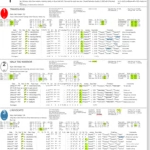

✓ Positives:(1) Dropping in class today ($16,000 → $10,000). (2) Hot trainer - high ITM rate (32%). (3) Hot jockey — high ITM rate (31%). (4) Switching turf-to-dirt with a strong turf pedigree rating (105) — pedigree suggests main-track improvement is likely. (5) Career-best figure (73) buried in races 4–10 back — 20 pts above race median and 7 pts above recent form — market has forgotten the peak effort. (6) Pick Pony Daily Edge Radar pick — value score 5/10 — angles: Hot Jockey, Hidden Figure, Class Drop, Pedigree-Backed Switch.