
Chart Guide (2.0.38)
- Bubbles
- Color = surface: green (turf), brown (dirt), blue (synthetic)
- Top number = finishing position; bottom number in parentheses = starting post position
- Height above line = beaten lengths — closer means a smaller margin
- Border = track conditions: green (FST/GD/FM), yellow (WF/SL/YLD), red (SY/MY/FRZ/SFT/HVY)
- Connecting Line
- Solid = good conditions; dashed = bad conditions
- Line Symbol
- ▲ Triangle = sprint (7f or less); ● Circle = route (more than 7f)
- Days Between Races
- Small number above each bubble (e.g. 19d) = days since the previous race — helps spot freshness, layoffs, and tight scheduling.
- Shaded Band (Bollinger)
- Highlights volatility — a wider band means more variation in recent performance
- Performance Trend
- Straight line showing the overall performance direction — angled up = improving, angled down = declining
- Dashed Reference Line
- AI Opponent = AI analysis class-level par for the race
⚠ Concerns:(1) Consider there will be likely pace pressure in this race - multiple E types entered. (2) Poor record at this distance (0 wins from 6 recent starts). (3) Trip note from last race: Ang off rail turn; bid.
Lane Bias Guide
- Bar Direction
- Bars above the line = more favorable lane • Bars below = less favorable, relative to the average at this track.
- Color
- Green = above-average advantage • Yellow = near-average • Red = below-average • Blue = this horse’s lane.
- Bias Score
- Derived from weighted average finishing positions across historical races at this track. Shown in the tooltip on hover. To use the bias score, calculate your handicap for the horse (e.g. finish position), then add (detrimental bias) or subtract (favorable bias) the bias score.
- Races
- Number of historical races used to compute each lane’s bias score.
Race Pace Bias Guide
- Bar Height & Direction
- Positive (green) = pace favors this horse • Negative (red) = pace works against this horse • Near-zero (amber) = neutral.
- Race Shape
- Projected race shape based on running styles of all horses (e.g. EE = two early horses, EP = one early presser).
- Pace Category
- FAST = contested early pace • LONE EARLY = one speed horse controlling pace • HONEST = moderate early pressure • SLOW = closers’ race.
- Flag (★)
- A star above the bar means this horse’s pace bias figure is ≥ 1.5 — a meaningful pace advantage or disadvantage.
Total Pace Guide
- Bar Segments
- Green = Early Pace (E1) • Amber = Mid Pace (E2) • Red = Late Pace (LP)
- Bar Height
- Total height = sum of E1 + E2 + LP average pace figures. Taller bars indicate a faster-paced horse overall.
- Grades & Rankings
- Hover to see each horse’s letter grade and ranking vs. other horses in this race (e.g. 2/9 = 2nd best of 9).
- Border
- Thicker border = this horse’s post position.
Performance vs. Peers Guide
- Bars (per post)
- Blue = avg career performance • Amber = avg last 3 races • Green = last race (improved vs. avg) • Red = last race (declined vs. avg)
- Trend Line
- Angled line above the bars: rising = improving form • falling = declining form.
- Horizontal Line
- Field average — the mean career performance of all horses in this race.
- Color Circles
- Standard post-position colors below each lane — same as the Total Pace chart.
- Border
- Thicker border = this horse’s post position.
Figure Comparison
- Rating
- The three Pick Pony algorithm ratings (Algo 1, Algo 2, Algo 3) that make up the overall PP AI Rating — higher is a stronger contender rating.
- Speed
- Career average speed, recent 3-race average, and last-race speed figure — spot horses in improving or declining form.
- Pace
- Average Early (E1), Mid (E2), and Stretch (LP) pace figures — reveals pace-setters vs. closers vs. all-the-way types.
- This horse
- The horse whose stats card is open is highlighted with a darker column background.
Winning Profiles
- Axes
- X: Win % from last 10 starts — Y: In-the-money % (top-3 finishes) from last 10 starts.
- Quadrants
- Consistent Winners (top-right): high win & ITM — reliable performers.
Place Threats (top-left): boards often but doesn’t win often — good exacta/trifecta angles.
Streaky (bottom-right): wins occasionally, misses the board often — all-or-nothing.
Developing (bottom-left): still finding form — longshot territory. - Reference Lines
- Dashed lines mark field averages. Dots to the right win more; dots higher board more.
- This horse
- Highlighted with a gold border and larger dot.
Race Pace Simulation Guide
- Slider
- Drag left→right to advance from gate to finish. Drag all the way back to reset the race.
- Predicted Finish Order
- Factors in contested pace burn, each horse’s effort curve (peaked-early vs. peaked-late), and wide trip cost from outside posts. Updated live when Track Bias changes.
- Pace Scenario
- Lone Speed: single E horse likely rates and holds. Contested: two E horses burn each other — closers benefit. Hot Pace: speed meltdown, deep closers thrive. Soft: no early speed, moderate fractions throughout.
- Track Bias
- Slider below canvas. −2 = strong closer/wet bias; +2 = strong speed/rail bias. Recomputes the predicted finish order.
- Boxed Indicator
- Dashed orange ring = horse is surrounded (rival ahead, rival behind, wall outside). In a real race this horse must find a clear path to run.
- Running Styles
- E/EE = early speed (rushes to rail). P = presser (stalks the pace). S = stalker. SS = slow starter / closer.
| Stat | vs. Current Card | vs. All Horses |
|---|---|---|
| Averages
Career-average metrics across all AI race analysis. Performance and pace averages reflect estimated historical performance; trainer and jockey grades score in-the-money percentages. Grading scale: A = elite • B = above average • C = average • D = below average • F = poor • — = no data |
||
| Pick Pony AI Rating | B | C |
| Pace Trip Longshot | — | — |
| Connections Longshot | — | — |
| Situational Longshot | — | — |
| Speed | C | D |
| Early Pace | C | B |
| Mid Pace | C | C |
| Late Pace | C | D |
| Finish Pos | B | C |
| Dirt Speed | A | A |
| Turf Speed | A | A |
| Distance Speed | A | A |
| Trainer Effectiveness | B | C |
| Jockey Effectiveness | F | D |
| 3rd Party Ratings | A | C |
| Recent
Performance analysis from the horse's recent races, weighted to reflect current form. Sprint and Route FPS (Foot Per Second) measure pace efficiency over the horse's recent sprints and routes respectively. Grading scale: A = elite • B = above average • C = average • D = below average • F = poor • — = no data |
||
| Speed | B | D |
| Early Pace | A | B |
| Mid Pace | B | C |
| Late Pace | B | C |
| Sprint FPS | A | A |
| Route FPS | A | A |
| Trainer Effectiveness | B | C |
| Jockey Effectiveness | F | D |
| 3rd Party Ratings | A | C |
| Predictions
AI-generated projections for the upcoming race, derived from prior AI analysis for speed and pace trends, surface and distance suitability, and current conditions. Grading scale: A = elite • B = above average • C = average • D = below average • F = poor • — = no data |
||
| Speed | C | D |
| Early Pace | B | B |
| Mid Pace | D | C |
| Late Pace | C | C |
Mod1(W): 82 (1/8) Mod2(W): 75 (2/8) Mod3(W): 79 (3/8) Mod1-LS: 55 (6/8) Win Prob: 18.4% Value Score: 1.35 ★
AI Model Comparison
- Winner Models (green)
- Mod1(W), Mod2(W), and Mod3(W) trained to predict race winners. Higher score = stronger contender.
- Longshot Models (red)
- Mod1-LS, Mod2-LS, and Mod3-LS trained to find high-value longshots. Higher score = stronger longshot candidate.
- Form Model (blue)
- Mod4 sequence model trained on recent form patterns. Higher score = stronger recent form profile.
- This horse
- Highlighted with a darker column background.
Chart Guide (2.0.38)
- Bubbles
- Color = surface: green (turf), brown (dirt), blue (synthetic)
- Top number = finishing position; bottom number in parentheses = starting post position
- Height above line = beaten lengths — closer means a smaller margin
- Border = track conditions: green (FST/GD/FM), yellow (WF/SL/YLD), red (SY/MY/FRZ/SFT/HVY)
- Connecting Line
- Solid = good conditions; dashed = bad conditions
- Line Symbol
- ▲ Triangle = sprint (7f or less); ● Circle = route (more than 7f)
- Days Between Races
- Small number above each bubble (e.g. 19d) = days since the previous race — helps spot freshness, layoffs, and tight scheduling.
- Shaded Band (Bollinger)
- Highlights volatility — a wider band means more variation in recent performance
- Performance Trend
- Straight line showing the overall performance direction — angled up = improving, angled down = declining
- Dashed Reference Line
- AI Opponent = AI analysis class-level par for the race
✓ Positives:(1) Hot trainer - high ITM rate (42%). (2) Hot jockey — high ITM rate (51%). (3) Has won at today's distance (1320 yds) within the last 10 starts — proven ability at this trip. (4) Has won at MVR on dirt in the last 10 starts — proven at today's exact track/surface combo. (5) Averages 68.8 speed pts in today's distance/surface configuration vs 60.8 in other configs (6 qualifying starts) — returning to ideal setup. (6) Pick Pony Daily Edge Radar pick — value score 6/10 — angles: Won Here Before, Hot Trainer, Won at This Distance, Hot Jockey, Return to Proven Setup.
⚠ Concerns:(1) Consider there will be likely pace pressure in this race - multiple E types entered. (2) 0 wins from 11 career starts on off tracks. (3) Trip note from last race: Forward 3 wide; empty.
Lane Bias Guide
- Bar Direction
- Bars above the line = more favorable lane • Bars below = less favorable, relative to the average at this track.
- Color
- Green = above-average advantage • Yellow = near-average • Red = below-average • Blue = this horse’s lane.
- Bias Score
- Derived from weighted average finishing positions across historical races at this track. Shown in the tooltip on hover. To use the bias score, calculate your handicap for the horse (e.g. finish position), then add (detrimental bias) or subtract (favorable bias) the bias score.
- Races
- Number of historical races used to compute each lane’s bias score.
Race Pace Bias Guide
- Bar Height & Direction
- Positive (green) = pace favors this horse • Negative (red) = pace works against this horse • Near-zero (amber) = neutral.
- Race Shape
- Projected race shape based on running styles of all horses (e.g. EE = two early horses, EP = one early presser).
- Pace Category
- FAST = contested early pace • LONE EARLY = one speed horse controlling pace • HONEST = moderate early pressure • SLOW = closers’ race.
- Flag (★)
- A star above the bar means this horse’s pace bias figure is ≥ 1.5 — a meaningful pace advantage or disadvantage.
Total Pace Guide
- Bar Segments
- Green = Early Pace (E1) • Amber = Mid Pace (E2) • Red = Late Pace (LP)
- Bar Height
- Total height = sum of E1 + E2 + LP average pace figures. Taller bars indicate a faster-paced horse overall.
- Grades & Rankings
- Hover to see each horse’s letter grade and ranking vs. other horses in this race (e.g. 2/9 = 2nd best of 9).
- Border
- Thicker border = this horse’s post position.
Performance vs. Peers Guide
- Bars (per post)
- Blue = avg career performance • Amber = avg last 3 races • Green = last race (improved vs. avg) • Red = last race (declined vs. avg)
- Trend Line
- Angled line above the bars: rising = improving form • falling = declining form.
- Horizontal Line
- Field average — the mean career performance of all horses in this race.
- Color Circles
- Standard post-position colors below each lane — same as the Total Pace chart.
- Border
- Thicker border = this horse’s post position.
Figure Comparison
- Rating
- The three Pick Pony algorithm ratings (Algo 1, Algo 2, Algo 3) that make up the overall PP AI Rating — higher is a stronger contender rating.
- Speed
- Career average speed, recent 3-race average, and last-race speed figure — spot horses in improving or declining form.
- Pace
- Average Early (E1), Mid (E2), and Stretch (LP) pace figures — reveals pace-setters vs. closers vs. all-the-way types.
- This horse
- The horse whose stats card is open is highlighted with a darker column background.
Winning Profiles
- Axes
- X: Win % from last 10 starts — Y: In-the-money % (top-3 finishes) from last 10 starts.
- Quadrants
- Consistent Winners (top-right): high win & ITM — reliable performers.
Place Threats (top-left): boards often but doesn’t win often — good exacta/trifecta angles.
Streaky (bottom-right): wins occasionally, misses the board often — all-or-nothing.
Developing (bottom-left): still finding form — longshot territory. - Reference Lines
- Dashed lines mark field averages. Dots to the right win more; dots higher board more.
- This horse
- Highlighted with a gold border and larger dot.
Race Pace Simulation Guide
- Slider
- Drag left→right to advance from gate to finish. Drag all the way back to reset the race.
- Predicted Finish Order
- Factors in contested pace burn, each horse’s effort curve (peaked-early vs. peaked-late), and wide trip cost from outside posts. Updated live when Track Bias changes.
- Pace Scenario
- Lone Speed: single E horse likely rates and holds. Contested: two E horses burn each other — closers benefit. Hot Pace: speed meltdown, deep closers thrive. Soft: no early speed, moderate fractions throughout.
- Track Bias
- Slider below canvas. −2 = strong closer/wet bias; +2 = strong speed/rail bias. Recomputes the predicted finish order.
- Boxed Indicator
- Dashed orange ring = horse is surrounded (rival ahead, rival behind, wall outside). In a real race this horse must find a clear path to run.
- Running Styles
- E/EE = early speed (rushes to rail). P = presser (stalks the pace). S = stalker. SS = slow starter / closer.
| Stat | vs. Current Card | vs. All Horses |
|---|---|---|
| Averages
Career-average metrics across all AI race analysis. Performance and pace averages reflect estimated historical performance; trainer and jockey grades score in-the-money percentages. Grading scale: A = elite • B = above average • C = average • D = below average • F = poor • — = no data |
||
| Pick Pony AI Rating | A | A |
| Pace Trip Longshot | — | — |
| Connections Longshot | — | — |
| Situational Longshot | — | — |
| Speed | A | D |
| Early Pace | A | B |
| Mid Pace | A | B |
| Late Pace | B | C |
| Finish Pos | A | B |
| Dirt Speed | B | B |
| Turf Speed | B | B |
| Distance Speed | A | B |
| Trainer Effectiveness | A | C |
| Jockey Effectiveness | A | A |
| 3rd Party Ratings | A | C |
| Recent
Performance analysis from the horse's recent races, weighted to reflect current form. Sprint and Route FPS (Foot Per Second) measure pace efficiency over the horse's recent sprints and routes respectively. Grading scale: A = elite • B = above average • C = average • D = below average • F = poor • — = no data |
||
| Speed | A | D |
| Early Pace | A | B |
| Mid Pace | A | C |
| Late Pace | A | B |
| Sprint FPS | B | B |
| Route FPS | B | A |
| Trainer Effectiveness | A | C |
| Jockey Effectiveness | A | A |
| 3rd Party Ratings | A | C |
| Predictions
AI-generated projections for the upcoming race, derived from prior AI analysis for speed and pace trends, surface and distance suitability, and current conditions. Grading scale: A = elite • B = above average • C = average • D = below average • F = poor • — = no data |
||
| Speed | A | D |
| Early Pace | A | B |
| Mid Pace | A | B |
| Late Pace | C | C |
Mod1(W): 82 (1/8) Mod2(W): 75 (2/8) Mod3(W): 79 (3/8) Mod1-LS: 55 (6/8) Win Prob: 18.4% Value Score: 1.35 ★
AI Model Comparison
- Winner Models (green)
- Mod1(W), Mod2(W), and Mod3(W) trained to predict race winners. Higher score = stronger contender.
- Longshot Models (red)
- Mod1-LS, Mod2-LS, and Mod3-LS trained to find high-value longshots. Higher score = stronger longshot candidate.
- Form Model (blue)
- Mod4 sequence model trained on recent form patterns. Higher score = stronger recent form profile.
- This horse
- Highlighted with a darker column background.
Chart Guide (2.0.38)
- Bubbles
- Color = surface: green (turf), brown (dirt), blue (synthetic)
- Top number = finishing position; bottom number in parentheses = starting post position
- Height above line = beaten lengths — closer means a smaller margin
- Border = track conditions: green (FST/GD/FM), yellow (WF/SL/YLD), red (SY/MY/FRZ/SFT/HVY)
- Connecting Line
- Solid = good conditions; dashed = bad conditions
- Line Symbol
- ▲ Triangle = sprint (7f or less); ● Circle = route (more than 7f)
- Days Between Races
- Small number above each bubble (e.g. 19d) = days since the previous race — helps spot freshness, layoffs, and tight scheduling.
- Shaded Band (Bollinger)
- Highlights volatility — a wider band means more variation in recent performance
- Performance Trend
- Straight line showing the overall performance direction — angled up = improving, angled down = declining
- Dashed Reference Line
- AI Opponent = AI analysis class-level par for the race
✓ Positives:(1) Hot trainer - high ITM rate (36%). (2) Hot jockey — high ITM rate (40%). (3) In the money in last 3 consecutive starts. (4) Late pace significantly above field median (LP: 77 vs field 69). (5) Closer/presser in a race with pace pressure — ideal race setup for late runners. (6) Strong speed 2 back (73), modest dip last out (61) — form reversal angle, ready to bounce back to top form. (7) Has won at today's distance (1320 yds) within the last 10 starts — proven ability at this trip. (8) Has won at MVR on dirt in the last 10 starts — proven at today's exact track/surface combo. (9) Had documented trouble last race (codes: ['B', 'D', 'S', 'T', 'U']) yet still finished 3rd — a clean trip today sets up a form reversal. (10) Pick Pony Daily Edge Radar pick — value score 8/10 — angles: Consistent In-The-Money, Won Here Before, Closer in Pace Duel, Form Reversal, Won at This Distance, Troubled Trip Comeback, Late Kick Advantage.
⚠ Concerns:(1) Consider there will be likely pace pressure in this race - multiple E types entered. (2) Trip note from last race: Bumped st; 5wd bid. (3) Speed figures are highly erratic over last 5 starts (σ = 10.8 pts: [61, 73, 70, 47, 54]) — unpredictable performer.
Lane Bias Guide
- Bar Direction
- Bars above the line = more favorable lane • Bars below = less favorable, relative to the average at this track.
- Color
- Green = above-average advantage • Yellow = near-average • Red = below-average • Blue = this horse’s lane.
- Bias Score
- Derived from weighted average finishing positions across historical races at this track. Shown in the tooltip on hover. To use the bias score, calculate your handicap for the horse (e.g. finish position), then add (detrimental bias) or subtract (favorable bias) the bias score.
- Races
- Number of historical races used to compute each lane’s bias score.
Race Pace Bias Guide
- Bar Height & Direction
- Positive (green) = pace favors this horse • Negative (red) = pace works against this horse • Near-zero (amber) = neutral.
- Race Shape
- Projected race shape based on running styles of all horses (e.g. EE = two early horses, EP = one early presser).
- Pace Category
- FAST = contested early pace • LONE EARLY = one speed horse controlling pace • HONEST = moderate early pressure • SLOW = closers’ race.
- Flag (★)
- A star above the bar means this horse’s pace bias figure is ≥ 1.5 — a meaningful pace advantage or disadvantage.
Total Pace Guide
- Bar Segments
- Green = Early Pace (E1) • Amber = Mid Pace (E2) • Red = Late Pace (LP)
- Bar Height
- Total height = sum of E1 + E2 + LP average pace figures. Taller bars indicate a faster-paced horse overall.
- Grades & Rankings
- Hover to see each horse’s letter grade and ranking vs. other horses in this race (e.g. 2/9 = 2nd best of 9).
- Border
- Thicker border = this horse’s post position.
Performance vs. Peers Guide
- Bars (per post)
- Blue = avg career performance • Amber = avg last 3 races • Green = last race (improved vs. avg) • Red = last race (declined vs. avg)
- Trend Line
- Angled line above the bars: rising = improving form • falling = declining form.
- Horizontal Line
- Field average — the mean career performance of all horses in this race.
- Color Circles
- Standard post-position colors below each lane — same as the Total Pace chart.
- Border
- Thicker border = this horse’s post position.
Figure Comparison
- Rating
- The three Pick Pony algorithm ratings (Algo 1, Algo 2, Algo 3) that make up the overall PP AI Rating — higher is a stronger contender rating.
- Speed
- Career average speed, recent 3-race average, and last-race speed figure — spot horses in improving or declining form.
- Pace
- Average Early (E1), Mid (E2), and Stretch (LP) pace figures — reveals pace-setters vs. closers vs. all-the-way types.
- This horse
- The horse whose stats card is open is highlighted with a darker column background.
Winning Profiles
- Axes
- X: Win % from last 10 starts — Y: In-the-money % (top-3 finishes) from last 10 starts.
- Quadrants
- Consistent Winners (top-right): high win & ITM — reliable performers.
Place Threats (top-left): boards often but doesn’t win often — good exacta/trifecta angles.
Streaky (bottom-right): wins occasionally, misses the board often — all-or-nothing.
Developing (bottom-left): still finding form — longshot territory. - Reference Lines
- Dashed lines mark field averages. Dots to the right win more; dots higher board more.
- This horse
- Highlighted with a gold border and larger dot.
Race Pace Simulation Guide
- Slider
- Drag left→right to advance from gate to finish. Drag all the way back to reset the race.
- Predicted Finish Order
- Factors in contested pace burn, each horse’s effort curve (peaked-early vs. peaked-late), and wide trip cost from outside posts. Updated live when Track Bias changes.
- Pace Scenario
- Lone Speed: single E horse likely rates and holds. Contested: two E horses burn each other — closers benefit. Hot Pace: speed meltdown, deep closers thrive. Soft: no early speed, moderate fractions throughout.
- Track Bias
- Slider below canvas. −2 = strong closer/wet bias; +2 = strong speed/rail bias. Recomputes the predicted finish order.
- Boxed Indicator
- Dashed orange ring = horse is surrounded (rival ahead, rival behind, wall outside). In a real race this horse must find a clear path to run.
- Running Styles
- E/EE = early speed (rushes to rail). P = presser (stalks the pace). S = stalker. SS = slow starter / closer.
| Stat | vs. Current Card | vs. All Horses |
|---|---|---|
| Averages
Career-average metrics across all AI race analysis. Performance and pace averages reflect estimated historical performance; trainer and jockey grades score in-the-money percentages. Grading scale: A = elite • B = above average • C = average • D = below average • F = poor • — = no data |
||
| Pick Pony AI Rating | A | C |
| Pace Trip Longshot | — | — |
| Connections Longshot | — | — |
| Situational Longshot | — | — |
| Speed | B | D |
| Early Pace | D | C |
| Mid Pace | D | C |
| Late Pace | A | B |
| Finish Pos | A | C |
| Dirt Speed | C | B |
| Turf Speed | F | C |
| Distance Speed | B | B |
| Trainer Effectiveness | C | D |
| Jockey Effectiveness | B | C |
| 3rd Party Ratings | C | D |
| Recent
Performance analysis from the horse's recent races, weighted to reflect current form. Sprint and Route FPS (Foot Per Second) measure pace efficiency over the horse's recent sprints and routes respectively. Grading scale: A = elite • B = above average • C = average • D = below average • F = poor • — = no data |
||
| Speed | A | C |
| Early Pace | D | C |
| Mid Pace | C | C |
| Late Pace | A | A |
| Sprint FPS | D | D |
| Route FPS | D | C |
| Trainer Effectiveness | C | D |
| Jockey Effectiveness | B | C |
| 3rd Party Ratings | C | D |
| Predictions
AI-generated projections for the upcoming race, derived from prior AI analysis for speed and pace trends, surface and distance suitability, and current conditions. Grading scale: A = elite • B = above average • C = average • D = below average • F = poor • — = no data |
||
| Speed | B | D |
| Early Pace | D | C |
| Mid Pace | C | C |
| Late Pace | C | C |
Mod1(W): 82 (1/8) Mod2(W): 75 (2/8) Mod3(W): 79 (3/8) Mod1-LS: 55 (6/8) Win Prob: 18.4% Value Score: 1.35 ★
AI Model Comparison
- Winner Models (green)
- Mod1(W), Mod2(W), and Mod3(W) trained to predict race winners. Higher score = stronger contender.
- Longshot Models (red)
- Mod1-LS, Mod2-LS, and Mod3-LS trained to find high-value longshots. Higher score = stronger longshot candidate.
- Form Model (blue)
- Mod4 sequence model trained on recent form patterns. Higher score = stronger recent form profile.
- This horse
- Highlighted with a darker column background.
Chart Guide (2.0.38)
- Bubbles
- Color = surface: green (turf), brown (dirt), blue (synthetic)
- Top number = finishing position; bottom number in parentheses = starting post position
- Height above line = beaten lengths — closer means a smaller margin
- Border = track conditions: green (FST/GD/FM), yellow (WF/SL/YLD), red (SY/MY/FRZ/SFT/HVY)
- Connecting Line
- Solid = good conditions; dashed = bad conditions
- Line Symbol
- ▲ Triangle = sprint (7f or less); ● Circle = route (more than 7f)
- Days Between Races
- Small number above each bubble (e.g. 19d) = days since the previous race — helps spot freshness, layoffs, and tight scheduling.
- Shaded Band (Bollinger)
- Highlights volatility — a wider band means more variation in recent performance
- Performance Trend
- Straight line showing the overall performance direction — angled up = improving, angled down = declining
- Dashed Reference Line
- AI Opponent = AI analysis class-level par for the race
✓ Positives:(1) Hot trainer - high ITM rate (37%). (2) Hot jockey — high ITM rate (40%). (3) Fourth race back from a 49-day layoff — often the peak fitness race. (4) Carries 5 lbs less than field median (119 lbs vs median 124 lbs). (5) Pick Pony Daily Edge Radar pick — value score 4/10 — angles: Hot Trainer, Weight Advantage, Classic Fourth Race Pattern.
⚠ Concerns:(1) Consider there will be likely pace pressure in this race - multiple E types entered. (2) Poor record at this track (0 wins from 6 starts). (3) Tends to fade in the stretch at similar distances (2 of 3 starts). (4) Trip note from last race: Chased 4 wide; tired. (5) 0 wins from post 4 in 3 recent starts. (6) Speed figures are highly erratic over last 5 starts (σ = 8.5 pts: [50, 64, 72, 57, 66]) — unpredictable performer.
Lane Bias Guide
- Bar Direction
- Bars above the line = more favorable lane • Bars below = less favorable, relative to the average at this track.
- Color
- Green = above-average advantage • Yellow = near-average • Red = below-average • Blue = this horse’s lane.
- Bias Score
- Derived from weighted average finishing positions across historical races at this track. Shown in the tooltip on hover. To use the bias score, calculate your handicap for the horse (e.g. finish position), then add (detrimental bias) or subtract (favorable bias) the bias score.
- Races
- Number of historical races used to compute each lane’s bias score.
Race Pace Bias Guide
- Bar Height & Direction
- Positive (green) = pace favors this horse • Negative (red) = pace works against this horse • Near-zero (amber) = neutral.
- Race Shape
- Projected race shape based on running styles of all horses (e.g. EE = two early horses, EP = one early presser).
- Pace Category
- FAST = contested early pace • LONE EARLY = one speed horse controlling pace • HONEST = moderate early pressure • SLOW = closers’ race.
- Flag (★)
- A star above the bar means this horse’s pace bias figure is ≥ 1.5 — a meaningful pace advantage or disadvantage.
Total Pace Guide
- Bar Segments
- Green = Early Pace (E1) • Amber = Mid Pace (E2) • Red = Late Pace (LP)
- Bar Height
- Total height = sum of E1 + E2 + LP average pace figures. Taller bars indicate a faster-paced horse overall.
- Grades & Rankings
- Hover to see each horse’s letter grade and ranking vs. other horses in this race (e.g. 2/9 = 2nd best of 9).
- Border
- Thicker border = this horse’s post position.
Performance vs. Peers Guide
- Bars (per post)
- Blue = avg career performance • Amber = avg last 3 races • Green = last race (improved vs. avg) • Red = last race (declined vs. avg)
- Trend Line
- Angled line above the bars: rising = improving form • falling = declining form.
- Horizontal Line
- Field average — the mean career performance of all horses in this race.
- Color Circles
- Standard post-position colors below each lane — same as the Total Pace chart.
- Border
- Thicker border = this horse’s post position.
Figure Comparison
- Rating
- The three Pick Pony algorithm ratings (Algo 1, Algo 2, Algo 3) that make up the overall PP AI Rating — higher is a stronger contender rating.
- Speed
- Career average speed, recent 3-race average, and last-race speed figure — spot horses in improving or declining form.
- Pace
- Average Early (E1), Mid (E2), and Stretch (LP) pace figures — reveals pace-setters vs. closers vs. all-the-way types.
- This horse
- The horse whose stats card is open is highlighted with a darker column background.
Winning Profiles
- Axes
- X: Win % from last 10 starts — Y: In-the-money % (top-3 finishes) from last 10 starts.
- Quadrants
- Consistent Winners (top-right): high win & ITM — reliable performers.
Place Threats (top-left): boards often but doesn’t win often — good exacta/trifecta angles.
Streaky (bottom-right): wins occasionally, misses the board often — all-or-nothing.
Developing (bottom-left): still finding form — longshot territory. - Reference Lines
- Dashed lines mark field averages. Dots to the right win more; dots higher board more.
- This horse
- Highlighted with a gold border and larger dot.
Race Pace Simulation Guide
- Slider
- Drag left→right to advance from gate to finish. Drag all the way back to reset the race.
- Predicted Finish Order
- Factors in contested pace burn, each horse’s effort curve (peaked-early vs. peaked-late), and wide trip cost from outside posts. Updated live when Track Bias changes.
- Pace Scenario
- Lone Speed: single E horse likely rates and holds. Contested: two E horses burn each other — closers benefit. Hot Pace: speed meltdown, deep closers thrive. Soft: no early speed, moderate fractions throughout.
- Track Bias
- Slider below canvas. −2 = strong closer/wet bias; +2 = strong speed/rail bias. Recomputes the predicted finish order.
- Boxed Indicator
- Dashed orange ring = horse is surrounded (rival ahead, rival behind, wall outside). In a real race this horse must find a clear path to run.
- Running Styles
- E/EE = early speed (rushes to rail). P = presser (stalks the pace). S = stalker. SS = slow starter / closer.
| Stat | vs. Current Card | vs. All Horses |
|---|---|---|
| Averages
Career-average metrics across all AI race analysis. Performance and pace averages reflect estimated historical performance; trainer and jockey grades score in-the-money percentages. Grading scale: A = elite • B = above average • C = average • D = below average • F = poor • — = no data |
||
| Pick Pony AI Rating | C | C |
| Pace Trip Longshot | — | — |
| Connections Longshot | — | — |
| Situational Longshot | — | — |
| Speed | A | D |
| Early Pace | B | B |
| Mid Pace | A | B |
| Late Pace | D | D |
| Finish Pos | D | D |
| Dirt Speed | B | B |
| Turf Speed | A | B |
| Distance Speed | C | C |
| Trainer Effectiveness | B | C |
| Jockey Effectiveness | C | C |
| 3rd Party Ratings | B | D |
| Recent
Performance analysis from the horse's recent races, weighted to reflect current form. Sprint and Route FPS (Foot Per Second) measure pace efficiency over the horse's recent sprints and routes respectively. Grading scale: A = elite • B = above average • C = average • D = below average • F = poor • — = no data |
||
| Speed | C | D |
| Early Pace | B | B |
| Mid Pace | A | C |
| Late Pace | D | C |
| Sprint FPS | A | A |
| Route FPS | A | A |
| Trainer Effectiveness | B | C |
| Jockey Effectiveness | C | C |
| 3rd Party Ratings | B | D |
| Predictions
AI-generated projections for the upcoming race, derived from prior AI analysis for speed and pace trends, surface and distance suitability, and current conditions. Grading scale: A = elite • B = above average • C = average • D = below average • F = poor • — = no data |
||
| Speed | A | D |
| Early Pace | C | B |
| Mid Pace | B | B |
| Late Pace | C | C |
Mod1(W): 82 (1/8) Mod2(W): 75 (2/8) Mod3(W): 79 (3/8) Mod1-LS: 55 (6/8) Win Prob: 18.4% Value Score: 1.35 ★
AI Model Comparison
- Winner Models (green)
- Mod1(W), Mod2(W), and Mod3(W) trained to predict race winners. Higher score = stronger contender.
- Longshot Models (red)
- Mod1-LS, Mod2-LS, and Mod3-LS trained to find high-value longshots. Higher score = stronger longshot candidate.
- Form Model (blue)
- Mod4 sequence model trained on recent form patterns. Higher score = stronger recent form profile.
- This horse
- Highlighted with a darker column background.
Chart Guide (2.0.38)
- Bubbles
- Color = surface: green (turf), brown (dirt), blue (synthetic)
- Top number = finishing position; bottom number in parentheses = starting post position
- Height above line = beaten lengths — closer means a smaller margin
- Border = track conditions: green (FST/GD/FM), yellow (WF/SL/YLD), red (SY/MY/FRZ/SFT/HVY)
- Connecting Line
- Solid = good conditions; dashed = bad conditions
- Line Symbol
- ▲ Triangle = sprint (7f or less); ● Circle = route (more than 7f)
- Days Between Races
- Small number above each bubble (e.g. 19d) = days since the previous race — helps spot freshness, layoffs, and tight scheduling.
- Shaded Band (Bollinger)
- Highlights volatility — a wider band means more variation in recent performance
- Performance Trend
- Straight line showing the overall performance direction — angled up = improving, angled down = declining
- Dashed Reference Line
- AI Opponent = AI analysis class-level par for the race
✓ Positives:(1) Hot trainer - high ITM rate (33%). (2) Hot jockey — high ITM rate (43%). (3) Has a bullet work (fastest at track that day) — sharp conditioning signal. (4) Closer/presser in a race with pace pressure — ideal race setup for late runners. (5) Dropping in class ($4,000 vs last $5,000) after a 76-day freshening — trainer setup-for-win angle. (6) Returning from 76-day layoff with a bullet workout — trainer signaling extra readiness for today's spot. (7) Last race E1 pace (93.0) was 8.0 pts above personal avg (85.0) and horse still finished 6th — pace collapse victim; expect bounce if today's fractions are softer. (8) Pick Pony Daily Edge Radar pick — value score 8/10 — angles: Class Drop After Rest, Bullet Workout, Closer in Pace Duel, Pace Collapse Victim, Sharp Return Workout, Hot Jockey.
⚠ Concerns:(1) Has not raced in 76 days. (2) Consider there will be likely pace pressure in this race - multiple E types entered. (3) Speed average (55) well below field median (62). (4) Limited experience at today's distance (2 starts). (5) Moving from a route to a sprint today. (6) Trip note from last race: Bmp brk;2p;tired. (7) Speed figures are highly erratic over last 5 starts (σ = 9.1 pts: [51, 64, 42, 55, 63]) — unpredictable performer.
Lane Bias Guide
- Bar Direction
- Bars above the line = more favorable lane • Bars below = less favorable, relative to the average at this track.
- Color
- Green = above-average advantage • Yellow = near-average • Red = below-average • Blue = this horse’s lane.
- Bias Score
- Derived from weighted average finishing positions across historical races at this track. Shown in the tooltip on hover. To use the bias score, calculate your handicap for the horse (e.g. finish position), then add (detrimental bias) or subtract (favorable bias) the bias score.
- Races
- Number of historical races used to compute each lane’s bias score.
Race Pace Bias Guide
- Bar Height & Direction
- Positive (green) = pace favors this horse • Negative (red) = pace works against this horse • Near-zero (amber) = neutral.
- Race Shape
- Projected race shape based on running styles of all horses (e.g. EE = two early horses, EP = one early presser).
- Pace Category
- FAST = contested early pace • LONE EARLY = one speed horse controlling pace • HONEST = moderate early pressure • SLOW = closers’ race.
- Flag (★)
- A star above the bar means this horse’s pace bias figure is ≥ 1.5 — a meaningful pace advantage or disadvantage.
Total Pace Guide
- Bar Segments
- Green = Early Pace (E1) • Amber = Mid Pace (E2) • Red = Late Pace (LP)
- Bar Height
- Total height = sum of E1 + E2 + LP average pace figures. Taller bars indicate a faster-paced horse overall.
- Grades & Rankings
- Hover to see each horse’s letter grade and ranking vs. other horses in this race (e.g. 2/9 = 2nd best of 9).
- Border
- Thicker border = this horse’s post position.
Performance vs. Peers Guide
- Bars (per post)
- Blue = avg career performance • Amber = avg last 3 races • Green = last race (improved vs. avg) • Red = last race (declined vs. avg)
- Trend Line
- Angled line above the bars: rising = improving form • falling = declining form.
- Horizontal Line
- Field average — the mean career performance of all horses in this race.
- Color Circles
- Standard post-position colors below each lane — same as the Total Pace chart.
- Border
- Thicker border = this horse’s post position.
Figure Comparison
- Rating
- The three Pick Pony algorithm ratings (Algo 1, Algo 2, Algo 3) that make up the overall PP AI Rating — higher is a stronger contender rating.
- Speed
- Career average speed, recent 3-race average, and last-race speed figure — spot horses in improving or declining form.
- Pace
- Average Early (E1), Mid (E2), and Stretch (LP) pace figures — reveals pace-setters vs. closers vs. all-the-way types.
- This horse
- The horse whose stats card is open is highlighted with a darker column background.
Winning Profiles
- Axes
- X: Win % from last 10 starts — Y: In-the-money % (top-3 finishes) from last 10 starts.
- Quadrants
- Consistent Winners (top-right): high win & ITM — reliable performers.
Place Threats (top-left): boards often but doesn’t win often — good exacta/trifecta angles.
Streaky (bottom-right): wins occasionally, misses the board often — all-or-nothing.
Developing (bottom-left): still finding form — longshot territory. - Reference Lines
- Dashed lines mark field averages. Dots to the right win more; dots higher board more.
- This horse
- Highlighted with a gold border and larger dot.
Race Pace Simulation Guide
- Slider
- Drag left→right to advance from gate to finish. Drag all the way back to reset the race.
- Predicted Finish Order
- Factors in contested pace burn, each horse’s effort curve (peaked-early vs. peaked-late), and wide trip cost from outside posts. Updated live when Track Bias changes.
- Pace Scenario
- Lone Speed: single E horse likely rates and holds. Contested: two E horses burn each other — closers benefit. Hot Pace: speed meltdown, deep closers thrive. Soft: no early speed, moderate fractions throughout.
- Track Bias
- Slider below canvas. −2 = strong closer/wet bias; +2 = strong speed/rail bias. Recomputes the predicted finish order.
- Boxed Indicator
- Dashed orange ring = horse is surrounded (rival ahead, rival behind, wall outside). In a real race this horse must find a clear path to run.
- Running Styles
- E/EE = early speed (rushes to rail). P = presser (stalks the pace). S = stalker. SS = slow starter / closer.
| Stat | vs. Current Card | vs. All Horses |
|---|---|---|
| Averages
Career-average metrics across all AI race analysis. Performance and pace averages reflect estimated historical performance; trainer and jockey grades score in-the-money percentages. Grading scale: A = elite • B = above average • C = average • D = below average • F = poor • — = no data |
||
| Pick Pony AI Rating | D | F |
| Pace Trip Longshot | — | — |
| Connections Longshot | — | — |
| Situational Longshot | — | — |
| Speed | D | F |
| Early Pace | B | B |
| Mid Pace | B | B |
| Late Pace | F | D |
| Finish Pos | C | D |
| Dirt Speed | D | C |
| Turf Speed | D | C |
| Distance Speed | C | C |
| Trainer Effectiveness | F | D |
| Jockey Effectiveness | A | B |
| 3rd Party Ratings | D | D |
| Recent
Performance analysis from the horse's recent races, weighted to reflect current form. Sprint and Route FPS (Foot Per Second) measure pace efficiency over the horse's recent sprints and routes respectively. Grading scale: A = elite • B = above average • C = average • D = below average • F = poor • — = no data |
||
| Speed | F | F |
| Early Pace | C | C |
| Mid Pace | D | C |
| Late Pace | F | D |
| Sprint FPS | C | C |
| Route FPS | C | C |
| Trainer Effectiveness | F | D |
| Jockey Effectiveness | A | B |
| 3rd Party Ratings | D | D |
| Predictions
AI-generated projections for the upcoming race, derived from prior AI analysis for speed and pace trends, surface and distance suitability, and current conditions. Grading scale: A = elite • B = above average • C = average • D = below average • F = poor • — = no data |
||
| Speed | D | F |
| Early Pace | A | B |
| Mid Pace | A | B |
| Late Pace | C | C |
Mod1(W): 82 (1/8) Mod2(W): 75 (2/8) Mod3(W): 79 (3/8) Mod1-LS: 55 (6/8) Win Prob: 18.4% Value Score: 1.35 ★
AI Model Comparison
- Winner Models (green)
- Mod1(W), Mod2(W), and Mod3(W) trained to predict race winners. Higher score = stronger contender.
- Longshot Models (red)
- Mod1-LS, Mod2-LS, and Mod3-LS trained to find high-value longshots. Higher score = stronger longshot candidate.
- Form Model (blue)
- Mod4 sequence model trained on recent form patterns. Higher score = stronger recent form profile.
- This horse
- Highlighted with a darker column background.
Chart Guide (2.0.38)
- Bubbles
- Color = surface: green (turf), brown (dirt), blue (synthetic)
- Top number = finishing position; bottom number in parentheses = starting post position
- Height above line = beaten lengths — closer means a smaller margin
- Border = track conditions: green (FST/GD/FM), yellow (WF/SL/YLD), red (SY/MY/FRZ/SFT/HVY)
- Connecting Line
- Solid = good conditions; dashed = bad conditions
- Line Symbol
- ▲ Triangle = sprint (7f or less); ● Circle = route (more than 7f)
- Days Between Races
- Small number above each bubble (e.g. 19d) = days since the previous race — helps spot freshness, layoffs, and tight scheduling.
- Shaded Band (Bollinger)
- Highlights volatility — a wider band means more variation in recent performance
- Performance Trend
- Straight line showing the overall performance direction — angled up = improving, angled down = declining
- Dashed Reference Line
- AI Opponent = AI analysis class-level par for the race
✓ Positives:(1) Dropping in class today ($7,500 → $4,000). (2) Hot trainer - high ITM rate (36%). (3) Hot jockey — high ITM rate (37%). (4) Late pace significantly above field median (LP: 72 vs field 69). (5) Closer/presser in a race with pace pressure — ideal race setup for late runners. (6) Had documented trouble last race (codes: ['B', 'D', 'O', 'V']) yet still finished 3rd — a clean trip today sets up a form reversal. (7) Pick Pony Daily Edge Radar pick — value score 6/10 — angles: Closer in Pace Duel, Troubled Trip Comeback, Class Drop, Late Kick Advantage.
⚠ Concerns:(1) Consider there will be likely pace pressure in this race - multiple E types entered. (2) Speed average (53) well below field median (62). (3) Poor record at this distance (0 wins from 7 recent starts). (4) Trip note from last race: Bid3/8;4p;improved. (5) Consistently breaks behind post position (3 of last 5 starts). (6) Consistently runs wide at the first call (3 of last 5 starts). (7) 0 wins from 10 starts on dirt in last 10 — repeated failure on today's surface.
Lane Bias Guide
- Bar Direction
- Bars above the line = more favorable lane • Bars below = less favorable, relative to the average at this track.
- Color
- Green = above-average advantage • Yellow = near-average • Red = below-average • Blue = this horse’s lane.
- Bias Score
- Derived from weighted average finishing positions across historical races at this track. Shown in the tooltip on hover. To use the bias score, calculate your handicap for the horse (e.g. finish position), then add (detrimental bias) or subtract (favorable bias) the bias score.
- Races
- Number of historical races used to compute each lane’s bias score.
Race Pace Bias Guide
- Bar Height & Direction
- Positive (green) = pace favors this horse • Negative (red) = pace works against this horse • Near-zero (amber) = neutral.
- Race Shape
- Projected race shape based on running styles of all horses (e.g. EE = two early horses, EP = one early presser).
- Pace Category
- FAST = contested early pace • LONE EARLY = one speed horse controlling pace • HONEST = moderate early pressure • SLOW = closers’ race.
- Flag (★)
- A star above the bar means this horse’s pace bias figure is ≥ 1.5 — a meaningful pace advantage or disadvantage.
Total Pace Guide
- Bar Segments
- Green = Early Pace (E1) • Amber = Mid Pace (E2) • Red = Late Pace (LP)
- Bar Height
- Total height = sum of E1 + E2 + LP average pace figures. Taller bars indicate a faster-paced horse overall.
- Grades & Rankings
- Hover to see each horse’s letter grade and ranking vs. other horses in this race (e.g. 2/9 = 2nd best of 9).
- Border
- Thicker border = this horse’s post position.
Performance vs. Peers Guide
- Bars (per post)
- Blue = avg career performance • Amber = avg last 3 races • Green = last race (improved vs. avg) • Red = last race (declined vs. avg)
- Trend Line
- Angled line above the bars: rising = improving form • falling = declining form.
- Horizontal Line
- Field average — the mean career performance of all horses in this race.
- Color Circles
- Standard post-position colors below each lane — same as the Total Pace chart.
- Border
- Thicker border = this horse’s post position.
Figure Comparison
- Rating
- The three Pick Pony algorithm ratings (Algo 1, Algo 2, Algo 3) that make up the overall PP AI Rating — higher is a stronger contender rating.
- Speed
- Career average speed, recent 3-race average, and last-race speed figure — spot horses in improving or declining form.
- Pace
- Average Early (E1), Mid (E2), and Stretch (LP) pace figures — reveals pace-setters vs. closers vs. all-the-way types.
- This horse
- The horse whose stats card is open is highlighted with a darker column background.
Winning Profiles
- Axes
- X: Win % from last 10 starts — Y: In-the-money % (top-3 finishes) from last 10 starts.
- Quadrants
- Consistent Winners (top-right): high win & ITM — reliable performers.
Place Threats (top-left): boards often but doesn’t win often — good exacta/trifecta angles.
Streaky (bottom-right): wins occasionally, misses the board often — all-or-nothing.
Developing (bottom-left): still finding form — longshot territory. - Reference Lines
- Dashed lines mark field averages. Dots to the right win more; dots higher board more.
- This horse
- Highlighted with a gold border and larger dot.
Race Pace Simulation Guide
- Slider
- Drag left→right to advance from gate to finish. Drag all the way back to reset the race.
- Predicted Finish Order
- Factors in contested pace burn, each horse’s effort curve (peaked-early vs. peaked-late), and wide trip cost from outside posts. Updated live when Track Bias changes.
- Pace Scenario
- Lone Speed: single E horse likely rates and holds. Contested: two E horses burn each other — closers benefit. Hot Pace: speed meltdown, deep closers thrive. Soft: no early speed, moderate fractions throughout.
- Track Bias
- Slider below canvas. −2 = strong closer/wet bias; +2 = strong speed/rail bias. Recomputes the predicted finish order.
- Boxed Indicator
- Dashed orange ring = horse is surrounded (rival ahead, rival behind, wall outside). In a real race this horse must find a clear path to run.
- Running Styles
- E/EE = early speed (rushes to rail). P = presser (stalks the pace). S = stalker. SS = slow starter / closer.
| Stat | vs. Current Card | vs. All Horses |
|---|---|---|
| Averages
Career-average metrics across all AI race analysis. Performance and pace averages reflect estimated historical performance; trainer and jockey grades score in-the-money percentages. Grading scale: A = elite • B = above average • C = average • D = below average • F = poor • — = no data |
||
| Pick Pony AI Rating | F | F |
| Pace Trip Longshot | — | — |
| Connections Longshot | — | — |
| Situational Longshot | — | — |
| Speed | F | F |
| Early Pace | F | D |
| Mid Pace | F | D |
| Late Pace | A | C |
| Finish Pos | F | F |
| Dirt Speed | F | C |
| Turf Speed | C | C |
| Distance Speed | F | C |
| Trainer Effectiveness | D | D |
| Jockey Effectiveness | D | C |
| 3rd Party Ratings | F | D |
| Recent
Performance analysis from the horse's recent races, weighted to reflect current form. Sprint and Route FPS (Foot Per Second) measure pace efficiency over the horse's recent sprints and routes respectively. Grading scale: A = elite • B = above average • C = average • D = below average • F = poor • — = no data |
||
| Speed | D | F |
| Early Pace | F | D |
| Mid Pace | F | D |
| Late Pace | C | C |
| Sprint FPS | F | D |
| Route FPS | F | D |
| Trainer Effectiveness | D | D |
| Jockey Effectiveness | D | C |
| 3rd Party Ratings | F | D |
| Predictions
AI-generated projections for the upcoming race, derived from prior AI analysis for speed and pace trends, surface and distance suitability, and current conditions. Grading scale: A = elite • B = above average • C = average • D = below average • F = poor • — = no data |
||
| Speed | F | F |
| Early Pace | F | D |
| Mid Pace | F | D |
| Late Pace | C | C |
Mod1(W): 82 (1/8) Mod2(W): 75 (2/8) Mod3(W): 79 (3/8) Mod1-LS: 55 (6/8) Win Prob: 18.4% Value Score: 1.35 ★
AI Model Comparison
- Winner Models (green)
- Mod1(W), Mod2(W), and Mod3(W) trained to predict race winners. Higher score = stronger contender.
- Longshot Models (red)
- Mod1-LS, Mod2-LS, and Mod3-LS trained to find high-value longshots. Higher score = stronger longshot candidate.
- Form Model (blue)
- Mod4 sequence model trained on recent form patterns. Higher score = stronger recent form profile.
- This horse
- Highlighted with a darker column background.
Chart Guide (2.0.38)
- Bubbles
- Color = surface: green (turf), brown (dirt), blue (synthetic)
- Top number = finishing position; bottom number in parentheses = starting post position
- Height above line = beaten lengths — closer means a smaller margin
- Border = track conditions: green (FST/GD/FM), yellow (WF/SL/YLD), red (SY/MY/FRZ/SFT/HVY)
- Connecting Line
- Solid = good conditions; dashed = bad conditions
- Line Symbol
- ▲ Triangle = sprint (7f or less); ● Circle = route (more than 7f)
- Days Between Races
- Small number above each bubble (e.g. 19d) = days since the previous race — helps spot freshness, layoffs, and tight scheduling.
- Shaded Band (Bollinger)
- Highlights volatility — a wider band means more variation in recent performance
- Performance Trend
- Straight line showing the overall performance direction — angled up = improving, angled down = declining
- Dashed Reference Line
- AI Opponent = AI analysis class-level par for the race
✓ Positives:(1) Returning from 136-day layoff with a recent workout. (2) Hot trainer - high ITM rate (49%). (3) Strong trainer/jockey combo - 16 wins from 56 starts (29%). (4) Career-best speed figure (72) recorded in last 1-2 starts — peaking form. (5) Hot jockey — high ITM rate (58%). (6) Closer/presser in a race with pace pressure — ideal race setup for late runners. (7) Has won at today's distance (1320 yds) within the last 10 starts — proven ability at this trip. (8) Carries 8 lbs less than field median (116 lbs vs median 124 lbs). (9) Had documented trouble last race (codes: ['D', 'F', 'O', 'S', 'T', 'U', 'V']) yet still finished 4th — a clean trip today sets up a form reversal. (10) Pick Pony Daily Edge Radar pick — value score 9/10 — angles: Hot Trainer-Jockey Pairing, Career-Best Recent Figure, Closer in Pace Duel, Hot Trainer, Won at This Distance, Hot Jockey, Troubled Trip Comeback, Weight Advantage.
⚠ Concerns:(1) Has not raced in 136 days. (2) Consider there will be likely pace pressure in this race - multiple E types entered. (3) Moving from a route to a sprint today. (4) Trip note from last race: Svd grnd;outfnshd 3rd. (5) Consistently breaks behind post position (3 of last 5 starts).
Lane Bias Guide
- Bar Direction
- Bars above the line = more favorable lane • Bars below = less favorable, relative to the average at this track.
- Color
- Green = above-average advantage • Yellow = near-average • Red = below-average • Blue = this horse’s lane.
- Bias Score
- Derived from weighted average finishing positions across historical races at this track. Shown in the tooltip on hover. To use the bias score, calculate your handicap for the horse (e.g. finish position), then add (detrimental bias) or subtract (favorable bias) the bias score.
- Races
- Number of historical races used to compute each lane’s bias score.
Race Pace Bias Guide
- Bar Height & Direction
- Positive (green) = pace favors this horse • Negative (red) = pace works against this horse • Near-zero (amber) = neutral.
- Race Shape
- Projected race shape based on running styles of all horses (e.g. EE = two early horses, EP = one early presser).
- Pace Category
- FAST = contested early pace • LONE EARLY = one speed horse controlling pace • HONEST = moderate early pressure • SLOW = closers’ race.
- Flag (★)
- A star above the bar means this horse’s pace bias figure is ≥ 1.5 — a meaningful pace advantage or disadvantage.
Total Pace Guide
- Bar Segments
- Green = Early Pace (E1) • Amber = Mid Pace (E2) • Red = Late Pace (LP)
- Bar Height
- Total height = sum of E1 + E2 + LP average pace figures. Taller bars indicate a faster-paced horse overall.
- Grades & Rankings
- Hover to see each horse’s letter grade and ranking vs. other horses in this race (e.g. 2/9 = 2nd best of 9).
- Border
- Thicker border = this horse’s post position.
Performance vs. Peers Guide
- Bars (per post)
- Blue = avg career performance • Amber = avg last 3 races • Green = last race (improved vs. avg) • Red = last race (declined vs. avg)
- Trend Line
- Angled line above the bars: rising = improving form • falling = declining form.
- Horizontal Line
- Field average — the mean career performance of all horses in this race.
- Color Circles
- Standard post-position colors below each lane — same as the Total Pace chart.
- Border
- Thicker border = this horse’s post position.
Figure Comparison
- Rating
- The three Pick Pony algorithm ratings (Algo 1, Algo 2, Algo 3) that make up the overall PP AI Rating — higher is a stronger contender rating.
- Speed
- Career average speed, recent 3-race average, and last-race speed figure — spot horses in improving or declining form.
- Pace
- Average Early (E1), Mid (E2), and Stretch (LP) pace figures — reveals pace-setters vs. closers vs. all-the-way types.
- This horse
- The horse whose stats card is open is highlighted with a darker column background.
Winning Profiles
- Axes
- X: Win % from last 10 starts — Y: In-the-money % (top-3 finishes) from last 10 starts.
- Quadrants
- Consistent Winners (top-right): high win & ITM — reliable performers.
Place Threats (top-left): boards often but doesn’t win often — good exacta/trifecta angles.
Streaky (bottom-right): wins occasionally, misses the board often — all-or-nothing.
Developing (bottom-left): still finding form — longshot territory. - Reference Lines
- Dashed lines mark field averages. Dots to the right win more; dots higher board more.
- This horse
- Highlighted with a gold border and larger dot.
Race Pace Simulation Guide
- Slider
- Drag left→right to advance from gate to finish. Drag all the way back to reset the race.
- Predicted Finish Order
- Factors in contested pace burn, each horse’s effort curve (peaked-early vs. peaked-late), and wide trip cost from outside posts. Updated live when Track Bias changes.
- Pace Scenario
- Lone Speed: single E horse likely rates and holds. Contested: two E horses burn each other — closers benefit. Hot Pace: speed meltdown, deep closers thrive. Soft: no early speed, moderate fractions throughout.
- Track Bias
- Slider below canvas. −2 = strong closer/wet bias; +2 = strong speed/rail bias. Recomputes the predicted finish order.
- Boxed Indicator
- Dashed orange ring = horse is surrounded (rival ahead, rival behind, wall outside). In a real race this horse must find a clear path to run.
- Running Styles
- E/EE = early speed (rushes to rail). P = presser (stalks the pace). S = stalker. SS = slow starter / closer.
| Stat | vs. Current Card | vs. All Horses |
|---|---|---|
| Averages
Career-average metrics across all AI race analysis. Performance and pace averages reflect estimated historical performance; trainer and jockey grades score in-the-money percentages. Grading scale: A = elite • B = above average • C = average • D = below average • F = poor • — = no data |
||
| Pick Pony AI Rating | A | B |
| Pace Trip Longshot | — | — |
| Connections Longshot | — | — |
| Situational Longshot | — | — |
| Speed | A | C |
| Early Pace | C | C |
| Mid Pace | C | C |
| Late Pace | A | B |
| Finish Pos | A | B |
| Dirt Speed | C | C |
| Turf Speed | C | D |
| Distance Speed | C | C |
| Trainer Effectiveness | A | A |
| Jockey Effectiveness | A | A |
| 3rd Party Ratings | A | B |
| Recent
Performance analysis from the horse's recent races, weighted to reflect current form. Sprint and Route FPS (Foot Per Second) measure pace efficiency over the horse's recent sprints and routes respectively. Grading scale: A = elite • B = above average • C = average • D = below average • F = poor • — = no data |
||
| Speed | A | C |
| Early Pace | D | C |
| Mid Pace | D | C |
| Late Pace | A | B |
| Sprint FPS | C | D |
| Route FPS | F | D |
| Trainer Effectiveness | A | A |
| Jockey Effectiveness | A | A |
| 3rd Party Ratings | A | B |
| Predictions
AI-generated projections for the upcoming race, derived from prior AI analysis for speed and pace trends, surface and distance suitability, and current conditions. Grading scale: A = elite • B = above average • C = average • D = below average • F = poor • — = no data |
||
| Speed | A | D |
| Early Pace | C | C |
| Mid Pace | D | C |
| Late Pace | C | C |
Mod1(W): 82 (1/8) Mod2(W): 75 (2/8) Mod3(W): 79 (3/8) Mod1-LS: 55 (6/8) Win Prob: 18.4% Value Score: 1.35 ★
AI Model Comparison
- Winner Models (green)
- Mod1(W), Mod2(W), and Mod3(W) trained to predict race winners. Higher score = stronger contender.
- Longshot Models (red)
- Mod1-LS, Mod2-LS, and Mod3-LS trained to find high-value longshots. Higher score = stronger longshot candidate.
- Form Model (blue)
- Mod4 sequence model trained on recent form patterns. Higher score = stronger recent form profile.
- This horse
- Highlighted with a darker column background.
Chart Guide (2.0.38)
- Bubbles
- Color = surface: green (turf), brown (dirt), blue (synthetic)
- Top number = finishing position; bottom number in parentheses = starting post position
- Height above line = beaten lengths — closer means a smaller margin
- Border = track conditions: green (FST/GD/FM), yellow (WF/SL/YLD), red (SY/MY/FRZ/SFT/HVY)
- Connecting Line
- Solid = good conditions; dashed = bad conditions
- Line Symbol
- ▲ Triangle = sprint (7f or less); ● Circle = route (more than 7f)
- Days Between Races
- Small number above each bubble (e.g. 19d) = days since the previous race — helps spot freshness, layoffs, and tight scheduling.
- Shaded Band (Bollinger)
- Highlights volatility — a wider band means more variation in recent performance
- Performance Trend
- Straight line showing the overall performance direction — angled up = improving, angled down = declining
- Dashed Reference Line
- AI Opponent = AI analysis class-level par for the race
✓ Positives:(1) Hot trainer - high ITM rate (50%). (2) Big last-race effort (75) — 16 pts above recent average. (3) Hot jockey — high ITM rate (54%). (4) Early pace significantly above field median (E1: 89 vs field 85). (5) Has won at today's distance (1320 yds) within the last 10 starts — proven ability at this trip. (6) Outstanding wet-track record: 2W from 5 starts (40%) — thrives when the going is off. (7) Has won at MVR on dirt in the last 10 starts — proven at today's exact track/surface combo. (8) Had documented trouble last race (codes: ['D', 'S', 'V']) yet still finished 1st — a clean trip today sets up a form reversal. (9) Pick Pony Daily Edge Radar pick — value score 8/10 — angles: Big Last Effort, Won Here Before, Early Speed Edge, Hot Trainer, Off-Track Ace, Won at This Distance, Hot Jockey, Troubled Trip Comeback.
⚠ Concerns:(1) Has not raced in 55 days. (2) Consider there will be likely pace pressure in this race - multiple E types entered. (3) Tends to fade in the stretch at similar distances (7 of 9 starts). (4) Trip note from last race: Was pressed;driving. (5) 0 wins from post 2 in 3 recent starts. (6) Last race was career-best speed (75) — bounce risk after peak effort. (7) No workout in last 30 days despite 55 days since last race. (8) Speed figures are highly erratic over last 5 starts (σ = 9.7 pts: [75, 53, 65, 58, 74]) — unpredictable performer.
Lane Bias Guide
- Bar Direction
- Bars above the line = more favorable lane • Bars below = less favorable, relative to the average at this track.
- Color
- Green = above-average advantage • Yellow = near-average • Red = below-average • Blue = this horse’s lane.
- Bias Score
- Derived from weighted average finishing positions across historical races at this track. Shown in the tooltip on hover. To use the bias score, calculate your handicap for the horse (e.g. finish position), then add (detrimental bias) or subtract (favorable bias) the bias score.
- Races
- Number of historical races used to compute each lane’s bias score.
Race Pace Bias Guide
- Bar Height & Direction
- Positive (green) = pace favors this horse • Negative (red) = pace works against this horse • Near-zero (amber) = neutral.
- Race Shape
- Projected race shape based on running styles of all horses (e.g. EE = two early horses, EP = one early presser).
- Pace Category
- FAST = contested early pace • LONE EARLY = one speed horse controlling pace • HONEST = moderate early pressure • SLOW = closers’ race.
- Flag (★)
- A star above the bar means this horse’s pace bias figure is ≥ 1.5 — a meaningful pace advantage or disadvantage.
Total Pace Guide
- Bar Segments
- Green = Early Pace (E1) • Amber = Mid Pace (E2) • Red = Late Pace (LP)
- Bar Height
- Total height = sum of E1 + E2 + LP average pace figures. Taller bars indicate a faster-paced horse overall.
- Grades & Rankings
- Hover to see each horse’s letter grade and ranking vs. other horses in this race (e.g. 2/9 = 2nd best of 9).
- Border
- Thicker border = this horse’s post position.
Performance vs. Peers Guide
- Bars (per post)
- Blue = avg career performance • Amber = avg last 3 races • Green = last race (improved vs. avg) • Red = last race (declined vs. avg)
- Trend Line
- Angled line above the bars: rising = improving form • falling = declining form.
- Horizontal Line
- Field average — the mean career performance of all horses in this race.
- Color Circles
- Standard post-position colors below each lane — same as the Total Pace chart.
- Border
- Thicker border = this horse’s post position.
Figure Comparison
- Rating
- The three Pick Pony algorithm ratings (Algo 1, Algo 2, Algo 3) that make up the overall PP AI Rating — higher is a stronger contender rating.
- Speed
- Career average speed, recent 3-race average, and last-race speed figure — spot horses in improving or declining form.
- Pace
- Average Early (E1), Mid (E2), and Stretch (LP) pace figures — reveals pace-setters vs. closers vs. all-the-way types.
- This horse
- The horse whose stats card is open is highlighted with a darker column background.
Winning Profiles
- Axes
- X: Win % from last 10 starts — Y: In-the-money % (top-3 finishes) from last 10 starts.
- Quadrants
- Consistent Winners (top-right): high win & ITM — reliable performers.
Place Threats (top-left): boards often but doesn’t win often — good exacta/trifecta angles.
Streaky (bottom-right): wins occasionally, misses the board often — all-or-nothing.
Developing (bottom-left): still finding form — longshot territory. - Reference Lines
- Dashed lines mark field averages. Dots to the right win more; dots higher board more.
- This horse
- Highlighted with a gold border and larger dot.
Race Pace Simulation Guide
- Slider
- Drag left→right to advance from gate to finish. Drag all the way back to reset the race.
- Predicted Finish Order
- Factors in contested pace burn, each horse’s effort curve (peaked-early vs. peaked-late), and wide trip cost from outside posts. Updated live when Track Bias changes.
- Pace Scenario
- Lone Speed: single E horse likely rates and holds. Contested: two E horses burn each other — closers benefit. Hot Pace: speed meltdown, deep closers thrive. Soft: no early speed, moderate fractions throughout.
- Track Bias
- Slider below canvas. −2 = strong closer/wet bias; +2 = strong speed/rail bias. Recomputes the predicted finish order.
- Boxed Indicator
- Dashed orange ring = horse is surrounded (rival ahead, rival behind, wall outside). In a real race this horse must find a clear path to run.
- Running Styles
- E/EE = early speed (rushes to rail). P = presser (stalks the pace). S = stalker. SS = slow starter / closer.
| Stat | vs. Current Card | vs. All Horses |
|---|---|---|
| Averages
Career-average metrics across all AI race analysis. Performance and pace averages reflect estimated historical performance; trainer and jockey grades score in-the-money percentages. Grading scale: A = elite • B = above average • C = average • D = below average • F = poor • — = no data |
||
| Pick Pony AI Rating | B | C |
| Pace Trip Longshot | — | — |
| Connections Longshot | — | — |
| Situational Longshot | — | — |
| Speed | B | D |
| Early Pace | A | A |
| Mid Pace | A | A |
| Late Pace | F | D |
| Finish Pos | A | B |
| Dirt Speed | B | C |
| Turf Speed | C | D |
| Distance Speed | B | B |
| Trainer Effectiveness | A | A |
| Jockey Effectiveness | A | A |
| 3rd Party Ratings | B | B |
| Recent
Performance analysis from the horse's recent races, weighted to reflect current form. Sprint and Route FPS (Foot Per Second) measure pace efficiency over the horse's recent sprints and routes respectively. Grading scale: A = elite • B = above average • C = average • D = below average • F = poor • — = no data |
||
| Speed | B | D |
| Early Pace | A | A |
| Mid Pace | A | A |
| Late Pace | F | D |
| Sprint FPS | B | A |
| Route FPS | B | B |
| Trainer Effectiveness | A | A |
| Jockey Effectiveness | A | A |
| 3rd Party Ratings | B | B |
| Predictions
AI-generated projections for the upcoming race, derived from prior AI analysis for speed and pace trends, surface and distance suitability, and current conditions. Grading scale: A = elite • B = above average • C = average • D = below average • F = poor • — = no data |
||
| Speed | B | D |
| Early Pace | A | B |
| Mid Pace | A | B |
| Late Pace | C | C |
Mod1(W): 82 (1/8) Mod2(W): 75 (2/8) Mod3(W): 79 (3/8) Mod1-LS: 55 (6/8) Win Prob: 18.4% Value Score: 1.35 ★
AI Model Comparison
- Winner Models (green)
- Mod1(W), Mod2(W), and Mod3(W) trained to predict race winners. Higher score = stronger contender.
- Longshot Models (red)
- Mod1-LS, Mod2-LS, and Mod3-LS trained to find high-value longshots. Higher score = stronger longshot candidate.
- Form Model (blue)
- Mod4 sequence model trained on recent form patterns. Higher score = stronger recent form profile.
- This horse
- Highlighted with a darker column background.
Chart Guide (2.0.38)
- Bubbles
- Color = surface: green (turf), brown (dirt), blue (synthetic)
- Top number = finishing position; bottom number in parentheses = starting post position
- Height above line = beaten lengths — closer means a smaller margin
- Border = track conditions: green (FST/GD/FM), yellow (WF/SL/YLD), red (SY/MY/FRZ/SFT/HVY)
- Connecting Line
- Solid = good conditions; dashed = bad conditions
- Line Symbol
- ▲ Triangle = sprint (7f or less); ● Circle = route (more than 7f)
- Days Between Races
- Small number above each bubble (e.g. 19d) = days since the previous race — helps spot freshness, layoffs, and tight scheduling.
- Shaded Band (Bollinger)
- Highlights volatility — a wider band means more variation in recent performance
- Performance Trend
- Straight line showing the overall performance direction — angled up = improving, angled down = declining
- Dashed Reference Line
- AI Opponent = AI analysis class-level par for the race
✓ Positives:(1) Finish positions improving over last 4 starts. (2) Hot trainer - high ITM rate (53%). (3) Strong trainer/jockey combo - 3 wins from 9 starts (33%). (4) Big last-race effort (88) — 10 pts above recent average. (5) Hot jockey — high ITM rate (36%). (6) Late pace significantly above field median (LP: 87 vs field 81). (7) Has won at today's distance (1760 yds) within the last 10 starts — proven ability at this trip. (8) Has won at MVR on dirt in the last 10 starts — proven at today's exact track/surface combo. (9) Trainer 'RIVERA NESTOR R' has 3 horses in today's card all showing last-race improvement — barn appears sharp right now. (10) Had documented trouble last race (codes: ['B', 'D', 'L', 'U']) yet still finished 1st — a clean trip today sets up a form reversal. (11) Averages 81.7 speed pts in today's distance/surface configuration vs 76.6 in other configs (3 qualifying starts) — returning to ideal setup. (12) Pick Pony Daily Edge Radar pick — value score 10/10 — angles: Big Last Effort, Hot Trainer-Jockey Pairing, Improving Finisher, Won Here Before, Hot Trainer, Stable on Fire, Won at This Distance, Troubled Trip Comeback, Return to Proven Setup, Late Kick Advantage.
⚠ Concerns:(1) Trip note from last race: 2p;bid1/4;duel;up. (2) Consistently breaks behind post position (3 of last 5 starts). (3) Consistently runs wide at the first call (4 of last 5 starts). (4) Last race was career-best speed (88) — bounce risk after peak effort.
Lane Bias Guide
- Bar Direction
- Bars above the line = more favorable lane • Bars below = less favorable, relative to the average at this track.
- Color
- Green = above-average advantage • Yellow = near-average • Red = below-average • Blue = this horse’s lane.
- Bias Score
- Derived from weighted average finishing positions across historical races at this track. Shown in the tooltip on hover. To use the bias score, calculate your handicap for the horse (e.g. finish position), then add (detrimental bias) or subtract (favorable bias) the bias score.
- Races
- Number of historical races used to compute each lane’s bias score.
Race Pace Bias Guide
- Bar Height & Direction
- Positive (green) = pace favors this horse • Negative (red) = pace works against this horse • Near-zero (amber) = neutral.
- Race Shape
- Projected race shape based on running styles of all horses (e.g. EE = two early horses, EP = one early presser).
- Pace Category
- FAST = contested early pace • LONE EARLY = one speed horse controlling pace • HONEST = moderate early pressure • SLOW = closers’ race.
- Flag (★)
- A star above the bar means this horse’s pace bias figure is ≥ 1.5 — a meaningful pace advantage or disadvantage.
Total Pace Guide
- Bar Segments
- Green = Early Pace (E1) • Amber = Mid Pace (E2) • Red = Late Pace (LP)
- Bar Height
- Total height = sum of E1 + E2 + LP average pace figures. Taller bars indicate a faster-paced horse overall.
- Grades & Rankings
- Hover to see each horse’s letter grade and ranking vs. other horses in this race (e.g. 2/9 = 2nd best of 9).
- Border
- Thicker border = this horse’s post position.
Performance vs. Peers Guide
- Bars (per post)
- Blue = avg career performance • Amber = avg last 3 races • Green = last race (improved vs. avg) • Red = last race (declined vs. avg)
- Trend Line
- Angled line above the bars: rising = improving form • falling = declining form.
- Horizontal Line
- Field average — the mean career performance of all horses in this race.
- Color Circles
- Standard post-position colors below each lane — same as the Total Pace chart.
- Border
- Thicker border = this horse’s post position.
Figure Comparison
- Rating
- The three Pick Pony algorithm ratings (Algo 1, Algo 2, Algo 3) that make up the overall PP AI Rating — higher is a stronger contender rating.
- Speed
- Career average speed, recent 3-race average, and last-race speed figure — spot horses in improving or declining form.
- Pace
- Average Early (E1), Mid (E2), and Stretch (LP) pace figures — reveals pace-setters vs. closers vs. all-the-way types.
- This horse
- The horse whose stats card is open is highlighted with a darker column background.
Winning Profiles
- Axes
- X: Win % from last 10 starts — Y: In-the-money % (top-3 finishes) from last 10 starts.
- Quadrants
- Consistent Winners (top-right): high win & ITM — reliable performers.
Place Threats (top-left): boards often but doesn’t win often — good exacta/trifecta angles.
Streaky (bottom-right): wins occasionally, misses the board often — all-or-nothing.
Developing (bottom-left): still finding form — longshot territory. - Reference Lines
- Dashed lines mark field averages. Dots to the right win more; dots higher board more.
- This horse
- Highlighted with a gold border and larger dot.
Race Pace Simulation Guide
- Slider
- Drag left→right to advance from gate to finish. Drag all the way back to reset the race.
- Predicted Finish Order
- Factors in contested pace burn, each horse’s effort curve (peaked-early vs. peaked-late), and wide trip cost from outside posts. Updated live when Track Bias changes.
- Pace Scenario
- Lone Speed: single E horse likely rates and holds. Contested: two E horses burn each other — closers benefit. Hot Pace: speed meltdown, deep closers thrive. Soft: no early speed, moderate fractions throughout.
- Track Bias
- Slider below canvas. −2 = strong closer/wet bias; +2 = strong speed/rail bias. Recomputes the predicted finish order.
- Boxed Indicator
- Dashed orange ring = horse is surrounded (rival ahead, rival behind, wall outside). In a real race this horse must find a clear path to run.
- Running Styles
- E/EE = early speed (rushes to rail). P = presser (stalks the pace). S = stalker. SS = slow starter / closer.
| Stat | vs. Current Card | vs. All Horses |
|---|---|---|
| Averages
Career-average metrics across all AI race analysis. Performance and pace averages reflect estimated historical performance; trainer and jockey grades score in-the-money percentages. Grading scale: A = elite • B = above average • C = average • D = below average • F = poor • — = no data |
||
| Pick Pony AI Rating | D | D |
| Pace Trip Longshot | — | — |
| Connections Longshot | — | — |
| Situational Longshot | — | — |
| Speed | A | B |
| Early Pace | C | C |
| Mid Pace | C | C |
| Late Pace | A | A |
| Finish Pos | A | B |
| Dirt Speed | B | A |
| Turf Speed | A | A |
| Distance Speed | A | A |
| Trainer Effectiveness | B | A |
| Jockey Effectiveness | D | D |
| 3rd Party Ratings | A | A |
| Recent
Performance analysis from the horse's recent races, weighted to reflect current form. Sprint and Route FPS (Foot Per Second) measure pace efficiency over the horse's recent sprints and routes respectively. Grading scale: A = elite • B = above average • C = average • D = below average • F = poor • — = no data |
||
| Speed | A | A |
| Early Pace | A | C |
| Mid Pace | A | B |
| Late Pace | A | A |
| Sprint FPS | D | D |
| Route FPS | C | C |
| Trainer Effectiveness | B | A |
| Jockey Effectiveness | D | D |
| 3rd Party Ratings | A | A |
| Predictions
AI-generated projections for the upcoming race, derived from prior AI analysis for speed and pace trends, surface and distance suitability, and current conditions. Grading scale: A = elite • B = above average • C = average • D = below average • F = poor • — = no data |
||
| Speed | A | B |
| Early Pace | B | C |
| Mid Pace | A | B |
| Late Pace | B | C |
Mod1(W): 82 (1/8) Mod2(W): 75 (2/8) Mod3(W): 79 (3/8) Mod1-LS: 55 (6/8) Win Prob: 18.4% Value Score: 1.35 ★
AI Model Comparison
- Winner Models (green)
- Mod1(W), Mod2(W), and Mod3(W) trained to predict race winners. Higher score = stronger contender.
- Longshot Models (red)
- Mod1-LS, Mod2-LS, and Mod3-LS trained to find high-value longshots. Higher score = stronger longshot candidate.
- Form Model (blue)
- Mod4 sequence model trained on recent form patterns. Higher score = stronger recent form profile.
- This horse
- Highlighted with a darker column background.
Chart Guide (2.0.38)
- Bubbles
- Color = surface: green (turf), brown (dirt), blue (synthetic)
- Top number = finishing position; bottom number in parentheses = starting post position
- Height above line = beaten lengths — closer means a smaller margin
- Border = track conditions: green (FST/GD/FM), yellow (WF/SL/YLD), red (SY/MY/FRZ/SFT/HVY)
- Connecting Line
- Solid = good conditions; dashed = bad conditions
- Line Symbol
- ▲ Triangle = sprint (7f or less); ● Circle = route (more than 7f)
- Days Between Races
- Small number above each bubble (e.g. 19d) = days since the previous race — helps spot freshness, layoffs, and tight scheduling.
- Shaded Band (Bollinger)
- Highlights volatility — a wider band means more variation in recent performance
- Performance Trend
- Straight line showing the overall performance direction — angled up = improving, angled down = declining
- Dashed Reference Line
- AI Opponent = AI analysis class-level par for the race
✓ Positives:(1) Speed average (69) well above field median (63). (2) Hot trainer - high ITM rate (49%). (3) Hot jockey — high ITM rate (43%). (4) Returning from 34-day layoff with a bullet workout — trainer signaling extra readiness for today's spot. (5) Has won at MVR on dirt in the last 10 starts — proven at today's exact track/surface combo. (6) Trainer 'ZIELINSKI RICHARD' has 2 horses in today's card all showing last-race improvement — barn appears sharp right now. (7) Had documented trouble last race (codes: ['D', 'S', 'T']) yet still finished 3rd — a clean trip today sets up a form reversal. (8) Averages 71.3 speed pts in today's distance/surface configuration vs 65.3 in other configs (6 qualifying starts) — returning to ideal setup. (9) Pick Pony Daily Edge Radar pick — value score 9/10 — angles: Class Superiority, Won Here Before, Stable on Fire, Sharp Return Workout, Troubled Trip Comeback, Return to Proven Setup.
⚠ Concerns:(1) Has not raced in 34 days. (2) Consider there will be likely pace pressure in this race - multiple E types entered. (3) Poor record at this distance (0 wins from 7 recent starts). (4) Tends to fade in the stretch at similar distances (5 of 6 starts). (5) Trip note from last race: Set pace; weakened. (6) Has not won in last 9 starts despite career wins. (7) No workout in last 30 days despite 34 days since last race.
Lane Bias Guide
- Bar Direction
- Bars above the line = more favorable lane • Bars below = less favorable, relative to the average at this track.
- Color
- Green = above-average advantage • Yellow = near-average • Red = below-average • Blue = this horse’s lane.
- Bias Score
- Derived from weighted average finishing positions across historical races at this track. Shown in the tooltip on hover. To use the bias score, calculate your handicap for the horse (e.g. finish position), then add (detrimental bias) or subtract (favorable bias) the bias score.
- Races
- Number of historical races used to compute each lane’s bias score.
Race Pace Bias Guide
- Bar Height & Direction
- Positive (green) = pace favors this horse • Negative (red) = pace works against this horse • Near-zero (amber) = neutral.
- Race Shape
- Projected race shape based on running styles of all horses (e.g. EE = two early horses, EP = one early presser).
- Pace Category
- FAST = contested early pace • LONE EARLY = one speed horse controlling pace • HONEST = moderate early pressure • SLOW = closers’ race.
- Flag (★)
- A star above the bar means this horse’s pace bias figure is ≥ 1.5 — a meaningful pace advantage or disadvantage.
Total Pace Guide
- Bar Segments
- Green = Early Pace (E1) • Amber = Mid Pace (E2) • Red = Late Pace (LP)
- Bar Height
- Total height = sum of E1 + E2 + LP average pace figures. Taller bars indicate a faster-paced horse overall.
- Grades & Rankings
- Hover to see each horse’s letter grade and ranking vs. other horses in this race (e.g. 2/9 = 2nd best of 9).
- Border
- Thicker border = this horse’s post position.
Performance vs. Peers Guide
- Bars (per post)
- Blue = avg career performance • Amber = avg last 3 races • Green = last race (improved vs. avg) • Red = last race (declined vs. avg)
- Trend Line
- Angled line above the bars: rising = improving form • falling = declining form.
- Horizontal Line
- Field average — the mean career performance of all horses in this race.
- Color Circles
- Standard post-position colors below each lane — same as the Total Pace chart.
- Border
- Thicker border = this horse’s post position.
Figure Comparison
- Rating
- The three Pick Pony algorithm ratings (Algo 1, Algo 2, Algo 3) that make up the overall PP AI Rating — higher is a stronger contender rating.
- Speed
- Career average speed, recent 3-race average, and last-race speed figure — spot horses in improving or declining form.
- Pace
- Average Early (E1), Mid (E2), and Stretch (LP) pace figures — reveals pace-setters vs. closers vs. all-the-way types.
- This horse
- The horse whose stats card is open is highlighted with a darker column background.
Winning Profiles
- Axes
- X: Win % from last 10 starts — Y: In-the-money % (top-3 finishes) from last 10 starts.
- Quadrants
- Consistent Winners (top-right): high win & ITM — reliable performers.
Place Threats (top-left): boards often but doesn’t win often — good exacta/trifecta angles.
Streaky (bottom-right): wins occasionally, misses the board often — all-or-nothing.
Developing (bottom-left): still finding form — longshot territory. - Reference Lines
- Dashed lines mark field averages. Dots to the right win more; dots higher board more.
- This horse
- Highlighted with a gold border and larger dot.
Race Pace Simulation Guide
- Slider
- Drag left→right to advance from gate to finish. Drag all the way back to reset the race.
- Predicted Finish Order
- Factors in contested pace burn, each horse’s effort curve (peaked-early vs. peaked-late), and wide trip cost from outside posts. Updated live when Track Bias changes.
- Pace Scenario
- Lone Speed: single E horse likely rates and holds. Contested: two E horses burn each other — closers benefit. Hot Pace: speed meltdown, deep closers thrive. Soft: no early speed, moderate fractions throughout.
- Track Bias
- Slider below canvas. −2 = strong closer/wet bias; +2 = strong speed/rail bias. Recomputes the predicted finish order.
- Boxed Indicator
- Dashed orange ring = horse is surrounded (rival ahead, rival behind, wall outside). In a real race this horse must find a clear path to run.
- Running Styles
- E/EE = early speed (rushes to rail). P = presser (stalks the pace). S = stalker. SS = slow starter / closer.
| Stat | vs. Current Card | vs. All Horses |
|---|---|---|
| Averages
Career-average metrics across all AI race analysis. Performance and pace averages reflect estimated historical performance; trainer and jockey grades score in-the-money percentages. Grading scale: A = elite • B = above average • C = average • D = below average • F = poor • — = no data |
||
| Pick Pony AI Rating | A | B |
| Pace Trip Longshot | — | — |
| Connections Longshot | — | — |
| Situational Longshot | — | — |
| Speed | A | C |
| Early Pace | B | B |
| Mid Pace | B | B |
| Late Pace | B | C |
| Finish Pos | C | C |
| Dirt Speed | A | C |
| Turf Speed | C | D |
| Distance Speed | B | B |
| Trainer Effectiveness | B | B |
| Jockey Effectiveness | D | B |
| 3rd Party Ratings | A | B |
| Recent
Performance analysis from the horse's recent races, weighted to reflect current form. Sprint and Route FPS (Foot Per Second) measure pace efficiency over the horse's recent sprints and routes respectively. Grading scale: A = elite • B = above average • C = average • D = below average • F = poor • — = no data |
||
| Speed | A | B |
| Early Pace | B | A |
| Mid Pace | A | B |
| Late Pace | A | B |
| Sprint FPS | A | A |
| Route FPS | A | A |
| Trainer Effectiveness | B | B |
| Jockey Effectiveness | D | B |
| 3rd Party Ratings | A | B |
| Predictions
AI-generated projections for the upcoming race, derived from prior AI analysis for speed and pace trends, surface and distance suitability, and current conditions. Grading scale: A = elite • B = above average • C = average • D = below average • F = poor • — = no data |
||
| Speed | A | C |
| Early Pace | B | B |
| Mid Pace | A | B |
| Late Pace | C | C |
Mod1(W): 82 (1/8) Mod2(W): 75 (2/8) Mod3(W): 79 (3/8) Mod1-LS: 55 (6/8) Win Prob: 18.4% Value Score: 1.35 ★
AI Model Comparison
- Winner Models (green)
- Mod1(W), Mod2(W), and Mod3(W) trained to predict race winners. Higher score = stronger contender.
- Longshot Models (red)
- Mod1-LS, Mod2-LS, and Mod3-LS trained to find high-value longshots. Higher score = stronger longshot candidate.
- Form Model (blue)
- Mod4 sequence model trained on recent form patterns. Higher score = stronger recent form profile.
- This horse
- Highlighted with a darker column background.
Chart Guide (2.0.38)
- Bubbles
- Color = surface: green (turf), brown (dirt), blue (synthetic)
- Top number = finishing position; bottom number in parentheses = starting post position
- Height above line = beaten lengths — closer means a smaller margin
- Border = track conditions: green (FST/GD/FM), yellow (WF/SL/YLD), red (SY/MY/FRZ/SFT/HVY)
- Connecting Line
- Solid = good conditions; dashed = bad conditions
- Line Symbol
- ▲ Triangle = sprint (7f or less); ● Circle = route (more than 7f)
- Days Between Races
- Small number above each bubble (e.g. 19d) = days since the previous race — helps spot freshness, layoffs, and tight scheduling.
- Shaded Band (Bollinger)
- Highlights volatility — a wider band means more variation in recent performance
- Performance Trend
- Straight line showing the overall performance direction — angled up = improving, angled down = declining
- Dashed Reference Line
- AI Opponent = AI analysis class-level par for the race
✓ Positives:(1) Significantly better on off tracks (off: 69 vs fast: 63). (2) Hot trainer - high ITM rate (31%). (3) Big last-race effort (69) — 13 pts above recent average. (4) Hot jockey — high ITM rate (45%). (5) Closer/presser in a race with pace pressure — ideal race setup for late runners. (6) Has won at today's distance (1320 yds) within the last 10 starts — proven ability at this trip. (7) Has won at MVR on dirt in the last 10 starts — proven at today's exact track/surface combo. (8) Had documented trouble last race (codes: ['D', 'L']) yet still finished 1st — a clean trip today sets up a form reversal. (9) Averages 62.6 speed pts in today's distance/surface configuration vs 50.7 in other configs (7 qualifying starts) — returning to ideal setup. (10) Pick Pony Daily Edge Radar pick — value score 8/10 — angles: Big Last Effort, Off-Track Preference, Won Here Before, Closer in Pace Duel, Won at This Distance, Troubled Trip Comeback, Return to Proven Setup.
⚠ Concerns:(1) Consider there will be likely pace pressure in this race - multiple E types entered. (2) Trip note from last race: Ang 3wd 1/8; rallied. (3) Last race was career-best speed (69) — bounce risk after peak effort. (4) No workout in last 30 days despite 22 days since last race. (5) Speed figures are highly erratic over last 5 starts (σ = 8.0 pts: [69, 48, 64, 56, 61]) — unpredictable performer.
Lane Bias Guide
- Bar Direction
- Bars above the line = more favorable lane • Bars below = less favorable, relative to the average at this track.
- Color
- Green = above-average advantage • Yellow = near-average • Red = below-average • Blue = this horse’s lane.
- Bias Score
- Derived from weighted average finishing positions across historical races at this track. Shown in the tooltip on hover. To use the bias score, calculate your handicap for the horse (e.g. finish position), then add (detrimental bias) or subtract (favorable bias) the bias score.
- Races
- Number of historical races used to compute each lane’s bias score.
Race Pace Bias Guide
- Bar Height & Direction
- Positive (green) = pace favors this horse • Negative (red) = pace works against this horse • Near-zero (amber) = neutral.
- Race Shape
- Projected race shape based on running styles of all horses (e.g. EE = two early horses, EP = one early presser).
- Pace Category
- FAST = contested early pace • LONE EARLY = one speed horse controlling pace • HONEST = moderate early pressure • SLOW = closers’ race.
- Flag (★)
- A star above the bar means this horse’s pace bias figure is ≥ 1.5 — a meaningful pace advantage or disadvantage.
Total Pace Guide
- Bar Segments
- Green = Early Pace (E1) • Amber = Mid Pace (E2) • Red = Late Pace (LP)
- Bar Height
- Total height = sum of E1 + E2 + LP average pace figures. Taller bars indicate a faster-paced horse overall.
- Grades & Rankings
- Hover to see each horse’s letter grade and ranking vs. other horses in this race (e.g. 2/9 = 2nd best of 9).
- Border
- Thicker border = this horse’s post position.
Performance vs. Peers Guide
- Bars (per post)
- Blue = avg career performance • Amber = avg last 3 races • Green = last race (improved vs. avg) • Red = last race (declined vs. avg)
- Trend Line
- Angled line above the bars: rising = improving form • falling = declining form.
- Horizontal Line
- Field average — the mean career performance of all horses in this race.
- Color Circles
- Standard post-position colors below each lane — same as the Total Pace chart.
- Border
- Thicker border = this horse’s post position.
Figure Comparison
- Rating
- The three Pick Pony algorithm ratings (Algo 1, Algo 2, Algo 3) that make up the overall PP AI Rating — higher is a stronger contender rating.
- Speed
- Career average speed, recent 3-race average, and last-race speed figure — spot horses in improving or declining form.
- Pace
- Average Early (E1), Mid (E2), and Stretch (LP) pace figures — reveals pace-setters vs. closers vs. all-the-way types.
- This horse
- The horse whose stats card is open is highlighted with a darker column background.
Winning Profiles
- Axes
- X: Win % from last 10 starts — Y: In-the-money % (top-3 finishes) from last 10 starts.
- Quadrants
- Consistent Winners (top-right): high win & ITM — reliable performers.
Place Threats (top-left): boards often but doesn’t win often — good exacta/trifecta angles.
Streaky (bottom-right): wins occasionally, misses the board often — all-or-nothing.
Developing (bottom-left): still finding form — longshot territory. - Reference Lines
- Dashed lines mark field averages. Dots to the right win more; dots higher board more.
- This horse
- Highlighted with a gold border and larger dot.
Race Pace Simulation Guide
- Slider
- Drag left→right to advance from gate to finish. Drag all the way back to reset the race.
- Predicted Finish Order
- Factors in contested pace burn, each horse’s effort curve (peaked-early vs. peaked-late), and wide trip cost from outside posts. Updated live when Track Bias changes.
- Pace Scenario
- Lone Speed: single E horse likely rates and holds. Contested: two E horses burn each other — closers benefit. Hot Pace: speed meltdown, deep closers thrive. Soft: no early speed, moderate fractions throughout.
- Track Bias
- Slider below canvas. −2 = strong closer/wet bias; +2 = strong speed/rail bias. Recomputes the predicted finish order.
- Boxed Indicator
- Dashed orange ring = horse is surrounded (rival ahead, rival behind, wall outside). In a real race this horse must find a clear path to run.
- Running Styles
- E/EE = early speed (rushes to rail). P = presser (stalks the pace). S = stalker. SS = slow starter / closer.
| Stat | vs. Current Card | vs. All Horses |
|---|---|---|
| Averages
Career-average metrics across all AI race analysis. Performance and pace averages reflect estimated historical performance; trainer and jockey grades score in-the-money percentages. Grading scale: A = elite • B = above average • C = average • D = below average • F = poor • — = no data |
||
| Pick Pony AI Rating | C | D |
| Pace Trip Longshot | — | — |
| Connections Longshot | — | — |
| Situational Longshot | — | — |
| Speed | C | D |
| Early Pace | D | D |
| Mid Pace | D | C |
| Late Pace | C | C |
| Finish Pos | C | C |
| Dirt Speed | F | C |
| Turf Speed | C | D |
| Distance Speed | D | C |
| Trainer Effectiveness | F | D |
| Jockey Effectiveness | C | B |
| 3rd Party Ratings | D | C |
| Recent
Performance analysis from the horse's recent races, weighted to reflect current form. Sprint and Route FPS (Foot Per Second) measure pace efficiency over the horse's recent sprints and routes respectively. Grading scale: A = elite • B = above average • C = average • D = below average • F = poor • — = no data |
||
| Speed | C | D |
| Early Pace | C | C |
| Mid Pace | C | B |
| Late Pace | C | D |
| Sprint FPS | D | D |
| Route FPS | C | C |
| Trainer Effectiveness | F | D |
| Jockey Effectiveness | C | B |
| 3rd Party Ratings | D | C |
| Predictions
AI-generated projections for the upcoming race, derived from prior AI analysis for speed and pace trends, surface and distance suitability, and current conditions. Grading scale: A = elite • B = above average • C = average • D = below average • F = poor • — = no data |
||
| Speed | C | F |
| Early Pace | D | D |
| Mid Pace | F | C |
| Late Pace | C | C |
Mod1(W): 82 (1/8) Mod2(W): 75 (2/8) Mod3(W): 79 (3/8) Mod1-LS: 55 (6/8) Win Prob: 18.4% Value Score: 1.35 ★
AI Model Comparison
- Winner Models (green)
- Mod1(W), Mod2(W), and Mod3(W) trained to predict race winners. Higher score = stronger contender.
- Longshot Models (red)
- Mod1-LS, Mod2-LS, and Mod3-LS trained to find high-value longshots. Higher score = stronger longshot candidate.
- Form Model (blue)
- Mod4 sequence model trained on recent form patterns. Higher score = stronger recent form profile.
- This horse
- Highlighted with a darker column background.
Chart Guide (2.0.38)
- Bubbles
- Color = surface: green (turf), brown (dirt), blue (synthetic)
- Top number = finishing position; bottom number in parentheses = starting post position
- Height above line = beaten lengths — closer means a smaller margin
- Border = track conditions: green (FST/GD/FM), yellow (WF/SL/YLD), red (SY/MY/FRZ/SFT/HVY)
- Connecting Line
- Solid = good conditions; dashed = bad conditions
- Line Symbol
- ▲ Triangle = sprint (7f or less); ● Circle = route (more than 7f)
- Days Between Races
- Small number above each bubble (e.g. 19d) = days since the previous race — helps spot freshness, layoffs, and tight scheduling.
- Shaded Band (Bollinger)
- Highlights volatility — a wider band means more variation in recent performance
- Performance Trend
- Straight line showing the overall performance direction — angled up = improving, angled down = declining
- Dashed Reference Line
- AI Opponent = AI analysis class-level par for the race
✓ Positives:(1) Hot trainer - high ITM rate (47%). (2) Hot jockey — high ITM rate (48%). (3) Has won at today's distance (1320 yds) within the last 10 starts — proven ability at this trip. (4) Returning from 33-day layoff with a bullet workout — trainer signaling extra readiness for today's spot. (5) Has won at MVR on dirt in the last 10 starts — proven at today's exact track/surface combo. (6) Carries 8 lbs less than field median (116 lbs vs median 124 lbs). (7) Speed improved +10 pts then +6 pts in last 2 starts (48 → 58 → 64) — trainer is progressively building fitness. (8) Had documented trouble last race (codes: ['D', 'L', 'S']) yet still finished 1st — a clean trip today sets up a form reversal. (9) Pick Pony Daily Edge Radar pick — value score 7/10 — angles: Form Surge, Won Here Before, Won at This Distance, Sharp Return Workout, Troubled Trip Comeback, Weight Advantage.
⚠ Concerns:(1) Has not raced in 33 days. (2) Consider there will be likely pace pressure in this race - multiple E types entered. (3) Speed average (58) well below field median (63). (4) Moving from a route to a sprint today. (5) Trip note from last race: Inside; drew clear. (6) Consistently breaks behind post position (3 of last 5 starts). (7) Last race was career-best speed (64) — bounce risk after peak effort. (8) No workout in last 30 days despite 33 days since last race. (9) Two consecutive 5+ pt speed jumps (48 → 58 → 64) and last race speed is well above career average (58) — high bounce risk after back-to-back peak efforts.
Lane Bias Guide
- Bar Direction
- Bars above the line = more favorable lane • Bars below = less favorable, relative to the average at this track.
- Color
- Green = above-average advantage • Yellow = near-average • Red = below-average • Blue = this horse’s lane.
- Bias Score
- Derived from weighted average finishing positions across historical races at this track. Shown in the tooltip on hover. To use the bias score, calculate your handicap for the horse (e.g. finish position), then add (detrimental bias) or subtract (favorable bias) the bias score.
- Races
- Number of historical races used to compute each lane’s bias score.
Race Pace Bias Guide
- Bar Height & Direction
- Positive (green) = pace favors this horse • Negative (red) = pace works against this horse • Near-zero (amber) = neutral.
- Race Shape
- Projected race shape based on running styles of all horses (e.g. EE = two early horses, EP = one early presser).
- Pace Category
- FAST = contested early pace • LONE EARLY = one speed horse controlling pace • HONEST = moderate early pressure • SLOW = closers’ race.
- Flag (★)
- A star above the bar means this horse’s pace bias figure is ≥ 1.5 — a meaningful pace advantage or disadvantage.
Total Pace Guide
- Bar Segments
- Green = Early Pace (E1) • Amber = Mid Pace (E2) • Red = Late Pace (LP)
- Bar Height
- Total height = sum of E1 + E2 + LP average pace figures. Taller bars indicate a faster-paced horse overall.
- Grades & Rankings
- Hover to see each horse’s letter grade and ranking vs. other horses in this race (e.g. 2/9 = 2nd best of 9).
- Border
- Thicker border = this horse’s post position.
Performance vs. Peers Guide
- Bars (per post)
- Blue = avg career performance • Amber = avg last 3 races • Green = last race (improved vs. avg) • Red = last race (declined vs. avg)
- Trend Line
- Angled line above the bars: rising = improving form • falling = declining form.
- Horizontal Line
- Field average — the mean career performance of all horses in this race.
- Color Circles
- Standard post-position colors below each lane — same as the Total Pace chart.
- Border
- Thicker border = this horse’s post position.
Figure Comparison
- Rating
- The three Pick Pony algorithm ratings (Algo 1, Algo 2, Algo 3) that make up the overall PP AI Rating — higher is a stronger contender rating.
- Speed
- Career average speed, recent 3-race average, and last-race speed figure — spot horses in improving or declining form.
- Pace
- Average Early (E1), Mid (E2), and Stretch (LP) pace figures — reveals pace-setters vs. closers vs. all-the-way types.
- This horse
- The horse whose stats card is open is highlighted with a darker column background.
Winning Profiles
- Axes
- X: Win % from last 10 starts — Y: In-the-money % (top-3 finishes) from last 10 starts.
- Quadrants
- Consistent Winners (top-right): high win & ITM — reliable performers.
Place Threats (top-left): boards often but doesn’t win often — good exacta/trifecta angles.
Streaky (bottom-right): wins occasionally, misses the board often — all-or-nothing.
Developing (bottom-left): still finding form — longshot territory. - Reference Lines
- Dashed lines mark field averages. Dots to the right win more; dots higher board more.
- This horse
- Highlighted with a gold border and larger dot.
Race Pace Simulation Guide
- Slider
- Drag left→right to advance from gate to finish. Drag all the way back to reset the race.
- Predicted Finish Order
- Factors in contested pace burn, each horse’s effort curve (peaked-early vs. peaked-late), and wide trip cost from outside posts. Updated live when Track Bias changes.
- Pace Scenario
- Lone Speed: single E horse likely rates and holds. Contested: two E horses burn each other — closers benefit. Hot Pace: speed meltdown, deep closers thrive. Soft: no early speed, moderate fractions throughout.
- Track Bias
- Slider below canvas. −2 = strong closer/wet bias; +2 = strong speed/rail bias. Recomputes the predicted finish order.
- Boxed Indicator
- Dashed orange ring = horse is surrounded (rival ahead, rival behind, wall outside). In a real race this horse must find a clear path to run.
- Running Styles
- E/EE = early speed (rushes to rail). P = presser (stalks the pace). S = stalker. SS = slow starter / closer.
| Stat | vs. Current Card | vs. All Horses |
|---|---|---|
| Averages
Career-average metrics across all AI race analysis. Performance and pace averages reflect estimated historical performance; trainer and jockey grades score in-the-money percentages. Grading scale: A = elite • B = above average • C = average • D = below average • F = poor • — = no data |
||
| Pick Pony AI Rating | F | F |
| Pace Trip Longshot | — | — |
| Connections Longshot | — | — |
| Situational Longshot | — | — |
| Speed | D | D |
| Early Pace | F | D |
| Mid Pace | F | D |
| Late Pace | A | B |
| Finish Pos | F | D |
| Dirt Speed | D | C |
| Turf Speed | C | D |
| Distance Speed | F | C |
| Trainer Effectiveness | C | B |
| Jockey Effectiveness | B | A |
| 3rd Party Ratings | C | C |
| Recent
Performance analysis from the horse's recent races, weighted to reflect current form. Sprint and Route FPS (Foot Per Second) measure pace efficiency over the horse's recent sprints and routes respectively. Grading scale: A = elite • B = above average • C = average • D = below average • F = poor • — = no data |
||
| Speed | F | D |
| Early Pace | F | D |
| Mid Pace | F | D |
| Late Pace | B | C |
| Sprint FPS | F | D |
| Route FPS | D | D |
| Trainer Effectiveness | C | B |
| Jockey Effectiveness | B | A |
| 3rd Party Ratings | C | C |
| Predictions
AI-generated projections for the upcoming race, derived from prior AI analysis for speed and pace trends, surface and distance suitability, and current conditions. Grading scale: A = elite • B = above average • C = average • D = below average • F = poor • — = no data |
||
| Speed | F | F |
| Early Pace | F | D |
| Mid Pace | C | C |
| Late Pace | C | C |
Mod1(W): 82 (1/8) Mod2(W): 75 (2/8) Mod3(W): 79 (3/8) Mod1-LS: 55 (6/8) Win Prob: 18.4% Value Score: 1.35 ★
AI Model Comparison
- Winner Models (green)
- Mod1(W), Mod2(W), and Mod3(W) trained to predict race winners. Higher score = stronger contender.
- Longshot Models (red)
- Mod1-LS, Mod2-LS, and Mod3-LS trained to find high-value longshots. Higher score = stronger longshot candidate.
- Form Model (blue)
- Mod4 sequence model trained on recent form patterns. Higher score = stronger recent form profile.
- This horse
- Highlighted with a darker column background.
Chart Guide (2.0.38)
- Bubbles
- Color = surface: green (turf), brown (dirt), blue (synthetic)
- Top number = finishing position; bottom number in parentheses = starting post position
- Height above line = beaten lengths — closer means a smaller margin
- Border = track conditions: green (FST/GD/FM), yellow (WF/SL/YLD), red (SY/MY/FRZ/SFT/HVY)
- Connecting Line
- Solid = good conditions; dashed = bad conditions
- Line Symbol
- ▲ Triangle = sprint (7f or less); ● Circle = route (more than 7f)
- Days Between Races
- Small number above each bubble (e.g. 19d) = days since the previous race — helps spot freshness, layoffs, and tight scheduling.
- Shaded Band (Bollinger)
- Highlights volatility — a wider band means more variation in recent performance
- Performance Trend
- Straight line showing the overall performance direction — angled up = improving, angled down = declining
- Dashed Reference Line
- AI Opponent = AI analysis class-level par for the race
✓ Positives:(1) Hot trainer - high ITM rate (45%). (2) Hot jockey — high ITM rate (40%). (3) Track specialist — 2 wins from 6 starts here (33%). (4) Early pace significantly above field median (E1: 92 vs field 85). (5) Fourth race back from a 49-day layoff — often the peak fitness race. (6) Has won at today's distance (1320 yds) within the last 10 starts — proven ability at this trip. (7) Outstanding wet-track record: 1W from 4 starts (25%) — thrives when the going is off. (8) Has won at MVR on dirt in the last 10 starts — proven at today's exact track/surface combo. (9) Career-best figure (77) buried in races 4–10 back — 14 pts above race median and 9 pts above recent form — market has forgotten the peak effort. (10) Pick Pony Daily Edge Radar pick — value score 7/10 — angles: Won Here Before, Early Speed Edge, Off-Track Ace, Won at This Distance, Track Specialist, Hidden Figure, Classic Fourth Race Pattern.
⚠ Concerns:(1) Consider there will be likely pace pressure in this race - multiple E types entered. (2) Speed average (46) well below field median (63). (3) Tends to fade in the stretch at similar distances (7 of 9 starts). (4) Trip note from last race: 3wd; dropped back turn. (5) Speed figures are highly erratic over last 5 starts (σ = 16.6 pts: [40, 68, 68, 43, 77]) — unpredictable performer.
Lane Bias Guide
- Bar Direction
- Bars above the line = more favorable lane • Bars below = less favorable, relative to the average at this track.
- Color
- Green = above-average advantage • Yellow = near-average • Red = below-average • Blue = this horse’s lane.
- Bias Score
- Derived from weighted average finishing positions across historical races at this track. Shown in the tooltip on hover. To use the bias score, calculate your handicap for the horse (e.g. finish position), then add (detrimental bias) or subtract (favorable bias) the bias score.
- Races
- Number of historical races used to compute each lane’s bias score.
Race Pace Bias Guide
- Bar Height & Direction
- Positive (green) = pace favors this horse • Negative (red) = pace works against this horse • Near-zero (amber) = neutral.
- Race Shape
- Projected race shape based on running styles of all horses (e.g. EE = two early horses, EP = one early presser).
- Pace Category
- FAST = contested early pace • LONE EARLY = one speed horse controlling pace • HONEST = moderate early pressure • SLOW = closers’ race.
- Flag (★)
- A star above the bar means this horse’s pace bias figure is ≥ 1.5 — a meaningful pace advantage or disadvantage.
Total Pace Guide
- Bar Segments
- Green = Early Pace (E1) • Amber = Mid Pace (E2) • Red = Late Pace (LP)
- Bar Height
- Total height = sum of E1 + E2 + LP average pace figures. Taller bars indicate a faster-paced horse overall.
- Grades & Rankings
- Hover to see each horse’s letter grade and ranking vs. other horses in this race (e.g. 2/9 = 2nd best of 9).
- Border
- Thicker border = this horse’s post position.
Performance vs. Peers Guide
- Bars (per post)
- Blue = avg career performance • Amber = avg last 3 races • Green = last race (improved vs. avg) • Red = last race (declined vs. avg)
- Trend Line
- Angled line above the bars: rising = improving form • falling = declining form.
- Horizontal Line
- Field average — the mean career performance of all horses in this race.
- Color Circles
- Standard post-position colors below each lane — same as the Total Pace chart.
- Border
- Thicker border = this horse’s post position.
Figure Comparison
- Rating
- The three Pick Pony algorithm ratings (Algo 1, Algo 2, Algo 3) that make up the overall PP AI Rating — higher is a stronger contender rating.
- Speed
- Career average speed, recent 3-race average, and last-race speed figure — spot horses in improving or declining form.
- Pace
- Average Early (E1), Mid (E2), and Stretch (LP) pace figures — reveals pace-setters vs. closers vs. all-the-way types.
- This horse
- The horse whose stats card is open is highlighted with a darker column background.
Winning Profiles
- Axes
- X: Win % from last 10 starts — Y: In-the-money % (top-3 finishes) from last 10 starts.
- Quadrants
- Consistent Winners (top-right): high win & ITM — reliable performers.
Place Threats (top-left): boards often but doesn’t win often — good exacta/trifecta angles.
Streaky (bottom-right): wins occasionally, misses the board often — all-or-nothing.
Developing (bottom-left): still finding form — longshot territory. - Reference Lines
- Dashed lines mark field averages. Dots to the right win more; dots higher board more.
- This horse
- Highlighted with a gold border and larger dot.
Race Pace Simulation Guide
- Slider
- Drag left→right to advance from gate to finish. Drag all the way back to reset the race.
- Predicted Finish Order
- Factors in contested pace burn, each horse’s effort curve (peaked-early vs. peaked-late), and wide trip cost from outside posts. Updated live when Track Bias changes.
- Pace Scenario
- Lone Speed: single E horse likely rates and holds. Contested: two E horses burn each other — closers benefit. Hot Pace: speed meltdown, deep closers thrive. Soft: no early speed, moderate fractions throughout.
- Track Bias
- Slider below canvas. −2 = strong closer/wet bias; +2 = strong speed/rail bias. Recomputes the predicted finish order.
- Boxed Indicator
- Dashed orange ring = horse is surrounded (rival ahead, rival behind, wall outside). In a real race this horse must find a clear path to run.
- Running Styles
- E/EE = early speed (rushes to rail). P = presser (stalks the pace). S = stalker. SS = slow starter / closer.
| Stat | vs. Current Card | vs. All Horses |
|---|---|---|
| Averages
Career-average metrics across all AI race analysis. Performance and pace averages reflect estimated historical performance; trainer and jockey grades score in-the-money percentages. Grading scale: A = elite • B = above average • C = average • D = below average • F = poor • — = no data |
||
| Pick Pony AI Rating | D | F |
| Pace Trip Longshot | — | — |
| Connections Longshot | — | — |
| Situational Longshot | — | — |
| Speed | F | F |
| Early Pace | A | A |
| Mid Pace | A | B |
| Late Pace | D | D |
| Finish Pos | D | C |
| Dirt Speed | A | B |
| Turf Speed | C | D |
| Distance Speed | A | B |
| Trainer Effectiveness | D | B |
| Jockey Effectiveness | F | C |
| 3rd Party Ratings | F | C |
| Recent
Performance analysis from the horse's recent races, weighted to reflect current form. Sprint and Route FPS (Foot Per Second) measure pace efficiency over the horse's recent sprints and routes respectively. Grading scale: A = elite • B = above average • C = average • D = below average • F = poor • — = no data |
||
| Speed | D | D |
| Early Pace | B | A |
| Mid Pace | B | B |
| Late Pace | D | D |
| Sprint FPS | A | A |
| Route FPS | A | A |
| Trainer Effectiveness | D | B |
| Jockey Effectiveness | F | C |
| 3rd Party Ratings | F | C |
| Predictions
AI-generated projections for the upcoming race, derived from prior AI analysis for speed and pace trends, surface and distance suitability, and current conditions. Grading scale: A = elite • B = above average • C = average • D = below average • F = poor • — = no data |
||
| Speed | D | F |
| Early Pace | A | A |
| Mid Pace | B | B |
| Late Pace | C | C |
Mod1(W): 82 (1/8) Mod2(W): 75 (2/8) Mod3(W): 79 (3/8) Mod1-LS: 55 (6/8) Win Prob: 18.4% Value Score: 1.35 ★
AI Model Comparison
- Winner Models (green)
- Mod1(W), Mod2(W), and Mod3(W) trained to predict race winners. Higher score = stronger contender.
- Longshot Models (red)
- Mod1-LS, Mod2-LS, and Mod3-LS trained to find high-value longshots. Higher score = stronger longshot candidate.
- Form Model (blue)
- Mod4 sequence model trained on recent form patterns. Higher score = stronger recent form profile.
- This horse
- Highlighted with a darker column background.
Chart Guide (2.0.38)
- Bubbles
- Color = surface: green (turf), brown (dirt), blue (synthetic)
- Top number = finishing position; bottom number in parentheses = starting post position
- Height above line = beaten lengths — closer means a smaller margin
- Border = track conditions: green (FST/GD/FM), yellow (WF/SL/YLD), red (SY/MY/FRZ/SFT/HVY)
- Connecting Line
- Solid = good conditions; dashed = bad conditions
- Line Symbol
- ▲ Triangle = sprint (7f or less); ● Circle = route (more than 7f)
- Days Between Races
- Small number above each bubble (e.g. 19d) = days since the previous race — helps spot freshness, layoffs, and tight scheduling.
- Shaded Band (Bollinger)
- Highlights volatility — a wider band means more variation in recent performance
- Performance Trend
- Straight line showing the overall performance direction — angled up = improving, angled down = declining
- Dashed Reference Line
- AI Opponent = AI analysis class-level par for the race
✓ Positives:(1) Hot trainer - high ITM rate (57%). (2) Hot jockey — high ITM rate (45%). (3) Early pace significantly above field median (E1: 84 vs field 77). (4) Career-best figure (75) buried in races 4–10 back — 9 pts above race median and 7 pts above recent form — market has forgotten the peak effort. (5) Had documented trouble last race (codes: ['F', 'O', 'S', 'T']) yet still finished 4th — a clean trip today sets up a form reversal. (6) Pick Pony Daily Edge Radar pick — value score 5/10 — angles: Hot Trainer, Troubled Trip Comeback, Hidden Figure.
⚠ Concerns:(1) Speed average (60) well below field median (66). (2) Poor record at this distance (0 wins from 5 recent starts). (3) Trip note from last race: Off pace4w;empty str. (4) Has not won in last 10 starts despite career wins. (5) 0 wins from 8 starts on dirt in last 10 — repeated failure on today's surface. (6) First start at MVR — never raced here before (last seen at: CT).
Lane Bias Guide
- Bar Direction
- Bars above the line = more favorable lane • Bars below = less favorable, relative to the average at this track.
- Color
- Green = above-average advantage • Yellow = near-average • Red = below-average • Blue = this horse’s lane.
- Bias Score
- Derived from weighted average finishing positions across historical races at this track. Shown in the tooltip on hover. To use the bias score, calculate your handicap for the horse (e.g. finish position), then add (detrimental bias) or subtract (favorable bias) the bias score.
- Races
- Number of historical races used to compute each lane’s bias score.
Race Pace Bias Guide
- Bar Height & Direction
- Positive (green) = pace favors this horse • Negative (red) = pace works against this horse • Near-zero (amber) = neutral.
- Race Shape
- Projected race shape based on running styles of all horses (e.g. EE = two early horses, EP = one early presser).
- Pace Category
- FAST = contested early pace • LONE EARLY = one speed horse controlling pace • HONEST = moderate early pressure • SLOW = closers’ race.
- Flag (★)
- A star above the bar means this horse’s pace bias figure is ≥ 1.5 — a meaningful pace advantage or disadvantage.
Total Pace Guide
- Bar Segments
- Green = Early Pace (E1) • Amber = Mid Pace (E2) • Red = Late Pace (LP)
- Bar Height
- Total height = sum of E1 + E2 + LP average pace figures. Taller bars indicate a faster-paced horse overall.
- Grades & Rankings
- Hover to see each horse’s letter grade and ranking vs. other horses in this race (e.g. 2/9 = 2nd best of 9).
- Border
- Thicker border = this horse’s post position.
Performance vs. Peers Guide
- Bars (per post)
- Blue = avg career performance • Amber = avg last 3 races • Green = last race (improved vs. avg) • Red = last race (declined vs. avg)
- Trend Line
- Angled line above the bars: rising = improving form • falling = declining form.
- Horizontal Line
- Field average — the mean career performance of all horses in this race.
- Color Circles
- Standard post-position colors below each lane — same as the Total Pace chart.
- Border
- Thicker border = this horse’s post position.
Figure Comparison
- Rating
- The three Pick Pony algorithm ratings (Algo 1, Algo 2, Algo 3) that make up the overall PP AI Rating — higher is a stronger contender rating.
- Speed
- Career average speed, recent 3-race average, and last-race speed figure — spot horses in improving or declining form.
- Pace
- Average Early (E1), Mid (E2), and Stretch (LP) pace figures — reveals pace-setters vs. closers vs. all-the-way types.
- This horse
- The horse whose stats card is open is highlighted with a darker column background.
Winning Profiles
- Axes
- X: Win % from last 10 starts — Y: In-the-money % (top-3 finishes) from last 10 starts.
- Quadrants
- Consistent Winners (top-right): high win & ITM — reliable performers.
Place Threats (top-left): boards often but doesn’t win often — good exacta/trifecta angles.
Streaky (bottom-right): wins occasionally, misses the board often — all-or-nothing.
Developing (bottom-left): still finding form — longshot territory. - Reference Lines
- Dashed lines mark field averages. Dots to the right win more; dots higher board more.
- This horse
- Highlighted with a gold border and larger dot.
Race Pace Simulation Guide
- Slider
- Drag left→right to advance from gate to finish. Drag all the way back to reset the race.
- Predicted Finish Order
- Factors in contested pace burn, each horse’s effort curve (peaked-early vs. peaked-late), and wide trip cost from outside posts. Updated live when Track Bias changes.
- Pace Scenario
- Lone Speed: single E horse likely rates and holds. Contested: two E horses burn each other — closers benefit. Hot Pace: speed meltdown, deep closers thrive. Soft: no early speed, moderate fractions throughout.
- Track Bias
- Slider below canvas. −2 = strong closer/wet bias; +2 = strong speed/rail bias. Recomputes the predicted finish order.
- Boxed Indicator
- Dashed orange ring = horse is surrounded (rival ahead, rival behind, wall outside). In a real race this horse must find a clear path to run.
- Running Styles
- E/EE = early speed (rushes to rail). P = presser (stalks the pace). S = stalker. SS = slow starter / closer.
| Stat | vs. Current Card | vs. All Horses |
|---|---|---|
| Averages
Career-average metrics across all AI race analysis. Performance and pace averages reflect estimated historical performance; trainer and jockey grades score in-the-money percentages. Grading scale: A = elite • B = above average • C = average • D = below average • F = poor • — = no data |
||
| Pick Pony AI Rating | C | D |
| Pace Trip Longshot | — | — |
| Connections Longshot | — | — |
| Situational Longshot | — | — |
| Speed | C | D |
| Early Pace | B | B |
| Mid Pace | B | B |
| Late Pace | F | D |
| Finish Pos | D | D |
| Dirt Speed | A | A |
| Turf Speed | A | B |
| Distance Speed | B | B |
| Trainer Effectiveness | A | A |
| Jockey Effectiveness | C | B |
| 3rd Party Ratings | D | D |
| Recent
Performance analysis from the horse's recent races, weighted to reflect current form. Sprint and Route FPS (Foot Per Second) measure pace efficiency over the horse's recent sprints and routes respectively. Grading scale: A = elite • B = above average • C = average • D = below average • F = poor • — = no data |
||
| Speed | C | D |
| Early Pace | C | C |
| Mid Pace | B | B |
| Late Pace | C | C |
| Sprint FPS | C | D |
| Route FPS | D | D |
| Trainer Effectiveness | A | A |
| Jockey Effectiveness | C | B |
| 3rd Party Ratings | D | D |
| Predictions
AI-generated projections for the upcoming race, derived from prior AI analysis for speed and pace trends, surface and distance suitability, and current conditions. Grading scale: A = elite • B = above average • C = average • D = below average • F = poor • — = no data |
||
| Speed | C | D |
| Early Pace | B | C |
| Mid Pace | C | C |
| Late Pace | C | C |
Mod1(W): 82 (1/8) Mod2(W): 75 (2/8) Mod3(W): 79 (3/8) Mod1-LS: 55 (6/8) Win Prob: 18.4% Value Score: 1.35 ★
AI Model Comparison
- Winner Models (green)
- Mod1(W), Mod2(W), and Mod3(W) trained to predict race winners. Higher score = stronger contender.
- Longshot Models (red)
- Mod1-LS, Mod2-LS, and Mod3-LS trained to find high-value longshots. Higher score = stronger longshot candidate.
- Form Model (blue)
- Mod4 sequence model trained on recent form patterns. Higher score = stronger recent form profile.
- This horse
- Highlighted with a darker column background.
Chart Guide (2.0.38)
- Bubbles
- Color = surface: green (turf), brown (dirt), blue (synthetic)
- Top number = finishing position; bottom number in parentheses = starting post position
- Height above line = beaten lengths — closer means a smaller margin
- Border = track conditions: green (FST/GD/FM), yellow (WF/SL/YLD), red (SY/MY/FRZ/SFT/HVY)
- Connecting Line
- Solid = good conditions; dashed = bad conditions
- Line Symbol
- ▲ Triangle = sprint (7f or less); ● Circle = route (more than 7f)
- Days Between Races
- Small number above each bubble (e.g. 19d) = days since the previous race — helps spot freshness, layoffs, and tight scheduling.
- Shaded Band (Bollinger)
- Highlights volatility — a wider band means more variation in recent performance
- Performance Trend
- Straight line showing the overall performance direction — angled up = improving, angled down = declining
- Dashed Reference Line
- AI Opponent = AI analysis class-level par for the race
✓ Positives:(1) Significantly better on off tracks (off: 77 vs fast: 69). (2) Hot trainer - high ITM rate (38%). (3) Career-best speed figure (69) recorded in last 1-2 starts — peaking form. (4) Hot jockey — high ITM rate (36%). (5) Fourth race back from a 62-day layoff — often the peak fitness race. (6) Strong speed 2 back (77), modest dip last out (65) — form reversal angle, ready to bounce back to top form. (7) Early pace significantly above field median (E1: 85 vs field 82). (8) Has won at today's distance (1320 yds) within the last 10 starts — proven ability at this trip. (9) Returning from 33-day layoff with a bullet workout — trainer signaling extra readiness for today's spot. (10) Has won at MVR on dirt in the last 10 starts — proven at today's exact track/surface combo. (11) Pick Pony Daily Edge Radar pick — value score 8/10 — angles: Career-Best Recent Figure, Off-Track Preference, Won Here Before, Early Speed Edge, Form Reversal, Won at This Distance, Sharp Return Workout, Classic Fourth Race Pattern.
⚠ Concerns:(1) Has not raced in 33 days. (2) Trip note from last race: 2-w; weakened. (3) No workout in last 30 days despite 33 days since last race.
Lane Bias Guide
- Bar Direction
- Bars above the line = more favorable lane • Bars below = less favorable, relative to the average at this track.
- Color
- Green = above-average advantage • Yellow = near-average • Red = below-average • Blue = this horse’s lane.
- Bias Score
- Derived from weighted average finishing positions across historical races at this track. Shown in the tooltip on hover. To use the bias score, calculate your handicap for the horse (e.g. finish position), then add (detrimental bias) or subtract (favorable bias) the bias score.
- Races
- Number of historical races used to compute each lane’s bias score.
Race Pace Bias Guide
- Bar Height & Direction
- Positive (green) = pace favors this horse • Negative (red) = pace works against this horse • Near-zero (amber) = neutral.
- Race Shape
- Projected race shape based on running styles of all horses (e.g. EE = two early horses, EP = one early presser).
- Pace Category
- FAST = contested early pace • LONE EARLY = one speed horse controlling pace • HONEST = moderate early pressure • SLOW = closers’ race.
- Flag (★)
- A star above the bar means this horse’s pace bias figure is ≥ 1.5 — a meaningful pace advantage or disadvantage.
Total Pace Guide
- Bar Segments
- Green = Early Pace (E1) • Amber = Mid Pace (E2) • Red = Late Pace (LP)
- Bar Height
- Total height = sum of E1 + E2 + LP average pace figures. Taller bars indicate a faster-paced horse overall.
- Grades & Rankings
- Hover to see each horse’s letter grade and ranking vs. other horses in this race (e.g. 2/9 = 2nd best of 9).
- Border
- Thicker border = this horse’s post position.
Performance vs. Peers Guide
- Bars (per post)
- Blue = avg career performance • Amber = avg last 3 races • Green = last race (improved vs. avg) • Red = last race (declined vs. avg)
- Trend Line
- Angled line above the bars: rising = improving form • falling = declining form.
- Horizontal Line
- Field average — the mean career performance of all horses in this race.
- Color Circles
- Standard post-position colors below each lane — same as the Total Pace chart.
- Border
- Thicker border = this horse’s post position.
Figure Comparison
- Rating
- The three Pick Pony algorithm ratings (Algo 1, Algo 2, Algo 3) that make up the overall PP AI Rating — higher is a stronger contender rating.
- Speed
- Career average speed, recent 3-race average, and last-race speed figure — spot horses in improving or declining form.
- Pace
- Average Early (E1), Mid (E2), and Stretch (LP) pace figures — reveals pace-setters vs. closers vs. all-the-way types.
- This horse
- The horse whose stats card is open is highlighted with a darker column background.
Winning Profiles
- Axes
- X: Win % from last 10 starts — Y: In-the-money % (top-3 finishes) from last 10 starts.
- Quadrants
- Consistent Winners (top-right): high win & ITM — reliable performers.
Place Threats (top-left): boards often but doesn’t win often — good exacta/trifecta angles.
Streaky (bottom-right): wins occasionally, misses the board often — all-or-nothing.
Developing (bottom-left): still finding form — longshot territory. - Reference Lines
- Dashed lines mark field averages. Dots to the right win more; dots higher board more.
- This horse
- Highlighted with a gold border and larger dot.
Race Pace Simulation Guide
- Slider
- Drag left→right to advance from gate to finish. Drag all the way back to reset the race.
- Predicted Finish Order
- Factors in contested pace burn, each horse’s effort curve (peaked-early vs. peaked-late), and wide trip cost from outside posts. Updated live when Track Bias changes.
- Pace Scenario
- Lone Speed: single E horse likely rates and holds. Contested: two E horses burn each other — closers benefit. Hot Pace: speed meltdown, deep closers thrive. Soft: no early speed, moderate fractions throughout.
- Track Bias
- Slider below canvas. −2 = strong closer/wet bias; +2 = strong speed/rail bias. Recomputes the predicted finish order.
- Boxed Indicator
- Dashed orange ring = horse is surrounded (rival ahead, rival behind, wall outside). In a real race this horse must find a clear path to run.
- Running Styles
- E/EE = early speed (rushes to rail). P = presser (stalks the pace). S = stalker. SS = slow starter / closer.
| Stat | vs. Current Card | vs. All Horses |
|---|---|---|
| Averages
Career-average metrics across all AI race analysis. Performance and pace averages reflect estimated historical performance; trainer and jockey grades score in-the-money percentages. Grading scale: A = elite • B = above average • C = average • D = below average • F = poor • — = no data |
||
| Pick Pony AI Rating | C | D |
| Pace Trip Longshot | — | — |
| Connections Longshot | — | — |
| Situational Longshot | — | — |
| Speed | C | C |
| Early Pace | A | B |
| Mid Pace | A | B |
| Late Pace | C | B |
| Finish Pos | A | B |
| Dirt Speed | D | C |
| Turf Speed | F | D |
| Distance Speed | A | B |
| Trainer Effectiveness | D | C |
| Jockey Effectiveness | D | D |
| 3rd Party Ratings | B | C |
| Recent
Performance analysis from the horse's recent races, weighted to reflect current form. Sprint and Route FPS (Foot Per Second) measure pace efficiency over the horse's recent sprints and routes respectively. Grading scale: A = elite • B = above average • C = average • D = below average • F = poor • — = no data |
||
| Speed | A | C |
| Early Pace | A | B |
| Mid Pace | A | B |
| Late Pace | A | B |
| Sprint FPS | A | C |
| Route FPS | A | B |
| Trainer Effectiveness | D | C |
| Jockey Effectiveness | D | D |
| 3rd Party Ratings | B | C |
| Predictions
AI-generated projections for the upcoming race, derived from prior AI analysis for speed and pace trends, surface and distance suitability, and current conditions. Grading scale: A = elite • B = above average • C = average • D = below average • F = poor • — = no data |
||
| Speed | C | D |
| Early Pace | A | B |
| Mid Pace | B | B |
| Late Pace | C | C |
Mod1(W): 82 (1/8) Mod2(W): 75 (2/8) Mod3(W): 79 (3/8) Mod1-LS: 55 (6/8) Win Prob: 18.4% Value Score: 1.35 ★
AI Model Comparison
- Winner Models (green)
- Mod1(W), Mod2(W), and Mod3(W) trained to predict race winners. Higher score = stronger contender.
- Longshot Models (red)
- Mod1-LS, Mod2-LS, and Mod3-LS trained to find high-value longshots. Higher score = stronger longshot candidate.
- Form Model (blue)
- Mod4 sequence model trained on recent form patterns. Higher score = stronger recent form profile.
- This horse
- Highlighted with a darker column background.
Chart Guide (2.0.38)
- Bubbles
- Color = surface: green (turf), brown (dirt), blue (synthetic)
- Top number = finishing position; bottom number in parentheses = starting post position
- Height above line = beaten lengths — closer means a smaller margin
- Border = track conditions: green (FST/GD/FM), yellow (WF/SL/YLD), red (SY/MY/FRZ/SFT/HVY)
- Connecting Line
- Solid = good conditions; dashed = bad conditions
- Line Symbol
- ▲ Triangle = sprint (7f or less); ● Circle = route (more than 7f)
- Days Between Races
- Small number above each bubble (e.g. 19d) = days since the previous race — helps spot freshness, layoffs, and tight scheduling.
- Shaded Band (Bollinger)
- Highlights volatility — a wider band means more variation in recent performance
- Performance Trend
- Straight line showing the overall performance direction — angled up = improving, angled down = declining
- Dashed Reference Line
- AI Opponent = AI analysis class-level par for the race
✓ Positives:(1) Hot trainer - high ITM rate (44%). (2) Hot jockey — high ITM rate (47%). (3) Fourth race back from a 51-day layoff — often the peak fitness race. (4) Has won at today's distance (1320 yds) within the last 10 starts — proven ability at this trip. (5) Pick Pony Daily Edge Radar pick — value score 5/10 — angles: Won at This Distance, Hot Jockey, Classic Fourth Race Pattern.
⚠ Concerns:(1) Rising in class today ($5,000 → $7,500). (2) Speed average (60) well below field median (66). (3) 0 wins from 6 career starts on off tracks. (4) Poor record at this track (0 wins from 7 starts). (5) Trip note from last race: Awkward start; outrun. (6) Consistently runs wide at the first call (3 of last 5 starts). (7) No workout in last 30 days despite 22 days since last race. (8) Rising in class ($5,000 → $7,500) after finishing 9 last out — double negative. (9) Speed figures are highly erratic over last 5 starts (σ = 9.9 pts: [46, 49, 68, 66, 60]) — unpredictable performer.
Lane Bias Guide
- Bar Direction
- Bars above the line = more favorable lane • Bars below = less favorable, relative to the average at this track.
- Color
- Green = above-average advantage • Yellow = near-average • Red = below-average • Blue = this horse’s lane.
- Bias Score
- Derived from weighted average finishing positions across historical races at this track. Shown in the tooltip on hover. To use the bias score, calculate your handicap for the horse (e.g. finish position), then add (detrimental bias) or subtract (favorable bias) the bias score.
- Races
- Number of historical races used to compute each lane’s bias score.
Race Pace Bias Guide
- Bar Height & Direction
- Positive (green) = pace favors this horse • Negative (red) = pace works against this horse • Near-zero (amber) = neutral.
- Race Shape
- Projected race shape based on running styles of all horses (e.g. EE = two early horses, EP = one early presser).
- Pace Category
- FAST = contested early pace • LONE EARLY = one speed horse controlling pace • HONEST = moderate early pressure • SLOW = closers’ race.
- Flag (★)
- A star above the bar means this horse’s pace bias figure is ≥ 1.5 — a meaningful pace advantage or disadvantage.
Total Pace Guide
- Bar Segments
- Green = Early Pace (E1) • Amber = Mid Pace (E2) • Red = Late Pace (LP)
- Bar Height
- Total height = sum of E1 + E2 + LP average pace figures. Taller bars indicate a faster-paced horse overall.
- Grades & Rankings
- Hover to see each horse’s letter grade and ranking vs. other horses in this race (e.g. 2/9 = 2nd best of 9).
- Border
- Thicker border = this horse’s post position.
Performance vs. Peers Guide
- Bars (per post)
- Blue = avg career performance • Amber = avg last 3 races • Green = last race (improved vs. avg) • Red = last race (declined vs. avg)
- Trend Line
- Angled line above the bars: rising = improving form • falling = declining form.
- Horizontal Line
- Field average — the mean career performance of all horses in this race.
- Color Circles
- Standard post-position colors below each lane — same as the Total Pace chart.
- Border
- Thicker border = this horse’s post position.
Figure Comparison
- Rating
- The three Pick Pony algorithm ratings (Algo 1, Algo 2, Algo 3) that make up the overall PP AI Rating — higher is a stronger contender rating.
- Speed
- Career average speed, recent 3-race average, and last-race speed figure — spot horses in improving or declining form.
- Pace
- Average Early (E1), Mid (E2), and Stretch (LP) pace figures — reveals pace-setters vs. closers vs. all-the-way types.
- This horse
- The horse whose stats card is open is highlighted with a darker column background.
Winning Profiles
- Axes
- X: Win % from last 10 starts — Y: In-the-money % (top-3 finishes) from last 10 starts.
- Quadrants
- Consistent Winners (top-right): high win & ITM — reliable performers.
Place Threats (top-left): boards often but doesn’t win often — good exacta/trifecta angles.
Streaky (bottom-right): wins occasionally, misses the board often — all-or-nothing.
Developing (bottom-left): still finding form — longshot territory. - Reference Lines
- Dashed lines mark field averages. Dots to the right win more; dots higher board more.
- This horse
- Highlighted with a gold border and larger dot.
Race Pace Simulation Guide
- Slider
- Drag left→right to advance from gate to finish. Drag all the way back to reset the race.
- Predicted Finish Order
- Factors in contested pace burn, each horse’s effort curve (peaked-early vs. peaked-late), and wide trip cost from outside posts. Updated live when Track Bias changes.
- Pace Scenario
- Lone Speed: single E horse likely rates and holds. Contested: two E horses burn each other — closers benefit. Hot Pace: speed meltdown, deep closers thrive. Soft: no early speed, moderate fractions throughout.
- Track Bias
- Slider below canvas. −2 = strong closer/wet bias; +2 = strong speed/rail bias. Recomputes the predicted finish order.
- Boxed Indicator
- Dashed orange ring = horse is surrounded (rival ahead, rival behind, wall outside). In a real race this horse must find a clear path to run.
- Running Styles
- E/EE = early speed (rushes to rail). P = presser (stalks the pace). S = stalker. SS = slow starter / closer.
| Stat | vs. Current Card | vs. All Horses |
|---|---|---|
| Averages
Career-average metrics across all AI race analysis. Performance and pace averages reflect estimated historical performance; trainer and jockey grades score in-the-money percentages. Grading scale: A = elite • B = above average • C = average • D = below average • F = poor • — = no data |
||
| Pick Pony AI Rating | F | F |
| Pace Trip Longshot | — | — |
| Connections Longshot | — | — |
| Situational Longshot | — | — |
| Speed | D | D |
| Early Pace | C | D |
| Mid Pace | C | D |
| Late Pace | B | B |
| Finish Pos | C | D |
| Dirt Speed | C | C |
| Turf Speed | D | B |
| Distance Speed | C | C |
| Trainer Effectiveness | C | B |
| Jockey Effectiveness | B | B |
| 3rd Party Ratings | F | D |
| Recent
Performance analysis from the horse's recent races, weighted to reflect current form. Sprint and Route FPS (Foot Per Second) measure pace efficiency over the horse's recent sprints and routes respectively. Grading scale: A = elite • B = above average • C = average • D = below average • F = poor • — = no data |
||
| Speed | F | F |
| Early Pace | D | D |
| Mid Pace | F | D |
| Late Pace | D | C |
| Sprint FPS | D | D |
| Route FPS | F | D |
| Trainer Effectiveness | C | B |
| Jockey Effectiveness | B | B |
| 3rd Party Ratings | F | D |
| Predictions
AI-generated projections for the upcoming race, derived from prior AI analysis for speed and pace trends, surface and distance suitability, and current conditions. Grading scale: A = elite • B = above average • C = average • D = below average • F = poor • — = no data |
||
| Speed | D | D |
| Early Pace | C | C |
| Mid Pace | C | C |
| Late Pace | C | C |
Mod1(W): 82 (1/8) Mod2(W): 75 (2/8) Mod3(W): 79 (3/8) Mod1-LS: 55 (6/8) Win Prob: 18.4% Value Score: 1.35 ★
AI Model Comparison
- Winner Models (green)
- Mod1(W), Mod2(W), and Mod3(W) trained to predict race winners. Higher score = stronger contender.
- Longshot Models (red)
- Mod1-LS, Mod2-LS, and Mod3-LS trained to find high-value longshots. Higher score = stronger longshot candidate.
- Form Model (blue)
- Mod4 sequence model trained on recent form patterns. Higher score = stronger recent form profile.
- This horse
- Highlighted with a darker column background.
Chart Guide (2.0.38)
- Bubbles
- Color = surface: green (turf), brown (dirt), blue (synthetic)
- Top number = finishing position; bottom number in parentheses = starting post position
- Height above line = beaten lengths — closer means a smaller margin
- Border = track conditions: green (FST/GD/FM), yellow (WF/SL/YLD), red (SY/MY/FRZ/SFT/HVY)
- Connecting Line
- Solid = good conditions; dashed = bad conditions
- Line Symbol
- ▲ Triangle = sprint (7f or less); ● Circle = route (more than 7f)
- Days Between Races
- Small number above each bubble (e.g. 19d) = days since the previous race — helps spot freshness, layoffs, and tight scheduling.
- Shaded Band (Bollinger)
- Highlights volatility — a wider band means more variation in recent performance
- Performance Trend
- Straight line showing the overall performance direction — angled up = improving, angled down = declining
- Dashed Reference Line
- AI Opponent = AI analysis class-level par for the race
✓ Positives:(1) Hot trainer - high ITM rate (38%). (2) Career-best speed figure (65) recorded in last 1-2 starts — peaking form. (3) Big last-race effort (62) — 10 pts above recent average. (4) Hot jockey — high ITM rate (37%). (5) Strong speed 2 back (68), modest dip last out (62) — form reversal angle, ready to bounce back to top form. (6) Has won at today's distance (1320 yds) within the last 10 starts — proven ability at this trip. (7) Has won at MVR on dirt in the last 10 starts — proven at today's exact track/surface combo. (8) Trainer 'BAILEY RICARDO' has 2 horses in today's card all showing last-race improvement — barn appears sharp right now. (9) Had documented trouble last race (codes: ['B', 'D', 'L', 'O', 'T']) yet still finished 4th — a clean trip today sets up a form reversal. (10) Pick Pony Daily Edge Radar pick — value score 9/10 — angles: Big Last Effort, Career-Best Recent Figure, Won Here Before, Form Reversal, Won at This Distance, Stable on Fire, Troubled Trip Comeback.
⚠ Concerns:(1) Rising in class today ($5,000 → $7,500). (2) Speed average (59) well below field median (66). (3) Limited experience at today's distance (2 starts). (4) Moving from a route to a sprint today. (5) Trip note from last race: Bid4w;no late impact. (6) Consistently breaks behind post position (3 of last 5 starts). (7) Rising in class ($5,000 → $7,500) after finishing 4 last out — double negative. (8) Speed figures are highly erratic over last 5 starts (σ = 12.2 pts: [62, 68, 48, 40, 66]) — unpredictable performer.
Lane Bias Guide
- Bar Direction
- Bars above the line = more favorable lane • Bars below = less favorable, relative to the average at this track.
- Color
- Green = above-average advantage • Yellow = near-average • Red = below-average • Blue = this horse’s lane.
- Bias Score
- Derived from weighted average finishing positions across historical races at this track. Shown in the tooltip on hover. To use the bias score, calculate your handicap for the horse (e.g. finish position), then add (detrimental bias) or subtract (favorable bias) the bias score.
- Races
- Number of historical races used to compute each lane’s bias score.
Race Pace Bias Guide
- Bar Height & Direction
- Positive (green) = pace favors this horse • Negative (red) = pace works against this horse • Near-zero (amber) = neutral.
- Race Shape
- Projected race shape based on running styles of all horses (e.g. EE = two early horses, EP = one early presser).
- Pace Category
- FAST = contested early pace • LONE EARLY = one speed horse controlling pace • HONEST = moderate early pressure • SLOW = closers’ race.
- Flag (★)
- A star above the bar means this horse’s pace bias figure is ≥ 1.5 — a meaningful pace advantage or disadvantage.
Total Pace Guide
- Bar Segments
- Green = Early Pace (E1) • Amber = Mid Pace (E2) • Red = Late Pace (LP)
- Bar Height
- Total height = sum of E1 + E2 + LP average pace figures. Taller bars indicate a faster-paced horse overall.
- Grades & Rankings
- Hover to see each horse’s letter grade and ranking vs. other horses in this race (e.g. 2/9 = 2nd best of 9).
- Border
- Thicker border = this horse’s post position.
Performance vs. Peers Guide
- Bars (per post)
- Blue = avg career performance • Amber = avg last 3 races • Green = last race (improved vs. avg) • Red = last race (declined vs. avg)
- Trend Line
- Angled line above the bars: rising = improving form • falling = declining form.
- Horizontal Line
- Field average — the mean career performance of all horses in this race.
- Color Circles
- Standard post-position colors below each lane — same as the Total Pace chart.
- Border
- Thicker border = this horse’s post position.
Figure Comparison
- Rating
- The three Pick Pony algorithm ratings (Algo 1, Algo 2, Algo 3) that make up the overall PP AI Rating — higher is a stronger contender rating.
- Speed
- Career average speed, recent 3-race average, and last-race speed figure — spot horses in improving or declining form.
- Pace
- Average Early (E1), Mid (E2), and Stretch (LP) pace figures — reveals pace-setters vs. closers vs. all-the-way types.
- This horse
- The horse whose stats card is open is highlighted with a darker column background.
Winning Profiles
- Axes
- X: Win % from last 10 starts — Y: In-the-money % (top-3 finishes) from last 10 starts.
- Quadrants
- Consistent Winners (top-right): high win & ITM — reliable performers.
Place Threats (top-left): boards often but doesn’t win often — good exacta/trifecta angles.
Streaky (bottom-right): wins occasionally, misses the board often — all-or-nothing.
Developing (bottom-left): still finding form — longshot territory. - Reference Lines
- Dashed lines mark field averages. Dots to the right win more; dots higher board more.
- This horse
- Highlighted with a gold border and larger dot.
Race Pace Simulation Guide
- Slider
- Drag left→right to advance from gate to finish. Drag all the way back to reset the race.
- Predicted Finish Order
- Factors in contested pace burn, each horse’s effort curve (peaked-early vs. peaked-late), and wide trip cost from outside posts. Updated live when Track Bias changes.
- Pace Scenario
- Lone Speed: single E horse likely rates and holds. Contested: two E horses burn each other — closers benefit. Hot Pace: speed meltdown, deep closers thrive. Soft: no early speed, moderate fractions throughout.
- Track Bias
- Slider below canvas. −2 = strong closer/wet bias; +2 = strong speed/rail bias. Recomputes the predicted finish order.
- Boxed Indicator
- Dashed orange ring = horse is surrounded (rival ahead, rival behind, wall outside). In a real race this horse must find a clear path to run.
- Running Styles
- E/EE = early speed (rushes to rail). P = presser (stalks the pace). S = stalker. SS = slow starter / closer.
| Stat | vs. Current Card | vs. All Horses |
|---|---|---|
| Averages
Career-average metrics across all AI race analysis. Performance and pace averages reflect estimated historical performance; trainer and jockey grades score in-the-money percentages. Grading scale: A = elite • B = above average • C = average • D = below average • F = poor • — = no data |
||
| Pick Pony AI Rating | D | F |
| Pace Trip Longshot | — | — |
| Connections Longshot | — | — |
| Situational Longshot | — | — |
| Speed | F | D |
| Early Pace | D | D |
| Mid Pace | D | D |
| Late Pace | D | C |
| Finish Pos | C | C |
| Dirt Speed | F | C |
| Turf Speed | C | B |
| Distance Speed | D | C |
| Trainer Effectiveness | C | C |
| Jockey Effectiveness | C | D |
| 3rd Party Ratings | C | D |
| Recent
Performance analysis from the horse's recent races, weighted to reflect current form. Sprint and Route FPS (Foot Per Second) measure pace efficiency over the horse's recent sprints and routes respectively. Grading scale: A = elite • B = above average • C = average • D = below average • F = poor • — = no data |
||
| Speed | D | D |
| Early Pace | F | D |
| Mid Pace | D | D |
| Late Pace | F | C |
| Sprint FPS | C | D |
| Route FPS | C | D |
| Trainer Effectiveness | C | C |
| Jockey Effectiveness | C | D |
| 3rd Party Ratings | C | D |
| Predictions
AI-generated projections for the upcoming race, derived from prior AI analysis for speed and pace trends, surface and distance suitability, and current conditions. Grading scale: A = elite • B = above average • C = average • D = below average • F = poor • — = no data |
||
| Speed | F | D |
| Early Pace | D | D |
| Mid Pace | D | D |
| Late Pace | C | C |
Mod1(W): 82 (1/8) Mod2(W): 75 (2/8) Mod3(W): 79 (3/8) Mod1-LS: 55 (6/8) Win Prob: 18.4% Value Score: 1.35 ★
AI Model Comparison
- Winner Models (green)
- Mod1(W), Mod2(W), and Mod3(W) trained to predict race winners. Higher score = stronger contender.
- Longshot Models (red)
- Mod1-LS, Mod2-LS, and Mod3-LS trained to find high-value longshots. Higher score = stronger longshot candidate.
- Form Model (blue)
- Mod4 sequence model trained on recent form patterns. Higher score = stronger recent form profile.
- This horse
- Highlighted with a darker column background.
Chart Guide (2.0.38)
- Bubbles
- Color = surface: green (turf), brown (dirt), blue (synthetic)
- Top number = finishing position; bottom number in parentheses = starting post position
- Height above line = beaten lengths — closer means a smaller margin
- Border = track conditions: green (FST/GD/FM), yellow (WF/SL/YLD), red (SY/MY/FRZ/SFT/HVY)
- Connecting Line
- Solid = good conditions; dashed = bad conditions
- Line Symbol
- ▲ Triangle = sprint (7f or less); ● Circle = route (more than 7f)
- Days Between Races
- Small number above each bubble (e.g. 19d) = days since the previous race — helps spot freshness, layoffs, and tight scheduling.
- Shaded Band (Bollinger)
- Highlights volatility — a wider band means more variation in recent performance
- Performance Trend
- Straight line showing the overall performance direction — angled up = improving, angled down = declining
- Dashed Reference Line
- AI Opponent = AI analysis class-level par for the race
✓ Positives:(1) Hot trainer - high ITM rate (38%). (2) Hot jockey — high ITM rate (36%). (3) Early pace significantly above field median (E1: 82 vs field 77). (4) Has won at today's distance (1320 yds) within the last 10 starts — proven ability at this trip. (5) Had documented trouble last race (codes: ['B', 'D', 'O', 'S', 'T', 'U']) yet still finished 4th — a clean trip today sets up a form reversal. (6) Pick Pony Daily Edge Radar pick — value score 4/10 — angles: Won at This Distance, Troubled Trip Comeback.
⚠ Concerns:(1) Moving from a route to a sprint today. (2) Trip note from last race: Duck out st;ins;no bid. (3) Consistently breaks behind post position (3 of last 5 starts). (4) No workout in last 30 days despite 21 days since last race.
Lane Bias Guide
- Bar Direction
- Bars above the line = more favorable lane • Bars below = less favorable, relative to the average at this track.
- Color
- Green = above-average advantage • Yellow = near-average • Red = below-average • Blue = this horse’s lane.
- Bias Score
- Derived from weighted average finishing positions across historical races at this track. Shown in the tooltip on hover. To use the bias score, calculate your handicap for the horse (e.g. finish position), then add (detrimental bias) or subtract (favorable bias) the bias score.
- Races
- Number of historical races used to compute each lane’s bias score.
Race Pace Bias Guide
- Bar Height & Direction
- Positive (green) = pace favors this horse • Negative (red) = pace works against this horse • Near-zero (amber) = neutral.
- Race Shape
- Projected race shape based on running styles of all horses (e.g. EE = two early horses, EP = one early presser).
- Pace Category
- FAST = contested early pace • LONE EARLY = one speed horse controlling pace • HONEST = moderate early pressure • SLOW = closers’ race.
- Flag (★)
- A star above the bar means this horse’s pace bias figure is ≥ 1.5 — a meaningful pace advantage or disadvantage.
Total Pace Guide
- Bar Segments
- Green = Early Pace (E1) • Amber = Mid Pace (E2) • Red = Late Pace (LP)
- Bar Height
- Total height = sum of E1 + E2 + LP average pace figures. Taller bars indicate a faster-paced horse overall.
- Grades & Rankings
- Hover to see each horse’s letter grade and ranking vs. other horses in this race (e.g. 2/9 = 2nd best of 9).
- Border
- Thicker border = this horse’s post position.
Performance vs. Peers Guide
- Bars (per post)
- Blue = avg career performance • Amber = avg last 3 races • Green = last race (improved vs. avg) • Red = last race (declined vs. avg)
- Trend Line
- Angled line above the bars: rising = improving form • falling = declining form.
- Horizontal Line
- Field average — the mean career performance of all horses in this race.
- Color Circles
- Standard post-position colors below each lane — same as the Total Pace chart.
- Border
- Thicker border = this horse’s post position.
Figure Comparison
- Rating
- The three Pick Pony algorithm ratings (Algo 1, Algo 2, Algo 3) that make up the overall PP AI Rating — higher is a stronger contender rating.
- Speed
- Career average speed, recent 3-race average, and last-race speed figure — spot horses in improving or declining form.
- Pace
- Average Early (E1), Mid (E2), and Stretch (LP) pace figures — reveals pace-setters vs. closers vs. all-the-way types.
- This horse
- The horse whose stats card is open is highlighted with a darker column background.
Winning Profiles
- Axes
- X: Win % from last 10 starts — Y: In-the-money % (top-3 finishes) from last 10 starts.
- Quadrants
- Consistent Winners (top-right): high win & ITM — reliable performers.
Place Threats (top-left): boards often but doesn’t win often — good exacta/trifecta angles.
Streaky (bottom-right): wins occasionally, misses the board often — all-or-nothing.
Developing (bottom-left): still finding form — longshot territory. - Reference Lines
- Dashed lines mark field averages. Dots to the right win more; dots higher board more.
- This horse
- Highlighted with a gold border and larger dot.
Race Pace Simulation Guide
- Slider
- Drag left→right to advance from gate to finish. Drag all the way back to reset the race.
- Predicted Finish Order
- Factors in contested pace burn, each horse’s effort curve (peaked-early vs. peaked-late), and wide trip cost from outside posts. Updated live when Track Bias changes.
- Pace Scenario
- Lone Speed: single E horse likely rates and holds. Contested: two E horses burn each other — closers benefit. Hot Pace: speed meltdown, deep closers thrive. Soft: no early speed, moderate fractions throughout.
- Track Bias
- Slider below canvas. −2 = strong closer/wet bias; +2 = strong speed/rail bias. Recomputes the predicted finish order.
- Boxed Indicator
- Dashed orange ring = horse is surrounded (rival ahead, rival behind, wall outside). In a real race this horse must find a clear path to run.
- Running Styles
- E/EE = early speed (rushes to rail). P = presser (stalks the pace). S = stalker. SS = slow starter / closer.
| Stat | vs. Current Card | vs. All Horses |
|---|---|---|
| Averages
Career-average metrics across all AI race analysis. Performance and pace averages reflect estimated historical performance; trainer and jockey grades score in-the-money percentages. Grading scale: A = elite • B = above average • C = average • D = below average • F = poor • — = no data |
||
| Pick Pony AI Rating | B | D |
| Pace Trip Longshot | — | — |
| Connections Longshot | — | — |
| Situational Longshot | — | — |
| Speed | B | C |
| Early Pace | C | C |
| Mid Pace | C | C |
| Late Pace | A | B |
| Finish Pos | B | C |
| Dirt Speed | B | C |
| Turf Speed | C | B |
| Distance Speed | C | C |
| Trainer Effectiveness | D | C |
| Jockey Effectiveness | F | D |
| 3rd Party Ratings | A | B |
| Recent
Performance analysis from the horse's recent races, weighted to reflect current form. Sprint and Route FPS (Foot Per Second) measure pace efficiency over the horse's recent sprints and routes respectively. Grading scale: A = elite • B = above average • C = average • D = below average • F = poor • — = no data |
||
| Speed | B | C |
| Early Pace | C | C |
| Mid Pace | C | C |
| Late Pace | B | B |
| Sprint FPS | F | D |
| Route FPS | B | D |
| Trainer Effectiveness | D | C |
| Jockey Effectiveness | F | D |
| 3rd Party Ratings | A | B |
| Predictions
AI-generated projections for the upcoming race, derived from prior AI analysis for speed and pace trends, surface and distance suitability, and current conditions. Grading scale: A = elite • B = above average • C = average • D = below average • F = poor • — = no data |
||
| Speed | B | C |
| Early Pace | C | C |
| Mid Pace | A | A |
| Late Pace | C | C |
Mod1(W): 82 (1/8) Mod2(W): 75 (2/8) Mod3(W): 79 (3/8) Mod1-LS: 55 (6/8) Win Prob: 18.4% Value Score: 1.35 ★
AI Model Comparison
- Winner Models (green)
- Mod1(W), Mod2(W), and Mod3(W) trained to predict race winners. Higher score = stronger contender.
- Longshot Models (red)
- Mod1-LS, Mod2-LS, and Mod3-LS trained to find high-value longshots. Higher score = stronger longshot candidate.
- Form Model (blue)
- Mod4 sequence model trained on recent form patterns. Higher score = stronger recent form profile.
- This horse
- Highlighted with a darker column background.
Chart Guide (2.0.38)
- Bubbles
- Color = surface: green (turf), brown (dirt), blue (synthetic)
- Top number = finishing position; bottom number in parentheses = starting post position
- Height above line = beaten lengths — closer means a smaller margin
- Border = track conditions: green (FST/GD/FM), yellow (WF/SL/YLD), red (SY/MY/FRZ/SFT/HVY)
- Connecting Line
- Solid = good conditions; dashed = bad conditions
- Line Symbol
- ▲ Triangle = sprint (7f or less); ● Circle = route (more than 7f)
- Days Between Races
- Small number above each bubble (e.g. 19d) = days since the previous race — helps spot freshness, layoffs, and tight scheduling.
- Shaded Band (Bollinger)
- Highlights volatility — a wider band means more variation in recent performance
- Performance Trend
- Straight line showing the overall performance direction — angled up = improving, angled down = declining
- Dashed Reference Line
- AI Opponent = AI analysis class-level par for the race
✓ Positives:(1) Speed average (72) well above field median (66). (2) Significantly better on off tracks (off: 88 vs fast: 79). (3) Hot trainer - high ITM rate (57%). (4) Hot jockey — high ITM rate (54%). (5) Early pace significantly above field median (E1: 90 vs field 82). (6) Has won at today's distance (1320 yds) within the last 10 starts — proven ability at this trip. (7) Returning from 33-day layoff with a bullet workout — trainer signaling extra readiness for today's spot. (8) Has won at MVR on dirt in the last 10 starts — proven at today's exact track/surface combo. (9) Speed improved +8 pts then +8 pts in last 2 starts (61 → 69 → 77) — trainer is progressively building fitness. (10) Career-best figure (88) buried in races 4–10 back — 22 pts above race median and 11 pts above recent form — market has forgotten the peak effort. (11) Had documented trouble last race (codes: ['D', 'L', 'T', 'U']) yet still finished 2nd — a clean trip today sets up a form reversal. (12) Pick Pony Daily Edge Radar pick — value score 10/10 — angles: Class Superiority, Form Surge, Off-Track Preference, Won Here Before, Early Speed Edge, Hidden Figure, Hot Trainer, Won at This Distance, Sharp Return Workout, Hot Jockey, Troubled Trip Comeback.
⚠ Concerns:(1) Has not raced in 33 days. (2) Trip note from last race: 4-w 1/4; led; caught. (3) No workout in last 30 days despite 33 days since last race. (4) Speed figures are highly erratic over last 5 starts (σ = 10.3 pts: [77, 69, 61, 88, 79]) — unpredictable performer.
Lane Bias Guide
- Bar Direction
- Bars above the line = more favorable lane • Bars below = less favorable, relative to the average at this track.
- Color
- Green = above-average advantage • Yellow = near-average • Red = below-average • Blue = this horse’s lane.
- Bias Score
- Derived from weighted average finishing positions across historical races at this track. Shown in the tooltip on hover. To use the bias score, calculate your handicap for the horse (e.g. finish position), then add (detrimental bias) or subtract (favorable bias) the bias score.
- Races
- Number of historical races used to compute each lane’s bias score.
Race Pace Bias Guide
- Bar Height & Direction
- Positive (green) = pace favors this horse • Negative (red) = pace works against this horse • Near-zero (amber) = neutral.
- Race Shape
- Projected race shape based on running styles of all horses (e.g. EE = two early horses, EP = one early presser).
- Pace Category
- FAST = contested early pace • LONE EARLY = one speed horse controlling pace • HONEST = moderate early pressure • SLOW = closers’ race.
- Flag (★)
- A star above the bar means this horse’s pace bias figure is ≥ 1.5 — a meaningful pace advantage or disadvantage.
Total Pace Guide
- Bar Segments
- Green = Early Pace (E1) • Amber = Mid Pace (E2) • Red = Late Pace (LP)
- Bar Height
- Total height = sum of E1 + E2 + LP average pace figures. Taller bars indicate a faster-paced horse overall.
- Grades & Rankings
- Hover to see each horse’s letter grade and ranking vs. other horses in this race (e.g. 2/9 = 2nd best of 9).
- Border
- Thicker border = this horse’s post position.
Performance vs. Peers Guide
- Bars (per post)
- Blue = avg career performance • Amber = avg last 3 races • Green = last race (improved vs. avg) • Red = last race (declined vs. avg)
- Trend Line
- Angled line above the bars: rising = improving form • falling = declining form.
- Horizontal Line
- Field average — the mean career performance of all horses in this race.
- Color Circles
- Standard post-position colors below each lane — same as the Total Pace chart.
- Border
- Thicker border = this horse’s post position.
Figure Comparison
- Rating
- The three Pick Pony algorithm ratings (Algo 1, Algo 2, Algo 3) that make up the overall PP AI Rating — higher is a stronger contender rating.
- Speed
- Career average speed, recent 3-race average, and last-race speed figure — spot horses in improving or declining form.
- Pace
- Average Early (E1), Mid (E2), and Stretch (LP) pace figures — reveals pace-setters vs. closers vs. all-the-way types.
- This horse
- The horse whose stats card is open is highlighted with a darker column background.
Winning Profiles
- Axes
- X: Win % from last 10 starts — Y: In-the-money % (top-3 finishes) from last 10 starts.
- Quadrants
- Consistent Winners (top-right): high win & ITM — reliable performers.
Place Threats (top-left): boards often but doesn’t win often — good exacta/trifecta angles.
Streaky (bottom-right): wins occasionally, misses the board often — all-or-nothing.
Developing (bottom-left): still finding form — longshot territory. - Reference Lines
- Dashed lines mark field averages. Dots to the right win more; dots higher board more.
- This horse
- Highlighted with a gold border and larger dot.
Race Pace Simulation Guide
- Slider
- Drag left→right to advance from gate to finish. Drag all the way back to reset the race.
- Predicted Finish Order
- Factors in contested pace burn, each horse’s effort curve (peaked-early vs. peaked-late), and wide trip cost from outside posts. Updated live when Track Bias changes.
- Pace Scenario
- Lone Speed: single E horse likely rates and holds. Contested: two E horses burn each other — closers benefit. Hot Pace: speed meltdown, deep closers thrive. Soft: no early speed, moderate fractions throughout.
- Track Bias
- Slider below canvas. −2 = strong closer/wet bias; +2 = strong speed/rail bias. Recomputes the predicted finish order.
- Boxed Indicator
- Dashed orange ring = horse is surrounded (rival ahead, rival behind, wall outside). In a real race this horse must find a clear path to run.
- Running Styles
- E/EE = early speed (rushes to rail). P = presser (stalks the pace). S = stalker. SS = slow starter / closer.
| Stat | vs. Current Card | vs. All Horses |
|---|---|---|
| Averages
Career-average metrics across all AI race analysis. Performance and pace averages reflect estimated historical performance; trainer and jockey grades score in-the-money percentages. Grading scale: A = elite • B = above average • C = average • D = below average • F = poor • — = no data |
||
| Pick Pony AI Rating | A | A |
| Pace Trip Longshot | — | — |
| Connections Longshot | — | — |
| Situational Longshot | — | — |
| Speed | A | B |
| Early Pace | A | A |
| Mid Pace | A | A |
| Late Pace | C | C |
| Finish Pos | B | C |
| Dirt Speed | A | B |
| Turf Speed | B | B |
| Distance Speed | A | A |
| Trainer Effectiveness | B | A |
| Jockey Effectiveness | A | A |
| 3rd Party Ratings | A | B |
| Recent
Performance analysis from the horse's recent races, weighted to reflect current form. Sprint and Route FPS (Foot Per Second) measure pace efficiency over the horse's recent sprints and routes respectively. Grading scale: A = elite • B = above average • C = average • D = below average • F = poor • — = no data |
||
| Speed | B | C |
| Early Pace | A | B |
| Mid Pace | A | B |
| Late Pace | C | C |
| Sprint FPS | B | C |
| Route FPS | A | B |
| Trainer Effectiveness | B | A |
| Jockey Effectiveness | A | A |
| 3rd Party Ratings | A | B |
| Predictions
AI-generated projections for the upcoming race, derived from prior AI analysis for speed and pace trends, surface and distance suitability, and current conditions. Grading scale: A = elite • B = above average • C = average • D = below average • F = poor • — = no data |
||
| Speed | A | C |
| Early Pace | A | A |
| Mid Pace | A | A |
| Late Pace | C | C |
Mod1(W): 82 (1/8) Mod2(W): 75 (2/8) Mod3(W): 79 (3/8) Mod1-LS: 55 (6/8) Win Prob: 18.4% Value Score: 1.35 ★
AI Model Comparison
- Winner Models (green)
- Mod1(W), Mod2(W), and Mod3(W) trained to predict race winners. Higher score = stronger contender.
- Longshot Models (red)
- Mod1-LS, Mod2-LS, and Mod3-LS trained to find high-value longshots. Higher score = stronger longshot candidate.
- Form Model (blue)
- Mod4 sequence model trained on recent form patterns. Higher score = stronger recent form profile.
- This horse
- Highlighted with a darker column background.
Chart Guide (2.0.38)
- Bubbles
- Color = surface: green (turf), brown (dirt), blue (synthetic)
- Top number = finishing position; bottom number in parentheses = starting post position
- Height above line = beaten lengths — closer means a smaller margin
- Border = track conditions: green (FST/GD/FM), yellow (WF/SL/YLD), red (SY/MY/FRZ/SFT/HVY)
- Connecting Line
- Solid = good conditions; dashed = bad conditions
- Line Symbol
- ▲ Triangle = sprint (7f or less); ● Circle = route (more than 7f)
- Days Between Races
- Small number above each bubble (e.g. 19d) = days since the previous race — helps spot freshness, layoffs, and tight scheduling.
- Shaded Band (Bollinger)
- Highlights volatility — a wider band means more variation in recent performance
- Performance Trend
- Straight line showing the overall performance direction — angled up = improving, angled down = declining
- Dashed Reference Line
- AI Opponent = AI analysis class-level par for the race
✓ Positives:(1) Speed average (71) well above field median (66). (2) Hot trainer - high ITM rate (57%). (3) Hot jockey — high ITM rate (58%). (4) Late pace significantly above field median (LP: 81 vs field 74). (5) Fourth race back from a 58-day layoff — often the peak fitness race. (6) Pick Pony Daily Edge Radar pick — value score 8/10 — angles: Class Superiority, Hot Trainer, Hot Jockey, Late Kick Advantage, Classic Fourth Race Pattern.
⚠ Concerns:(1) Limited experience at today's distance (1 start). (2) Trip note from last race: Inside speed; gave way.
Lane Bias Guide
- Bar Direction
- Bars above the line = more favorable lane • Bars below = less favorable, relative to the average at this track.
- Color
- Green = above-average advantage • Yellow = near-average • Red = below-average • Blue = this horse’s lane.
- Bias Score
- Derived from weighted average finishing positions across historical races at this track. Shown in the tooltip on hover. To use the bias score, calculate your handicap for the horse (e.g. finish position), then add (detrimental bias) or subtract (favorable bias) the bias score.
- Races
- Number of historical races used to compute each lane’s bias score.
Race Pace Bias Guide
- Bar Height & Direction
- Positive (green) = pace favors this horse • Negative (red) = pace works against this horse • Near-zero (amber) = neutral.
- Race Shape
- Projected race shape based on running styles of all horses (e.g. EE = two early horses, EP = one early presser).
- Pace Category
- FAST = contested early pace • LONE EARLY = one speed horse controlling pace • HONEST = moderate early pressure • SLOW = closers’ race.
- Flag (★)
- A star above the bar means this horse’s pace bias figure is ≥ 1.5 — a meaningful pace advantage or disadvantage.
Total Pace Guide
- Bar Segments
- Green = Early Pace (E1) • Amber = Mid Pace (E2) • Red = Late Pace (LP)
- Bar Height
- Total height = sum of E1 + E2 + LP average pace figures. Taller bars indicate a faster-paced horse overall.
- Grades & Rankings
- Hover to see each horse’s letter grade and ranking vs. other horses in this race (e.g. 2/9 = 2nd best of 9).
- Border
- Thicker border = this horse’s post position.
Performance vs. Peers Guide
- Bars (per post)
- Blue = avg career performance • Amber = avg last 3 races • Green = last race (improved vs. avg) • Red = last race (declined vs. avg)
- Trend Line
- Angled line above the bars: rising = improving form • falling = declining form.
- Horizontal Line
- Field average — the mean career performance of all horses in this race.
- Color Circles
- Standard post-position colors below each lane — same as the Total Pace chart.
- Border
- Thicker border = this horse’s post position.
Figure Comparison
- Rating
- The three Pick Pony algorithm ratings (Algo 1, Algo 2, Algo 3) that make up the overall PP AI Rating — higher is a stronger contender rating.
- Speed
- Career average speed, recent 3-race average, and last-race speed figure — spot horses in improving or declining form.
- Pace
- Average Early (E1), Mid (E2), and Stretch (LP) pace figures — reveals pace-setters vs. closers vs. all-the-way types.
- This horse
- The horse whose stats card is open is highlighted with a darker column background.
Winning Profiles
- Axes
- X: Win % from last 10 starts — Y: In-the-money % (top-3 finishes) from last 10 starts.
- Quadrants
- Consistent Winners (top-right): high win & ITM — reliable performers.
Place Threats (top-left): boards often but doesn’t win often — good exacta/trifecta angles.
Streaky (bottom-right): wins occasionally, misses the board often — all-or-nothing.
Developing (bottom-left): still finding form — longshot territory. - Reference Lines
- Dashed lines mark field averages. Dots to the right win more; dots higher board more.
- This horse
- Highlighted with a gold border and larger dot.
Race Pace Simulation Guide
- Slider
- Drag left→right to advance from gate to finish. Drag all the way back to reset the race.
- Predicted Finish Order
- Factors in contested pace burn, each horse’s effort curve (peaked-early vs. peaked-late), and wide trip cost from outside posts. Updated live when Track Bias changes.
- Pace Scenario
- Lone Speed: single E horse likely rates and holds. Contested: two E horses burn each other — closers benefit. Hot Pace: speed meltdown, deep closers thrive. Soft: no early speed, moderate fractions throughout.
- Track Bias
- Slider below canvas. −2 = strong closer/wet bias; +2 = strong speed/rail bias. Recomputes the predicted finish order.
- Boxed Indicator
- Dashed orange ring = horse is surrounded (rival ahead, rival behind, wall outside). In a real race this horse must find a clear path to run.
- Running Styles
- E/EE = early speed (rushes to rail). P = presser (stalks the pace). S = stalker. SS = slow starter / closer.
| Stat | vs. Current Card | vs. All Horses |
|---|---|---|
| Averages
Career-average metrics across all AI race analysis. Performance and pace averages reflect estimated historical performance; trainer and jockey grades score in-the-money percentages. Grading scale: A = elite • B = above average • C = average • D = below average • F = poor • — = no data |
||
| Pick Pony AI Rating | A | B |
| Pace Trip Longshot | — | — |
| Connections Longshot | — | — |
| Situational Longshot | — | — |
| Speed | A | C |
| Early Pace | F | D |
| Mid Pace | F | D |
| Late Pace | A | A |
| Finish Pos | D | D |
| Dirt Speed | B | C |
| Turf Speed | A | B |
| Distance Speed | D | C |
| Trainer Effectiveness | A | A |
| Jockey Effectiveness | A | A |
| 3rd Party Ratings | C | C |
| Recent
Performance analysis from the horse's recent races, weighted to reflect current form. Sprint and Route FPS (Foot Per Second) measure pace efficiency over the horse's recent sprints and routes respectively. Grading scale: A = elite • B = above average • C = average • D = below average • F = poor • — = no data |
||
| Speed | A | C |
| Early Pace | B | C |
| Mid Pace | C | C |
| Late Pace | A | B |
| Sprint FPS | A | C |
| Route FPS | C | D |
| Trainer Effectiveness | A | A |
| Jockey Effectiveness | A | A |
| 3rd Party Ratings | C | C |
| Predictions
AI-generated projections for the upcoming race, derived from prior AI analysis for speed and pace trends, surface and distance suitability, and current conditions. Grading scale: A = elite • B = above average • C = average • D = below average • F = poor • — = no data |
||
| Speed | A | C |
| Early Pace | F | D |
| Mid Pace | F | D |
| Late Pace | C | C |
Mod1(W): 82 (1/8) Mod2(W): 75 (2/8) Mod3(W): 79 (3/8) Mod1-LS: 55 (6/8) Win Prob: 18.4% Value Score: 1.35 ★
AI Model Comparison
- Winner Models (green)
- Mod1(W), Mod2(W), and Mod3(W) trained to predict race winners. Higher score = stronger contender.
- Longshot Models (red)
- Mod1-LS, Mod2-LS, and Mod3-LS trained to find high-value longshots. Higher score = stronger longshot candidate.
- Form Model (blue)
- Mod4 sequence model trained on recent form patterns. Higher score = stronger recent form profile.
- This horse
- Highlighted with a darker column background.
Chart Guide (2.0.38)
- Bubbles
- Color = surface: green (turf), brown (dirt), blue (synthetic)
- Top number = finishing position; bottom number in parentheses = starting post position
- Height above line = beaten lengths — closer means a smaller margin
- Border = track conditions: green (FST/GD/FM), yellow (WF/SL/YLD), red (SY/MY/FRZ/SFT/HVY)
- Connecting Line
- Solid = good conditions; dashed = bad conditions
- Line Symbol
- ▲ Triangle = sprint (7f or less); ● Circle = route (more than 7f)
- Days Between Races
- Small number above each bubble (e.g. 19d) = days since the previous race — helps spot freshness, layoffs, and tight scheduling.
- Shaded Band (Bollinger)
- Highlights volatility — a wider band means more variation in recent performance
- Performance Trend
- Straight line showing the overall performance direction — angled up = improving, angled down = declining
- Dashed Reference Line
- AI Opponent = AI analysis class-level par for the race
✓ Positives:(1) Hot trainer - high ITM rate (37%). (2) Hot jockey — high ITM rate (39%). (3) Fourth race back from a 189-day layoff — often the peak fitness race. (4) Has won at today's distance (1320 yds) within the last 10 starts — proven ability at this trip. (5) Speed improved +6 pts then +7 pts in last 2 starts (64 → 70 → 77) — trainer is progressively building fitness. (6) Had documented trouble last race (codes: ['D', 'L', 'T', 'V']) yet still finished 3rd — a clean trip today sets up a form reversal. (7) Pick Pony Daily Edge Radar pick — value score 6/10 — angles: Form Surge, Won at This Distance, Troubled Trip Comeback, Classic Fourth Race Pattern.
⚠ Concerns:(1) Repeatedly beaten at this class level (4 of last 5 starts). (2) Trip note from last race: Tracked4w; evenly.
Lane Bias Guide
- Bar Direction
- Bars above the line = more favorable lane • Bars below = less favorable, relative to the average at this track.
- Color
- Green = above-average advantage • Yellow = near-average • Red = below-average • Blue = this horse’s lane.
- Bias Score
- Derived from weighted average finishing positions across historical races at this track. Shown in the tooltip on hover. To use the bias score, calculate your handicap for the horse (e.g. finish position), then add (detrimental bias) or subtract (favorable bias) the bias score.
- Races
- Number of historical races used to compute each lane’s bias score.
Race Pace Bias Guide
- Bar Height & Direction
- Positive (green) = pace favors this horse • Negative (red) = pace works against this horse • Near-zero (amber) = neutral.
- Race Shape
- Projected race shape based on running styles of all horses (e.g. EE = two early horses, EP = one early presser).
- Pace Category
- FAST = contested early pace • LONE EARLY = one speed horse controlling pace • HONEST = moderate early pressure • SLOW = closers’ race.
- Flag (★)
- A star above the bar means this horse’s pace bias figure is ≥ 1.5 — a meaningful pace advantage or disadvantage.
Total Pace Guide
- Bar Segments
- Green = Early Pace (E1) • Amber = Mid Pace (E2) • Red = Late Pace (LP)
- Bar Height
- Total height = sum of E1 + E2 + LP average pace figures. Taller bars indicate a faster-paced horse overall.
- Grades & Rankings
- Hover to see each horse’s letter grade and ranking vs. other horses in this race (e.g. 2/9 = 2nd best of 9).
- Border
- Thicker border = this horse’s post position.
Performance vs. Peers Guide
- Bars (per post)
- Blue = avg career performance • Amber = avg last 3 races • Green = last race (improved vs. avg) • Red = last race (declined vs. avg)
- Trend Line
- Angled line above the bars: rising = improving form • falling = declining form.
- Horizontal Line
- Field average — the mean career performance of all horses in this race.
- Color Circles
- Standard post-position colors below each lane — same as the Total Pace chart.
- Border
- Thicker border = this horse’s post position.
Figure Comparison
- Rating
- The three Pick Pony algorithm ratings (Algo 1, Algo 2, Algo 3) that make up the overall PP AI Rating — higher is a stronger contender rating.
- Speed
- Career average speed, recent 3-race average, and last-race speed figure — spot horses in improving or declining form.
- Pace
- Average Early (E1), Mid (E2), and Stretch (LP) pace figures — reveals pace-setters vs. closers vs. all-the-way types.
- This horse
- The horse whose stats card is open is highlighted with a darker column background.
Winning Profiles
- Axes
- X: Win % from last 10 starts — Y: In-the-money % (top-3 finishes) from last 10 starts.
- Quadrants
- Consistent Winners (top-right): high win & ITM — reliable performers.
Place Threats (top-left): boards often but doesn’t win often — good exacta/trifecta angles.
Streaky (bottom-right): wins occasionally, misses the board often — all-or-nothing.
Developing (bottom-left): still finding form — longshot territory. - Reference Lines
- Dashed lines mark field averages. Dots to the right win more; dots higher board more.
- This horse
- Highlighted with a gold border and larger dot.
Race Pace Simulation Guide
- Slider
- Drag left→right to advance from gate to finish. Drag all the way back to reset the race.
- Predicted Finish Order
- Factors in contested pace burn, each horse’s effort curve (peaked-early vs. peaked-late), and wide trip cost from outside posts. Updated live when Track Bias changes.
- Pace Scenario
- Lone Speed: single E horse likely rates and holds. Contested: two E horses burn each other — closers benefit. Hot Pace: speed meltdown, deep closers thrive. Soft: no early speed, moderate fractions throughout.
- Track Bias
- Slider below canvas. −2 = strong closer/wet bias; +2 = strong speed/rail bias. Recomputes the predicted finish order.
- Boxed Indicator
- Dashed orange ring = horse is surrounded (rival ahead, rival behind, wall outside). In a real race this horse must find a clear path to run.
- Running Styles
- E/EE = early speed (rushes to rail). P = presser (stalks the pace). S = stalker. SS = slow starter / closer.
| Stat | vs. Current Card | vs. All Horses |
|---|---|---|
| Averages
Career-average metrics across all AI race analysis. Performance and pace averages reflect estimated historical performance; trainer and jockey grades score in-the-money percentages. Grading scale: A = elite • B = above average • C = average • D = below average • F = poor • — = no data |
||
| Pick Pony AI Rating | A | B |
| Pace Trip Longshot | — | — |
| Connections Longshot | — | — |
| Situational Longshot | — | — |
| Speed | B | B |
| Early Pace | D | C |
| Mid Pace | D | B |
| Late Pace | A | A |
| Finish Pos | B | D |
| Dirt Speed | C | B |
| Turf Speed | C | B |
| Distance Speed | D | B |
| Trainer Effectiveness | D | C |
| Jockey Effectiveness | B | C |
| 3rd Party Ratings | B | C |
| Recent
Performance analysis from the horse's recent races, weighted to reflect current form. Sprint and Route FPS (Foot Per Second) measure pace efficiency over the horse's recent sprints and routes respectively. Grading scale: A = elite • B = above average • C = average • D = below average • F = poor • — = no data |
||
| Speed | B | C |
| Early Pace | D | C |
| Mid Pace | C | C |
| Late Pace | C | B |
| Sprint FPS | B | C |
| Route FPS | C | C |
| Trainer Effectiveness | D | C |
| Jockey Effectiveness | B | C |
| 3rd Party Ratings | B | C |
| Predictions
AI-generated projections for the upcoming race, derived from prior AI analysis for speed and pace trends, surface and distance suitability, and current conditions. Grading scale: A = elite • B = above average • C = average • D = below average • F = poor • — = no data |
||
| Speed | B | C |
| Early Pace | D | C |
| Mid Pace | D | B |
| Late Pace | C | C |
Mod1(W): 82 (1/8) Mod2(W): 75 (2/8) Mod3(W): 79 (3/8) Mod1-LS: 55 (6/8) Win Prob: 18.4% Value Score: 1.35 ★
AI Model Comparison
- Winner Models (green)
- Mod1(W), Mod2(W), and Mod3(W) trained to predict race winners. Higher score = stronger contender.
- Longshot Models (red)
- Mod1-LS, Mod2-LS, and Mod3-LS trained to find high-value longshots. Higher score = stronger longshot candidate.
- Form Model (blue)
- Mod4 sequence model trained on recent form patterns. Higher score = stronger recent form profile.
- This horse
- Highlighted with a darker column background.
Chart Guide (2.0.38)
- Bubbles
- Color = surface: green (turf), brown (dirt), blue (synthetic)
- Top number = finishing position; bottom number in parentheses = starting post position
- Height above line = beaten lengths — closer means a smaller margin
- Border = track conditions: green (FST/GD/FM), yellow (WF/SL/YLD), red (SY/MY/FRZ/SFT/HVY)
- Connecting Line
- Solid = good conditions; dashed = bad conditions
- Line Symbol
- ▲ Triangle = sprint (7f or less); ● Circle = route (more than 7f)
- Days Between Races
- Small number above each bubble (e.g. 19d) = days since the previous race — helps spot freshness, layoffs, and tight scheduling.
- Shaded Band (Bollinger)
- Highlights volatility — a wider band means more variation in recent performance
- Performance Trend
- Straight line showing the overall performance direction — angled up = improving, angled down = declining
- Dashed Reference Line
- AI Opponent = AI analysis class-level par for the race
✓ Positives:(1) Speed average (76) well above field median (71). (2) Hot trainer - high ITM rate (55%). (3) Hot jockey — high ITM rate (46%). (4) Has won at today's distance (1320 yds) within the last 10 starts — proven ability at this trip. (5) Career-best figure (84) buried in races 4–10 back — 13 pts above race median and 7 pts above recent form — market has forgotten the peak effort. (6) Had documented trouble last race (codes: ['B', 'D', 'L', 'O']) yet still finished 4th — a clean trip today sets up a form reversal. (7) Pick Pony Daily Edge Radar pick — value score 9/10 — angles: Class Superiority, Hidden Figure, Hot Trainer, Won at This Distance, Hot Jockey, Troubled Trip Comeback.
⚠ Concerns:(1) Moving from a route to a sprint today. (2) 0 wins from 9 career starts on off tracks. (3) Trip note from last race: Ang 3wd early; no bid. (4) No workout in last 30 days despite 22 days since last race.
Lane Bias Guide
- Bar Direction
- Bars above the line = more favorable lane • Bars below = less favorable, relative to the average at this track.
- Color
- Green = above-average advantage • Yellow = near-average • Red = below-average • Blue = this horse’s lane.
- Bias Score
- Derived from weighted average finishing positions across historical races at this track. Shown in the tooltip on hover. To use the bias score, calculate your handicap for the horse (e.g. finish position), then add (detrimental bias) or subtract (favorable bias) the bias score.
- Races
- Number of historical races used to compute each lane’s bias score.
Race Pace Bias Guide
- Bar Height & Direction
- Positive (green) = pace favors this horse • Negative (red) = pace works against this horse • Near-zero (amber) = neutral.
- Race Shape
- Projected race shape based on running styles of all horses (e.g. EE = two early horses, EP = one early presser).
- Pace Category
- FAST = contested early pace • LONE EARLY = one speed horse controlling pace • HONEST = moderate early pressure • SLOW = closers’ race.
- Flag (★)
- A star above the bar means this horse’s pace bias figure is ≥ 1.5 — a meaningful pace advantage or disadvantage.
Total Pace Guide
- Bar Segments
- Green = Early Pace (E1) • Amber = Mid Pace (E2) • Red = Late Pace (LP)
- Bar Height
- Total height = sum of E1 + E2 + LP average pace figures. Taller bars indicate a faster-paced horse overall.
- Grades & Rankings
- Hover to see each horse’s letter grade and ranking vs. other horses in this race (e.g. 2/9 = 2nd best of 9).
- Border
- Thicker border = this horse’s post position.
Performance vs. Peers Guide
- Bars (per post)
- Blue = avg career performance • Amber = avg last 3 races • Green = last race (improved vs. avg) • Red = last race (declined vs. avg)
- Trend Line
- Angled line above the bars: rising = improving form • falling = declining form.
- Horizontal Line
- Field average — the mean career performance of all horses in this race.
- Color Circles
- Standard post-position colors below each lane — same as the Total Pace chart.
- Border
- Thicker border = this horse’s post position.
Figure Comparison
- Rating
- The three Pick Pony algorithm ratings (Algo 1, Algo 2, Algo 3) that make up the overall PP AI Rating — higher is a stronger contender rating.
- Speed
- Career average speed, recent 3-race average, and last-race speed figure — spot horses in improving or declining form.
- Pace
- Average Early (E1), Mid (E2), and Stretch (LP) pace figures — reveals pace-setters vs. closers vs. all-the-way types.
- This horse
- The horse whose stats card is open is highlighted with a darker column background.
Winning Profiles
- Axes
- X: Win % from last 10 starts — Y: In-the-money % (top-3 finishes) from last 10 starts.
- Quadrants
- Consistent Winners (top-right): high win & ITM — reliable performers.
Place Threats (top-left): boards often but doesn’t win often — good exacta/trifecta angles.
Streaky (bottom-right): wins occasionally, misses the board often — all-or-nothing.
Developing (bottom-left): still finding form — longshot territory. - Reference Lines
- Dashed lines mark field averages. Dots to the right win more; dots higher board more.
- This horse
- Highlighted with a gold border and larger dot.
Race Pace Simulation Guide
- Slider
- Drag left→right to advance from gate to finish. Drag all the way back to reset the race.
- Predicted Finish Order
- Factors in contested pace burn, each horse’s effort curve (peaked-early vs. peaked-late), and wide trip cost from outside posts. Updated live when Track Bias changes.
- Pace Scenario
- Lone Speed: single E horse likely rates and holds. Contested: two E horses burn each other — closers benefit. Hot Pace: speed meltdown, deep closers thrive. Soft: no early speed, moderate fractions throughout.
- Track Bias
- Slider below canvas. −2 = strong closer/wet bias; +2 = strong speed/rail bias. Recomputes the predicted finish order.
- Boxed Indicator
- Dashed orange ring = horse is surrounded (rival ahead, rival behind, wall outside). In a real race this horse must find a clear path to run.
- Running Styles
- E/EE = early speed (rushes to rail). P = presser (stalks the pace). S = stalker. SS = slow starter / closer.
| Stat | vs. Current Card | vs. All Horses |
|---|---|---|
| Averages
Career-average metrics across all AI race analysis. Performance and pace averages reflect estimated historical performance; trainer and jockey grades score in-the-money percentages. Grading scale: A = elite • B = above average • C = average • D = below average • F = poor • — = no data |
||
| Pick Pony AI Rating | B | C |
| Pace Trip Longshot | — | — |
| Connections Longshot | — | — |
| Situational Longshot | — | — |
| Speed | A | B |
| Early Pace | B | B |
| Mid Pace | A | A |
| Late Pace | B | B |
| Finish Pos | A | C |
| Dirt Speed | A | A |
| Turf Speed | D | C |
| Distance Speed | B | A |
| Trainer Effectiveness | B | A |
| Jockey Effectiveness | A | B |
| 3rd Party Ratings | A | B |
| Recent
Performance analysis from the horse's recent races, weighted to reflect current form. Sprint and Route FPS (Foot Per Second) measure pace efficiency over the horse's recent sprints and routes respectively. Grading scale: A = elite • B = above average • C = average • D = below average • F = poor • — = no data |
||
| Speed | A | B |
| Early Pace | A | B |
| Mid Pace | A | B |
| Late Pace | A | B |
| Sprint FPS | D | C |
| Route FPS | A | B |
| Trainer Effectiveness | B | A |
| Jockey Effectiveness | A | B |
| 3rd Party Ratings | A | B |
| Predictions
AI-generated projections for the upcoming race, derived from prior AI analysis for speed and pace trends, surface and distance suitability, and current conditions. Grading scale: A = elite • B = above average • C = average • D = below average • F = poor • — = no data |
||
| Speed | A | B |
| Early Pace | B | B |
| Mid Pace | A | A |
| Late Pace | C | C |
Mod1(W): 82 (1/8) Mod2(W): 75 (2/8) Mod3(W): 79 (3/8) Mod1-LS: 55 (6/8) Win Prob: 18.4% Value Score: 1.35 ★
AI Model Comparison
- Winner Models (green)
- Mod1(W), Mod2(W), and Mod3(W) trained to predict race winners. Higher score = stronger contender.
- Longshot Models (red)
- Mod1-LS, Mod2-LS, and Mod3-LS trained to find high-value longshots. Higher score = stronger longshot candidate.
- Form Model (blue)
- Mod4 sequence model trained on recent form patterns. Higher score = stronger recent form profile.
- This horse
- Highlighted with a darker column background.
Chart Guide (2.0.38)
- Bubbles
- Color = surface: green (turf), brown (dirt), blue (synthetic)
- Top number = finishing position; bottom number in parentheses = starting post position
- Height above line = beaten lengths — closer means a smaller margin
- Border = track conditions: green (FST/GD/FM), yellow (WF/SL/YLD), red (SY/MY/FRZ/SFT/HVY)
- Connecting Line
- Solid = good conditions; dashed = bad conditions
- Line Symbol
- ▲ Triangle = sprint (7f or less); ● Circle = route (more than 7f)
- Days Between Races
- Small number above each bubble (e.g. 19d) = days since the previous race — helps spot freshness, layoffs, and tight scheduling.
- Shaded Band (Bollinger)
- Highlights volatility — a wider band means more variation in recent performance
- Performance Trend
- Straight line showing the overall performance direction — angled up = improving, angled down = declining
- Dashed Reference Line
- AI Opponent = AI analysis class-level par for the race
✓ Positives:(1) Hot trainer - high ITM rate (38%). (2) Big last-race effort (71) — 13 pts above recent average. (3) Hot jockey — high ITM rate (36%). (4) Has a bullet work (fastest at track that day) — sharp conditioning signal. (5) Has won at today's distance (1320 yds) within the last 10 starts — proven ability at this trip. (6) Career-best figure (79) buried in races 4–10 back — 8 pts above race median and 8 pts above recent form — market has forgotten the peak effort. (7) Had documented trouble last race (codes: ['D', 'L', 'S', 'T']) yet still finished 4th — a clean trip today sets up a form reversal. (8) Averages 63.8 speed pts in today's distance/surface configuration vs 58.6 in other configs (4 qualifying starts) — returning to ideal setup. (9) Pick Pony Daily Edge Radar pick — value score 9/10 — angles: Big Last Effort, Bullet Workout, Won at This Distance, Troubled Trip Comeback, Return to Proven Setup, Hidden Figure.
⚠ Concerns:(1) Speed average (61) well below field median (71). (2) Trip note from last race: Shdw; trail; gain ins. (3) Speed figures are highly erratic over last 5 starts (σ = 14.3 pts: [71, 64, 68, 41, 79]) — unpredictable performer.
Lane Bias Guide
- Bar Direction
- Bars above the line = more favorable lane • Bars below = less favorable, relative to the average at this track.
- Color
- Green = above-average advantage • Yellow = near-average • Red = below-average • Blue = this horse’s lane.
- Bias Score
- Derived from weighted average finishing positions across historical races at this track. Shown in the tooltip on hover. To use the bias score, calculate your handicap for the horse (e.g. finish position), then add (detrimental bias) or subtract (favorable bias) the bias score.
- Races
- Number of historical races used to compute each lane’s bias score.
Race Pace Bias Guide
- Bar Height & Direction
- Positive (green) = pace favors this horse • Negative (red) = pace works against this horse • Near-zero (amber) = neutral.
- Race Shape
- Projected race shape based on running styles of all horses (e.g. EE = two early horses, EP = one early presser).
- Pace Category
- FAST = contested early pace • LONE EARLY = one speed horse controlling pace • HONEST = moderate early pressure • SLOW = closers’ race.
- Flag (★)
- A star above the bar means this horse’s pace bias figure is ≥ 1.5 — a meaningful pace advantage or disadvantage.
Total Pace Guide
- Bar Segments
- Green = Early Pace (E1) • Amber = Mid Pace (E2) • Red = Late Pace (LP)
- Bar Height
- Total height = sum of E1 + E2 + LP average pace figures. Taller bars indicate a faster-paced horse overall.
- Grades & Rankings
- Hover to see each horse’s letter grade and ranking vs. other horses in this race (e.g. 2/9 = 2nd best of 9).
- Border
- Thicker border = this horse’s post position.
Performance vs. Peers Guide
- Bars (per post)
- Blue = avg career performance • Amber = avg last 3 races • Green = last race (improved vs. avg) • Red = last race (declined vs. avg)
- Trend Line
- Angled line above the bars: rising = improving form • falling = declining form.
- Horizontal Line
- Field average — the mean career performance of all horses in this race.
- Color Circles
- Standard post-position colors below each lane — same as the Total Pace chart.
- Border
- Thicker border = this horse’s post position.
Figure Comparison
- Rating
- The three Pick Pony algorithm ratings (Algo 1, Algo 2, Algo 3) that make up the overall PP AI Rating — higher is a stronger contender rating.
- Speed
- Career average speed, recent 3-race average, and last-race speed figure — spot horses in improving or declining form.
- Pace
- Average Early (E1), Mid (E2), and Stretch (LP) pace figures — reveals pace-setters vs. closers vs. all-the-way types.
- This horse
- The horse whose stats card is open is highlighted with a darker column background.
Winning Profiles
- Axes
- X: Win % from last 10 starts — Y: In-the-money % (top-3 finishes) from last 10 starts.
- Quadrants
- Consistent Winners (top-right): high win & ITM — reliable performers.
Place Threats (top-left): boards often but doesn’t win often — good exacta/trifecta angles.
Streaky (bottom-right): wins occasionally, misses the board often — all-or-nothing.
Developing (bottom-left): still finding form — longshot territory. - Reference Lines
- Dashed lines mark field averages. Dots to the right win more; dots higher board more.
- This horse
- Highlighted with a gold border and larger dot.
Race Pace Simulation Guide
- Slider
- Drag left→right to advance from gate to finish. Drag all the way back to reset the race.
- Predicted Finish Order
- Factors in contested pace burn, each horse’s effort curve (peaked-early vs. peaked-late), and wide trip cost from outside posts. Updated live when Track Bias changes.
- Pace Scenario
- Lone Speed: single E horse likely rates and holds. Contested: two E horses burn each other — closers benefit. Hot Pace: speed meltdown, deep closers thrive. Soft: no early speed, moderate fractions throughout.
- Track Bias
- Slider below canvas. −2 = strong closer/wet bias; +2 = strong speed/rail bias. Recomputes the predicted finish order.
- Boxed Indicator
- Dashed orange ring = horse is surrounded (rival ahead, rival behind, wall outside). In a real race this horse must find a clear path to run.
- Running Styles
- E/EE = early speed (rushes to rail). P = presser (stalks the pace). S = stalker. SS = slow starter / closer.
| Stat | vs. Current Card | vs. All Horses |
|---|---|---|
| Averages
Career-average metrics across all AI race analysis. Performance and pace averages reflect estimated historical performance; trainer and jockey grades score in-the-money percentages. Grading scale: A = elite • B = above average • C = average • D = below average • F = poor • — = no data |
||
| Pick Pony AI Rating | F | F |
| Pace Trip Longshot | — | — |
| Connections Longshot | — | — |
| Situational Longshot | — | — |
| Speed | F | D |
| Early Pace | D | C |
| Mid Pace | D | C |
| Late Pace | D | C |
| Finish Pos | A | D |
| Dirt Speed | F | B |
| Turf Speed | D | B |
| Distance Speed | F | C |
| Trainer Effectiveness | C | C |
| Jockey Effectiveness | D | D |
| 3rd Party Ratings | C | C |
| Recent
Performance analysis from the horse's recent races, weighted to reflect current form. Sprint and Route FPS (Foot Per Second) measure pace efficiency over the horse's recent sprints and routes respectively. Grading scale: A = elite • B = above average • C = average • D = below average • F = poor • — = no data |
||
| Speed | C | C |
| Early Pace | B | B |
| Mid Pace | D | C |
| Late Pace | D | B |
| Sprint FPS | B | C |
| Route FPS | D | D |
| Trainer Effectiveness | C | C |
| Jockey Effectiveness | D | D |
| 3rd Party Ratings | C | C |
| Predictions
AI-generated projections for the upcoming race, derived from prior AI analysis for speed and pace trends, surface and distance suitability, and current conditions. Grading scale: A = elite • B = above average • C = average • D = below average • F = poor • — = no data |
||
| Speed | F | D |
| Early Pace | F | D |
| Mid Pace | D | C |
| Late Pace | C | C |
Mod1(W): 82 (1/8) Mod2(W): 75 (2/8) Mod3(W): 79 (3/8) Mod1-LS: 55 (6/8) Win Prob: 18.4% Value Score: 1.35 ★
AI Model Comparison
- Winner Models (green)
- Mod1(W), Mod2(W), and Mod3(W) trained to predict race winners. Higher score = stronger contender.
- Longshot Models (red)
- Mod1-LS, Mod2-LS, and Mod3-LS trained to find high-value longshots. Higher score = stronger longshot candidate.
- Form Model (blue)
- Mod4 sequence model trained on recent form patterns. Higher score = stronger recent form profile.
- This horse
- Highlighted with a darker column background.
Chart Guide (2.0.38)
- Bubbles
- Color = surface: green (turf), brown (dirt), blue (synthetic)
- Top number = finishing position; bottom number in parentheses = starting post position
- Height above line = beaten lengths — closer means a smaller margin
- Border = track conditions: green (FST/GD/FM), yellow (WF/SL/YLD), red (SY/MY/FRZ/SFT/HVY)
- Connecting Line
- Solid = good conditions; dashed = bad conditions
- Line Symbol
- ▲ Triangle = sprint (7f or less); ● Circle = route (more than 7f)
- Days Between Races
- Small number above each bubble (e.g. 19d) = days since the previous race — helps spot freshness, layoffs, and tight scheduling.
- Shaded Band (Bollinger)
- Highlights volatility — a wider band means more variation in recent performance
- Performance Trend
- Straight line showing the overall performance direction — angled up = improving, angled down = declining
- Dashed Reference Line
- AI Opponent = AI analysis class-level par for the race
✓ Positives:(1) Hot trainer - high ITM rate (59%). (2) Hot jockey — high ITM rate (44%). (3) Fourth race back from a 117-day layoff — often the peak fitness race. (4) Early pace significantly above field median (E1: 89 vs field 85). (5) Has won at today's distance (1320 yds) within the last 10 starts — proven ability at this trip. (6) Career-best figure (81) buried in races 4–10 back — 10 pts above race median and 17 pts above recent form — market has forgotten the peak effort. (7) Pick Pony Daily Edge Radar pick — value score 6/10 — angles: Early Speed Edge, Hot Trainer, Won at This Distance, Hot Jockey, Hidden Figure, Classic Fourth Race Pattern.
⚠ Concerns:(1) Repeatedly beaten at this class level (3 of last 5 starts). (2) Trip note from last race: Ins; 5w; brshd; faded. (3) Speed figures are highly erratic over last 5 starts (σ = 10.3 pts: [52, 64, 56, 79, 64]) — unpredictable performer.
Lane Bias Guide
- Bar Direction
- Bars above the line = more favorable lane • Bars below = less favorable, relative to the average at this track.
- Color
- Green = above-average advantage • Yellow = near-average • Red = below-average • Blue = this horse’s lane.
- Bias Score
- Derived from weighted average finishing positions across historical races at this track. Shown in the tooltip on hover. To use the bias score, calculate your handicap for the horse (e.g. finish position), then add (detrimental bias) or subtract (favorable bias) the bias score.
- Races
- Number of historical races used to compute each lane’s bias score.
Race Pace Bias Guide
- Bar Height & Direction
- Positive (green) = pace favors this horse • Negative (red) = pace works against this horse • Near-zero (amber) = neutral.
- Race Shape
- Projected race shape based on running styles of all horses (e.g. EE = two early horses, EP = one early presser).
- Pace Category
- FAST = contested early pace • LONE EARLY = one speed horse controlling pace • HONEST = moderate early pressure • SLOW = closers’ race.
- Flag (★)
- A star above the bar means this horse’s pace bias figure is ≥ 1.5 — a meaningful pace advantage or disadvantage.
Total Pace Guide
- Bar Segments
- Green = Early Pace (E1) • Amber = Mid Pace (E2) • Red = Late Pace (LP)
- Bar Height
- Total height = sum of E1 + E2 + LP average pace figures. Taller bars indicate a faster-paced horse overall.
- Grades & Rankings
- Hover to see each horse’s letter grade and ranking vs. other horses in this race (e.g. 2/9 = 2nd best of 9).
- Border
- Thicker border = this horse’s post position.
Performance vs. Peers Guide
- Bars (per post)
- Blue = avg career performance • Amber = avg last 3 races • Green = last race (improved vs. avg) • Red = last race (declined vs. avg)
- Trend Line
- Angled line above the bars: rising = improving form • falling = declining form.
- Horizontal Line
- Field average — the mean career performance of all horses in this race.
- Color Circles
- Standard post-position colors below each lane — same as the Total Pace chart.
- Border
- Thicker border = this horse’s post position.
Figure Comparison
- Rating
- The three Pick Pony algorithm ratings (Algo 1, Algo 2, Algo 3) that make up the overall PP AI Rating — higher is a stronger contender rating.
- Speed
- Career average speed, recent 3-race average, and last-race speed figure — spot horses in improving or declining form.
- Pace
- Average Early (E1), Mid (E2), and Stretch (LP) pace figures — reveals pace-setters vs. closers vs. all-the-way types.
- This horse
- The horse whose stats card is open is highlighted with a darker column background.
Winning Profiles
- Axes
- X: Win % from last 10 starts — Y: In-the-money % (top-3 finishes) from last 10 starts.
- Quadrants
- Consistent Winners (top-right): high win & ITM — reliable performers.
Place Threats (top-left): boards often but doesn’t win often — good exacta/trifecta angles.
Streaky (bottom-right): wins occasionally, misses the board often — all-or-nothing.
Developing (bottom-left): still finding form — longshot territory. - Reference Lines
- Dashed lines mark field averages. Dots to the right win more; dots higher board more.
- This horse
- Highlighted with a gold border and larger dot.
Race Pace Simulation Guide
- Slider
- Drag left→right to advance from gate to finish. Drag all the way back to reset the race.
- Predicted Finish Order
- Factors in contested pace burn, each horse’s effort curve (peaked-early vs. peaked-late), and wide trip cost from outside posts. Updated live when Track Bias changes.
- Pace Scenario
- Lone Speed: single E horse likely rates and holds. Contested: two E horses burn each other — closers benefit. Hot Pace: speed meltdown, deep closers thrive. Soft: no early speed, moderate fractions throughout.
- Track Bias
- Slider below canvas. −2 = strong closer/wet bias; +2 = strong speed/rail bias. Recomputes the predicted finish order.
- Boxed Indicator
- Dashed orange ring = horse is surrounded (rival ahead, rival behind, wall outside). In a real race this horse must find a clear path to run.
- Running Styles
- E/EE = early speed (rushes to rail). P = presser (stalks the pace). S = stalker. SS = slow starter / closer.
| Stat | vs. Current Card | vs. All Horses |
|---|---|---|
| Averages
Career-average metrics across all AI race analysis. Performance and pace averages reflect estimated historical performance; trainer and jockey grades score in-the-money percentages. Grading scale: A = elite • B = above average • C = average • D = below average • F = poor • — = no data |
||
| Pick Pony AI Rating | D | D |
| Pace Trip Longshot | — | — |
| Connections Longshot | — | — |
| Situational Longshot | — | — |
| Speed | D | C |
| Early Pace | A | A |
| Mid Pace | A | A |
| Late Pace | F | D |
| Finish Pos | F | F |
| Dirt Speed | C | B |
| Turf Speed | A | A |
| Distance Speed | A | A |
| Trainer Effectiveness | A | A |
| Jockey Effectiveness | B | B |
| 3rd Party Ratings | D | C |
| Recent
Performance analysis from the horse's recent races, weighted to reflect current form. Sprint and Route FPS (Foot Per Second) measure pace efficiency over the horse's recent sprints and routes respectively. Grading scale: A = elite • B = above average • C = average • D = below average • F = poor • — = no data |
||
| Speed | F | D |
| Early Pace | B | B |
| Mid Pace | B | B |
| Late Pace | F | D |
| Sprint FPS | C | C |
| Route FPS | D | D |
| Trainer Effectiveness | A | A |
| Jockey Effectiveness | B | B |
| 3rd Party Ratings | D | C |
| Predictions
AI-generated projections for the upcoming race, derived from prior AI analysis for speed and pace trends, surface and distance suitability, and current conditions. Grading scale: A = elite • B = above average • C = average • D = below average • F = poor • — = no data |
||
| Speed | D | D |
| Early Pace | A | A |
| Mid Pace | A | A |
| Late Pace | C | C |
Mod1(W): 82 (1/8) Mod2(W): 75 (2/8) Mod3(W): 79 (3/8) Mod1-LS: 55 (6/8) Win Prob: 18.4% Value Score: 1.35 ★
AI Model Comparison
- Winner Models (green)
- Mod1(W), Mod2(W), and Mod3(W) trained to predict race winners. Higher score = stronger contender.
- Longshot Models (red)
- Mod1-LS, Mod2-LS, and Mod3-LS trained to find high-value longshots. Higher score = stronger longshot candidate.
- Form Model (blue)
- Mod4 sequence model trained on recent form patterns. Higher score = stronger recent form profile.
- This horse
- Highlighted with a darker column background.
Chart Guide (2.0.38)
- Bubbles
- Color = surface: green (turf), brown (dirt), blue (synthetic)
- Top number = finishing position; bottom number in parentheses = starting post position
- Height above line = beaten lengths — closer means a smaller margin
- Border = track conditions: green (FST/GD/FM), yellow (WF/SL/YLD), red (SY/MY/FRZ/SFT/HVY)
- Connecting Line
- Solid = good conditions; dashed = bad conditions
- Line Symbol
- ▲ Triangle = sprint (7f or less); ● Circle = route (more than 7f)
- Days Between Races
- Small number above each bubble (e.g. 19d) = days since the previous race — helps spot freshness, layoffs, and tight scheduling.
- Shaded Band (Bollinger)
- Highlights volatility — a wider band means more variation in recent performance
- Performance Trend
- Straight line showing the overall performance direction — angled up = improving, angled down = declining
- Dashed Reference Line
- AI Opponent = AI analysis class-level par for the race
✓ Positives:(1) Hot trainer - high ITM rate (37%). (2) Hot jockey — high ITM rate (34%). (3) Has won at today's distance (1320 yds) within the last 10 starts — proven ability at this trip. (4) Career-best figure (80) buried in races 4–10 back — 9 pts above race median and 12 pts above recent form — market has forgotten the peak effort. (5) Averages 73.3 speed pts in today's distance/surface configuration vs 67.0 in other configs (6 qualifying starts) — returning to ideal setup. (6) Pick Pony Daily Edge Radar pick — value score 5/10 — angles: Won at This Distance, Return to Proven Setup, Hidden Figure.
⚠ Concerns:(1) Repeatedly beaten at this class level (3 of last 5 starts). (2) Moving from a route to a sprint today. (3) 0 wins from 4 career starts on off tracks. (4) Trip note from last race: Stalk 3p;btw;wknd 2nd.
Lane Bias Guide
- Bar Direction
- Bars above the line = more favorable lane • Bars below = less favorable, relative to the average at this track.
- Color
- Green = above-average advantage • Yellow = near-average • Red = below-average • Blue = this horse’s lane.
- Bias Score
- Derived from weighted average finishing positions across historical races at this track. Shown in the tooltip on hover. To use the bias score, calculate your handicap for the horse (e.g. finish position), then add (detrimental bias) or subtract (favorable bias) the bias score.
- Races
- Number of historical races used to compute each lane’s bias score.
Race Pace Bias Guide
- Bar Height & Direction
- Positive (green) = pace favors this horse • Negative (red) = pace works against this horse • Near-zero (amber) = neutral.
- Race Shape
- Projected race shape based on running styles of all horses (e.g. EE = two early horses, EP = one early presser).
- Pace Category
- FAST = contested early pace • LONE EARLY = one speed horse controlling pace • HONEST = moderate early pressure • SLOW = closers’ race.
- Flag (★)
- A star above the bar means this horse’s pace bias figure is ≥ 1.5 — a meaningful pace advantage or disadvantage.
Total Pace Guide
- Bar Segments
- Green = Early Pace (E1) • Amber = Mid Pace (E2) • Red = Late Pace (LP)
- Bar Height
- Total height = sum of E1 + E2 + LP average pace figures. Taller bars indicate a faster-paced horse overall.
- Grades & Rankings
- Hover to see each horse’s letter grade and ranking vs. other horses in this race (e.g. 2/9 = 2nd best of 9).
- Border
- Thicker border = this horse’s post position.
Performance vs. Peers Guide
- Bars (per post)
- Blue = avg career performance • Amber = avg last 3 races • Green = last race (improved vs. avg) • Red = last race (declined vs. avg)
- Trend Line
- Angled line above the bars: rising = improving form • falling = declining form.
- Horizontal Line
- Field average — the mean career performance of all horses in this race.
- Color Circles
- Standard post-position colors below each lane — same as the Total Pace chart.
- Border
- Thicker border = this horse’s post position.
Figure Comparison
- Rating
- The three Pick Pony algorithm ratings (Algo 1, Algo 2, Algo 3) that make up the overall PP AI Rating — higher is a stronger contender rating.
- Speed
- Career average speed, recent 3-race average, and last-race speed figure — spot horses in improving or declining form.
- Pace
- Average Early (E1), Mid (E2), and Stretch (LP) pace figures — reveals pace-setters vs. closers vs. all-the-way types.
- This horse
- The horse whose stats card is open is highlighted with a darker column background.
Winning Profiles
- Axes
- X: Win % from last 10 starts — Y: In-the-money % (top-3 finishes) from last 10 starts.
- Quadrants
- Consistent Winners (top-right): high win & ITM — reliable performers.
Place Threats (top-left): boards often but doesn’t win often — good exacta/trifecta angles.
Streaky (bottom-right): wins occasionally, misses the board often — all-or-nothing.
Developing (bottom-left): still finding form — longshot territory. - Reference Lines
- Dashed lines mark field averages. Dots to the right win more; dots higher board more.
- This horse
- Highlighted with a gold border and larger dot.
Race Pace Simulation Guide
- Slider
- Drag left→right to advance from gate to finish. Drag all the way back to reset the race.
- Predicted Finish Order
- Factors in contested pace burn, each horse’s effort curve (peaked-early vs. peaked-late), and wide trip cost from outside posts. Updated live when Track Bias changes.
- Pace Scenario
- Lone Speed: single E horse likely rates and holds. Contested: two E horses burn each other — closers benefit. Hot Pace: speed meltdown, deep closers thrive. Soft: no early speed, moderate fractions throughout.
- Track Bias
- Slider below canvas. −2 = strong closer/wet bias; +2 = strong speed/rail bias. Recomputes the predicted finish order.
- Boxed Indicator
- Dashed orange ring = horse is surrounded (rival ahead, rival behind, wall outside). In a real race this horse must find a clear path to run.
- Running Styles
- E/EE = early speed (rushes to rail). P = presser (stalks the pace). S = stalker. SS = slow starter / closer.
| Stat | vs. Current Card | vs. All Horses |
|---|---|---|
| Averages
Career-average metrics across all AI race analysis. Performance and pace averages reflect estimated historical performance; trainer and jockey grades score in-the-money percentages. Grading scale: A = elite • B = above average • C = average • D = below average • F = poor • — = no data |
||
| Pick Pony AI Rating | C | D |
| Pace Trip Longshot | — | — |
| Connections Longshot | — | — |
| Situational Longshot | — | — |
| Speed | B | C |
| Early Pace | C | B |
| Mid Pace | C | B |
| Late Pace | D | C |
| Finish Pos | D | D |
| Dirt Speed | D | B |
| Turf Speed | F | D |
| Distance Speed | D | B |
| Trainer Effectiveness | D | C |
| Jockey Effectiveness | F | D |
| 3rd Party Ratings | B | C |
| Recent
Performance analysis from the horse's recent races, weighted to reflect current form. Sprint and Route FPS (Foot Per Second) measure pace efficiency over the horse's recent sprints and routes respectively. Grading scale: A = elite • B = above average • C = average • D = below average • F = poor • — = no data |
||
| Speed | D | D |
| Early Pace | D | C |
| Mid Pace | D | C |
| Late Pace | D | C |
| Sprint FPS | A | B |
| Route FPS | B | C |
| Trainer Effectiveness | D | C |
| Jockey Effectiveness | F | D |
| 3rd Party Ratings | B | C |
| Predictions
AI-generated projections for the upcoming race, derived from prior AI analysis for speed and pace trends, surface and distance suitability, and current conditions. Grading scale: A = elite • B = above average • C = average • D = below average • F = poor • — = no data |
||
| Speed | B | C |
| Early Pace | C | B |
| Mid Pace | C | B |
| Late Pace | C | C |
Mod1(W): 82 (1/8) Mod2(W): 75 (2/8) Mod3(W): 79 (3/8) Mod1-LS: 55 (6/8) Win Prob: 18.4% Value Score: 1.35 ★
AI Model Comparison
- Winner Models (green)
- Mod1(W), Mod2(W), and Mod3(W) trained to predict race winners. Higher score = stronger contender.
- Longshot Models (red)
- Mod1-LS, Mod2-LS, and Mod3-LS trained to find high-value longshots. Higher score = stronger longshot candidate.
- Form Model (blue)
- Mod4 sequence model trained on recent form patterns. Higher score = stronger recent form profile.
- This horse
- Highlighted with a darker column background.
Chart Guide (2.0.38)
- Bubbles
- Color = surface: green (turf), brown (dirt), blue (synthetic)
- Top number = finishing position; bottom number in parentheses = starting post position
- Height above line = beaten lengths — closer means a smaller margin
- Border = track conditions: green (FST/GD/FM), yellow (WF/SL/YLD), red (SY/MY/FRZ/SFT/HVY)
- Connecting Line
- Solid = good conditions; dashed = bad conditions
- Line Symbol
- ▲ Triangle = sprint (7f or less); ● Circle = route (more than 7f)
- Days Between Races
- Small number above each bubble (e.g. 19d) = days since the previous race — helps spot freshness, layoffs, and tight scheduling.
- Shaded Band (Bollinger)
- Highlights volatility — a wider band means more variation in recent performance
- Performance Trend
- Straight line showing the overall performance direction — angled up = improving, angled down = declining
- Dashed Reference Line
- AI Opponent = AI analysis class-level par for the race
✓ Positives:(1) Speed average (78) well above field median (72). (2) Hot trainer - high ITM rate (57%). (3) Hot jockey — high ITM rate (58%). (4) Fourth race back from a 56-day layoff — often the peak fitness race. (5) Strong speed 2 back (84), modest dip last out (76) — form reversal angle, ready to bounce back to top form. (6) Has won at today's distance (1320 yds) within the last 10 starts — proven ability at this trip. (7) Outstanding wet-track record: 3W from 6 starts (50%) — thrives when the going is off. (8) Has won at MVR on dirt in the last 10 starts — proven at today's exact track/surface combo. (9) Had documented trouble last race (codes: ['D', 'L', 'S', 'U']) yet still finished 3rd — a clean trip today sets up a form reversal. (10) Pick Pony Daily Edge Radar pick — value score 10/10 — angles: Class Superiority, Hot Jockey, Form Reversal, Won Here Before, Off-Track Ace, Hot Trainer, Troubled Trip Comeback, Won at This Distance, Classic Fourth Race Pattern.
⚠ Concerns:(1) Consider there will be likely pace pressure in this race - multiple E types entered. (2) Trip note from last race: Speed;duel ins;weaknd. (3) No workout in last 30 days despite 17 days since last race.
Lane Bias Guide
- Bar Direction
- Bars above the line = more favorable lane • Bars below = less favorable, relative to the average at this track.
- Color
- Green = above-average advantage • Yellow = near-average • Red = below-average • Blue = this horse’s lane.
- Bias Score
- Derived from weighted average finishing positions across historical races at this track. Shown in the tooltip on hover. To use the bias score, calculate your handicap for the horse (e.g. finish position), then add (detrimental bias) or subtract (favorable bias) the bias score.
- Races
- Number of historical races used to compute each lane’s bias score.
Race Pace Bias Guide
- Bar Height & Direction
- Positive (green) = pace favors this horse • Negative (red) = pace works against this horse • Near-zero (amber) = neutral.
- Race Shape
- Projected race shape based on running styles of all horses (e.g. EE = two early horses, EP = one early presser).
- Pace Category
- FAST = contested early pace • LONE EARLY = one speed horse controlling pace • HONEST = moderate early pressure • SLOW = closers’ race.
- Flag (★)
- A star above the bar means this horse’s pace bias figure is ≥ 1.5 — a meaningful pace advantage or disadvantage.
Total Pace Guide
- Bar Segments
- Green = Early Pace (E1) • Amber = Mid Pace (E2) • Red = Late Pace (LP)
- Bar Height
- Total height = sum of E1 + E2 + LP average pace figures. Taller bars indicate a faster-paced horse overall.
- Grades & Rankings
- Hover to see each horse’s letter grade and ranking vs. other horses in this race (e.g. 2/9 = 2nd best of 9).
- Border
- Thicker border = this horse’s post position.
Performance vs. Peers Guide
- Bars (per post)
- Blue = avg career performance • Amber = avg last 3 races • Green = last race (improved vs. avg) • Red = last race (declined vs. avg)
- Trend Line
- Angled line above the bars: rising = improving form • falling = declining form.
- Horizontal Line
- Field average — the mean career performance of all horses in this race.
- Color Circles
- Standard post-position colors below each lane — same as the Total Pace chart.
- Border
- Thicker border = this horse’s post position.
Figure Comparison
- Rating
- The three Pick Pony algorithm ratings (Algo 1, Algo 2, Algo 3) that make up the overall PP AI Rating — higher is a stronger contender rating.
- Speed
- Career average speed, recent 3-race average, and last-race speed figure — spot horses in improving or declining form.
- Pace
- Average Early (E1), Mid (E2), and Stretch (LP) pace figures — reveals pace-setters vs. closers vs. all-the-way types.
- This horse
- The horse whose stats card is open is highlighted with a darker column background.
Winning Profiles
- Axes
- X: Win % from last 10 starts — Y: In-the-money % (top-3 finishes) from last 10 starts.
- Quadrants
- Consistent Winners (top-right): high win & ITM — reliable performers.
Place Threats (top-left): boards often but doesn’t win often — good exacta/trifecta angles.
Streaky (bottom-right): wins occasionally, misses the board often — all-or-nothing.
Developing (bottom-left): still finding form — longshot territory. - Reference Lines
- Dashed lines mark field averages. Dots to the right win more; dots higher board more.
- This horse
- Highlighted with a gold border and larger dot.
Race Pace Simulation Guide
- Slider
- Drag left→right to advance from gate to finish. Drag all the way back to reset the race.
- Predicted Finish Order
- Factors in contested pace burn, each horse’s effort curve (peaked-early vs. peaked-late), and wide trip cost from outside posts. Updated live when Track Bias changes.
- Pace Scenario
- Lone Speed: single E horse likely rates and holds. Contested: two E horses burn each other — closers benefit. Hot Pace: speed meltdown, deep closers thrive. Soft: no early speed, moderate fractions throughout.
- Track Bias
- Slider below canvas. −2 = strong closer/wet bias; +2 = strong speed/rail bias. Recomputes the predicted finish order.
- Boxed Indicator
- Dashed orange ring = horse is surrounded (rival ahead, rival behind, wall outside). In a real race this horse must find a clear path to run.
- Running Styles
- E/EE = early speed (rushes to rail). P = presser (stalks the pace). S = stalker. SS = slow starter / closer.
| Stat | vs. Current Card | vs. All Horses |
|---|---|---|
| Averages
Career-average metrics across all AI race analysis. Performance and pace averages reflect estimated historical performance; trainer and jockey grades score in-the-money percentages. Grading scale: A = elite • B = above average • C = average • D = below average • F = poor • — = no data |
||
| Pick Pony AI Rating | A | A |
| Pace Trip Longshot | — | — |
| Connections Longshot | — | — |
| Situational Longshot | — | — |
| Speed | A | B |
| Early Pace | A | A |
| Mid Pace | A | A |
| Late Pace | A | B |
| Finish Pos | A | A |
| Dirt Speed | A | A |
| Turf Speed | F | D |
| Distance Speed | B | A |
| Trainer Effectiveness | A | A |
| Jockey Effectiveness | A | A |
| 3rd Party Ratings | A | A |
| Recent
Performance analysis from the horse's recent races, weighted to reflect current form. Sprint and Route FPS (Foot Per Second) measure pace efficiency over the horse's recent sprints and routes respectively. Grading scale: A = elite • B = above average • C = average • D = below average • F = poor • — = no data |
||
| Speed | A | B |
| Early Pace | A | A |
| Mid Pace | A | A |
| Late Pace | C | B |
| Sprint FPS | A | B |
| Route FPS | A | A |
| Trainer Effectiveness | A | A |
| Jockey Effectiveness | A | A |
| 3rd Party Ratings | A | A |
| Predictions
AI-generated projections for the upcoming race, derived from prior AI analysis for speed and pace trends, surface and distance suitability, and current conditions. Grading scale: A = elite • B = above average • C = average • D = below average • F = poor • — = no data |
||
| Speed | A | B |
| Early Pace | A | A |
| Mid Pace | A | A |
| Late Pace | C | C |
Mod1(W): 82 (1/8) Mod2(W): 75 (2/8) Mod3(W): 79 (3/8) Mod1-LS: 55 (6/8) Win Prob: 18.4% Value Score: 1.35 ★
AI Model Comparison
- Winner Models (green)
- Mod1(W), Mod2(W), and Mod3(W) trained to predict race winners. Higher score = stronger contender.
- Longshot Models (red)
- Mod1-LS, Mod2-LS, and Mod3-LS trained to find high-value longshots. Higher score = stronger longshot candidate.
- Form Model (blue)
- Mod4 sequence model trained on recent form patterns. Higher score = stronger recent form profile.
- This horse
- Highlighted with a darker column background.
Chart Guide (2.0.38)
- Bubbles
- Color = surface: green (turf), brown (dirt), blue (synthetic)
- Top number = finishing position; bottom number in parentheses = starting post position
- Height above line = beaten lengths — closer means a smaller margin
- Border = track conditions: green (FST/GD/FM), yellow (WF/SL/YLD), red (SY/MY/FRZ/SFT/HVY)
- Connecting Line
- Solid = good conditions; dashed = bad conditions
- Line Symbol
- ▲ Triangle = sprint (7f or less); ● Circle = route (more than 7f)
- Days Between Races
- Small number above each bubble (e.g. 19d) = days since the previous race — helps spot freshness, layoffs, and tight scheduling.
- Shaded Band (Bollinger)
- Highlights volatility — a wider band means more variation in recent performance
- Performance Trend
- Straight line showing the overall performance direction — angled up = improving, angled down = declining
- Dashed Reference Line
- AI Opponent = AI analysis class-level par for the race
✓ Positives:(1) Dropping in class today ($10,000 → $5,000). (2) Speed average (77) well above field median (71). (3) Hot trainer - high ITM rate (57%). (4) Hot jockey — high ITM rate (58%). (5) Early pace significantly above field median (E1: 85 vs field 82). (6) Career-best figure (87) buried in races 4–10 back — 16 pts above race median and 6 pts above recent form — market has forgotten the peak effort. (7) Pick Pony Daily Edge Radar pick — value score 8/10 — angles: Class Superiority, Hidden Figure, Hot Trainer, Hot Jockey, Class Drop.
⚠ Concerns:(1) Moving from a route to a sprint today. (2) Poor record at this distance (0 wins from 9 recent starts). (3) Trip note from last race: Bump;3w;lacked rally. (4) Has not won in last 10 starts despite career wins. (5) No workout in last 30 days despite 19 days since last race. (6) 0 wins from 10 starts on dirt in last 10 — repeated failure on today's surface.
Lane Bias Guide
- Bar Direction
- Bars above the line = more favorable lane • Bars below = less favorable, relative to the average at this track.
- Color
- Green = above-average advantage • Yellow = near-average • Red = below-average • Blue = this horse’s lane.
- Bias Score
- Derived from weighted average finishing positions across historical races at this track. Shown in the tooltip on hover. To use the bias score, calculate your handicap for the horse (e.g. finish position), then add (detrimental bias) or subtract (favorable bias) the bias score.
- Races
- Number of historical races used to compute each lane’s bias score.
Race Pace Bias Guide
- Bar Height & Direction
- Positive (green) = pace favors this horse • Negative (red) = pace works against this horse • Near-zero (amber) = neutral.
- Race Shape
- Projected race shape based on running styles of all horses (e.g. EE = two early horses, EP = one early presser).
- Pace Category
- FAST = contested early pace • LONE EARLY = one speed horse controlling pace • HONEST = moderate early pressure • SLOW = closers’ race.
- Flag (★)
- A star above the bar means this horse’s pace bias figure is ≥ 1.5 — a meaningful pace advantage or disadvantage.
Total Pace Guide
- Bar Segments
- Green = Early Pace (E1) • Amber = Mid Pace (E2) • Red = Late Pace (LP)
- Bar Height
- Total height = sum of E1 + E2 + LP average pace figures. Taller bars indicate a faster-paced horse overall.
- Grades & Rankings
- Hover to see each horse’s letter grade and ranking vs. other horses in this race (e.g. 2/9 = 2nd best of 9).
- Border
- Thicker border = this horse’s post position.
Performance vs. Peers Guide
- Bars (per post)
- Blue = avg career performance • Amber = avg last 3 races • Green = last race (improved vs. avg) • Red = last race (declined vs. avg)
- Trend Line
- Angled line above the bars: rising = improving form • falling = declining form.
- Horizontal Line
- Field average — the mean career performance of all horses in this race.
- Color Circles
- Standard post-position colors below each lane — same as the Total Pace chart.
- Border
- Thicker border = this horse’s post position.
Figure Comparison
- Rating
- The three Pick Pony algorithm ratings (Algo 1, Algo 2, Algo 3) that make up the overall PP AI Rating — higher is a stronger contender rating.
- Speed
- Career average speed, recent 3-race average, and last-race speed figure — spot horses in improving or declining form.
- Pace
- Average Early (E1), Mid (E2), and Stretch (LP) pace figures — reveals pace-setters vs. closers vs. all-the-way types.
- This horse
- The horse whose stats card is open is highlighted with a darker column background.
Winning Profiles
- Axes
- X: Win % from last 10 starts — Y: In-the-money % (top-3 finishes) from last 10 starts.
- Quadrants
- Consistent Winners (top-right): high win & ITM — reliable performers.
Place Threats (top-left): boards often but doesn’t win often — good exacta/trifecta angles.
Streaky (bottom-right): wins occasionally, misses the board often — all-or-nothing.
Developing (bottom-left): still finding form — longshot territory. - Reference Lines
- Dashed lines mark field averages. Dots to the right win more; dots higher board more.
- This horse
- Highlighted with a gold border and larger dot.
Race Pace Simulation Guide
- Slider
- Drag left→right to advance from gate to finish. Drag all the way back to reset the race.
- Predicted Finish Order
- Factors in contested pace burn, each horse’s effort curve (peaked-early vs. peaked-late), and wide trip cost from outside posts. Updated live when Track Bias changes.
- Pace Scenario
- Lone Speed: single E horse likely rates and holds. Contested: two E horses burn each other — closers benefit. Hot Pace: speed meltdown, deep closers thrive. Soft: no early speed, moderate fractions throughout.
- Track Bias
- Slider below canvas. −2 = strong closer/wet bias; +2 = strong speed/rail bias. Recomputes the predicted finish order.
- Boxed Indicator
- Dashed orange ring = horse is surrounded (rival ahead, rival behind, wall outside). In a real race this horse must find a clear path to run.
- Running Styles
- E/EE = early speed (rushes to rail). P = presser (stalks the pace). S = stalker. SS = slow starter / closer.
| Stat | vs. Current Card | vs. All Horses |
|---|---|---|
| Averages
Career-average metrics across all AI race analysis. Performance and pace averages reflect estimated historical performance; trainer and jockey grades score in-the-money percentages. Grading scale: A = elite • B = above average • C = average • D = below average • F = poor • — = no data |
||
| Pick Pony AI Rating | A | B |
| Pace Trip Longshot | — | — |
| Connections Longshot | — | — |
| Situational Longshot | — | — |
| Speed | A | B |
| Early Pace | B | B |
| Mid Pace | B | A |
| Late Pace | A | A |
| Finish Pos | C | D |
| Dirt Speed | A | A |
| Turf Speed | C | B |
| Distance Speed | A | A |
| Trainer Effectiveness | A | A |
| Jockey Effectiveness | A | A |
| 3rd Party Ratings | A | B |
| Recent
Performance analysis from the horse's recent races, weighted to reflect current form. Sprint and Route FPS (Foot Per Second) measure pace efficiency over the horse's recent sprints and routes respectively. Grading scale: A = elite • B = above average • C = average • D = below average • F = poor • — = no data |
||
| Speed | A | B |
| Early Pace | C | B |
| Mid Pace | A | B |
| Late Pace | A | B |
| Sprint FPS | D | C |
| Route FPS | A | B |
| Trainer Effectiveness | A | A |
| Jockey Effectiveness | A | A |
| 3rd Party Ratings | A | B |
| Predictions
AI-generated projections for the upcoming race, derived from prior AI analysis for speed and pace trends, surface and distance suitability, and current conditions. Grading scale: A = elite • B = above average • C = average • D = below average • F = poor • — = no data |
||
| Speed | A | B |
| Early Pace | B | B |
| Mid Pace | B | B |
| Late Pace | C | C |
Mod1(W): 82 (1/8) Mod2(W): 75 (2/8) Mod3(W): 79 (3/8) Mod1-LS: 55 (6/8) Win Prob: 18.4% Value Score: 1.35 ★
AI Model Comparison
- Winner Models (green)
- Mod1(W), Mod2(W), and Mod3(W) trained to predict race winners. Higher score = stronger contender.
- Longshot Models (red)
- Mod1-LS, Mod2-LS, and Mod3-LS trained to find high-value longshots. Higher score = stronger longshot candidate.
- Form Model (blue)
- Mod4 sequence model trained on recent form patterns. Higher score = stronger recent form profile.
- This horse
- Highlighted with a darker column background.
Chart Guide (2.0.38)
- Bubbles
- Color = surface: green (turf), brown (dirt), blue (synthetic)
- Top number = finishing position; bottom number in parentheses = starting post position
- Height above line = beaten lengths — closer means a smaller margin
- Border = track conditions: green (FST/GD/FM), yellow (WF/SL/YLD), red (SY/MY/FRZ/SFT/HVY)
- Connecting Line
- Solid = good conditions; dashed = bad conditions
- Line Symbol
- ▲ Triangle = sprint (7f or less); ● Circle = route (more than 7f)
- Days Between Races
- Small number above each bubble (e.g. 19d) = days since the previous race — helps spot freshness, layoffs, and tight scheduling.
- Shaded Band (Bollinger)
- Highlights volatility — a wider band means more variation in recent performance
- Performance Trend
- Straight line showing the overall performance direction — angled up = improving, angled down = declining
- Dashed Reference Line
- AI Opponent = AI analysis class-level par for the race
✓ Positives:(1) Hot trainer - high ITM rate (29%). (2) Big last-race effort (70) — 8 pts above recent average. (3) Hot jockey — high ITM rate (36%). (4) Career-best figure (81) buried in races 4–10 back — 10 pts above race median and 8 pts above recent form — market has forgotten the peak effort. (5) Averages 72.9 speed pts in today's distance/surface configuration vs 55.7 in other configs (7 qualifying starts) — returning to ideal setup. (6) Pick Pony Daily Edge Radar pick — value score 7/10 — angles: Big Last Effort, Return to Proven Setup, Hidden Figure.
⚠ Concerns:(1) Repeatedly beaten at this class level (5 of last 5 starts). (2) 0 wins from 12 career starts on off tracks. (3) Poor record at this distance (0 wins from 7 recent starts). (4) Trip note from last race: Trail; brshd3/16; gain. (5) Has not won in last 10 starts despite career wins. (6) Post 7 in a 8-horse dirt sprint — wide draw forces extra ground and a difficult first-turn path. (7) Speed figures are highly erratic over last 5 starts (σ = 8.8 pts: [70, 54, 73, 58, 72]) — unpredictable performer. (8) 0 wins from 10 starts on dirt in last 10 — repeated failure on today's surface.
Lane Bias Guide
- Bar Direction
- Bars above the line = more favorable lane • Bars below = less favorable, relative to the average at this track.
- Color
- Green = above-average advantage • Yellow = near-average • Red = below-average • Blue = this horse’s lane.
- Bias Score
- Derived from weighted average finishing positions across historical races at this track. Shown in the tooltip on hover. To use the bias score, calculate your handicap for the horse (e.g. finish position), then add (detrimental bias) or subtract (favorable bias) the bias score.
- Races
- Number of historical races used to compute each lane’s bias score.
Race Pace Bias Guide
- Bar Height & Direction
- Positive (green) = pace favors this horse • Negative (red) = pace works against this horse • Near-zero (amber) = neutral.
- Race Shape
- Projected race shape based on running styles of all horses (e.g. EE = two early horses, EP = one early presser).
- Pace Category
- FAST = contested early pace • LONE EARLY = one speed horse controlling pace • HONEST = moderate early pressure • SLOW = closers’ race.
- Flag (★)
- A star above the bar means this horse’s pace bias figure is ≥ 1.5 — a meaningful pace advantage or disadvantage.
Total Pace Guide
- Bar Segments
- Green = Early Pace (E1) • Amber = Mid Pace (E2) • Red = Late Pace (LP)
- Bar Height
- Total height = sum of E1 + E2 + LP average pace figures. Taller bars indicate a faster-paced horse overall.
- Grades & Rankings
- Hover to see each horse’s letter grade and ranking vs. other horses in this race (e.g. 2/9 = 2nd best of 9).
- Border
- Thicker border = this horse’s post position.
Performance vs. Peers Guide
- Bars (per post)
- Blue = avg career performance • Amber = avg last 3 races • Green = last race (improved vs. avg) • Red = last race (declined vs. avg)
- Trend Line
- Angled line above the bars: rising = improving form • falling = declining form.
- Horizontal Line
- Field average — the mean career performance of all horses in this race.
- Color Circles
- Standard post-position colors below each lane — same as the Total Pace chart.
- Border
- Thicker border = this horse’s post position.
Figure Comparison
- Rating
- The three Pick Pony algorithm ratings (Algo 1, Algo 2, Algo 3) that make up the overall PP AI Rating — higher is a stronger contender rating.
- Speed
- Career average speed, recent 3-race average, and last-race speed figure — spot horses in improving or declining form.
- Pace
- Average Early (E1), Mid (E2), and Stretch (LP) pace figures — reveals pace-setters vs. closers vs. all-the-way types.
- This horse
- The horse whose stats card is open is highlighted with a darker column background.
Winning Profiles
- Axes
- X: Win % from last 10 starts — Y: In-the-money % (top-3 finishes) from last 10 starts.
- Quadrants
- Consistent Winners (top-right): high win & ITM — reliable performers.
Place Threats (top-left): boards often but doesn’t win often — good exacta/trifecta angles.
Streaky (bottom-right): wins occasionally, misses the board often — all-or-nothing.
Developing (bottom-left): still finding form — longshot territory. - Reference Lines
- Dashed lines mark field averages. Dots to the right win more; dots higher board more.
- This horse
- Highlighted with a gold border and larger dot.
Race Pace Simulation Guide
- Slider
- Drag left→right to advance from gate to finish. Drag all the way back to reset the race.
- Predicted Finish Order
- Factors in contested pace burn, each horse’s effort curve (peaked-early vs. peaked-late), and wide trip cost from outside posts. Updated live when Track Bias changes.
- Pace Scenario
- Lone Speed: single E horse likely rates and holds. Contested: two E horses burn each other — closers benefit. Hot Pace: speed meltdown, deep closers thrive. Soft: no early speed, moderate fractions throughout.
- Track Bias
- Slider below canvas. −2 = strong closer/wet bias; +2 = strong speed/rail bias. Recomputes the predicted finish order.
- Boxed Indicator
- Dashed orange ring = horse is surrounded (rival ahead, rival behind, wall outside). In a real race this horse must find a clear path to run.
- Running Styles
- E/EE = early speed (rushes to rail). P = presser (stalks the pace). S = stalker. SS = slow starter / closer.
| Stat | vs. Current Card | vs. All Horses |
|---|---|---|
| Averages
Career-average metrics across all AI race analysis. Performance and pace averages reflect estimated historical performance; trainer and jockey grades score in-the-money percentages. Grading scale: A = elite • B = above average • C = average • D = below average • F = poor • — = no data |
||
| Pick Pony AI Rating | D | D |
| Pace Trip Longshot | — | — |
| Connections Longshot | — | — |
| Situational Longshot | — | — |
| Speed | C | C |
| Early Pace | F | D |
| Mid Pace | F | D |
| Late Pace | B | A |
| Finish Pos | D | F |
| Dirt Speed | B | A |
| Turf Speed | A | A |
| Distance Speed | C | A |
| Trainer Effectiveness | F | D |
| Jockey Effectiveness | D | D |
| 3rd Party Ratings | F | C |
| Recent
Performance analysis from the horse's recent races, weighted to reflect current form. Sprint and Route FPS (Foot Per Second) measure pace efficiency over the horse's recent sprints and routes respectively. Grading scale: A = elite • B = above average • C = average • D = below average • F = poor • — = no data |
||
| Speed | D | D |
| Early Pace | F | D |
| Mid Pace | F | D |
| Late Pace | A | A |
| Sprint FPS | F | D |
| Route FPS | F | D |
| Trainer Effectiveness | F | D |
| Jockey Effectiveness | D | D |
| 3rd Party Ratings | F | C |
| Predictions
AI-generated projections for the upcoming race, derived from prior AI analysis for speed and pace trends, surface and distance suitability, and current conditions. Grading scale: A = elite • B = above average • C = average • D = below average • F = poor • — = no data |
||
| Speed | C | C |
| Early Pace | D | D |
| Mid Pace | F | D |
| Late Pace | C | C |
Mod1(W): 82 (1/8) Mod2(W): 75 (2/8) Mod3(W): 79 (3/8) Mod1-LS: 55 (6/8) Win Prob: 18.4% Value Score: 1.35 ★
AI Model Comparison
- Winner Models (green)
- Mod1(W), Mod2(W), and Mod3(W) trained to predict race winners. Higher score = stronger contender.
- Longshot Models (red)
- Mod1-LS, Mod2-LS, and Mod3-LS trained to find high-value longshots. Higher score = stronger longshot candidate.
- Form Model (blue)
- Mod4 sequence model trained on recent form patterns. Higher score = stronger recent form profile.
- This horse
- Highlighted with a darker column background.
Chart Guide (2.0.38)
- Bubbles
- Color = surface: green (turf), brown (dirt), blue (synthetic)
- Top number = finishing position; bottom number in parentheses = starting post position
- Height above line = beaten lengths — closer means a smaller margin
- Border = track conditions: green (FST/GD/FM), yellow (WF/SL/YLD), red (SY/MY/FRZ/SFT/HVY)
- Connecting Line
- Solid = good conditions; dashed = bad conditions
- Line Symbol
- ▲ Triangle = sprint (7f or less); ● Circle = route (more than 7f)
- Days Between Races
- Small number above each bubble (e.g. 19d) = days since the previous race — helps spot freshness, layoffs, and tight scheduling.
- Shaded Band (Bollinger)
- Highlights volatility — a wider band means more variation in recent performance
- Performance Trend
- Straight line showing the overall performance direction — angled up = improving, angled down = declining
- Dashed Reference Line
- AI Opponent = AI analysis class-level par for the race
✓ Positives:(1) Returning from 92-day layoff with a recent workout. (2) Hot trainer - high ITM rate (44%). (3) Hot jockey — high ITM rate (38%). (4) Has a bullet work (fastest at track that day) — sharp conditioning signal. (5) Track specialist — 2 wins from 8 starts here (25%). (6) Has won at today's distance (1320 yds) within the last 10 starts — proven ability at this trip. (7) Returning from 92-day layoff with a bullet workout — trainer signaling extra readiness for today's spot. (8) Has won at MVR on dirt in the last 10 starts — proven at today's exact track/surface combo. (9) Had documented trouble last race (codes: ['B', 'D', 'S', 'T']) yet still finished 4th — a clean trip today sets up a form reversal. (10) Pick Pony Daily Edge Radar pick — value score 6/10 — angles: Bullet Workout, Won Here Before, Won at This Distance, Sharp Return Workout, Troubled Trip Comeback, Track Specialist.
⚠ Concerns:(1) Has not raced in 92 days. (2) Repeatedly beaten at this class level (5 of last 5 starts). (3) Trip note from last race: 2wbtw;tight 7/16;chasd. (4) Post 8 in a 8-horse dirt sprint — wide draw forces extra ground and a difficult first-turn path.
Lane Bias Guide
- Bar Direction
- Bars above the line = more favorable lane • Bars below = less favorable, relative to the average at this track.
- Color
- Green = above-average advantage • Yellow = near-average • Red = below-average • Blue = this horse’s lane.
- Bias Score
- Derived from weighted average finishing positions across historical races at this track. Shown in the tooltip on hover. To use the bias score, calculate your handicap for the horse (e.g. finish position), then add (detrimental bias) or subtract (favorable bias) the bias score.
- Races
- Number of historical races used to compute each lane’s bias score.
Race Pace Bias Guide
- Bar Height & Direction
- Positive (green) = pace favors this horse • Negative (red) = pace works against this horse • Near-zero (amber) = neutral.
- Race Shape
- Projected race shape based on running styles of all horses (e.g. EE = two early horses, EP = one early presser).
- Pace Category
- FAST = contested early pace • LONE EARLY = one speed horse controlling pace • HONEST = moderate early pressure • SLOW = closers’ race.
- Flag (★)
- A star above the bar means this horse’s pace bias figure is ≥ 1.5 — a meaningful pace advantage or disadvantage.
Total Pace Guide
- Bar Segments
- Green = Early Pace (E1) • Amber = Mid Pace (E2) • Red = Late Pace (LP)
- Bar Height
- Total height = sum of E1 + E2 + LP average pace figures. Taller bars indicate a faster-paced horse overall.
- Grades & Rankings
- Hover to see each horse’s letter grade and ranking vs. other horses in this race (e.g. 2/9 = 2nd best of 9).
- Border
- Thicker border = this horse’s post position.
Performance vs. Peers Guide
- Bars (per post)
- Blue = avg career performance • Amber = avg last 3 races • Green = last race (improved vs. avg) • Red = last race (declined vs. avg)
- Trend Line
- Angled line above the bars: rising = improving form • falling = declining form.
- Horizontal Line
- Field average — the mean career performance of all horses in this race.
- Color Circles
- Standard post-position colors below each lane — same as the Total Pace chart.
- Border
- Thicker border = this horse’s post position.
Figure Comparison
- Rating
- The three Pick Pony algorithm ratings (Algo 1, Algo 2, Algo 3) that make up the overall PP AI Rating — higher is a stronger contender rating.
- Speed
- Career average speed, recent 3-race average, and last-race speed figure — spot horses in improving or declining form.
- Pace
- Average Early (E1), Mid (E2), and Stretch (LP) pace figures — reveals pace-setters vs. closers vs. all-the-way types.
- This horse
- The horse whose stats card is open is highlighted with a darker column background.
Winning Profiles
- Axes
- X: Win % from last 10 starts — Y: In-the-money % (top-3 finishes) from last 10 starts.
- Quadrants
- Consistent Winners (top-right): high win & ITM — reliable performers.
Place Threats (top-left): boards often but doesn’t win often — good exacta/trifecta angles.
Streaky (bottom-right): wins occasionally, misses the board often — all-or-nothing.
Developing (bottom-left): still finding form — longshot territory. - Reference Lines
- Dashed lines mark field averages. Dots to the right win more; dots higher board more.
- This horse
- Highlighted with a gold border and larger dot.
Race Pace Simulation Guide
- Slider
- Drag left→right to advance from gate to finish. Drag all the way back to reset the race.
- Predicted Finish Order
- Factors in contested pace burn, each horse’s effort curve (peaked-early vs. peaked-late), and wide trip cost from outside posts. Updated live when Track Bias changes.
- Pace Scenario
- Lone Speed: single E horse likely rates and holds. Contested: two E horses burn each other — closers benefit. Hot Pace: speed meltdown, deep closers thrive. Soft: no early speed, moderate fractions throughout.
- Track Bias
- Slider below canvas. −2 = strong closer/wet bias; +2 = strong speed/rail bias. Recomputes the predicted finish order.
- Boxed Indicator
- Dashed orange ring = horse is surrounded (rival ahead, rival behind, wall outside). In a real race this horse must find a clear path to run.
- Running Styles
- E/EE = early speed (rushes to rail). P = presser (stalks the pace). S = stalker. SS = slow starter / closer.
| Stat | vs. Current Card | vs. All Horses |
|---|---|---|
| Averages
Career-average metrics across all AI race analysis. Performance and pace averages reflect estimated historical performance; trainer and jockey grades score in-the-money percentages. Grading scale: A = elite • B = above average • C = average • D = below average • F = poor • — = no data |
||
| Pick Pony AI Rating | B | C |
| Pace Trip Longshot | — | — |
| Connections Longshot | — | — |
| Situational Longshot | — | — |
| Speed | D | C |
| Early Pace | A | B |
| Mid Pace | B | B |
| Late Pace | C | C |
| Finish Pos | B | D |
| Dirt Speed | A | A |
| Turf Speed | B | A |
| Distance Speed | B | A |
| Trainer Effectiveness | B | B |
| Jockey Effectiveness | C | C |
| 3rd Party Ratings | D | C |
| Recent
Performance analysis from the horse's recent races, weighted to reflect current form. Sprint and Route FPS (Foot Per Second) measure pace efficiency over the horse's recent sprints and routes respectively. Grading scale: A = elite • B = above average • C = average • D = below average • F = poor • — = no data |
||
| Speed | B | C |
| Early Pace | A | B |
| Mid Pace | B | B |
| Late Pace | C | B |
| Sprint FPS | A | B |
| Route FPS | B | C |
| Trainer Effectiveness | B | B |
| Jockey Effectiveness | C | C |
| 3rd Party Ratings | D | C |
| Predictions
AI-generated projections for the upcoming race, derived from prior AI analysis for speed and pace trends, surface and distance suitability, and current conditions. Grading scale: A = elite • B = above average • C = average • D = below average • F = poor • — = no data |
||
| Speed | D | C |
| Early Pace | A | B |
| Mid Pace | B | B |
| Late Pace | C | C |
Mod1(W): 82 (1/8) Mod2(W): 75 (2/8) Mod3(W): 79 (3/8) Mod1-LS: 55 (6/8) Win Prob: 18.4% Value Score: 1.35 ★
AI Model Comparison
- Winner Models (green)
- Mod1(W), Mod2(W), and Mod3(W) trained to predict race winners. Higher score = stronger contender.
- Longshot Models (red)
- Mod1-LS, Mod2-LS, and Mod3-LS trained to find high-value longshots. Higher score = stronger longshot candidate.
- Form Model (blue)
- Mod4 sequence model trained on recent form patterns. Higher score = stronger recent form profile.
- This horse
- Highlighted with a darker column background.
Chart Guide (2.0.38)
- Bubbles
- Color = surface: green (turf), brown (dirt), blue (synthetic)
- Top number = finishing position; bottom number in parentheses = starting post position
- Height above line = beaten lengths — closer means a smaller margin
- Border = track conditions: green (FST/GD/FM), yellow (WF/SL/YLD), red (SY/MY/FRZ/SFT/HVY)
- Connecting Line
- Solid = good conditions; dashed = bad conditions
- Line Symbol
- ▲ Triangle = sprint (7f or less); ● Circle = route (more than 7f)
- Days Between Races
- Small number above each bubble (e.g. 19d) = days since the previous race — helps spot freshness, layoffs, and tight scheduling.
- Shaded Band (Bollinger)
- Highlights volatility — a wider band means more variation in recent performance
- Performance Trend
- Straight line showing the overall performance direction — angled up = improving, angled down = declining
- Dashed Reference Line
- AI Opponent = AI analysis class-level par for the race
✓ Positives:(1) Hot trainer - high ITM rate (38%). (2) Hot jockey — high ITM rate (24.39%). (3) Late pace significantly above field median (LP: 79 vs field 73). (4) Closer/presser in a race with pace pressure — ideal race setup for late runners. (5) Trainer 'BAILEY RICARDO' has 2 horses in today's card all showing last-race improvement — barn appears sharp right now. (6) Had documented trouble last race (codes: ['D', 'O', 'S', 'U']) yet still finished 4th — a clean trip today sets up a form reversal. (7) Pick Pony Daily Edge Radar pick — value score 6/10 — angles: Closer in Pace Duel, Stable on Fire, Troubled Trip Comeback, Late Kick Advantage.
⚠ Concerns:(1) Consider there will be likely pace pressure in this race - multiple E types entered. (2) Poor record at this distance (0 wins from 8 recent starts). (3) Trip note from last race: Swung wide;needed more. (4) 0 wins from post 1 in 3 recent starts. (5) Has not won in last 10 starts despite career wins. (6) No workout in last 30 days despite 18 days since last race. (7) Speed figures are highly erratic over last 5 starts (σ = 8.8 pts: [76, 59, 72, 75, 58]) — unpredictable performer. (8) 0 wins from 10 starts on dirt in last 10 — repeated failure on today's surface.
Lane Bias Guide
- Bar Direction
- Bars above the line = more favorable lane • Bars below = less favorable, relative to the average at this track.
- Color
- Green = above-average advantage • Yellow = near-average • Red = below-average • Blue = this horse’s lane.
- Bias Score
- Derived from weighted average finishing positions across historical races at this track. Shown in the tooltip on hover. To use the bias score, calculate your handicap for the horse (e.g. finish position), then add (detrimental bias) or subtract (favorable bias) the bias score.
- Races
- Number of historical races used to compute each lane’s bias score.
Race Pace Bias Guide
- Bar Height & Direction
- Positive (green) = pace favors this horse • Negative (red) = pace works against this horse • Near-zero (amber) = neutral.
- Race Shape
- Projected race shape based on running styles of all horses (e.g. EE = two early horses, EP = one early presser).
- Pace Category
- FAST = contested early pace • LONE EARLY = one speed horse controlling pace • HONEST = moderate early pressure • SLOW = closers’ race.
- Flag (★)
- A star above the bar means this horse’s pace bias figure is ≥ 1.5 — a meaningful pace advantage or disadvantage.
Total Pace Guide
- Bar Segments
- Green = Early Pace (E1) • Amber = Mid Pace (E2) • Red = Late Pace (LP)
- Bar Height
- Total height = sum of E1 + E2 + LP average pace figures. Taller bars indicate a faster-paced horse overall.
- Grades & Rankings
- Hover to see each horse’s letter grade and ranking vs. other horses in this race (e.g. 2/9 = 2nd best of 9).
- Border
- Thicker border = this horse’s post position.
Performance vs. Peers Guide
- Bars (per post)
- Blue = avg career performance • Amber = avg last 3 races • Green = last race (improved vs. avg) • Red = last race (declined vs. avg)
- Trend Line
- Angled line above the bars: rising = improving form • falling = declining form.
- Horizontal Line
- Field average — the mean career performance of all horses in this race.
- Color Circles
- Standard post-position colors below each lane — same as the Total Pace chart.
- Border
- Thicker border = this horse’s post position.
Figure Comparison
- Rating
- The three Pick Pony algorithm ratings (Algo 1, Algo 2, Algo 3) that make up the overall PP AI Rating — higher is a stronger contender rating.
- Speed
- Career average speed, recent 3-race average, and last-race speed figure — spot horses in improving or declining form.
- Pace
- Average Early (E1), Mid (E2), and Stretch (LP) pace figures — reveals pace-setters vs. closers vs. all-the-way types.
- This horse
- The horse whose stats card is open is highlighted with a darker column background.
Winning Profiles
- Axes
- X: Win % from last 10 starts — Y: In-the-money % (top-3 finishes) from last 10 starts.
- Quadrants
- Consistent Winners (top-right): high win & ITM — reliable performers.
Place Threats (top-left): boards often but doesn’t win often — good exacta/trifecta angles.
Streaky (bottom-right): wins occasionally, misses the board often — all-or-nothing.
Developing (bottom-left): still finding form — longshot territory. - Reference Lines
- Dashed lines mark field averages. Dots to the right win more; dots higher board more.
- This horse
- Highlighted with a gold border and larger dot.
Race Pace Simulation Guide
- Slider
- Drag left→right to advance from gate to finish. Drag all the way back to reset the race.
- Predicted Finish Order
- Factors in contested pace burn, each horse’s effort curve (peaked-early vs. peaked-late), and wide trip cost from outside posts. Updated live when Track Bias changes.
- Pace Scenario
- Lone Speed: single E horse likely rates and holds. Contested: two E horses burn each other — closers benefit. Hot Pace: speed meltdown, deep closers thrive. Soft: no early speed, moderate fractions throughout.
- Track Bias
- Slider below canvas. −2 = strong closer/wet bias; +2 = strong speed/rail bias. Recomputes the predicted finish order.
- Boxed Indicator
- Dashed orange ring = horse is surrounded (rival ahead, rival behind, wall outside). In a real race this horse must find a clear path to run.
- Running Styles
- E/EE = early speed (rushes to rail). P = presser (stalks the pace). S = stalker. SS = slow starter / closer.
| Stat | vs. Current Card | vs. All Horses |
|---|---|---|
| Averages
Career-average metrics across all AI race analysis. Performance and pace averages reflect estimated historical performance; trainer and jockey grades score in-the-money percentages. Grading scale: A = elite • B = above average • C = average • D = below average • F = poor • — = no data |
||
| Pick Pony AI Rating | B | B |
| Pace Trip Longshot | — | — |
| Connections Longshot | — | — |
| Situational Longshot | — | — |
| Speed | A | C |
| Early Pace | F | D |
| Mid Pace | D | C |
| Late Pace | B | B |
| Finish Pos | B | D |
| Dirt Speed | A | A |
| Turf Speed | A | B |
| Distance Speed | A | A |
| Trainer Effectiveness | C | C |
| Jockey Effectiveness | F | F |
| 3rd Party Ratings | A | B |
| Recent
Performance analysis from the horse's recent races, weighted to reflect current form. Sprint and Route FPS (Foot Per Second) measure pace efficiency over the horse's recent sprints and routes respectively. Grading scale: A = elite • B = above average • C = average • D = below average • F = poor • — = no data |
||
| Speed | B | C |
| Early Pace | C | D |
| Mid Pace | B | C |
| Late Pace | B | B |
| Sprint FPS | D | D |
| Route FPS | C | C |
| Trainer Effectiveness | C | C |
| Jockey Effectiveness | F | F |
| 3rd Party Ratings | A | B |
| Predictions
AI-generated projections for the upcoming race, derived from prior AI analysis for speed and pace trends, surface and distance suitability, and current conditions. Grading scale: A = elite • B = above average • C = average • D = below average • F = poor • — = no data |
||
| Speed | C | D |
| Early Pace | F | D |
| Mid Pace | D | C |
| Late Pace | C | C |
Mod1(W): 82 (1/8) Mod2(W): 75 (2/8) Mod3(W): 79 (3/8) Mod1-LS: 55 (6/8) Win Prob: 18.4% Value Score: 1.35 ★
AI Model Comparison
- Winner Models (green)
- Mod1(W), Mod2(W), and Mod3(W) trained to predict race winners. Higher score = stronger contender.
- Longshot Models (red)
- Mod1-LS, Mod2-LS, and Mod3-LS trained to find high-value longshots. Higher score = stronger longshot candidate.
- Form Model (blue)
- Mod4 sequence model trained on recent form patterns. Higher score = stronger recent form profile.
- This horse
- Highlighted with a darker column background.
Chart Guide (2.0.38)
- Bubbles
- Color = surface: green (turf), brown (dirt), blue (synthetic)
- Top number = finishing position; bottom number in parentheses = starting post position
- Height above line = beaten lengths — closer means a smaller margin
- Border = track conditions: green (FST/GD/FM), yellow (WF/SL/YLD), red (SY/MY/FRZ/SFT/HVY)
- Connecting Line
- Solid = good conditions; dashed = bad conditions
- Line Symbol
- ▲ Triangle = sprint (7f or less); ● Circle = route (more than 7f)
- Days Between Races
- Small number above each bubble (e.g. 19d) = days since the previous race — helps spot freshness, layoffs, and tight scheduling.
- Shaded Band (Bollinger)
- Highlights volatility — a wider band means more variation in recent performance
- Performance Trend
- Straight line showing the overall performance direction — angled up = improving, angled down = declining
- Dashed Reference Line
- AI Opponent = AI analysis class-level par for the race
✓ Positives:(1) Hot trainer - high ITM rate (48%). (2) Hot jockey — high ITM rate (49%). (3) Early pace significantly above field median (E1: 87 vs field 83). (4) Fourth race back from a 71-day layoff — often the peak fitness race. (5) Has won at today's distance (1320 yds) within the last 10 starts — proven ability at this trip. (6) Has won at MVR on dirt in the last 10 starts — proven at today's exact track/surface combo. (7) Had documented trouble last race (codes: ['D', 'L', 'O', 'T']) yet still finished 3rd — a clean trip today sets up a form reversal. (8) Pick Pony Daily Edge Radar pick — value score 7/10 — angles: Won Here Before, Early Speed Edge, Hot Trainer, Won at This Distance, Hot Jockey, Troubled Trip Comeback, Classic Fourth Race Pattern.
⚠ Concerns:(1) Consider there will be likely pace pressure in this race - multiple E types entered. (2) Tends to fade in the stretch at similar distances (6 of 8 starts). (3) Trip note from last race: Headed 1/4 pl;no match. (4) Last race was career-best speed (68) — bounce risk after peak effort. (5) No workout in last 30 days despite 21 days since last race.
Lane Bias Guide
- Bar Direction
- Bars above the line = more favorable lane • Bars below = less favorable, relative to the average at this track.
- Color
- Green = above-average advantage • Yellow = near-average • Red = below-average • Blue = this horse’s lane.
- Bias Score
- Derived from weighted average finishing positions across historical races at this track. Shown in the tooltip on hover. To use the bias score, calculate your handicap for the horse (e.g. finish position), then add (detrimental bias) or subtract (favorable bias) the bias score.
- Races
- Number of historical races used to compute each lane’s bias score.
Race Pace Bias Guide
- Bar Height & Direction
- Positive (green) = pace favors this horse • Negative (red) = pace works against this horse • Near-zero (amber) = neutral.
- Race Shape
- Projected race shape based on running styles of all horses (e.g. EE = two early horses, EP = one early presser).
- Pace Category
- FAST = contested early pace • LONE EARLY = one speed horse controlling pace • HONEST = moderate early pressure • SLOW = closers’ race.
- Flag (★)
- A star above the bar means this horse’s pace bias figure is ≥ 1.5 — a meaningful pace advantage or disadvantage.
Total Pace Guide
- Bar Segments
- Green = Early Pace (E1) • Amber = Mid Pace (E2) • Red = Late Pace (LP)
- Bar Height
- Total height = sum of E1 + E2 + LP average pace figures. Taller bars indicate a faster-paced horse overall.
- Grades & Rankings
- Hover to see each horse’s letter grade and ranking vs. other horses in this race (e.g. 2/9 = 2nd best of 9).
- Border
- Thicker border = this horse’s post position.
Performance vs. Peers Guide
- Bars (per post)
- Blue = avg career performance • Amber = avg last 3 races • Green = last race (improved vs. avg) • Red = last race (declined vs. avg)
- Trend Line
- Angled line above the bars: rising = improving form • falling = declining form.
- Horizontal Line
- Field average — the mean career performance of all horses in this race.
- Color Circles
- Standard post-position colors below each lane — same as the Total Pace chart.
- Border
- Thicker border = this horse’s post position.
Figure Comparison
- Rating
- The three Pick Pony algorithm ratings (Algo 1, Algo 2, Algo 3) that make up the overall PP AI Rating — higher is a stronger contender rating.
- Speed
- Career average speed, recent 3-race average, and last-race speed figure — spot horses in improving or declining form.
- Pace
- Average Early (E1), Mid (E2), and Stretch (LP) pace figures — reveals pace-setters vs. closers vs. all-the-way types.
- This horse
- The horse whose stats card is open is highlighted with a darker column background.
Winning Profiles
- Axes
- X: Win % from last 10 starts — Y: In-the-money % (top-3 finishes) from last 10 starts.
- Quadrants
- Consistent Winners (top-right): high win & ITM — reliable performers.
Place Threats (top-left): boards often but doesn’t win often — good exacta/trifecta angles.
Streaky (bottom-right): wins occasionally, misses the board often — all-or-nothing.
Developing (bottom-left): still finding form — longshot territory. - Reference Lines
- Dashed lines mark field averages. Dots to the right win more; dots higher board more.
- This horse
- Highlighted with a gold border and larger dot.
Race Pace Simulation Guide
- Slider
- Drag left→right to advance from gate to finish. Drag all the way back to reset the race.
- Predicted Finish Order
- Factors in contested pace burn, each horse’s effort curve (peaked-early vs. peaked-late), and wide trip cost from outside posts. Updated live when Track Bias changes.
- Pace Scenario
- Lone Speed: single E horse likely rates and holds. Contested: two E horses burn each other — closers benefit. Hot Pace: speed meltdown, deep closers thrive. Soft: no early speed, moderate fractions throughout.
- Track Bias
- Slider below canvas. −2 = strong closer/wet bias; +2 = strong speed/rail bias. Recomputes the predicted finish order.
- Boxed Indicator
- Dashed orange ring = horse is surrounded (rival ahead, rival behind, wall outside). In a real race this horse must find a clear path to run.
- Running Styles
- E/EE = early speed (rushes to rail). P = presser (stalks the pace). S = stalker. SS = slow starter / closer.
| Stat | vs. Current Card | vs. All Horses |
|---|---|---|
| Averages
Career-average metrics across all AI race analysis. Performance and pace averages reflect estimated historical performance; trainer and jockey grades score in-the-money percentages. Grading scale: A = elite • B = above average • C = average • D = below average • F = poor • — = no data |
||
| Pick Pony AI Rating | B | C |
| Pace Trip Longshot | — | — |
| Connections Longshot | — | — |
| Situational Longshot | — | — |
| Speed | C | D |
| Early Pace | A | B |
| Mid Pace | B | B |
| Late Pace | F | D |
| Finish Pos | C | D |
| Dirt Speed | D | C |
| Turf Speed | D | D |
| Distance Speed | F | C |
| Trainer Effectiveness | B | B |
| Jockey Effectiveness | B | A |
| 3rd Party Ratings | C | C |
| Recent
Performance analysis from the horse's recent races, weighted to reflect current form. Sprint and Route FPS (Foot Per Second) measure pace efficiency over the horse's recent sprints and routes respectively. Grading scale: A = elite • B = above average • C = average • D = below average • F = poor • — = no data |
||
| Speed | B | D |
| Early Pace | A | A |
| Mid Pace | A | B |
| Late Pace | C | C |
| Sprint FPS | A | A |
| Route FPS | A | A |
| Trainer Effectiveness | B | B |
| Jockey Effectiveness | B | A |
| 3rd Party Ratings | C | C |
| Predictions
AI-generated projections for the upcoming race, derived from prior AI analysis for speed and pace trends, surface and distance suitability, and current conditions. Grading scale: A = elite • B = above average • C = average • D = below average • F = poor • — = no data |
||
| Speed | F | F |
| Early Pace | A | B |
| Mid Pace | A | B |
| Late Pace | C | C |
Mod1(W): 82 (1/8) Mod2(W): 75 (2/8) Mod3(W): 79 (3/8) Mod1-LS: 55 (6/8) Win Prob: 18.4% Value Score: 1.35 ★
AI Model Comparison
- Winner Models (green)
- Mod1(W), Mod2(W), and Mod3(W) trained to predict race winners. Higher score = stronger contender.
- Longshot Models (red)
- Mod1-LS, Mod2-LS, and Mod3-LS trained to find high-value longshots. Higher score = stronger longshot candidate.
- Form Model (blue)
- Mod4 sequence model trained on recent form patterns. Higher score = stronger recent form profile.
- This horse
- Highlighted with a darker column background.
Chart Guide (2.0.38)
- Bubbles
- Color = surface: green (turf), brown (dirt), blue (synthetic)
- Top number = finishing position; bottom number in parentheses = starting post position
- Height above line = beaten lengths — closer means a smaller margin
- Border = track conditions: green (FST/GD/FM), yellow (WF/SL/YLD), red (SY/MY/FRZ/SFT/HVY)
- Connecting Line
- Solid = good conditions; dashed = bad conditions
- Line Symbol
- ▲ Triangle = sprint (7f or less); ● Circle = route (more than 7f)
- Days Between Races
- Small number above each bubble (e.g. 19d) = days since the previous race — helps spot freshness, layoffs, and tight scheduling.
- Shaded Band (Bollinger)
- Highlights volatility — a wider band means more variation in recent performance
- Performance Trend
- Straight line showing the overall performance direction — angled up = improving, angled down = declining
- Dashed Reference Line
- AI Opponent = AI analysis class-level par for the race
✓ Positives:(1) Hot trainer - high ITM rate (31%). (2) Strong trainer/jockey combo - 2 wins from 6 starts (33%). (3) Hot jockey — high ITM rate (54%). (4) Has won at today's distance (1320 yds) within the last 10 starts — proven ability at this trip. (5) Has won at MVR on dirt in the last 10 starts — proven at today's exact track/surface combo. (6) Career-best figure (82) buried in races 4–10 back — 18 pts above race median and 19 pts above recent form — market has forgotten the peak effort. (7) Pick Pony Daily Edge Radar pick — value score 7/10 — angles: Hot Trainer-Jockey Pairing, Won Here Before, Won at This Distance, Hot Jockey, Hidden Figure.
⚠ Concerns:(1) Consider there will be likely pace pressure in this race - multiple E types entered. (2) Trip note from last race: Stumbled badly;trailed. (3) No workout in last 30 days despite 19 days since last race. (4) Speed figures are highly erratic over last 5 starts (σ = 9.4 pts: [59, 60, 63, 82, 68]) — unpredictable performer.
Lane Bias Guide
- Bar Direction
- Bars above the line = more favorable lane • Bars below = less favorable, relative to the average at this track.
- Color
- Green = above-average advantage • Yellow = near-average • Red = below-average • Blue = this horse’s lane.
- Bias Score
- Derived from weighted average finishing positions across historical races at this track. Shown in the tooltip on hover. To use the bias score, calculate your handicap for the horse (e.g. finish position), then add (detrimental bias) or subtract (favorable bias) the bias score.
- Races
- Number of historical races used to compute each lane’s bias score.
Race Pace Bias Guide
- Bar Height & Direction
- Positive (green) = pace favors this horse • Negative (red) = pace works against this horse • Near-zero (amber) = neutral.
- Race Shape
- Projected race shape based on running styles of all horses (e.g. EE = two early horses, EP = one early presser).
- Pace Category
- FAST = contested early pace • LONE EARLY = one speed horse controlling pace • HONEST = moderate early pressure • SLOW = closers’ race.
- Flag (★)
- A star above the bar means this horse’s pace bias figure is ≥ 1.5 — a meaningful pace advantage or disadvantage.
Total Pace Guide
- Bar Segments
- Green = Early Pace (E1) • Amber = Mid Pace (E2) • Red = Late Pace (LP)
- Bar Height
- Total height = sum of E1 + E2 + LP average pace figures. Taller bars indicate a faster-paced horse overall.
- Grades & Rankings
- Hover to see each horse’s letter grade and ranking vs. other horses in this race (e.g. 2/9 = 2nd best of 9).
- Border
- Thicker border = this horse’s post position.
Performance vs. Peers Guide
- Bars (per post)
- Blue = avg career performance • Amber = avg last 3 races • Green = last race (improved vs. avg) • Red = last race (declined vs. avg)
- Trend Line
- Angled line above the bars: rising = improving form • falling = declining form.
- Horizontal Line
- Field average — the mean career performance of all horses in this race.
- Color Circles
- Standard post-position colors below each lane — same as the Total Pace chart.
- Border
- Thicker border = this horse’s post position.
Figure Comparison
- Rating
- The three Pick Pony algorithm ratings (Algo 1, Algo 2, Algo 3) that make up the overall PP AI Rating — higher is a stronger contender rating.
- Speed
- Career average speed, recent 3-race average, and last-race speed figure — spot horses in improving or declining form.
- Pace
- Average Early (E1), Mid (E2), and Stretch (LP) pace figures — reveals pace-setters vs. closers vs. all-the-way types.
- This horse
- The horse whose stats card is open is highlighted with a darker column background.
Winning Profiles
- Axes
- X: Win % from last 10 starts — Y: In-the-money % (top-3 finishes) from last 10 starts.
- Quadrants
- Consistent Winners (top-right): high win & ITM — reliable performers.
Place Threats (top-left): boards often but doesn’t win often — good exacta/trifecta angles.
Streaky (bottom-right): wins occasionally, misses the board often — all-or-nothing.
Developing (bottom-left): still finding form — longshot territory. - Reference Lines
- Dashed lines mark field averages. Dots to the right win more; dots higher board more.
- This horse
- Highlighted with a gold border and larger dot.
Race Pace Simulation Guide
- Slider
- Drag left→right to advance from gate to finish. Drag all the way back to reset the race.
- Predicted Finish Order
- Factors in contested pace burn, each horse’s effort curve (peaked-early vs. peaked-late), and wide trip cost from outside posts. Updated live when Track Bias changes.
- Pace Scenario
- Lone Speed: single E horse likely rates and holds. Contested: two E horses burn each other — closers benefit. Hot Pace: speed meltdown, deep closers thrive. Soft: no early speed, moderate fractions throughout.
- Track Bias
- Slider below canvas. −2 = strong closer/wet bias; +2 = strong speed/rail bias. Recomputes the predicted finish order.
- Boxed Indicator
- Dashed orange ring = horse is surrounded (rival ahead, rival behind, wall outside). In a real race this horse must find a clear path to run.
- Running Styles
- E/EE = early speed (rushes to rail). P = presser (stalks the pace). S = stalker. SS = slow starter / closer.
| Stat | vs. Current Card | vs. All Horses |
|---|---|---|
| Averages
Career-average metrics across all AI race analysis. Performance and pace averages reflect estimated historical performance; trainer and jockey grades score in-the-money percentages. Grading scale: A = elite • B = above average • C = average • D = below average • F = poor • — = no data |
||
| Pick Pony AI Rating | C | D |
| Pace Trip Longshot | — | — |
| Connections Longshot | — | — |
| Situational Longshot | — | — |
| Speed | B | C |
| Early Pace | B | B |
| Mid Pace | A | B |
| Late Pace | B | C |
| Finish Pos | D | D |
| Dirt Speed | B | B |
| Turf Speed | B | C |
| Distance Speed | B | B |
| Trainer Effectiveness | D | D |
| Jockey Effectiveness | A | A |
| 3rd Party Ratings | B | C |
| Recent
Performance analysis from the horse's recent races, weighted to reflect current form. Sprint and Route FPS (Foot Per Second) measure pace efficiency over the horse's recent sprints and routes respectively. Grading scale: A = elite • B = above average • C = average • D = below average • F = poor • — = no data |
||
| Speed | C | D |
| Early Pace | D | D |
| Mid Pace | B | C |
| Late Pace | C | C |
| Sprint FPS | C | C |
| Route FPS | D | D |
| Trainer Effectiveness | D | D |
| Jockey Effectiveness | A | A |
| 3rd Party Ratings | B | C |
| Predictions
AI-generated projections for the upcoming race, derived from prior AI analysis for speed and pace trends, surface and distance suitability, and current conditions. Grading scale: A = elite • B = above average • C = average • D = below average • F = poor • — = no data |
||
| Speed | A | D |
| Early Pace | B | B |
| Mid Pace | A | A |
| Late Pace | C | C |
Mod1(W): 82 (1/8) Mod2(W): 75 (2/8) Mod3(W): 79 (3/8) Mod1-LS: 55 (6/8) Win Prob: 18.4% Value Score: 1.35 ★
AI Model Comparison
- Winner Models (green)
- Mod1(W), Mod2(W), and Mod3(W) trained to predict race winners. Higher score = stronger contender.
- Longshot Models (red)
- Mod1-LS, Mod2-LS, and Mod3-LS trained to find high-value longshots. Higher score = stronger longshot candidate.
- Form Model (blue)
- Mod4 sequence model trained on recent form patterns. Higher score = stronger recent form profile.
- This horse
- Highlighted with a darker column background.
Chart Guide (2.0.38)
- Bubbles
- Color = surface: green (turf), brown (dirt), blue (synthetic)
- Top number = finishing position; bottom number in parentheses = starting post position
- Height above line = beaten lengths — closer means a smaller margin
- Border = track conditions: green (FST/GD/FM), yellow (WF/SL/YLD), red (SY/MY/FRZ/SFT/HVY)
- Connecting Line
- Solid = good conditions; dashed = bad conditions
- Line Symbol
- ▲ Triangle = sprint (7f or less); ● Circle = route (more than 7f)
- Days Between Races
- Small number above each bubble (e.g. 19d) = days since the previous race — helps spot freshness, layoffs, and tight scheduling.
- Shaded Band (Bollinger)
- Highlights volatility — a wider band means more variation in recent performance
- Performance Trend
- Straight line showing the overall performance direction — angled up = improving, angled down = declining
- Dashed Reference Line
- AI Opponent = AI analysis class-level par for the race
✓ Positives:(1) Significantly better on off tracks (off: 74 vs fast: 65). (2) Hot trainer - high ITM rate (26%). (3) Strong trainer/jockey combo - 2 wins from 6 starts (33%). (4) Hot jockey — high ITM rate (39%). (5) Closer/presser in a race with pace pressure — ideal race setup for late runners. (6) Fourth race back from a 54-day layoff — often the peak fitness race. (7) Strong speed 2 back (74), modest dip last out (66) — form reversal angle, ready to bounce back to top form. (8) Has won at today's distance (1320 yds) within the last 10 starts — proven ability at this trip. (9) Has won at MVR on dirt in the last 10 starts — proven at today's exact track/surface combo. (10) Averages 62.5 speed pts in today's distance/surface configuration vs 49.5 in other configs (8 qualifying starts) — returning to ideal setup. (11) Pick Pony Daily Edge Radar pick — value score 9/10 — angles: Hot Trainer-Jockey Pairing, Off-Track Preference, Won Here Before, Closer in Pace Duel, Form Reversal, Won at This Distance, Return to Proven Setup, Classic Fourth Race Pattern.
⚠ Concerns:(1) Rising in class today ($6,500 → $15,000). (2) Consider there will be likely pace pressure in this race - multiple E types entered. (3) Trip note from last race: Left lead str; altered. (4) Consistently breaks behind post position (4 of last 5 starts). (5) Last race was career-best speed (66) — bounce risk after peak effort. (6) No workout in last 30 days despite 19 days since last race. (7) Rising in class ($6,500 → $15,000) after finishing 5 last out — double negative. (8) Speed figures are highly erratic over last 5 starts (σ = 11.6 pts: [66, 74, 43, 60, 56]) — unpredictable performer.
Lane Bias Guide
- Bar Direction
- Bars above the line = more favorable lane • Bars below = less favorable, relative to the average at this track.
- Color
- Green = above-average advantage • Yellow = near-average • Red = below-average • Blue = this horse’s lane.
- Bias Score
- Derived from weighted average finishing positions across historical races at this track. Shown in the tooltip on hover. To use the bias score, calculate your handicap for the horse (e.g. finish position), then add (detrimental bias) or subtract (favorable bias) the bias score.
- Races
- Number of historical races used to compute each lane’s bias score.
Race Pace Bias Guide
- Bar Height & Direction
- Positive (green) = pace favors this horse • Negative (red) = pace works against this horse • Near-zero (amber) = neutral.
- Race Shape
- Projected race shape based on running styles of all horses (e.g. EE = two early horses, EP = one early presser).
- Pace Category
- FAST = contested early pace • LONE EARLY = one speed horse controlling pace • HONEST = moderate early pressure • SLOW = closers’ race.
- Flag (★)
- A star above the bar means this horse’s pace bias figure is ≥ 1.5 — a meaningful pace advantage or disadvantage.
Total Pace Guide
- Bar Segments
- Green = Early Pace (E1) • Amber = Mid Pace (E2) • Red = Late Pace (LP)
- Bar Height
- Total height = sum of E1 + E2 + LP average pace figures. Taller bars indicate a faster-paced horse overall.
- Grades & Rankings
- Hover to see each horse’s letter grade and ranking vs. other horses in this race (e.g. 2/9 = 2nd best of 9).
- Border
- Thicker border = this horse’s post position.
Performance vs. Peers Guide
- Bars (per post)
- Blue = avg career performance • Amber = avg last 3 races • Green = last race (improved vs. avg) • Red = last race (declined vs. avg)
- Trend Line
- Angled line above the bars: rising = improving form • falling = declining form.
- Horizontal Line
- Field average — the mean career performance of all horses in this race.
- Color Circles
- Standard post-position colors below each lane — same as the Total Pace chart.
- Border
- Thicker border = this horse’s post position.
Figure Comparison
- Rating
- The three Pick Pony algorithm ratings (Algo 1, Algo 2, Algo 3) that make up the overall PP AI Rating — higher is a stronger contender rating.
- Speed
- Career average speed, recent 3-race average, and last-race speed figure — spot horses in improving or declining form.
- Pace
- Average Early (E1), Mid (E2), and Stretch (LP) pace figures — reveals pace-setters vs. closers vs. all-the-way types.
- This horse
- The horse whose stats card is open is highlighted with a darker column background.
Winning Profiles
- Axes
- X: Win % from last 10 starts — Y: In-the-money % (top-3 finishes) from last 10 starts.
- Quadrants
- Consistent Winners (top-right): high win & ITM — reliable performers.
Place Threats (top-left): boards often but doesn’t win often — good exacta/trifecta angles.
Streaky (bottom-right): wins occasionally, misses the board often — all-or-nothing.
Developing (bottom-left): still finding form — longshot territory. - Reference Lines
- Dashed lines mark field averages. Dots to the right win more; dots higher board more.
- This horse
- Highlighted with a gold border and larger dot.
Race Pace Simulation Guide
- Slider
- Drag left→right to advance from gate to finish. Drag all the way back to reset the race.
- Predicted Finish Order
- Factors in contested pace burn, each horse’s effort curve (peaked-early vs. peaked-late), and wide trip cost from outside posts. Updated live when Track Bias changes.
- Pace Scenario
- Lone Speed: single E horse likely rates and holds. Contested: two E horses burn each other — closers benefit. Hot Pace: speed meltdown, deep closers thrive. Soft: no early speed, moderate fractions throughout.
- Track Bias
- Slider below canvas. −2 = strong closer/wet bias; +2 = strong speed/rail bias. Recomputes the predicted finish order.
- Boxed Indicator
- Dashed orange ring = horse is surrounded (rival ahead, rival behind, wall outside). In a real race this horse must find a clear path to run.
- Running Styles
- E/EE = early speed (rushes to rail). P = presser (stalks the pace). S = stalker. SS = slow starter / closer.
| Stat | vs. Current Card | vs. All Horses |
|---|---|---|
| Averages
Career-average metrics across all AI race analysis. Performance and pace averages reflect estimated historical performance; trainer and jockey grades score in-the-money percentages. Grading scale: A = elite • B = above average • C = average • D = below average • F = poor • — = no data |
||
| Pick Pony AI Rating | D | F |
| Pace Trip Longshot | — | — |
| Connections Longshot | — | — |
| Situational Longshot | — | — |
| Speed | D | D |
| Early Pace | D | D |
| Mid Pace | D | C |
| Late Pace | C | C |
| Finish Pos | C | D |
| Dirt Speed | F | C |
| Turf Speed | D | D |
| Distance Speed | D | B |
| Trainer Effectiveness | F | D |
| Jockey Effectiveness | C | C |
| 3rd Party Ratings | C | C |
| Recent
Performance analysis from the horse's recent races, weighted to reflect current form. Sprint and Route FPS (Foot Per Second) measure pace efficiency over the horse's recent sprints and routes respectively. Grading scale: A = elite • B = above average • C = average • D = below average • F = poor • — = no data |
||
| Speed | C | D |
| Early Pace | C | C |
| Mid Pace | C | C |
| Late Pace | D | D |
| Sprint FPS | C | C |
| Route FPS | A | B |
| Trainer Effectiveness | F | D |
| Jockey Effectiveness | C | C |
| 3rd Party Ratings | C | C |
| Predictions
AI-generated projections for the upcoming race, derived from prior AI analysis for speed and pace trends, surface and distance suitability, and current conditions. Grading scale: A = elite • B = above average • C = average • D = below average • F = poor • — = no data |
||
| Speed | C | D |
| Early Pace | D | D |
| Mid Pace | C | C |
| Late Pace | C | C |
Mod1(W): 82 (1/8) Mod2(W): 75 (2/8) Mod3(W): 79 (3/8) Mod1-LS: 55 (6/8) Win Prob: 18.4% Value Score: 1.35 ★
AI Model Comparison
- Winner Models (green)
- Mod1(W), Mod2(W), and Mod3(W) trained to predict race winners. Higher score = stronger contender.
- Longshot Models (red)
- Mod1-LS, Mod2-LS, and Mod3-LS trained to find high-value longshots. Higher score = stronger longshot candidate.
- Form Model (blue)
- Mod4 sequence model trained on recent form patterns. Higher score = stronger recent form profile.
- This horse
- Highlighted with a darker column background.
Chart Guide (2.0.38)
- Bubbles
- Color = surface: green (turf), brown (dirt), blue (synthetic)
- Top number = finishing position; bottom number in parentheses = starting post position
- Height above line = beaten lengths — closer means a smaller margin
- Border = track conditions: green (FST/GD/FM), yellow (WF/SL/YLD), red (SY/MY/FRZ/SFT/HVY)
- Connecting Line
- Solid = good conditions; dashed = bad conditions
- Line Symbol
- ▲ Triangle = sprint (7f or less); ● Circle = route (more than 7f)
- Days Between Races
- Small number above each bubble (e.g. 19d) = days since the previous race — helps spot freshness, layoffs, and tight scheduling.
- Shaded Band (Bollinger)
- Highlights volatility — a wider band means more variation in recent performance
- Performance Trend
- Straight line showing the overall performance direction — angled up = improving, angled down = declining
- Dashed Reference Line
- AI Opponent = AI analysis class-level par for the race
✓ Positives:(1) Significantly better on off tracks (off: 83 vs fast: 73). (2) Hot trainer - high ITM rate (58%). (3) Big last-race effort (68) — 25 pts above recent average. (4) Hot jockey — high ITM rate (36%). (5) Closer/presser in a race with pace pressure — ideal race setup for late runners. (6) Fourth race back from a 63-day layoff — often the peak fitness race. (7) Has won at today's distance (1320 yds) within the last 10 starts — proven ability at this trip. (8) Speed improved +15 pts then +17 pts in last 2 starts (36 → 51 → 68) — trainer is progressively building fitness. (9) Last race: surged from 9th at 1st call to 3rd/2nd at stretch but faded to 4th — hidden energy often signals next-race win. (10) Career-best figure (73) buried in races 4–10 back — 9 pts above race median and 5 pts above recent form — market has forgotten the peak effort. (11) Had documented trouble last race (codes: ['L', 'S', 'T', 'V']) yet still finished 4th — a clean trip today sets up a form reversal. (12) Pick Pony Daily Edge Radar pick — value score 10/10 — angles: Big Last Effort, Form Surge, Off-Track Preference, Closer in Pace Duel, Hot Trainer, Won at This Distance, Troubled Trip Comeback, Hidden Figure, Classic Fourth Race Pattern, Middle Move Upside.
⚠ Concerns:(1) Rising in class today ($7,500 → $15,000). (2) Consider there will be likely pace pressure in this race - multiple E types entered. (3) Speed average (57) well below field median (64). (4) Trip note from last race: In tight st;ins;evenly. (5) Rising in class ($7,500 → $15,000) after finishing 4 last out — double negative. (6) Speed figures are highly erratic over last 5 starts (σ = 14.2 pts: [68, 51, 36, 42, 66]) — unpredictable performer. (7) Two consecutive 5+ pt speed jumps (36 → 51 → 68) and last race speed is well above career average (57) — high bounce risk after back-to-back peak efforts.
Lane Bias Guide
- Bar Direction
- Bars above the line = more favorable lane • Bars below = less favorable, relative to the average at this track.
- Color
- Green = above-average advantage • Yellow = near-average • Red = below-average • Blue = this horse’s lane.
- Bias Score
- Derived from weighted average finishing positions across historical races at this track. Shown in the tooltip on hover. To use the bias score, calculate your handicap for the horse (e.g. finish position), then add (detrimental bias) or subtract (favorable bias) the bias score.
- Races
- Number of historical races used to compute each lane’s bias score.
Race Pace Bias Guide
- Bar Height & Direction
- Positive (green) = pace favors this horse • Negative (red) = pace works against this horse • Near-zero (amber) = neutral.
- Race Shape
- Projected race shape based on running styles of all horses (e.g. EE = two early horses, EP = one early presser).
- Pace Category
- FAST = contested early pace • LONE EARLY = one speed horse controlling pace • HONEST = moderate early pressure • SLOW = closers’ race.
- Flag (★)
- A star above the bar means this horse’s pace bias figure is ≥ 1.5 — a meaningful pace advantage or disadvantage.
Total Pace Guide
- Bar Segments
- Green = Early Pace (E1) • Amber = Mid Pace (E2) • Red = Late Pace (LP)
- Bar Height
- Total height = sum of E1 + E2 + LP average pace figures. Taller bars indicate a faster-paced horse overall.
- Grades & Rankings
- Hover to see each horse’s letter grade and ranking vs. other horses in this race (e.g. 2/9 = 2nd best of 9).
- Border
- Thicker border = this horse’s post position.
Performance vs. Peers Guide
- Bars (per post)
- Blue = avg career performance • Amber = avg last 3 races • Green = last race (improved vs. avg) • Red = last race (declined vs. avg)
- Trend Line
- Angled line above the bars: rising = improving form • falling = declining form.
- Horizontal Line
- Field average — the mean career performance of all horses in this race.
- Color Circles
- Standard post-position colors below each lane — same as the Total Pace chart.
- Border
- Thicker border = this horse’s post position.
Figure Comparison
- Rating
- The three Pick Pony algorithm ratings (Algo 1, Algo 2, Algo 3) that make up the overall PP AI Rating — higher is a stronger contender rating.
- Speed
- Career average speed, recent 3-race average, and last-race speed figure — spot horses in improving or declining form.
- Pace
- Average Early (E1), Mid (E2), and Stretch (LP) pace figures — reveals pace-setters vs. closers vs. all-the-way types.
- This horse
- The horse whose stats card is open is highlighted with a darker column background.
Winning Profiles
- Axes
- X: Win % from last 10 starts — Y: In-the-money % (top-3 finishes) from last 10 starts.
- Quadrants
- Consistent Winners (top-right): high win & ITM — reliable performers.
Place Threats (top-left): boards often but doesn’t win often — good exacta/trifecta angles.
Streaky (bottom-right): wins occasionally, misses the board often — all-or-nothing.
Developing (bottom-left): still finding form — longshot territory. - Reference Lines
- Dashed lines mark field averages. Dots to the right win more; dots higher board more.
- This horse
- Highlighted with a gold border and larger dot.
Race Pace Simulation Guide
- Slider
- Drag left→right to advance from gate to finish. Drag all the way back to reset the race.
- Predicted Finish Order
- Factors in contested pace burn, each horse’s effort curve (peaked-early vs. peaked-late), and wide trip cost from outside posts. Updated live when Track Bias changes.
- Pace Scenario
- Lone Speed: single E horse likely rates and holds. Contested: two E horses burn each other — closers benefit. Hot Pace: speed meltdown, deep closers thrive. Soft: no early speed, moderate fractions throughout.
- Track Bias
- Slider below canvas. −2 = strong closer/wet bias; +2 = strong speed/rail bias. Recomputes the predicted finish order.
- Boxed Indicator
- Dashed orange ring = horse is surrounded (rival ahead, rival behind, wall outside). In a real race this horse must find a clear path to run.
- Running Styles
- E/EE = early speed (rushes to rail). P = presser (stalks the pace). S = stalker. SS = slow starter / closer.
| Stat | vs. Current Card | vs. All Horses |
|---|---|---|
| Averages
Career-average metrics across all AI race analysis. Performance and pace averages reflect estimated historical performance; trainer and jockey grades score in-the-money percentages. Grading scale: A = elite • B = above average • C = average • D = below average • F = poor • — = no data |
||
| Pick Pony AI Rating | C | D |
| Pace Trip Longshot | — | — |
| Connections Longshot | — | — |
| Situational Longshot | — | — |
| Speed | F | D |
| Early Pace | C | C |
| Mid Pace | C | C |
| Late Pace | D | D |
| Finish Pos | D | D |
| Dirt Speed | D | C |
| Turf Speed | D | D |
| Distance Speed | B | A |
| Trainer Effectiveness | A | A |
| Jockey Effectiveness | D | D |
| 3rd Party Ratings | D | C |
| Recent
Performance analysis from the horse's recent races, weighted to reflect current form. Sprint and Route FPS (Foot Per Second) measure pace efficiency over the horse's recent sprints and routes respectively. Grading scale: A = elite • B = above average • C = average • D = below average • F = poor • — = no data |
||
| Speed | F | F |
| Early Pace | F | D |
| Mid Pace | F | C |
| Late Pace | D | D |
| Sprint FPS | F | D |
| Route FPS | F | D |
| Trainer Effectiveness | A | A |
| Jockey Effectiveness | D | D |
| 3rd Party Ratings | D | C |
| Predictions
AI-generated projections for the upcoming race, derived from prior AI analysis for speed and pace trends, surface and distance suitability, and current conditions. Grading scale: A = elite • B = above average • C = average • D = below average • F = poor • — = no data |
||
| Speed | D | D |
| Early Pace | A | A |
| Mid Pace | C | C |
| Late Pace | C | C |
Mod1(W): 82 (1/8) Mod2(W): 75 (2/8) Mod3(W): 79 (3/8) Mod1-LS: 55 (6/8) Win Prob: 18.4% Value Score: 1.35 ★
AI Model Comparison
- Winner Models (green)
- Mod1(W), Mod2(W), and Mod3(W) trained to predict race winners. Higher score = stronger contender.
- Longshot Models (red)
- Mod1-LS, Mod2-LS, and Mod3-LS trained to find high-value longshots. Higher score = stronger longshot candidate.
- Form Model (blue)
- Mod4 sequence model trained on recent form patterns. Higher score = stronger recent form profile.
- This horse
- Highlighted with a darker column background.
Chart Guide (2.0.38)
- Bubbles
- Color = surface: green (turf), brown (dirt), blue (synthetic)
- Top number = finishing position; bottom number in parentheses = starting post position
- Height above line = beaten lengths — closer means a smaller margin
- Border = track conditions: green (FST/GD/FM), yellow (WF/SL/YLD), red (SY/MY/FRZ/SFT/HVY)
- Connecting Line
- Solid = good conditions; dashed = bad conditions
- Line Symbol
- ▲ Triangle = sprint (7f or less); ● Circle = route (more than 7f)
- Days Between Races
- Small number above each bubble (e.g. 19d) = days since the previous race — helps spot freshness, layoffs, and tight scheduling.
- Shaded Band (Bollinger)
- Highlights volatility — a wider band means more variation in recent performance
- Performance Trend
- Straight line showing the overall performance direction — angled up = improving, angled down = declining
- Dashed Reference Line
- AI Opponent = AI analysis class-level par for the race
✓ Positives:(1) Hot trainer - high ITM rate (49%). (2) Hot jockey — high ITM rate (43%). (3) Closer/presser in a race with pace pressure — ideal race setup for late runners. (4) Has won at MVR on dirt in the last 10 starts — proven at today's exact track/surface combo. (5) Trainer 'ZIELINSKI RICHARD' has 2 horses in today's card all showing last-race improvement — barn appears sharp right now. (6) Had documented trouble last race (codes: ['D', 'L', 'T']) yet still finished 2nd — a clean trip today sets up a form reversal. (7) Averages 68.8 speed pts in today's distance/surface configuration vs 62.4 in other configs (5 qualifying starts) — returning to ideal setup. (8) Pick Pony Daily Edge Radar pick — value score 6/10 — angles: Won Here Before, Closer in Pace Duel, Hot Trainer, Stable on Fire, Troubled Trip Comeback, Return to Proven Setup.
⚠ Concerns:(1) Consider there will be likely pace pressure in this race - multiple E types entered. (2) Poor record at this distance (0 wins from 5 recent starts). (3) Trip note from last race: 5 wide trip; rallied. (4) Last race was career-best speed (74) — bounce risk after peak effort. (5) No workout in last 30 days despite 21 days since last race.
Lane Bias Guide
- Bar Direction
- Bars above the line = more favorable lane • Bars below = less favorable, relative to the average at this track.
- Color
- Green = above-average advantage • Yellow = near-average • Red = below-average • Blue = this horse’s lane.
- Bias Score
- Derived from weighted average finishing positions across historical races at this track. Shown in the tooltip on hover. To use the bias score, calculate your handicap for the horse (e.g. finish position), then add (detrimental bias) or subtract (favorable bias) the bias score.
- Races
- Number of historical races used to compute each lane’s bias score.
Race Pace Bias Guide
- Bar Height & Direction
- Positive (green) = pace favors this horse • Negative (red) = pace works against this horse • Near-zero (amber) = neutral.
- Race Shape
- Projected race shape based on running styles of all horses (e.g. EE = two early horses, EP = one early presser).
- Pace Category
- FAST = contested early pace • LONE EARLY = one speed horse controlling pace • HONEST = moderate early pressure • SLOW = closers’ race.
- Flag (★)
- A star above the bar means this horse’s pace bias figure is ≥ 1.5 — a meaningful pace advantage or disadvantage.
Total Pace Guide
- Bar Segments
- Green = Early Pace (E1) • Amber = Mid Pace (E2) • Red = Late Pace (LP)
- Bar Height
- Total height = sum of E1 + E2 + LP average pace figures. Taller bars indicate a faster-paced horse overall.
- Grades & Rankings
- Hover to see each horse’s letter grade and ranking vs. other horses in this race (e.g. 2/9 = 2nd best of 9).
- Border
- Thicker border = this horse’s post position.
Performance vs. Peers Guide
- Bars (per post)
- Blue = avg career performance • Amber = avg last 3 races • Green = last race (improved vs. avg) • Red = last race (declined vs. avg)
- Trend Line
- Angled line above the bars: rising = improving form • falling = declining form.
- Horizontal Line
- Field average — the mean career performance of all horses in this race.
- Color Circles
- Standard post-position colors below each lane — same as the Total Pace chart.
- Border
- Thicker border = this horse’s post position.
Figure Comparison
- Rating
- The three Pick Pony algorithm ratings (Algo 1, Algo 2, Algo 3) that make up the overall PP AI Rating — higher is a stronger contender rating.
- Speed
- Career average speed, recent 3-race average, and last-race speed figure — spot horses in improving or declining form.
- Pace
- Average Early (E1), Mid (E2), and Stretch (LP) pace figures — reveals pace-setters vs. closers vs. all-the-way types.
- This horse
- The horse whose stats card is open is highlighted with a darker column background.
Winning Profiles
- Axes
- X: Win % from last 10 starts — Y: In-the-money % (top-3 finishes) from last 10 starts.
- Quadrants
- Consistent Winners (top-right): high win & ITM — reliable performers.
Place Threats (top-left): boards often but doesn’t win often — good exacta/trifecta angles.
Streaky (bottom-right): wins occasionally, misses the board often — all-or-nothing.
Developing (bottom-left): still finding form — longshot territory. - Reference Lines
- Dashed lines mark field averages. Dots to the right win more; dots higher board more.
- This horse
- Highlighted with a gold border and larger dot.
Race Pace Simulation Guide
- Slider
- Drag left→right to advance from gate to finish. Drag all the way back to reset the race.
- Predicted Finish Order
- Factors in contested pace burn, each horse’s effort curve (peaked-early vs. peaked-late), and wide trip cost from outside posts. Updated live when Track Bias changes.
- Pace Scenario
- Lone Speed: single E horse likely rates and holds. Contested: two E horses burn each other — closers benefit. Hot Pace: speed meltdown, deep closers thrive. Soft: no early speed, moderate fractions throughout.
- Track Bias
- Slider below canvas. −2 = strong closer/wet bias; +2 = strong speed/rail bias. Recomputes the predicted finish order.
- Boxed Indicator
- Dashed orange ring = horse is surrounded (rival ahead, rival behind, wall outside). In a real race this horse must find a clear path to run.
- Running Styles
- E/EE = early speed (rushes to rail). P = presser (stalks the pace). S = stalker. SS = slow starter / closer.
| Stat | vs. Current Card | vs. All Horses |
|---|---|---|
| Averages
Career-average metrics across all AI race analysis. Performance and pace averages reflect estimated historical performance; trainer and jockey grades score in-the-money percentages. Grading scale: A = elite • B = above average • C = average • D = below average • F = poor • — = no data |
||
| Pick Pony AI Rating | A | B |
| Pace Trip Longshot | — | — |
| Connections Longshot | — | — |
| Situational Longshot | — | — |
| Speed | B | D |
| Early Pace | A | B |
| Mid Pace | B | B |
| Late Pace | C | C |
| Finish Pos | A | B |
| Dirt Speed | C | C |
| Turf Speed | D | D |
| Distance Speed | D | B |
| Trainer Effectiveness | A | B |
| Jockey Effectiveness | C | B |
| 3rd Party Ratings | B | C |
| Recent
Performance analysis from the horse's recent races, weighted to reflect current form. Sprint and Route FPS (Foot Per Second) measure pace efficiency over the horse's recent sprints and routes respectively. Grading scale: A = elite • B = above average • C = average • D = below average • F = poor • — = no data |
||
| Speed | A | C |
| Early Pace | B | C |
| Mid Pace | C | C |
| Late Pace | A | B |
| Sprint FPS | B | C |
| Route FPS | C | C |
| Trainer Effectiveness | A | B |
| Jockey Effectiveness | C | B |
| 3rd Party Ratings | B | C |
| Predictions
AI-generated projections for the upcoming race, derived from prior AI analysis for speed and pace trends, surface and distance suitability, and current conditions. Grading scale: A = elite • B = above average • C = average • D = below average • F = poor • — = no data |
||
| Speed | B | D |
| Early Pace | B | B |
| Mid Pace | B | B |
| Late Pace | C | C |
Mod1(W): 82 (1/8) Mod2(W): 75 (2/8) Mod3(W): 79 (3/8) Mod1-LS: 55 (6/8) Win Prob: 18.4% Value Score: 1.35 ★
AI Model Comparison
- Winner Models (green)
- Mod1(W), Mod2(W), and Mod3(W) trained to predict race winners. Higher score = stronger contender.
- Longshot Models (red)
- Mod1-LS, Mod2-LS, and Mod3-LS trained to find high-value longshots. Higher score = stronger longshot candidate.
- Form Model (blue)
- Mod4 sequence model trained on recent form patterns. Higher score = stronger recent form profile.
- This horse
- Highlighted with a darker column background.
Chart Guide (2.0.38)
- Bubbles
- Color = surface: green (turf), brown (dirt), blue (synthetic)
- Top number = finishing position; bottom number in parentheses = starting post position
- Height above line = beaten lengths — closer means a smaller margin
- Border = track conditions: green (FST/GD/FM), yellow (WF/SL/YLD), red (SY/MY/FRZ/SFT/HVY)
- Connecting Line
- Solid = good conditions; dashed = bad conditions
- Line Symbol
- ▲ Triangle = sprint (7f or less); ● Circle = route (more than 7f)
- Days Between Races
- Small number above each bubble (e.g. 19d) = days since the previous race — helps spot freshness, layoffs, and tight scheduling.
- Shaded Band (Bollinger)
- Highlights volatility — a wider band means more variation in recent performance
- Performance Trend
- Straight line showing the overall performance direction — angled up = improving, angled down = declining
- Dashed Reference Line
- AI Opponent = AI analysis class-level par for the race
✓ Positives:(1) Speed average (74) well above field median (64). (2) Hot trainer - high ITM rate (40%). (3) Hot jockey — high ITM rate (38%). (4) Late pace significantly above field median (LP: 82 vs field 73). (5) Closer/presser in a race with pace pressure — ideal race setup for late runners. (6) Fourth race back from a 50-day layoff — often the peak fitness race. (7) Career-best figure (85) buried in races 4–10 back — 21 pts above race median and 10 pts above recent form — market has forgotten the peak effort. (8) Had documented trouble last race (codes: ['B', 'D', 'L', 'O', 'S', 'T']) yet still finished 4th — a clean trip today sets up a form reversal. (9) Averages 75.4 speed pts in today's distance/surface configuration vs 70.3 in other configs (7 qualifying starts) — returning to ideal setup. (10) Pick Pony Daily Edge Radar pick — value score 9/10 — angles: Class Superiority, Closer in Pace Duel, Hidden Figure, Troubled Trip Comeback, Return to Proven Setup, Late Kick Advantage, Classic Fourth Race Pattern.
⚠ Concerns:(1) Consider there will be likely pace pressure in this race - multiple E types entered. (2) Poor record at this distance (0 wins from 7 recent starts). (3) Trip note from last race: Sttld bk;loom3w;tired. (4) Consistently runs wide at the first call (3 of last 5 starts). (5) Has not won in last 10 starts despite career wins. (6) No workout in last 30 days despite 19 days since last race. (7) Post 7 in a 9-horse dirt sprint — wide draw forces extra ground and a difficult first-turn path. (8) 0 wins from 10 starts on dirt in last 10 — repeated failure on today's surface.
Lane Bias Guide
- Bar Direction
- Bars above the line = more favorable lane • Bars below = less favorable, relative to the average at this track.
- Color
- Green = above-average advantage • Yellow = near-average • Red = below-average • Blue = this horse’s lane.
- Bias Score
- Derived from weighted average finishing positions across historical races at this track. Shown in the tooltip on hover. To use the bias score, calculate your handicap for the horse (e.g. finish position), then add (detrimental bias) or subtract (favorable bias) the bias score.
- Races
- Number of historical races used to compute each lane’s bias score.
Race Pace Bias Guide
- Bar Height & Direction
- Positive (green) = pace favors this horse • Negative (red) = pace works against this horse • Near-zero (amber) = neutral.
- Race Shape
- Projected race shape based on running styles of all horses (e.g. EE = two early horses, EP = one early presser).
- Pace Category
- FAST = contested early pace • LONE EARLY = one speed horse controlling pace • HONEST = moderate early pressure • SLOW = closers’ race.
- Flag (★)
- A star above the bar means this horse’s pace bias figure is ≥ 1.5 — a meaningful pace advantage or disadvantage.
Total Pace Guide
- Bar Segments
- Green = Early Pace (E1) • Amber = Mid Pace (E2) • Red = Late Pace (LP)
- Bar Height
- Total height = sum of E1 + E2 + LP average pace figures. Taller bars indicate a faster-paced horse overall.
- Grades & Rankings
- Hover to see each horse’s letter grade and ranking vs. other horses in this race (e.g. 2/9 = 2nd best of 9).
- Border
- Thicker border = this horse’s post position.
Performance vs. Peers Guide
- Bars (per post)
- Blue = avg career performance • Amber = avg last 3 races • Green = last race (improved vs. avg) • Red = last race (declined vs. avg)
- Trend Line
- Angled line above the bars: rising = improving form • falling = declining form.
- Horizontal Line
- Field average — the mean career performance of all horses in this race.
- Color Circles
- Standard post-position colors below each lane — same as the Total Pace chart.
- Border
- Thicker border = this horse’s post position.
Figure Comparison
- Rating
- The three Pick Pony algorithm ratings (Algo 1, Algo 2, Algo 3) that make up the overall PP AI Rating — higher is a stronger contender rating.
- Speed
- Career average speed, recent 3-race average, and last-race speed figure — spot horses in improving or declining form.
- Pace
- Average Early (E1), Mid (E2), and Stretch (LP) pace figures — reveals pace-setters vs. closers vs. all-the-way types.
- This horse
- The horse whose stats card is open is highlighted with a darker column background.
Winning Profiles
- Axes
- X: Win % from last 10 starts — Y: In-the-money % (top-3 finishes) from last 10 starts.
- Quadrants
- Consistent Winners (top-right): high win & ITM — reliable performers.
Place Threats (top-left): boards often but doesn’t win often — good exacta/trifecta angles.
Streaky (bottom-right): wins occasionally, misses the board often — all-or-nothing.
Developing (bottom-left): still finding form — longshot territory. - Reference Lines
- Dashed lines mark field averages. Dots to the right win more; dots higher board more.
- This horse
- Highlighted with a gold border and larger dot.
Race Pace Simulation Guide
- Slider
- Drag left→right to advance from gate to finish. Drag all the way back to reset the race.
- Predicted Finish Order
- Factors in contested pace burn, each horse’s effort curve (peaked-early vs. peaked-late), and wide trip cost from outside posts. Updated live when Track Bias changes.
- Pace Scenario
- Lone Speed: single E horse likely rates and holds. Contested: two E horses burn each other — closers benefit. Hot Pace: speed meltdown, deep closers thrive. Soft: no early speed, moderate fractions throughout.
- Track Bias
- Slider below canvas. −2 = strong closer/wet bias; +2 = strong speed/rail bias. Recomputes the predicted finish order.
- Boxed Indicator
- Dashed orange ring = horse is surrounded (rival ahead, rival behind, wall outside). In a real race this horse must find a clear path to run.
- Running Styles
- E/EE = early speed (rushes to rail). P = presser (stalks the pace). S = stalker. SS = slow starter / closer.
| Stat | vs. Current Card | vs. All Horses |
|---|---|---|
| Averages
Career-average metrics across all AI race analysis. Performance and pace averages reflect estimated historical performance; trainer and jockey grades score in-the-money percentages. Grading scale: A = elite • B = above average • C = average • D = below average • F = poor • — = no data |
||
| Pick Pony AI Rating | A | A |
| Pace Trip Longshot | — | — |
| Connections Longshot | — | — |
| Situational Longshot | — | — |
| Speed | A | B |
| Early Pace | C | C |
| Mid Pace | A | B |
| Late Pace | A | A |
| Finish Pos | B | C |
| Dirt Speed | A | A |
| Turf Speed | D | D |
| Distance Speed | A | A |
| Trainer Effectiveness | C | C |
| Jockey Effectiveness | D | C |
| 3rd Party Ratings | A | B |
| Recent
Performance analysis from the horse's recent races, weighted to reflect current form. Sprint and Route FPS (Foot Per Second) measure pace efficiency over the horse's recent sprints and routes respectively. Grading scale: A = elite • B = above average • C = average • D = below average • F = poor • — = no data |
||
| Speed | A | B |
| Early Pace | B | C |
| Mid Pace | A | C |
| Late Pace | A | A |
| Sprint FPS | B | C |
| Route FPS | B | C |
| Trainer Effectiveness | C | C |
| Jockey Effectiveness | D | C |
| 3rd Party Ratings | A | B |
| Predictions
AI-generated projections for the upcoming race, derived from prior AI analysis for speed and pace trends, surface and distance suitability, and current conditions. Grading scale: A = elite • B = above average • C = average • D = below average • F = poor • — = no data |
||
| Speed | A | B |
| Early Pace | C | C |
| Mid Pace | B | C |
| Late Pace | C | C |
Mod1(W): 82 (1/8) Mod2(W): 75 (2/8) Mod3(W): 79 (3/8) Mod1-LS: 55 (6/8) Win Prob: 18.4% Value Score: 1.35 ★
AI Model Comparison
- Winner Models (green)
- Mod1(W), Mod2(W), and Mod3(W) trained to predict race winners. Higher score = stronger contender.
- Longshot Models (red)
- Mod1-LS, Mod2-LS, and Mod3-LS trained to find high-value longshots. Higher score = stronger longshot candidate.
- Form Model (blue)
- Mod4 sequence model trained on recent form patterns. Higher score = stronger recent form profile.
- This horse
- Highlighted with a darker column background.
Chart Guide (2.0.38)
- Bubbles
- Color = surface: green (turf), brown (dirt), blue (synthetic)
- Top number = finishing position; bottom number in parentheses = starting post position
- Height above line = beaten lengths — closer means a smaller margin
- Border = track conditions: green (FST/GD/FM), yellow (WF/SL/YLD), red (SY/MY/FRZ/SFT/HVY)
- Connecting Line
- Solid = good conditions; dashed = bad conditions
- Line Symbol
- ▲ Triangle = sprint (7f or less); ● Circle = route (more than 7f)
- Days Between Races
- Small number above each bubble (e.g. 19d) = days since the previous race — helps spot freshness, layoffs, and tight scheduling.
- Shaded Band (Bollinger)
- Highlights volatility — a wider band means more variation in recent performance
- Performance Trend
- Straight line showing the overall performance direction — angled up = improving, angled down = declining
- Dashed Reference Line
- AI Opponent = AI analysis class-level par for the race
✓ Positives:(1) Hot trainer - high ITM rate (42%). (2) Big last-race effort (63) — 12 pts above recent average. (3) Hot jockey — high ITM rate (46%). (4) Fourth race back from a 51-day layoff — often the peak fitness race. (5) Has won at today's distance (1320 yds) within the last 10 starts — proven ability at this trip. (6) Has won at MVR on dirt in the last 10 starts — proven at today's exact track/surface combo. (7) Had documented trouble last race (codes: ['D', 'F', 'O', 'S', 'T']) yet still finished 1st — a clean trip today sets up a form reversal. (8) Averages 62.3 speed pts in today's distance/surface configuration vs 51.7 in other configs (7 qualifying starts) — returning to ideal setup. (9) Pick Pony Daily Edge Radar pick — value score 7/10 — angles: Big Last Effort, Won Here Before, Won at This Distance, Troubled Trip Comeback, Return to Proven Setup, Classic Fourth Race Pattern.
⚠ Concerns:(1) Rising in class today ($10,000 → $15,000). (2) Consider there will be likely pace pressure in this race - multiple E types entered. (3) Trip note from last race: Perfect trip;responded. (4) Post 8 in a 9-horse dirt sprint — wide draw forces extra ground and a difficult first-turn path. (5) Speed figures are highly erratic over last 5 starts (σ = 11.9 pts: [63, 35, 64, 53, 59]) — unpredictable performer.
Lane Bias Guide
- Bar Direction
- Bars above the line = more favorable lane • Bars below = less favorable, relative to the average at this track.
- Color
- Green = above-average advantage • Yellow = near-average • Red = below-average • Blue = this horse’s lane.
- Bias Score
- Derived from weighted average finishing positions across historical races at this track. Shown in the tooltip on hover. To use the bias score, calculate your handicap for the horse (e.g. finish position), then add (detrimental bias) or subtract (favorable bias) the bias score.
- Races
- Number of historical races used to compute each lane’s bias score.
Race Pace Bias Guide
- Bar Height & Direction
- Positive (green) = pace favors this horse • Negative (red) = pace works against this horse • Near-zero (amber) = neutral.
- Race Shape
- Projected race shape based on running styles of all horses (e.g. EE = two early horses, EP = one early presser).
- Pace Category
- FAST = contested early pace • LONE EARLY = one speed horse controlling pace • HONEST = moderate early pressure • SLOW = closers’ race.
- Flag (★)
- A star above the bar means this horse’s pace bias figure is ≥ 1.5 — a meaningful pace advantage or disadvantage.
Total Pace Guide
- Bar Segments
- Green = Early Pace (E1) • Amber = Mid Pace (E2) • Red = Late Pace (LP)
- Bar Height
- Total height = sum of E1 + E2 + LP average pace figures. Taller bars indicate a faster-paced horse overall.
- Grades & Rankings
- Hover to see each horse’s letter grade and ranking vs. other horses in this race (e.g. 2/9 = 2nd best of 9).
- Border
- Thicker border = this horse’s post position.
Performance vs. Peers Guide
- Bars (per post)
- Blue = avg career performance • Amber = avg last 3 races • Green = last race (improved vs. avg) • Red = last race (declined vs. avg)
- Trend Line
- Angled line above the bars: rising = improving form • falling = declining form.
- Horizontal Line
- Field average — the mean career performance of all horses in this race.
- Color Circles
- Standard post-position colors below each lane — same as the Total Pace chart.
- Border
- Thicker border = this horse’s post position.
Figure Comparison
- Rating
- The three Pick Pony algorithm ratings (Algo 1, Algo 2, Algo 3) that make up the overall PP AI Rating — higher is a stronger contender rating.
- Speed
- Career average speed, recent 3-race average, and last-race speed figure — spot horses in improving or declining form.
- Pace
- Average Early (E1), Mid (E2), and Stretch (LP) pace figures — reveals pace-setters vs. closers vs. all-the-way types.
- This horse
- The horse whose stats card is open is highlighted with a darker column background.
Winning Profiles
- Axes
- X: Win % from last 10 starts — Y: In-the-money % (top-3 finishes) from last 10 starts.
- Quadrants
- Consistent Winners (top-right): high win & ITM — reliable performers.
Place Threats (top-left): boards often but doesn’t win often — good exacta/trifecta angles.
Streaky (bottom-right): wins occasionally, misses the board often — all-or-nothing.
Developing (bottom-left): still finding form — longshot territory. - Reference Lines
- Dashed lines mark field averages. Dots to the right win more; dots higher board more.
- This horse
- Highlighted with a gold border and larger dot.
Race Pace Simulation Guide
- Slider
- Drag left→right to advance from gate to finish. Drag all the way back to reset the race.
- Predicted Finish Order
- Factors in contested pace burn, each horse’s effort curve (peaked-early vs. peaked-late), and wide trip cost from outside posts. Updated live when Track Bias changes.
- Pace Scenario
- Lone Speed: single E horse likely rates and holds. Contested: two E horses burn each other — closers benefit. Hot Pace: speed meltdown, deep closers thrive. Soft: no early speed, moderate fractions throughout.
- Track Bias
- Slider below canvas. −2 = strong closer/wet bias; +2 = strong speed/rail bias. Recomputes the predicted finish order.
- Boxed Indicator
- Dashed orange ring = horse is surrounded (rival ahead, rival behind, wall outside). In a real race this horse must find a clear path to run.
- Running Styles
- E/EE = early speed (rushes to rail). P = presser (stalks the pace). S = stalker. SS = slow starter / closer.
| Stat | vs. Current Card | vs. All Horses |
|---|---|---|
| Averages
Career-average metrics across all AI race analysis. Performance and pace averages reflect estimated historical performance; trainer and jockey grades score in-the-money percentages. Grading scale: A = elite • B = above average • C = average • D = below average • F = poor • — = no data |
||
| Pick Pony AI Rating | D | D |
| Pace Trip Longshot | — | — |
| Connections Longshot | — | — |
| Situational Longshot | — | — |
| Speed | D | D |
| Early Pace | B | B |
| Mid Pace | C | C |
| Late Pace | D | C |
| Finish Pos | F | F |
| Dirt Speed | B | B |
| Turf Speed | A | C |
| Distance Speed | C | B |
| Trainer Effectiveness | B | C |
| Jockey Effectiveness | B | B |
| 3rd Party Ratings | F | D |
| Recent
Performance analysis from the horse's recent races, weighted to reflect current form. Sprint and Route FPS (Foot Per Second) measure pace efficiency over the horse's recent sprints and routes respectively. Grading scale: A = elite • B = above average • C = average • D = below average • F = poor • — = no data |
||
| Speed | D | F |
| Early Pace | A | B |
| Mid Pace | D | C |
| Late Pace | F | D |
| Sprint FPS | A | B |
| Route FPS | B | B |
| Trainer Effectiveness | B | C |
| Jockey Effectiveness | B | B |
| 3rd Party Ratings | F | D |
| Predictions
AI-generated projections for the upcoming race, derived from prior AI analysis for speed and pace trends, surface and distance suitability, and current conditions. Grading scale: A = elite • B = above average • C = average • D = below average • F = poor • — = no data |
||
| Speed | D | D |
| Early Pace | C | C |
| Mid Pace | D | C |
| Late Pace | C | C |
Mod1(W): 82 (1/8) Mod2(W): 75 (2/8) Mod3(W): 79 (3/8) Mod1-LS: 55 (6/8) Win Prob: 18.4% Value Score: 1.35 ★
AI Model Comparison
- Winner Models (green)
- Mod1(W), Mod2(W), and Mod3(W) trained to predict race winners. Higher score = stronger contender.
- Longshot Models (red)
- Mod1-LS, Mod2-LS, and Mod3-LS trained to find high-value longshots. Higher score = stronger longshot candidate.
- Form Model (blue)
- Mod4 sequence model trained on recent form patterns. Higher score = stronger recent form profile.
- This horse
- Highlighted with a darker column background.
Chart Guide (2.0.38)
- Bubbles
- Color = surface: green (turf), brown (dirt), blue (synthetic)
- Top number = finishing position; bottom number in parentheses = starting post position
- Height above line = beaten lengths — closer means a smaller margin
- Border = track conditions: green (FST/GD/FM), yellow (WF/SL/YLD), red (SY/MY/FRZ/SFT/HVY)
- Connecting Line
- Solid = good conditions; dashed = bad conditions
- Line Symbol
- ▲ Triangle = sprint (7f or less); ● Circle = route (more than 7f)
- Days Between Races
- Small number above each bubble (e.g. 19d) = days since the previous race — helps spot freshness, layoffs, and tight scheduling.
- Shaded Band (Bollinger)
- Highlights volatility — a wider band means more variation in recent performance
- Performance Trend
- Straight line showing the overall performance direction — angled up = improving, angled down = declining
- Dashed Reference Line
- AI Opponent = AI analysis class-level par for the race
✓ Positives:(1) Hot trainer - high ITM rate (37%). (2) Hot jockey — high ITM rate (52%). (3) Late pace significantly above field median (LP: 79 vs field 73). (4) Closer/presser in a race with pace pressure — ideal race setup for late runners. (5) Fourth race back from a 72-day layoff — often the peak fitness race. (6) Has won at today's distance (1320 yds) within the last 10 starts — proven ability at this trip. (7) Has won at MVR on dirt in the last 10 starts — proven at today's exact track/surface combo. (8) Career-best figure (76) buried in races 4–10 back — 12 pts above race median and 6 pts above recent form — market has forgotten the peak effort. (9) Pick Pony Daily Edge Radar pick — value score 8/10 — angles: Won Here Before, Closer in Pace Duel, Won at This Distance, Hot Jockey, Hidden Figure, Late Kick Advantage, Classic Fourth Race Pattern.
⚠ Concerns:(1) Consider there will be likely pace pressure in this race - multiple E types entered. (2) Trip note from last race: Bmpd st; mild late bid. (3) Consistently runs wide at the first call (3 of last 5 starts). (4) No workout in last 30 days despite 21 days since last race. (5) Post 9 in a 9-horse dirt sprint — wide draw forces extra ground and a difficult first-turn path. (6) Speed figures are highly erratic over last 5 starts (σ = 9.3 pts: [63, 47, 70, 61, 51]) — unpredictable performer.
Lane Bias Guide
- Bar Direction
- Bars above the line = more favorable lane • Bars below = less favorable, relative to the average at this track.
- Color
- Green = above-average advantage • Yellow = near-average • Red = below-average • Blue = this horse’s lane.
- Bias Score
- Derived from weighted average finishing positions across historical races at this track. Shown in the tooltip on hover. To use the bias score, calculate your handicap for the horse (e.g. finish position), then add (detrimental bias) or subtract (favorable bias) the bias score.
- Races
- Number of historical races used to compute each lane’s bias score.
Race Pace Bias Guide
- Bar Height & Direction
- Positive (green) = pace favors this horse • Negative (red) = pace works against this horse • Near-zero (amber) = neutral.
- Race Shape
- Projected race shape based on running styles of all horses (e.g. EE = two early horses, EP = one early presser).
- Pace Category
- FAST = contested early pace • LONE EARLY = one speed horse controlling pace • HONEST = moderate early pressure • SLOW = closers’ race.
- Flag (★)
- A star above the bar means this horse’s pace bias figure is ≥ 1.5 — a meaningful pace advantage or disadvantage.
Total Pace Guide
- Bar Segments
- Green = Early Pace (E1) • Amber = Mid Pace (E2) • Red = Late Pace (LP)
- Bar Height
- Total height = sum of E1 + E2 + LP average pace figures. Taller bars indicate a faster-paced horse overall.
- Grades & Rankings
- Hover to see each horse’s letter grade and ranking vs. other horses in this race (e.g. 2/9 = 2nd best of 9).
- Border
- Thicker border = this horse’s post position.
Performance vs. Peers Guide
- Bars (per post)
- Blue = avg career performance • Amber = avg last 3 races • Green = last race (improved vs. avg) • Red = last race (declined vs. avg)
- Trend Line
- Angled line above the bars: rising = improving form • falling = declining form.
- Horizontal Line
- Field average — the mean career performance of all horses in this race.
- Color Circles
- Standard post-position colors below each lane — same as the Total Pace chart.
- Border
- Thicker border = this horse’s post position.
Figure Comparison
- Rating
- The three Pick Pony algorithm ratings (Algo 1, Algo 2, Algo 3) that make up the overall PP AI Rating — higher is a stronger contender rating.
- Speed
- Career average speed, recent 3-race average, and last-race speed figure — spot horses in improving or declining form.
- Pace
- Average Early (E1), Mid (E2), and Stretch (LP) pace figures — reveals pace-setters vs. closers vs. all-the-way types.
- This horse
- The horse whose stats card is open is highlighted with a darker column background.
Winning Profiles
- Axes
- X: Win % from last 10 starts — Y: In-the-money % (top-3 finishes) from last 10 starts.
- Quadrants
- Consistent Winners (top-right): high win & ITM — reliable performers.
Place Threats (top-left): boards often but doesn’t win often — good exacta/trifecta angles.
Streaky (bottom-right): wins occasionally, misses the board often — all-or-nothing.
Developing (bottom-left): still finding form — longshot territory. - Reference Lines
- Dashed lines mark field averages. Dots to the right win more; dots higher board more.
- This horse
- Highlighted with a gold border and larger dot.
Race Pace Simulation Guide
- Slider
- Drag left→right to advance from gate to finish. Drag all the way back to reset the race.
- Predicted Finish Order
- Factors in contested pace burn, each horse’s effort curve (peaked-early vs. peaked-late), and wide trip cost from outside posts. Updated live when Track Bias changes.
- Pace Scenario
- Lone Speed: single E horse likely rates and holds. Contested: two E horses burn each other — closers benefit. Hot Pace: speed meltdown, deep closers thrive. Soft: no early speed, moderate fractions throughout.
- Track Bias
- Slider below canvas. −2 = strong closer/wet bias; +2 = strong speed/rail bias. Recomputes the predicted finish order.
- Boxed Indicator
- Dashed orange ring = horse is surrounded (rival ahead, rival behind, wall outside). In a real race this horse must find a clear path to run.
- Running Styles
- E/EE = early speed (rushes to rail). P = presser (stalks the pace). S = stalker. SS = slow starter / closer.
| Stat | vs. Current Card | vs. All Horses |
|---|---|---|
| Averages
Career-average metrics across all AI race analysis. Performance and pace averages reflect estimated historical performance; trainer and jockey grades score in-the-money percentages. Grading scale: A = elite • B = above average • C = average • D = below average • F = poor • — = no data |
||
| Pick Pony AI Rating | F | F |
| Pace Trip Longshot | — | — |
| Connections Longshot | — | — |
| Situational Longshot | — | — |
| Speed | C | D |
| Early Pace | D | C |
| Mid Pace | F | D |
| Late Pace | A | B |
| Finish Pos | A | C |
| Dirt Speed | C | B |
| Turf Speed | D | D |
| Distance Speed | C | B |
| Trainer Effectiveness | D | C |
| Jockey Effectiveness | A | A |
| 3rd Party Ratings | D | D |
| Recent
Performance analysis from the horse's recent races, weighted to reflect current form. Sprint and Route FPS (Foot Per Second) measure pace efficiency over the horse's recent sprints and routes respectively. Grading scale: A = elite • B = above average • C = average • D = below average • F = poor • — = no data |
||
| Speed | D | D |
| Early Pace | D | D |
| Mid Pace | D | C |
| Late Pace | B | C |
| Sprint FPS | D | D |
| Route FPS | D | D |
| Trainer Effectiveness | D | C |
| Jockey Effectiveness | A | A |
| 3rd Party Ratings | D | D |
| Predictions
AI-generated projections for the upcoming race, derived from prior AI analysis for speed and pace trends, surface and distance suitability, and current conditions. Grading scale: A = elite • B = above average • C = average • D = below average • F = poor • — = no data |
||
| Speed | B | D |
| Early Pace | D | C |
| Mid Pace | F | C |
| Late Pace | C | C |
Mod1(W): 82 (1/8) Mod2(W): 75 (2/8) Mod3(W): 79 (3/8) Mod1-LS: 55 (6/8) Win Prob: 18.4% Value Score: 1.35 ★
AI Model Comparison
- Winner Models (green)
- Mod1(W), Mod2(W), and Mod3(W) trained to predict race winners. Higher score = stronger contender.
- Longshot Models (red)
- Mod1-LS, Mod2-LS, and Mod3-LS trained to find high-value longshots. Higher score = stronger longshot candidate.
- Form Model (blue)
- Mod4 sequence model trained on recent form patterns. Higher score = stronger recent form profile.
- This horse
- Highlighted with a darker column background.
Chart Guide (2.0.38)
- Bubbles
- Color = surface: green (turf), brown (dirt), blue (synthetic)
- Top number = finishing position; bottom number in parentheses = starting post position
- Height above line = beaten lengths — closer means a smaller margin
- Border = track conditions: green (FST/GD/FM), yellow (WF/SL/YLD), red (SY/MY/FRZ/SFT/HVY)
- Connecting Line
- Solid = good conditions; dashed = bad conditions
- Line Symbol
- ▲ Triangle = sprint (7f or less); ● Circle = route (more than 7f)
- Days Between Races
- Small number above each bubble (e.g. 19d) = days since the previous race — helps spot freshness, layoffs, and tight scheduling.
- Shaded Band (Bollinger)
- Highlights volatility — a wider band means more variation in recent performance
- Performance Trend
- Straight line showing the overall performance direction — angled up = improving, angled down = declining
- Dashed Reference Line
- AI Opponent = AI analysis class-level par for the race
✓ Positives:(1) Hot trainer - high ITM rate (49%). (2) Hot jockey — high ITM rate (43%). (3) Fourth race back from a 47-day layoff — often the peak fitness race. (4) Has won at today's distance (1210 yds) within the last 10 starts — proven ability at this trip. (5) Has won at MVR on dirt in the last 10 starts — proven at today's exact track/surface combo. (6) Trainer 'ZIELINSKI RICHARD' has 2 horses in today's card all showing last-race improvement — barn appears sharp right now. (7) Career-best figure (93) buried in races 4–10 back — 15 pts above race median and 12 pts above recent form — market has forgotten the peak effort. (8) Had documented trouble last race (codes: ['B', 'D', 'F', 'L', 'T']) yet still finished 4th — a clean trip today sets up a form reversal. (9) Pick Pony Daily Edge Radar pick — value score 6/10 — angles: Won Here Before, Stable on Fire, Won at This Distance, Troubled Trip Comeback, Hidden Figure, Classic Fourth Race Pattern.
⚠ Concerns:(1) Consider there will be likely pace pressure in this race - multiple E types entered. (2) Trip note from last race: Rail bid 3/16; flatten. (3) Consistently breaks behind post position (3 of last 5 starts).
Lane Bias Guide
- Bar Direction
- Bars above the line = more favorable lane • Bars below = less favorable, relative to the average at this track.
- Color
- Green = above-average advantage • Yellow = near-average • Red = below-average • Blue = this horse’s lane.
- Bias Score
- Derived from weighted average finishing positions across historical races at this track. Shown in the tooltip on hover. To use the bias score, calculate your handicap for the horse (e.g. finish position), then add (detrimental bias) or subtract (favorable bias) the bias score.
- Races
- Number of historical races used to compute each lane’s bias score.
Race Pace Bias Guide
- Bar Height & Direction
- Positive (green) = pace favors this horse • Negative (red) = pace works against this horse • Near-zero (amber) = neutral.
- Race Shape
- Projected race shape based on running styles of all horses (e.g. EE = two early horses, EP = one early presser).
- Pace Category
- FAST = contested early pace • LONE EARLY = one speed horse controlling pace • HONEST = moderate early pressure • SLOW = closers’ race.
- Flag (★)
- A star above the bar means this horse’s pace bias figure is ≥ 1.5 — a meaningful pace advantage or disadvantage.
Total Pace Guide
- Bar Segments
- Green = Early Pace (E1) • Amber = Mid Pace (E2) • Red = Late Pace (LP)
- Bar Height
- Total height = sum of E1 + E2 + LP average pace figures. Taller bars indicate a faster-paced horse overall.
- Grades & Rankings
- Hover to see each horse’s letter grade and ranking vs. other horses in this race (e.g. 2/9 = 2nd best of 9).
- Border
- Thicker border = this horse’s post position.
Performance vs. Peers Guide
- Bars (per post)
- Blue = avg career performance • Amber = avg last 3 races • Green = last race (improved vs. avg) • Red = last race (declined vs. avg)
- Trend Line
- Angled line above the bars: rising = improving form • falling = declining form.
- Horizontal Line
- Field average — the mean career performance of all horses in this race.
- Color Circles
- Standard post-position colors below each lane — same as the Total Pace chart.
- Border
- Thicker border = this horse’s post position.
Figure Comparison
- Rating
- The three Pick Pony algorithm ratings (Algo 1, Algo 2, Algo 3) that make up the overall PP AI Rating — higher is a stronger contender rating.
- Speed
- Career average speed, recent 3-race average, and last-race speed figure — spot horses in improving or declining form.
- Pace
- Average Early (E1), Mid (E2), and Stretch (LP) pace figures — reveals pace-setters vs. closers vs. all-the-way types.
- This horse
- The horse whose stats card is open is highlighted with a darker column background.
Winning Profiles
- Axes
- X: Win % from last 10 starts — Y: In-the-money % (top-3 finishes) from last 10 starts.
- Quadrants
- Consistent Winners (top-right): high win & ITM — reliable performers.
Place Threats (top-left): boards often but doesn’t win often — good exacta/trifecta angles.
Streaky (bottom-right): wins occasionally, misses the board often — all-or-nothing.
Developing (bottom-left): still finding form — longshot territory. - Reference Lines
- Dashed lines mark field averages. Dots to the right win more; dots higher board more.
- This horse
- Highlighted with a gold border and larger dot.
Race Pace Simulation Guide
- Slider
- Drag left→right to advance from gate to finish. Drag all the way back to reset the race.
- Predicted Finish Order
- Factors in contested pace burn, each horse’s effort curve (peaked-early vs. peaked-late), and wide trip cost from outside posts. Updated live when Track Bias changes.
- Pace Scenario
- Lone Speed: single E horse likely rates and holds. Contested: two E horses burn each other — closers benefit. Hot Pace: speed meltdown, deep closers thrive. Soft: no early speed, moderate fractions throughout.
- Track Bias
- Slider below canvas. −2 = strong closer/wet bias; +2 = strong speed/rail bias. Recomputes the predicted finish order.
- Boxed Indicator
- Dashed orange ring = horse is surrounded (rival ahead, rival behind, wall outside). In a real race this horse must find a clear path to run.
- Running Styles
- E/EE = early speed (rushes to rail). P = presser (stalks the pace). S = stalker. SS = slow starter / closer.
| Stat | vs. Current Card | vs. All Horses |
|---|---|---|
| Averages
Career-average metrics across all AI race analysis. Performance and pace averages reflect estimated historical performance; trainer and jockey grades score in-the-money percentages. Grading scale: A = elite • B = above average • C = average • D = below average • F = poor • — = no data |
||
| Pick Pony AI Rating | A | B |
| Pace Trip Longshot | — | — |
| Connections Longshot | — | — |
| Situational Longshot | — | — |
| Speed | A | B |
| Early Pace | C | A |
| Mid Pace | B | A |
| Late Pace | A | A |
| Finish Pos | C | B |
| Dirt Speed | A | A |
| Turf Speed | A | A |
| Distance Speed | F | F |
| Trainer Effectiveness | B | B |
| Jockey Effectiveness | C | B |
| 3rd Party Ratings | B | B |
| Recent
Performance analysis from the horse's recent races, weighted to reflect current form. Sprint and Route FPS (Foot Per Second) measure pace efficiency over the horse's recent sprints and routes respectively. Grading scale: A = elite • B = above average • C = average • D = below average • F = poor • — = no data |
||
| Speed | B | B |
| Early Pace | D | A |
| Mid Pace | C | A |
| Late Pace | A | B |
| Sprint FPS | D | B |
| Route FPS | B | B |
| Trainer Effectiveness | B | B |
| Jockey Effectiveness | C | B |
| 3rd Party Ratings | B | B |
| Predictions
AI-generated projections for the upcoming race, derived from prior AI analysis for speed and pace trends, surface and distance suitability, and current conditions. Grading scale: A = elite • B = above average • C = average • D = below average • F = poor • — = no data |
||
| Speed | B | B |
| Early Pace | D | B |
| Mid Pace | B | A |
| Late Pace | C | C |
Mod1(W): 82 (1/8) Mod2(W): 75 (2/8) Mod3(W): 79 (3/8) Mod1-LS: 55 (6/8) Win Prob: 18.4% Value Score: 1.35 ★
AI Model Comparison
- Winner Models (green)
- Mod1(W), Mod2(W), and Mod3(W) trained to predict race winners. Higher score = stronger contender.
- Longshot Models (red)
- Mod1-LS, Mod2-LS, and Mod3-LS trained to find high-value longshots. Higher score = stronger longshot candidate.
- Form Model (blue)
- Mod4 sequence model trained on recent form patterns. Higher score = stronger recent form profile.
- This horse
- Highlighted with a darker column background.
Chart Guide (2.0.38)
- Bubbles
- Color = surface: green (turf), brown (dirt), blue (synthetic)
- Top number = finishing position; bottom number in parentheses = starting post position
- Height above line = beaten lengths — closer means a smaller margin
- Border = track conditions: green (FST/GD/FM), yellow (WF/SL/YLD), red (SY/MY/FRZ/SFT/HVY)
- Connecting Line
- Solid = good conditions; dashed = bad conditions
- Line Symbol
- ▲ Triangle = sprint (7f or less); ● Circle = route (more than 7f)
- Days Between Races
- Small number above each bubble (e.g. 19d) = days since the previous race — helps spot freshness, layoffs, and tight scheduling.
- Shaded Band (Bollinger)
- Highlights volatility — a wider band means more variation in recent performance
- Performance Trend
- Straight line showing the overall performance direction — angled up = improving, angled down = declining
- Dashed Reference Line
- AI Opponent = AI analysis class-level par for the race
✓ Positives:(1) Hot trainer - high ITM rate (57%). (2) Hot jockey — high ITM rate (45%). (3) Track specialist — 7 wins from 21 starts here (33%). (4) Late pace significantly above field median (LP: 83 vs field 79). (5) Has won at today's distance (1210 yds) within the last 10 starts — proven ability at this trip. (6) Outstanding wet-track record: 7W from 23 starts (30%) — thrives when the going is off. (7) Has won at MVR on dirt in the last 10 starts — proven at today's exact track/surface combo. (8) Career-best figure (89) buried in races 4–10 back — 11 pts above race median and 16 pts above recent form — market has forgotten the peak effort. (9) Pick Pony Daily Edge Radar pick — value score 7/10 — angles: Won Here Before, Hot Trainer, Off-Track Ace, Won at This Distance, Track Specialist, Hidden Figure, Late Kick Advantage.
⚠ Concerns:(1) Consider there will be likely pace pressure in this race - multiple E types entered. (2) Trip note from last race: Stalk btw;chs2w;flattn.
Lane Bias Guide
- Bar Direction
- Bars above the line = more favorable lane • Bars below = less favorable, relative to the average at this track.
- Color
- Green = above-average advantage • Yellow = near-average • Red = below-average • Blue = this horse’s lane.
- Bias Score
- Derived from weighted average finishing positions across historical races at this track. Shown in the tooltip on hover. To use the bias score, calculate your handicap for the horse (e.g. finish position), then add (detrimental bias) or subtract (favorable bias) the bias score.
- Races
- Number of historical races used to compute each lane’s bias score.
Race Pace Bias Guide
- Bar Height & Direction
- Positive (green) = pace favors this horse • Negative (red) = pace works against this horse • Near-zero (amber) = neutral.
- Race Shape
- Projected race shape based on running styles of all horses (e.g. EE = two early horses, EP = one early presser).
- Pace Category
- FAST = contested early pace • LONE EARLY = one speed horse controlling pace • HONEST = moderate early pressure • SLOW = closers’ race.
- Flag (★)
- A star above the bar means this horse’s pace bias figure is ≥ 1.5 — a meaningful pace advantage or disadvantage.
Total Pace Guide
- Bar Segments
- Green = Early Pace (E1) • Amber = Mid Pace (E2) • Red = Late Pace (LP)
- Bar Height
- Total height = sum of E1 + E2 + LP average pace figures. Taller bars indicate a faster-paced horse overall.
- Grades & Rankings
- Hover to see each horse’s letter grade and ranking vs. other horses in this race (e.g. 2/9 = 2nd best of 9).
- Border
- Thicker border = this horse’s post position.
Performance vs. Peers Guide
- Bars (per post)
- Blue = avg career performance • Amber = avg last 3 races • Green = last race (improved vs. avg) • Red = last race (declined vs. avg)
- Trend Line
- Angled line above the bars: rising = improving form • falling = declining form.
- Horizontal Line
- Field average — the mean career performance of all horses in this race.
- Color Circles
- Standard post-position colors below each lane — same as the Total Pace chart.
- Border
- Thicker border = this horse’s post position.
Figure Comparison
- Rating
- The three Pick Pony algorithm ratings (Algo 1, Algo 2, Algo 3) that make up the overall PP AI Rating — higher is a stronger contender rating.
- Speed
- Career average speed, recent 3-race average, and last-race speed figure — spot horses in improving or declining form.
- Pace
- Average Early (E1), Mid (E2), and Stretch (LP) pace figures — reveals pace-setters vs. closers vs. all-the-way types.
- This horse
- The horse whose stats card is open is highlighted with a darker column background.
Winning Profiles
- Axes
- X: Win % from last 10 starts — Y: In-the-money % (top-3 finishes) from last 10 starts.
- Quadrants
- Consistent Winners (top-right): high win & ITM — reliable performers.
Place Threats (top-left): boards often but doesn’t win often — good exacta/trifecta angles.
Streaky (bottom-right): wins occasionally, misses the board often — all-or-nothing.
Developing (bottom-left): still finding form — longshot territory. - Reference Lines
- Dashed lines mark field averages. Dots to the right win more; dots higher board more.
- This horse
- Highlighted with a gold border and larger dot.
Race Pace Simulation Guide
- Slider
- Drag left→right to advance from gate to finish. Drag all the way back to reset the race.
- Predicted Finish Order
- Factors in contested pace burn, each horse’s effort curve (peaked-early vs. peaked-late), and wide trip cost from outside posts. Updated live when Track Bias changes.
- Pace Scenario
- Lone Speed: single E horse likely rates and holds. Contested: two E horses burn each other — closers benefit. Hot Pace: speed meltdown, deep closers thrive. Soft: no early speed, moderate fractions throughout.
- Track Bias
- Slider below canvas. −2 = strong closer/wet bias; +2 = strong speed/rail bias. Recomputes the predicted finish order.
- Boxed Indicator
- Dashed orange ring = horse is surrounded (rival ahead, rival behind, wall outside). In a real race this horse must find a clear path to run.
- Running Styles
- E/EE = early speed (rushes to rail). P = presser (stalks the pace). S = stalker. SS = slow starter / closer.
| Stat | vs. Current Card | vs. All Horses |
|---|---|---|
| Averages
Career-average metrics across all AI race analysis. Performance and pace averages reflect estimated historical performance; trainer and jockey grades score in-the-money percentages. Grading scale: A = elite • B = above average • C = average • D = below average • F = poor • — = no data |
||
| Pick Pony AI Rating | B | B |
| Pace Trip Longshot | — | — |
| Connections Longshot | — | — |
| Situational Longshot | — | — |
| Speed | A | A |
| Early Pace | D | B |
| Mid Pace | C | A |
| Late Pace | A | A |
| Finish Pos | B | B |
| Dirt Speed | A | A |
| Turf Speed | B | C |
| Distance Speed | A | A |
| Trainer Effectiveness | A | A |
| Jockey Effectiveness | B | B |
| 3rd Party Ratings | B | B |
| Recent
Performance analysis from the horse's recent races, weighted to reflect current form. Sprint and Route FPS (Foot Per Second) measure pace efficiency over the horse's recent sprints and routes respectively. Grading scale: A = elite • B = above average • C = average • D = below average • F = poor • — = no data |
||
| Speed | B | C |
| Early Pace | C | A |
| Mid Pace | C | A |
| Late Pace | B | B |
| Sprint FPS | B | A |
| Route FPS | B | B |
| Trainer Effectiveness | A | A |
| Jockey Effectiveness | B | B |
| 3rd Party Ratings | B | B |
| Predictions
AI-generated projections for the upcoming race, derived from prior AI analysis for speed and pace trends, surface and distance suitability, and current conditions. Grading scale: A = elite • B = above average • C = average • D = below average • F = poor • — = no data |
||
| Speed | C | C |
| Early Pace | C | B |
| Mid Pace | C | A |
| Late Pace | C | C |
Mod1(W): 82 (1/8) Mod2(W): 75 (2/8) Mod3(W): 79 (3/8) Mod1-LS: 55 (6/8) Win Prob: 18.4% Value Score: 1.35 ★
AI Model Comparison
- Winner Models (green)
- Mod1(W), Mod2(W), and Mod3(W) trained to predict race winners. Higher score = stronger contender.
- Longshot Models (red)
- Mod1-LS, Mod2-LS, and Mod3-LS trained to find high-value longshots. Higher score = stronger longshot candidate.
- Form Model (blue)
- Mod4 sequence model trained on recent form patterns. Higher score = stronger recent form profile.
- This horse
- Highlighted with a darker column background.
Chart Guide (2.0.38)
- Bubbles
- Color = surface: green (turf), brown (dirt), blue (synthetic)
- Top number = finishing position; bottom number in parentheses = starting post position
- Height above line = beaten lengths — closer means a smaller margin
- Border = track conditions: green (FST/GD/FM), yellow (WF/SL/YLD), red (SY/MY/FRZ/SFT/HVY)
- Connecting Line
- Solid = good conditions; dashed = bad conditions
- Line Symbol
- ▲ Triangle = sprint (7f or less); ● Circle = route (more than 7f)
- Days Between Races
- Small number above each bubble (e.g. 19d) = days since the previous race — helps spot freshness, layoffs, and tight scheduling.
- Shaded Band (Bollinger)
- Highlights volatility — a wider band means more variation in recent performance
- Performance Trend
- Straight line showing the overall performance direction — angled up = improving, angled down = declining
- Dashed Reference Line
- AI Opponent = AI analysis class-level par for the race
✓ Positives:(1) Hot trainer - high ITM rate (57%). (2) Hot jockey — high ITM rate (58%). (3) Fourth race back from a 56-day layoff — often the peak fitness race. (4) Strong speed 2 back (84), modest dip last out (76) — form reversal angle, ready to bounce back to top form. (5) Has won at today's distance (1210 yds) within the last 10 starts — proven ability at this trip. (6) Outstanding wet-track record: 3W from 6 starts (50%) — thrives when the going is off. (7) Has won at MVR on dirt in the last 10 starts — proven at today's exact track/surface combo. (8) Had documented trouble last race (codes: ['D', 'L', 'S', 'U']) yet still finished 3rd — a clean trip today sets up a form reversal. (9) Pick Pony Daily Edge Radar pick — value score 7/10 — angles: Won Here Before, Form Reversal, Hot Trainer, Off-Track Ace, Won at This Distance, Hot Jockey, Troubled Trip Comeback, Classic Fourth Race Pattern.
⚠ Concerns:(1) Consider there will be likely pace pressure in this race - multiple E types entered. (2) Trip note from last race: Speed;duel ins;weaknd.
Lane Bias Guide
- Bar Direction
- Bars above the line = more favorable lane • Bars below = less favorable, relative to the average at this track.
- Color
- Green = above-average advantage • Yellow = near-average • Red = below-average • Blue = this horse’s lane.
- Bias Score
- Derived from weighted average finishing positions across historical races at this track. Shown in the tooltip on hover. To use the bias score, calculate your handicap for the horse (e.g. finish position), then add (detrimental bias) or subtract (favorable bias) the bias score.
- Races
- Number of historical races used to compute each lane’s bias score.
Race Pace Bias Guide
- Bar Height & Direction
- Positive (green) = pace favors this horse • Negative (red) = pace works against this horse • Near-zero (amber) = neutral.
- Race Shape
- Projected race shape based on running styles of all horses (e.g. EE = two early horses, EP = one early presser).
- Pace Category
- FAST = contested early pace • LONE EARLY = one speed horse controlling pace • HONEST = moderate early pressure • SLOW = closers’ race.
- Flag (★)
- A star above the bar means this horse’s pace bias figure is ≥ 1.5 — a meaningful pace advantage or disadvantage.
Total Pace Guide
- Bar Segments
- Green = Early Pace (E1) • Amber = Mid Pace (E2) • Red = Late Pace (LP)
- Bar Height
- Total height = sum of E1 + E2 + LP average pace figures. Taller bars indicate a faster-paced horse overall.
- Grades & Rankings
- Hover to see each horse’s letter grade and ranking vs. other horses in this race (e.g. 2/9 = 2nd best of 9).
- Border
- Thicker border = this horse’s post position.
Performance vs. Peers Guide
- Bars (per post)
- Blue = avg career performance • Amber = avg last 3 races • Green = last race (improved vs. avg) • Red = last race (declined vs. avg)
- Trend Line
- Angled line above the bars: rising = improving form • falling = declining form.
- Horizontal Line
- Field average — the mean career performance of all horses in this race.
- Color Circles
- Standard post-position colors below each lane — same as the Total Pace chart.
- Border
- Thicker border = this horse’s post position.
Figure Comparison
- Rating
- The three Pick Pony algorithm ratings (Algo 1, Algo 2, Algo 3) that make up the overall PP AI Rating — higher is a stronger contender rating.
- Speed
- Career average speed, recent 3-race average, and last-race speed figure — spot horses in improving or declining form.
- Pace
- Average Early (E1), Mid (E2), and Stretch (LP) pace figures — reveals pace-setters vs. closers vs. all-the-way types.
- This horse
- The horse whose stats card is open is highlighted with a darker column background.
Winning Profiles
- Axes
- X: Win % from last 10 starts — Y: In-the-money % (top-3 finishes) from last 10 starts.
- Quadrants
- Consistent Winners (top-right): high win & ITM — reliable performers.
Place Threats (top-left): boards often but doesn’t win often — good exacta/trifecta angles.
Streaky (bottom-right): wins occasionally, misses the board often — all-or-nothing.
Developing (bottom-left): still finding form — longshot territory. - Reference Lines
- Dashed lines mark field averages. Dots to the right win more; dots higher board more.
- This horse
- Highlighted with a gold border and larger dot.
Race Pace Simulation Guide
- Slider
- Drag left→right to advance from gate to finish. Drag all the way back to reset the race.
- Predicted Finish Order
- Factors in contested pace burn, each horse’s effort curve (peaked-early vs. peaked-late), and wide trip cost from outside posts. Updated live when Track Bias changes.
- Pace Scenario
- Lone Speed: single E horse likely rates and holds. Contested: two E horses burn each other — closers benefit. Hot Pace: speed meltdown, deep closers thrive. Soft: no early speed, moderate fractions throughout.
- Track Bias
- Slider below canvas. −2 = strong closer/wet bias; +2 = strong speed/rail bias. Recomputes the predicted finish order.
- Boxed Indicator
- Dashed orange ring = horse is surrounded (rival ahead, rival behind, wall outside). In a real race this horse must find a clear path to run.
- Running Styles
- E/EE = early speed (rushes to rail). P = presser (stalks the pace). S = stalker. SS = slow starter / closer.
| Stat | vs. Current Card | vs. All Horses |
|---|---|---|
| Averages
Career-average metrics across all AI race analysis. Performance and pace averages reflect estimated historical performance; trainer and jockey grades score in-the-money percentages. Grading scale: A = elite • B = above average • C = average • D = below average • F = poor • — = no data |
||
| Pick Pony AI Rating | A | A |
| Pace Trip Longshot | — | — |
| Connections Longshot | — | — |
| Situational Longshot | — | — |
| Speed | B | B |
| Early Pace | B | A |
| Mid Pace | A | A |
| Late Pace | C | B |
| Finish Pos | A | A |
| Dirt Speed | C | A |
| Turf Speed | D | D |
| Distance Speed | A | A |
| Trainer Effectiveness | A | A |
| Jockey Effectiveness | A | A |
| 3rd Party Ratings | A | A |
| Recent
Performance analysis from the horse's recent races, weighted to reflect current form. Sprint and Route FPS (Foot Per Second) measure pace efficiency over the horse's recent sprints and routes respectively. Grading scale: A = elite • B = above average • C = average • D = below average • F = poor • — = no data |
||
| Speed | A | B |
| Early Pace | B | A |
| Mid Pace | A | A |
| Late Pace | B | B |
| Sprint FPS | B | B |
| Route FPS | A | A |
| Trainer Effectiveness | A | A |
| Jockey Effectiveness | A | A |
| 3rd Party Ratings | A | A |
| Predictions
AI-generated projections for the upcoming race, derived from prior AI analysis for speed and pace trends, surface and distance suitability, and current conditions. Grading scale: A = elite • B = above average • C = average • D = below average • F = poor • — = no data |
||
| Speed | A | B |
| Early Pace | B | A |
| Mid Pace | A | A |
| Late Pace | C | C |
Mod1(W): 82 (1/8) Mod2(W): 75 (2/8) Mod3(W): 79 (3/8) Mod1-LS: 55 (6/8) Win Prob: 18.4% Value Score: 1.35 ★
AI Model Comparison
- Winner Models (green)
- Mod1(W), Mod2(W), and Mod3(W) trained to predict race winners. Higher score = stronger contender.
- Longshot Models (red)
- Mod1-LS, Mod2-LS, and Mod3-LS trained to find high-value longshots. Higher score = stronger longshot candidate.
- Form Model (blue)
- Mod4 sequence model trained on recent form patterns. Higher score = stronger recent form profile.
- This horse
- Highlighted with a darker column background.
Chart Guide (2.0.38)
- Bubbles
- Color = surface: green (turf), brown (dirt), blue (synthetic)
- Top number = finishing position; bottom number in parentheses = starting post position
- Height above line = beaten lengths — closer means a smaller margin
- Border = track conditions: green (FST/GD/FM), yellow (WF/SL/YLD), red (SY/MY/FRZ/SFT/HVY)
- Connecting Line
- Solid = good conditions; dashed = bad conditions
- Line Symbol
- ▲ Triangle = sprint (7f or less); ● Circle = route (more than 7f)
- Days Between Races
- Small number above each bubble (e.g. 19d) = days since the previous race — helps spot freshness, layoffs, and tight scheduling.
- Shaded Band (Bollinger)
- Highlights volatility — a wider band means more variation in recent performance
- Performance Trend
- Straight line showing the overall performance direction — angled up = improving, angled down = declining
- Dashed Reference Line
- AI Opponent = AI analysis class-level par for the race
✓ Positives:(1) Hot trainer - high ITM rate (20%). (2) Hot jockey — high ITM rate (36%). (3) Closer/presser in a race with pace pressure — ideal race setup for late runners. (4) Averages 70.4 speed pts in today's distance/surface configuration vs 61.0 in other configs (7 qualifying starts) — returning to ideal setup. (5) Pick Pony Daily Edge Radar pick — value score 5/10 — angles: Closer in Pace Duel, Return to Proven Setup.
⚠ Concerns:(1) Rising in class today ($10,000 → $15,000). (2) Repeatedly beaten at this class level (3 of last 5 starts). (3) Consider there will be likely pace pressure in this race - multiple E types entered. (4) Speed average (68) well below field median (78). (5) Poor record at this distance (0 wins from 7 recent starts). (6) Trip note from last race: Never menaced. (7) No workout in last 30 days despite 20 days since last race. (8) Rising in class ($10,000 → $15,000) after finishing 5 last out — double negative. (9) 0 wins from 10 starts on dirt in last 10 — repeated failure on today's surface.
Lane Bias Guide
- Bar Direction
- Bars above the line = more favorable lane • Bars below = less favorable, relative to the average at this track.
- Color
- Green = above-average advantage • Yellow = near-average • Red = below-average • Blue = this horse’s lane.
- Bias Score
- Derived from weighted average finishing positions across historical races at this track. Shown in the tooltip on hover. To use the bias score, calculate your handicap for the horse (e.g. finish position), then add (detrimental bias) or subtract (favorable bias) the bias score.
- Races
- Number of historical races used to compute each lane’s bias score.
Race Pace Bias Guide
- Bar Height & Direction
- Positive (green) = pace favors this horse • Negative (red) = pace works against this horse • Near-zero (amber) = neutral.
- Race Shape
- Projected race shape based on running styles of all horses (e.g. EE = two early horses, EP = one early presser).
- Pace Category
- FAST = contested early pace • LONE EARLY = one speed horse controlling pace • HONEST = moderate early pressure • SLOW = closers’ race.
- Flag (★)
- A star above the bar means this horse’s pace bias figure is ≥ 1.5 — a meaningful pace advantage or disadvantage.
Total Pace Guide
- Bar Segments
- Green = Early Pace (E1) • Amber = Mid Pace (E2) • Red = Late Pace (LP)
- Bar Height
- Total height = sum of E1 + E2 + LP average pace figures. Taller bars indicate a faster-paced horse overall.
- Grades & Rankings
- Hover to see each horse’s letter grade and ranking vs. other horses in this race (e.g. 2/9 = 2nd best of 9).
- Border
- Thicker border = this horse’s post position.
Performance vs. Peers Guide
- Bars (per post)
- Blue = avg career performance • Amber = avg last 3 races • Green = last race (improved vs. avg) • Red = last race (declined vs. avg)
- Trend Line
- Angled line above the bars: rising = improving form • falling = declining form.
- Horizontal Line
- Field average — the mean career performance of all horses in this race.
- Color Circles
- Standard post-position colors below each lane — same as the Total Pace chart.
- Border
- Thicker border = this horse’s post position.
Figure Comparison
- Rating
- The three Pick Pony algorithm ratings (Algo 1, Algo 2, Algo 3) that make up the overall PP AI Rating — higher is a stronger contender rating.
- Speed
- Career average speed, recent 3-race average, and last-race speed figure — spot horses in improving or declining form.
- Pace
- Average Early (E1), Mid (E2), and Stretch (LP) pace figures — reveals pace-setters vs. closers vs. all-the-way types.
- This horse
- The horse whose stats card is open is highlighted with a darker column background.
Winning Profiles
- Axes
- X: Win % from last 10 starts — Y: In-the-money % (top-3 finishes) from last 10 starts.
- Quadrants
- Consistent Winners (top-right): high win & ITM — reliable performers.
Place Threats (top-left): boards often but doesn’t win often — good exacta/trifecta angles.
Streaky (bottom-right): wins occasionally, misses the board often — all-or-nothing.
Developing (bottom-left): still finding form — longshot territory. - Reference Lines
- Dashed lines mark field averages. Dots to the right win more; dots higher board more.
- This horse
- Highlighted with a gold border and larger dot.
Race Pace Simulation Guide
- Slider
- Drag left→right to advance from gate to finish. Drag all the way back to reset the race.
- Predicted Finish Order
- Factors in contested pace burn, each horse’s effort curve (peaked-early vs. peaked-late), and wide trip cost from outside posts. Updated live when Track Bias changes.
- Pace Scenario
- Lone Speed: single E horse likely rates and holds. Contested: two E horses burn each other — closers benefit. Hot Pace: speed meltdown, deep closers thrive. Soft: no early speed, moderate fractions throughout.
- Track Bias
- Slider below canvas. −2 = strong closer/wet bias; +2 = strong speed/rail bias. Recomputes the predicted finish order.
- Boxed Indicator
- Dashed orange ring = horse is surrounded (rival ahead, rival behind, wall outside). In a real race this horse must find a clear path to run.
- Running Styles
- E/EE = early speed (rushes to rail). P = presser (stalks the pace). S = stalker. SS = slow starter / closer.
| Stat | vs. Current Card | vs. All Horses |
|---|---|---|
| Averages
Career-average metrics across all AI race analysis. Performance and pace averages reflect estimated historical performance; trainer and jockey grades score in-the-money percentages. Grading scale: A = elite • B = above average • C = average • D = below average • F = poor • — = no data |
||
| Pick Pony AI Rating | D | D |
| Pace Trip Longshot | — | — |
| Connections Longshot | — | — |
| Situational Longshot | — | — |
| Speed | D | C |
| Early Pace | D | C |
| Mid Pace | D | B |
| Late Pace | D | C |
| Finish Pos | D | D |
| Dirt Speed | D | B |
| Turf Speed | D | D |
| Distance Speed | D | B |
| Trainer Effectiveness | D | F |
| Jockey Effectiveness | D | D |
| 3rd Party Ratings | F | C |
| Recent
Performance analysis from the horse's recent races, weighted to reflect current form. Sprint and Route FPS (Foot Per Second) measure pace efficiency over the horse's recent sprints and routes respectively. Grading scale: A = elite • B = above average • C = average • D = below average • F = poor • — = no data |
||
| Speed | D | D |
| Early Pace | D | C |
| Mid Pace | D | C |
| Late Pace | D | D |
| Sprint FPS | F | C |
| Route FPS | F | D |
| Trainer Effectiveness | D | F |
| Jockey Effectiveness | D | D |
| 3rd Party Ratings | F | C |
| Predictions
AI-generated projections for the upcoming race, derived from prior AI analysis for speed and pace trends, surface and distance suitability, and current conditions. Grading scale: A = elite • B = above average • C = average • D = below average • F = poor • — = no data |
||
| Speed | D | C |
| Early Pace | F | D |
| Mid Pace | F | C |
| Late Pace | C | C |
Mod1(W): 82 (1/8) Mod2(W): 75 (2/8) Mod3(W): 79 (3/8) Mod1-LS: 55 (6/8) Win Prob: 18.4% Value Score: 1.35 ★
AI Model Comparison
- Winner Models (green)
- Mod1(W), Mod2(W), and Mod3(W) trained to predict race winners. Higher score = stronger contender.
- Longshot Models (red)
- Mod1-LS, Mod2-LS, and Mod3-LS trained to find high-value longshots. Higher score = stronger longshot candidate.
- Form Model (blue)
- Mod4 sequence model trained on recent form patterns. Higher score = stronger recent form profile.
- This horse
- Highlighted with a darker column background.
Chart Guide (2.0.38)
- Bubbles
- Color = surface: green (turf), brown (dirt), blue (synthetic)
- Top number = finishing position; bottom number in parentheses = starting post position
- Height above line = beaten lengths — closer means a smaller margin
- Border = track conditions: green (FST/GD/FM), yellow (WF/SL/YLD), red (SY/MY/FRZ/SFT/HVY)
- Connecting Line
- Solid = good conditions; dashed = bad conditions
- Line Symbol
- ▲ Triangle = sprint (7f or less); ● Circle = route (more than 7f)
- Days Between Races
- Small number above each bubble (e.g. 19d) = days since the previous race — helps spot freshness, layoffs, and tight scheduling.
- Shaded Band (Bollinger)
- Highlights volatility — a wider band means more variation in recent performance
- Performance Trend
- Straight line showing the overall performance direction — angled up = improving, angled down = declining
- Dashed Reference Line
- AI Opponent = AI analysis class-level par for the race
✓ Positives:(1) Hot trainer - high ITM rate. (2) Big last-race effort (63) — 10 pts above recent average. (3) Hot jockey — high ITM rate (46%). (4) Pick Pony Daily Edge Radar pick — value score 6/10 — angles: Big Last Effort, Hot Jockey.
⚠ Concerns:(1) Rising in class today ($10,000 → $15,000). (2) Consider there will be likely pace pressure in this race - multiple E types entered. (3) Speed average (64) well below field median (78). (4) 0 wins from 10 career starts on off tracks. (5) Poor record at this distance (0 wins from 10 recent starts). (6) Poor record at this track (0 wins from 6 starts). (7) Trip note from last race: Forward between; faded. (8) Has not won in last 10 starts despite career wins. (9) No workout in last 30 days despite 20 days since last race. (10) Rising in class ($10,000 → $15,000) after finishing 6 last out — double negative. (11) Speed figures are highly erratic over last 5 starts (σ = 8.1 pts: [63, 53, 62, 43, 57]) — unpredictable performer. (12) 0 wins from 10 starts on dirt in last 10 — repeated failure on today's surface.
Lane Bias Guide
- Bar Direction
- Bars above the line = more favorable lane • Bars below = less favorable, relative to the average at this track.
- Color
- Green = above-average advantage • Yellow = near-average • Red = below-average • Blue = this horse’s lane.
- Bias Score
- Derived from weighted average finishing positions across historical races at this track. Shown in the tooltip on hover. To use the bias score, calculate your handicap for the horse (e.g. finish position), then add (detrimental bias) or subtract (favorable bias) the bias score.
- Races
- Number of historical races used to compute each lane’s bias score.
Race Pace Bias Guide
- Bar Height & Direction
- Positive (green) = pace favors this horse • Negative (red) = pace works against this horse • Near-zero (amber) = neutral.
- Race Shape
- Projected race shape based on running styles of all horses (e.g. EE = two early horses, EP = one early presser).
- Pace Category
- FAST = contested early pace • LONE EARLY = one speed horse controlling pace • HONEST = moderate early pressure • SLOW = closers’ race.
- Flag (★)
- A star above the bar means this horse’s pace bias figure is ≥ 1.5 — a meaningful pace advantage or disadvantage.
Total Pace Guide
- Bar Segments
- Green = Early Pace (E1) • Amber = Mid Pace (E2) • Red = Late Pace (LP)
- Bar Height
- Total height = sum of E1 + E2 + LP average pace figures. Taller bars indicate a faster-paced horse overall.
- Grades & Rankings
- Hover to see each horse’s letter grade and ranking vs. other horses in this race (e.g. 2/9 = 2nd best of 9).
- Border
- Thicker border = this horse’s post position.
Performance vs. Peers Guide
- Bars (per post)
- Blue = avg career performance • Amber = avg last 3 races • Green = last race (improved vs. avg) • Red = last race (declined vs. avg)
- Trend Line
- Angled line above the bars: rising = improving form • falling = declining form.
- Horizontal Line
- Field average — the mean career performance of all horses in this race.
- Color Circles
- Standard post-position colors below each lane — same as the Total Pace chart.
- Border
- Thicker border = this horse’s post position.
Figure Comparison
- Rating
- The three Pick Pony algorithm ratings (Algo 1, Algo 2, Algo 3) that make up the overall PP AI Rating — higher is a stronger contender rating.
- Speed
- Career average speed, recent 3-race average, and last-race speed figure — spot horses in improving or declining form.
- Pace
- Average Early (E1), Mid (E2), and Stretch (LP) pace figures — reveals pace-setters vs. closers vs. all-the-way types.
- This horse
- The horse whose stats card is open is highlighted with a darker column background.
Winning Profiles
- Axes
- X: Win % from last 10 starts — Y: In-the-money % (top-3 finishes) from last 10 starts.
- Quadrants
- Consistent Winners (top-right): high win & ITM — reliable performers.
Place Threats (top-left): boards often but doesn’t win often — good exacta/trifecta angles.
Streaky (bottom-right): wins occasionally, misses the board often — all-or-nothing.
Developing (bottom-left): still finding form — longshot territory. - Reference Lines
- Dashed lines mark field averages. Dots to the right win more; dots higher board more.
- This horse
- Highlighted with a gold border and larger dot.
Race Pace Simulation Guide
- Slider
- Drag left→right to advance from gate to finish. Drag all the way back to reset the race.
- Predicted Finish Order
- Factors in contested pace burn, each horse’s effort curve (peaked-early vs. peaked-late), and wide trip cost from outside posts. Updated live when Track Bias changes.
- Pace Scenario
- Lone Speed: single E horse likely rates and holds. Contested: two E horses burn each other — closers benefit. Hot Pace: speed meltdown, deep closers thrive. Soft: no early speed, moderate fractions throughout.
- Track Bias
- Slider below canvas. −2 = strong closer/wet bias; +2 = strong speed/rail bias. Recomputes the predicted finish order.
- Boxed Indicator
- Dashed orange ring = horse is surrounded (rival ahead, rival behind, wall outside). In a real race this horse must find a clear path to run.
- Running Styles
- E/EE = early speed (rushes to rail). P = presser (stalks the pace). S = stalker. SS = slow starter / closer.
| Stat | vs. Current Card | vs. All Horses |
|---|---|---|
| Averages
Career-average metrics across all AI race analysis. Performance and pace averages reflect estimated historical performance; trainer and jockey grades score in-the-money percentages. Grading scale: A = elite • B = above average • C = average • D = below average • F = poor • — = no data |
||
| Pick Pony AI Rating | D | D |
| Pace Trip Longshot | — | — |
| Connections Longshot | — | — |
| Situational Longshot | — | — |
| Speed | F | D |
| Early Pace | B | A |
| Mid Pace | D | A |
| Late Pace | D | D |
| Finish Pos | F | F |
| Dirt Speed | D | B |
| Turf Speed | D | D |
| Distance Speed | C | B |
| Trainer Effectiveness | F | F |
| Jockey Effectiveness | B | B |
| 3rd Party Ratings | D | C |
| Recent
Performance analysis from the horse's recent races, weighted to reflect current form. Sprint and Route FPS (Foot Per Second) measure pace efficiency over the horse's recent sprints and routes respectively. Grading scale: A = elite • B = above average • C = average • D = below average • F = poor • — = no data |
||
| Speed | F | D |
| Early Pace | A | A |
| Mid Pace | D | A |
| Late Pace | F | D |
| Sprint FPS | C | B |
| Route FPS | C | B |
| Trainer Effectiveness | F | F |
| Jockey Effectiveness | B | B |
| 3rd Party Ratings | D | C |
| Predictions
AI-generated projections for the upcoming race, derived from prior AI analysis for speed and pace trends, surface and distance suitability, and current conditions. Grading scale: A = elite • B = above average • C = average • D = below average • F = poor • — = no data |
||
| Speed | F | D |
| Early Pace | B | A |
| Mid Pace | D | A |
| Late Pace | C | C |
Mod1(W): 82 (1/8) Mod2(W): 75 (2/8) Mod3(W): 79 (3/8) Mod1-LS: 55 (6/8) Win Prob: 18.4% Value Score: 1.35 ★
AI Model Comparison
- Winner Models (green)
- Mod1(W), Mod2(W), and Mod3(W) trained to predict race winners. Higher score = stronger contender.
- Longshot Models (red)
- Mod1-LS, Mod2-LS, and Mod3-LS trained to find high-value longshots. Higher score = stronger longshot candidate.
- Form Model (blue)
- Mod4 sequence model trained on recent form patterns. Higher score = stronger recent form profile.
- This horse
- Highlighted with a darker column background.
Chart Guide (2.0.38)
- Bubbles
- Color = surface: green (turf), brown (dirt), blue (synthetic)
- Top number = finishing position; bottom number in parentheses = starting post position
- Height above line = beaten lengths — closer means a smaller margin
- Border = track conditions: green (FST/GD/FM), yellow (WF/SL/YLD), red (SY/MY/FRZ/SFT/HVY)
- Connecting Line
- Solid = good conditions; dashed = bad conditions
- Line Symbol
- ▲ Triangle = sprint (7f or less); ● Circle = route (more than 7f)
- Days Between Races
- Small number above each bubble (e.g. 19d) = days since the previous race — helps spot freshness, layoffs, and tight scheduling.
- Shaded Band (Bollinger)
- Highlights volatility — a wider band means more variation in recent performance
- Performance Trend
- Straight line showing the overall performance direction — angled up = improving, angled down = declining
- Dashed Reference Line
- AI Opponent = AI analysis class-level par for the race
✓ Positives:(1) Hot trainer - high ITM rate (37%). (2) Hot jockey — high ITM rate (36%). (3) Closer/presser in a race with pace pressure — ideal race setup for late runners. (4) Has won at today's distance (1210 yds) within the last 10 starts — proven ability at this trip. (5) Has won at MVR on dirt in the last 10 starts — proven at today's exact track/surface combo. (6) Career-best figure (87) buried in races 4–10 back — 9 pts above race median and 8 pts above recent form — market has forgotten the peak effort. (7) Averages 78.2 speed pts in today's distance/surface configuration vs 71.2 in other configs (5 qualifying starts) — returning to ideal setup. (8) Pick Pony Daily Edge Radar pick — value score 6/10 — angles: Won Here Before, Closer in Pace Duel, Won at This Distance, Return to Proven Setup, Hidden Figure.
⚠ Concerns:(1) Rising in class today ($10,000 → $15,000). (2) Was claimed from its most recent race - new connections. (3) Consider there will be likely pace pressure in this race - multiple E types entered. (4) Moving from a route to a sprint today. (5) Trip note from last race: Urged 4wd 3/8; no bid. (6) Was the betting favorite in the last race but finished off the board. (7) No workout in last 30 days despite 20 days since last race. (8) Rising in class ($10,000 → $15,000) after finishing 5 last out — double negative. (9) Stepping up to $15,000 — highest class level in last 10 starts (previous high: $11,000). (10) Post 7 in a 8-horse dirt sprint — wide draw forces extra ground and a difficult first-turn path. (11) Speed figures are highly erratic over last 5 starts (σ = 12.4 pts: [63, 79, 54, 84, 76]) — unpredictable performer.
Lane Bias Guide
- Bar Direction
- Bars above the line = more favorable lane • Bars below = less favorable, relative to the average at this track.
- Color
- Green = above-average advantage • Yellow = near-average • Red = below-average • Blue = this horse’s lane.
- Bias Score
- Derived from weighted average finishing positions across historical races at this track. Shown in the tooltip on hover. To use the bias score, calculate your handicap for the horse (e.g. finish position), then add (detrimental bias) or subtract (favorable bias) the bias score.
- Races
- Number of historical races used to compute each lane’s bias score.
Race Pace Bias Guide
- Bar Height & Direction
- Positive (green) = pace favors this horse • Negative (red) = pace works against this horse • Near-zero (amber) = neutral.
- Race Shape
- Projected race shape based on running styles of all horses (e.g. EE = two early horses, EP = one early presser).
- Pace Category
- FAST = contested early pace • LONE EARLY = one speed horse controlling pace • HONEST = moderate early pressure • SLOW = closers’ race.
- Flag (★)
- A star above the bar means this horse’s pace bias figure is ≥ 1.5 — a meaningful pace advantage or disadvantage.
Total Pace Guide
- Bar Segments
- Green = Early Pace (E1) • Amber = Mid Pace (E2) • Red = Late Pace (LP)
- Bar Height
- Total height = sum of E1 + E2 + LP average pace figures. Taller bars indicate a faster-paced horse overall.
- Grades & Rankings
- Hover to see each horse’s letter grade and ranking vs. other horses in this race (e.g. 2/9 = 2nd best of 9).
- Border
- Thicker border = this horse’s post position.
Performance vs. Peers Guide
- Bars (per post)
- Blue = avg career performance • Amber = avg last 3 races • Green = last race (improved vs. avg) • Red = last race (declined vs. avg)
- Trend Line
- Angled line above the bars: rising = improving form • falling = declining form.
- Horizontal Line
- Field average — the mean career performance of all horses in this race.
- Color Circles
- Standard post-position colors below each lane — same as the Total Pace chart.
- Border
- Thicker border = this horse’s post position.
Figure Comparison
- Rating
- The three Pick Pony algorithm ratings (Algo 1, Algo 2, Algo 3) that make up the overall PP AI Rating — higher is a stronger contender rating.
- Speed
- Career average speed, recent 3-race average, and last-race speed figure — spot horses in improving or declining form.
- Pace
- Average Early (E1), Mid (E2), and Stretch (LP) pace figures — reveals pace-setters vs. closers vs. all-the-way types.
- This horse
- The horse whose stats card is open is highlighted with a darker column background.
Winning Profiles
- Axes
- X: Win % from last 10 starts — Y: In-the-money % (top-3 finishes) from last 10 starts.
- Quadrants
- Consistent Winners (top-right): high win & ITM — reliable performers.
Place Threats (top-left): boards often but doesn’t win often — good exacta/trifecta angles.
Streaky (bottom-right): wins occasionally, misses the board often — all-or-nothing.
Developing (bottom-left): still finding form — longshot territory. - Reference Lines
- Dashed lines mark field averages. Dots to the right win more; dots higher board more.
- This horse
- Highlighted with a gold border and larger dot.
Race Pace Simulation Guide
- Slider
- Drag left→right to advance from gate to finish. Drag all the way back to reset the race.
- Predicted Finish Order
- Factors in contested pace burn, each horse’s effort curve (peaked-early vs. peaked-late), and wide trip cost from outside posts. Updated live when Track Bias changes.
- Pace Scenario
- Lone Speed: single E horse likely rates and holds. Contested: two E horses burn each other — closers benefit. Hot Pace: speed meltdown, deep closers thrive. Soft: no early speed, moderate fractions throughout.
- Track Bias
- Slider below canvas. −2 = strong closer/wet bias; +2 = strong speed/rail bias. Recomputes the predicted finish order.
- Boxed Indicator
- Dashed orange ring = horse is surrounded (rival ahead, rival behind, wall outside). In a real race this horse must find a clear path to run.
- Running Styles
- E/EE = early speed (rushes to rail). P = presser (stalks the pace). S = stalker. SS = slow starter / closer.
| Stat | vs. Current Card | vs. All Horses |
|---|---|---|
| Averages
Career-average metrics across all AI race analysis. Performance and pace averages reflect estimated historical performance; trainer and jockey grades score in-the-money percentages. Grading scale: A = elite • B = above average • C = average • D = below average • F = poor • — = no data |
||
| Pick Pony AI Rating | F | F |
| Pace Trip Longshot | — | — |
| Connections Longshot | — | — |
| Situational Longshot | — | — |
| Speed | C | B |
| Early Pace | F | C |
| Mid Pace | F | B |
| Late Pace | B | B |
| Finish Pos | B | B |
| Dirt Speed | C | A |
| Turf Speed | D | D |
| Distance Speed | C | B |
| Trainer Effectiveness | D | C |
| Jockey Effectiveness | D | D |
| 3rd Party Ratings | C | B |
| Recent
Performance analysis from the horse's recent races, weighted to reflect current form. Sprint and Route FPS (Foot Per Second) measure pace efficiency over the horse's recent sprints and routes respectively. Grading scale: A = elite • B = above average • C = average • D = below average • F = poor • — = no data |
||
| Speed | D | D |
| Early Pace | F | C |
| Mid Pace | F | C |
| Late Pace | C | C |
| Sprint FPS | D | C |
| Route FPS | D | C |
| Trainer Effectiveness | D | C |
| Jockey Effectiveness | D | D |
| 3rd Party Ratings | C | B |
| Predictions
AI-generated projections for the upcoming race, derived from prior AI analysis for speed and pace trends, surface and distance suitability, and current conditions. Grading scale: A = elite • B = above average • C = average • D = below average • F = poor • — = no data |
||
| Speed | B | B |
| Early Pace | D | C |
| Mid Pace | D | C |
| Late Pace | C | C |
Mod1(W): 82 (1/8) Mod2(W): 75 (2/8) Mod3(W): 79 (3/8) Mod1-LS: 55 (6/8) Win Prob: 18.4% Value Score: 1.35 ★
AI Model Comparison
- Winner Models (green)
- Mod1(W), Mod2(W), and Mod3(W) trained to predict race winners. Higher score = stronger contender.
- Longshot Models (red)
- Mod1-LS, Mod2-LS, and Mod3-LS trained to find high-value longshots. Higher score = stronger longshot candidate.
- Form Model (blue)
- Mod4 sequence model trained on recent form patterns. Higher score = stronger recent form profile.
- This horse
- Highlighted with a darker column background.
Chart Guide (2.0.38)
- Bubbles
- Color = surface: green (turf), brown (dirt), blue (synthetic)
- Top number = finishing position; bottom number in parentheses = starting post position
- Height above line = beaten lengths — closer means a smaller margin
- Border = track conditions: green (FST/GD/FM), yellow (WF/SL/YLD), red (SY/MY/FRZ/SFT/HVY)
- Connecting Line
- Solid = good conditions; dashed = bad conditions
- Line Symbol
- ▲ Triangle = sprint (7f or less); ● Circle = route (more than 7f)
- Days Between Races
- Small number above each bubble (e.g. 19d) = days since the previous race — helps spot freshness, layoffs, and tight scheduling.
- Shaded Band (Bollinger)
- Highlights volatility — a wider band means more variation in recent performance
- Performance Trend
- Straight line showing the overall performance direction — angled up = improving, angled down = declining
- Dashed Reference Line
- AI Opponent = AI analysis class-level par for the race
✓ Positives:(1) Hot trainer - high ITM rate (54%). (2) Strong trainer/jockey combo - 6 wins from 22 starts (27%). (3) Hot jockey — high ITM rate (52%). (4) In the money in last 3 consecutive starts. (5) Track specialist — 3 wins from 7 starts here (43%). (6) Has won at today's distance (1210 yds) within the last 10 starts — proven ability at this trip. (7) Outstanding wet-track record: 3W from 8 starts (38%) — thrives when the going is off. (8) Has won at MVR on dirt in the last 10 starts — proven at today's exact track/surface combo. (9) Career-best figure (88) buried in races 4–10 back — 10 pts above race median and 6 pts above recent form — market has forgotten the peak effort. (10) Had documented trouble last race (codes: ['D', 'F', 'L', 'O', 'U']) yet still finished 1st — a clean trip today sets up a form reversal. (11) Pick Pony Daily Edge Radar pick — value score 10/10 — angles: Hot Trainer-Jockey Pairing, Consistent In-The-Money, Won Here Before, Hot Trainer, Won at This Distance, Hot Jockey, Off-Track Ace, Track Specialist, Troubled Trip Comeback, Hidden Figure.
⚠ Concerns:(1) Rising in class today ($10,000 → $15,000). (2) Consider there will be likely pace pressure in this race - multiple E types entered. (3) Trip note from last race: Dueled; repelled foe. (4) No workout in last 30 days despite 20 days since last race. (5) Stepping up to $15,000 — highest class level in last 10 starts (previous high: $12,500). (6) Post 8 in a 8-horse dirt sprint — wide draw forces extra ground and a difficult first-turn path.
Lane Bias Guide
- Bar Direction
- Bars above the line = more favorable lane • Bars below = less favorable, relative to the average at this track.
- Color
- Green = above-average advantage • Yellow = near-average • Red = below-average • Blue = this horse’s lane.
- Bias Score
- Derived from weighted average finishing positions across historical races at this track. Shown in the tooltip on hover. To use the bias score, calculate your handicap for the horse (e.g. finish position), then add (detrimental bias) or subtract (favorable bias) the bias score.
- Races
- Number of historical races used to compute each lane’s bias score.
Race Pace Bias Guide
- Bar Height & Direction
- Positive (green) = pace favors this horse • Negative (red) = pace works against this horse • Near-zero (amber) = neutral.
- Race Shape
- Projected race shape based on running styles of all horses (e.g. EE = two early horses, EP = one early presser).
- Pace Category
- FAST = contested early pace • LONE EARLY = one speed horse controlling pace • HONEST = moderate early pressure • SLOW = closers’ race.
- Flag (★)
- A star above the bar means this horse’s pace bias figure is ≥ 1.5 — a meaningful pace advantage or disadvantage.
Total Pace Guide
- Bar Segments
- Green = Early Pace (E1) • Amber = Mid Pace (E2) • Red = Late Pace (LP)
- Bar Height
- Total height = sum of E1 + E2 + LP average pace figures. Taller bars indicate a faster-paced horse overall.
- Grades & Rankings
- Hover to see each horse’s letter grade and ranking vs. other horses in this race (e.g. 2/9 = 2nd best of 9).
- Border
- Thicker border = this horse’s post position.
Performance vs. Peers Guide
- Bars (per post)
- Blue = avg career performance • Amber = avg last 3 races • Green = last race (improved vs. avg) • Red = last race (declined vs. avg)
- Trend Line
- Angled line above the bars: rising = improving form • falling = declining form.
- Horizontal Line
- Field average — the mean career performance of all horses in this race.
- Color Circles
- Standard post-position colors below each lane — same as the Total Pace chart.
- Border
- Thicker border = this horse’s post position.
Figure Comparison
- Rating
- The three Pick Pony algorithm ratings (Algo 1, Algo 2, Algo 3) that make up the overall PP AI Rating — higher is a stronger contender rating.
- Speed
- Career average speed, recent 3-race average, and last-race speed figure — spot horses in improving or declining form.
- Pace
- Average Early (E1), Mid (E2), and Stretch (LP) pace figures — reveals pace-setters vs. closers vs. all-the-way types.
- This horse
- The horse whose stats card is open is highlighted with a darker column background.
Winning Profiles
- Axes
- X: Win % from last 10 starts — Y: In-the-money % (top-3 finishes) from last 10 starts.
- Quadrants
- Consistent Winners (top-right): high win & ITM — reliable performers.
Place Threats (top-left): boards often but doesn’t win often — good exacta/trifecta angles.
Streaky (bottom-right): wins occasionally, misses the board often — all-or-nothing.
Developing (bottom-left): still finding form — longshot territory. - Reference Lines
- Dashed lines mark field averages. Dots to the right win more; dots higher board more.
- This horse
- Highlighted with a gold border and larger dot.
Race Pace Simulation Guide
- Slider
- Drag left→right to advance from gate to finish. Drag all the way back to reset the race.
- Predicted Finish Order
- Factors in contested pace burn, each horse’s effort curve (peaked-early vs. peaked-late), and wide trip cost from outside posts. Updated live when Track Bias changes.
- Pace Scenario
- Lone Speed: single E horse likely rates and holds. Contested: two E horses burn each other — closers benefit. Hot Pace: speed meltdown, deep closers thrive. Soft: no early speed, moderate fractions throughout.
- Track Bias
- Slider below canvas. −2 = strong closer/wet bias; +2 = strong speed/rail bias. Recomputes the predicted finish order.
- Boxed Indicator
- Dashed orange ring = horse is surrounded (rival ahead, rival behind, wall outside). In a real race this horse must find a clear path to run.
- Running Styles
- E/EE = early speed (rushes to rail). P = presser (stalks the pace). S = stalker. SS = slow starter / closer.
| Stat | vs. Current Card | vs. All Horses |
|---|---|---|
| Averages
Career-average metrics across all AI race analysis. Performance and pace averages reflect estimated historical performance; trainer and jockey grades score in-the-money percentages. Grading scale: A = elite • B = above average • C = average • D = below average • F = poor • — = no data |
||
| Pick Pony AI Rating | B | B |
| Pace Trip Longshot | — | — |
| Connections Longshot | — | — |
| Situational Longshot | — | — |
| Speed | A | B |
| Early Pace | A | A |
| Mid Pace | A | A |
| Late Pace | B | B |
| Finish Pos | A | A |
| Dirt Speed | B | A |
| Turf Speed | A | B |
| Distance Speed | B | B |
| Trainer Effectiveness | B | A |
| Jockey Effectiveness | A | A |
| 3rd Party Ratings | A | A |
| Recent
Performance analysis from the horse's recent races, weighted to reflect current form. Sprint and Route FPS (Foot Per Second) measure pace efficiency over the horse's recent sprints and routes respectively. Grading scale: A = elite • B = above average • C = average • D = below average • F = poor • — = no data |
||
| Speed | A | B |
| Early Pace | A | A |
| Mid Pace | A | A |
| Late Pace | A | B |
| Sprint FPS | A | A |
| Route FPS | A | A |
| Trainer Effectiveness | B | A |
| Jockey Effectiveness | A | A |
| 3rd Party Ratings | A | A |
| Predictions
AI-generated projections for the upcoming race, derived from prior AI analysis for speed and pace trends, surface and distance suitability, and current conditions. Grading scale: A = elite • B = above average • C = average • D = below average • F = poor • — = no data |
||
| Speed | A | B |
| Early Pace | A | A |
| Mid Pace | A | A |
| Late Pace | C | C |
Mod1(W): 82 (1/8) Mod2(W): 75 (2/8) Mod3(W): 79 (3/8) Mod1-LS: 55 (6/8) Win Prob: 18.4% Value Score: 1.35 ★
AI Model Comparison
- Winner Models (green)
- Mod1(W), Mod2(W), and Mod3(W) trained to predict race winners. Higher score = stronger contender.
- Longshot Models (red)
- Mod1-LS, Mod2-LS, and Mod3-LS trained to find high-value longshots. Higher score = stronger longshot candidate.
- Form Model (blue)
- Mod4 sequence model trained on recent form patterns. Higher score = stronger recent form profile.
- This horse
- Highlighted with a darker column background.
Chart Guide (2.0.38)
- Bubbles
- Color = surface: green (turf), brown (dirt), blue (synthetic)
- Top number = finishing position; bottom number in parentheses = starting post position
- Height above line = beaten lengths — closer means a smaller margin
- Border = track conditions: green (FST/GD/FM), yellow (WF/SL/YLD), red (SY/MY/FRZ/SFT/HVY)
- Connecting Line
- Solid = good conditions; dashed = bad conditions
- Line Symbol
- ▲ Triangle = sprint (7f or less); ● Circle = route (more than 7f)
- Days Between Races
- Small number above each bubble (e.g. 19d) = days since the previous race — helps spot freshness, layoffs, and tight scheduling.
- Shaded Band (Bollinger)
- Highlights volatility — a wider band means more variation in recent performance
- Performance Trend
- Straight line showing the overall performance direction — angled up = improving, angled down = declining
- Dashed Reference Line
- AI Opponent = AI analysis class-level par for the race
✓ Positives:(1) Returning from 55-day layoff with a recent workout. (2) Significantly better on off tracks (off: 74 vs fast: 61). (3) Hot trainer - high ITM rate (47%). (4) Strong trainer/jockey combo - 3 wins from 9 starts (33%). (5) Big last-race effort (74) — 14 pts above recent average. (6) Hot jockey — high ITM rate (48%). (7) In the money in last 3 consecutive starts. (8) Has won at today's distance (1320 yds) within the last 10 starts — proven ability at this trip. (9) Returning from 55-day layoff with a bullet workout — trainer signaling extra readiness for today's spot. (10) Has won at MVR on dirt in the last 10 starts — proven at today's exact track/surface combo. (11) Carries 8 lbs less than field median (116 lbs vs median 124 lbs). (12) Had documented trouble last race (codes: ['D', 'T', 'U', 'V']) yet still finished 1st — a clean trip today sets up a form reversal. (13) Pick Pony Daily Edge Radar pick — value score 10/10 — angles: Big Last Effort, Hot Trainer-Jockey Pairing, Consistent In-The-Money, Off-Track Preference, Won Here Before, Won at This Distance, Sharp Return Workout, Troubled Trip Comeback, Weight Advantage.
⚠ Concerns:(1) Has not raced in 55 days. (2) Consider there will be likely pace pressure in this race - multiple E types entered. (3) Speed average (53) well below field median (64). (4) Trip note from last race: 4wd turn; driving. (5) Consistently breaks behind post position (3 of last 5 starts). (6) Last race was career-best speed (74) — bounce risk after peak effort. (7) Speed figures are highly erratic over last 5 starts (σ = 11.0 pts: [74, 71, 63, 46, 60]) — unpredictable performer.
Lane Bias Guide
- Bar Direction
- Bars above the line = more favorable lane • Bars below = less favorable, relative to the average at this track.
- Color
- Green = above-average advantage • Yellow = near-average • Red = below-average • Blue = this horse’s lane.
- Bias Score
- Derived from weighted average finishing positions across historical races at this track. Shown in the tooltip on hover. To use the bias score, calculate your handicap for the horse (e.g. finish position), then add (detrimental bias) or subtract (favorable bias) the bias score.
- Races
- Number of historical races used to compute each lane’s bias score.
Race Pace Bias Guide
- Bar Height & Direction
- Positive (green) = pace favors this horse • Negative (red) = pace works against this horse • Near-zero (amber) = neutral.
- Race Shape
- Projected race shape based on running styles of all horses (e.g. EE = two early horses, EP = one early presser).
- Pace Category
- FAST = contested early pace • LONE EARLY = one speed horse controlling pace • HONEST = moderate early pressure • SLOW = closers’ race.
- Flag (★)
- A star above the bar means this horse’s pace bias figure is ≥ 1.5 — a meaningful pace advantage or disadvantage.
Total Pace Guide
- Bar Segments
- Green = Early Pace (E1) • Amber = Mid Pace (E2) • Red = Late Pace (LP)
- Bar Height
- Total height = sum of E1 + E2 + LP average pace figures. Taller bars indicate a faster-paced horse overall.
- Grades & Rankings
- Hover to see each horse’s letter grade and ranking vs. other horses in this race (e.g. 2/9 = 2nd best of 9).
- Border
- Thicker border = this horse’s post position.
Performance vs. Peers Guide
- Bars (per post)
- Blue = avg career performance • Amber = avg last 3 races • Green = last race (improved vs. avg) • Red = last race (declined vs. avg)
- Trend Line
- Angled line above the bars: rising = improving form • falling = declining form.
- Horizontal Line
- Field average — the mean career performance of all horses in this race.
- Color Circles
- Standard post-position colors below each lane — same as the Total Pace chart.
- Border
- Thicker border = this horse’s post position.
Figure Comparison
- Rating
- The three Pick Pony algorithm ratings (Algo 1, Algo 2, Algo 3) that make up the overall PP AI Rating — higher is a stronger contender rating.
- Speed
- Career average speed, recent 3-race average, and last-race speed figure — spot horses in improving or declining form.
- Pace
- Average Early (E1), Mid (E2), and Stretch (LP) pace figures — reveals pace-setters vs. closers vs. all-the-way types.
- This horse
- The horse whose stats card is open is highlighted with a darker column background.
Winning Profiles
- Axes
- X: Win % from last 10 starts — Y: In-the-money % (top-3 finishes) from last 10 starts.
- Quadrants
- Consistent Winners (top-right): high win & ITM — reliable performers.
Place Threats (top-left): boards often but doesn’t win often — good exacta/trifecta angles.
Streaky (bottom-right): wins occasionally, misses the board often — all-or-nothing.
Developing (bottom-left): still finding form — longshot territory. - Reference Lines
- Dashed lines mark field averages. Dots to the right win more; dots higher board more.
- This horse
- Highlighted with a gold border and larger dot.
Race Pace Simulation Guide
- Slider
- Drag left→right to advance from gate to finish. Drag all the way back to reset the race.
- Predicted Finish Order
- Factors in contested pace burn, each horse’s effort curve (peaked-early vs. peaked-late), and wide trip cost from outside posts. Updated live when Track Bias changes.
- Pace Scenario
- Lone Speed: single E horse likely rates and holds. Contested: two E horses burn each other — closers benefit. Hot Pace: speed meltdown, deep closers thrive. Soft: no early speed, moderate fractions throughout.
- Track Bias
- Slider below canvas. −2 = strong closer/wet bias; +2 = strong speed/rail bias. Recomputes the predicted finish order.
- Boxed Indicator
- Dashed orange ring = horse is surrounded (rival ahead, rival behind, wall outside). In a real race this horse must find a clear path to run.
- Running Styles
- E/EE = early speed (rushes to rail). P = presser (stalks the pace). S = stalker. SS = slow starter / closer.
| Stat | vs. Current Card | vs. All Horses |
|---|---|---|
| Averages
Career-average metrics across all AI race analysis. Performance and pace averages reflect estimated historical performance; trainer and jockey grades score in-the-money percentages. Grading scale: A = elite • B = above average • C = average • D = below average • F = poor • — = no data |
||
| Pick Pony AI Rating | C | D |
| Pace Trip Longshot | — | — |
| Connections Longshot | — | — |
| Situational Longshot | — | — |
| Speed | F | F |
| Early Pace | F | D |
| Mid Pace | D | C |
| Late Pace | F | C |
| Finish Pos | C | C |
| Dirt Speed | F | D |
| Turf Speed | C | D |
| Distance Speed | C | B |
| Trainer Effectiveness | C | B |
| Jockey Effectiveness | C | A |
| 3rd Party Ratings | A | B |
| Recent
Performance analysis from the horse's recent races, weighted to reflect current form. Sprint and Route FPS (Foot Per Second) measure pace efficiency over the horse's recent sprints and routes respectively. Grading scale: A = elite • B = above average • C = average • D = below average • F = poor • — = no data |
||
| Speed | B | C |
| Early Pace | B | B |
| Mid Pace | B | B |
| Late Pace | D | B |
| Sprint FPS | A | B |
| Route FPS | A | A |
| Trainer Effectiveness | C | B |
| Jockey Effectiveness | C | A |
| 3rd Party Ratings | A | B |
| Predictions
AI-generated projections for the upcoming race, derived from prior AI analysis for speed and pace trends, surface and distance suitability, and current conditions. Grading scale: A = elite • B = above average • C = average • D = below average • F = poor • — = no data |
||
| Speed | F | F |
| Early Pace | F | D |
| Mid Pace | D | C |
| Late Pace | C | C |
Mod1(W): 82 (1/8) Mod2(W): 75 (2/8) Mod3(W): 79 (3/8) Mod1-LS: 55 (6/8) Win Prob: 18.4% Value Score: 1.35 ★
AI Model Comparison
- Winner Models (green)
- Mod1(W), Mod2(W), and Mod3(W) trained to predict race winners. Higher score = stronger contender.
- Longshot Models (red)
- Mod1-LS, Mod2-LS, and Mod3-LS trained to find high-value longshots. Higher score = stronger longshot candidate.
- Form Model (blue)
- Mod4 sequence model trained on recent form patterns. Higher score = stronger recent form profile.
- This horse
- Highlighted with a darker column background.
Chart Guide (2.0.38)
- Bubbles
- Color = surface: green (turf), brown (dirt), blue (synthetic)
- Top number = finishing position; bottom number in parentheses = starting post position
- Height above line = beaten lengths — closer means a smaller margin
- Border = track conditions: green (FST/GD/FM), yellow (WF/SL/YLD), red (SY/MY/FRZ/SFT/HVY)
- Connecting Line
- Solid = good conditions; dashed = bad conditions
- Line Symbol
- ▲ Triangle = sprint (7f or less); ● Circle = route (more than 7f)
- Days Between Races
- Small number above each bubble (e.g. 19d) = days since the previous race — helps spot freshness, layoffs, and tight scheduling.
- Shaded Band (Bollinger)
- Highlights volatility — a wider band means more variation in recent performance
- Performance Trend
- Straight line showing the overall performance direction — angled up = improving, angled down = declining
- Dashed Reference Line
- AI Opponent = AI analysis class-level par for the race
✓ Positives:(1) Hot trainer - high ITM rate (45%). (2) Hot jockey — high ITM rate (43%). (3) Early pace significantly above field median (E1: 87 vs field 82). (4) Has won at today's distance (1320 yds) within the last 10 starts — proven ability at this trip. (5) Career-best figure (86) buried in races 4–10 back — 22 pts above race median and 11 pts above recent form — market has forgotten the peak effort. (6) Had documented trouble last race (codes: ['D', 'O', 'S', 'T', 'V']) yet still finished 2nd — a clean trip today sets up a form reversal. (7) Pick Pony Daily Edge Radar pick — value score 7/10 — angles: Early Speed Edge, Won at This Distance, Troubled Trip Comeback, Hidden Figure.
⚠ Concerns:(1) Was claimed from its most recent race - new connections. (2) Consider there will be likely pace pressure in this race - multiple E types entered. (3) 0 wins from 4 career starts on off tracks. (4) Poor record at this track (0 wins from 6 starts). (5) Trip note from last race: Veered in st;worn down.
Lane Bias Guide
- Bar Direction
- Bars above the line = more favorable lane • Bars below = less favorable, relative to the average at this track.
- Color
- Green = above-average advantage • Yellow = near-average • Red = below-average • Blue = this horse’s lane.
- Bias Score
- Derived from weighted average finishing positions across historical races at this track. Shown in the tooltip on hover. To use the bias score, calculate your handicap for the horse (e.g. finish position), then add (detrimental bias) or subtract (favorable bias) the bias score.
- Races
- Number of historical races used to compute each lane’s bias score.
Race Pace Bias Guide
- Bar Height & Direction
- Positive (green) = pace favors this horse • Negative (red) = pace works against this horse • Near-zero (amber) = neutral.
- Race Shape
- Projected race shape based on running styles of all horses (e.g. EE = two early horses, EP = one early presser).
- Pace Category
- FAST = contested early pace • LONE EARLY = one speed horse controlling pace • HONEST = moderate early pressure • SLOW = closers’ race.
- Flag (★)
- A star above the bar means this horse’s pace bias figure is ≥ 1.5 — a meaningful pace advantage or disadvantage.
Total Pace Guide
- Bar Segments
- Green = Early Pace (E1) • Amber = Mid Pace (E2) • Red = Late Pace (LP)
- Bar Height
- Total height = sum of E1 + E2 + LP average pace figures. Taller bars indicate a faster-paced horse overall.
- Grades & Rankings
- Hover to see each horse’s letter grade and ranking vs. other horses in this race (e.g. 2/9 = 2nd best of 9).
- Border
- Thicker border = this horse’s post position.
Performance vs. Peers Guide
- Bars (per post)
- Blue = avg career performance • Amber = avg last 3 races • Green = last race (improved vs. avg) • Red = last race (declined vs. avg)
- Trend Line
- Angled line above the bars: rising = improving form • falling = declining form.
- Horizontal Line
- Field average — the mean career performance of all horses in this race.
- Color Circles
- Standard post-position colors below each lane — same as the Total Pace chart.
- Border
- Thicker border = this horse’s post position.
Figure Comparison
- Rating
- The three Pick Pony algorithm ratings (Algo 1, Algo 2, Algo 3) that make up the overall PP AI Rating — higher is a stronger contender rating.
- Speed
- Career average speed, recent 3-race average, and last-race speed figure — spot horses in improving or declining form.
- Pace
- Average Early (E1), Mid (E2), and Stretch (LP) pace figures — reveals pace-setters vs. closers vs. all-the-way types.
- This horse
- The horse whose stats card is open is highlighted with a darker column background.
Winning Profiles
- Axes
- X: Win % from last 10 starts — Y: In-the-money % (top-3 finishes) from last 10 starts.
- Quadrants
- Consistent Winners (top-right): high win & ITM — reliable performers.
Place Threats (top-left): boards often but doesn’t win often — good exacta/trifecta angles.
Streaky (bottom-right): wins occasionally, misses the board often — all-or-nothing.
Developing (bottom-left): still finding form — longshot territory. - Reference Lines
- Dashed lines mark field averages. Dots to the right win more; dots higher board more.
- This horse
- Highlighted with a gold border and larger dot.
Race Pace Simulation Guide
- Slider
- Drag left→right to advance from gate to finish. Drag all the way back to reset the race.
- Predicted Finish Order
- Factors in contested pace burn, each horse’s effort curve (peaked-early vs. peaked-late), and wide trip cost from outside posts. Updated live when Track Bias changes.
- Pace Scenario
- Lone Speed: single E horse likely rates and holds. Contested: two E horses burn each other — closers benefit. Hot Pace: speed meltdown, deep closers thrive. Soft: no early speed, moderate fractions throughout.
- Track Bias
- Slider below canvas. −2 = strong closer/wet bias; +2 = strong speed/rail bias. Recomputes the predicted finish order.
- Boxed Indicator
- Dashed orange ring = horse is surrounded (rival ahead, rival behind, wall outside). In a real race this horse must find a clear path to run.
- Running Styles
- E/EE = early speed (rushes to rail). P = presser (stalks the pace). S = stalker. SS = slow starter / closer.
| Stat | vs. Current Card | vs. All Horses |
|---|---|---|
| Averages
Career-average metrics across all AI race analysis. Performance and pace averages reflect estimated historical performance; trainer and jockey grades score in-the-money percentages. Grading scale: A = elite • B = above average • C = average • D = below average • F = poor • — = no data |
||
| Pick Pony AI Rating | C | D |
| Pace Trip Longshot | — | — |
| Connections Longshot | — | — |
| Situational Longshot | — | — |
| Speed | A | C |
| Early Pace | A | B |
| Mid Pace | A | B |
| Late Pace | C | C |
| Finish Pos | A | B |
| Dirt Speed | A | A |
| Turf Speed | C | D |
| Distance Speed | A | A |
| Trainer Effectiveness | D | B |
| Jockey Effectiveness | D | B |
| 3rd Party Ratings | B | C |
| Recent
Performance analysis from the horse's recent races, weighted to reflect current form. Sprint and Route FPS (Foot Per Second) measure pace efficiency over the horse's recent sprints and routes respectively. Grading scale: A = elite • B = above average • C = average • D = below average • F = poor • — = no data |
||
| Speed | D | C |
| Early Pace | A | B |
| Mid Pace | C | B |
| Late Pace | C | B |
| Sprint FPS | A | B |
| Route FPS | A | A |
| Trainer Effectiveness | D | B |
| Jockey Effectiveness | D | B |
| 3rd Party Ratings | B | C |
| Predictions
AI-generated projections for the upcoming race, derived from prior AI analysis for speed and pace trends, surface and distance suitability, and current conditions. Grading scale: A = elite • B = above average • C = average • D = below average • F = poor • — = no data |
||
| Speed | A | C |
| Early Pace | A | B |
| Mid Pace | A | B |
| Late Pace | C | C |
Mod1(W): 82 (1/8) Mod2(W): 75 (2/8) Mod3(W): 79 (3/8) Mod1-LS: 55 (6/8) Win Prob: 18.4% Value Score: 1.35 ★
AI Model Comparison
- Winner Models (green)
- Mod1(W), Mod2(W), and Mod3(W) trained to predict race winners. Higher score = stronger contender.
- Longshot Models (red)
- Mod1-LS, Mod2-LS, and Mod3-LS trained to find high-value longshots. Higher score = stronger longshot candidate.
- Form Model (blue)
- Mod4 sequence model trained on recent form patterns. Higher score = stronger recent form profile.
- This horse
- Highlighted with a darker column background.
Chart Guide (2.0.38)
- Bubbles
- Color = surface: green (turf), brown (dirt), blue (synthetic)
- Top number = finishing position; bottom number in parentheses = starting post position
- Height above line = beaten lengths — closer means a smaller margin
- Border = track conditions: green (FST/GD/FM), yellow (WF/SL/YLD), red (SY/MY/FRZ/SFT/HVY)
- Connecting Line
- Solid = good conditions; dashed = bad conditions
- Line Symbol
- ▲ Triangle = sprint (7f or less); ● Circle = route (more than 7f)
- Days Between Races
- Small number above each bubble (e.g. 19d) = days since the previous race — helps spot freshness, layoffs, and tight scheduling.
- Shaded Band (Bollinger)
- Highlights volatility — a wider band means more variation in recent performance
- Performance Trend
- Straight line showing the overall performance direction — angled up = improving, angled down = declining
- Dashed Reference Line
- AI Opponent = AI analysis class-level par for the race
✓ Positives:(1) Hot trainer - high ITM rate (57%). (2) Career-best speed figure (67) recorded in last 1-2 starts — peaking form. (3) Hot jockey — high ITM rate (54%). (4) Track specialist — 2 wins from 6 starts here (33%). (5) Closer/presser in a race with pace pressure — ideal race setup for late runners. (6) Outstanding wet-track record: 1W from 4 starts (25%) — thrives when the going is off. (7) Has won at MVR on dirt in the last 10 starts — proven at today's exact track/surface combo. (8) Pick Pony Daily Edge Radar pick — value score 9/10 — angles: Career-Best Recent Figure, Closer in Pace Duel, Won Here Before, Hot Trainer, Off-Track Ace, Hot Jockey, Track Specialist.
⚠ Concerns:(1) Has not raced in 34 days. (2) Consider there will be likely pace pressure in this race - multiple E types entered. (3) Poor record at this distance (0 wins from 8 recent starts). (4) Trip note from last race: Unhurried; outrun. (5) No workout in last 30 days despite 34 days since last race.
Lane Bias Guide
- Bar Direction
- Bars above the line = more favorable lane • Bars below = less favorable, relative to the average at this track.
- Color
- Green = above-average advantage • Yellow = near-average • Red = below-average • Blue = this horse’s lane.
- Bias Score
- Derived from weighted average finishing positions across historical races at this track. Shown in the tooltip on hover. To use the bias score, calculate your handicap for the horse (e.g. finish position), then add (detrimental bias) or subtract (favorable bias) the bias score.
- Races
- Number of historical races used to compute each lane’s bias score.
Race Pace Bias Guide
- Bar Height & Direction
- Positive (green) = pace favors this horse • Negative (red) = pace works against this horse • Near-zero (amber) = neutral.
- Race Shape
- Projected race shape based on running styles of all horses (e.g. EE = two early horses, EP = one early presser).
- Pace Category
- FAST = contested early pace • LONE EARLY = one speed horse controlling pace • HONEST = moderate early pressure • SLOW = closers’ race.
- Flag (★)
- A star above the bar means this horse’s pace bias figure is ≥ 1.5 — a meaningful pace advantage or disadvantage.
Total Pace Guide
- Bar Segments
- Green = Early Pace (E1) • Amber = Mid Pace (E2) • Red = Late Pace (LP)
- Bar Height
- Total height = sum of E1 + E2 + LP average pace figures. Taller bars indicate a faster-paced horse overall.
- Grades & Rankings
- Hover to see each horse’s letter grade and ranking vs. other horses in this race (e.g. 2/9 = 2nd best of 9).
- Border
- Thicker border = this horse’s post position.
Performance vs. Peers Guide
- Bars (per post)
- Blue = avg career performance • Amber = avg last 3 races • Green = last race (improved vs. avg) • Red = last race (declined vs. avg)
- Trend Line
- Angled line above the bars: rising = improving form • falling = declining form.
- Horizontal Line
- Field average — the mean career performance of all horses in this race.
- Color Circles
- Standard post-position colors below each lane — same as the Total Pace chart.
- Border
- Thicker border = this horse’s post position.
Figure Comparison
- Rating
- The three Pick Pony algorithm ratings (Algo 1, Algo 2, Algo 3) that make up the overall PP AI Rating — higher is a stronger contender rating.
- Speed
- Career average speed, recent 3-race average, and last-race speed figure — spot horses in improving or declining form.
- Pace
- Average Early (E1), Mid (E2), and Stretch (LP) pace figures — reveals pace-setters vs. closers vs. all-the-way types.
- This horse
- The horse whose stats card is open is highlighted with a darker column background.
Winning Profiles
- Axes
- X: Win % from last 10 starts — Y: In-the-money % (top-3 finishes) from last 10 starts.
- Quadrants
- Consistent Winners (top-right): high win & ITM — reliable performers.
Place Threats (top-left): boards often but doesn’t win often — good exacta/trifecta angles.
Streaky (bottom-right): wins occasionally, misses the board often — all-or-nothing.
Developing (bottom-left): still finding form — longshot territory. - Reference Lines
- Dashed lines mark field averages. Dots to the right win more; dots higher board more.
- This horse
- Highlighted with a gold border and larger dot.
Race Pace Simulation Guide
- Slider
- Drag left→right to advance from gate to finish. Drag all the way back to reset the race.
- Predicted Finish Order
- Factors in contested pace burn, each horse’s effort curve (peaked-early vs. peaked-late), and wide trip cost from outside posts. Updated live when Track Bias changes.
- Pace Scenario
- Lone Speed: single E horse likely rates and holds. Contested: two E horses burn each other — closers benefit. Hot Pace: speed meltdown, deep closers thrive. Soft: no early speed, moderate fractions throughout.
- Track Bias
- Slider below canvas. −2 = strong closer/wet bias; +2 = strong speed/rail bias. Recomputes the predicted finish order.
- Boxed Indicator
- Dashed orange ring = horse is surrounded (rival ahead, rival behind, wall outside). In a real race this horse must find a clear path to run.
- Running Styles
- E/EE = early speed (rushes to rail). P = presser (stalks the pace). S = stalker. SS = slow starter / closer.
| Stat | vs. Current Card | vs. All Horses |
|---|---|---|
| Averages
Career-average metrics across all AI race analysis. Performance and pace averages reflect estimated historical performance; trainer and jockey grades score in-the-money percentages. Grading scale: A = elite • B = above average • C = average • D = below average • F = poor • — = no data |
||
| Pick Pony AI Rating | D | D |
| Pace Trip Longshot | — | — |
| Connections Longshot | — | — |
| Situational Longshot | — | — |
| Speed | C | D |
| Early Pace | D | C |
| Mid Pace | F | D |
| Late Pace | B | B |
| Finish Pos | B | B |
| Dirt Speed | D | C |
| Turf Speed | C | D |
| Distance Speed | F | C |
| Trainer Effectiveness | A | A |
| Jockey Effectiveness | A | A |
| 3rd Party Ratings | F | C |
| Recent
Performance analysis from the horse's recent races, weighted to reflect current form. Sprint and Route FPS (Foot Per Second) measure pace efficiency over the horse's recent sprints and routes respectively. Grading scale: A = elite • B = above average • C = average • D = below average • F = poor • — = no data |
||
| Speed | C | C |
| Early Pace | D | C |
| Mid Pace | F | C |
| Late Pace | A | A |
| Sprint FPS | D | C |
| Route FPS | F | C |
| Trainer Effectiveness | A | A |
| Jockey Effectiveness | A | A |
| 3rd Party Ratings | F | C |
| Predictions
AI-generated projections for the upcoming race, derived from prior AI analysis for speed and pace trends, surface and distance suitability, and current conditions. Grading scale: A = elite • B = above average • C = average • D = below average • F = poor • — = no data |
||
| Speed | C | D |
| Early Pace | D | C |
| Mid Pace | F | C |
| Late Pace | C | C |
Mod1(W): 82 (1/8) Mod2(W): 75 (2/8) Mod3(W): 79 (3/8) Mod1-LS: 55 (6/8) Win Prob: 18.4% Value Score: 1.35 ★
AI Model Comparison
- Winner Models (green)
- Mod1(W), Mod2(W), and Mod3(W) trained to predict race winners. Higher score = stronger contender.
- Longshot Models (red)
- Mod1-LS, Mod2-LS, and Mod3-LS trained to find high-value longshots. Higher score = stronger longshot candidate.
- Form Model (blue)
- Mod4 sequence model trained on recent form patterns. Higher score = stronger recent form profile.
- This horse
- Highlighted with a darker column background.
Chart Guide (2.0.38)
- Bubbles
- Color = surface: green (turf), brown (dirt), blue (synthetic)
- Top number = finishing position; bottom number in parentheses = starting post position
- Height above line = beaten lengths — closer means a smaller margin
- Border = track conditions: green (FST/GD/FM), yellow (WF/SL/YLD), red (SY/MY/FRZ/SFT/HVY)
- Connecting Line
- Solid = good conditions; dashed = bad conditions
- Line Symbol
- ▲ Triangle = sprint (7f or less); ● Circle = route (more than 7f)
- Days Between Races
- Small number above each bubble (e.g. 19d) = days since the previous race — helps spot freshness, layoffs, and tight scheduling.
- Shaded Band (Bollinger)
- Highlights volatility — a wider band means more variation in recent performance
- Performance Trend
- Straight line showing the overall performance direction — angled up = improving, angled down = declining
- Dashed Reference Line
- AI Opponent = AI analysis class-level par for the race
✓ Positives:(1) Hot trainer - high ITM rate (41%). (2) Strong trainer/jockey combo - 10 wins from 31 starts (32%). (3) Career-best speed figure (69) recorded in last 1-2 starts — peaking form. (4) Hot jockey — high ITM rate (42%). (5) Has won at today's distance (1320 yds) within the last 10 starts — proven ability at this trip. (6) Outstanding wet-track record: 1W from 4 starts (25%) — thrives when the going is off. (7) Has won at MVR on dirt in the last 10 starts — proven at today's exact track/surface combo. (8) Pick Pony Daily Edge Radar pick — value score 9/10 — angles: Hot Trainer-Jockey Pairing, Career-Best Recent Figure, Won Here Before, Won at This Distance, Off-Track Ace.
⚠ Concerns:(1) Has not raced in 47 days. (2) Consider there will be likely pace pressure in this race - multiple E types entered. (3) Trip note from last race: Lag;circld;loom;flattn. (4) Consistently breaks behind post position (3 of last 5 starts). (5) Consistently runs wide at the first call (3 of last 5 starts).
Lane Bias Guide
- Bar Direction
- Bars above the line = more favorable lane • Bars below = less favorable, relative to the average at this track.
- Color
- Green = above-average advantage • Yellow = near-average • Red = below-average • Blue = this horse’s lane.
- Bias Score
- Derived from weighted average finishing positions across historical races at this track. Shown in the tooltip on hover. To use the bias score, calculate your handicap for the horse (e.g. finish position), then add (detrimental bias) or subtract (favorable bias) the bias score.
- Races
- Number of historical races used to compute each lane’s bias score.
Race Pace Bias Guide
- Bar Height & Direction
- Positive (green) = pace favors this horse • Negative (red) = pace works against this horse • Near-zero (amber) = neutral.
- Race Shape
- Projected race shape based on running styles of all horses (e.g. EE = two early horses, EP = one early presser).
- Pace Category
- FAST = contested early pace • LONE EARLY = one speed horse controlling pace • HONEST = moderate early pressure • SLOW = closers’ race.
- Flag (★)
- A star above the bar means this horse’s pace bias figure is ≥ 1.5 — a meaningful pace advantage or disadvantage.
Total Pace Guide
- Bar Segments
- Green = Early Pace (E1) • Amber = Mid Pace (E2) • Red = Late Pace (LP)
- Bar Height
- Total height = sum of E1 + E2 + LP average pace figures. Taller bars indicate a faster-paced horse overall.
- Grades & Rankings
- Hover to see each horse’s letter grade and ranking vs. other horses in this race (e.g. 2/9 = 2nd best of 9).
- Border
- Thicker border = this horse’s post position.
Performance vs. Peers Guide
- Bars (per post)
- Blue = avg career performance • Amber = avg last 3 races • Green = last race (improved vs. avg) • Red = last race (declined vs. avg)
- Trend Line
- Angled line above the bars: rising = improving form • falling = declining form.
- Horizontal Line
- Field average — the mean career performance of all horses in this race.
- Color Circles
- Standard post-position colors below each lane — same as the Total Pace chart.
- Border
- Thicker border = this horse’s post position.
Figure Comparison
- Rating
- The three Pick Pony algorithm ratings (Algo 1, Algo 2, Algo 3) that make up the overall PP AI Rating — higher is a stronger contender rating.
- Speed
- Career average speed, recent 3-race average, and last-race speed figure — spot horses in improving or declining form.
- Pace
- Average Early (E1), Mid (E2), and Stretch (LP) pace figures — reveals pace-setters vs. closers vs. all-the-way types.
- This horse
- The horse whose stats card is open is highlighted with a darker column background.
Winning Profiles
- Axes
- X: Win % from last 10 starts — Y: In-the-money % (top-3 finishes) from last 10 starts.
- Quadrants
- Consistent Winners (top-right): high win & ITM — reliable performers.
Place Threats (top-left): boards often but doesn’t win often — good exacta/trifecta angles.
Streaky (bottom-right): wins occasionally, misses the board often — all-or-nothing.
Developing (bottom-left): still finding form — longshot territory. - Reference Lines
- Dashed lines mark field averages. Dots to the right win more; dots higher board more.
- This horse
- Highlighted with a gold border and larger dot.
Race Pace Simulation Guide
- Slider
- Drag left→right to advance from gate to finish. Drag all the way back to reset the race.
- Predicted Finish Order
- Factors in contested pace burn, each horse’s effort curve (peaked-early vs. peaked-late), and wide trip cost from outside posts. Updated live when Track Bias changes.
- Pace Scenario
- Lone Speed: single E horse likely rates and holds. Contested: two E horses burn each other — closers benefit. Hot Pace: speed meltdown, deep closers thrive. Soft: no early speed, moderate fractions throughout.
- Track Bias
- Slider below canvas. −2 = strong closer/wet bias; +2 = strong speed/rail bias. Recomputes the predicted finish order.
- Boxed Indicator
- Dashed orange ring = horse is surrounded (rival ahead, rival behind, wall outside). In a real race this horse must find a clear path to run.
- Running Styles
- E/EE = early speed (rushes to rail). P = presser (stalks the pace). S = stalker. SS = slow starter / closer.
| Stat | vs. Current Card | vs. All Horses |
|---|---|---|
| Averages
Career-average metrics across all AI race analysis. Performance and pace averages reflect estimated historical performance; trainer and jockey grades score in-the-money percentages. Grading scale: A = elite • B = above average • C = average • D = below average • F = poor • — = no data |
||
| Pick Pony AI Rating | F | F |
| Pace Trip Longshot | — | — |
| Connections Longshot | — | — |
| Situational Longshot | — | — |
| Speed | D | D |
| Early Pace | C | C |
| Mid Pace | C | C |
| Late Pace | D | C |
| Finish Pos | D | C |
| Dirt Speed | C | C |
| Turf Speed | C | D |
| Distance Speed | D | C |
| Trainer Effectiveness | F | C |
| Jockey Effectiveness | F | B |
| 3rd Party Ratings | D | C |
| Recent
Performance analysis from the horse's recent races, weighted to reflect current form. Sprint and Route FPS (Foot Per Second) measure pace efficiency over the horse's recent sprints and routes respectively. Grading scale: A = elite • B = above average • C = average • D = below average • F = poor • — = no data |
||
| Speed | F | C |
| Early Pace | F | C |
| Mid Pace | A | B |
| Late Pace | F | C |
| Sprint FPS | F | D |
| Route FPS | C | B |
| Trainer Effectiveness | F | C |
| Jockey Effectiveness | F | B |
| 3rd Party Ratings | D | C |
| Predictions
AI-generated projections for the upcoming race, derived from prior AI analysis for speed and pace trends, surface and distance suitability, and current conditions. Grading scale: A = elite • B = above average • C = average • D = below average • F = poor • — = no data |
||
| Speed | D | D |
| Early Pace | C | C |
| Mid Pace | B | C |
| Late Pace | C | C |
Mod1(W): 82 (1/8) Mod2(W): 75 (2/8) Mod3(W): 79 (3/8) Mod1-LS: 55 (6/8) Win Prob: 18.4% Value Score: 1.35 ★
AI Model Comparison
- Winner Models (green)
- Mod1(W), Mod2(W), and Mod3(W) trained to predict race winners. Higher score = stronger contender.
- Longshot Models (red)
- Mod1-LS, Mod2-LS, and Mod3-LS trained to find high-value longshots. Higher score = stronger longshot candidate.
- Form Model (blue)
- Mod4 sequence model trained on recent form patterns. Higher score = stronger recent form profile.
- This horse
- Highlighted with a darker column background.
Chart Guide (2.0.38)
- Bubbles
- Color = surface: green (turf), brown (dirt), blue (synthetic)
- Top number = finishing position; bottom number in parentheses = starting post position
- Height above line = beaten lengths — closer means a smaller margin
- Border = track conditions: green (FST/GD/FM), yellow (WF/SL/YLD), red (SY/MY/FRZ/SFT/HVY)
- Connecting Line
- Solid = good conditions; dashed = bad conditions
- Line Symbol
- ▲ Triangle = sprint (7f or less); ● Circle = route (more than 7f)
- Days Between Races
- Small number above each bubble (e.g. 19d) = days since the previous race — helps spot freshness, layoffs, and tight scheduling.
- Shaded Band (Bollinger)
- Highlights volatility — a wider band means more variation in recent performance
- Performance Trend
- Straight line showing the overall performance direction — angled up = improving, angled down = declining
- Dashed Reference Line
- AI Opponent = AI analysis class-level par for the race
✓ Positives:(1) Significantly better on off tracks (off: 76 vs fast: 67). (2) Hot trainer - high ITM rate (49%). (3) Hot jockey — high ITM rate (49%). (4) Track specialist — 2 wins from 8 starts here (25%). (5) Closer/presser in a race with pace pressure — ideal race setup for late runners. (6) Has won at today's distance (1320 yds) within the last 10 starts — proven ability at this trip. (7) Has won at MVR on dirt in the last 10 starts — proven at today's exact track/surface combo. (8) Trainer 'ZIELINSKI RICHARD' has 2 horses in today's card all showing last-race improvement — barn appears sharp right now. (9) Had documented trouble last race (codes: ['B', 'D', 'L', 'S', 'T']) yet still finished 2nd — a clean trip today sets up a form reversal. (10) Pick Pony Daily Edge Radar pick — value score 7/10 — angles: Off-Track Preference, Closer in Pace Duel, Won Here Before, Stable on Fire, Won at This Distance, Hot Jockey, Troubled Trip Comeback, Track Specialist.
⚠ Concerns:(1) Has not raced in 34 days. (2) Consider there will be likely pace pressure in this race - multiple E types entered. (3) Trip note from last race: Rallied; 4w; 2nd best. (4) Consistently breaks behind post position (3 of last 5 starts). (5) Consistently runs wide at the first call (3 of last 5 starts). (6) Last race was career-best speed (76) — bounce risk after peak effort. (7) No workout in last 30 days despite 34 days since last race.
Lane Bias Guide
- Bar Direction
- Bars above the line = more favorable lane • Bars below = less favorable, relative to the average at this track.
- Color
- Green = above-average advantage • Yellow = near-average • Red = below-average • Blue = this horse’s lane.
- Bias Score
- Derived from weighted average finishing positions across historical races at this track. Shown in the tooltip on hover. To use the bias score, calculate your handicap for the horse (e.g. finish position), then add (detrimental bias) or subtract (favorable bias) the bias score.
- Races
- Number of historical races used to compute each lane’s bias score.
Race Pace Bias Guide
- Bar Height & Direction
- Positive (green) = pace favors this horse • Negative (red) = pace works against this horse • Near-zero (amber) = neutral.
- Race Shape
- Projected race shape based on running styles of all horses (e.g. EE = two early horses, EP = one early presser).
- Pace Category
- FAST = contested early pace • LONE EARLY = one speed horse controlling pace • HONEST = moderate early pressure • SLOW = closers’ race.
- Flag (★)
- A star above the bar means this horse’s pace bias figure is ≥ 1.5 — a meaningful pace advantage or disadvantage.
Total Pace Guide
- Bar Segments
- Green = Early Pace (E1) • Amber = Mid Pace (E2) • Red = Late Pace (LP)
- Bar Height
- Total height = sum of E1 + E2 + LP average pace figures. Taller bars indicate a faster-paced horse overall.
- Grades & Rankings
- Hover to see each horse’s letter grade and ranking vs. other horses in this race (e.g. 2/9 = 2nd best of 9).
- Border
- Thicker border = this horse’s post position.
Performance vs. Peers Guide
- Bars (per post)
- Blue = avg career performance • Amber = avg last 3 races • Green = last race (improved vs. avg) • Red = last race (declined vs. avg)
- Trend Line
- Angled line above the bars: rising = improving form • falling = declining form.
- Horizontal Line
- Field average — the mean career performance of all horses in this race.
- Color Circles
- Standard post-position colors below each lane — same as the Total Pace chart.
- Border
- Thicker border = this horse’s post position.
Figure Comparison
- Rating
- The three Pick Pony algorithm ratings (Algo 1, Algo 2, Algo 3) that make up the overall PP AI Rating — higher is a stronger contender rating.
- Speed
- Career average speed, recent 3-race average, and last-race speed figure — spot horses in improving or declining form.
- Pace
- Average Early (E1), Mid (E2), and Stretch (LP) pace figures — reveals pace-setters vs. closers vs. all-the-way types.
- This horse
- The horse whose stats card is open is highlighted with a darker column background.
Winning Profiles
- Axes
- X: Win % from last 10 starts — Y: In-the-money % (top-3 finishes) from last 10 starts.
- Quadrants
- Consistent Winners (top-right): high win & ITM — reliable performers.
Place Threats (top-left): boards often but doesn’t win often — good exacta/trifecta angles.
Streaky (bottom-right): wins occasionally, misses the board often — all-or-nothing.
Developing (bottom-left): still finding form — longshot territory. - Reference Lines
- Dashed lines mark field averages. Dots to the right win more; dots higher board more.
- This horse
- Highlighted with a gold border and larger dot.
Race Pace Simulation Guide
- Slider
- Drag left→right to advance from gate to finish. Drag all the way back to reset the race.
- Predicted Finish Order
- Factors in contested pace burn, each horse’s effort curve (peaked-early vs. peaked-late), and wide trip cost from outside posts. Updated live when Track Bias changes.
- Pace Scenario
- Lone Speed: single E horse likely rates and holds. Contested: two E horses burn each other — closers benefit. Hot Pace: speed meltdown, deep closers thrive. Soft: no early speed, moderate fractions throughout.
- Track Bias
- Slider below canvas. −2 = strong closer/wet bias; +2 = strong speed/rail bias. Recomputes the predicted finish order.
- Boxed Indicator
- Dashed orange ring = horse is surrounded (rival ahead, rival behind, wall outside). In a real race this horse must find a clear path to run.
- Running Styles
- E/EE = early speed (rushes to rail). P = presser (stalks the pace). S = stalker. SS = slow starter / closer.
| Stat | vs. Current Card | vs. All Horses |
|---|---|---|
| Averages
Career-average metrics across all AI race analysis. Performance and pace averages reflect estimated historical performance; trainer and jockey grades score in-the-money percentages. Grading scale: A = elite • B = above average • C = average • D = below average • F = poor • — = no data |
||
| Pick Pony AI Rating | B | D |
| Pace Trip Longshot | — | — |
| Connections Longshot | — | — |
| Situational Longshot | — | — |
| Speed | C | D |
| Early Pace | B | B |
| Mid Pace | C | C |
| Late Pace | A | B |
| Finish Pos | D | C |
| Dirt Speed | D | C |
| Turf Speed | C | D |
| Distance Speed | B | B |
| Trainer Effectiveness | C | B |
| Jockey Effectiveness | B | A |
| 3rd Party Ratings | C | C |
| Recent
Performance analysis from the horse's recent races, weighted to reflect current form. Sprint and Route FPS (Foot Per Second) measure pace efficiency over the horse's recent sprints and routes respectively. Grading scale: A = elite • B = above average • C = average • D = below average • F = poor • — = no data |
||
| Speed | A | C |
| Early Pace | C | B |
| Mid Pace | D | C |
| Late Pace | A | A |
| Sprint FPS | C | C |
| Route FPS | C | B |
| Trainer Effectiveness | C | B |
| Jockey Effectiveness | B | A |
| 3rd Party Ratings | C | C |
| Predictions
AI-generated projections for the upcoming race, derived from prior AI analysis for speed and pace trends, surface and distance suitability, and current conditions. Grading scale: A = elite • B = above average • C = average • D = below average • F = poor • — = no data |
||
| Speed | C | D |
| Early Pace | B | C |
| Mid Pace | C | C |
| Late Pace | C | C |
Mod1(W): 82 (1/8) Mod2(W): 75 (2/8) Mod3(W): 79 (3/8) Mod1-LS: 55 (6/8) Win Prob: 18.4% Value Score: 1.35 ★
AI Model Comparison
- Winner Models (green)
- Mod1(W), Mod2(W), and Mod3(W) trained to predict race winners. Higher score = stronger contender.
- Longshot Models (red)
- Mod1-LS, Mod2-LS, and Mod3-LS trained to find high-value longshots. Higher score = stronger longshot candidate.
- Form Model (blue)
- Mod4 sequence model trained on recent form patterns. Higher score = stronger recent form profile.
- This horse
- Highlighted with a darker column background.
Chart Guide (2.0.38)
- Bubbles
- Color = surface: green (turf), brown (dirt), blue (synthetic)
- Top number = finishing position; bottom number in parentheses = starting post position
- Height above line = beaten lengths — closer means a smaller margin
- Border = track conditions: green (FST/GD/FM), yellow (WF/SL/YLD), red (SY/MY/FRZ/SFT/HVY)
- Connecting Line
- Solid = good conditions; dashed = bad conditions
- Line Symbol
- ▲ Triangle = sprint (7f or less); ● Circle = route (more than 7f)
- Days Between Races
- Small number above each bubble (e.g. 19d) = days since the previous race — helps spot freshness, layoffs, and tight scheduling.
- Shaded Band (Bollinger)
- Highlights volatility — a wider band means more variation in recent performance
- Performance Trend
- Straight line showing the overall performance direction — angled up = improving, angled down = declining
- Dashed Reference Line
- AI Opponent = AI analysis class-level par for the race
✓ Positives:(1) Returning from 34-day layoff with a recent workout. (2) Speed average (75) well above field median (64). (3) Significantly better on off tracks (off: 85 vs fast: 71). (4) Hot trainer - high ITM rate (59%). (5) Strong trainer/jockey combo - 4 wins from 12 starts (33%). (6) Big last-race effort (85) — 13 pts above recent average. (7) Hot jockey — high ITM rate (58%). (8) Fourth race back from a 68-day layoff — often the peak fitness race. (9) Early pace significantly above field median (E1: 86 vs field 82). (10) Has won at today's distance (1320 yds) within the last 10 starts — proven ability at this trip. (11) Returning from 34-day layoff with a bullet workout — trainer signaling extra readiness for today's spot. (12) Has won at MVR on dirt in the last 10 starts — proven at today's exact track/surface combo. (13) Speed improved +7 pts then +12 pts in last 2 starts (66 → 73 → 85) — trainer is progressively building fitness. (14) Had documented trouble last race (codes: ['D', 'F', 'L', 'O', 'S', 'T']) yet still finished 1st — a clean trip today sets up a form reversal. (15) Pick Pony Daily Edge Radar pick — value score 10/10 — angles: Class Superiority, Hot Trainer-Jockey Pairing, Form Surge, Big Last Effort, Early Speed Edge, Sharp Return Workout, Won Here Before, Off-Track Preference, Hot Trainer, Won at This Distance, Hot Jockey, Troubled Trip Comeback, Classic Fourth Race Pattern.
⚠ Concerns:(1) Has not raced in 34 days. (2) Consider there will be likely pace pressure in this race - multiple E types entered. (3) Trip note from last race: Settled; 3w; drew off. (4) Last race was career-best speed (85) — bounce risk after peak effort. (5) Two consecutive 5+ pt speed jumps (66 → 73 → 85) and last race speed is well above career average (75) — high bounce risk after back-to-back peak efforts.
Lane Bias Guide
- Bar Direction
- Bars above the line = more favorable lane • Bars below = less favorable, relative to the average at this track.
- Color
- Green = above-average advantage • Yellow = near-average • Red = below-average • Blue = this horse’s lane.
- Bias Score
- Derived from weighted average finishing positions across historical races at this track. Shown in the tooltip on hover. To use the bias score, calculate your handicap for the horse (e.g. finish position), then add (detrimental bias) or subtract (favorable bias) the bias score.
- Races
- Number of historical races used to compute each lane’s bias score.
Race Pace Bias Guide
- Bar Height & Direction
- Positive (green) = pace favors this horse • Negative (red) = pace works against this horse • Near-zero (amber) = neutral.
- Race Shape
- Projected race shape based on running styles of all horses (e.g. EE = two early horses, EP = one early presser).
- Pace Category
- FAST = contested early pace • LONE EARLY = one speed horse controlling pace • HONEST = moderate early pressure • SLOW = closers’ race.
- Flag (★)
- A star above the bar means this horse’s pace bias figure is ≥ 1.5 — a meaningful pace advantage or disadvantage.
Total Pace Guide
- Bar Segments
- Green = Early Pace (E1) • Amber = Mid Pace (E2) • Red = Late Pace (LP)
- Bar Height
- Total height = sum of E1 + E2 + LP average pace figures. Taller bars indicate a faster-paced horse overall.
- Grades & Rankings
- Hover to see each horse’s letter grade and ranking vs. other horses in this race (e.g. 2/9 = 2nd best of 9).
- Border
- Thicker border = this horse’s post position.
Performance vs. Peers Guide
- Bars (per post)
- Blue = avg career performance • Amber = avg last 3 races • Green = last race (improved vs. avg) • Red = last race (declined vs. avg)
- Trend Line
- Angled line above the bars: rising = improving form • falling = declining form.
- Horizontal Line
- Field average — the mean career performance of all horses in this race.
- Color Circles
- Standard post-position colors below each lane — same as the Total Pace chart.
- Border
- Thicker border = this horse’s post position.
Figure Comparison
- Rating
- The three Pick Pony algorithm ratings (Algo 1, Algo 2, Algo 3) that make up the overall PP AI Rating — higher is a stronger contender rating.
- Speed
- Career average speed, recent 3-race average, and last-race speed figure — spot horses in improving or declining form.
- Pace
- Average Early (E1), Mid (E2), and Stretch (LP) pace figures — reveals pace-setters vs. closers vs. all-the-way types.
- This horse
- The horse whose stats card is open is highlighted with a darker column background.
Winning Profiles
- Axes
- X: Win % from last 10 starts — Y: In-the-money % (top-3 finishes) from last 10 starts.
- Quadrants
- Consistent Winners (top-right): high win & ITM — reliable performers.
Place Threats (top-left): boards often but doesn’t win often — good exacta/trifecta angles.
Streaky (bottom-right): wins occasionally, misses the board often — all-or-nothing.
Developing (bottom-left): still finding form — longshot territory. - Reference Lines
- Dashed lines mark field averages. Dots to the right win more; dots higher board more.
- This horse
- Highlighted with a gold border and larger dot.
Race Pace Simulation Guide
- Slider
- Drag left→right to advance from gate to finish. Drag all the way back to reset the race.
- Predicted Finish Order
- Factors in contested pace burn, each horse’s effort curve (peaked-early vs. peaked-late), and wide trip cost from outside posts. Updated live when Track Bias changes.
- Pace Scenario
- Lone Speed: single E horse likely rates and holds. Contested: two E horses burn each other — closers benefit. Hot Pace: speed meltdown, deep closers thrive. Soft: no early speed, moderate fractions throughout.
- Track Bias
- Slider below canvas. −2 = strong closer/wet bias; +2 = strong speed/rail bias. Recomputes the predicted finish order.
- Boxed Indicator
- Dashed orange ring = horse is surrounded (rival ahead, rival behind, wall outside). In a real race this horse must find a clear path to run.
- Running Styles
- E/EE = early speed (rushes to rail). P = presser (stalks the pace). S = stalker. SS = slow starter / closer.
| Stat | vs. Current Card | vs. All Horses |
|---|---|---|
| Averages
Career-average metrics across all AI race analysis. Performance and pace averages reflect estimated historical performance; trainer and jockey grades score in-the-money percentages. Grading scale: A = elite • B = above average • C = average • D = below average • F = poor • — = no data |
||
| Pick Pony AI Rating | A | A |
| Pace Trip Longshot | — | — |
| Connections Longshot | — | — |
| Situational Longshot | — | — |
| Speed | A | B |
| Early Pace | A | B |
| Mid Pace | A | B |
| Late Pace | C | B |
| Finish Pos | A | B |
| Dirt Speed | B | C |
| Turf Speed | A | A |
| Distance Speed | A | A |
| Trainer Effectiveness | A | A |
| Jockey Effectiveness | A | A |
| 3rd Party Ratings | A | B |
| Recent
Performance analysis from the horse's recent races, weighted to reflect current form. Sprint and Route FPS (Foot Per Second) measure pace efficiency over the horse's recent sprints and routes respectively. Grading scale: A = elite • B = above average • C = average • D = below average • F = poor • — = no data |
||
| Speed | A | B |
| Early Pace | A | B |
| Mid Pace | A | A |
| Late Pace | C | B |
| Sprint FPS | B | B |
| Route FPS | B | A |
| Trainer Effectiveness | A | A |
| Jockey Effectiveness | A | A |
| 3rd Party Ratings | A | B |
| Predictions
AI-generated projections for the upcoming race, derived from prior AI analysis for speed and pace trends, surface and distance suitability, and current conditions. Grading scale: A = elite • B = above average • C = average • D = below average • F = poor • — = no data |
||
| Speed | A | B |
| Early Pace | A | B |
| Mid Pace | A | B |
| Late Pace | C | C |
Mod1(W): 82 (1/8) Mod2(W): 75 (2/8) Mod3(W): 79 (3/8) Mod1-LS: 55 (6/8) Win Prob: 18.4% Value Score: 1.35 ★
AI Model Comparison
- Winner Models (green)
- Mod1(W), Mod2(W), and Mod3(W) trained to predict race winners. Higher score = stronger contender.
- Longshot Models (red)
- Mod1-LS, Mod2-LS, and Mod3-LS trained to find high-value longshots. Higher score = stronger longshot candidate.
- Form Model (blue)
- Mod4 sequence model trained on recent form patterns. Higher score = stronger recent form profile.
- This horse
- Highlighted with a darker column background.
Chart Guide (2.0.38)
- Bubbles
- Color = surface: green (turf), brown (dirt), blue (synthetic)
- Top number = finishing position; bottom number in parentheses = starting post position
- Height above line = beaten lengths — closer means a smaller margin
- Border = track conditions: green (FST/GD/FM), yellow (WF/SL/YLD), red (SY/MY/FRZ/SFT/HVY)
- Connecting Line
- Solid = good conditions; dashed = bad conditions
- Line Symbol
- ▲ Triangle = sprint (7f or less); ● Circle = route (more than 7f)
- Days Between Races
- Small number above each bubble (e.g. 19d) = days since the previous race — helps spot freshness, layoffs, and tight scheduling.
- Shaded Band (Bollinger)
- Highlights volatility — a wider band means more variation in recent performance
- Performance Trend
- Straight line showing the overall performance direction — angled up = improving, angled down = declining
- Dashed Reference Line
- AI Opponent = AI analysis class-level par for the race
✓ Positives:(1) Hot trainer - high ITM rate (49%). (2) Career-best speed figure (75) recorded in last 1-2 starts — peaking form. (3) Hot jockey — high ITM rate (48%). (4) Closer/presser in a race with pace pressure — ideal race setup for late runners. (5) Strong speed 2 back (76), modest dip last out (71) — form reversal angle, ready to bounce back to top form. (6) Has won at today's distance (1320 yds) within the last 10 starts — proven ability at this trip. (7) Returning from 34-day layoff with a bullet workout — trainer signaling extra readiness for today's spot. (8) Had documented trouble last race (codes: ['D', 'L', 'O', 'T']) yet still finished 4th — a clean trip today sets up a form reversal. (9) Pick Pony Daily Edge Radar pick — value score 8/10 — angles: Career-Best Recent Figure, Closer in Pace Duel, Form Reversal, Hot Trainer, Won at This Distance, Sharp Return Workout, Troubled Trip Comeback.
⚠ Concerns:(1) Has not raced in 34 days. (2) Consider there will be likely pace pressure in this race - multiple E types entered. (3) Trip note from last race: Mild rally; no threat;. (4) No workout in last 30 days despite 34 days since last race.
Lane Bias Guide
- Bar Direction
- Bars above the line = more favorable lane • Bars below = less favorable, relative to the average at this track.
- Color
- Green = above-average advantage • Yellow = near-average • Red = below-average • Blue = this horse’s lane.
- Bias Score
- Derived from weighted average finishing positions across historical races at this track. Shown in the tooltip on hover. To use the bias score, calculate your handicap for the horse (e.g. finish position), then add (detrimental bias) or subtract (favorable bias) the bias score.
- Races
- Number of historical races used to compute each lane’s bias score.
Race Pace Bias Guide
- Bar Height & Direction
- Positive (green) = pace favors this horse • Negative (red) = pace works against this horse • Near-zero (amber) = neutral.
- Race Shape
- Projected race shape based on running styles of all horses (e.g. EE = two early horses, EP = one early presser).
- Pace Category
- FAST = contested early pace • LONE EARLY = one speed horse controlling pace • HONEST = moderate early pressure • SLOW = closers’ race.
- Flag (★)
- A star above the bar means this horse’s pace bias figure is ≥ 1.5 — a meaningful pace advantage or disadvantage.
Total Pace Guide
- Bar Segments
- Green = Early Pace (E1) • Amber = Mid Pace (E2) • Red = Late Pace (LP)
- Bar Height
- Total height = sum of E1 + E2 + LP average pace figures. Taller bars indicate a faster-paced horse overall.
- Grades & Rankings
- Hover to see each horse’s letter grade and ranking vs. other horses in this race (e.g. 2/9 = 2nd best of 9).
- Border
- Thicker border = this horse’s post position.
Performance vs. Peers Guide
- Bars (per post)
- Blue = avg career performance • Amber = avg last 3 races • Green = last race (improved vs. avg) • Red = last race (declined vs. avg)
- Trend Line
- Angled line above the bars: rising = improving form • falling = declining form.
- Horizontal Line
- Field average — the mean career performance of all horses in this race.
- Color Circles
- Standard post-position colors below each lane — same as the Total Pace chart.
- Border
- Thicker border = this horse’s post position.
Figure Comparison
- Rating
- The three Pick Pony algorithm ratings (Algo 1, Algo 2, Algo 3) that make up the overall PP AI Rating — higher is a stronger contender rating.
- Speed
- Career average speed, recent 3-race average, and last-race speed figure — spot horses in improving or declining form.
- Pace
- Average Early (E1), Mid (E2), and Stretch (LP) pace figures — reveals pace-setters vs. closers vs. all-the-way types.
- This horse
- The horse whose stats card is open is highlighted with a darker column background.
Winning Profiles
- Axes
- X: Win % from last 10 starts — Y: In-the-money % (top-3 finishes) from last 10 starts.
- Quadrants
- Consistent Winners (top-right): high win & ITM — reliable performers.
Place Threats (top-left): boards often but doesn’t win often — good exacta/trifecta angles.
Streaky (bottom-right): wins occasionally, misses the board often — all-or-nothing.
Developing (bottom-left): still finding form — longshot territory. - Reference Lines
- Dashed lines mark field averages. Dots to the right win more; dots higher board more.
- This horse
- Highlighted with a gold border and larger dot.
Race Pace Simulation Guide
- Slider
- Drag left→right to advance from gate to finish. Drag all the way back to reset the race.
- Predicted Finish Order
- Factors in contested pace burn, each horse’s effort curve (peaked-early vs. peaked-late), and wide trip cost from outside posts. Updated live when Track Bias changes.
- Pace Scenario
- Lone Speed: single E horse likely rates and holds. Contested: two E horses burn each other — closers benefit. Hot Pace: speed meltdown, deep closers thrive. Soft: no early speed, moderate fractions throughout.
- Track Bias
- Slider below canvas. −2 = strong closer/wet bias; +2 = strong speed/rail bias. Recomputes the predicted finish order.
- Boxed Indicator
- Dashed orange ring = horse is surrounded (rival ahead, rival behind, wall outside). In a real race this horse must find a clear path to run.
- Running Styles
- E/EE = early speed (rushes to rail). P = presser (stalks the pace). S = stalker. SS = slow starter / closer.
| Stat | vs. Current Card | vs. All Horses |
|---|---|---|
| Averages
Career-average metrics across all AI race analysis. Performance and pace averages reflect estimated historical performance; trainer and jockey grades score in-the-money percentages. Grading scale: A = elite • B = above average • C = average • D = below average • F = poor • — = no data |
||
| Pick Pony AI Rating | A | C |
| Pace Trip Longshot | — | — |
| Connections Longshot | — | — |
| Situational Longshot | — | — |
| Speed | B | C |
| Early Pace | C | C |
| Mid Pace | B | C |
| Late Pace | A | B |
| Finish Pos | C | B |
| Dirt Speed | A | C |
| Turf Speed | C | D |
| Distance Speed | B | B |
| Trainer Effectiveness | B | A |
| Jockey Effectiveness | C | A |
| 3rd Party Ratings | C | C |
| Recent
Performance analysis from the horse's recent races, weighted to reflect current form. Sprint and Route FPS (Foot Per Second) measure pace efficiency over the horse's recent sprints and routes respectively. Grading scale: A = elite • B = above average • C = average • D = below average • F = poor • — = no data |
||
| Speed | B | C |
| Early Pace | C | C |
| Mid Pace | C | B |
| Late Pace | B | B |
| Sprint FPS | D | C |
| Route FPS | D | C |
| Trainer Effectiveness | B | A |
| Jockey Effectiveness | C | A |
| 3rd Party Ratings | C | C |
| Predictions
AI-generated projections for the upcoming race, derived from prior AI analysis for speed and pace trends, surface and distance suitability, and current conditions. Grading scale: A = elite • B = above average • C = average • D = below average • F = poor • — = no data |
||
| Speed | B | C |
| Early Pace | C | C |
| Mid Pace | C | C |
| Late Pace | C | C |
Mod1(W): 82 (1/8) Mod2(W): 75 (2/8) Mod3(W): 79 (3/8) Mod1-LS: 55 (6/8) Win Prob: 18.4% Value Score: 1.35 ★
AI Model Comparison
- Winner Models (green)
- Mod1(W), Mod2(W), and Mod3(W) trained to predict race winners. Higher score = stronger contender.
- Longshot Models (red)
- Mod1-LS, Mod2-LS, and Mod3-LS trained to find high-value longshots. Higher score = stronger longshot candidate.
- Form Model (blue)
- Mod4 sequence model trained on recent form patterns. Higher score = stronger recent form profile.
- This horse
- Highlighted with a darker column background.
Chart Guide (2.0.38)
- Bubbles
- Color = surface: green (turf), brown (dirt), blue (synthetic)
- Top number = finishing position; bottom number in parentheses = starting post position
- Height above line = beaten lengths — closer means a smaller margin
- Border = track conditions: green (FST/GD/FM), yellow (WF/SL/YLD), red (SY/MY/FRZ/SFT/HVY)
- Connecting Line
- Solid = good conditions; dashed = bad conditions
- Line Symbol
- ▲ Triangle = sprint (7f or less); ● Circle = route (more than 7f)
- Days Between Races
- Small number above each bubble (e.g. 19d) = days since the previous race — helps spot freshness, layoffs, and tight scheduling.
- Shaded Band (Bollinger)
- Highlights volatility — a wider band means more variation in recent performance
- Performance Trend
- Straight line showing the overall performance direction — angled up = improving, angled down = declining
- Dashed Reference Line
- AI Opponent = AI analysis class-level par for the race
✓ Positives:(1) Hot trainer - high ITM rate (49%). (2) Hot jockey — high ITM rate (40%). (3) Late pace significantly above field median (LP: 87 vs field 74). (4) Has won at today's distance (1760 yds) within the last 10 starts — proven ability at this trip. (5) Has won at MVR on dirt in the last 10 starts — proven at today's exact track/surface combo. (6) Trainer 'ZIELINSKI RICHARD' has 2 horses in today's card all showing last-race improvement — barn appears sharp right now. (7) Had documented trouble last race (codes: ['D', 'L', 'S', 'T', 'V']) yet still finished 4th — a clean trip today sets up a form reversal. (8) Pick Pony Daily Edge Radar pick — value score 6/10 — angles: Won Here Before, Stable on Fire, Won at This Distance, Troubled Trip Comeback, Late Kick Advantage.
⚠ Concerns:(1) Has not raced in 64 days. (2) Consider there will be likely pace pressure in this race - multiple E types entered. (3) Trip note from last race: 3-4w;stdy 7/16;evenly.
Lane Bias Guide
- Bar Direction
- Bars above the line = more favorable lane • Bars below = less favorable, relative to the average at this track.
- Color
- Green = above-average advantage • Yellow = near-average • Red = below-average • Blue = this horse’s lane.
- Bias Score
- Derived from weighted average finishing positions across historical races at this track. Shown in the tooltip on hover. To use the bias score, calculate your handicap for the horse (e.g. finish position), then add (detrimental bias) or subtract (favorable bias) the bias score.
- Races
- Number of historical races used to compute each lane’s bias score.
Race Pace Bias Guide
- Bar Height & Direction
- Positive (green) = pace favors this horse • Negative (red) = pace works against this horse • Near-zero (amber) = neutral.
- Race Shape
- Projected race shape based on running styles of all horses (e.g. EE = two early horses, EP = one early presser).
- Pace Category
- FAST = contested early pace • LONE EARLY = one speed horse controlling pace • HONEST = moderate early pressure • SLOW = closers’ race.
- Flag (★)
- A star above the bar means this horse’s pace bias figure is ≥ 1.5 — a meaningful pace advantage or disadvantage.
Total Pace Guide
- Bar Segments
- Green = Early Pace (E1) • Amber = Mid Pace (E2) • Red = Late Pace (LP)
- Bar Height
- Total height = sum of E1 + E2 + LP average pace figures. Taller bars indicate a faster-paced horse overall.
- Grades & Rankings
- Hover to see each horse’s letter grade and ranking vs. other horses in this race (e.g. 2/9 = 2nd best of 9).
- Border
- Thicker border = this horse’s post position.
Performance vs. Peers Guide
- Bars (per post)
- Blue = avg career performance • Amber = avg last 3 races • Green = last race (improved vs. avg) • Red = last race (declined vs. avg)
- Trend Line
- Angled line above the bars: rising = improving form • falling = declining form.
- Horizontal Line
- Field average — the mean career performance of all horses in this race.
- Color Circles
- Standard post-position colors below each lane — same as the Total Pace chart.
- Border
- Thicker border = this horse’s post position.
Figure Comparison
- Rating
- The three Pick Pony algorithm ratings (Algo 1, Algo 2, Algo 3) that make up the overall PP AI Rating — higher is a stronger contender rating.
- Speed
- Career average speed, recent 3-race average, and last-race speed figure — spot horses in improving or declining form.
- Pace
- Average Early (E1), Mid (E2), and Stretch (LP) pace figures — reveals pace-setters vs. closers vs. all-the-way types.
- This horse
- The horse whose stats card is open is highlighted with a darker column background.
Winning Profiles
- Axes
- X: Win % from last 10 starts — Y: In-the-money % (top-3 finishes) from last 10 starts.
- Quadrants
- Consistent Winners (top-right): high win & ITM — reliable performers.
Place Threats (top-left): boards often but doesn’t win often — good exacta/trifecta angles.
Streaky (bottom-right): wins occasionally, misses the board often — all-or-nothing.
Developing (bottom-left): still finding form — longshot territory. - Reference Lines
- Dashed lines mark field averages. Dots to the right win more; dots higher board more.
- This horse
- Highlighted with a gold border and larger dot.
Race Pace Simulation Guide
- Slider
- Drag left→right to advance from gate to finish. Drag all the way back to reset the race.
- Predicted Finish Order
- Factors in contested pace burn, each horse’s effort curve (peaked-early vs. peaked-late), and wide trip cost from outside posts. Updated live when Track Bias changes.
- Pace Scenario
- Lone Speed: single E horse likely rates and holds. Contested: two E horses burn each other — closers benefit. Hot Pace: speed meltdown, deep closers thrive. Soft: no early speed, moderate fractions throughout.
- Track Bias
- Slider below canvas. −2 = strong closer/wet bias; +2 = strong speed/rail bias. Recomputes the predicted finish order.
- Boxed Indicator
- Dashed orange ring = horse is surrounded (rival ahead, rival behind, wall outside). In a real race this horse must find a clear path to run.
- Running Styles
- E/EE = early speed (rushes to rail). P = presser (stalks the pace). S = stalker. SS = slow starter / closer.
| Stat | vs. Current Card | vs. All Horses |
|---|---|---|
| Averages
Career-average metrics across all AI race analysis. Performance and pace averages reflect estimated historical performance; trainer and jockey grades score in-the-money percentages. Grading scale: A = elite • B = above average • C = average • D = below average • F = poor • — = no data |
||
| Pick Pony AI Rating | A | A |
| Pace Trip Longshot | — | — |
| Connections Longshot | — | — |
| Situational Longshot | — | — |
| Speed | A | A |
| Early Pace | C | B |
| Mid Pace | D | B |
| Late Pace | A | A |
| Finish Pos | A | B |
| Dirt Speed | D | B |
| Turf Speed | D | D |
| Distance Speed | C | B |
| Trainer Effectiveness | C | B |
| Jockey Effectiveness | C | C |
| 3rd Party Ratings | B | A |
| Recent
Performance analysis from the horse's recent races, weighted to reflect current form. Sprint and Route FPS (Foot Per Second) measure pace efficiency over the horse's recent sprints and routes respectively. Grading scale: A = elite • B = above average • C = average • D = below average • F = poor • — = no data |
||
| Speed | B | B |
| Early Pace | C | C |
| Mid Pace | D | B |
| Late Pace | B | A |
| Sprint FPS | B | B |
| Route FPS | B | B |
| Trainer Effectiveness | C | B |
| Jockey Effectiveness | C | C |
| 3rd Party Ratings | B | A |
| Predictions
AI-generated projections for the upcoming race, derived from prior AI analysis for speed and pace trends, surface and distance suitability, and current conditions. Grading scale: A = elite • B = above average • C = average • D = below average • F = poor • — = no data |
||
| Speed | A | B |
| Early Pace | C | B |
| Mid Pace | C | B |
| Late Pace | C | C |
Mod1(W): 82 (1/8) Mod2(W): 75 (2/8) Mod3(W): 79 (3/8) Mod1-LS: 55 (6/8) Win Prob: 18.4% Value Score: 1.35 ★
AI Model Comparison
- Winner Models (green)
- Mod1(W), Mod2(W), and Mod3(W) trained to predict race winners. Higher score = stronger contender.
- Longshot Models (red)
- Mod1-LS, Mod2-LS, and Mod3-LS trained to find high-value longshots. Higher score = stronger longshot candidate.
- Form Model (blue)
- Mod4 sequence model trained on recent form patterns. Higher score = stronger recent form profile.
- This horse
- Highlighted with a darker column background.
Chart Guide (2.0.38)
- Bubbles
- Color = surface: green (turf), brown (dirt), blue (synthetic)
- Top number = finishing position; bottom number in parentheses = starting post position
- Height above line = beaten lengths — closer means a smaller margin
- Border = track conditions: green (FST/GD/FM), yellow (WF/SL/YLD), red (SY/MY/FRZ/SFT/HVY)
- Connecting Line
- Solid = good conditions; dashed = bad conditions
- Line Symbol
- ▲ Triangle = sprint (7f or less); ● Circle = route (more than 7f)
- Days Between Races
- Small number above each bubble (e.g. 19d) = days since the previous race — helps spot freshness, layoffs, and tight scheduling.
- Shaded Band (Bollinger)
- Highlights volatility — a wider band means more variation in recent performance
- Performance Trend
- Straight line showing the overall performance direction — angled up = improving, angled down = declining
- Dashed Reference Line
- AI Opponent = AI analysis class-level par for the race
✓ Positives:(1) Speed average (80) well above field median (74). (2) Hot trainer - high ITM rate (41%). (3) Big last-race effort (88) — 10 pts above recent average. (4) Hot jockey — high ITM rate (48%). (5) In the money in last 3 consecutive starts. (6) Track specialist — 6 wins from 13 starts here (46%). (7) Late pace significantly above field median (LP: 83 vs field 74). (8) Has won at today's distance (1760 yds) within the last 10 starts — proven ability at this trip. (9) Outstanding wet-track record: 4W from 7 starts (57%) — thrives when the going is off. (10) Has won at MVR on dirt in the last 10 starts — proven at today's exact track/surface combo. (11) Had documented trouble last race (codes: ['D', 'F', 'S', 'T']) yet still finished 2nd — a clean trip today sets up a form reversal. (12) Averages 81.4 speed pts in today's distance/surface configuration vs 75.3 in other configs (7 qualifying starts) — returning to ideal setup. (13) Pick Pony Daily Edge Radar pick — value score 10/10 — angles: Class Superiority, Big Last Effort, Consistent In-The-Money, Return to Proven Setup, Won Here Before, Won at This Distance, Hot Jockey, Off-Track Ace, Track Specialist, Troubled Trip Comeback, Late Kick Advantage.
⚠ Concerns:(1) Consider there will be likely pace pressure in this race - multiple E types entered. (2) Trip note from last race: 3-4p;drift;miss. (3) Last race was career-best speed (88) — bounce risk after peak effort. (4) Speed figures are highly erratic over last 5 starts (σ = 8.1 pts: [88, 85, 79, 71, 70]) — unpredictable performer.
Lane Bias Guide
- Bar Direction
- Bars above the line = more favorable lane • Bars below = less favorable, relative to the average at this track.
- Color
- Green = above-average advantage • Yellow = near-average • Red = below-average • Blue = this horse’s lane.
- Bias Score
- Derived from weighted average finishing positions across historical races at this track. Shown in the tooltip on hover. To use the bias score, calculate your handicap for the horse (e.g. finish position), then add (detrimental bias) or subtract (favorable bias) the bias score.
- Races
- Number of historical races used to compute each lane’s bias score.
Race Pace Bias Guide
- Bar Height & Direction
- Positive (green) = pace favors this horse • Negative (red) = pace works against this horse • Near-zero (amber) = neutral.
- Race Shape
- Projected race shape based on running styles of all horses (e.g. EE = two early horses, EP = one early presser).
- Pace Category
- FAST = contested early pace • LONE EARLY = one speed horse controlling pace • HONEST = moderate early pressure • SLOW = closers’ race.
- Flag (★)
- A star above the bar means this horse’s pace bias figure is ≥ 1.5 — a meaningful pace advantage or disadvantage.
Total Pace Guide
- Bar Segments
- Green = Early Pace (E1) • Amber = Mid Pace (E2) • Red = Late Pace (LP)
- Bar Height
- Total height = sum of E1 + E2 + LP average pace figures. Taller bars indicate a faster-paced horse overall.
- Grades & Rankings
- Hover to see each horse’s letter grade and ranking vs. other horses in this race (e.g. 2/9 = 2nd best of 9).
- Border
- Thicker border = this horse’s post position.
Performance vs. Peers Guide
- Bars (per post)
- Blue = avg career performance • Amber = avg last 3 races • Green = last race (improved vs. avg) • Red = last race (declined vs. avg)
- Trend Line
- Angled line above the bars: rising = improving form • falling = declining form.
- Horizontal Line
- Field average — the mean career performance of all horses in this race.
- Color Circles
- Standard post-position colors below each lane — same as the Total Pace chart.
- Border
- Thicker border = this horse’s post position.
Figure Comparison
- Rating
- The three Pick Pony algorithm ratings (Algo 1, Algo 2, Algo 3) that make up the overall PP AI Rating — higher is a stronger contender rating.
- Speed
- Career average speed, recent 3-race average, and last-race speed figure — spot horses in improving or declining form.
- Pace
- Average Early (E1), Mid (E2), and Stretch (LP) pace figures — reveals pace-setters vs. closers vs. all-the-way types.
- This horse
- The horse whose stats card is open is highlighted with a darker column background.
Winning Profiles
- Axes
- X: Win % from last 10 starts — Y: In-the-money % (top-3 finishes) from last 10 starts.
- Quadrants
- Consistent Winners (top-right): high win & ITM — reliable performers.
Place Threats (top-left): boards often but doesn’t win often — good exacta/trifecta angles.
Streaky (bottom-right): wins occasionally, misses the board often — all-or-nothing.
Developing (bottom-left): still finding form — longshot territory. - Reference Lines
- Dashed lines mark field averages. Dots to the right win more; dots higher board more.
- This horse
- Highlighted with a gold border and larger dot.
Race Pace Simulation Guide
- Slider
- Drag left→right to advance from gate to finish. Drag all the way back to reset the race.
- Predicted Finish Order
- Factors in contested pace burn, each horse’s effort curve (peaked-early vs. peaked-late), and wide trip cost from outside posts. Updated live when Track Bias changes.
- Pace Scenario
- Lone Speed: single E horse likely rates and holds. Contested: two E horses burn each other — closers benefit. Hot Pace: speed meltdown, deep closers thrive. Soft: no early speed, moderate fractions throughout.
- Track Bias
- Slider below canvas. −2 = strong closer/wet bias; +2 = strong speed/rail bias. Recomputes the predicted finish order.
- Boxed Indicator
- Dashed orange ring = horse is surrounded (rival ahead, rival behind, wall outside). In a real race this horse must find a clear path to run.
- Running Styles
- E/EE = early speed (rushes to rail). P = presser (stalks the pace). S = stalker. SS = slow starter / closer.
| Stat | vs. Current Card | vs. All Horses |
|---|---|---|
| Averages
Career-average metrics across all AI race analysis. Performance and pace averages reflect estimated historical performance; trainer and jockey grades score in-the-money percentages. Grading scale: A = elite • B = above average • C = average • D = below average • F = poor • — = no data |
||
| Pick Pony AI Rating | A | A |
| Pace Trip Longshot | — | — |
| Connections Longshot | — | — |
| Situational Longshot | — | — |
| Speed | A | A |
| Early Pace | B | B |
| Mid Pace | B | B |
| Late Pace | B | A |
| Finish Pos | B | B |
| Dirt Speed | C | A |
| Turf Speed | B | B |
| Distance Speed | A | A |
| Trainer Effectiveness | C | C |
| Jockey Effectiveness | A | A |
| 3rd Party Ratings | A | A |
| Recent
Performance analysis from the horse's recent races, weighted to reflect current form. Sprint and Route FPS (Foot Per Second) measure pace efficiency over the horse's recent sprints and routes respectively. Grading scale: A = elite • B = above average • C = average • D = below average • F = poor • — = no data |
||
| Speed | A | A |
| Early Pace | C | B |
| Mid Pace | C | B |
| Late Pace | A | A |
| Sprint FPS | A | B |
| Route FPS | A | A |
| Trainer Effectiveness | C | C |
| Jockey Effectiveness | A | A |
| 3rd Party Ratings | A | A |
| Predictions
AI-generated projections for the upcoming race, derived from prior AI analysis for speed and pace trends, surface and distance suitability, and current conditions. Grading scale: A = elite • B = above average • C = average • D = below average • F = poor • — = no data |
||
| Speed | A | B |
| Early Pace | B | B |
| Mid Pace | B | B |
| Late Pace | C | C |
Mod1(W): 82 (1/8) Mod2(W): 75 (2/8) Mod3(W): 79 (3/8) Mod1-LS: 55 (6/8) Win Prob: 18.4% Value Score: 1.35 ★
AI Model Comparison
- Winner Models (green)
- Mod1(W), Mod2(W), and Mod3(W) trained to predict race winners. Higher score = stronger contender.
- Longshot Models (red)
- Mod1-LS, Mod2-LS, and Mod3-LS trained to find high-value longshots. Higher score = stronger longshot candidate.
- Form Model (blue)
- Mod4 sequence model trained on recent form patterns. Higher score = stronger recent form profile.
- This horse
- Highlighted with a darker column background.
Chart Guide (2.0.38)
- Bubbles
- Color = surface: green (turf), brown (dirt), blue (synthetic)
- Top number = finishing position; bottom number in parentheses = starting post position
- Height above line = beaten lengths — closer means a smaller margin
- Border = track conditions: green (FST/GD/FM), yellow (WF/SL/YLD), red (SY/MY/FRZ/SFT/HVY)
- Connecting Line
- Solid = good conditions; dashed = bad conditions
- Line Symbol
- ▲ Triangle = sprint (7f or less); ● Circle = route (more than 7f)
- Days Between Races
- Small number above each bubble (e.g. 19d) = days since the previous race — helps spot freshness, layoffs, and tight scheduling.
- Shaded Band (Bollinger)
- Highlights volatility — a wider band means more variation in recent performance
- Performance Trend
- Straight line showing the overall performance direction — angled up = improving, angled down = declining
- Dashed Reference Line
- AI Opponent = AI analysis class-level par for the race
✓ Positives:(1) Hot trainer - high ITM rate (66%). (2) Hot jockey — high ITM rate (38%). (3) Track specialist — 2 wins from 8 starts here (25%). (4) Late pace significantly above field median (LP: 82 vs field 74). (5) Strong speed 2 back (85), modest dip last out (79) — form reversal angle, ready to bounce back to top form. (6) Has won at today's distance (1760 yds) within the last 10 starts — proven ability at this trip. (7) Has won at MVR on dirt in the last 10 starts — proven at today's exact track/surface combo. (8) Had documented trouble last race (codes: ['B', 'D', 'O', 'S', 'T']) yet still finished 3rd — a clean trip today sets up a form reversal. (9) Pick Pony Daily Edge Radar pick — value score 7/10 — angles: Won Here Before, Form Reversal, Hot Trainer, Won at This Distance, Troubled Trip Comeback, Track Specialist, Late Kick Advantage.
⚠ Concerns:(1) Consider there will be likely pace pressure in this race - multiple E types entered. (2) Trip note from last race: Bmp st;prompt ins;wknd. (3) No workout in last 30 days despite 18 days since last race.
Lane Bias Guide
- Bar Direction
- Bars above the line = more favorable lane • Bars below = less favorable, relative to the average at this track.
- Color
- Green = above-average advantage • Yellow = near-average • Red = below-average • Blue = this horse’s lane.
- Bias Score
- Derived from weighted average finishing positions across historical races at this track. Shown in the tooltip on hover. To use the bias score, calculate your handicap for the horse (e.g. finish position), then add (detrimental bias) or subtract (favorable bias) the bias score.
- Races
- Number of historical races used to compute each lane’s bias score.
Race Pace Bias Guide
- Bar Height & Direction
- Positive (green) = pace favors this horse • Negative (red) = pace works against this horse • Near-zero (amber) = neutral.
- Race Shape
- Projected race shape based on running styles of all horses (e.g. EE = two early horses, EP = one early presser).
- Pace Category
- FAST = contested early pace • LONE EARLY = one speed horse controlling pace • HONEST = moderate early pressure • SLOW = closers’ race.
- Flag (★)
- A star above the bar means this horse’s pace bias figure is ≥ 1.5 — a meaningful pace advantage or disadvantage.
Total Pace Guide
- Bar Segments
- Green = Early Pace (E1) • Amber = Mid Pace (E2) • Red = Late Pace (LP)
- Bar Height
- Total height = sum of E1 + E2 + LP average pace figures. Taller bars indicate a faster-paced horse overall.
- Grades & Rankings
- Hover to see each horse’s letter grade and ranking vs. other horses in this race (e.g. 2/9 = 2nd best of 9).
- Border
- Thicker border = this horse’s post position.
Performance vs. Peers Guide
- Bars (per post)
- Blue = avg career performance • Amber = avg last 3 races • Green = last race (improved vs. avg) • Red = last race (declined vs. avg)
- Trend Line
- Angled line above the bars: rising = improving form • falling = declining form.
- Horizontal Line
- Field average — the mean career performance of all horses in this race.
- Color Circles
- Standard post-position colors below each lane — same as the Total Pace chart.
- Border
- Thicker border = this horse’s post position.
Figure Comparison
- Rating
- The three Pick Pony algorithm ratings (Algo 1, Algo 2, Algo 3) that make up the overall PP AI Rating — higher is a stronger contender rating.
- Speed
- Career average speed, recent 3-race average, and last-race speed figure — spot horses in improving or declining form.
- Pace
- Average Early (E1), Mid (E2), and Stretch (LP) pace figures — reveals pace-setters vs. closers vs. all-the-way types.
- This horse
- The horse whose stats card is open is highlighted with a darker column background.
Winning Profiles
- Axes
- X: Win % from last 10 starts — Y: In-the-money % (top-3 finishes) from last 10 starts.
- Quadrants
- Consistent Winners (top-right): high win & ITM — reliable performers.
Place Threats (top-left): boards often but doesn’t win often — good exacta/trifecta angles.
Streaky (bottom-right): wins occasionally, misses the board often — all-or-nothing.
Developing (bottom-left): still finding form — longshot territory. - Reference Lines
- Dashed lines mark field averages. Dots to the right win more; dots higher board more.
- This horse
- Highlighted with a gold border and larger dot.
Race Pace Simulation Guide
- Slider
- Drag left→right to advance from gate to finish. Drag all the way back to reset the race.
- Predicted Finish Order
- Factors in contested pace burn, each horse’s effort curve (peaked-early vs. peaked-late), and wide trip cost from outside posts. Updated live when Track Bias changes.
- Pace Scenario
- Lone Speed: single E horse likely rates and holds. Contested: two E horses burn each other — closers benefit. Hot Pace: speed meltdown, deep closers thrive. Soft: no early speed, moderate fractions throughout.
- Track Bias
- Slider below canvas. −2 = strong closer/wet bias; +2 = strong speed/rail bias. Recomputes the predicted finish order.
- Boxed Indicator
- Dashed orange ring = horse is surrounded (rival ahead, rival behind, wall outside). In a real race this horse must find a clear path to run.
- Running Styles
- E/EE = early speed (rushes to rail). P = presser (stalks the pace). S = stalker. SS = slow starter / closer.
| Stat | vs. Current Card | vs. All Horses |
|---|---|---|
| Averages
Career-average metrics across all AI race analysis. Performance and pace averages reflect estimated historical performance; trainer and jockey grades score in-the-money percentages. Grading scale: A = elite • B = above average • C = average • D = below average • F = poor • — = no data |
||
| Pick Pony AI Rating | C | B |
| Pace Trip Longshot | — | — |
| Connections Longshot | — | — |
| Situational Longshot | — | — |
| Speed | B | B |
| Early Pace | D | C |
| Mid Pace | C | B |
| Late Pace | B | A |
| Finish Pos | A | B |
| Dirt Speed | B | A |
| Turf Speed | D | D |
| Distance Speed | D | B |
| Trainer Effectiveness | A | A |
| Jockey Effectiveness | C | C |
| 3rd Party Ratings | C | B |
| Recent
Performance analysis from the horse's recent races, weighted to reflect current form. Sprint and Route FPS (Foot Per Second) measure pace efficiency over the horse's recent sprints and routes respectively. Grading scale: A = elite • B = above average • C = average • D = below average • F = poor • — = no data |
||
| Speed | B | B |
| Early Pace | D | C |
| Mid Pace | B | A |
| Late Pace | B | B |
| Sprint FPS | C | C |
| Route FPS | B | B |
| Trainer Effectiveness | A | A |
| Jockey Effectiveness | C | C |
| 3rd Party Ratings | C | B |
| Predictions
AI-generated projections for the upcoming race, derived from prior AI analysis for speed and pace trends, surface and distance suitability, and current conditions. Grading scale: A = elite • B = above average • C = average • D = below average • F = poor • — = no data |
||
| Speed | B | B |
| Early Pace | F | D |
| Mid Pace | F | D |
| Late Pace | C | C |
Mod1(W): 82 (1/8) Mod2(W): 75 (2/8) Mod3(W): 79 (3/8) Mod1-LS: 55 (6/8) Win Prob: 18.4% Value Score: 1.35 ★
AI Model Comparison
- Winner Models (green)
- Mod1(W), Mod2(W), and Mod3(W) trained to predict race winners. Higher score = stronger contender.
- Longshot Models (red)
- Mod1-LS, Mod2-LS, and Mod3-LS trained to find high-value longshots. Higher score = stronger longshot candidate.
- Form Model (blue)
- Mod4 sequence model trained on recent form patterns. Higher score = stronger recent form profile.
- This horse
- Highlighted with a darker column background.
Chart Guide (2.0.38)
- Bubbles
- Color = surface: green (turf), brown (dirt), blue (synthetic)
- Top number = finishing position; bottom number in parentheses = starting post position
- Height above line = beaten lengths — closer means a smaller margin
- Border = track conditions: green (FST/GD/FM), yellow (WF/SL/YLD), red (SY/MY/FRZ/SFT/HVY)
- Connecting Line
- Solid = good conditions; dashed = bad conditions
- Line Symbol
- ▲ Triangle = sprint (7f or less); ● Circle = route (more than 7f)
- Days Between Races
- Small number above each bubble (e.g. 19d) = days since the previous race — helps spot freshness, layoffs, and tight scheduling.
- Shaded Band (Bollinger)
- Highlights volatility — a wider band means more variation in recent performance
- Performance Trend
- Straight line showing the overall performance direction — angled up = improving, angled down = declining
- Dashed Reference Line
- AI Opponent = AI analysis class-level par for the race
✓ Positives:(1) Hot trainer - high ITM rate (57%). (2) Hot jockey — high ITM rate (51%). (3) Outstanding wet-track record: 2W from 4 starts (50%) — thrives when the going is off. (4) Career-best figure (84) buried in races 4–10 back — 10 pts above race median and 5 pts above recent form — market has forgotten the peak effort. (5) Had documented trouble last race (codes: ['B', 'D', 'F', 'T', 'U']) yet still finished 4th — a clean trip today sets up a form reversal. (6) Pick Pony Daily Edge Radar pick — value score 6/10 — angles: Hidden Figure, Hot Trainer, Off-Track Ace, Hot Jockey, Troubled Trip Comeback.
⚠ Concerns:(1) Consider there will be likely pace pressure in this race - multiple E types entered. (2) Poor record at this distance (0 wins from 10 recent starts). (3) Tends to fade in the stretch at similar distances (6 of 10 starts). (4) Trip note from last race: 3wd bid far turn;empty. (5) Was the betting favorite in the last race but finished off the board. (6) Has not won in last 10 starts despite career wins. (7) No workout in last 30 days despite 21 days since last race. (8) Dropping in class in consecutive starts ($20,000 → $16,000 → $15,000). (9) Speed figures are highly erratic over last 5 starts (σ = 9.2 pts: [60, 79, 79, 84, 78]) — unpredictable performer. (10) 0 wins from 9 starts on dirt in last 10 — repeated failure on today's surface.
Lane Bias Guide
- Bar Direction
- Bars above the line = more favorable lane • Bars below = less favorable, relative to the average at this track.
- Color
- Green = above-average advantage • Yellow = near-average • Red = below-average • Blue = this horse’s lane.
- Bias Score
- Derived from weighted average finishing positions across historical races at this track. Shown in the tooltip on hover. To use the bias score, calculate your handicap for the horse (e.g. finish position), then add (detrimental bias) or subtract (favorable bias) the bias score.
- Races
- Number of historical races used to compute each lane’s bias score.
Race Pace Bias Guide
- Bar Height & Direction
- Positive (green) = pace favors this horse • Negative (red) = pace works against this horse • Near-zero (amber) = neutral.
- Race Shape
- Projected race shape based on running styles of all horses (e.g. EE = two early horses, EP = one early presser).
- Pace Category
- FAST = contested early pace • LONE EARLY = one speed horse controlling pace • HONEST = moderate early pressure • SLOW = closers’ race.
- Flag (★)
- A star above the bar means this horse’s pace bias figure is ≥ 1.5 — a meaningful pace advantage or disadvantage.
Total Pace Guide
- Bar Segments
- Green = Early Pace (E1) • Amber = Mid Pace (E2) • Red = Late Pace (LP)
- Bar Height
- Total height = sum of E1 + E2 + LP average pace figures. Taller bars indicate a faster-paced horse overall.
- Grades & Rankings
- Hover to see each horse’s letter grade and ranking vs. other horses in this race (e.g. 2/9 = 2nd best of 9).
- Border
- Thicker border = this horse’s post position.
Performance vs. Peers Guide
- Bars (per post)
- Blue = avg career performance • Amber = avg last 3 races • Green = last race (improved vs. avg) • Red = last race (declined vs. avg)
- Trend Line
- Angled line above the bars: rising = improving form • falling = declining form.
- Horizontal Line
- Field average — the mean career performance of all horses in this race.
- Color Circles
- Standard post-position colors below each lane — same as the Total Pace chart.
- Border
- Thicker border = this horse’s post position.
Figure Comparison
- Rating
- The three Pick Pony algorithm ratings (Algo 1, Algo 2, Algo 3) that make up the overall PP AI Rating — higher is a stronger contender rating.
- Speed
- Career average speed, recent 3-race average, and last-race speed figure — spot horses in improving or declining form.
- Pace
- Average Early (E1), Mid (E2), and Stretch (LP) pace figures — reveals pace-setters vs. closers vs. all-the-way types.
- This horse
- The horse whose stats card is open is highlighted with a darker column background.
Winning Profiles
- Axes
- X: Win % from last 10 starts — Y: In-the-money % (top-3 finishes) from last 10 starts.
- Quadrants
- Consistent Winners (top-right): high win & ITM — reliable performers.
Place Threats (top-left): boards often but doesn’t win often — good exacta/trifecta angles.
Streaky (bottom-right): wins occasionally, misses the board often — all-or-nothing.
Developing (bottom-left): still finding form — longshot territory. - Reference Lines
- Dashed lines mark field averages. Dots to the right win more; dots higher board more.
- This horse
- Highlighted with a gold border and larger dot.
Race Pace Simulation Guide
- Slider
- Drag left→right to advance from gate to finish. Drag all the way back to reset the race.
- Predicted Finish Order
- Factors in contested pace burn, each horse’s effort curve (peaked-early vs. peaked-late), and wide trip cost from outside posts. Updated live when Track Bias changes.
- Pace Scenario
- Lone Speed: single E horse likely rates and holds. Contested: two E horses burn each other — closers benefit. Hot Pace: speed meltdown, deep closers thrive. Soft: no early speed, moderate fractions throughout.
- Track Bias
- Slider below canvas. −2 = strong closer/wet bias; +2 = strong speed/rail bias. Recomputes the predicted finish order.
- Boxed Indicator
- Dashed orange ring = horse is surrounded (rival ahead, rival behind, wall outside). In a real race this horse must find a clear path to run.
- Running Styles
- E/EE = early speed (rushes to rail). P = presser (stalks the pace). S = stalker. SS = slow starter / closer.
| Stat | vs. Current Card | vs. All Horses |
|---|---|---|
| Averages
Career-average metrics across all AI race analysis. Performance and pace averages reflect estimated historical performance; trainer and jockey grades score in-the-money percentages. Grading scale: A = elite • B = above average • C = average • D = below average • F = poor • — = no data |
||
| Pick Pony AI Rating | B | B |
| Pace Trip Longshot | — | — |
| Connections Longshot | — | — |
| Situational Longshot | — | — |
| Speed | C | B |
| Early Pace | B | B |
| Mid Pace | B | B |
| Late Pace | F | D |
| Finish Pos | D | D |
| Dirt Speed | A | A |
| Turf Speed | A | A |
| Distance Speed | B | A |
| Trainer Effectiveness | A | A |
| Jockey Effectiveness | A | A |
| 3rd Party Ratings | D | B |
| Recent
Performance analysis from the horse's recent races, weighted to reflect current form. Sprint and Route FPS (Foot Per Second) measure pace efficiency over the horse's recent sprints and routes respectively. Grading scale: A = elite • B = above average • C = average • D = below average • F = poor • — = no data |
||
| Speed | D | C |
| Early Pace | B | B |
| Mid Pace | C | B |
| Late Pace | F | D |
| Sprint FPS | D | C |
| Route FPS | C | B |
| Trainer Effectiveness | A | A |
| Jockey Effectiveness | A | A |
| 3rd Party Ratings | D | B |
| Predictions
AI-generated projections for the upcoming race, derived from prior AI analysis for speed and pace trends, surface and distance suitability, and current conditions. Grading scale: A = elite • B = above average • C = average • D = below average • F = poor • — = no data |
||
| Speed | C | B |
| Early Pace | B | B |
| Mid Pace | B | B |
| Late Pace | C | C |
Mod1(W): 82 (1/8) Mod2(W): 75 (2/8) Mod3(W): 79 (3/8) Mod1-LS: 55 (6/8) Win Prob: 18.4% Value Score: 1.35 ★
AI Model Comparison
- Winner Models (green)
- Mod1(W), Mod2(W), and Mod3(W) trained to predict race winners. Higher score = stronger contender.
- Longshot Models (red)
- Mod1-LS, Mod2-LS, and Mod3-LS trained to find high-value longshots. Higher score = stronger longshot candidate.
- Form Model (blue)
- Mod4 sequence model trained on recent form patterns. Higher score = stronger recent form profile.
- This horse
- Highlighted with a darker column background.
Chart Guide (2.0.38)
- Bubbles
- Color = surface: green (turf), brown (dirt), blue (synthetic)
- Top number = finishing position; bottom number in parentheses = starting post position
- Height above line = beaten lengths — closer means a smaller margin
- Border = track conditions: green (FST/GD/FM), yellow (WF/SL/YLD), red (SY/MY/FRZ/SFT/HVY)
- Connecting Line
- Solid = good conditions; dashed = bad conditions
- Line Symbol
- ▲ Triangle = sprint (7f or less); ● Circle = route (more than 7f)
- Days Between Races
- Small number above each bubble (e.g. 19d) = days since the previous race — helps spot freshness, layoffs, and tight scheduling.
- Shaded Band (Bollinger)
- Highlights volatility — a wider band means more variation in recent performance
- Performance Trend
- Straight line showing the overall performance direction — angled up = improving, angled down = declining
- Dashed Reference Line
- AI Opponent = AI analysis class-level par for the race
✓ Positives:(1) Hot trainer - high ITM rate (53%). (2) Hot jockey — high ITM rate (47%). (3) Early pace significantly above field median (E1: 92 vs field 84). (4) Strong speed 2 back (79), modest dip last out (72) — form reversal angle, ready to bounce back to top form. (5) Has won at today's distance (1760 yds) within the last 10 starts — proven ability at this trip. (6) Outstanding wet-track record: 4W from 15 starts (27%) — thrives when the going is off. (7) Has won at MVR on dirt in the last 10 starts — proven at today's exact track/surface combo. (8) Career-best figure (88) buried in races 4–10 back — 14 pts above race median and 9 pts above recent form — market has forgotten the peak effort. (9) Pick Pony Daily Edge Radar pick — value score 8/10 — angles: Won Here Before, Early Speed Edge, Form Reversal, Hot Trainer, Off-Track Ace, Won at This Distance, Hot Jockey, Hidden Figure.
⚠ Concerns:(1) Consider there will be likely pace pressure in this race - multiple E types entered. (2) Trip note from last race: Pressured pace;stoppd. (3) No workout in last 30 days despite 18 days since last race.
Lane Bias Guide
- Bar Direction
- Bars above the line = more favorable lane • Bars below = less favorable, relative to the average at this track.
- Color
- Green = above-average advantage • Yellow = near-average • Red = below-average • Blue = this horse’s lane.
- Bias Score
- Derived from weighted average finishing positions across historical races at this track. Shown in the tooltip on hover. To use the bias score, calculate your handicap for the horse (e.g. finish position), then add (detrimental bias) or subtract (favorable bias) the bias score.
- Races
- Number of historical races used to compute each lane’s bias score.
Race Pace Bias Guide
- Bar Height & Direction
- Positive (green) = pace favors this horse • Negative (red) = pace works against this horse • Near-zero (amber) = neutral.
- Race Shape
- Projected race shape based on running styles of all horses (e.g. EE = two early horses, EP = one early presser).
- Pace Category
- FAST = contested early pace • LONE EARLY = one speed horse controlling pace • HONEST = moderate early pressure • SLOW = closers’ race.
- Flag (★)
- A star above the bar means this horse’s pace bias figure is ≥ 1.5 — a meaningful pace advantage or disadvantage.
Total Pace Guide
- Bar Segments
- Green = Early Pace (E1) • Amber = Mid Pace (E2) • Red = Late Pace (LP)
- Bar Height
- Total height = sum of E1 + E2 + LP average pace figures. Taller bars indicate a faster-paced horse overall.
- Grades & Rankings
- Hover to see each horse’s letter grade and ranking vs. other horses in this race (e.g. 2/9 = 2nd best of 9).
- Border
- Thicker border = this horse’s post position.
Performance vs. Peers Guide
- Bars (per post)
- Blue = avg career performance • Amber = avg last 3 races • Green = last race (improved vs. avg) • Red = last race (declined vs. avg)
- Trend Line
- Angled line above the bars: rising = improving form • falling = declining form.
- Horizontal Line
- Field average — the mean career performance of all horses in this race.
- Color Circles
- Standard post-position colors below each lane — same as the Total Pace chart.
- Border
- Thicker border = this horse’s post position.
Figure Comparison
- Rating
- The three Pick Pony algorithm ratings (Algo 1, Algo 2, Algo 3) that make up the overall PP AI Rating — higher is a stronger contender rating.
- Speed
- Career average speed, recent 3-race average, and last-race speed figure — spot horses in improving or declining form.
- Pace
- Average Early (E1), Mid (E2), and Stretch (LP) pace figures — reveals pace-setters vs. closers vs. all-the-way types.
- This horse
- The horse whose stats card is open is highlighted with a darker column background.
Winning Profiles
- Axes
- X: Win % from last 10 starts — Y: In-the-money % (top-3 finishes) from last 10 starts.
- Quadrants
- Consistent Winners (top-right): high win & ITM — reliable performers.
Place Threats (top-left): boards often but doesn’t win often — good exacta/trifecta angles.
Streaky (bottom-right): wins occasionally, misses the board often — all-or-nothing.
Developing (bottom-left): still finding form — longshot territory. - Reference Lines
- Dashed lines mark field averages. Dots to the right win more; dots higher board more.
- This horse
- Highlighted with a gold border and larger dot.
Race Pace Simulation Guide
- Slider
- Drag left→right to advance from gate to finish. Drag all the way back to reset the race.
- Predicted Finish Order
- Factors in contested pace burn, each horse’s effort curve (peaked-early vs. peaked-late), and wide trip cost from outside posts. Updated live when Track Bias changes.
- Pace Scenario
- Lone Speed: single E horse likely rates and holds. Contested: two E horses burn each other — closers benefit. Hot Pace: speed meltdown, deep closers thrive. Soft: no early speed, moderate fractions throughout.
- Track Bias
- Slider below canvas. −2 = strong closer/wet bias; +2 = strong speed/rail bias. Recomputes the predicted finish order.
- Boxed Indicator
- Dashed orange ring = horse is surrounded (rival ahead, rival behind, wall outside). In a real race this horse must find a clear path to run.
- Running Styles
- E/EE = early speed (rushes to rail). P = presser (stalks the pace). S = stalker. SS = slow starter / closer.
| Stat | vs. Current Card | vs. All Horses |
|---|---|---|
| Averages
Career-average metrics across all AI race analysis. Performance and pace averages reflect estimated historical performance; trainer and jockey grades score in-the-money percentages. Grading scale: A = elite • B = above average • C = average • D = below average • F = poor • — = no data |
||
| Pick Pony AI Rating | D | C |
| Pace Trip Longshot | — | — |
| Connections Longshot | — | — |
| Situational Longshot | — | — |
| Speed | D | B |
| Early Pace | A | A |
| Mid Pace | A | A |
| Late Pace | D | C |
| Finish Pos | C | D |
| Dirt Speed | A | A |
| Turf Speed | C | B |
| Distance Speed | D | B |
| Trainer Effectiveness | B | A |
| Jockey Effectiveness | B | B |
| 3rd Party Ratings | C | B |
| Recent
Performance analysis from the horse's recent races, weighted to reflect current form. Sprint and Route FPS (Foot Per Second) measure pace efficiency over the horse's recent sprints and routes respectively. Grading scale: A = elite • B = above average • C = average • D = below average • F = poor • — = no data |
||
| Speed | C | B |
| Early Pace | A | A |
| Mid Pace | A | A |
| Late Pace | D | C |
| Sprint FPS | A | A |
| Route FPS | A | B |
| Trainer Effectiveness | B | A |
| Jockey Effectiveness | B | B |
| 3rd Party Ratings | C | B |
| Predictions
AI-generated projections for the upcoming race, derived from prior AI analysis for speed and pace trends, surface and distance suitability, and current conditions. Grading scale: A = elite • B = above average • C = average • D = below average • F = poor • — = no data |
||
| Speed | D | B |
| Early Pace | A | A |
| Mid Pace | A | A |
| Late Pace | C | C |
Mod1(W): 82 (1/8) Mod2(W): 75 (2/8) Mod3(W): 79 (3/8) Mod1-LS: 55 (6/8) Win Prob: 18.4% Value Score: 1.35 ★
AI Model Comparison
- Winner Models (green)
- Mod1(W), Mod2(W), and Mod3(W) trained to predict race winners. Higher score = stronger contender.
- Longshot Models (red)
- Mod1-LS, Mod2-LS, and Mod3-LS trained to find high-value longshots. Higher score = stronger longshot candidate.
- Form Model (blue)
- Mod4 sequence model trained on recent form patterns. Higher score = stronger recent form profile.
- This horse
- Highlighted with a darker column background.
Chart Guide (2.0.38)
- Bubbles
- Color = surface: green (turf), brown (dirt), blue (synthetic)
- Top number = finishing position; bottom number in parentheses = starting post position
- Height above line = beaten lengths — closer means a smaller margin
- Border = track conditions: green (FST/GD/FM), yellow (WF/SL/YLD), red (SY/MY/FRZ/SFT/HVY)
- Connecting Line
- Solid = good conditions; dashed = bad conditions
- Line Symbol
- ▲ Triangle = sprint (7f or less); ● Circle = route (more than 7f)
- Days Between Races
- Small number above each bubble (e.g. 19d) = days since the previous race — helps spot freshness, layoffs, and tight scheduling.
- Shaded Band (Bollinger)
- Highlights volatility — a wider band means more variation in recent performance
- Performance Trend
- Straight line showing the overall performance direction — angled up = improving, angled down = declining
- Dashed Reference Line
- AI Opponent = AI analysis class-level par for the race
✓ Positives:(1) Hot trainer - high ITM rate (37%). (2) Hot jockey — high ITM rate (35%). (3) Strong speed 2 back (81), modest dip last out (76) — form reversal angle, ready to bounce back to top form. (4) Has won at today's distance (1760 yds) within the last 10 starts — proven ability at this trip. (5) Last race E1 pace (92.0) was 7.8 pts above personal avg (84.2) and horse still finished 4th — pace collapse victim; expect bounce if today's fractions are softer. (6) Had documented trouble last race (codes: ['B', 'D', 'S', 'T', 'V']) yet still finished 4th — a clean trip today sets up a form reversal. (7) Pick Pony Daily Edge Radar pick — value score 6/10 — angles: Form Reversal, Pace Collapse Victim, Won at This Distance, Troubled Trip Comeback.
⚠ Concerns:(1) Consider there will be likely pace pressure in this race - multiple E types entered. (2) 0 wins from 7 career starts on off tracks. (3) Poor record at this track (0 wins from 5 starts). (4) Trip note from last race: Bmpd st;4-w 1/4;even. (5) Has not won in last 10 starts despite career wins. (6) No workout in last 30 days despite 18 days since last race.
Lane Bias Guide
- Bar Direction
- Bars above the line = more favorable lane • Bars below = less favorable, relative to the average at this track.
- Color
- Green = above-average advantage • Yellow = near-average • Red = below-average • Blue = this horse’s lane.
- Bias Score
- Derived from weighted average finishing positions across historical races at this track. Shown in the tooltip on hover. To use the bias score, calculate your handicap for the horse (e.g. finish position), then add (detrimental bias) or subtract (favorable bias) the bias score.
- Races
- Number of historical races used to compute each lane’s bias score.
Race Pace Bias Guide
- Bar Height & Direction
- Positive (green) = pace favors this horse • Negative (red) = pace works against this horse • Near-zero (amber) = neutral.
- Race Shape
- Projected race shape based on running styles of all horses (e.g. EE = two early horses, EP = one early presser).
- Pace Category
- FAST = contested early pace • LONE EARLY = one speed horse controlling pace • HONEST = moderate early pressure • SLOW = closers’ race.
- Flag (★)
- A star above the bar means this horse’s pace bias figure is ≥ 1.5 — a meaningful pace advantage or disadvantage.
Total Pace Guide
- Bar Segments
- Green = Early Pace (E1) • Amber = Mid Pace (E2) • Red = Late Pace (LP)
- Bar Height
- Total height = sum of E1 + E2 + LP average pace figures. Taller bars indicate a faster-paced horse overall.
- Grades & Rankings
- Hover to see each horse’s letter grade and ranking vs. other horses in this race (e.g. 2/9 = 2nd best of 9).
- Border
- Thicker border = this horse’s post position.
Performance vs. Peers Guide
- Bars (per post)
- Blue = avg career performance • Amber = avg last 3 races • Green = last race (improved vs. avg) • Red = last race (declined vs. avg)
- Trend Line
- Angled line above the bars: rising = improving form • falling = declining form.
- Horizontal Line
- Field average — the mean career performance of all horses in this race.
- Color Circles
- Standard post-position colors below each lane — same as the Total Pace chart.
- Border
- Thicker border = this horse’s post position.
Figure Comparison
- Rating
- The three Pick Pony algorithm ratings (Algo 1, Algo 2, Algo 3) that make up the overall PP AI Rating — higher is a stronger contender rating.
- Speed
- Career average speed, recent 3-race average, and last-race speed figure — spot horses in improving or declining form.
- Pace
- Average Early (E1), Mid (E2), and Stretch (LP) pace figures — reveals pace-setters vs. closers vs. all-the-way types.
- This horse
- The horse whose stats card is open is highlighted with a darker column background.
Winning Profiles
- Axes
- X: Win % from last 10 starts — Y: In-the-money % (top-3 finishes) from last 10 starts.
- Quadrants
- Consistent Winners (top-right): high win & ITM — reliable performers.
Place Threats (top-left): boards often but doesn’t win often — good exacta/trifecta angles.
Streaky (bottom-right): wins occasionally, misses the board often — all-or-nothing.
Developing (bottom-left): still finding form — longshot territory. - Reference Lines
- Dashed lines mark field averages. Dots to the right win more; dots higher board more.
- This horse
- Highlighted with a gold border and larger dot.
Race Pace Simulation Guide
- Slider
- Drag left→right to advance from gate to finish. Drag all the way back to reset the race.
- Predicted Finish Order
- Factors in contested pace burn, each horse’s effort curve (peaked-early vs. peaked-late), and wide trip cost from outside posts. Updated live when Track Bias changes.
- Pace Scenario
- Lone Speed: single E horse likely rates and holds. Contested: two E horses burn each other — closers benefit. Hot Pace: speed meltdown, deep closers thrive. Soft: no early speed, moderate fractions throughout.
- Track Bias
- Slider below canvas. −2 = strong closer/wet bias; +2 = strong speed/rail bias. Recomputes the predicted finish order.
- Boxed Indicator
- Dashed orange ring = horse is surrounded (rival ahead, rival behind, wall outside). In a real race this horse must find a clear path to run.
- Running Styles
- E/EE = early speed (rushes to rail). P = presser (stalks the pace). S = stalker. SS = slow starter / closer.
| Stat | vs. Current Card | vs. All Horses |
|---|---|---|
| Averages
Career-average metrics across all AI race analysis. Performance and pace averages reflect estimated historical performance; trainer and jockey grades score in-the-money percentages. Grading scale: A = elite • B = above average • C = average • D = below average • F = poor • — = no data |
||
| Pick Pony AI Rating | C | C |
| Pace Trip Longshot | — | — |
| Connections Longshot | — | — |
| Situational Longshot | — | — |
| Speed | C | B |
| Early Pace | C | B |
| Mid Pace | C | B |
| Late Pace | C | B |
| Finish Pos | C | C |
| Dirt Speed | B | A |
| Turf Speed | A | A |
| Distance Speed | B | A |
| Trainer Effectiveness | D | C |
| Jockey Effectiveness | D | D |
| 3rd Party Ratings | B | B |
| Recent
Performance analysis from the horse's recent races, weighted to reflect current form. Sprint and Route FPS (Foot Per Second) measure pace efficiency over the horse's recent sprints and routes respectively. Grading scale: A = elite • B = above average • C = average • D = below average • F = poor • — = no data |
||
| Speed | B | B |
| Early Pace | A | A |
| Mid Pace | A | A |
| Late Pace | C | B |
| Sprint FPS | B | C |
| Route FPS | C | B |
| Trainer Effectiveness | D | C |
| Jockey Effectiveness | D | D |
| 3rd Party Ratings | B | B |
| Predictions
AI-generated projections for the upcoming race, derived from prior AI analysis for speed and pace trends, surface and distance suitability, and current conditions. Grading scale: A = elite • B = above average • C = average • D = below average • F = poor • — = no data |
||
| Speed | C | B |
| Early Pace | B | B |
| Mid Pace | C | B |
| Late Pace | C | C |
Mod1(W): 82 (1/8) Mod2(W): 75 (2/8) Mod3(W): 79 (3/8) Mod1-LS: 55 (6/8) Win Prob: 18.4% Value Score: 1.35 ★
AI Model Comparison
- Winner Models (green)
- Mod1(W), Mod2(W), and Mod3(W) trained to predict race winners. Higher score = stronger contender.
- Longshot Models (red)
- Mod1-LS, Mod2-LS, and Mod3-LS trained to find high-value longshots. Higher score = stronger longshot candidate.
- Form Model (blue)
- Mod4 sequence model trained on recent form patterns. Higher score = stronger recent form profile.
- This horse
- Highlighted with a darker column background.
Chart Guide (2.0.38)
- Bubbles
- Color = surface: green (turf), brown (dirt), blue (synthetic)
- Top number = finishing position; bottom number in parentheses = starting post position
- Height above line = beaten lengths — closer means a smaller margin
- Border = track conditions: green (FST/GD/FM), yellow (WF/SL/YLD), red (SY/MY/FRZ/SFT/HVY)
- Connecting Line
- Solid = good conditions; dashed = bad conditions
- Line Symbol
- ▲ Triangle = sprint (7f or less); ● Circle = route (more than 7f)
- Days Between Races
- Small number above each bubble (e.g. 19d) = days since the previous race — helps spot freshness, layoffs, and tight scheduling.
- Shaded Band (Bollinger)
- Highlights volatility — a wider band means more variation in recent performance
- Performance Trend
- Straight line showing the overall performance direction — angled up = improving, angled down = declining
- Dashed Reference Line
- AI Opponent = AI analysis class-level par for the race
✓ Positives:(1) Hot trainer - high ITM rate (32%). (2) Hot jockey — high ITM rate (42%). (3) Closer/presser in a race with pace pressure — ideal race setup for late runners. (4) Has won at today's distance (1760 yds) within the last 10 starts — proven ability at this trip. (5) Outstanding wet-track record: 4W from 12 starts (33%) — thrives when the going is off. (6) Pick Pony Daily Edge Radar pick — value score 6/10 — angles: Closer in Pace Duel, Off-Track Ace, Won at This Distance.
⚠ Concerns:(1) Consider there will be likely pace pressure in this race - multiple E types entered. (2) Speed average (69) well below field median (74). (3) Trip note from last race: Failed to respond;. (4) No workout in last 30 days despite 18 days since last race. (5) Post 7 in a 9-horse dirt sprint — wide draw forces extra ground and a difficult first-turn path.
Lane Bias Guide
- Bar Direction
- Bars above the line = more favorable lane • Bars below = less favorable, relative to the average at this track.
- Color
- Green = above-average advantage • Yellow = near-average • Red = below-average • Blue = this horse’s lane.
- Bias Score
- Derived from weighted average finishing positions across historical races at this track. Shown in the tooltip on hover. To use the bias score, calculate your handicap for the horse (e.g. finish position), then add (detrimental bias) or subtract (favorable bias) the bias score.
- Races
- Number of historical races used to compute each lane’s bias score.
Race Pace Bias Guide
- Bar Height & Direction
- Positive (green) = pace favors this horse • Negative (red) = pace works against this horse • Near-zero (amber) = neutral.
- Race Shape
- Projected race shape based on running styles of all horses (e.g. EE = two early horses, EP = one early presser).
- Pace Category
- FAST = contested early pace • LONE EARLY = one speed horse controlling pace • HONEST = moderate early pressure • SLOW = closers’ race.
- Flag (★)
- A star above the bar means this horse’s pace bias figure is ≥ 1.5 — a meaningful pace advantage or disadvantage.
Total Pace Guide
- Bar Segments
- Green = Early Pace (E1) • Amber = Mid Pace (E2) • Red = Late Pace (LP)
- Bar Height
- Total height = sum of E1 + E2 + LP average pace figures. Taller bars indicate a faster-paced horse overall.
- Grades & Rankings
- Hover to see each horse’s letter grade and ranking vs. other horses in this race (e.g. 2/9 = 2nd best of 9).
- Border
- Thicker border = this horse’s post position.
Performance vs. Peers Guide
- Bars (per post)
- Blue = avg career performance • Amber = avg last 3 races • Green = last race (improved vs. avg) • Red = last race (declined vs. avg)
- Trend Line
- Angled line above the bars: rising = improving form • falling = declining form.
- Horizontal Line
- Field average — the mean career performance of all horses in this race.
- Color Circles
- Standard post-position colors below each lane — same as the Total Pace chart.
- Border
- Thicker border = this horse’s post position.
Figure Comparison
- Rating
- The three Pick Pony algorithm ratings (Algo 1, Algo 2, Algo 3) that make up the overall PP AI Rating — higher is a stronger contender rating.
- Speed
- Career average speed, recent 3-race average, and last-race speed figure — spot horses in improving or declining form.
- Pace
- Average Early (E1), Mid (E2), and Stretch (LP) pace figures — reveals pace-setters vs. closers vs. all-the-way types.
- This horse
- The horse whose stats card is open is highlighted with a darker column background.
Winning Profiles
- Axes
- X: Win % from last 10 starts — Y: In-the-money % (top-3 finishes) from last 10 starts.
- Quadrants
- Consistent Winners (top-right): high win & ITM — reliable performers.
Place Threats (top-left): boards often but doesn’t win often — good exacta/trifecta angles.
Streaky (bottom-right): wins occasionally, misses the board often — all-or-nothing.
Developing (bottom-left): still finding form — longshot territory. - Reference Lines
- Dashed lines mark field averages. Dots to the right win more; dots higher board more.
- This horse
- Highlighted with a gold border and larger dot.
Race Pace Simulation Guide
- Slider
- Drag left→right to advance from gate to finish. Drag all the way back to reset the race.
- Predicted Finish Order
- Factors in contested pace burn, each horse’s effort curve (peaked-early vs. peaked-late), and wide trip cost from outside posts. Updated live when Track Bias changes.
- Pace Scenario
- Lone Speed: single E horse likely rates and holds. Contested: two E horses burn each other — closers benefit. Hot Pace: speed meltdown, deep closers thrive. Soft: no early speed, moderate fractions throughout.
- Track Bias
- Slider below canvas. −2 = strong closer/wet bias; +2 = strong speed/rail bias. Recomputes the predicted finish order.
- Boxed Indicator
- Dashed orange ring = horse is surrounded (rival ahead, rival behind, wall outside). In a real race this horse must find a clear path to run.
- Running Styles
- E/EE = early speed (rushes to rail). P = presser (stalks the pace). S = stalker. SS = slow starter / closer.
| Stat | vs. Current Card | vs. All Horses |
|---|---|---|
| Averages
Career-average metrics across all AI race analysis. Performance and pace averages reflect estimated historical performance; trainer and jockey grades score in-the-money percentages. Grading scale: A = elite • B = above average • C = average • D = below average • F = poor • — = no data |
||
| Pick Pony AI Rating | D | F |
| Pace Trip Longshot | — | — |
| Connections Longshot | — | — |
| Situational Longshot | — | — |
| Speed | F | C |
| Early Pace | F | C |
| Mid Pace | F | C |
| Late Pace | C | C |
| Finish Pos | F | F |
| Dirt Speed | D | B |
| Turf Speed | D | D |
| Distance Speed | D | B |
| Trainer Effectiveness | F | D |
| Jockey Effectiveness | B | B |
| 3rd Party Ratings | D | B |
| Recent
Performance analysis from the horse's recent races, weighted to reflect current form. Sprint and Route FPS (Foot Per Second) measure pace efficiency over the horse's recent sprints and routes respectively. Grading scale: A = elite • B = above average • C = average • D = below average • F = poor • — = no data |
||
| Speed | D | B |
| Early Pace | F | D |
| Mid Pace | F | C |
| Late Pace | C | B |
| Sprint FPS | F | D |
| Route FPS | F | D |
| Trainer Effectiveness | F | D |
| Jockey Effectiveness | B | B |
| 3rd Party Ratings | D | B |
| Predictions
AI-generated projections for the upcoming race, derived from prior AI analysis for speed and pace trends, surface and distance suitability, and current conditions. Grading scale: A = elite • B = above average • C = average • D = below average • F = poor • — = no data |
||
| Speed | F | C |
| Early Pace | D | C |
| Mid Pace | D | C |
| Late Pace | C | C |
Mod1(W): 82 (1/8) Mod2(W): 75 (2/8) Mod3(W): 79 (3/8) Mod1-LS: 55 (6/8) Win Prob: 18.4% Value Score: 1.35 ★
AI Model Comparison
- Winner Models (green)
- Mod1(W), Mod2(W), and Mod3(W) trained to predict race winners. Higher score = stronger contender.
- Longshot Models (red)
- Mod1-LS, Mod2-LS, and Mod3-LS trained to find high-value longshots. Higher score = stronger longshot candidate.
- Form Model (blue)
- Mod4 sequence model trained on recent form patterns. Higher score = stronger recent form profile.
- This horse
- Highlighted with a darker column background.
Chart Guide (2.0.38)
- Bubbles
- Color = surface: green (turf), brown (dirt), blue (synthetic)
- Top number = finishing position; bottom number in parentheses = starting post position
- Height above line = beaten lengths — closer means a smaller margin
- Border = track conditions: green (FST/GD/FM), yellow (WF/SL/YLD), red (SY/MY/FRZ/SFT/HVY)
- Connecting Line
- Solid = good conditions; dashed = bad conditions
- Line Symbol
- ▲ Triangle = sprint (7f or less); ● Circle = route (more than 7f)
- Days Between Races
- Small number above each bubble (e.g. 19d) = days since the previous race — helps spot freshness, layoffs, and tight scheduling.
- Shaded Band (Bollinger)
- Highlights volatility — a wider band means more variation in recent performance
- Performance Trend
- Straight line showing the overall performance direction — angled up = improving, angled down = declining
- Dashed Reference Line
- AI Opponent = AI analysis class-level par for the race
✓ Positives:(1) Hot trainer - high ITM rate (38%). (2) Hot jockey — high ITM rate (24.39%). (3) Track specialist — 3 wins from 11 starts here (27%). (4) Early pace significantly above field median (E1: 92 vs field 84). (5) Trainer 'BAILEY RICARDO' has 2 horses in today's card all showing last-race improvement — barn appears sharp right now. (6) Had documented trouble last race (codes: ['D', 'L']) yet still finished 3rd — a clean trip today sets up a form reversal. (7) Pick Pony Daily Edge Radar pick — value score 7/10 — angles: Early Speed Edge, Stable on Fire, Troubled Trip Comeback, Track Specialist.
⚠ Concerns:(1) Has not raced in 33 days. (2) Was claimed from its most recent race - new connections. (3) Consider there will be likely pace pressure in this race - multiple E types entered. (4) Limited experience at today's distance (2 starts). (5) Moving from a sprint to a route today. (6) Trip note from last race: 4-w; mild rally. (7) Post 8 in a 9-horse dirt sprint — wide draw forces extra ground and a difficult first-turn path. (8) 0 wins from 10 starts on dirt in last 10 — repeated failure on today's surface.
Lane Bias Guide
- Bar Direction
- Bars above the line = more favorable lane • Bars below = less favorable, relative to the average at this track.
- Color
- Green = above-average advantage • Yellow = near-average • Red = below-average • Blue = this horse’s lane.
- Bias Score
- Derived from weighted average finishing positions across historical races at this track. Shown in the tooltip on hover. To use the bias score, calculate your handicap for the horse (e.g. finish position), then add (detrimental bias) or subtract (favorable bias) the bias score.
- Races
- Number of historical races used to compute each lane’s bias score.
Race Pace Bias Guide
- Bar Height & Direction
- Positive (green) = pace favors this horse • Negative (red) = pace works against this horse • Near-zero (amber) = neutral.
- Race Shape
- Projected race shape based on running styles of all horses (e.g. EE = two early horses, EP = one early presser).
- Pace Category
- FAST = contested early pace • LONE EARLY = one speed horse controlling pace • HONEST = moderate early pressure • SLOW = closers’ race.
- Flag (★)
- A star above the bar means this horse’s pace bias figure is ≥ 1.5 — a meaningful pace advantage or disadvantage.
Total Pace Guide
- Bar Segments
- Green = Early Pace (E1) • Amber = Mid Pace (E2) • Red = Late Pace (LP)
- Bar Height
- Total height = sum of E1 + E2 + LP average pace figures. Taller bars indicate a faster-paced horse overall.
- Grades & Rankings
- Hover to see each horse’s letter grade and ranking vs. other horses in this race (e.g. 2/9 = 2nd best of 9).
- Border
- Thicker border = this horse’s post position.
Performance vs. Peers Guide
- Bars (per post)
- Blue = avg career performance • Amber = avg last 3 races • Green = last race (improved vs. avg) • Red = last race (declined vs. avg)
- Trend Line
- Angled line above the bars: rising = improving form • falling = declining form.
- Horizontal Line
- Field average — the mean career performance of all horses in this race.
- Color Circles
- Standard post-position colors below each lane — same as the Total Pace chart.
- Border
- Thicker border = this horse’s post position.
Figure Comparison
- Rating
- The three Pick Pony algorithm ratings (Algo 1, Algo 2, Algo 3) that make up the overall PP AI Rating — higher is a stronger contender rating.
- Speed
- Career average speed, recent 3-race average, and last-race speed figure — spot horses in improving or declining form.
- Pace
- Average Early (E1), Mid (E2), and Stretch (LP) pace figures — reveals pace-setters vs. closers vs. all-the-way types.
- This horse
- The horse whose stats card is open is highlighted with a darker column background.
Winning Profiles
- Axes
- X: Win % from last 10 starts — Y: In-the-money % (top-3 finishes) from last 10 starts.
- Quadrants
- Consistent Winners (top-right): high win & ITM — reliable performers.
Place Threats (top-left): boards often but doesn’t win often — good exacta/trifecta angles.
Streaky (bottom-right): wins occasionally, misses the board often — all-or-nothing.
Developing (bottom-left): still finding form — longshot territory. - Reference Lines
- Dashed lines mark field averages. Dots to the right win more; dots higher board more.
- This horse
- Highlighted with a gold border and larger dot.
Race Pace Simulation Guide
- Slider
- Drag left→right to advance from gate to finish. Drag all the way back to reset the race.
- Predicted Finish Order
- Factors in contested pace burn, each horse’s effort curve (peaked-early vs. peaked-late), and wide trip cost from outside posts. Updated live when Track Bias changes.
- Pace Scenario
- Lone Speed: single E horse likely rates and holds. Contested: two E horses burn each other — closers benefit. Hot Pace: speed meltdown, deep closers thrive. Soft: no early speed, moderate fractions throughout.
- Track Bias
- Slider below canvas. −2 = strong closer/wet bias; +2 = strong speed/rail bias. Recomputes the predicted finish order.
- Boxed Indicator
- Dashed orange ring = horse is surrounded (rival ahead, rival behind, wall outside). In a real race this horse must find a clear path to run.
- Running Styles
- E/EE = early speed (rushes to rail). P = presser (stalks the pace). S = stalker. SS = slow starter / closer.
| Stat | vs. Current Card | vs. All Horses |
|---|---|---|
| Averages
Career-average metrics across all AI race analysis. Performance and pace averages reflect estimated historical performance; trainer and jockey grades score in-the-money percentages. Grading scale: A = elite • B = above average • C = average • D = below average • F = poor • — = no data |
||
| Pick Pony AI Rating | F | F |
| Pace Trip Longshot | — | — |
| Connections Longshot | — | — |
| Situational Longshot | — | — |
| Speed | D | C |
| Early Pace | A | A |
| Mid Pace | A | A |
| Late Pace | D | C |
| Finish Pos | D | F |
| Dirt Speed | F | B |
| Turf Speed | D | D |
| Distance Speed | F | D |
| Trainer Effectiveness | D | C |
| Jockey Effectiveness | F | F |
| 3rd Party Ratings | F | C |
| Recent
Performance analysis from the horse's recent races, weighted to reflect current form. Sprint and Route FPS (Foot Per Second) measure pace efficiency over the horse's recent sprints and routes respectively. Grading scale: A = elite • B = above average • C = average • D = below average • F = poor • — = no data |
||
| Speed | F | C |
| Early Pace | B | B |
| Mid Pace | B | A |
| Late Pace | D | C |
| Sprint FPS | C | C |
| Route FPS | D | C |
| Trainer Effectiveness | D | C |
| Jockey Effectiveness | F | F |
| 3rd Party Ratings | F | C |
| Predictions
AI-generated projections for the upcoming race, derived from prior AI analysis for speed and pace trends, surface and distance suitability, and current conditions. Grading scale: A = elite • B = above average • C = average • D = below average • F = poor • — = no data |
||
| Speed | D | C |
| Early Pace | A | A |
| Mid Pace | A | A |
| Late Pace | C | C |
Mod1(W): 82 (1/8) Mod2(W): 75 (2/8) Mod3(W): 79 (3/8) Mod1-LS: 55 (6/8) Win Prob: 18.4% Value Score: 1.35 ★
AI Model Comparison
- Winner Models (green)
- Mod1(W), Mod2(W), and Mod3(W) trained to predict race winners. Higher score = stronger contender.
- Longshot Models (red)
- Mod1-LS, Mod2-LS, and Mod3-LS trained to find high-value longshots. Higher score = stronger longshot candidate.
- Form Model (blue)
- Mod4 sequence model trained on recent form patterns. Higher score = stronger recent form profile.
- This horse
- Highlighted with a darker column background.
Chart Guide (2.0.38)
- Bubbles
- Color = surface: green (turf), brown (dirt), blue (synthetic)
- Top number = finishing position; bottom number in parentheses = starting post position
- Height above line = beaten lengths — closer means a smaller margin
- Border = track conditions: green (FST/GD/FM), yellow (WF/SL/YLD), red (SY/MY/FRZ/SFT/HVY)
- Connecting Line
- Solid = good conditions; dashed = bad conditions
- Line Symbol
- ▲ Triangle = sprint (7f or less); ● Circle = route (more than 7f)
- Days Between Races
- Small number above each bubble (e.g. 19d) = days since the previous race — helps spot freshness, layoffs, and tight scheduling.
- Shaded Band (Bollinger)
- Highlights volatility — a wider band means more variation in recent performance
- Performance Trend
- Straight line showing the overall performance direction — angled up = improving, angled down = declining
- Dashed Reference Line
- AI Opponent = AI analysis class-level par for the race
✓ Positives:(1) Finish positions improving over last 4 starts. (2) Hot trainer - high ITM rate (53%). (3) Strong trainer/jockey combo - 3 wins from 8 starts (38%). (4) Big last-race effort (88) — 10 pts above recent average. (5) Hot jockey — high ITM rate (36%). (6) Late pace significantly above field median (LP: 87 vs field 74). (7) Closer/presser in a race with pace pressure — ideal race setup for late runners. (8) Has won at today's distance (1760 yds) within the last 10 starts — proven ability at this trip. (9) Has won at MVR on dirt in the last 10 starts — proven at today's exact track/surface combo. (10) Had documented trouble last race (codes: ['B', 'D', 'L', 'U']) yet still finished 1st — a clean trip today sets up a form reversal. (11) Averages 81.7 speed pts in today's distance/surface configuration vs 76.6 in other configs (3 qualifying starts) — returning to ideal setup. (12) Pick Pony Daily Edge Radar pick — value score 10/10 — angles: Big Last Effort, Hot Trainer-Jockey Pairing, Improving Finisher, Won Here Before, Closer in Pace Duel, Hot Trainer, Won at This Distance, Troubled Trip Comeback, Return to Proven Setup, Late Kick Advantage.
⚠ Concerns:(1) Consider there will be likely pace pressure in this race - multiple E types entered. (2) Trip note from last race: 2p;bid1/4;duel;up. (3) Consistently breaks behind post position (3 of last 5 starts). (4) Consistently runs wide at the first call (4 of last 5 starts). (5) Last race was career-best speed (88) — bounce risk after peak effort. (6) Post 9 in a 9-horse dirt sprint — wide draw forces extra ground and a difficult first-turn path.
Lane Bias Guide
- Bar Direction
- Bars above the line = more favorable lane • Bars below = less favorable, relative to the average at this track.
- Color
- Green = above-average advantage • Yellow = near-average • Red = below-average • Blue = this horse’s lane.
- Bias Score
- Derived from weighted average finishing positions across historical races at this track. Shown in the tooltip on hover. To use the bias score, calculate your handicap for the horse (e.g. finish position), then add (detrimental bias) or subtract (favorable bias) the bias score.
- Races
- Number of historical races used to compute each lane’s bias score.
Race Pace Bias Guide
- Bar Height & Direction
- Positive (green) = pace favors this horse • Negative (red) = pace works against this horse • Near-zero (amber) = neutral.
- Race Shape
- Projected race shape based on running styles of all horses (e.g. EE = two early horses, EP = one early presser).
- Pace Category
- FAST = contested early pace • LONE EARLY = one speed horse controlling pace • HONEST = moderate early pressure • SLOW = closers’ race.
- Flag (★)
- A star above the bar means this horse’s pace bias figure is ≥ 1.5 — a meaningful pace advantage or disadvantage.
Total Pace Guide
- Bar Segments
- Green = Early Pace (E1) • Amber = Mid Pace (E2) • Red = Late Pace (LP)
- Bar Height
- Total height = sum of E1 + E2 + LP average pace figures. Taller bars indicate a faster-paced horse overall.
- Grades & Rankings
- Hover to see each horse’s letter grade and ranking vs. other horses in this race (e.g. 2/9 = 2nd best of 9).
- Border
- Thicker border = this horse’s post position.
Performance vs. Peers Guide
- Bars (per post)
- Blue = avg career performance • Amber = avg last 3 races • Green = last race (improved vs. avg) • Red = last race (declined vs. avg)
- Trend Line
- Angled line above the bars: rising = improving form • falling = declining form.
- Horizontal Line
- Field average — the mean career performance of all horses in this race.
- Color Circles
- Standard post-position colors below each lane — same as the Total Pace chart.
- Border
- Thicker border = this horse’s post position.
Figure Comparison
- Rating
- The three Pick Pony algorithm ratings (Algo 1, Algo 2, Algo 3) that make up the overall PP AI Rating — higher is a stronger contender rating.
- Speed
- Career average speed, recent 3-race average, and last-race speed figure — spot horses in improving or declining form.
- Pace
- Average Early (E1), Mid (E2), and Stretch (LP) pace figures — reveals pace-setters vs. closers vs. all-the-way types.
- This horse
- The horse whose stats card is open is highlighted with a darker column background.
Winning Profiles
- Axes
- X: Win % from last 10 starts — Y: In-the-money % (top-3 finishes) from last 10 starts.
- Quadrants
- Consistent Winners (top-right): high win & ITM — reliable performers.
Place Threats (top-left): boards often but doesn’t win often — good exacta/trifecta angles.
Streaky (bottom-right): wins occasionally, misses the board often — all-or-nothing.
Developing (bottom-left): still finding form — longshot territory. - Reference Lines
- Dashed lines mark field averages. Dots to the right win more; dots higher board more.
- This horse
- Highlighted with a gold border and larger dot.
Race Pace Simulation Guide
- Slider
- Drag left→right to advance from gate to finish. Drag all the way back to reset the race.
- Predicted Finish Order
- Factors in contested pace burn, each horse’s effort curve (peaked-early vs. peaked-late), and wide trip cost from outside posts. Updated live when Track Bias changes.
- Pace Scenario
- Lone Speed: single E horse likely rates and holds. Contested: two E horses burn each other — closers benefit. Hot Pace: speed meltdown, deep closers thrive. Soft: no early speed, moderate fractions throughout.
- Track Bias
- Slider below canvas. −2 = strong closer/wet bias; +2 = strong speed/rail bias. Recomputes the predicted finish order.
- Boxed Indicator
- Dashed orange ring = horse is surrounded (rival ahead, rival behind, wall outside). In a real race this horse must find a clear path to run.
- Running Styles
- E/EE = early speed (rushes to rail). P = presser (stalks the pace). S = stalker. SS = slow starter / closer.
| Stat | vs. Current Card | vs. All Horses |
|---|---|---|
| Averages
Career-average metrics across all AI race analysis. Performance and pace averages reflect estimated historical performance; trainer and jockey grades score in-the-money percentages. Grading scale: A = elite • B = above average • C = average • D = below average • F = poor • — = no data |
||
| Pick Pony AI Rating | B | B |
| Pace Trip Longshot | — | — |
| Connections Longshot | — | — |
| Situational Longshot | — | — |
| Speed | B | B |
| Early Pace | D | C |
| Mid Pace | D | C |
| Late Pace | A | A |
| Finish Pos | A | B |
| Dirt Speed | C | A |
| Turf Speed | A | A |
| Distance Speed | A | A |
| Trainer Effectiveness | B | A |
| Jockey Effectiveness | D | D |
| 3rd Party Ratings | A | A |
| Recent
Performance analysis from the horse's recent races, weighted to reflect current form. Sprint and Route FPS (Foot Per Second) measure pace efficiency over the horse's recent sprints and routes respectively. Grading scale: A = elite • B = above average • C = average • D = below average • F = poor • — = no data |
||
| Speed | A | A |
| Early Pace | D | C |
| Mid Pace | D | B |
| Late Pace | A | A |
| Sprint FPS | D | D |
| Route FPS | D | C |
| Trainer Effectiveness | B | A |
| Jockey Effectiveness | D | D |
| 3rd Party Ratings | A | A |
| Predictions
AI-generated projections for the upcoming race, derived from prior AI analysis for speed and pace trends, surface and distance suitability, and current conditions. Grading scale: A = elite • B = above average • C = average • D = below average • F = poor • — = no data |
||
| Speed | B | B |
| Early Pace | D | C |
| Mid Pace | D | B |
| Late Pace | C | C |
Mod1(W): 82 (1/8) Mod2(W): 75 (2/8) Mod3(W): 79 (3/8) Mod1-LS: 55 (6/8) Win Prob: 18.4% Value Score: 1.35 ★
AI Model Comparison
- Winner Models (green)
- Mod1(W), Mod2(W), and Mod3(W) trained to predict race winners. Higher score = stronger contender.
- Longshot Models (red)
- Mod1-LS, Mod2-LS, and Mod3-LS trained to find high-value longshots. Higher score = stronger longshot candidate.
- Form Model (blue)
- Mod4 sequence model trained on recent form patterns. Higher score = stronger recent form profile.
- This horse
- Highlighted with a darker column background.
TL;DR
Toggle
Get more in-depth analysis, expert picks, handicapper reports, AI picks, handicapping tools, in-article data tooltips, NO ADVERTISEMENTS, and other membership perks with a Pick Pony subscription!
The Pick Pony Mini Tip Sheet is published daily and provides consolidated analysis of all races on the card. A Pick Pony analyst prepares the report, so selections may differ from the Pick Pony Expert Picks, which are based on the consensus of all Pick Pony analysts.
Don’t forget Pick Pony’s Expert Picks, AI Picks, and Past Performance Sheets/Racing Forms!
Mahoning Valley offers an eight-race dirt card today featuring a mix of lower- to mid-level claiming events and Ohio-bred allowance races, with seven sprints and one mile route. The card places a premium on early and tactical speed, rider pace judgment, and familiarity with the local surface.
Weather around Youngstown and Mahoning County points to a warm March day with overcast skies, highs in the low to mid-70s Fahrenheit, and no meaningful precipitation expected, supporting a fast main track. With no recent off-track conditions reported, the dirt surface should be dry and relatively tight, favoring speed and pressers more than deep closers.
Recent meet data and handicapping reviews suggest a mild but persistent lean toward early and tactical speed at 6 furlongs and shorter, with inside to mid posts (1 through 5) slightly preferred on a fast track. There is no strong evidence of an extreme rail or outside bias, but wide-drawn horses lacking speed are at some disadvantage, particularly in the cheaper claiming races. In the lone one-mile race, saving ground from inside and mid posts is useful, though sustained rally types can still win if the pace is honest.
Race 1 (Claiming 4000 N2X, 6 furlongs) presents a compact field of older mares with a modest but honest projected pace, lacking a true need-the-lead type and favoring forward stalkers. Maureenlovesfrank (1) and State Of Grace (6) are key contenders, with Maureenlovesfrank (1) offering solid current form and a likely ground-saving stalking trip, and State Of Grace (6) bringing steady claiming-level consistency and an advantageous pressing style from the outside. Wildcat Dream (5) and Right Trappe (2) are secondary players with pace and grinding ability, while Blazing Zenna (3) and She's So Bearrish (4) shape up as longer-priced mares who can clunk up for minor awards if the race falls apart.
Race 2 (Ohio-bred Allowance N2X, 6 furlongs) features a more contested pace with multiple early and pressing types, leaning toward a pressing or stalking winner. Bumpkin (2) and Mark My Words (1) are key contenders; Bumpkin (2) offers experience and consistent allowance-level form, while Mark My Words (1) is an improving 3-year-old with rail speed and upside. Jacobi (4) and Couple Beers Deep (6) serve as secondary closers who can capitalize if the pace is strong, whereas Judy's Comet (3) and Glory Reigns (5) appear more as longshots needing career-best efforts or perfect scenarios to upset.
Race 3 (Claiming 7500 N3L, 6 furlongs) has a balanced pace profile with several pressers and stalkers, likely producing an honest but not extreme tempo. Fair Trade (1) and She's So Sexy (6) are key contenders; Fair Trade (1) projects to control or track from the rail with competitive figures, and She's So Sexy (6) brings a reliable closing kick suited to a contested pace. Kate Wins (3) and Small Town Heroine (4) are secondary choices with tactical styles, while Fiveminutsofpasion (2), My Kathryn Rose (5), and Canadian Bear (7) are longer shots who need trips or improvement but can crash the exotics.
Race 4 (Claiming 5000 N1Y, 6 furlongs) looks like one of the more contentious pace races, with several older horses vying for or pressing the lead. Air Show (6) and Letmeknowbeforeugo (3) stand out as key contenders, with Air Show (6) dropping from allowance consideration and possessing strong back class, and Letmeknowbeforeugo (3) likely to get an ideal pressing trip. Versatile (1) and Ernie's Martini (2) are secondary grinders with inside position and consistency, while Commander Joe (4), Tom's Spirit (5), Land Mark Deal (7), and Charger (8) shape up as longshots more likely to play underneath roles unless they recapture older form.
Race 5 (Ohio-bred Claiming 15000 N4L, 6 furlongs) offers a strong early pace scenario with multiple speed and pressing types, increasing the importance of trip and stamina. Wasabi Beach (3) and A Van On The Run (9) are key contenders: Wasabi Beach (3) drops from allowance company and fits strongly on class and figures, while A Van On The Run (9) possesses tactical speed and stretch kick from an outside draw. Paint The Town (1) and Mails Here (5) are secondary choices who can benefit from inside trips or a late pace collapse, and Redden (2), Jim's River Runner (4), Man's Choice (6), Knock Wood (7), and Leroyisalagniappe (8) are longer-priced runners with conditional upside in exotics.
Race 6 (Claiming 15000 F&M, 5.5 furlongs) is a shorter sprint where early speed is particularly dangerous, though a three-way duel could set things up for a presser. Loaded Once More (2) and Hartful Hope (1) are key contenders; Loaded Once More (2) owns a strong pressing style ideal for this pace shape, while Hartful Hope (1) is a serious wire threat if she breaks sharply from the rail. A Little Canela (3) and Ceviche (5) are secondary fillies and mares who can run on late or sit just off the speed, and Comida Comida (6), The Shoe Lady (7), and Big Ginger (8) profile as longshots mainly for deeper exotics, with Big Ginger (8) the most intriguing if she can clear from the outside.
Race 7 (Ohio-bred Allowance N2X, 6 furlongs) again presents a contested inside pace, pointing to a stalking or closing winner. Truth N Soul (3) and Deterrent (6) are key contenders; Truth N Soul (3) has the ideal stalking style to sit behind Soup Today (1) and Magic Motown (2), while Deterrent (6) can produce a strong outside late run if the early fractions are quick. Magic Motown (2) and Kickstart (7) are secondary choices with early or tactical speed who can hold on for shares or win with favorable trips, whereas Soup Today (1), Last Minute Mikey (4), and Professor Nick (5) appear more as longshot or underneath types in a deep allowance field.
Race 8 (Allowance N1X, 1 mile) closes the card with an honest projected pace and a configuration that rewards ground-saving tactical efforts. Storming Chrome (4) and Romanian Prince (1) are key contenders; Storming Chrome (4) brings strong recent route form and a versatile pressing style, while Romanian Prince (1) leverages the rail and prior mile efforts at this track to secure a favorable forward position. Panthera's Fate (2) and More Than Five (9) are secondary options with competitive back efforts and tactical ability, and Dream Knight (3), Oklahoma Joe (5), The Doorman (6), Sight Unseen (7), and Lust For Life (8) shape up as longshots and exotics fillers in an otherwise well-matched finale.
Overall, the card is dominated by sprints on a likely fast, slightly speed-leaning dirt track, with multiple races where pressing and tactical trip horses are preferred over deep closers. The jockey and trainer colonies are composed of familiar Mahoning specialists with strong records in these conditions, and understanding their patterns combined with the mild inside and speed preferences of the surface is essential for making the most of today's races.

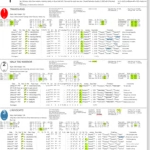
✓ Positives:(1) Hot trainer - high ITM rate (37%). (2) Hot jockey — high ITM rate (35%). (3) Track specialist — 3 wins from 11 starts here (27%). (4) Fourth race back from a 86-day layoff — often the peak fitness race. (5) Outstanding wet-track record: 5W from 12 starts (42%) — thrives when the going is off. (6) Career-best figure (71) buried in races 4–10 back — 9 pts above race median and 6 pts above recent form — market has forgotten the peak effort. (7) Had documented trouble last race (codes: ['B', 'D', 'F', 'L', 'O', 'T', 'U']) yet still finished 2nd — a clean trip today sets up a form reversal. (8) Pick Pony Daily Edge Radar pick — value score 6/10 — angles: Hot Trainer, Off-Track Ace, Troubled Trip Comeback, Track Specialist, Hidden Figure, Classic Fourth Race Pattern.